
The early signs of peripheral neuropathy often start with numbness and tingling in the feet.
I remember the exact moment I realized something was wrong with my feet.
I was standing in my kitchen, making dinner for my grandkids, and I noticed that the tile floor felt… different. Not cold like it usually does. Not warm. Just nothing. Like my feet had been wrapped in invisible cotton.
I brushed it off. We all do, don't we? We tell ourselves it's nothing. That we're just tired, or maybe we slept funny. But deep down, there was this quiet voice whispering that something had changed.
If you're reading this, chances are you've had your own version of that moment. Maybe it was a tingling that wouldn't go away. Maybe it was a burning sensation that woke you up at 2 AM. Or maybe, like me, it was the strange absence of feeling where feeling should be.
The question that probably brought you here — what stage am I in? — is one I've heard from hundreds of people in my support group over the years. And I want to give you a straight answer, because you deserve one.
How Neuropathy Progresses: What Actually Happens to Your Nerves
Here's the thing most doctors don't explain very well: neuropathy doesn't just show up one day at full force. It creeps in. It's gradual, like a tide coming in so slowly you don't realize your towel is wet until it's soaked.
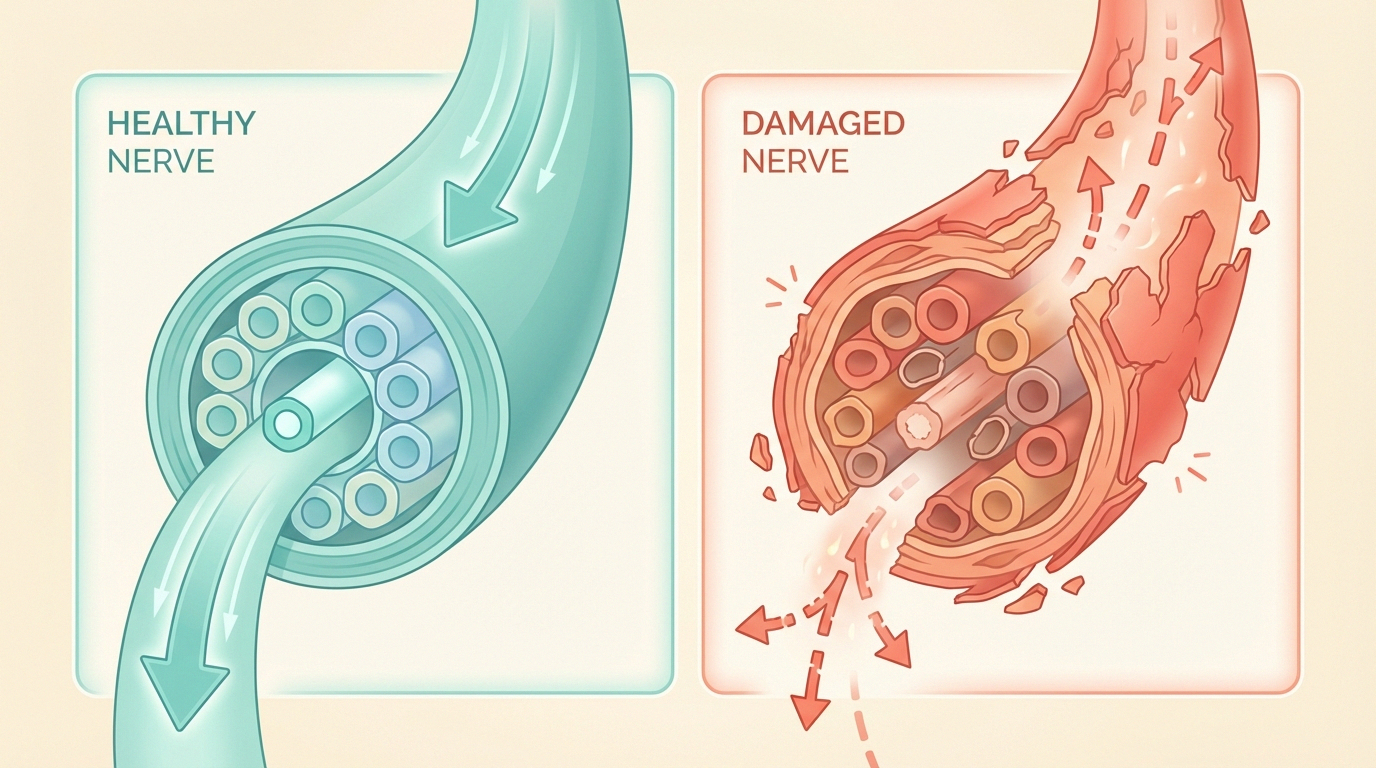
Your peripheral nerves — the ones that run from your spinal cord out to your fingers and toes — are getting damaged. Depending on the cause (diabetes, vitamin deficiencies, medications, or sometimes no identifiable reason at all), those nerves start losing their ability to send signals properly.
And this damage tends to follow a pattern. Not everyone experiences it exactly the same way, but after years of talking with fellow neuropathy sufferers and reading every study I can get my hands on, here's how it typically unfolds.
Stage 1: The “Something's Off” Phase — Numbness and Tingling
This is the stage where most people are in denial. I know I was.

You might notice:
- Occasional tingling in your toes or fingertips, like they've fallen asleep
- Brief episodes of numbness that come and go
- A sensation like you're wearing socks when you're barefoot
- Mild buzzing or “pins and needles” feelings
The tricky thing about Stage 1 is how easy it is to explain away. I've been on my feet too long. My shoes are too tight. It's probably just my age. And because the symptoms come and go, it's tempting to just wait and see.
But here's what I wish someone had told me: this is the stage where you have the most power to change the trajectory. Your nerves are sending you a signal — quite literally — that something needs attention.
If you're in this stage right now, please don't do what I did and wait months before taking it seriously.
Key Takeaway
Stage 1 is your window of opportunity. Nerves can regenerate, especially if you catch the damage early and address the root cause. Don't wait for the pain to arrive before taking action.
Stage 2: The Pain Arrives — Regular Discomfort and Sensitivity
Stage 2 is when neuropathy stops being easy to ignore.
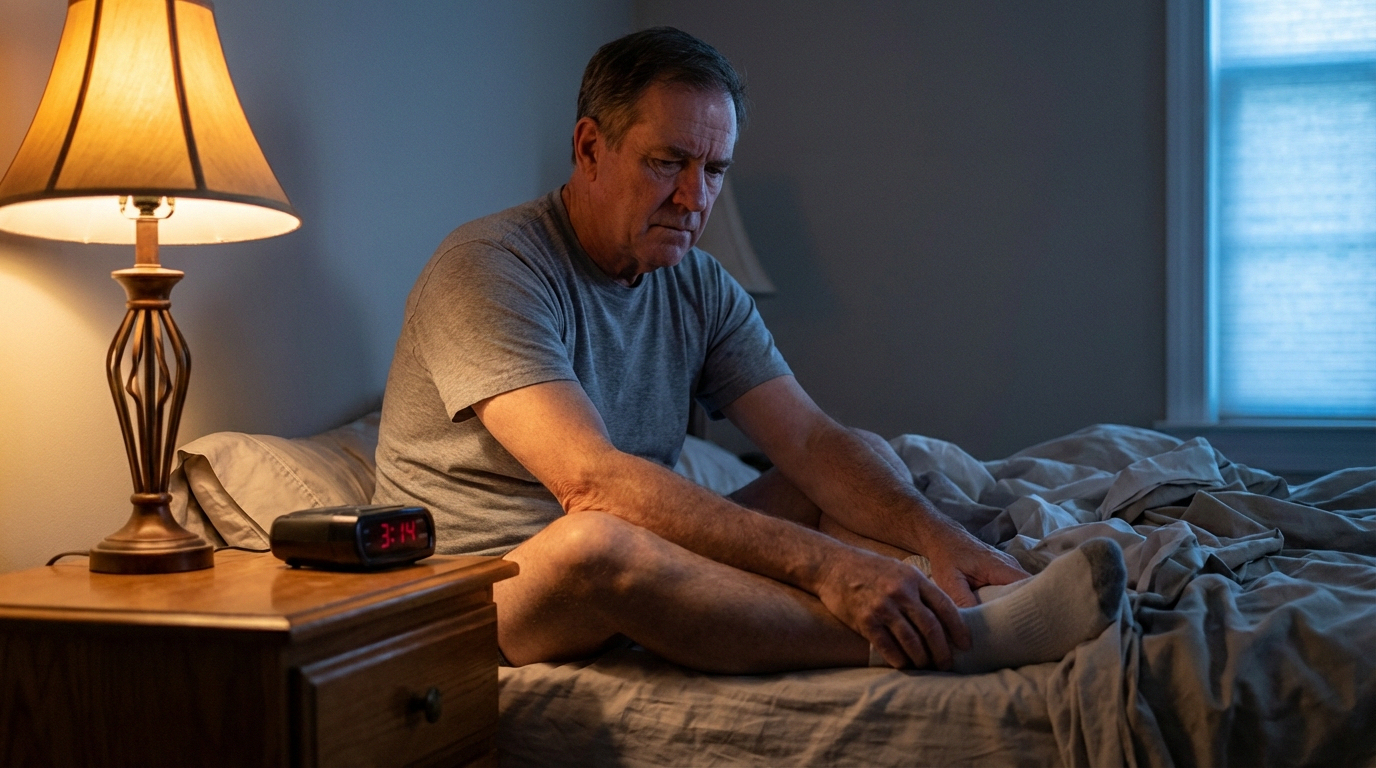
The tingling that used to come and go starts showing up more often. And it brings friends:
- Burning sensations in your feet, especially at night
- Sharp, shooting pains that seem to come from nowhere
- Increased sensitivity — your bedsheets might feel uncomfortable against your feet
- The feeling that you're walking on pebbles or hot sand
I remember my Stage 2 vividly. I'd be sitting in my book club meeting, trying to focus on the discussion, and all I could think about was the fire in my feet. It felt like someone had wrapped them in sandpaper that was slowly being pulled tighter.
The emotional toll at this stage is real, too. You might start declining invitations because you're not sure if you'll be in pain. You might stop going for walks because your feet hurt too much. Little by little, your world starts getting smaller.
This is the stage where most people finally see a doctor. And while I'd encourage you to get there sooner, the important thing is that you go.
Don't Wait — See Your Doctor
If burning pain, sharp shooting sensations, or increased sensitivity are disrupting your sleep or daily activities, it's time to see your doctor. Early diagnosis means more treatment options and a better chance of slowing how neuropathy progresses with age. Ask about a nerve conduction study.
Stage 3: When Pain Becomes Your Constant Companion
Stage 3 is where neuropathy starts taking things from you.

The pain is no longer occasional — it's a daily presence. Some people describe it as:
- Intense burning that nothing seems to relieve
- Stabbing pains that make you gasp
- Deep aching in your legs and feet
- Electric shock sensations
- Pain that makes sleeping nearly impossible
But pain isn't the only issue. By Stage 3, you may also notice:
- Balance problems — the nerves that help you feel the ground beneath you aren't working properly, and your brain doesn't know exactly where your feet are
- Muscle weakness — especially in the feet and lower legs
- Difficulty with everyday tasks — buttoning a shirt, opening a jar, or gripping a handrail
This is the stage that scares people the most, and I understand why. There was a period where I couldn't walk to my mailbox without holding onto something. The woman who used to spend Saturday mornings at the farmer's market could barely make it to her own garden.
I won't sugarcoat it: Stage 3 is hard. But it's also not a death sentence for your quality of life. I've seen people at this stage make meaningful improvements with the right combination of approaches.
adults 65 and older fall each year, and difficulties with walking and balance are a risk factor (CDC)
Stage 4: Loss of Sensation — The Silent Stage
This is the stage that sounds the least painful but may actually be the most dangerous.

In Stage 4, the burning and stabbing may actually decrease — not because your nerves are healing, but because they've become so damaged that they're barely sending signals at all. You might experience:
- Complete numbness in your feet and/or hands
- Inability to feel temperature changes (hot bath water could burn you without warning)
- No pain response (you could step on something sharp and not know it)
- Significant muscle weakness or wasting
- Severe balance issues and frequent falls
- Skin changes — dryness, cracking, or infections you don't feel
I'll be honest: this stage is dangerous because the protective role of pain is gone. Pain is awful to live with, but it serves a purpose — it tells you when something is wrong. Without it, small injuries can become serious infections, especially for people with diabetes.
If you're in Stage 4, close supervision from your healthcare team is essential. Daily foot inspections become a non-negotiable habit.
Critical: Daily Foot Checks
If you've lost sensation in your feet, check them every single day — top, bottom, and between toes. Look for cuts, blisters, redness, or swelling you can't feel. Use a mirror for hard-to-see areas. A small wound you don't notice can quickly become a serious infection, especially if you have diabetes.
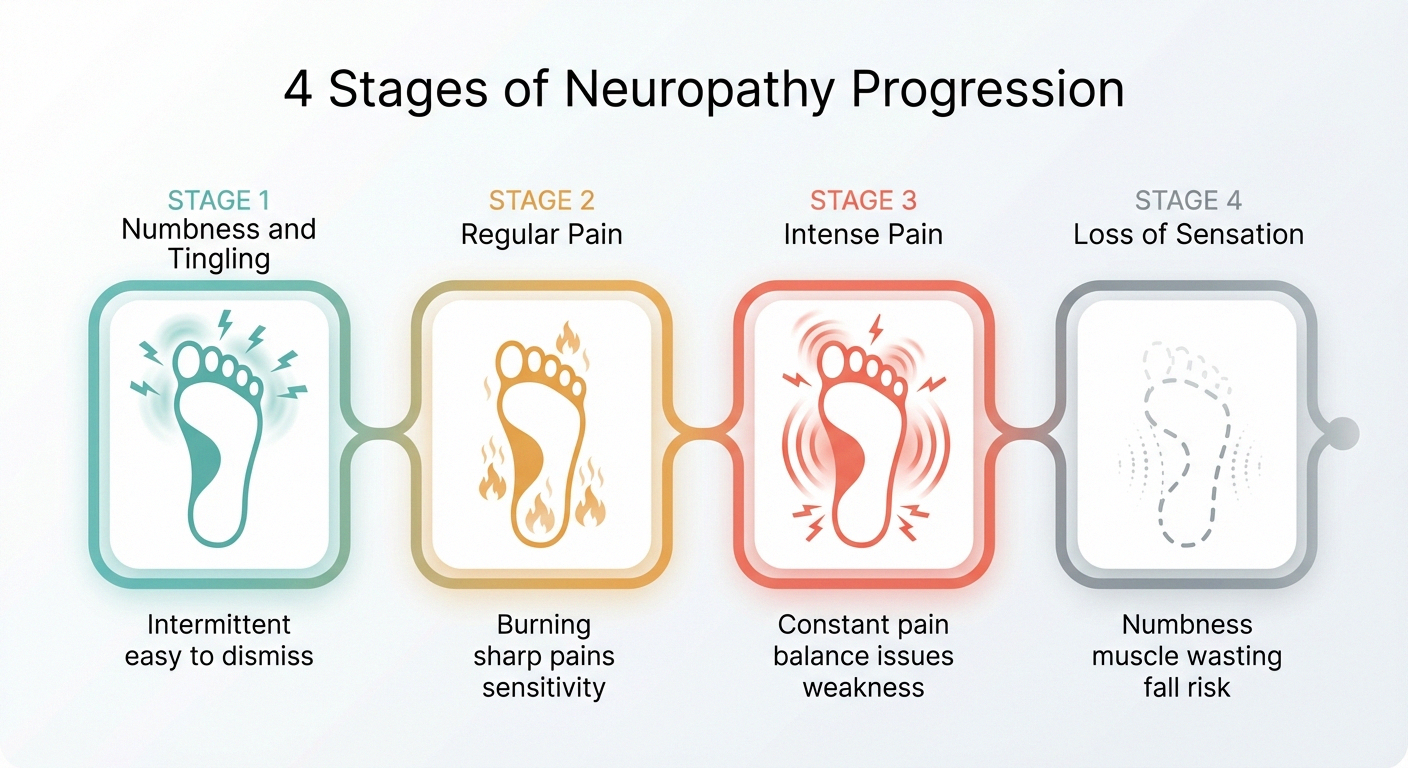
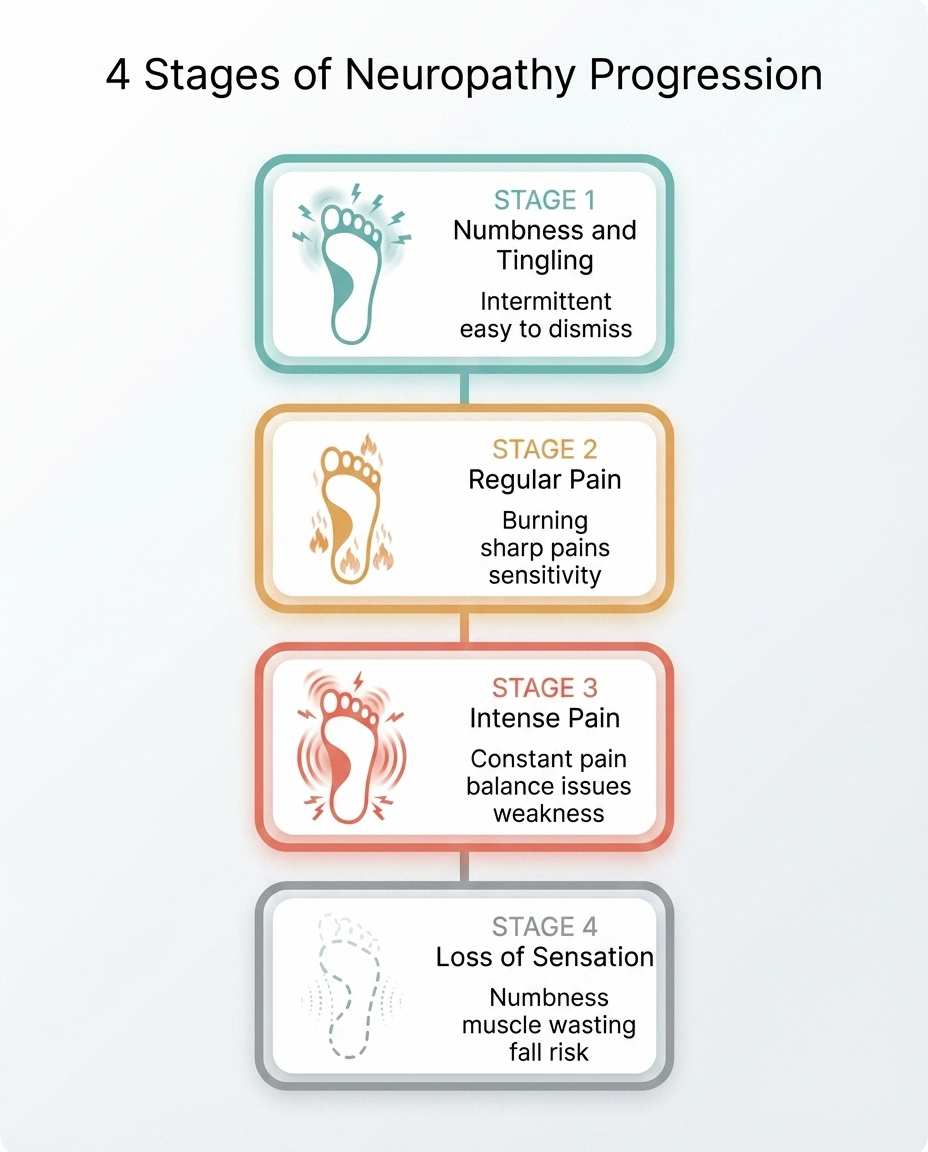
Neuropathy typically progresses through four stages, from intermittent tingling to complete loss of sensation.
How Fast Does Neuropathy Progress?
This is the million-dollar question, and the honest answer is: it depends.
Diabetic neuropathy tends to progress gradually over years, especially if blood sugar isn't well controlled. Some studies suggest that up to 50% of people with diabetes will develop neuropathy at some point, but the timeline varies enormously.
Chemotherapy-induced neuropathy can come on within weeks or months of starting treatment. Some people see improvement after treatment ends; others don't.
Vitamin deficiency neuropathy (especially B12) can progress steadily but also has one of the better outlooks — catching and correcting the deficiency can halt or even reverse the damage.
Idiopathic neuropathy (where the cause is unknown) is the most frustrating. Our article on idiopathic neuropathy covers what to do when doctors can't find a cause. It affects roughly 30-40% of neuropathy cases, and the progression is unpredictable.
The factors that tend to speed up progression:
- Uncontrolled blood sugar
- Continued exposure to whatever is causing the damage (alcohol, certain medications, toxins)
- Nutritional deficiencies
- Lack of physical activity
- Smoking (it restricts blood flow to nerves)
Without Intervention
• Damage continues spreading to new nerves
• Pain intensifies over months and years
• Balance and mobility steadily decline
• Risk of falls and injuries increases
• Eventually may lose sensation entirely
With Early Action
• Root cause identified and addressed
• Nerve damage can be slowed or halted
• Some nerve regeneration is possible
• Pain managed with targeted approaches
• Quality of life preserved or improved
Can You Stop Neuropathy From Getting Worse?
Yes — in many cases, you can slow, halt, or even partially reverse the progression. This isn't false hope. It's what the research shows and what I've seen firsthand.

The most important things you can do:
1. Identify and address the root cause. If it's diabetes, getting blood sugar under control is the single most important thing you can do. If it's a vitamin deficiency, correcting it can make a dramatic difference. If it's a medication, talk to your doctor about alternatives.
2. Support your nerve health nutritionally. Certain nutrients are critical for nerve repair and protection — B vitamins (especially B12 and B1) and alpha lipoic acid have the strongest research behind them. I've written about the best supplements for neuropathy if you want to dive deeper.
3. Keep moving. I know it's hard when your feet hurt. Believe me, I know. But gentle, regular exercise improves blood flow to your nerves and has been shown to slow diabetic neuropathy. Even seated exercises make a difference.
4. Remove what's hurting you. This means reducing alcohol, quitting smoking, cleaning up your diet, and minimizing exposure to environmental toxins that can damage nerves.
5. Don't wait. The earlier you take action, the more nerve function you can preserve. Nerves can regenerate, but they do it slowly. The less damage there is to repair, the better your chances.

5 Steps to Slow or Stop Neuropathy
Identify the Root Cause
Blood sugar, vitamin deficiency, medication side effect — finding the cause is the single most impactful step.
Support Nerve Health Nutritionally
B vitamins (especially B12 and B1) and alpha lipoic acid have the strongest research behind them.
Keep Moving
Gentle, regular exercise improves blood flow to nerves and can help slow progression. Even seated exercises make a difference.
Remove What's Hurting You
Reduce alcohol, quit smoking, clean up your diet, and minimize exposure to environmental toxins that damage nerves.
Don't Wait
Nerves regenerate slowly. The less damage there is to repair, the better your chances. Start today.
How to Know What Stage You're In
Reading through these stages, you probably have a general sense of where you fall. But neuropathy is personal — your experience won't match someone else's exactly.
A nerve conduction study (NCS) or electromyography (EMG) can give your doctor objective data about how your nerves are functioning. A simple filament test in your doctor's office can assess sensation loss. And a thorough blood panel can check for underlying causes like diabetes or vitamin deficiencies.
But you know your body better than anyone. If you want a quick way to understand where you stand and what your symptoms might mean, I created a simple neuropathy assessment that walks you through the key questions in about two minutes. It's not a diagnosis — only your doctor can provide that — but it can help you organize your thoughts and identify what to discuss at your next appointment.
What I Want You to Take Away From This
If you're in Stage 1 or 2, you have an incredible opportunity right now. The steps you take today — the supplements you start, the dietary changes you make, the conversations you have with your doctor — can genuinely change where this goes.
If you're in Stage 3 or 4, please don't lose hope. I've sat across from people in my support group who were convinced their situation was hopeless, and I've watched them claw back meaningful quality of life. It takes work, it takes patience, and it takes the right approach — but improvement is possible.
Neuropathy may be part of your life, but it doesn't get to define it. I truly believe that.
Take care of yourself,
Janet
Frequently Asked Questions
Browse all our understanding neuropathy guides for more articles like this one.
About the Author