
The two paths to diagnosing vitamin deficiency neuropathy: blood testing and nutritional support.
There's a question I get asked more than almost any other at my neuropathy support group: “Could this just be a burning feet from B12 deficiency thing?” For more, see our guide on stages of neuropathy. For more, see our guide on natural remedies for neuropathy.
These deficiencies can cause symptoms throughout the body, including neuropathy in hands.
Diabetes is one of the most common causes of nerve damage — see our diabetic neuropathy guide for more.
And honestly? That question carries so much hope in it. Because behind it is the thought that maybe — just maybe — there's a straightforward explanation for the burning, tingling, and numbness. Something that can be identified with a blood test and fixed with a supplement.
Here's what I want to tell you: for a significant number of people with neuropathy, vitamin deficiency causing numb feets are absolutely part of the answer. Not for everyone, and not always as the sole cause — but vitamin deficiencies are one of the most treatable and reversible causes of nerve damage.
I've seen people in my group who spent years chasing treatments, only to discover that a B12 injections vs oral supplements some foods block absorption of key vitamins was driving their symptoms the whole time. When they corrected it, the improvement was remarkable.
So let's talk about which deficiencies matter, how to know if you have one, and what to do about it.
Key Takeaway
Vitamin vitamin D and nerve health neuropathy is one of the most treatable forms of nerve damage. When caught early and the recipes rich in nerve-healing vitamins corrected, significant improvement — and even full reversal — is possible. A simple blood test could change everything.
The Vitamin-Nerve Connection: Why This Matters So Much
Your nerves are high-maintenance. They need a constant supply of specific nutrients to function properly, repair damage, and maintain the myelin sheath — that protective coating around nerve fibers that allows signals to travel quickly and efficiently.
When those nutrients run low, your nerves start to struggle. Signals slow down, misfire, or stop altogether. That's when you feel the tingling, the burning, the numbness.
The reason this is such important news is that vitamin deficiency neuropathy is often reversible — especially when caught early. Unlike some forms of nerve damage, nutritional neuropathy responds to treatment because you're giving the nerves exactly what they were missing to repair themselves.
But there's a catch: the longer the deficiency goes on, the harder it is to fully reverse the damage. Which is why understanding this connection — and acting on it — matters right now. For more, see our guide on whether nerve damage can be reversed.
Vitamin pregnancy neuropathy from vitamin deficiency Deficiency: The #1 Nutritional Cause of Neuropathy
If there's one vitamin every neuropathy patient should have tested, it's B12.
Vitamin B12 is essential for maintaining your myelin sheath and for nerve cell reproduction. When levels drop too low, the myelin starts to break down, and nerve signals become erratic or disappear entirely.
of adults over 50 may have B12 deficiency — often without knowing it
Who's at risk for B12 deficiency?
More people than you might think:
- Adults over 50 — our ability to absorb B12 from food decreases with age. Some estimates suggest up to 20% of older adults are deficient.
- People taking metformin for diabetes — this common medication can reduce B12 absorption by up to 30%
- Anyone on long-term acid reflux medication (PPIs like omeprazole or Prilosec) — stomach acid is needed to absorb B12
- Vegetarians and vegans — B12 comes primarily from animal products
- People with digestive conditions like Crohn's disease, celiac disease, or who've had gastric surgery
What B12 deficiency neuropathy feels like
The symptoms often start in the feet and work their way up:
B12 Deficiency Symptoms — Do Any of These Sound Familiar?
Tingling and numbness in the toes and fingers
A feeling like you're wearing gloves or socks when you're not
Difficulty with balance and coordination
A “heavy” feeling in the legs
Weakness in the hands
Brain fog and memory issues (B12 affects your brain too)
I had a woman in my support group — Margaret, she's 68 — who had been diagnosed with “idiopathic neuropathy” for three years. Meaning they couldn't find a cause. When she finally had her B12 tested (at my insistence, honestly), it came back severely low. Within four months of B12 supplementation, her tingling decreased significantly and her balance improved noticeably.
Three years of suffering because nobody thought to check a simple blood test.
What your B12 levels should be
Here's something that frustrates me: the “normal” range for B12 on most lab tests goes as low as 200 pg/mL. But many neurologists now agree that neurological symptoms can occur below 400 pg/mL, and optimal levels for nerve health are between 500-1000 pg/mL.
So if your doctor tells you your B12 is “normal” but it's sitting at 250, you might want to push for a closer look — especially if you have neuropathy symptoms.
How to correct it
- Methylcobalamin is the preferred form of B12 for nerve health (it's the form your body actually uses, unlike cyanocobalamin which needs to be converted)
- Typical therapeutic doses range from 1,000 to 5,000 mcg daily
- If absorption is an issue (and it often is in older adults), sublingual tablets or B12 injections may work better than regular pills
- Improvement timeline: most people notice changes within 1-3 months, but full recovery can take 6-12 months depending on how long the deficiency lasted

Vitamin B6: The Double-Edged Sword
B6 is critical for nerve function — it helps produce neurotransmitters and supports the myelin sheath. But here's the twist that catches many people off guard: both too little AND too much B6 can cause neuropathy.
B6 deficiency
Low B6 can cause burning pain in the feet, numbness and tingling, difficulty walking, irritability and depression. Deficiency is less common than B12 but can happen with poor diet, alcohol depleting nerve-essential vitaminsism, certain medications, and kidney disease.
B6 toxicity — the hidden danger
This is the one that surprises people. Taking too much B6 — typically above 200 mg per day for extended periods — can actually cause neuropathy. And it happens more often than you'd think because B6 is in so many supplements, energy drinks, and fortified foods.
I know someone who was taking a B-complex vitamin, a multivitamin, AND a separate whether products like Nervive actually work. When we added up the B6 from all three, she was getting over 300 mg daily. She had developed neuropathy from the very supplements she was taking to prevent it.
Talk to Your Doctor
B6 supplementation should stay under 100 mg per day unless specifically directed by your doctor. Check all your supplements — the B6 adds up fast across B-complex formulas, multivitamins, and nerve support products. If symptoms have worsened since starting a new supplement, B6 toxicity may be the reason.
Vitamin D: The Overlooked Player
Vitamin D doesn't get the attention it deserves in neuropathy discussions, and that's a problem.
Research is increasingly showing a connection between low vitamin D and peripheral neuropathy. A 2019 study found that people with vitamin D deficiency were significantly more likely to have neuropathy symptoms, and that supplementation improved pain scores.
Why? Vitamin D appears to play a role in nerve growth, reducing inflammation, and protecting nerve cells from damage. It's also involved in calcium regulation, which affects how nerve signals are transmitted.
Research Says
The Endocrine Society estimates that over 40% of American adults are deficient in vitamin D. If you live in a northern climate, spend most of your time indoors, have darker skin, or are over 65, your risk is even higher. A simple blood test can identify deficiency in minutes.
Getting tested is simple, and supplementation (typically 2,000-5,000 IU daily, depending on your levels) is safe and inexpensive.
Vitamin E and Folate: The Supporting Cast
These don't make headlines, but they matter:
Vitamin E is a powerful antioxidant that protects nerve cell membranes from damage. Deficiency is rare but can occur with fat malabsorption disorders. Symptoms include loss of coordination, muscle weakness, and — you guessed it — peripheral neuropathy. Learn more about a diet designed to support nerve health. Learn more about home remedies for neuropathy in legs.
Folate (Vitamin B9) works alongside B12 in nerve function. Deficiency can contribute to nerve damage, and it's particularly important for people taking medications that deplete folate (like methotrexate or certain seizure medications).
How to Test for Vitamin Deficiencies
If you suspect a deficiency might be contributing to your neuropathy, here's what to ask your doctor about:
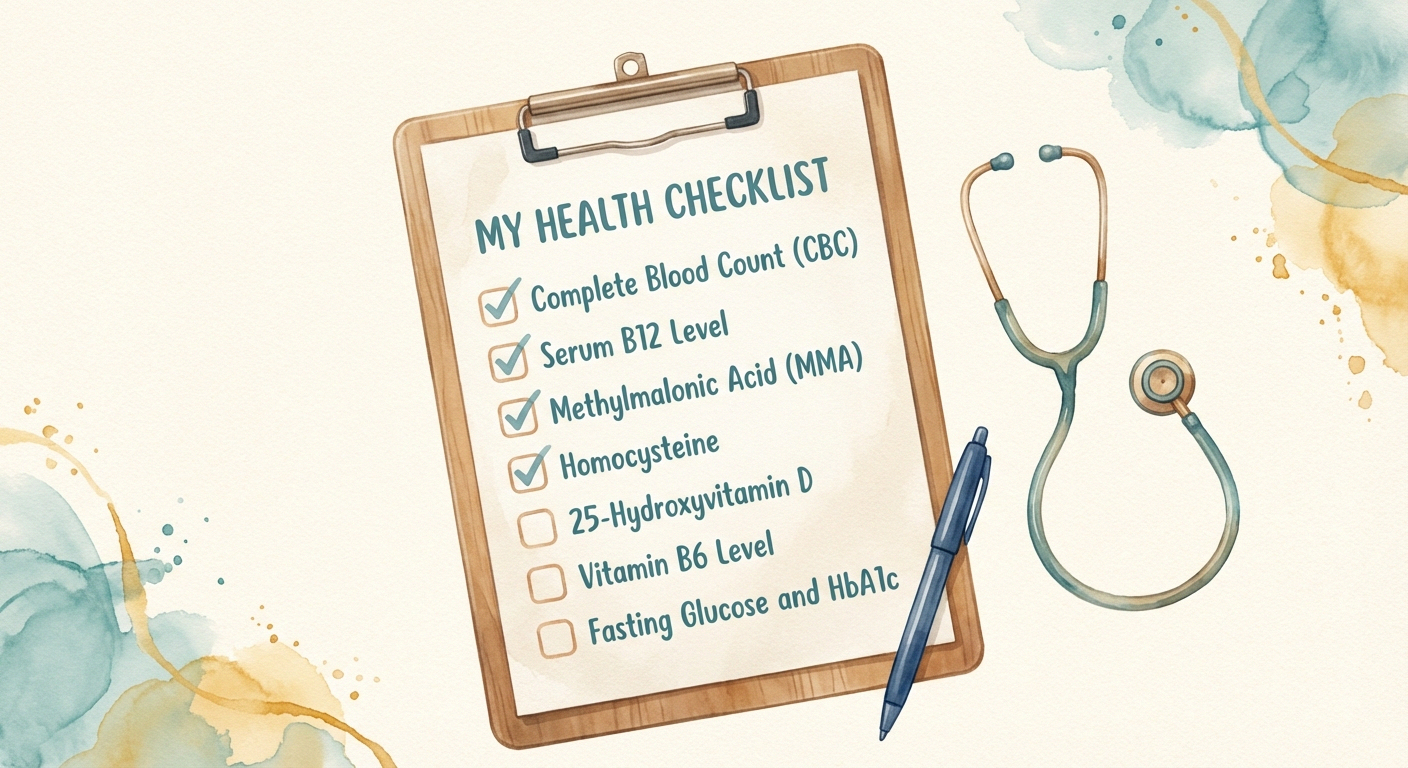
Your Vitamin Deficiency Test Checklist
Complete Blood Count (CBC)
Can reveal signs of B12 or folate deficiency
Serum B12 Level
Direct measurement — aim for above 400-500 pg/mL, not just “within range”
Methylmalonic Acid (MMA)
More sensitive marker for B12 deficiency — catches cases serum B12 misses
Homocysteine
Elevated levels can indicate B12, B6, or folate deficiency
25-Hydroxyvitamin D
Standard vitamin D test — check for deficiency affecting nerve function
Vitamin B6 Level
Especially important if you take multiple supplements — checks for both deficiency and toxicity
Fasting Glucose and HbA1c
Rules out diabetes as a concurrent cause of neuropathy
Don't be shy about requesting these tests. They're routine blood draws, and the information they provide could change the course of your treatment.
Can Fixing a Deficiency Reverse Neuropathy?
This is the question that matters most, and the answer is genuinely hopeful.
If the deficiency is the primary cause of your neuropathy, and it's caught before the damage becomes permanent — yes, significant improvement and even full reversal is possible.
❌ Untreated Deficiency
Nerve damage worsens progressively. What begins as occasional tingling advances to constant burning pain, then loss of sensation. After 12+ months, some damage may become permanent and irreversible.
✓ With Early Treatment
Months 1-3: Tingling lessens, energy improves. Months 3-6: Pain decreases, sensation returns, balance improves. Months 6-12: Maximum recovery. Full reversal is possible when caught early.
Here's what to realistically expect:
- First 1-3 months: Many people notice the tingling starts to lessen and energy improves
- 3-6 months: Pain often decreases, sensation may begin returning, and balance improves
- 6-12 months: Maximum recovery usually occurs within this window
- After 12 months: Whatever improvement you've gained is likely your new baseline
The key factors that affect recovery:
- How long the deficiency lasted (shorter = better recovery)
- How severe the deficiency was
- Whether you have other contributing factors (like diabetes)
- How consistently you maintain adequate nutrient levels going forward
I won't pretend everyone gets a miracle outcome. Some people have had deficiencies for so long that some nerve damage is permanent. But even in those cases, stopping the deficiency prevents further deterioration — and that matters enormously.
Best Vitamins and Supplements for Nerve Health
Based on the research and what I've seen work in practice, here's what I'd consider discussing with your doctor:

The essentials:
- Vitamin B12 (methylcobalamin) — 1,000-5,000 mcg daily
- Vitamin B1 (benfotiamine form is best absorbed) — 300-600 mg daily
- Vitamin D3 — 2,000-5,000 IU daily (adjust based on blood levels)
Strong supporting evidence:
- Alpha lipoic acid — 600 mg daily (a powerful antioxidant with multiple clinical trials supporting its use in neuropathy)
- Acetyl-L-carnitine — 1,000 mg daily (supports nerve regeneration)
- Folate (methylfolate form) — 400-800 mcg daily
Worth considering:
- Magnesium (glycinate form) — 200-400 mg daily (supports nerve signaling)
- Omega-3 fatty acids — 1,000-2,000 mg daily (anti-inflammatory)
If managing multiple individual supplements feels overwhelming, a comprehensive nerve support formula that combines several of these key ingredients can simplify things considerably. I've reviewed several options in my supplement guide if that's helpful.
The important thing is that you're not just guessing — get tested, identify what you're actually low in, and supplement strategically.
What I Want You to Take Away From This
If there's one message I hope sticks with you, it's this: don't assume your neuropathy is “just something you have to live with” until you've ruled out nutritional causes.
A blood test is simple. Supplements are relatively inexpensive. And the potential upside — actually reversing nerve damage — is enormous.
I've watched too many people in my support group suffer for years with a treatable condition because nobody thought to check their vitamin levels. If this article motivates even one person to get those tests done, it was worth writing.
You deserve to know what's causing your symptoms. And you deserve a chance to fix it.
Talk to your doctor. Get the tests. And if you want help figuring out where you stand, my neuropathy assessment tool can help you organize your symptoms and identify the right questions to ask at your next appointment.
With hope,
Janet
Frequently Asked Questions
Browse all our types and causes of neuropathy guides for more articles like this one.
About the Author