
One of the hardest conversations I have with members of our community starts the same way every time. Someone has been managing their neuropathy for years, working through the pain, adapting their job around the symptoms, and then the wall finally comes — they cannot stand a full shift anymore, their hands have gotten too clumsy for the work, the cognitive fog from chronic pain has eaten their concentration, and they realize they have to stop. The question that follows is always the same. Can I get Social Security Disability for this? The honest answer is yes, you can, and a lot of people with peripheral neuropathy do. But the path is not what most people expect, the medical listing that sounds like it was written for you is harder to meet than the SSA literature suggests, and most successful neuropathy claims are won through a back-door route called a medical-vocational allowance rather than through the listing itself. This article is meant to be a clear, honest walk through the whole landscape — the listing, the back door, the documentation that actually moves the needle, the timeline, and the realistic expectation of what the process looks like from the inside.
I am writing this as a patient advocate, not as a lawyer or a Social Security adjudicator. The decisions in your case will be made by people who have specific training in those roles. What I can do is translate the rules into language that makes sense, share what patients in our support community have learned the hard way, and point you toward the documentation and decisions that tend to matter most. If you take one thing from this article before you read further, take this: neuropathy claims are won and lost on the quality of the medical documentation about your function, not on the diagnosis itself. The SSA already accepts that peripheral neuropathy is a real condition. What they want to know is exactly what you can and cannot do across an eight-hour workday, five days a week, and that takes more careful documentation than most patients think to gather.
What Listing 11.14 Actually Says
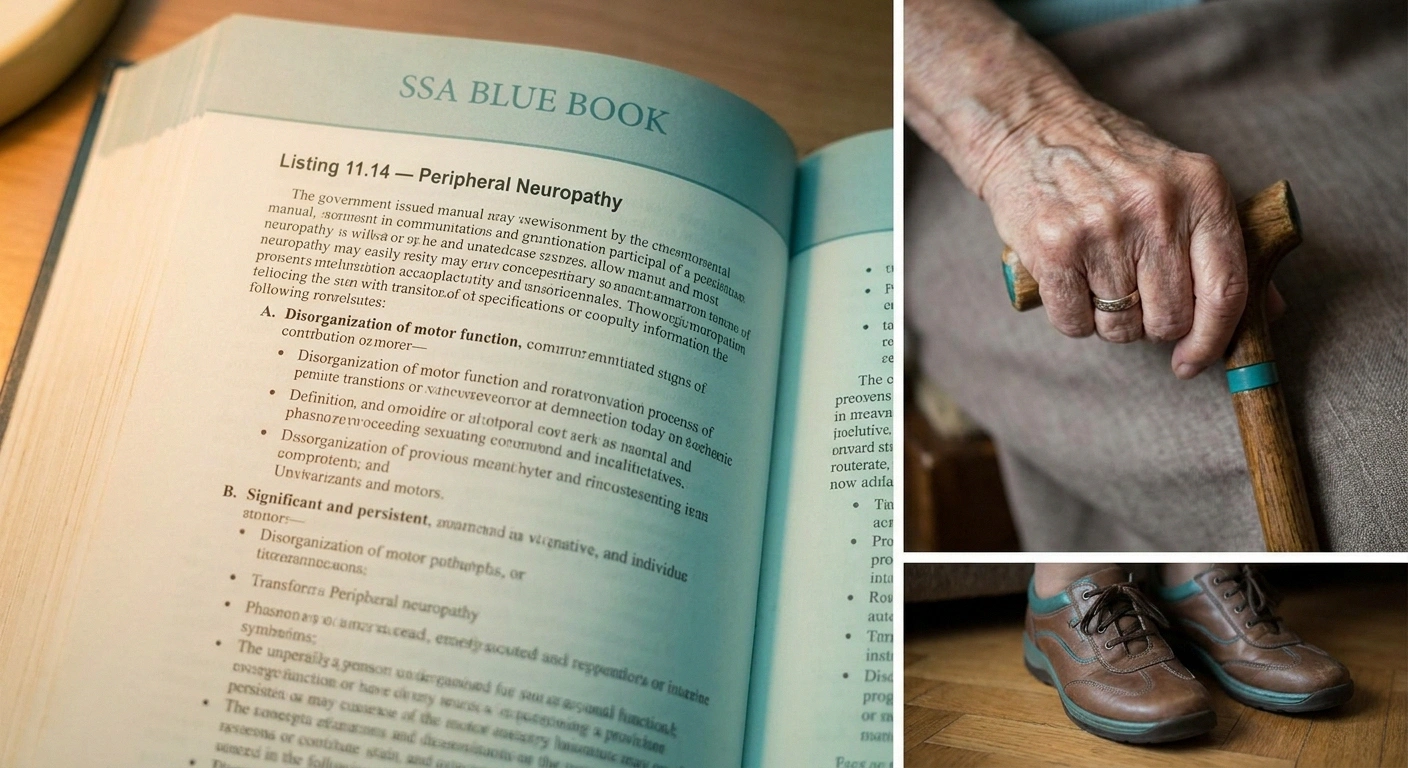
The Social Security Administration maintains what is informally called the Blue Book — the official “Listing of Impairments.” Each listing describes a medical condition severe enough that, if you meet every specific criterion, the SSA will approve your claim without further analysis. Peripheral neuropathy has its own listing under the neurological section, numbered 11.14. The listing was rewritten in 2016 to align with newer functional standards, and the version in force today asks you to meet one of two pathways.
The first pathway is called “disorganization of motor function in two extremities.” That phrase is doing a lot of work in a few words, so let me break it down. The two extremities can be both legs, both arms, or one leg and one arm — the SSA does not care about the combination, only that there are two of them with significant impairment. The disorganization must rise to the level of an extreme limitation in either the ability to stand up from a seated position, the ability to maintain balance while standing or walking, or the ability to use the upper extremities to perform activities like reaching, fingering, handling, and gripping. The word “extreme” is the catch. The SSA defines extreme as “not able to perform the function under any circumstances” — not slow, not limited, but genuinely unable to do it without assistance, sustained over time. A person who can stand up from their chair with effort and a hand on the table is not extreme. A person who cannot rise from a chair without another person physically lifting them is extreme.
The second pathway is called the “physical and mental” pathway, and it was added to recognize that severe chronic pain affects cognition. Under this pathway, you need a marked limitation — one step less severe than extreme — in physical functioning, plus a marked limitation in one of four mental functioning areas defined by the SSA. The four mental areas are understanding, remembering, and applying information; interacting with others; concentrating, persisting, and maintaining pace; and adapting or managing yourself. The connection to neuropathy here is real and underappreciated. Severe chronic pain genuinely impairs concentration and persistence. The brain fog that comes with long-term nerve pain is documented in research literature. The medication side effects from gabapentin, pregabalin, duloxetine, and especially the older tricyclic options can fog cognition further. The fatigue from disrupted sleep stacks on top of all of that. A neurologist plus a primary care provider plus, ideally, a mental health provider together can document that combination.
The Honest Truth About Meeting the Listing
Most people with peripheral neuropathy who apply for SSDI do not meet Listing 11.14, and that is not a personal failing — the listing was written to a very high bar. The SSA, by design, makes the listings reachable only for the most severe presentations of any condition. Patients who meet 11.14 typically have advanced neuropathy with significant motor weakness, foot drop, frequent falls, hand weakness severe enough that they cannot grip a coffee mug, and clear EMG and nerve conduction evidence of moderate-to-severe motor and sensory impairment. Patients with painful sensory neuropathy from diabetes or chemotherapy, the most common forms, often have devastating quality-of-life impact without meeting the strict motor criteria. Their burning feet keep them up half the night, their hands tingle and ache through every task, but their EMG shows mild changes and their strength testing is technically intact. That patient does not meet 11.14 on the motor pathway.
The good news is that not meeting the listing is the beginning of the analysis, not the end. The SSA has a second method of approval that I want to spend the rest of this article on, because it is how most successful neuropathy claims are actually won.
The Medical-Vocational Allowance — The Back-Door Path
If the SSA decides your condition does not meet a listing, the analysis moves to what they call the “five-step sequential evaluation.” Step four asks whether you can still do your past relevant work given your current condition. Step five asks whether, considering your age, education, and work history, there is any work you can sustain in the national economy. The decision at steps four and five is based on something called your Residual Functional Capacity, or RFC. The RFC is, essentially, a structured description of what you can still do across a full workday. If your RFC is restrictive enough that no work fits within it given your age, education, and skills, the SSA will approve your claim under what is called a medical-vocational allowance — an MVA — even though you never met a listing.

This is the path most neuropathy claims actually win on, and it is also the path most patients are least prepared for. The RFC is built from your medical records, from your own description of your day, from your treating providers' opinions about what you can sustain, and from a formal RFC form that the SSA may ask one of your doctors to complete. The level of detail required is much greater than “I have pain in my feet and I cannot work like I used to.” The SSA wants to know how many minutes you can stand before you have to sit, how many pounds you can lift occasionally and frequently, whether you can use your fingers for fine manipulation continuously or only briefly, whether you need to elevate your legs during the day, whether you need unscheduled breaks more often than every two hours, whether your pain or medication brain fog reduces your reliability below an industrial standard of 80 to 85 percent attendance.
An RFC built carefully around the real day of a neuropathy patient often lands somewhere like this: stand and walk no more than two hours total in an eight-hour day, with the option to alternate positions every 15 to 30 minutes; lift no more than 10 pounds occasionally; no climbing, balancing, kneeling, crouching, crawling; only occasional use of the lower extremities for foot controls; only frequent (not constant) fine fingering; no exposure to unprotected heights or moving machinery; needs the ability to take unscheduled breaks of 5 to 10 minutes once or twice per shift. An RFC like that, combined with a worker over 50 whose past work was on their feet, often leads to approval under the SSA's vocational grid rules. The grid is a chart that the SSA uses to decide whether the available jobs in the economy are enough to deny the claim. For older workers with restrictive RFCs, the grid often says no — meaning approved.
Building the Medical File That Actually Wins
The single biggest difference between winning and losing neuropathy claims is the quality of the medical file. The SSA decisionmaker — whether it is the initial Disability Determination Services examiner, the reconsideration reviewer, or the Administrative Law Judge — is reading paper. They have never met you. They cannot see your wince when you stand up, they cannot see your hand tremble when you try to button a shirt, they cannot see the four hours you spent on the couch after lunch because your feet were on fire. Everything they will believe about your function has to be on the page somewhere. Building that page takes some intentional effort.
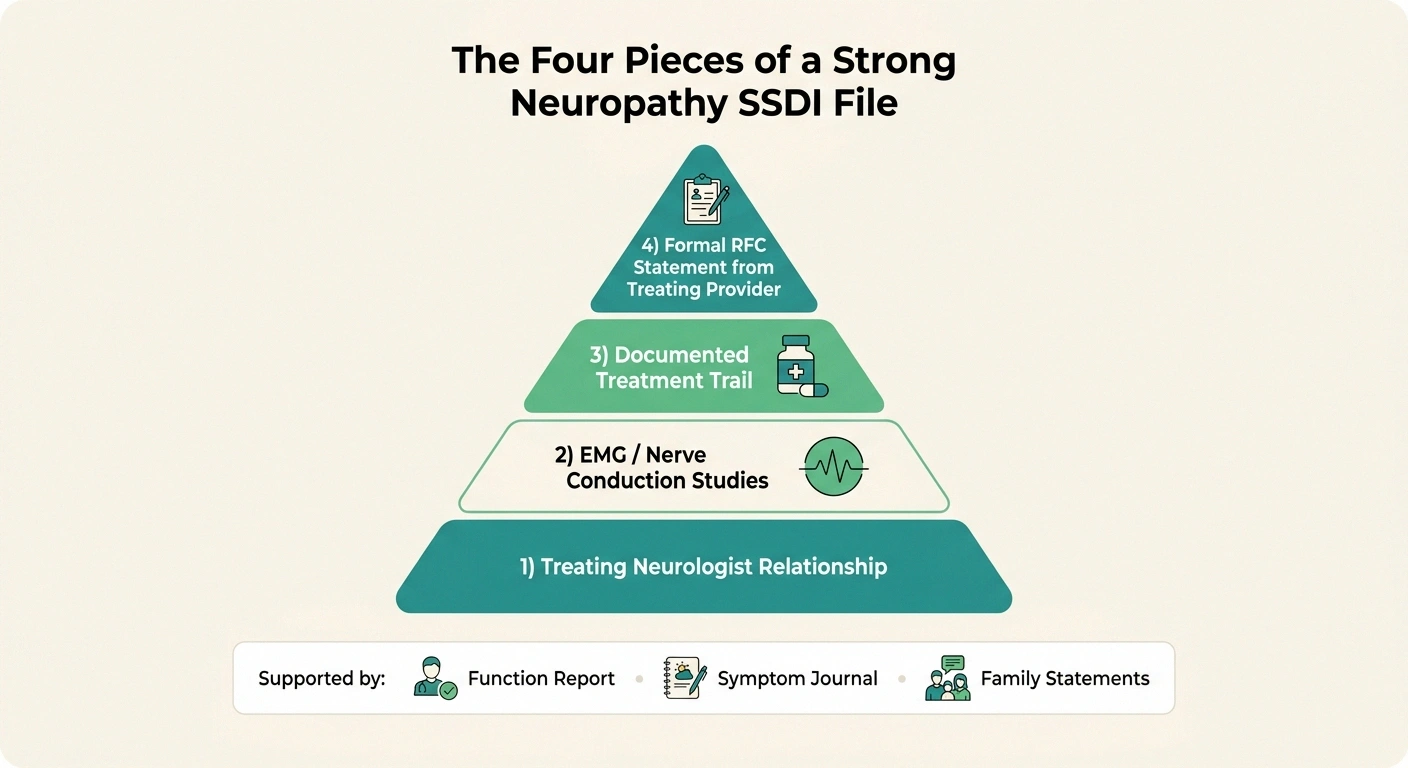
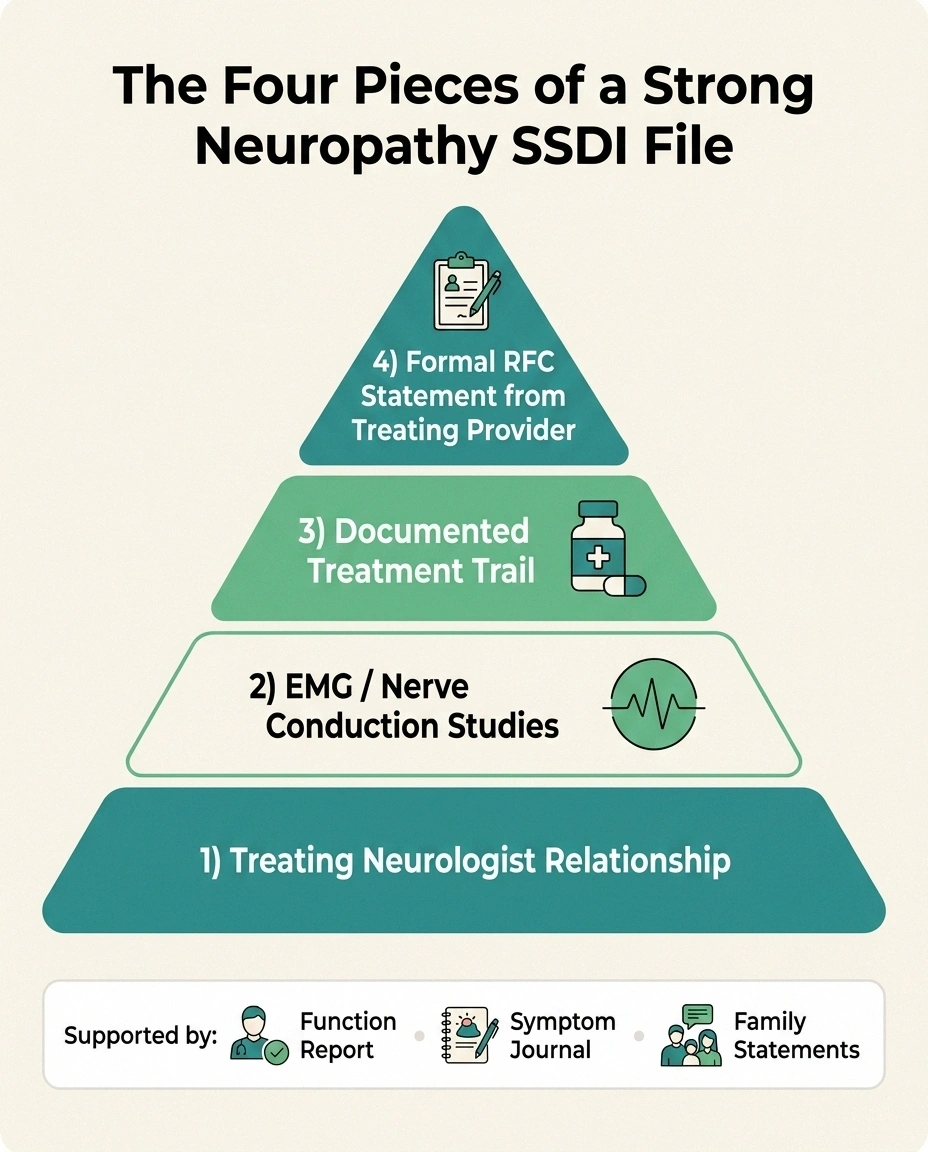
The most important piece is a treating neurologist. Primary care providers can manage neuropathy and many do it well, but the SSA gives much more weight to specialist opinions, and the documentation produced by a neurology visit tends to be more detailed about exam findings. A neurology evaluation that documents your strength on a 0-to-5 scale across multiple muscle groups, your reflexes, your sensory loss mapped to specific distributions, your gait, and your difficulty with tandem walking is the foundation of the file. EMG and nerve conduction studies should be in the file — they document the type and severity of nerve damage objectively. If you have had a skin biopsy for small fiber neuropathy, get that report into the record. If you have had imaging to rule out other causes, get that in too. The whole story of what has been investigated and what is now known should be on the page.
The second piece is documentation of treatment history — what you have tried, what helped a little, what did not help, what side effects you could not tolerate. The SSA does not want to see a patient who has not tried anything. They want to see a patient who has tried gabapentin, gone up to maximum tolerated dose, added duloxetine or another agent, tried topical treatments, perhaps tried a TENS unit, and still cannot get the symptoms below a level that allows sustained work. That treatment trail proves the condition is treatment-resistant and severe.
The third piece — and this is the one most patients leave out — is a formal Residual Functional Capacity statement from your treating provider. The SSA will sometimes send a form asking your doctor to fill this out, but you do not have to wait. You can ask your neurologist or primary care provider to complete an RFC form for SSDI purposes. Many providers will, especially if you bring them a form to use. The form asks specific quantitative questions: maximum sitting tolerance, maximum standing tolerance, maximum walking tolerance, lifting capacity, hand-use limitations, expected number of unscheduled breaks, expected absences per month. A completed RFC form from a treating specialist that lines up with the medical evidence is one of the most powerful pieces of evidence you can submit.
What to Document Yourself, Day to Day
Alongside the medical file, the SSA will ask you to fill out forms describing your typical day. The Function Report (SSA-3373) is one of the most important documents in your file because it lets you describe your function in your own words. Most patients fill it out too quickly, in language that is too general. The SSA decisionmaker reads dozens of these per week and learns to skim over phrases like “pain limits my activities” or “I cannot do what I used to.” Specific, concrete, time-anchored description is what works. “I can stand at the kitchen counter for about 10 minutes before I need to sit. I cannot walk to my mailbox at the end of my driveway and back without stopping to rest. I drop dishes when I try to do the breakfast cleanup because my fingers do not feel where the plate is. I cannot button my own shirt — my husband does it. I sleep in two-hour blocks because the burning in my feet wakes me.” That kind of writing tells a real story and is much harder to disbelieve.

A symptom journal kept over weeks and months supports this. You do not need to record every detail every day — that becomes a part-time job — but writing a few lines every few days about pain levels, what you could and could not do, what triggered flares, and what helped, creates a track record that backs up the function report. Family members can write statements too. A spouse or adult child describing how things have changed at home — what they have taken over, what you have stopped doing, how your sleep and mood have shifted — gives the SSA a non-medical view of function from someone who sees you every day. Keep these statements specific, not emotional. A statement that says “she used to do all the gardening and now she cannot weed for more than five minutes before her hands lock up” is worth far more than a statement that says “she suffers terribly.”
The Timeline and the Denial That Is Almost Coming
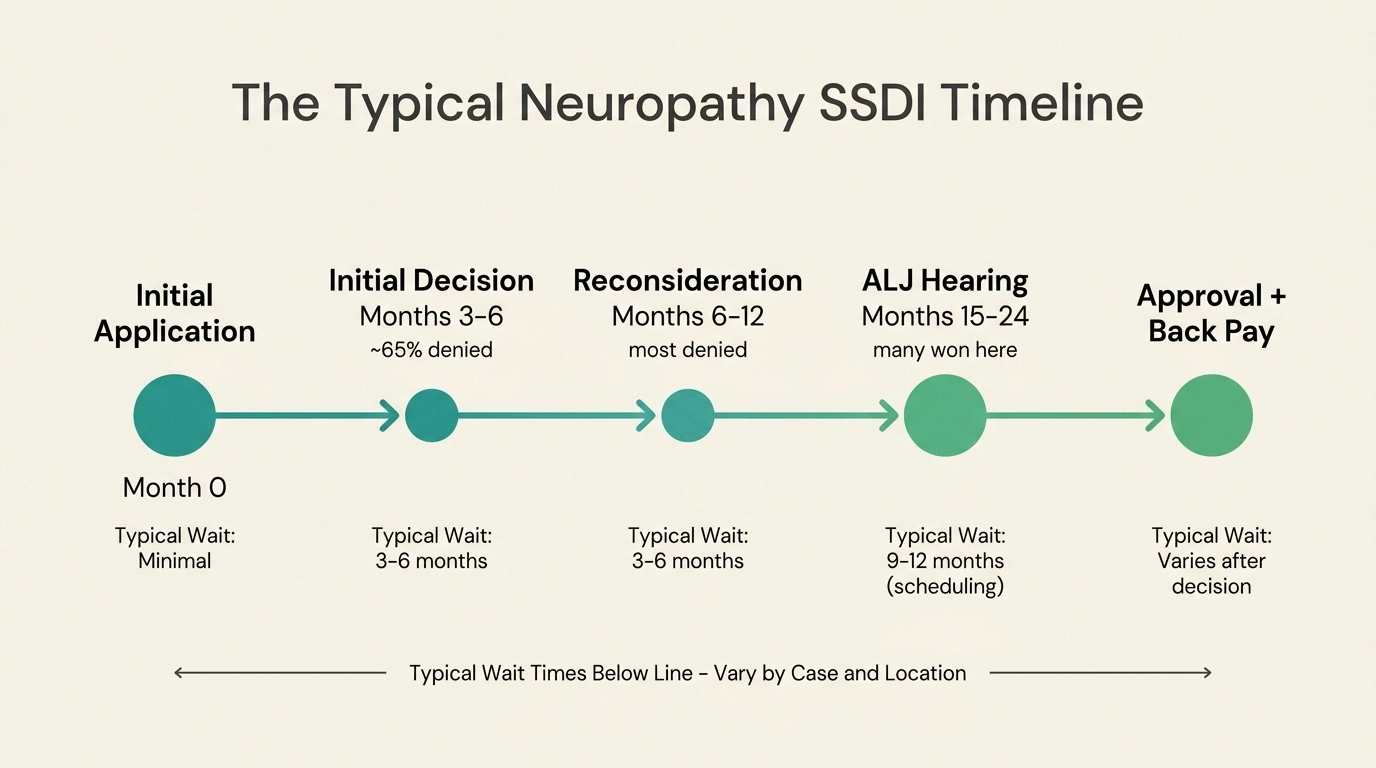
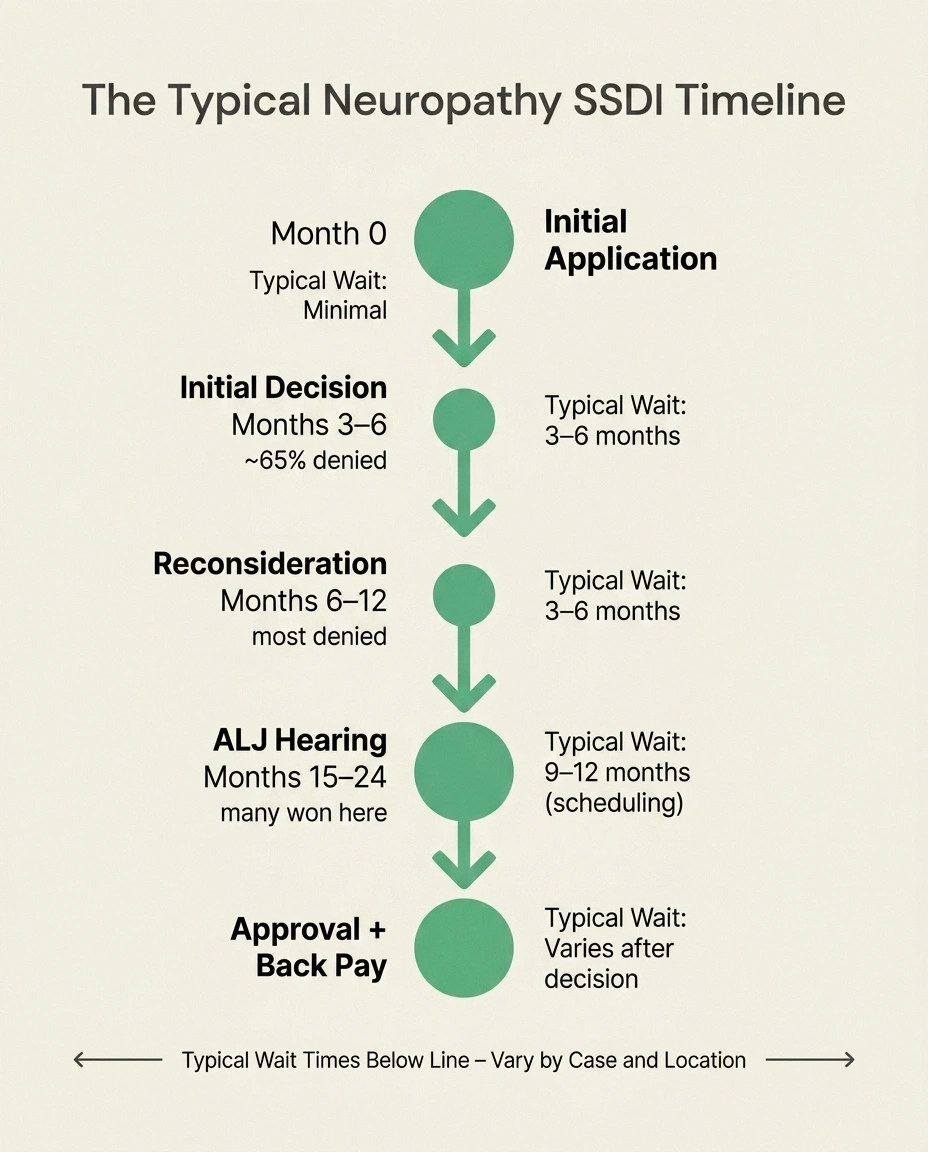
I want to be honest about the timeline because the cheerful estimates on legal-services pages do not match what most patients actually experience. From the day you submit an initial application to the day a final decision is made, the typical timeline for neuropathy claims is 12 to 24 months, sometimes longer. The initial decision takes three to six months and is denied for about 65 percent of all SSDI applicants — a number that includes most first-time neuropathy claims. The reconsideration step, where you ask the same office to look again, takes another three to six months and is denied the great majority of the time. The level where many neuropathy claims are actually won is the Administrative Law Judge hearing, which can take 9 to 18 months to be scheduled after reconsideration is denied. At the hearing, a judge sees and hears you in person (or by video), asks you and often a vocational expert questions, and writes a written decision usually within a few weeks.
- File the next-stage appeal within 60 days
- Do NOT restart the application from scratch — that erases back-pay accrual
- Keep seeing your neurologist regularly to maintain a current file
- Add any new evidence (RFC form, function journal, family statements)
- At the ALJ hearing stage, having a representative materially improves outcomes
The first denial is almost a routine event for chronic-pain claims like neuropathy. It does not mean your case is weak. It does not mean you are not actually disabled. What it usually means is that the initial DDS examiner could not find enough functional documentation in the file to approve, and that more development is needed. The right response to a denial is to file the next-stage appeal within the 60-day window, not to give up and reapply. Restarting the application clock erases your back-pay accrual and resets the timeline. Appealing through to a hearing preserves both. If you have an attorney, this is the work they do.
On the question of attorney representation: it is legal to represent yourself, and many patients do at the application and reconsideration stages. At the hearing stage, having a representative — either a disability attorney or a certified non-attorney representative — matters more. The hearings are formal, the questions get technical, the cross-examination of a vocational expert requires specific knowledge of SSA rules, and the difference in success rate between represented and unrepresented claimants at the ALJ level is real. Attorney fees are capped by federal law at 25 percent of your back pay, with a maximum of $7,200 as of 2026, paid out of the back pay rather than out of pocket. If you lose, the attorney is paid nothing.
What Counts as Work Under SSA Rules — The SGA Trap
One detail trips up many patients before their claim is even reviewed. The SSA defines disability as the inability to engage in “substantial gainful activity” — abbreviated as SGA — and they put a dollar amount on what counts as SGA. For 2026, the monthly SGA threshold for non-blind workers is $1,620 gross earnings. If you are earning at or above SGA when you apply, the SSA will deny your claim at step one of the sequential evaluation without ever looking at your medical evidence. The implication is practical: if you are still working through your neuropathy at any meaningful pay, you are unlikely to be approved while you continue to do so. Many patients try to bridge the gap by reducing hours below SGA before they file — going from full-time to part-time at low hours — and this is generally a sound move.
(non-blind workers)
before benefits start
after benefits start
Once you are approved, the SSA gives you a Trial Work Period of nine months across a rolling five-year window, during which you can earn any amount and still receive benefits. This is designed to encourage attempts to return to work. After the Trial Work Period, the SGA threshold reapplies, and earnings above it for sustained periods can lead to benefits being stopped. Understanding these mechanics matters if you are weighing whether to take a small job after approval.
Special Considerations for Different Neuropathy Causes
The cause of your neuropathy does not change which listing applies — Listing 11.14 covers peripheral neuropathy regardless of cause — but it does affect how the file is built. Diabetic neuropathy claims often include additional listings to consider, including endocrine listings and complications like progressive neuropathy with foot complications. Chemo-induced peripheral neuropathy claims benefit from clear oncology records documenting the chemotherapy regimen, the onset of symptoms, and the persistence of symptoms beyond active treatment. Alcoholic neuropathy claims can be approved but require documentation of current sobriety in many cases, because active substance use is grounds for separate analysis under SSA rules. Idiopathic neuropathy — where the cause is unknown — is fully eligible for SSDI; you do not have to prove a cause, only that the condition is real and limiting.
Patients with autoimmune neuropathies like CIDP variants sometimes qualify under Listing 14.06 (undifferentiated connective tissue disorders) or 11.09 (multiple sclerosis) if there is systemic involvement. Patients with neuropathy plus other conditions — and most patients with peripheral neuropathy have at least one other condition — should make sure every condition is in the file. The SSA evaluates the combined effect, not each condition in isolation. A patient with neuropathy plus diabetes plus depression plus arthritis presents as more disabled than the sum of any one of those.
Back Pay, Medicare, and What Approval Actually Looks Like
If your SSDI claim is approved, there are a few mechanics worth knowing in advance. The SSA establishes a date called your “established onset date” — the date they decide your disability began. You are entitled to back pay starting five months after your established onset date (the five-month waiting period is built into SSDI law) up to a maximum of 12 months before your application date plus the time from application to approval. For neuropathy claims that take 18 months from application to ALJ approval, the back-pay check can be substantial. The check is paid as a lump sum, with attorney fees deducted if you had representation.

SSDI recipients become eligible for Medicare 24 months after the start of SSDI benefits — counting from the established onset date plus the five-month waiting period. The 24-month Medicare wait is one of the harder pieces of SSDI, because patients are between insurance options during that gap. Marketplace coverage with subsidies, COBRA continuation, and state Medicaid expansion are the three usual bridges. Patients with end-stage renal disease and ALS skip the 24-month wait; peripheral neuropathy does not have that exception.
Once you are receiving SSDI, the SSA conducts periodic Continuing Disability Reviews — every three years, every five years, or every seven years depending on the assessed medical improvement potential. Peripheral neuropathy is generally classified as “medical improvement not expected” because it is a chronic and often progressive condition, which puts the review interval at the seven-year end. You will need to keep up with your medical care to demonstrate continued limitation at review time. Stopping your neurologist visits because you got approved is the move that occasionally costs people their benefits at the review.
Where Patients Get Discouraged, and Where Persistence Pays
The single most common pattern I see in our community is patients who apply once, get denied at the initial level, and decide the system does not work and give up. That is the wrong conclusion. The system is slow, frustrating, and often unfair on initial review, but it does work — particularly at the hearing level, where neuropathy claims for patients over 50 with well-documented files succeed at meaningful rates. The patients I have seen most likely to ultimately win are the ones who treated the initial denial as an expected procedural step, filed the next appeal promptly, kept seeing their neurologist regularly to keep the file current, and brought a clear, honest, specific function description into their hearing. They did not catastrophize the denial. They did not stop their medical care. They did not try to go back to a job that was making them worse. They built the record and waited the process out.
If you are at the beginning of this process, here is what I would suggest in concrete order: schedule a neurologist visit if you do not already have one; gather every relevant medical record from the last two years and bring copies home in a binder; start a function journal today; have an honest conversation with your treating providers about what you want them to document; reduce your work below SGA or stop working entirely if you genuinely cannot sustain it; file the application; and prepare yourself for a long process where the answer at the end is more often yes than the answer at the beginning is.
Neuropathy is a real, disabling condition that the Social Security system was built to cover. The system asks for more documentation than most patients expect, takes more time than most patients are prepared for, and denies more initial claims than feels reasonable. Patients who understand what the system is actually asking for and supply it carefully — clinical evidence, treatment trail, formal RFC, specific function documentation — succeed at much higher rates than patients who file with whatever happens to be in their existing records. The work of building the file is unglamorous, and it does not feel like progress in the way a treatment that helps your symptoms does, but it is the work that determines whether you end up with benefits or without them. If your neuropathy has reached the point where you can no longer sustain work, the file you build is your case.
Frequently Asked Questions
What is Listing 11.14 and do most neuropathy claims meet it?
Listing 11.14 is the SSA's peripheral neuropathy listing in the Blue Book. To meet it, you need extreme limitation in motor function in two extremities — meaning genuinely unable to stand from a seated position, balance while walking, or use the hands for activities like gripping. Alternatively, you can meet it through a marked physical limitation plus a marked mental limitation. Most neuropathy claims do not meet the listing because the bar is set at an extreme level of motor disability. They get approved instead through the medical-vocational allowance route based on residual functional capacity.
How long does it take to get approved for neuropathy SSDI?
The typical timeline from initial application to final decision is 12 to 24 months. Initial decisions take three to six months and are denied for the majority of neuropathy claims. Reconsideration takes another three to six months and is also commonly denied. Many claims are won at the Administrative Law Judge hearing, which can take nine to eighteen months to be scheduled after reconsideration. Patients who persist through the full appeals process succeed at much higher rates than the initial-decision numbers suggest.
Do I need a lawyer to apply for SSDI for neuropathy?
Legally, no. You can represent yourself throughout the process. Practically, having a disability attorney or certified representative becomes increasingly valuable at later appeal stages, particularly at the ALJ hearing where the cross-examination of vocational experts requires specific knowledge of SSA rules. Attorney fees are capped by federal law at 25 percent of back pay with a maximum of $7,200, paid only if you win, so there is no out-of-pocket risk in hiring representation.
Can I work while applying for SSDI?
You can work, but only below the Substantial Gainful Activity threshold, which is $1,620 gross monthly earnings for non-blind workers in 2026. Earnings above SGA at the time of application or during the claim period will result in denial at step one of the sequential evaluation without medical review. Many patients reduce to part-time work below SGA or stop working before filing. After approval, you have a nine-month Trial Work Period at any earnings level before SGA reapplies.
What medical evidence is most important for a neuropathy SSDI claim?
The most powerful evidence combination is a treating neurologist relationship with regular visits, EMG and nerve conduction studies documenting the type and severity of nerve damage, a documented treatment trail showing what has and has not worked, and a formal Residual Functional Capacity statement from your treating specialist that quantifies your standing tolerance, lifting capacity, hand-use limitations, and need for breaks. Your own detailed Function Report and a symptom journal kept over time fill out the picture.
What happens if my initial application is denied?
You file a Request for Reconsideration within 60 days. If reconsideration is also denied, you request a hearing before an Administrative Law Judge. The hearing stage is where many neuropathy claims succeed, particularly for patients over 50 with well-documented files. Restarting the application from scratch after a denial is almost always the wrong move because it erases your back-pay accrual and resets the timeline.
Are SSI and SSDI the same thing for neuropathy?
No. SSDI is funded through Social Security payroll taxes and requires sufficient work credits over the past several years. SSI is a needs-based program for low-income individuals with limited assets, regardless of work history. The medical disability standard — including how Listing 11.14 and RFC are applied — is identical for both programs. You can apply for both at the same time if you might qualify under either. Patients who do not have enough recent work history for SSDI but who meet income and asset limits often pursue SSI alone.
When does Medicare start after SSDI approval?
Medicare eligibility begins 24 months after the start of SSDI cash benefits, which themselves begin five months after your established onset date. The 24-month Medicare waiting period is one of the more difficult features of SSDI for patients managing chronic conditions like neuropathy that require ongoing care. Patients bridge the gap with Marketplace coverage with subsidies, COBRA continuation from a prior employer, or state Medicaid in states that have expanded eligibility. End-stage renal disease and ALS are the only conditions that skip the 24-month wait under current rules.
About the Author


