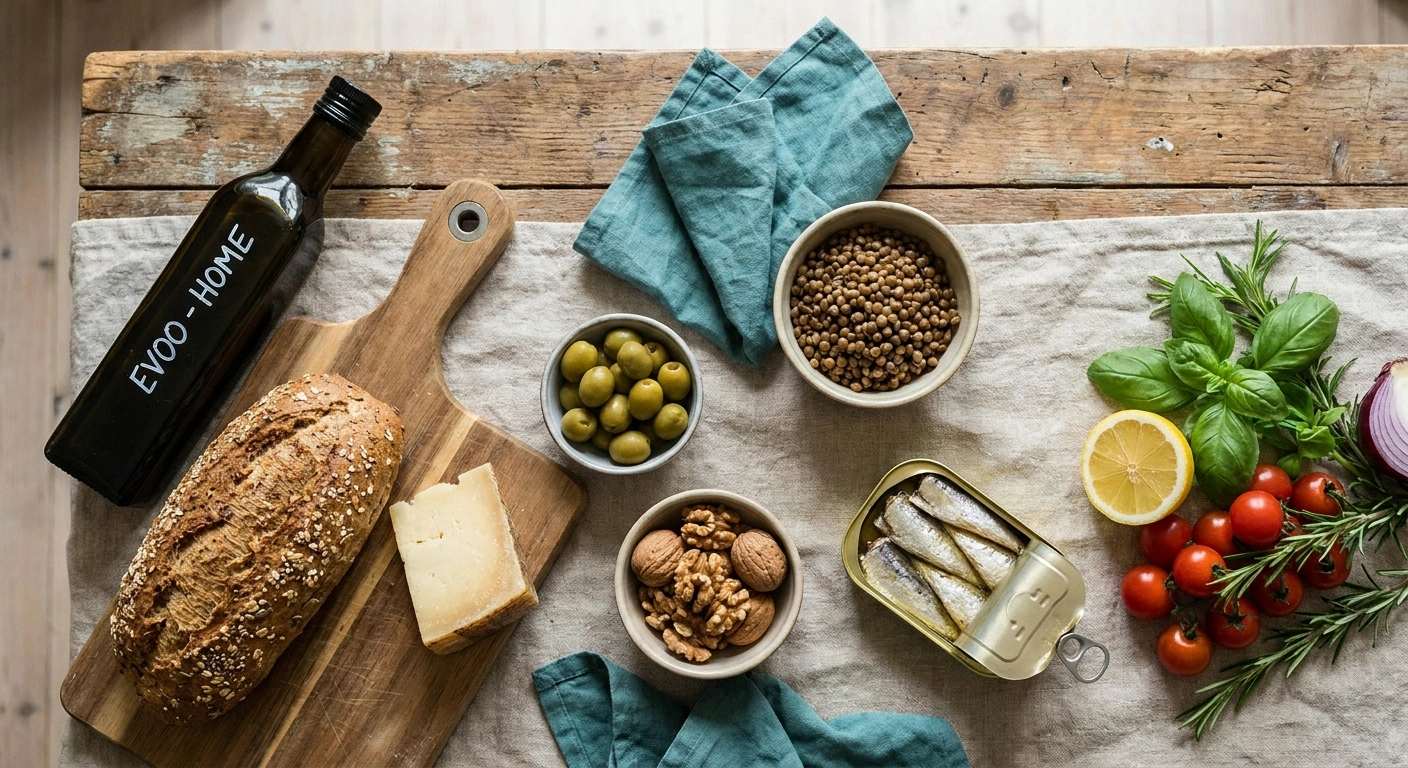
A woman from my support group, June, told me last spring that her neurologist had said something that stuck with her. He said: “If you're going to change one thing about how you eat for your nerves, change it to the Mediterranean pattern. It's the only diet that has actually been tested in nerve studies and held up.”
June, who is in her late 60s and has had diabetic neuropathy in both feet for almost a decade, came to our next meeting with a notebook full of questions. What does “Mediterranean” actually mean? Is she supposed to eat pasta every night? Is olive oil really doing anything or is it just expensive? Does she have to give up cheese? Does it work fast enough to be worth changing what she eats?
Those are the right questions, and they don't get answered well by the glossy magazine version of “eat more fish, drink more wine, smile in the sunshine.” The honest version is more interesting and more useful. The Mediterranean dietary pattern has, at this point, more high-quality evidence behind it for nerve health than any other named diet. The evidence isn't perfect or dramatic — nobody is curing neuropathy with olive oil — but the signal is consistent enough across enough studies that it's the one I'd start with if I were starting over today.
This guide walks through what the Mediterranean pattern actually is (not what the magazine version says), why it has a real mechanism case for helping damaged nerves, what the research actually shows, what it doesn't fix, and a practical Week 1 framework you can start tomorrow with whatever is already in your kitchen. The goal is to give you a real picture, not a glossy one.
What “Mediterranean Diet” Actually Means
The phrase “Mediterranean diet” doesn't refer to a single rigid meal plan. It refers to the traditional eating pattern of southern Europe — Greece, southern Italy, Spain, Crete, southern France — as it was documented by researchers in the 1950s and 1960s. The pattern was striking because the populations following it had much lower rates of heart disease, stroke, type 2 diabetes, and — as we now know — peripheral neuropathy than populations eating a typical American or northern European diet.
Stripped to its essentials, the Mediterranean pattern looks like this:
- Olive oil as the primary fat. Used liberally — for cooking, for dressing, for drizzling on bread, for finishing soups.
- Vegetables and fruits at every meal. Both cooked and raw. Variety matters more than any single “superfood.”
- Whole grains, beans, lentils, and nuts as the main starches and protein bases. Not refined white bread and white rice — whole-grain bread, farro, barley, bulgur, chickpeas, lentils, almonds, walnuts.
- Fish two to three times a week. Especially fatty fish like sardines, mackerel, salmon, anchovies — the ones high in omega-3 fatty acids.
- Modest amounts of dairy. Yogurt, cheese — usually a small amount with a meal rather than a glass of milk.
- Eggs and poultry a few times a week. Not the centerpiece, but present.
- Red meat occasionally. A few times a month, not a few times a week.
- Wine with meals in moderation. Optional — the benefit of moderate wine, if any, is small and doesn't justify starting if you don't already drink. Most modern guidance is leaning toward “this part is overrated.”
- Herbs and spices in place of salt. Rosemary, oregano, garlic, basil, thyme, parsley, sage.
- Sweets and sugar-sweetened drinks rarely. Honey or fruit for sweetness, not industrially refined sugar.
What's missing from that list matters as much as what's on it. There's no daily soda. No nightly steak. No fast food. No deep-fried anything. No ultra-processed snack foods. No syrupy coffee drinks. The traditional pattern was simple ingredients prepared at home, eaten slowly, often shared with other people.
If you compare that pattern to a typical American eating week — even one that already includes “healthy” choices — the differences are huge. And those differences are where the nerve benefit comes from.
Why It Might Actually Help Damaged Nerves
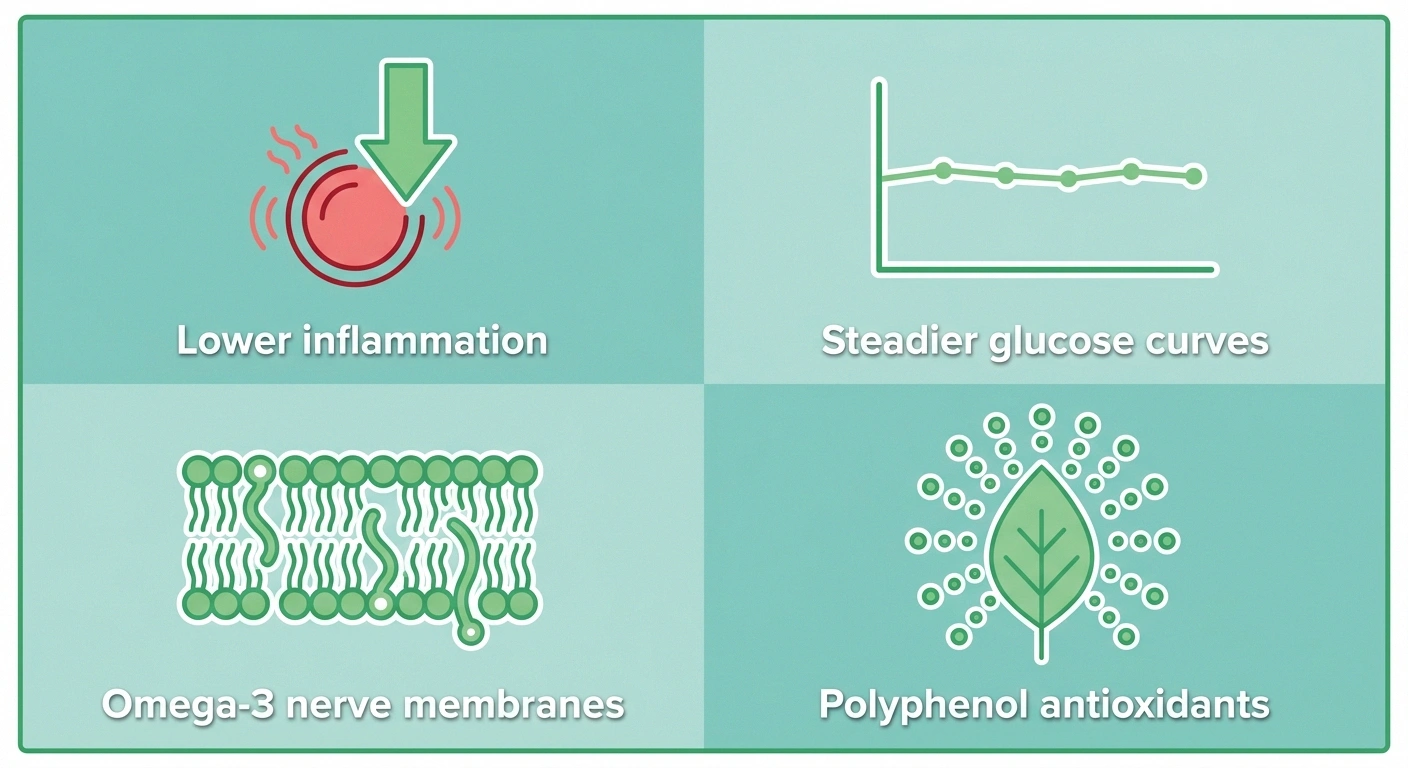
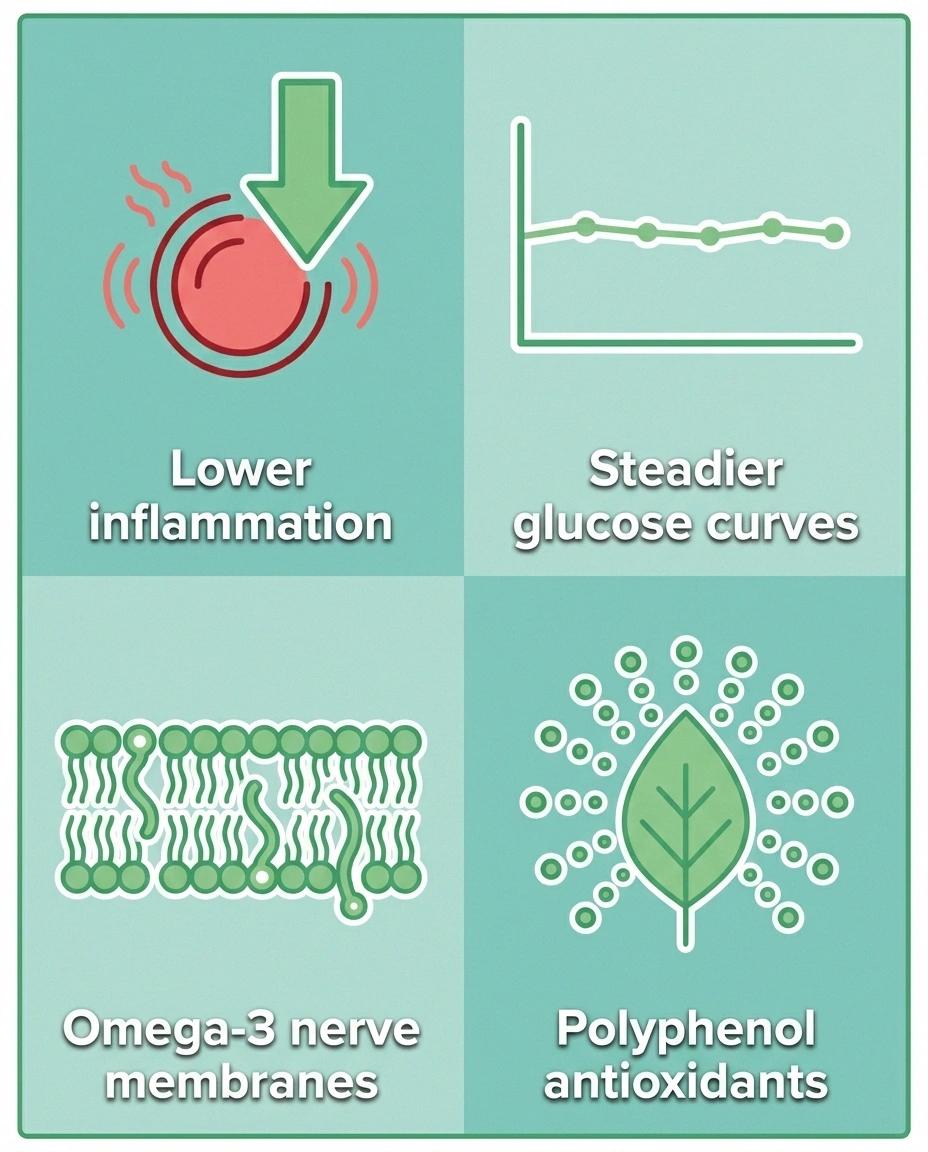
The case for the Mediterranean pattern in neuropathy rests on four overlapping mechanisms. None of them on its own is dramatic. The combination is what matters.
Four Overlapping Mechanisms
1. Less chronic inflammation
Lower CRP, IL-6, TNF-α — a better healing environment for damaged nerves.
2. Flatter glucose curves
Whole grains + fiber + fat slow absorption. Smaller swings = slower diabetic nerve progression.
3. Omega-3 for nerve membranes
EPA and DHA from fatty fish are structural components of myelin.
4. Polyphenol antioxidants
Olive oil oleocanthal, berry anthocyanins, herb polyphenols protect nerves from oxidative damage.
1. Chronic inflammation is part of nerve damage, and this pattern lowers it. Peripheral neuropathy, regardless of cause, involves chronic low-grade inflammation in and around the affected nerves. Multiple studies have shown that people following a Mediterranean pattern have measurably lower blood markers of inflammation — C-reactive protein, interleukin-6, tumor necrosis factor alpha — than people following a typical Western diet. The drop isn't enormous, but it's consistent. Less background inflammation means a more favorable environment for nerves to heal in.
Key Takeaway
The Mediterranean pattern has the strongest research base of any named diet for nerve health — not a cure, but a foundation. Four mechanisms (lower inflammation, steadier glucose, omega-3 for nerve membranes, polyphenol antioxidants) overlap to make damaged nerves heal as well as they're going to heal.
2. Blood sugar swings damage nerves, and this pattern flattens them. The combination of whole grains instead of refined ones, fiber-rich vegetables and legumes at every meal, healthy fats slowing carbohydrate absorption, and minimal added sugar produces a steadier glucose curve than almost any other commonly-eaten pattern. For anyone with diabetic neuropathy or prediabetes-related neuropathy, this matters enormously. Steadier glucose — not just lower averages, but smaller swings — is one of the most consistent predictors of slower neuropathy progression. (We dig into the broader nutrition foundations in our piece on the best neuropathy diet.)
3. Omega-3 fatty acids support nerve membrane health. Nerves are wrapped in fatty membranes called myelin. Omega-3 fatty acids (especially EPA and DHA from fatty fish) are structural components of those membranes. Several small studies have shown improvements in nerve conduction velocity in people who increased their omega-3 intake. The fatty fish two to three times a week of the Mediterranean pattern is a natural way to get them without thinking about it as supplementation.
4. Polyphenols protect nerves from oxidative damage. Olive oil, red wine, nuts, berries, dark leafy greens, and herbs are dense in plant compounds called polyphenols. Many polyphenols — including the oleocanthal in extra virgin olive oil, resveratrol in grapes, curcumin in turmeric, EGCG in green tea — have measurable antioxidant and anti-inflammatory effects in laboratory and small clinical studies. Nerve cells are particularly vulnerable to oxidative damage, and a daily dietary stream of polyphenols is one of the few interventions that may genuinely tilt that balance.
None of these mechanisms is a knockout punch. But the combination — less inflammation, steadier glucose, better nerve membrane building blocks, and a polyphenol-rich antioxidant environment — is exactly the picture of “an environment in which damaged nerves can heal as well as they're going to heal.”
What the Actual Evidence Shows
This is the part where I want to be honest with you, because there's a lot of overstatement on the internet about diet and neuropathy. The Mediterranean pattern has the best evidence base of any named diet for nerve health. The evidence is still mostly indirect, the studies are mostly small, and the magnitude of effect is modest. All of that is true at the same time.
Research Says
In the PREDIMED trial, type 2 diabetes patients on the Mediterranean diet with extra virgin olive oil had a roughly 66% lower incidence of diabetic peripheral neuropathy over the trial period compared with the low-fat control group.
Smaller follow-up trials in established neuropathy have shown improvements in nerve conduction velocity and self-reported pain after six months.
The largest piece of evidence is from PREDIMED. The Prevención con Dieta Mediterránea (PREDIMED) trial enrolled more than 7,400 older adults at high cardiovascular risk in Spain and randomized them to a Mediterranean diet enriched with extra virgin olive oil, a Mediterranean diet enriched with mixed nuts, or a control low-fat diet. The trial ran from 2003 to 2011. The headline result was a 30 percent reduction in major cardiovascular events in the Mediterranean groups.
For neuropathy specifically, a 2014 sub-study of about 700 PREDIMED participants with type 2 diabetes found that those randomized to the Mediterranean diet with extra virgin olive oil had a roughly 66 percent lower incidence of diabetic peripheral neuropathy over the trial period compared with the control group. That's a striking number for a dietary intervention, and it's the cleanest piece of randomized evidence we have on this topic.
Smaller studies have echoed the signal. A 2019 trial in Italy randomized about 80 patients with established diabetic neuropathy to either a Mediterranean dietary intervention or usual dietary advice. After six months, the Mediterranean group showed measurable improvements in nerve conduction velocity, reductions in self-reported pain scores, and improvements in quality-of-life measures. The control group, on average, did not change. Several other small trials have shown similar directional results.
Observational studies are consistent. Large cohort studies in the United States, Europe, and Australia have found that people who score higher on Mediterranean diet adherence scales have lower rates of diabetic neuropathy, lower rates of cognitive decline, and slower progression of small-fiber neuropathy than people who score lower. Observational data can't prove cause and effect — people who choose a Mediterranean diet may differ in other ways — but the directionality is consistent.
The mechanism studies make biological sense. Laboratory studies have shown that key components of the Mediterranean diet (olive oil polyphenols, omega-3 fatty acids, specific antioxidants) reduce inflammation and support nerve regeneration in cell and animal models.
Put all of that together and the synthesis is: the Mediterranean pattern is the eating approach most likely to slow neuropathy progression, modestly reduce neuropathic pain, and support nerve regeneration where it's possible. It is not a cure. It will not undo a decade of established nerve damage in three months. But it tilts the conditions in the right direction in a way that few other dietary changes consistently do.
What It Doesn't Fix
Honest expectations are part of why people stick with a change. The Mediterranean pattern won't reverse advanced neuropathy. It probably won't take pain from a 7 to a 2. It won't fix neuropathy caused by chemotherapy, alcohol, autoimmune disease, or genetics by itself. And it won't make up for poorly controlled diabetes if your blood sugar is still wildly variable.
What it does is give you a foundation. On top of that foundation, the other things that help nerves — exercise, sleep, blood sugar control, the supplements with real evidence, the medications that target specific symptoms — work better than they would on a poor dietary base. It's not the headline act. It's the stage you're building on. Our overview of whether neuropathy can be reversed walks through that broader picture honestly.
The Week 1 Starter Plate
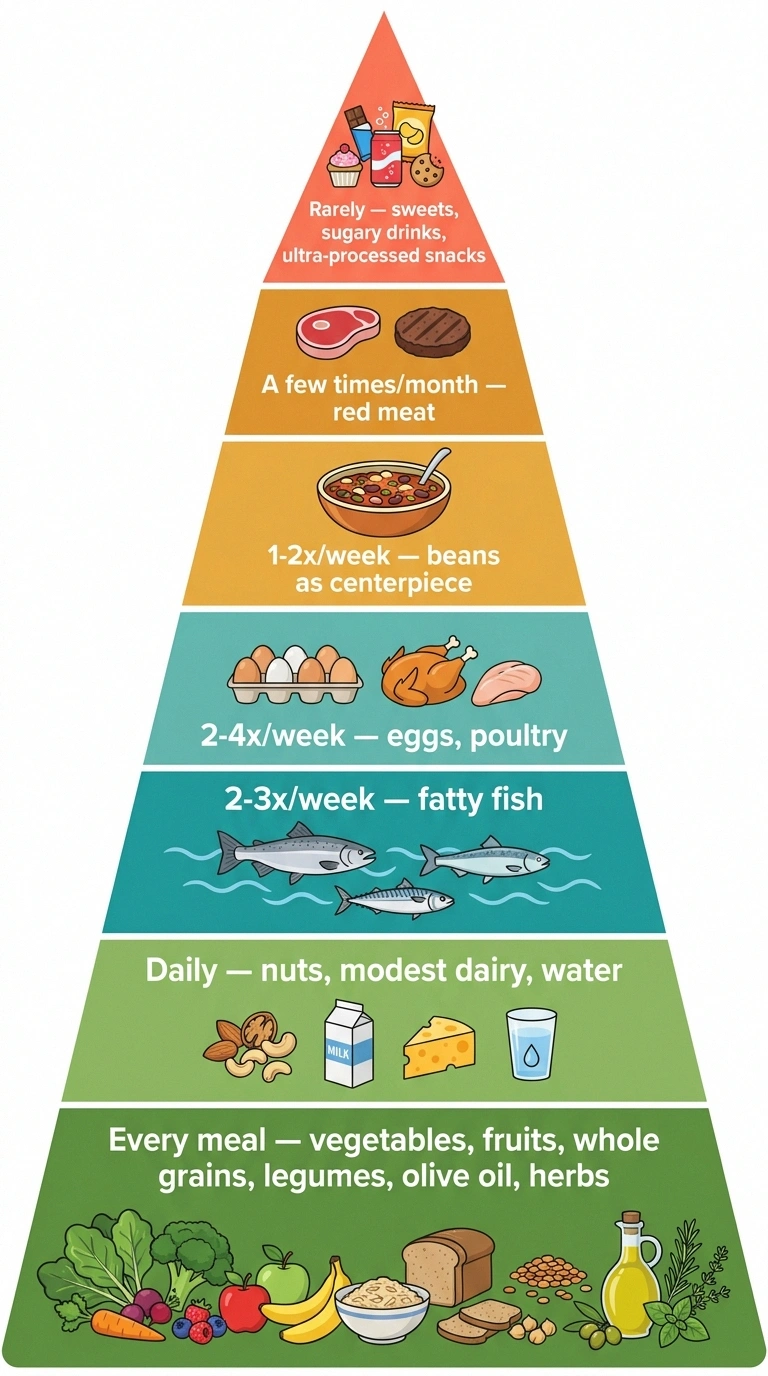
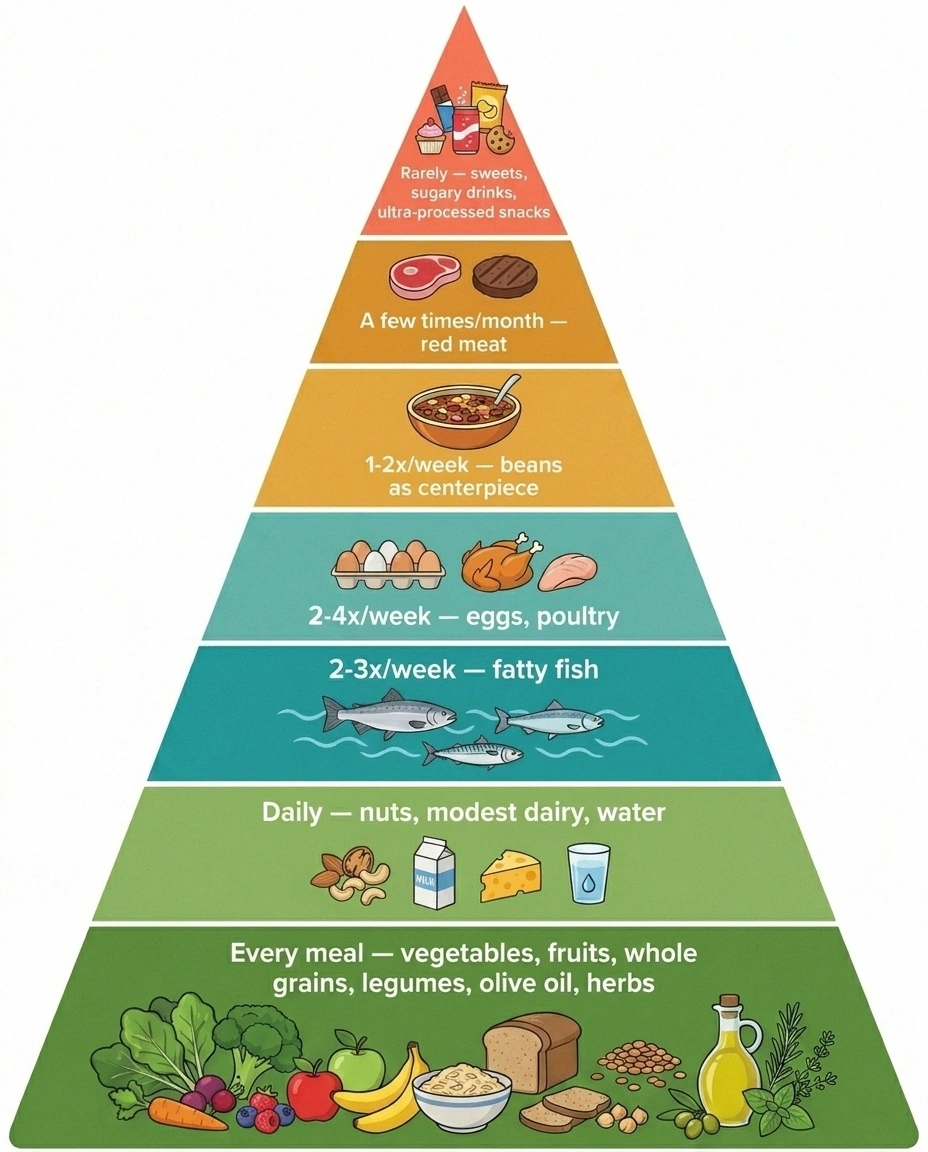
The biggest mistake people make starting the Mediterranean pattern is treating it as a sudden total reinvention of how they shop, cook, and eat. That almost never sticks. The change that sticks is small, gradual, and built on what you already do.
A Week of Mediterranean Eating
| Frequency | Foods |
|---|---|
| Every meal | Vegetables & fruit, whole grains or legumes, extra virgin olive oil, herbs |
| Daily | Small handful of nuts, modest dairy (yogurt or cheese), water as default drink |
| 2–3x per week | Fatty fish (sardines, salmon, mackerel, anchovies) |
| 2–4x per week | Eggs and poultry |
| 1–2x per week | Beans/lentils as main centerpiece (besides daily inclusion) |
| A few times a month | Red meat (not the centerpiece of any single week) |
| Rarely | Sweets, sugary drinks, deep-fried foods, ultra-processed snacks |
Here's the Week 1 framework I use with people in our group who want to start.
Change one thing per meal, not your whole pantry.
Breakfast. Add a piece of fruit. Switch from white toast to whole-grain. Sprinkle a tablespoon of chopped walnuts on your yogurt or oatmeal. Use olive oil instead of butter if you're cooking eggs. One swap, not five.
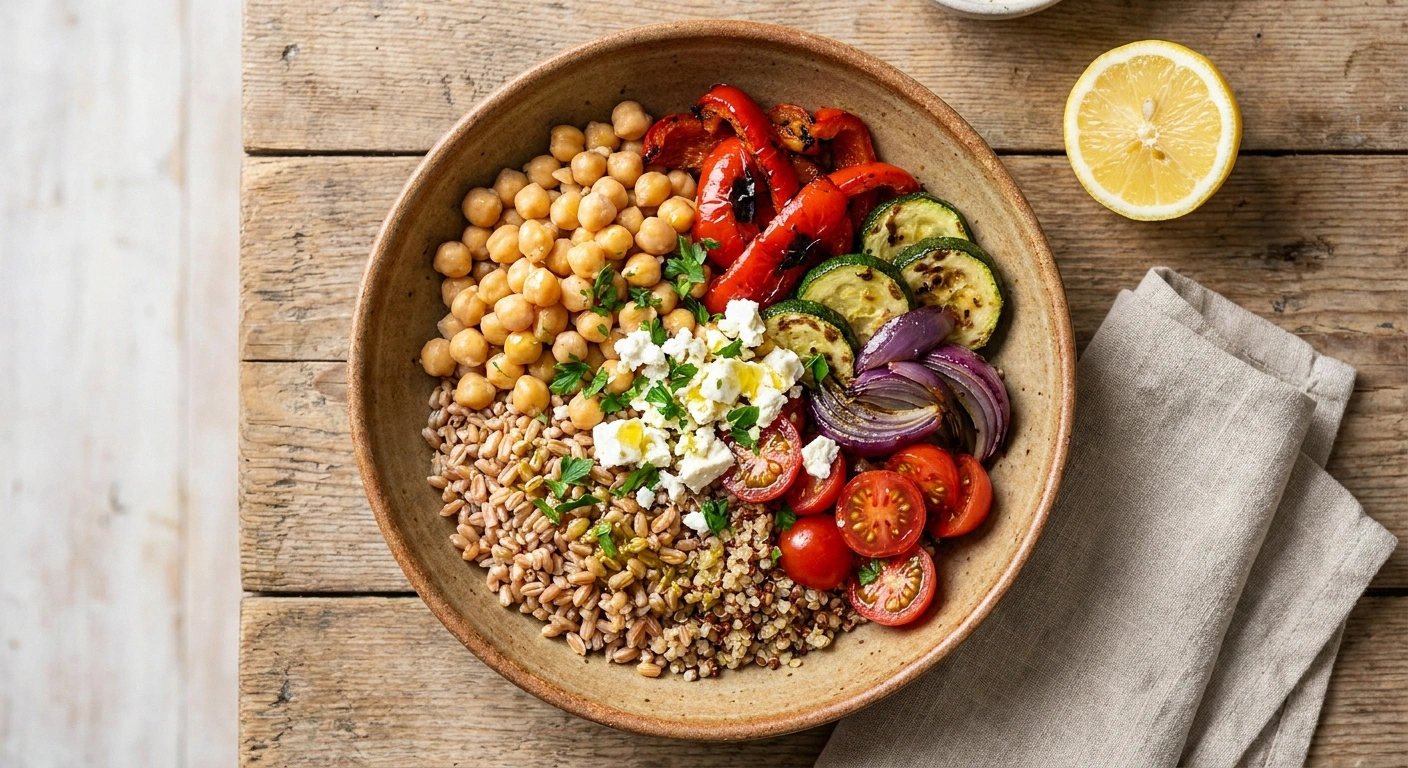
Lunch. Build a “Mediterranean bowl.” Start with a base of any whole grain (farro, brown rice, quinoa, barley, even whole-grain pasta). Add a half-cup of any beans (chickpeas, white beans, lentils). Add a generous handful of vegetables — raw, roasted, or whatever you have. Top with a drizzle of olive oil, a squeeze of lemon, salt, pepper, and any herbs. Add cheese if you want, fish or chicken if you want. This single template can carry you through five lunches with five different combinations.
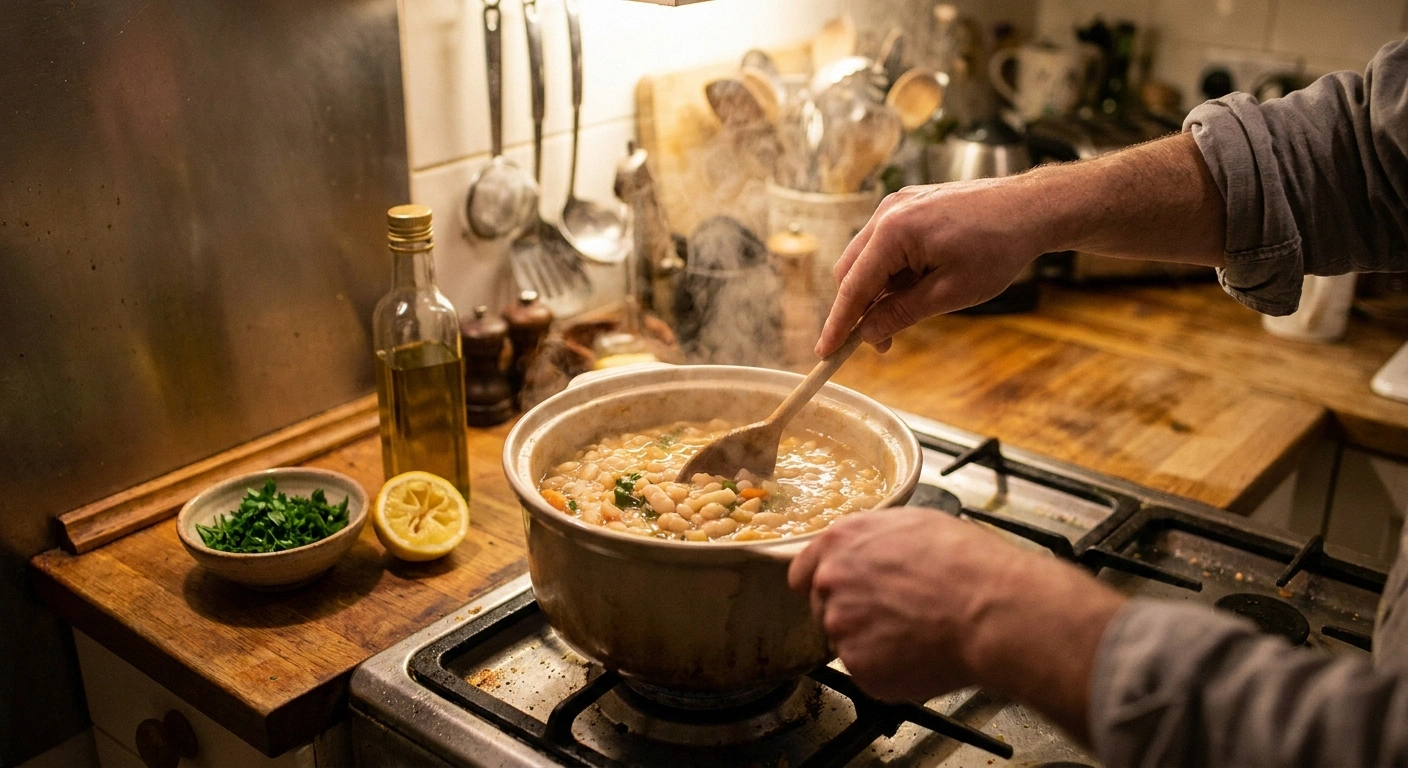
Dinner. Twice a week, make fish the centerpiece — sardines on toast, canned salmon mixed with olive oil and dill on greens, baked white fish with lemon and olive oil. Twice a week, make beans or lentils the centerpiece — a lentil soup, a white bean stew, chickpea pasta. Once a week, eat poultry. Once or twice a week, have a meatless meal. Save red meat for occasional, not regular.
Snacks. A small handful of nuts (about an ounce — 12 to 15 almonds, 6 to 8 walnut halves) once or twice a day. Fresh fruit. A piece of cheese with crackers. Olives. Plain Greek yogurt with a drizzle of honey.
Drinks. Water as the default. Coffee or tea is fine. If you want a glass of wine with dinner and your doctor is okay with it, the Mediterranean pattern accommodates it. If you don't already drink, don't start.
That's the framework. You don't need recipes from a Mediterranean cookbook. You don't need to buy 12 new ingredients. You need olive oil, a handful of dried beans or canned chickpeas, whole-grain bread, fish or canned fish, some nuts, plenty of fruit and vegetables, and a few good herbs.
What This Actually Costs
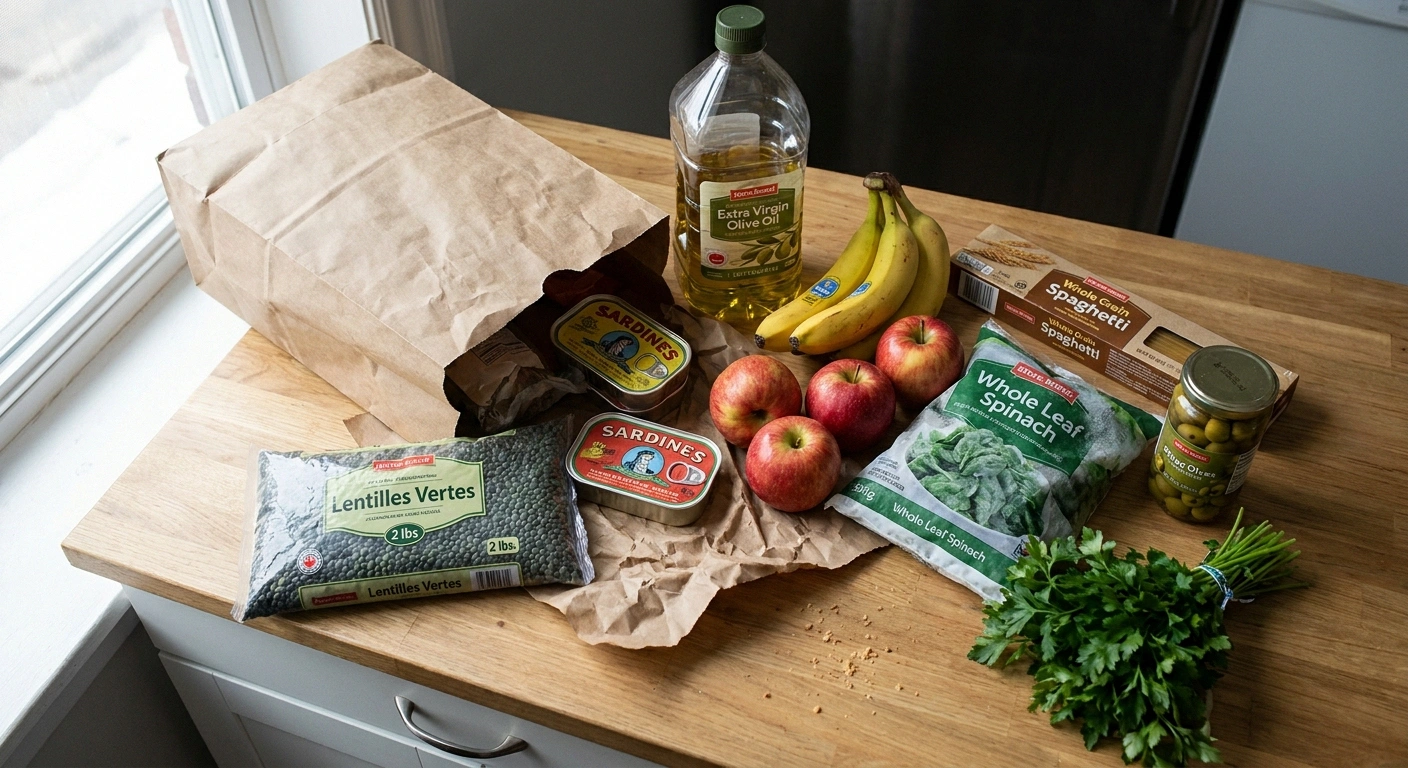
“Mediterranean diet” sometimes gets coded as expensive — fancy olive oil, imported cheeses, fresh fish from a specialty market. The actual traditional pattern is the opposite. It was the food of farmers, fishermen, and working people in southern Europe. The cheap-and-sticking-with-it version uses:
The Cheap-and-Sticky Mediterranean Starter Kit
Most people's weekly food budget stays flat or drops — cutting ultra-processed snacks and frequent restaurant meals offsets the olive oil and fish.
- Dried beans and lentils. A pound of dried beans makes about six cups cooked, costs around $2 to $3, and provides protein and fiber for a week of bowls and soups.
- Canned fish. Sardines, anchovies, tuna, and salmon are inexpensive and nutritionally similar to fresh. A can of sardines costs $2 to $4 and provides a full omega-3 dose for a meal.
- Frozen vegetables. Just as nutritious as fresh, often cheaper, and they don't go bad. Frozen spinach, peas, broccoli, and bell peppers are the workhorses.
- Whole-grain pasta and brown rice. Cheap, store well, work as bases for many meals.
- Olive oil bought by the larger bottle. Per-tablespoon cost drops sharply with the larger sizes. You don't need the $40 boutique bottle — a decent extra-virgin from the regular grocery store is fine for daily use.
- Eggs. Inexpensive complete protein. Two to four times a week works.
- Nuts in bulk. Buying nuts in larger bags (or from a bulk bin) cuts the per-ounce cost meaningfully.
- Seasonal fresh produce. Whatever's in season locally is almost always cheaper than out-of-season imports.
People who make this switch usually report their weekly food budget either stays flat or drops, because cutting out ultra-processed snacks, sugary drinks, and frequent restaurant meals more than offsets the cost of olive oil and fish.
Common Mistakes
Three patterns trip up most people who try the Mediterranean approach.
Three Patterns That Sabotage Most Starters
1. Treating it as low-carb. Mediterranean is NOT keto. Whole grains, beans, fruit are part of the pattern.
2. Pouring olive oil on a Western diet. The benefit is replacing other fats, not adding it on top.
3. Quitting after one off day. One pizza meal doesn't undo a week. The pattern is what you do most of the time.
Treating it as low-carb. The Mediterranean pattern is not low-carb. Whole grains, beans, lentils, fruit, and starchy vegetables are all carbohydrates and all part of the pattern. The key is that the carbohydrates come with fiber, healthy fat, and protein, which slows their absorption. Cutting out all carbs and only eating olive oil and salmon is not the Mediterranean pattern — it's keto with olive oil.
Treating olive oil as a free pass. Olive oil is calorie-dense (about 120 calories per tablespoon). The Mediterranean evidence is built on using it as a primary fat — replacing butter, margarine, vegetable oils, and processed snack foods — not adding it on top of everything else. If you're already eating a Western diet and you just start drizzling olive oil over everything without changing anything else, you're adding calories without much benefit.
Forgetting that it's a pattern, not a perfect day. One meal of pizza doesn't undo a week of Mediterranean eating. Three meals of pizza in a week starts to dilute the pattern. People often quit because they had a “cheat day” and felt like the whole thing was ruined. It isn't. The pattern is what you do most of the time.
How It Stacks With Everything Else
The Mediterranean foundation works alongside, not instead of, the other things that help nerves.
Mediterranean Diet Sits at the Foundation
The foundation isn't the headline. It's what everything else works better on top of.
Targeted nutrient deficiencies still need to be addressed. If you have a true B12 deficiency (which is common in older adults, in people on long-term metformin, and in vegetarians), no amount of olive oil will fix it. You need B12 supplementation or injections. The Mediterranean pattern is rich in many micronutrients, but it isn't a substitute for correcting a specific deficiency. Our piece on what vitamin deficiency causes neuropathy walks through the common ones to test for.
Supplements with real evidence still earn their place. Alpha-lipoic acid, acetyl-L-carnitine, benfotiamine, magnesium for cramping and sleep — these are not replaced by diet. They sit on top of it. Our overview of the supplements with the best evidence covers which ones have data behind them. And specific reads on alpha-lipoic acid and magnesium are the deepest dives we have on those individual supplements.
Glucose control still rules the day in diabetic neuropathy. The Mediterranean pattern helps flatten glucose curves, but it doesn't replace insulin, oral medications, blood-glucose monitoring, or the ongoing work of managing diabetic neuropathy with your care team.
Exercise pairs with it. Regular walking, gentle resistance training, and balance work amplify the benefits of the dietary pattern. The combination of diet and movement is meaningfully more powerful than either alone.
Mental health matters. Eating well is hard when you're depressed, exhausted, or grieving. If your mood is making it hard to cook and eat with care, that's a problem worth naming and treating directly. Our piece on neuropathy and mental health covers the connection.
The Bigger Picture
Here's the way I think about this in our support group. The Mediterranean pattern isn't a treatment. It's a soil. The seeds you plant — the medications, the supplements, the exercise, the sleep, the glucose work — grow better in good soil than in poor soil. Some people will see their pain or numbness measurably improve in a few months. Many will see slower progression and a general sense of being better than they were. A few will not notice a difference in symptoms but will get other benefits — cardiovascular, cognitive, weight, mood.
For someone who has been told there's nothing they can do, “you can build the soil” is a real answer. Not the only answer, not a complete answer, but a real one with a research base behind it.
Frequently Asked Questions
How long does it take to notice anything?
Most people who report changes in neuropathy symptoms describe noticing them somewhere between 8 and 16 weeks of consistent eating in the Mediterranean pattern. Some people see changes faster, especially if they were eating very poorly before. Others see changes in energy, sleep, or weight before they see changes in nerve symptoms. The nerve effects build slowly because nerve cells themselves regenerate slowly — millimeters per day at best — so it takes time for dietary changes to translate to felt differences.
Do I have to use extra virgin olive oil specifically?
For the daily-use bulk of your cooking, yes — extra virgin olive oil is what was used in the studies. The cold-pressing process preserves the polyphenols that drive most of the anti-inflammatory effect. Refined “light” olive oil is fine for high-heat cooking but loses most of the bioactive compounds. You don't need a $40 boutique bottle — a decent supermarket extra-virgin is far better than no olive oil at all. Look for a harvest date or “best by” date that's reasonably recent and store the bottle in a dark cupboard, not on the counter in sunlight.
Can I do the Mediterranean diet as a vegetarian or vegan?
Yes, with one important note. The pattern naturally accommodates a mostly plant-based approach — beans, lentils, whole grains, vegetables, fruits, nuts, olive oil, and eggs and dairy if you eat them. If you skip fish entirely, you should think about omega-3 intake from alternative sources (chia seeds, flax seeds, walnuts, and possibly an algae-based DHA supplement). And vegans in particular need to think about B12, which is not in plant foods in usable amounts and is critical for nerve health. A vegan-adapted Mediterranean pattern works well when those gaps are addressed.
What about the wine part?
This is the most overrated and most misunderstood piece. The modern view from most diabetes and neuropathy specialists is that the wine component is the weakest part of the dietary pattern's evidence base. Moderate wine intake (one small glass with a meal) is compatible with the pattern and probably doesn't add risk for most people. But the cardiovascular and nerve benefits of the Mediterranean diet are not primarily driven by the wine, and the alcohol downside — particularly for people on neuropathic pain medications, with sleep disturbance, or with a family history of alcohol use disorder — is real. If you don't drink, don't start. If you do drink, keep it moderate (one glass with a meal, not three).
Is it better than DASH or other heart-healthy diets?
For cardiovascular outcomes, the Mediterranean and DASH (Dietary Approaches to Stop Hypertension) patterns are close to a tie — both work. For neuropathy specifically, the Mediterranean pattern has more direct evidence, because more nerve-focused studies have used it. There's enough overlap between the two that someone already doing DASH can layer in Mediterranean elements (more olive oil, more fatty fish, more nuts) without conflict.
What if I have kidney disease or another medical condition that affects my diet?
The Mediterranean pattern is generally compatible with most diet modifications, but anyone with significant kidney disease should work with a renal dietitian on the specifics (potassium load from certain vegetables and fruits, phosphorus from beans and nuts, protein amount). The same is true for people on warfarin (because leafy green vegetables affect INR), for people with severe IBS or other GI conditions, and for people with significant food allergies. The Mediterranean pattern is a flexible framework that can be adapted, but a registered dietitian is the right partner if you have a layered medical picture.
Do I have to eat fish if I don't like fish?
The fish is the most efficient natural source of marine omega-3 fatty acids, but it's not the only path. If fish is genuinely off the table for you, an algae-based DHA/EPA supplement (typically 500 to 1,000 mg combined per day) is a reasonable substitute. Walnuts, ground flax seeds, and chia seeds provide the precursor ALA, which your body converts to EPA and DHA inefficiently — so they help but don't fully replace marine sources.
Will eating this way help if my neuropathy is from chemo or another non-diabetic cause?
The direct evidence is strongest in diabetic neuropathy because that's where most of the studies have been done. But the underlying mechanisms — less inflammation, better nerve membrane composition, more antioxidant support — are not diabetes-specific. The Mediterranean pattern is reasonable to try in chemotherapy-induced neuropathy, alcohol-related neuropathy, idiopathic small-fiber neuropathy, and post-infectious neuropathy as well, on the basis that the mechanisms make sense even where the direct trial evidence is thinner.
About the Author