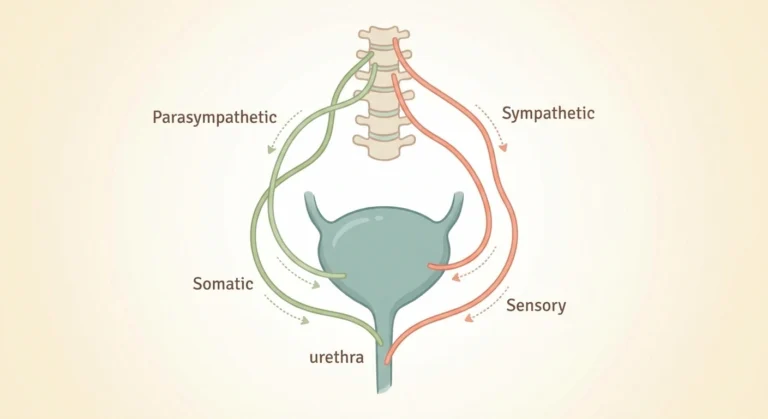
Hold your hand out in front of you and look at it. Not at the whole hand. At which specific fingers have gone numb.
That one detail carries more diagnostic weight than almost anything else you could bring to an appointment, and most people never think to check it. They arrive saying “my hand is numb,” which narrows nothing. The person who arrives saying “my thumb, index, and middle finger are numb, my palm is fine, and it wakes me at three in the morning” has essentially handed the doctor the answer.
So before anything else, the short version. Fingertip numbness that comes and goes with position, resolves in a minute or two when you shake your hand out, and stays confined to certain fingers is usually a compressed nerve rather than a damaged one. That is a mechanical problem with mechanical fixes. Fingertip numbness that is constant, symmetric across both hands, and arrived after your feet had been bothering you for a while is a different animal, and it is the one that points toward peripheral neuropathy.
The rest of this walks through how to tell which one you have. I write as someone who has lived with neuropathy for years and spent a long time learning to read my own symptoms, not as a clinician. But the pattern-reading below is standard, teachable, and it will make your next appointment considerably shorter.
Start With Which Fingers
Your hand is not served by one nerve. It is served by three, and they divide the territory in a way that is remarkably consistent from person to person. Once you know the map, your own numbness tells you which nerve is unhappy.
Which nerve owns which fingers
| Nerve | Skin it supplies | Usual pinch point | Classic tell |
|---|---|---|---|
| Median | Thumb, index, middle, thumb-side half of ring | Wrist (carpal tunnel) | Wakes you at night, eases when you shake the hand |
| Ulnar | Little finger, little-finger half of ring | Inside of elbow (cubital tunnel) | Worse with the elbow bent for a long stretch |
| Radial | Back of the hand and thumb web, not the pads | Upper arm | Follows sleeping with an arm over a chair back |
| All fingertips, both hands | Borders blurred, roughly symmetric | No single pinch point | Feet were affected first, often years earlier |
Overlap between territories is normal at the edges. The ring finger being split down the middle is the most reliable single clue in the whole hand.
The three are the median nerve, the ulnar nerve, and the radial nerve. Each one owns a specific patch of skin. When numbness respects those borders, the problem is almost certainly that one nerve, somewhere along its route. When numbness ignores the borders and covers all your fingertips more or less evenly on both hands, the problem is not one nerve. It is the nerve endings themselves.
That distinction is the whole fork in the road. Everything else follows from it.
Take a minute with this. Touch each fingertip with the pad of your other thumb and compare. Do the same on the palm side and the back side. People are frequently surprised to discover the numbness is much more specific than they had assumed.
The Thumb, Index, and Middle Finger Pattern
If your numbness sits in the thumb, the index finger, the middle finger, and the thumb-side half of the ring finger, you are looking at median nerve territory. The most common reason that nerve gets unhappy is carpal tunnel syndrome, where the nerve is compressed as it passes through a narrow channel at the wrist.
The classic version has a signature that is hard to mistake once you know it. Symptoms wake you at night. You shake your hand out over the side of the bed and it settles. Holding a phone, gripping a steering wheel, or reading a book with your wrist bent brings it on. Fine tasks get clumsy: buttons, earrings, picking up a coin off a flat surface.
Carpal tunnel is extremely common, it is not neuropathy in the systemic sense, and it responds well to unglamorous interventions. A rigid night splint that holds the wrist straight while you sleep is the first thing most people try, and for a meaningful share of people it is also the last thing they need to try.
What matters here is that this pattern is a local plumbing problem. It says nothing about your nerves in general.
When It's the Little Finger and Ring Finger
Numbness in the little finger and the little-finger side of the ring finger belongs to the ulnar nerve. That nerve wraps around the inside of your elbow through a groove you know well, because hitting it is what people call the funny bone.
Compression there is called cubital tunnel syndrome, and its tell is the elbow rather than the wrist. Symptoms show up when the elbow is bent for a long stretch: talking on the phone, sleeping curled with your hands near your face, resting your elbow on a car door or an armrest. Some people wake with the little finger dead and no idea why.
The fix is often equally unglamorous. Keeping the elbow from folding tightly overnight, sometimes with nothing more elaborate than a towel wrapped loosely around it, resolves a surprising number of cases. Ulnar compression that goes on long enough can produce visible muscle thinning between the thumb and index finger, and that is the point where it stops being something to manage at home.
Back of the Hand, Not the Pads
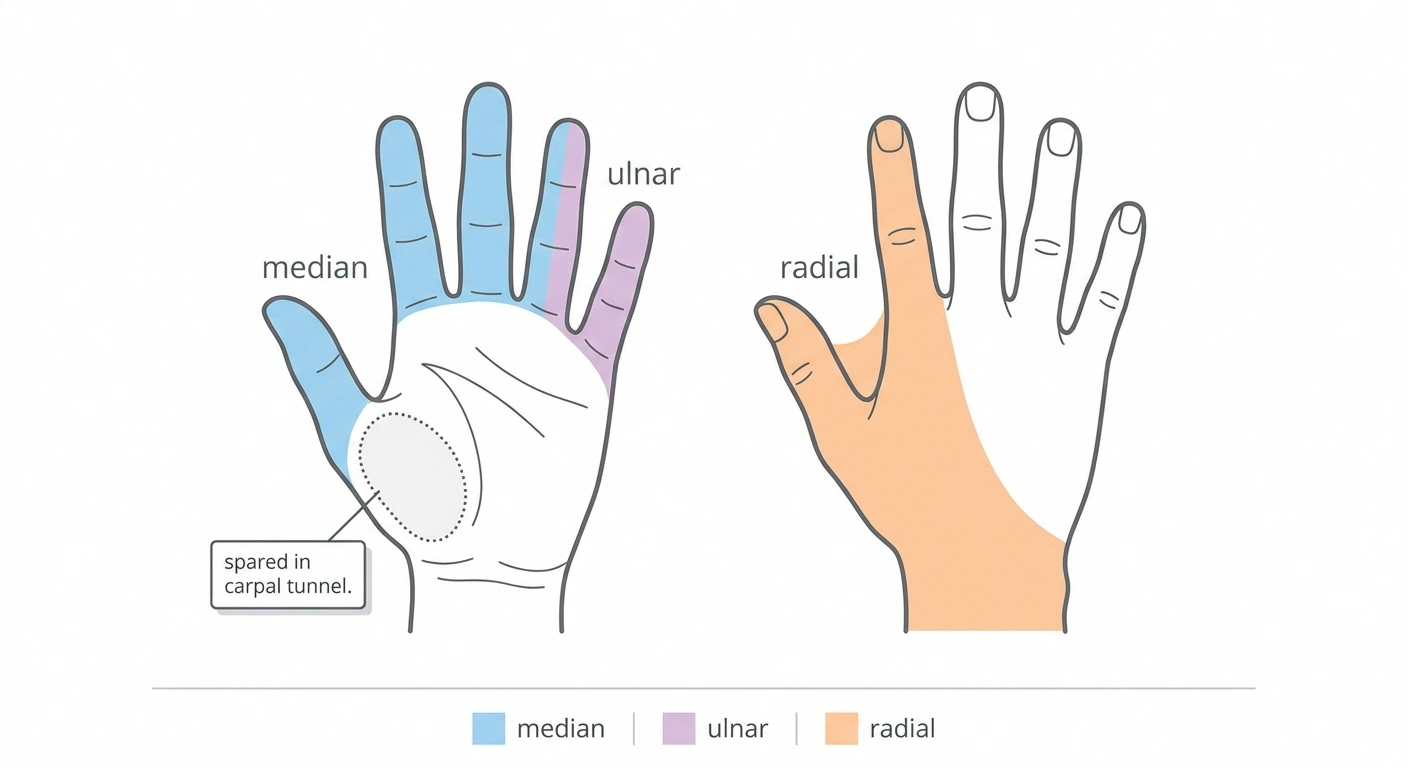
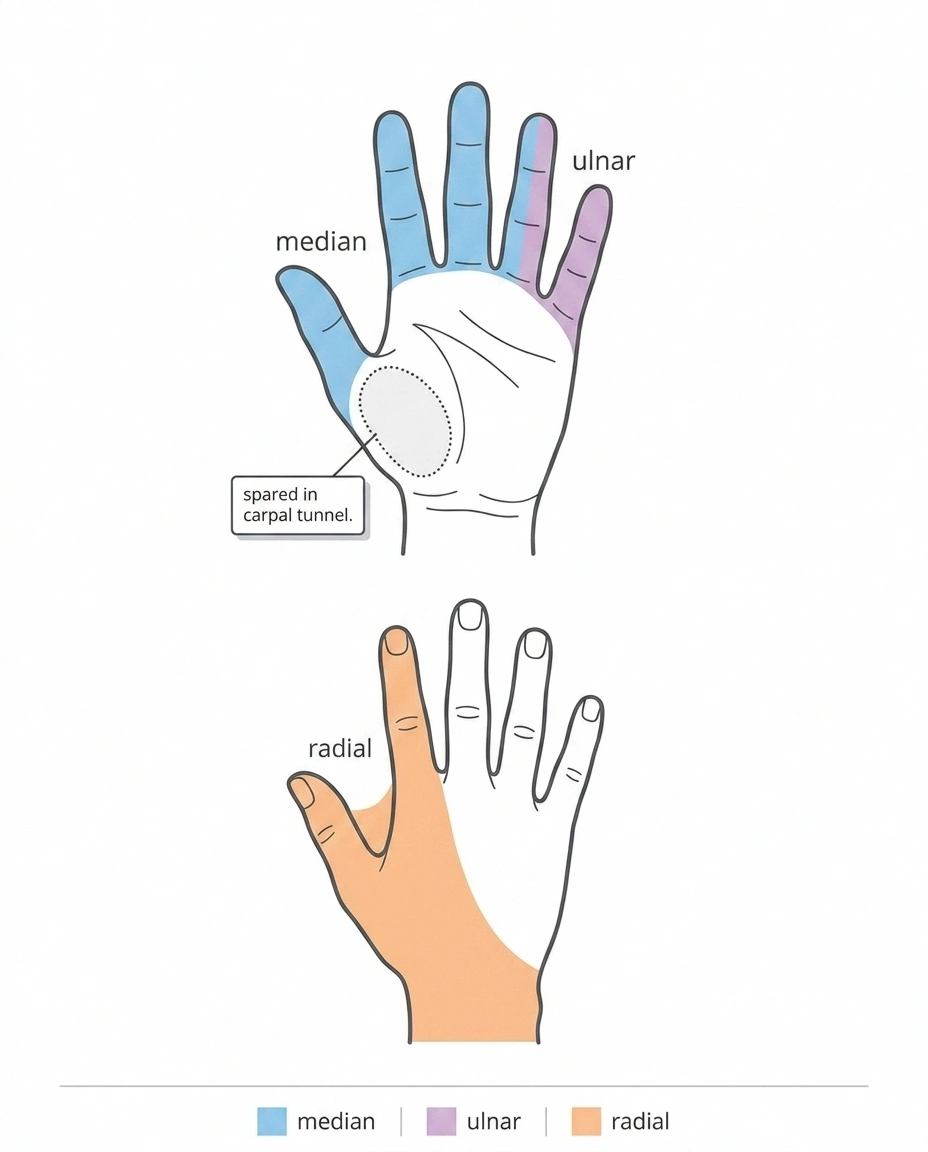
The radial nerve handles the back of your hand and the web of skin at the base of the thumb. It does not supply your fingertip pads. So if your numbness is on the back of the hand and does not involve the sensitive pads you use to feel textures, radial nerve is the likely address.
Radial compression tends to be positional and dramatic in origin. Falling asleep with an arm draped over the back of a chair is the textbook cause, which is why it earned the nickname Saturday night palsy. It usually recovers, though recovery can take weeks rather than days.
This one matters mostly because it rules things out. Readers who find their numbness is on the back of the hand can stop worrying about carpal tunnel entirely.
Numbness That Follows Your Neck
There is a fourth possibility that people rarely consider, because the symptom is in the hand and the cause is in the neck.
Nerve roots exit the spine in the neck and travel down the arm. When one of those roots is irritated by a disc or by arthritic narrowing, the numbness shows up wherever that root terminates. The C6 root sends symptoms to the thumb and index finger. C7 goes to the middle finger. C8 goes to the ring and little fingers.
Two features separate a neck problem from a wrist problem. It is usually one-sided, and it usually travels: people describe a band of symptom running from the neck or the shoulder blade down the outside of the arm and into the fingers. Turning or tipping the head can change the intensity, which no wrist problem does.
If tilting your head toward the numb side and looking up makes the fingers buzz harder, mention exactly that. It is a specific and useful observation.
Did Your Feet Go First?

Here is the question that sorts compression from true peripheral neuropathy, and it takes ten seconds to answer.
The fork, and what each branch changes
Feet have always felt normal
Points toward a single compressed nerve. Confirmable with nerve conduction studies, often fixable with a splint or a change in how you hold things.
Next step: primary care or a hand specialist, ordinary scheduling.
Feet went numb first, months or years ago
Points toward length-dependent polyneuropathy. The hands typically join once leg symptoms reach mid-calf to knee, so the arrival of hand symptoms is a progression marker worth dating.
Next step: blood work for a cause, because several of them are correctable.
Both can be true at once. A nerve already affected by polyneuropathy tolerates compression poorly, which is why carpal tunnel runs at higher rates in people with diabetes.
Before your fingertips started this, had your feet been numb, tingling, burning, or oddly sensitive for months or years?
If the answer is yes, the picture changes. Length-dependent peripheral neuropathy, which is the common kind, follows a strict order. Feet first. Then upward through the ankles and calves. And only once the leg symptoms have climbed to around the mid-calf or knee do the fingertips typically join in.
Clinicians call the finished pattern stocking-glove, because if you shaded in the affected skin it would look like you were wearing thin socks and thin gloves. The stocking always comes before the glove. Fingertip numbness that arrives out of nowhere, in someone whose feet have always felt normal, is much less likely to be this.
Please do not treat a yes here as bad news delivered by a webpage. It is a sorting question. The progression of neuropathy through its stages is gradual and, importantly, the underlying cause is often treatable. Knowing which category you are in is what lets anyone do anything useful.
Why the Longest Nerves Fail First
The stocking-glove order is not arbitrary, and the reason is oddly satisfying.
A single nerve fiber running from your spinal cord to your big toe is roughly three feet long, and the cell that maintains it sits at the far end of that distance. Everything the fiber needs has to be manufactured centrally and shipped the whole way out. Any process that degrades that supply chain, whether it is high blood sugar, a vitamin shortfall, a toxin, or an inflammatory attack, hits the longest fibers first, because they are the ones running the thinnest margin.
Your fingertips are served by fibers about half that length. They have more slack. So they fail later, and the gap between the feet going numb and the hands joining in can be years.
This also explains something readers often ask about: why sensation goes before strength. The small fibers carrying temperature and light touch are more vulnerable than the thicker fibers carrying muscle signals, so numbness, tingling, and burning sensations tend to arrive well before any weakness does.
The Palm Test That Narrows It Down
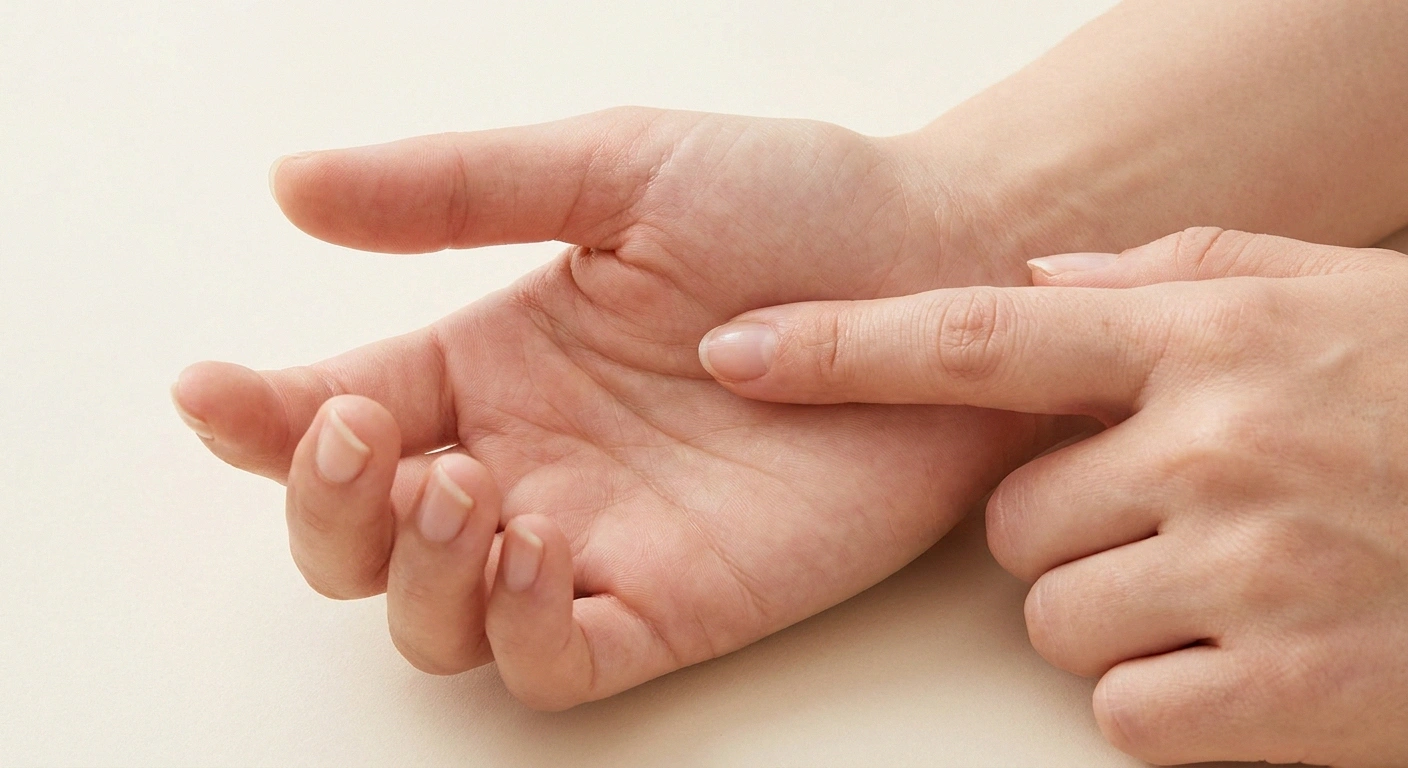
This one is genuinely useful and almost nobody knows it.
Run the palm test on yourself
Takes about ten seconds. The anatomy behind it: the median nerve's branch to the palm leaves the main trunk in the forearm and bypasses the carpal tunnel entirely.
- Step 1
- Find the fleshy mound of the palm just below the thumb. Press it with a fingernail from the opposite hand.
- Step 2
- Do the same on the other hand. Compare how sharp the sensation feels on each side.
- If that pad feels normal
- Consistent with carpal tunnel, even if the thumb and index finger are thoroughly numb. Sparing of the palm is expected there.
- If that pad is numb too
- Suggests the median nerve is affected above the wrist, or that something more general is going on. Worth saying out loud at the appointment, because it redirects the exam.
The median nerve gives off a small branch to the palm, and that branch splits off in the forearm, above the wrist. It does not pass through the carpal tunnel. Which means that in carpal tunnel syndrome, the fleshy mound of the palm below the thumb should still feel normal, even when the fingers it serves are thoroughly numb.
So press on that thenar pad and compare it to the other hand. Normal sensation there, with numb thumb and index finger, fits carpal tunnel neatly. Numbness that includes the palm suggests the median nerve is being pinched somewhere higher up the arm, or that something more general is going on.
It is a two-second check that changes what a clinician looks for.
What Causes Fingertip Numbness in Both Hands
When both hands are affected symmetrically and the borders between nerve territories have blurred, the search moves from anatomy to metabolism. The usual list is short and mostly checkable with blood work.
Diabetes and prediabetes lead it. Nerve damage can begin during the prediabetic years, before anyone has been given a diagnosis, which is why an A1C is nearly always part of the workup. Diabetic neuropathy is the single most common cause of the stocking-glove pattern worldwide.
Vitamin B12 deficiency is next, and it deserves attention because it is correctable and because it is easy to miss. It can be caused by absorption problems, by long-term acid-reducing medication, by metformin, or by a diet low in animal products. Other shortfalls, including B1, B6, folate, and copper, produce their own versions of the same symptom. Our guide to which vitamin deficiencies cause neuropathy covers what to test and what the numbers mean.
Thyroid disease, particularly an underactive thyroid, can produce both carpal tunnel and a broader neuropathy. Kidney disease, autoimmune conditions, and chronic inflammatory states each contribute. Sustained heavy drinking damages nerves both directly and through the nutritional deficits that accompany it. And some medications cause it outright, including several chemotherapy agents, certain antibiotics, and a handful of common prescriptions people never suspect. We keep a running list of medications that can cause neuropathy.
Sometimes the workup comes back clean and the label is idiopathic. That is unsatisfying, and it is also common.
Fingertips That Change Color

One pattern gets misfiled as neuropathy constantly, and it is worth separating out because the treatment is nothing alike.
In Raynaud's phenomenon, the small arteries in the fingers clamp down in response to cold or stress. The fingers go white, sometimes then blue, and flush red as they reopen. Numbness accompanies the color change and leaves when the color returns.
The distinguishing features are that it is episodic rather than constant, it has a clear trigger, and it produces a visible change you can photograph. If your numbness only happens in the frozen-food aisle and your fingertips turn the color of candle wax while it is happening, that is a circulation event, not a nerve one.
Take a picture next time. A photo of a Raynaud's attack is worth more than any description of one.
Numbness With No Pain at All
Plenty of people write in with a version of the same worry: the fingertips are numb, nothing hurts, and they cannot decide whether painlessness is reassuring or ominous.
Mostly it is neither. Numbness without pain simply means the affected fibers are the ones carrying sensation rather than the ones generating pain signals. Some people with substantial nerve damage never develop the burning that others find unbearable. The absence of pain is not evidence that nothing is happening, and it is also not a sign that something worse is coming.
What painless numbness does change is your risk profile. Reduced sensation in the fingers means you are less likely to notice a cut, a burn from a pan handle, or a blister forming under a tool. Practical adjustments matter here: checking water temperature with your wrist or elbow rather than your fingers, using oven mitts more liberally than seems necessary, and giving your hands a look each evening the way people with foot neuropathy are taught to inspect their feet.
Our overview of neuropathy affecting the hands goes deeper on adapting daily tasks when grip and sensation are both compromised.
When Numb Fingertips Are an Emergency
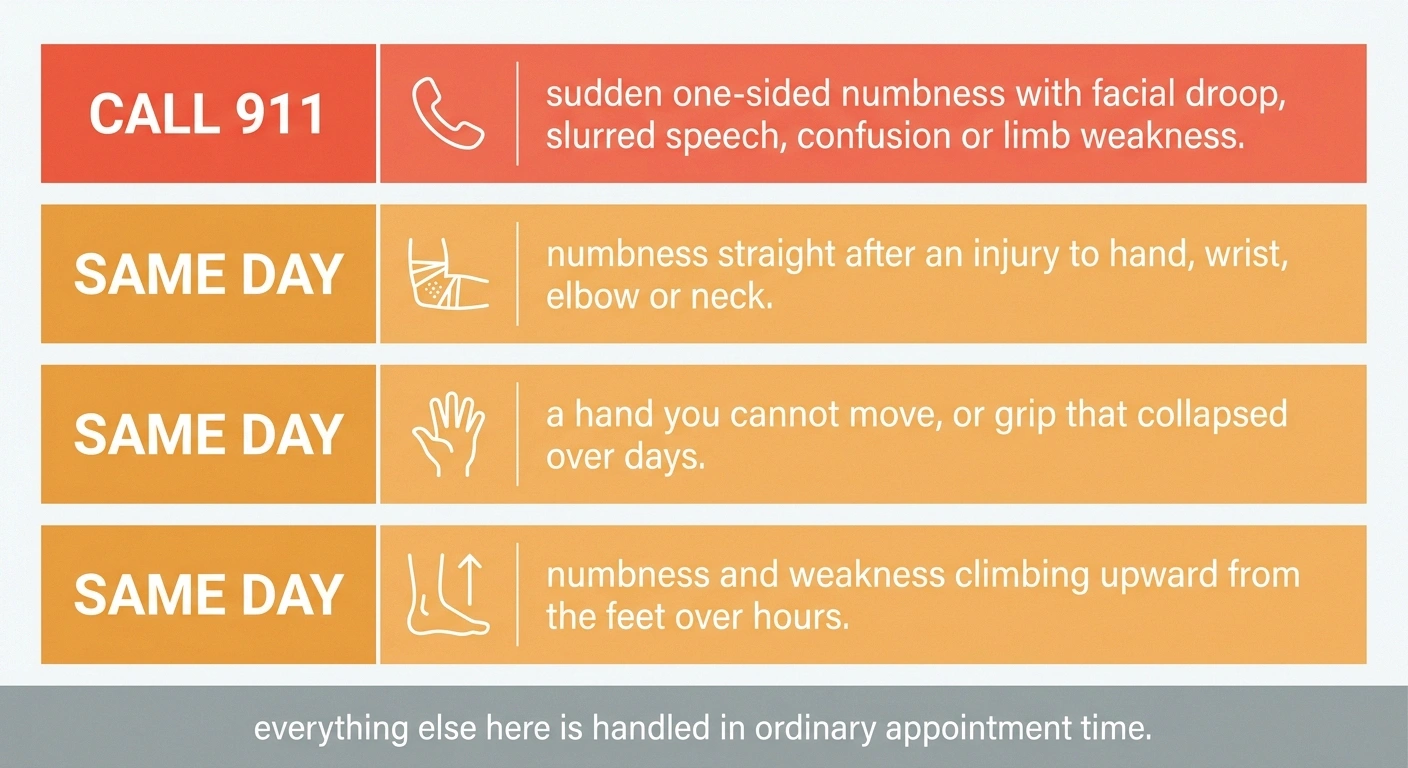
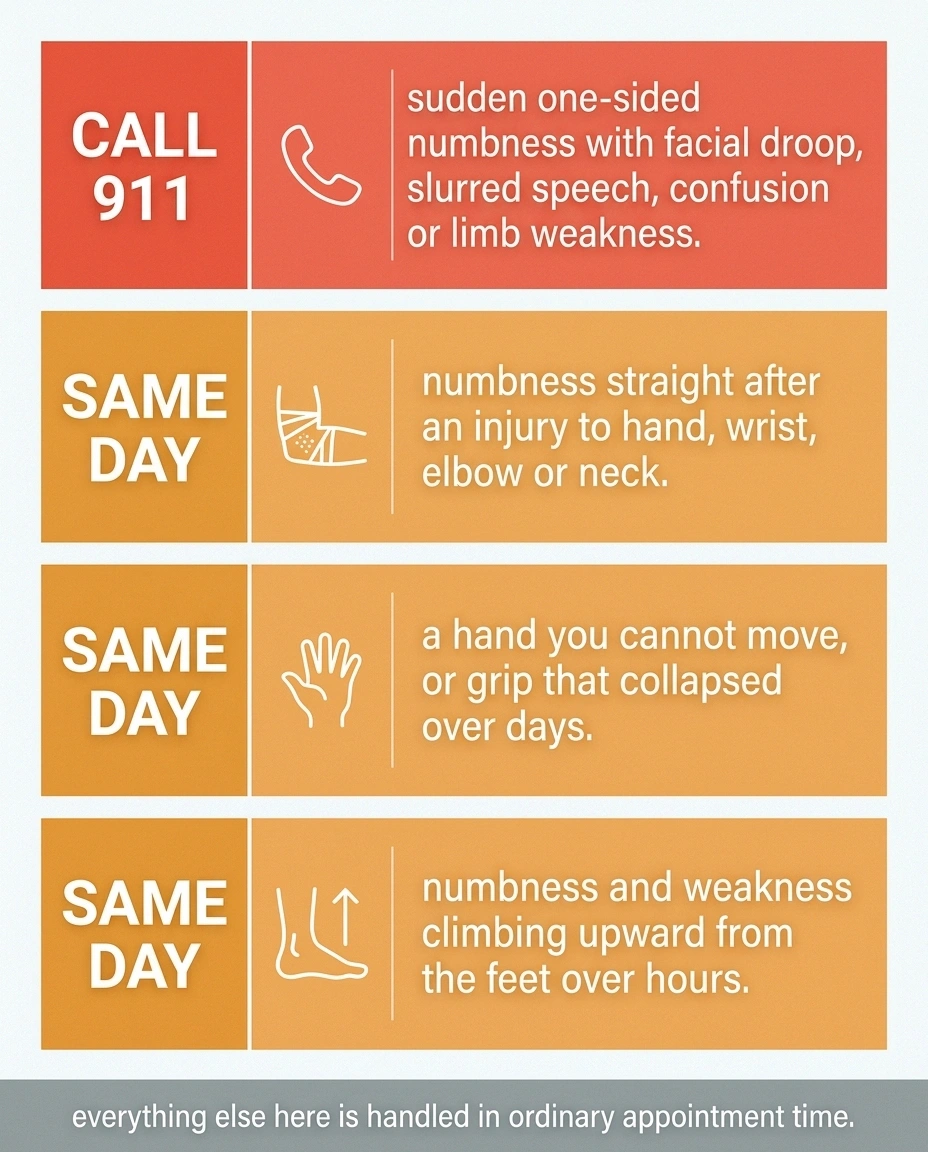
Almost all fingertip numbness is not urgent. A narrow set of presentations is, and they are easy to recognize because they arrive suddenly and they bring company.
The four situations that do not wait
- Call 911. Sudden one-sided numbness with facial droop, slurred speech, confusion, or limb weakness. Stroke treatment windows are measured in hours, and driving yourself forfeits them.
- Same day. Numbness immediately following an injury to the hand, wrist, elbow, or neck.
- Same day. A hand you cannot move, or grip strength that has collapsed over days rather than months.
- Same day. Numbness and weakness climbing upward from the feet over hours to days.
Nothing else on this page belongs in that category. Gradual, symmetric, position-related numbness is handled in ordinary appointment time, and the rest of this article is written on that assumption.
Numbness that begins abruptly on one side of the body, especially with a drooping face, slurred speech, confusion, or weakness in the arm or leg, is a stroke presentation until proven otherwise. That is an ambulance, not an appointment, and not a wait-and-see.
Numbness immediately after an injury to the hand, wrist, or neck, numbness with a hand you genuinely cannot move, or rapidly spreading numbness and weakness climbing from the feet upward over hours to days all warrant same-day evaluation rather than a scheduled visit.
Everything else on this page can be handled in ordinary time.
What to Bring to the Appointment
Appointments for this go badly when the patient describes a vague sensation and well when the patient brings observations. Write these down before you go.
Copy this onto one index card
Add one thing most people skip: trace the numb area onto a printed outline of a hand and hand the drawing over. It removes the guesswork from a description that is genuinely hard to put into words, and it gives the clinician a record to compare against at your next visit.
Which fingers, specifically, on which hand. Whether the palm is involved. Whether your feet were affected first, and roughly when. Whether it is constant or comes and goes. What brings it on and what makes it stop. Whether anything wakes you at night. Whether you have noticed weakness, dropped things, or seen muscle thinning. What you drink. Every medication and supplement, including over-the-counter reflux medication, which is relevant to B12 more often than people expect.
Tracing the numb area on a printed outline of a hand and handing that over is unreasonably effective. It takes the guesswork out of the description entirely.
Tests Your Doctor May Order

The workup is usually straightforward. Blood work comes first: fasting glucose and A1C, B12 with methylmalonic acid if the B12 sits in the low-normal range, thyroid function, kidney function, a complete blood count, and inflammatory markers depending on the history.
If a compressed nerve is suspected, nerve conduction studies and electromyography measure how well signals travel and where they slow down. These are the tests that confirm carpal tunnel and distinguish it from a neck problem or a broader neuropathy. They are uncomfortable rather than painful, and they take under an hour.
Small fiber involvement does not always show on those studies, because the fibers involved are too small to register. That is where a skin biopsy or specialized testing can help, and it is a common reason people are told their nerve study was normal while their symptoms are obviously real. Our article on small fiber neuropathy covers that gap. If you want to know what to expect from the process overall, our guide to neuropathy diagnosis and the tests involved walks through the sequence.
What Helps While You Sort It Out

Waiting for answers does not have to be passive. A few things are worth doing regardless of which category you land in.
If the pattern looks like carpal tunnel, a neutral wrist splint worn overnight costs very little and works for many people. Adjust the positions that provoke it: raise the keyboard height, stop resting your elbow on the car door, put the phone on speaker.
If blood sugar is anywhere in the picture, that is the intervention with the most evidence behind it. Glucose control does more for nerve outcomes than any supplement on the market.
Protect the hands you have. Reduced sensation plus hot pans, sharp knives, and power tools is how minor accidents happen. Gloves for yard work, mitts for the oven, and a habit of looking at your hands before bed cost nothing.
And be measured about supplements. B12 corrects a genuine deficiency and does nothing if you are not deficient. High-dose B6 taken casually can itself cause neuropathy, which is one of the crueler facts in this field. If you want an honest read on what has evidence behind it, our review of neuropathy supplements and what the research supports is the place to start.
Frequently Asked Questions
Why are only my fingertips numb and not my whole hand?
Fingertips are the furthest point from the nerve cell bodies that maintain them, so in length-dependent neuropathy they lose sensation first while the rest of the hand still feels normal. In compression problems like carpal tunnel, the fingertips carry the densest concentration of sensory endings, so they register the loss most obviously even though the nerve is being pinched at the wrist.
Does numbness in the fingertips always mean neuropathy?
No. The majority of fingertip numbness comes from pressure on a nerve rather than damage to it, most often at the wrist or the elbow, and it resolves when the pressure is relieved. Neuropathy is more likely when the numbness is constant, affects both hands symmetrically, ignores the boundaries between individual nerve territories, and followed months or years of foot symptoms.
Which vitamin deficiency causes numb fingertips?
B12 is the most common one, and it is worth testing because it is fully correctable when caught early. Deficiencies in B1, folate, and copper can produce similar symptoms. Vitamin B6 is unusual in that both too little and too much can cause nerve damage, so high-dose B6 supplements should not be taken without a reason.
Can carpal tunnel and peripheral neuropathy happen at the same time?
Yes, and the combination is common. Nerves already affected by a systemic neuropathy tolerate compression poorly, so people with diabetes develop carpal tunnel at higher rates than people without it. Treating the compression can improve symptoms substantially even when the underlying neuropathy remains.
How long does it take for numb fingertips to go away?
Positional numbness resolves in seconds to minutes. Numbness from a compressed nerve treated with splinting or activity changes often improves over weeks. Numbness from nerve damage depends entirely on the cause and how early it is addressed. A B12 deficiency caught quickly can improve within months, while damage from years of uncontrolled blood sugar improves slowly if at all, though progression can usually be halted.
Is numbness in the fingertips a sign of a heart problem?
Fingertip numbness on its own is not a typical cardiac symptom. Arm numbness combined with chest pressure, shortness of breath, jaw or back discomfort, nausea, or a cold sweat is a different situation and warrants emergency evaluation immediately.
Why do my fingertips go numb at night?
Night symptoms lean toward a compressed nerve rather than a damaged one, though they do not settle the question by themselves. Most people sleep with their wrists curled or their elbows folded, which narrows the tunnels those nerves pass through, and fluid redistributes when you lie flat and adds to the pressure. Waking and shaking the hand out for relief is one of the most characteristic features of carpal tunnel syndrome. Peripheral neuropathy also tends to get louder at night, so the timing on its own is a clue rather than an answer.
Can anxiety cause numb fingertips?
Hyperventilation during acute anxiety changes blood carbon dioxide levels and can produce tingling and numbness in the fingers and around the mouth, typically on both sides and lasting minutes. That mechanism is real but it does not cause persistent daily numbness, so ongoing symptoms should still be evaluated rather than attributed to stress.
About the Author