
A woman changes her pillowcase most mornings because the back of her head soaks it through. She keeps a second shirt in the car. Restaurant meals mean a napkin dabbing at her hairline before the plates arrive, and she has stopped wearing certain colors entirely.
The same woman puts lotion on her feet every night because the skin there cracks along the heels no matter what she does. Her feet have not been damp in years.
Those two facts sound like separate problems. A dermatologist might treat the first. A podiatrist might treat the second. But they are one finding, described from two ends, and the nerve damage underneath explains both at once. Understanding that connection changes what you ask for, and it changes which half of the problem you take seriously.
Because it is not the drenched collar that ends up in a wound clinic.
Two Complaints, One Nerve Map
Sweating is not a single system that dials up or down across the whole body. It is a distributed network, and every region of your skin is served by its own set of nerve endings arriving from its own distance.
When nerve damage follows a length-dependent pattern, meaning the longest fibers fail first, the map of your sweating changes in a predictable shape. The feet go quiet. Then the lower legs. The thighs, the trunk, the neck, the scalp and the face still have working supply lines, because the nerves reaching them are much shorter.
Your body still needs to regulate its temperature. It has not lost that requirement, only lost some of the surface area it used to accomplish it with. So the regions that still work take on more of the job, and they take it on visibly.
The result is the complaint that brings people in: soaked head, neck and upper back, paired with feet that never sweat at all. Clinicians see it often enough in longstanding diabetes that it functions as a pattern worth recognizing rather than a coincidence. It is one of the more common presentations of autonomic neuropathy, and it is also one of the most consistently misread, because the person experiencing it almost always describes the wet half.
Sweat Glands Run on the Smallest Nerves You Have
Here is the part that makes this an early sign rather than a late one.
Sweat glands are controlled by unmyelinated sympathetic C-fibers. These are the thinnest nerve fibers in the body, without the fatty insulation that wraps larger nerves, and they are among the first casualties in most kinds of peripheral nerve damage. They belong to the same population of small fibers responsible for carrying temperature and certain kinds of pain.
That shared vulnerability has a practical consequence. Changes in sweating frequently appear before the autonomic symptoms that get more attention, such as blood pressure drops on standing, digestive slowing, or heart rate irregularities. Those involve nerves running to organs, on different timetables. Sudomotor fibers, the ones going to sweat glands, are out at the very end of the longest routes, and they report trouble early.
This also explains why sweating changes often accompany burning, tingling and temperature confusion in the feet rather than arriving separately. They are the same fibers failing. If your feet have stopped sweating and also feel hot when they are cool to the touch, that combination points toward small fiber involvement more strongly than either observation alone.
Diabetes is the most common driver, but far from the only one. Small fiber damage also follows from certain autoimmune conditions, thyroid disease, B12 deficiency, some chemotherapy agents, amyloidosis, Parkinson's disease and a long list of less common causes. A meaningful fraction stays unexplained even after thorough workup.
Why the Top Half Works Overtime
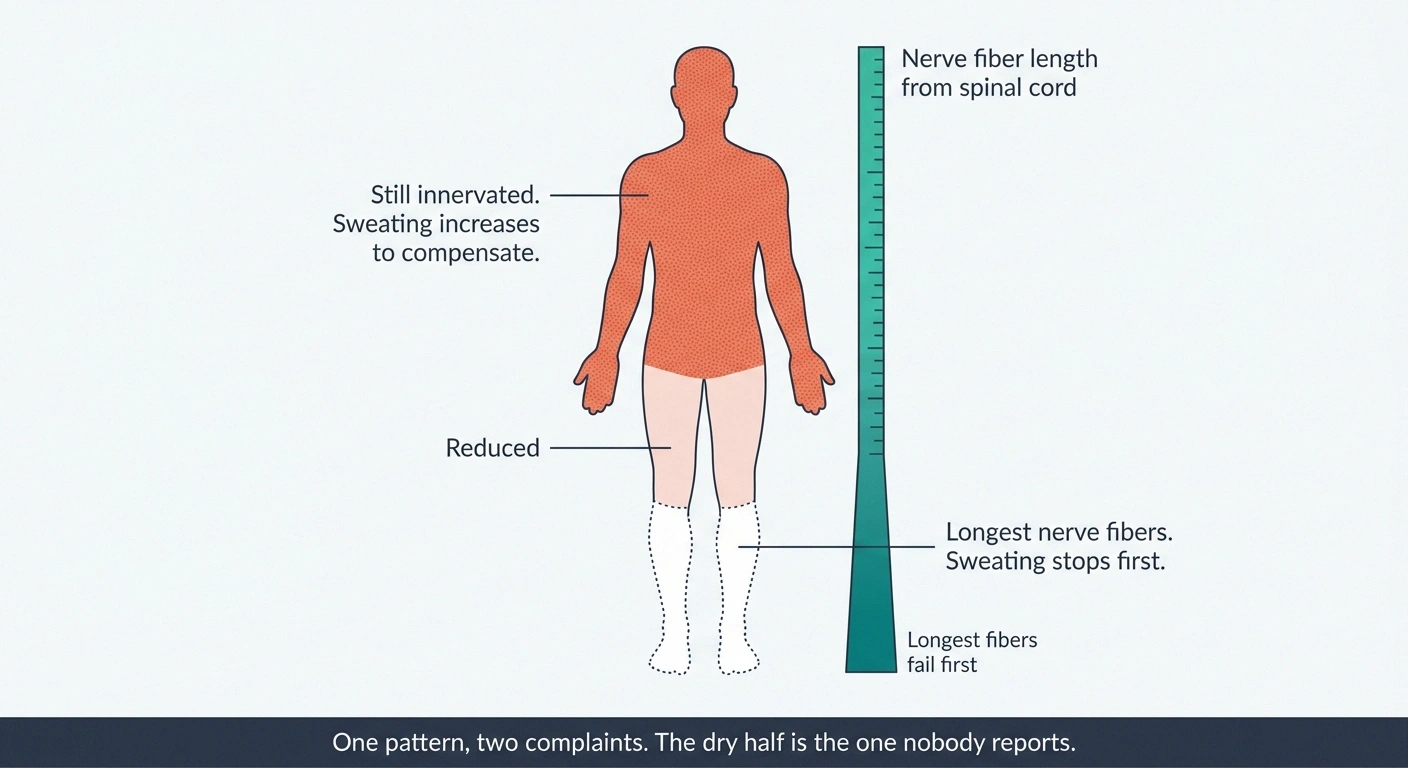
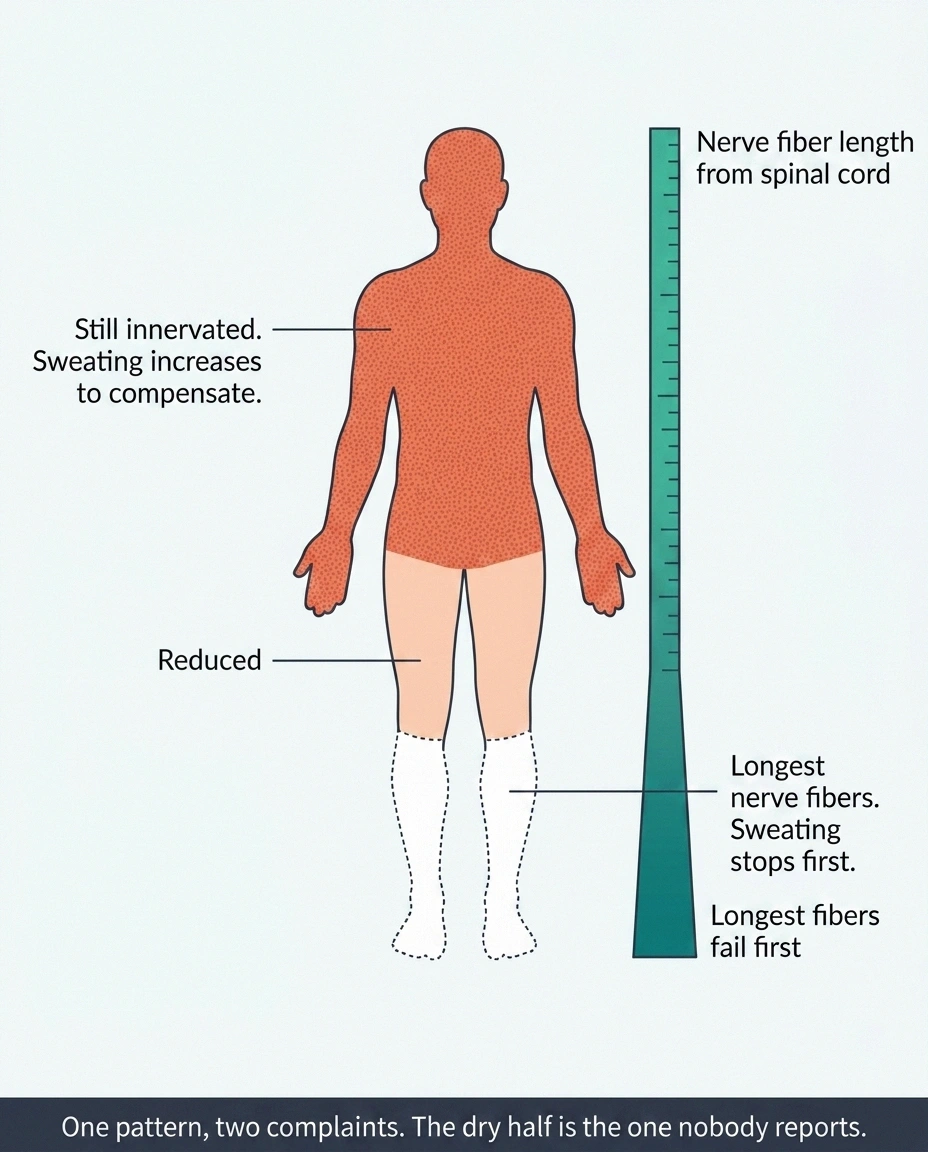
Compensatory sweating is a real and documented phenomenon, not an impression people have. When one region of skin loses its ability to sweat, the regions that retain it produce more than they otherwise would.
You have less cooling surface than you used to
Losing sweating across both legs removes a real share of your body's ability to shed heat. The upper body compensating hard can disguise that, because it feels like you are sweating plenty. Four adjustments that matter more for you than for the people around you:
- Move outdoor tasks to before 10am or after 6pm. Midday heat load is the specific problem, not heat generally.
- Wet a cloth for the back of the neck rather than the face. Evaporative cooling works best over large surface blood flow, and the neck is doing the work your legs cannot.
- Drink on a schedule, not on thirst. Thirst sensation is unreliable in older adults and heavy upper-body sweating loses more fluid than it appears to.
- Treat feeling unwell in heat as a stop signal. Headache, nausea or confusion in warm conditions warrants getting cool immediately rather than pushing through.
If a clinician has suggested an anticholinergic to reduce sweating, this is the specific tradeoff to raise: those medicines reduce sweating everywhere, including the surfaces still doing the cooling.
The logic is straightforward once you think about the total task. Your body needs to shed a certain amount of heat. Evaporation from skin is its primary tool. Take away the surface area of both feet and both lower legs, and the remaining skin has to do the same work across less territory. It responds by sweating harder.
What people notice, in rough order of how often they mention it:
- Scalp and hairline soaking during ordinary activity or mild warmth
- Face and forehead beading in situations that never previously caused it
- Neck and upper back wetting clothing through, often the first thing others see
- Night sweating concentrated on the head and pillow rather than the whole bed
- Hands becoming damp in some people, staying dry in others depending on where the damage has reached
Nighttime deserves a note of its own. Sweating overnight, particularly around the head, is a common complaint in this pattern and it is one of the reasons people with nerve damage sleep badly. It layers onto the other reasons symptoms intensify after dark, and the combination of a wet pillow and burning feet is a genuinely difficult thing to sleep through.
There is also a heat-tolerance consequence that rarely gets discussed. A person who has lost sweating across both legs has lost real cooling capacity. Hot weather, exertion and hot rooms become harder to manage, and the risk of overheating goes up in a way that is easy to underestimate because the upper body is working so visibly hard.
The Dry Feet Are the Dangerous Half
Almost nobody comes in complaining that their feet stopped sweating. It is not uncomfortable. It does not stain a shirt. Most people register it, if at all, as their skin simply getting drier with age.
Sixty seconds, done sitting down, every night
This is the routine that does the work sweating used to do. Attach it to something you already do at the same time each night, because a habit anchored to an existing one survives and a free-floating intention does not.
- Look at the soles. Use a hand mirror on the floor or against a wall. Do not rely on feel, since feel is exactly what is compromised.
- Check the heel margins and the ball of the foot. These are where fissures open first in skin that no longer sweats.
- Run a finger between each toe. Looking for softness, whiteness or dampness, which points to fungal trouble rather than dryness.
- Apply emollient to tops and soles. A thick cream or ointment holds better overnight than a thin lotion. Socks afterward keep it on the skin instead of the sheets.
- Leave the space between the toes bare and dry. Cream there traps moisture and creates the opposite problem.
Anything new that is open, red, warm, draining or has not improved in two days gets seen. Not next month, and not after you have tried something on it first.
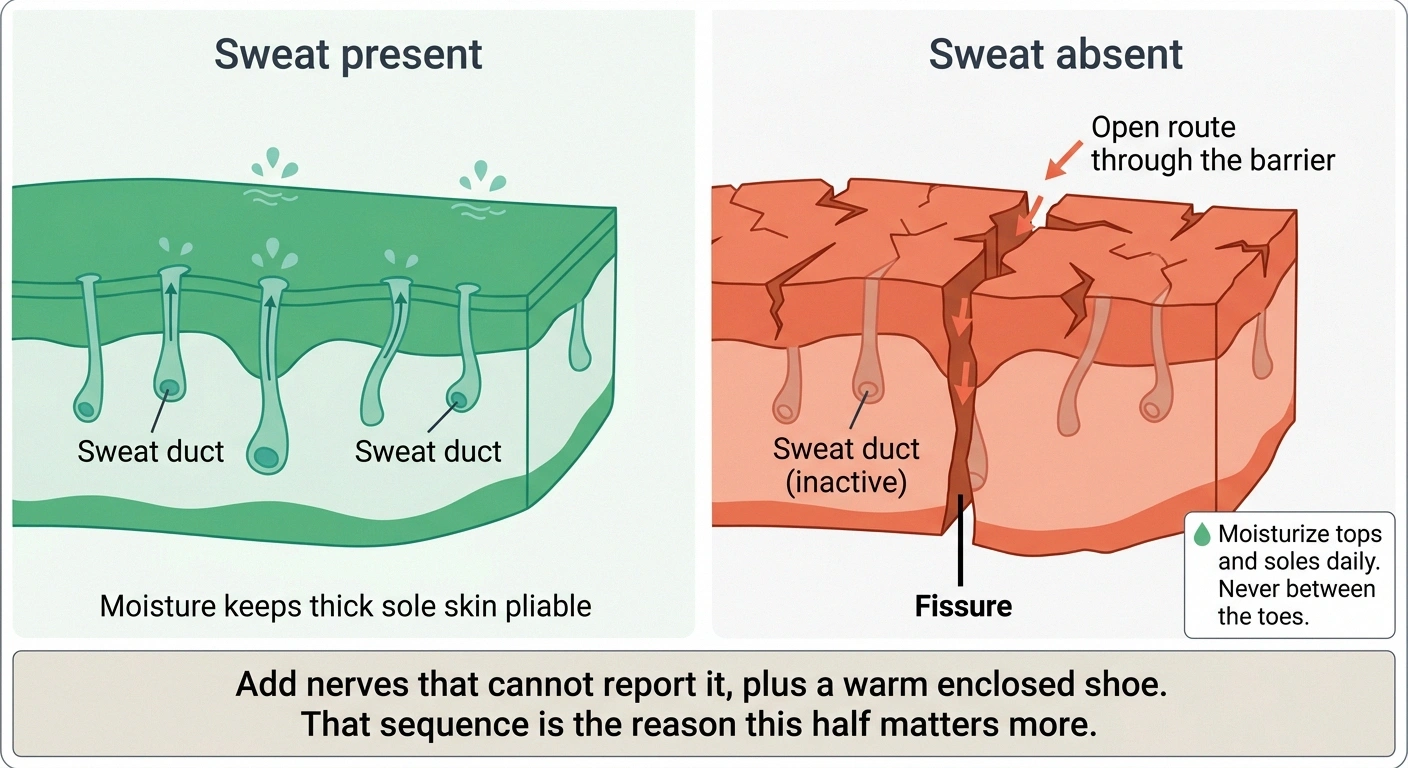
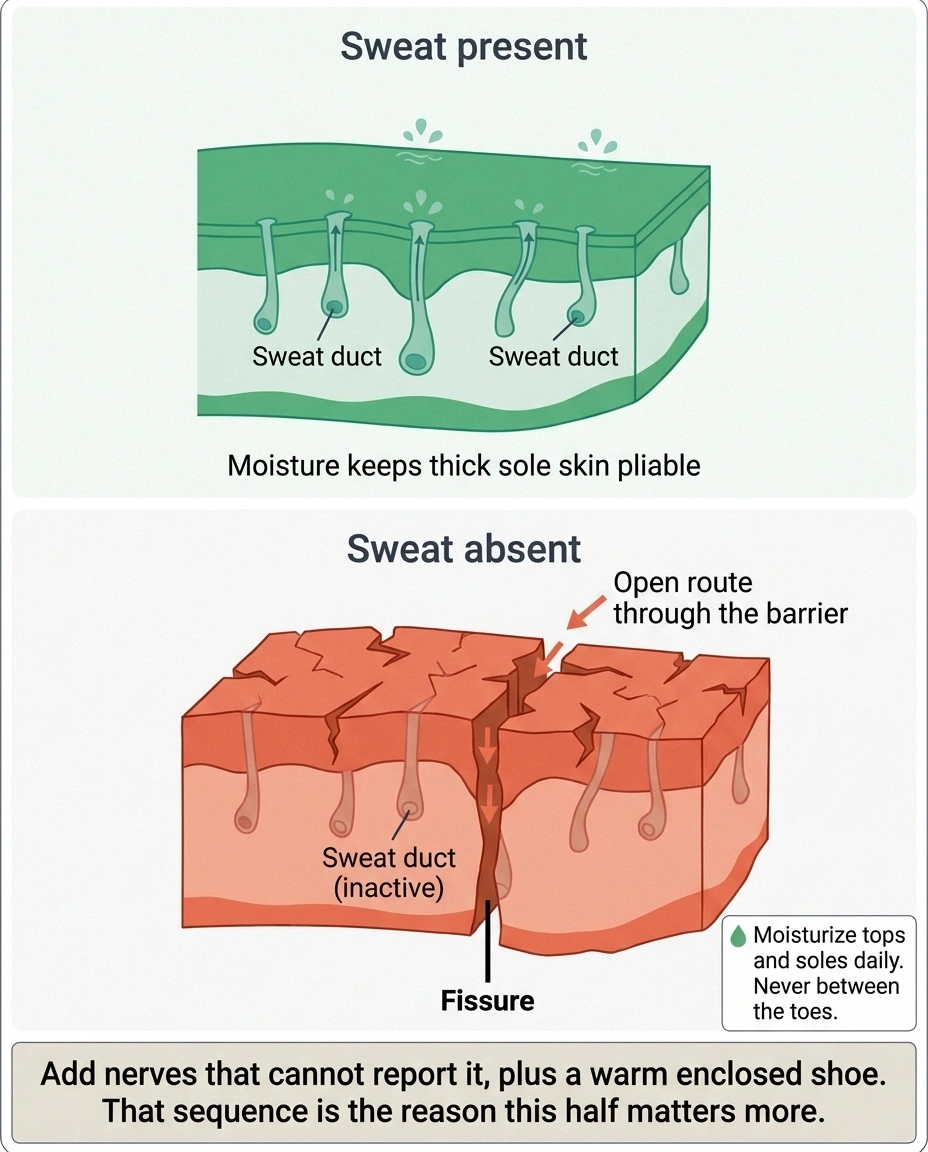
That silence is the problem, because sweat is doing structural work down there.
Perspiration is what keeps the thick skin of the sole pliable. Without it, the skin dries, hardens, and eventually splits, most often along the heel margin and under the ball of the foot. Those splits are called fissures, and they are not cosmetic. A fissure is an opening through the skin barrier.
Now combine that with the other thing happening in the same feet. The nerves that would normally report a crack, a rub, a blister or a stone in the shoe are the ones failing. So the opening exists in tissue that cannot raise an alarm about it, on a body part that spends the day in a warm enclosed shoe. That sequence is the beginning of most serious foot complications, and it starts with an absence that produces no symptoms at all.
This is why the response to dry, cracking feet in someone with nerve damage is not the same as the response in someone without it. Moisturizing is genuinely useful and should be done daily, on the tops and soles but not between the toes where trapped moisture encourages fungal growth. Alongside that, a daily visual check matters far more than it does for most people, and the full routine for protecting feet that cannot feel is worth building into an actual habit rather than an intention.
Sweating While You Eat

One pattern is distinctive enough to be worth naming separately, because people find it baffling and often do not mention it.
Gustatory sweating means sweating triggered by food. Within a minute or two of the first bite, sweat breaks out across the forehead, scalp, face and sometimes the neck and upper chest. In some people the trigger does not even require eating. The smell of something cooking, or occasionally the thought of a particular food, sets it off.
Certain foods come up repeatedly in reports: strong cheeses, chocolate, vinegar, pickles, citrus and spicy dishes. But the specific trigger varies enough between individuals that a food diary is more useful than any published list.
The leading explanation involves misdirected repair. After autonomic nerve fibers are damaged, regrowing fibers do not always find their original destination. Fibers that were meant to serve salivary glands can end up connected to sweat glands instead. The instruction to salivate arrives, and the tissue sweats in response, because the wiring now goes somewhere it was never intended to go.
What matters practically is distinguishing this from a different cause of sudden sweating around mealtimes: low blood sugar. Gustatory sweating begins with food and involves the face and scalp specifically. Hypoglycemic sweating tends to arrive before eating rather than during it, appears alongside shakiness, a racing heart or confusion, and resolves once sugar comes up. The two get conflated regularly, which leads directly into the most important part of this topic.
The Warning Signal You Can No Longer Read
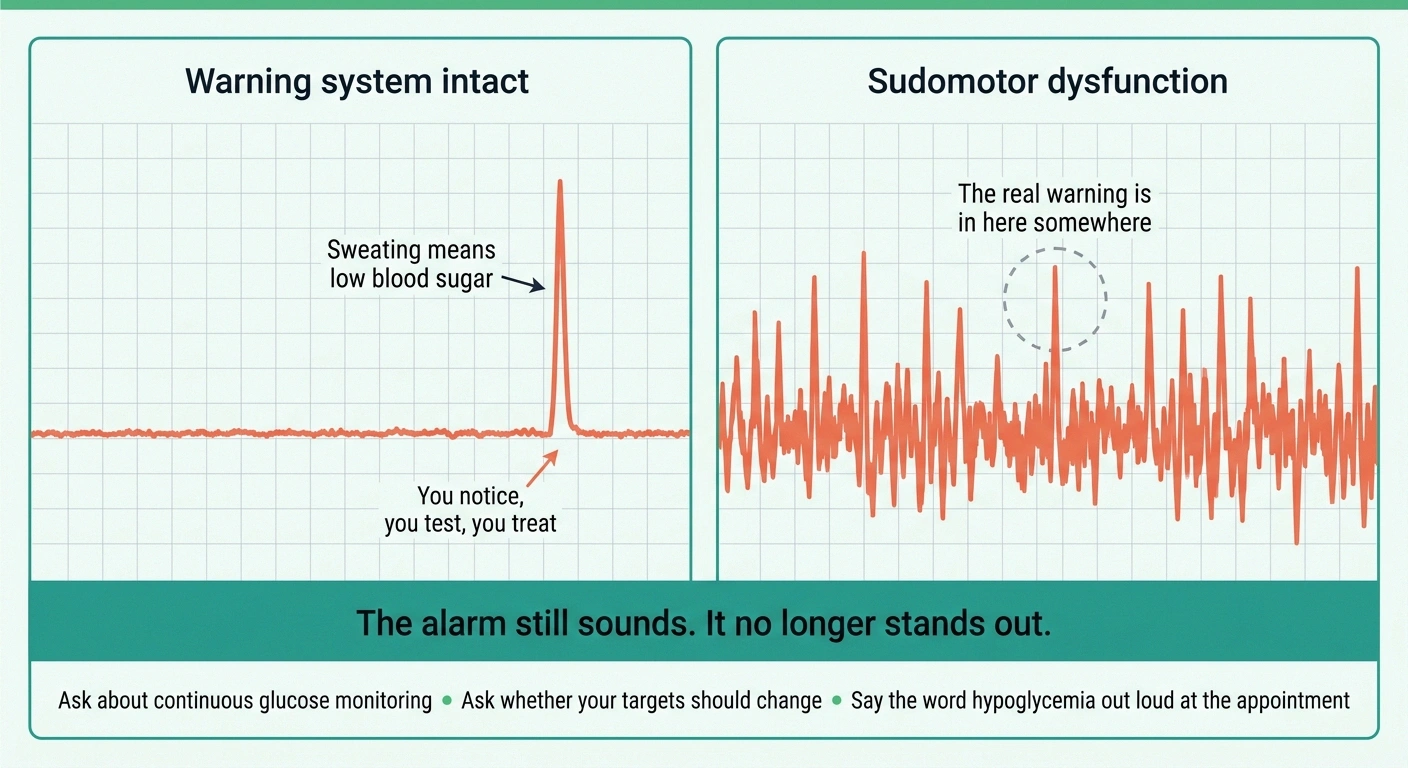
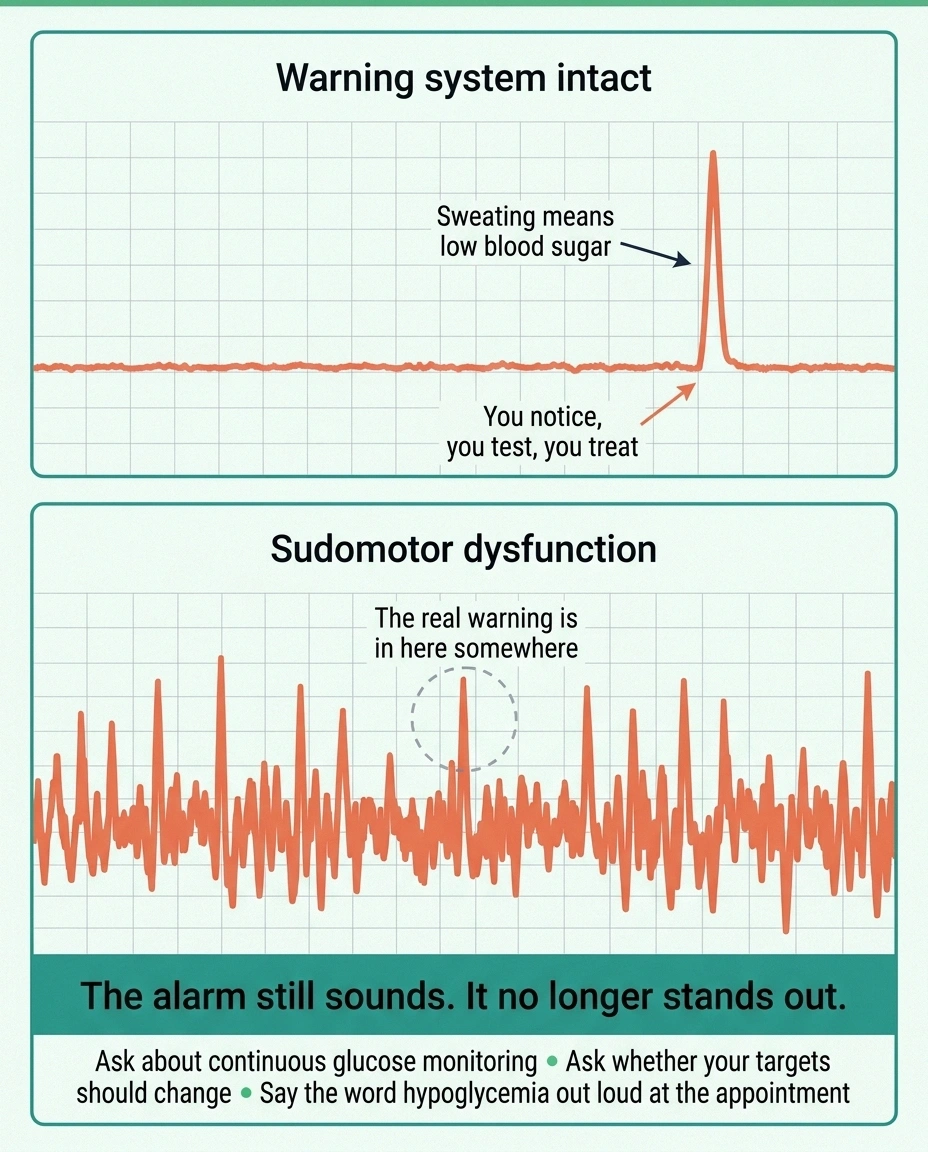
Sweating is one of the body's primary alarms for dangerously low blood sugar. For a great many people with diabetes, breaking out in a cold sweat is the signal that prompts them to test and treat, sometimes before any other symptom registers.
Three different sweats, three different responses
Only one of these needs action within minutes. Being able to sort them in the moment is the skill worth having.
| Which one | Timing and location | What comes with it | What to do |
|---|---|---|---|
| Low blood sugar | Any time, often before a meal or overnight. Cold and clammy, whole body | Shakiness, racing heart, hunger, confusion, irritability | Test and treat now |
| Gustatory | Within a minute or two of eating. Face, scalp, neck | Nothing else. You feel entirely normal otherwise | Note the food. Raise it at a visit |
| Compensatory | With warmth or effort, and often at night. Head, neck, upper back | Dry feet and lower legs at the same time | Manage comfort, protect the feet |
If you take insulin or a sulfonylurea and cannot reliably tell the first row from the third, that uncertainty is itself the reason to ask about continuous glucose monitoring.
Autonomic neuropathy interferes with that alarm in two separate ways, and they compound each other.
The first is direct. Autonomic damage can blunt the adrenaline-driven warning symptoms of hypoglycemia, a well-described problem called hypoglycemia unawareness. Blood sugar falls, and the trembling, pounding heart and sweating that should follow do not arrive, or arrive so late that thinking is already impaired.
The second is a signal-to-noise problem, and it is less recognized. Someone who sweats heavily many times a day for sudomotor reasons has lost the ability to treat sweating as informative. When the signal is present constantly, its appearance stops meaning anything. The alarm still sounds; it just no longer stands out from the background.
If you take insulin or a sulfonylurea and you have developed heavy unexplained sweating, this is worth raising directly and by name at your next appointment. It is one of the strongest arguments for continuous glucose monitoring, which replaces a symptom you can no longer trust with a number you can. It may also change what your blood sugar targets should be, since the usual targets assume the warning system is intact.
Before You Blame the Nerves
Excessive sweating has a long list of causes, and several of them matter more urgently than neuropathy does. Attributing it to nerve damage without checking the alternatives is a mistake worth avoiding.
Worth ruling out first:
- Thyroid overactivity, which produces sweating alongside weight loss, tremor, heat intolerance and a fast pulse
- Menopause and perimenopause, where hot flashes and night sweats have their own well-understood cause and their own treatments
- Medications, including many antidepressants, opioids, some diabetes drugs and certain hormone treatments
- Infection, particularly when fever, weight loss or feeling generally unwell accompany the sweating
- Low blood sugar itself, before anything else is considered
- Anxiety and panic, which produce genuine sweating that responds to entirely different treatment
One combination deserves emphasis rather than a bullet. Drenching night sweats occurring alongside unexplained weight loss, persistent fever or new swollen lymph nodes are not a neuropathy conversation. That pattern requires evaluation on its own terms and promptly.
When the alternatives are cleared and the pattern still fits, there are tests that measure sweating directly. QSART, the quantitative sudomotor axon reflex test, measures the sweat response at specific sites and shows whether the small fibers supplying them are working. Thermoregulatory sweat testing maps sweating across the whole body surface and produces a visual picture of exactly which regions have gone quiet. Used together they can locate where along the pathway the damage sits.
The reason these exist matters: standard nerve conduction studies measure large fibers and come back completely normal in pure small fiber disease. A person can have significant sudomotor damage and a clean EMG. If you have been told your nerve tests were normal while your symptoms continued, that gap is worth understanding when reviewing what each neuropathy test can and cannot detect.
What Actually Helps, and What Cannot Be Fixed
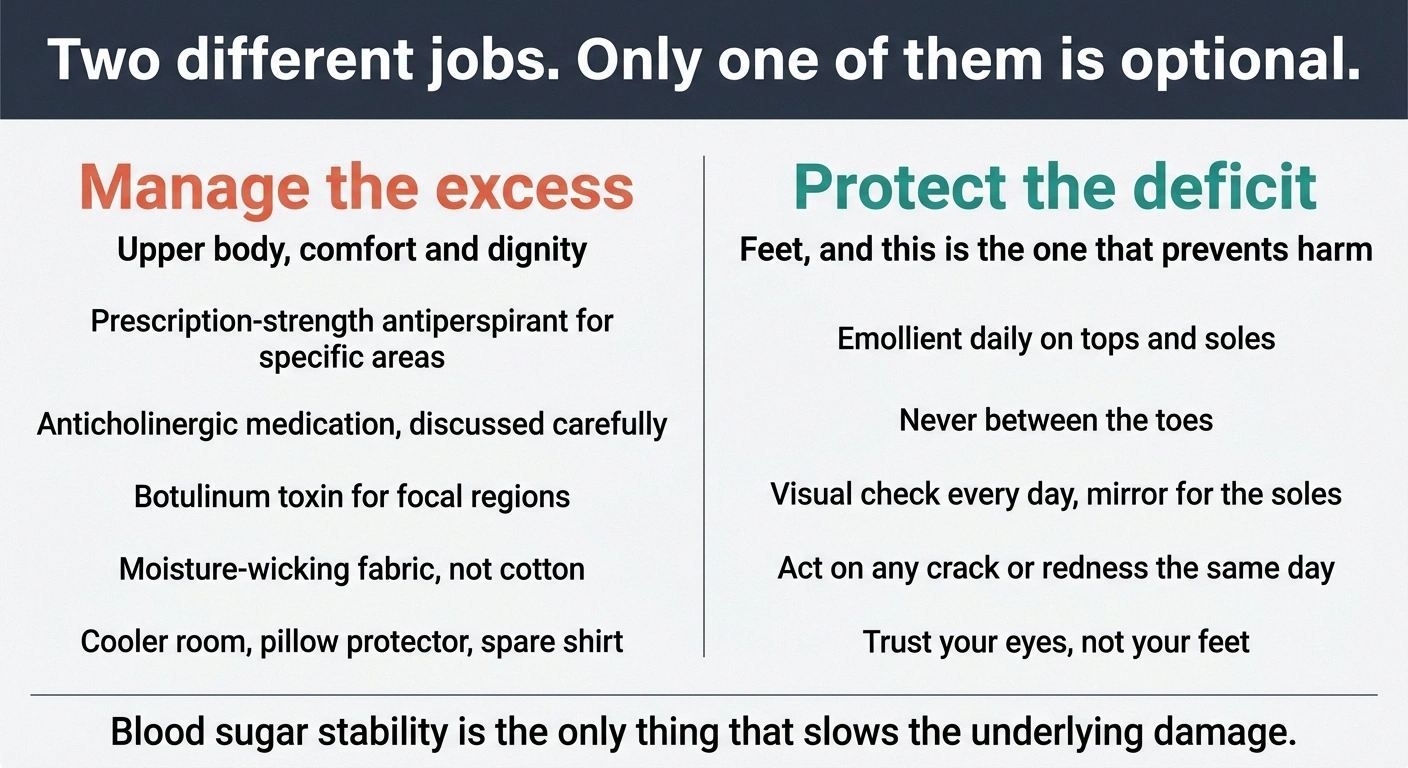
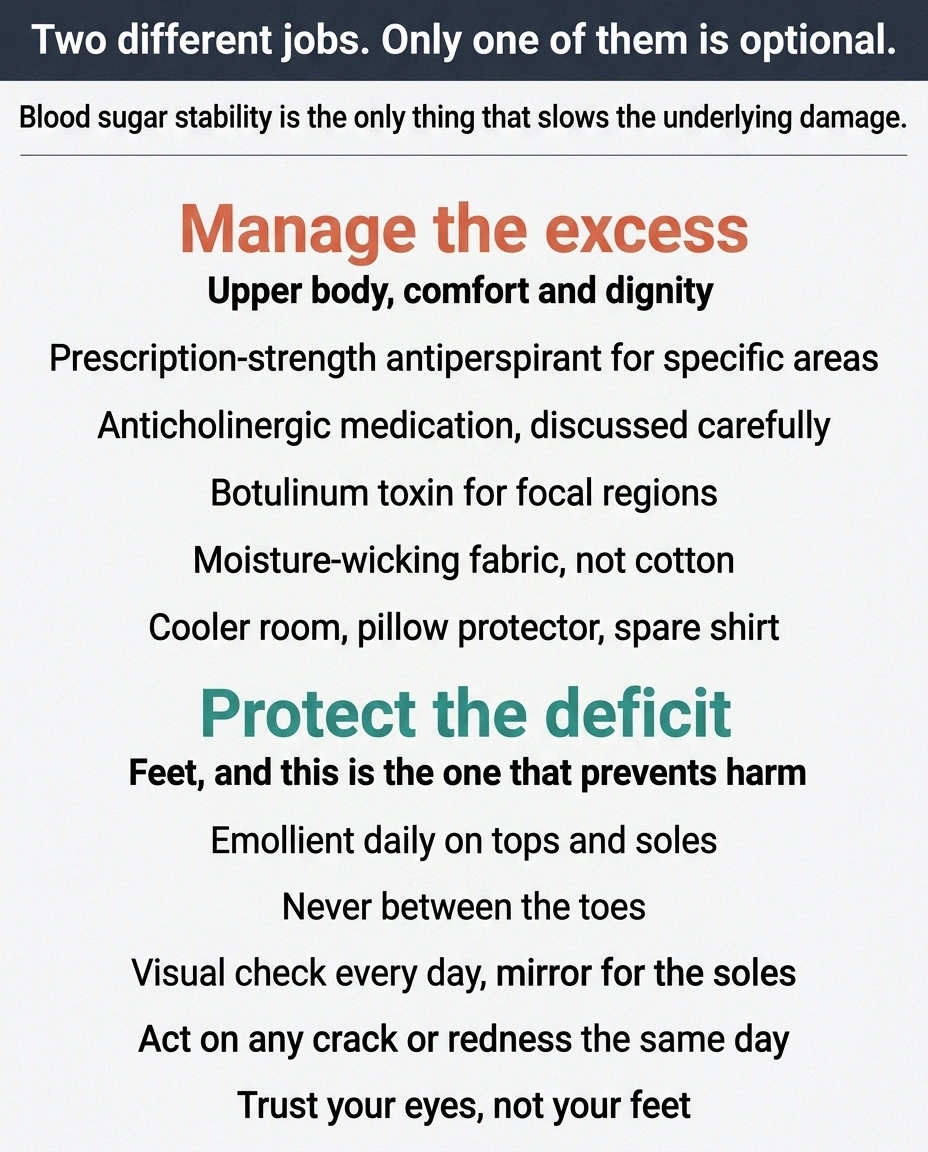
Two honest statements up front. Blood sugar stability is the only intervention that addresses the underlying nerve damage rather than the symptom, and it works slowly. And the lost sweating in your feet cannot currently be restored. There is no treatment that brings sudomotor function back once those fibers are gone.
Two weeks of notes beats twenty minutes of describing it
Sweating is hard to describe from memory and easy to dismiss without a record. Five columns on a phone note or a folded index card, filled in for fourteen days, changes the conversation from an impression into data.
- Time
- Clock time only. Patterns clustered around meals, around 3am, or around specific medication doses are the ones that mean something.
- Where on the body
- Scalp, face, neck, upper back, hands, whole body. The distribution is the diagnostic detail, more than the amount.
- What preceded it
- Food and which food, warmth, exertion, stress, or nothing identifiable. Nothing identifiable is itself a useful entry.
- Anything alongside it
- Shakiness, racing heart, dizziness on standing, confusion. This column is what separates a nerve problem from a blood sugar problem.
- Glucose reading, if you took one
- Even a handful of readings taken during episodes settles the question faster than any description will.
Bring the state of your feet to the same appointment. The two findings belong in one conversation, and separating them across two specialists is how the more important half gets lost.
That leaves managing the excess on top and protecting the deficit below.
For the excessive sweating, the options a clinician may discuss include prescription-strength aluminium chloride antiperspirants applied to specific areas including the scalp, anticholinergic medications such as glycopyrrolate in oral or topical form, botulinum toxin injections for focal regions like the scalp or underarms, and iontophoresis for hands. Anticholinergics reduce sweating everywhere, which is worth weighing carefully when parts of your body have already stopped sweating and heat tolerance is already reduced.
Practical adjustments carry real weight here and cost nothing. Moisture-wicking fabrics rather than cotton next to the skin. A small towel kept where you sit. Layers that come off without a whole outfit change. A cooler bedroom and a pillow protector. Advance notice given to people you see regularly, which removes the social weight faster than any product does.
For the feet, the routine is short and unglamorous: emollient daily on tops and soles, never between the toes, a visual inspection every day using a mirror for the soles, and prompt attention to any crack, redness or opening rather than a wait-and-see approach. Because the sensory nerves are compromised too, pay attention to what your eyes report instead of what your feet do, since the feedback that would normally prompt action is exactly what has been lost. That same principle governs how nerve damage progresses over time, and it is why monitoring beats waiting.
Frequently Asked Questions
Why do I sweat so much on my head but my feet are completely dry?
This is the classic distribution in length-dependent autonomic neuropathy. The nerve fibers controlling sweat glands in your feet are the longest in your body and fail first, so those glands stop working. Your body still needs to release the same amount of heat, so the regions with intact nerve supply, mainly the head, neck and upper trunk, increase their output to compensate. Both halves come from the same nerve damage, which is why treating them as separate conditions rarely resolves either one.
Can autonomic neuropathy cause night sweats?
Yes, and sweating concentrated around the head and upper body at night is a recognized pattern. It is worth distinguishing from two other causes, though. Nighttime low blood sugar produces sweating alongside a racing heart, unsettled sleep and sometimes a headache on waking, and needs different action. Drenching night sweats with fever, weight loss or swollen glands point somewhere else entirely and should be evaluated promptly rather than attributed to nerve damage.
Will my feet ever sweat normally again?
Once sudomotor nerve fibers have degenerated, there is currently no treatment that restores sweating to that skin. Stabilizing blood sugar or addressing the underlying cause can slow further loss, and some people with early damage see partial recovery, but for established anhidrosis the realistic goal is management rather than reversal. Daily moisturizing and daily foot inspection do the work that sweating used to do, which is keeping the skin intact and catching breaks before they become wounds.
Is excessive sweating dangerous by itself?
The sweating itself is mostly a quality-of-life problem rather than a medical danger, though heavy prolonged sweating can contribute to dehydration and to skin irritation in folds. The two genuine risks sit alongside it. The first is losing sweating as a usable warning sign of low blood sugar. The second is reduced heat tolerance, since a body that has lost the sweating surface of both legs cannot cool itself as effectively during hot weather or exertion.
Why do I sweat as soon as I start eating?
That pattern is called gustatory sweating and it is well described in diabetic autonomic neuropathy. It typically affects the face, scalp and neck within a minute or two of the first bite, and in some people it is triggered by smell or even the anticipation of food. The leading explanation is that autonomic nerve fibers regrowing after damage connect to sweat glands rather than to their original targets, so a signal meant to produce saliva produces sweat instead. Keeping a food diary is more useful than any general trigger list, since the specific foods vary widely.
Which doctor should I see about this?
Start with whoever manages your diabetes or your neuropathy, usually an endocrinologist or a neurologist, because the sweating is a symptom of the underlying nerve condition rather than a skin problem. A neurologist can arrange autonomic testing such as QSART or thermoregulatory sweat testing. A dermatologist becomes useful for treating the excessive sweating itself with antiperspirants, botulinum toxin or iontophoresis. A podiatrist is the right person for the dry, cracking feet, and that referral is the one people most often skip.
Do normal nerve conduction tests rule this out?
No, and this is a common source of confusion. Standard nerve conduction studies and EMG measure large myelinated nerve fibers. The fibers controlling sweat glands are small and unmyelinated, so they are invisible to those tests. A completely normal nerve conduction study is entirely compatible with significant sudomotor dysfunction. Detecting it requires tests built for the purpose, such as QSART, thermoregulatory sweat testing, or a skin biopsy measuring small fiber density.
About the Author