
A rubber band around the calf. A sock that isn’t there. An ace bandage somebody wrapped too tight and forgot to remove. A blood pressure cuff that never deflates. Shrink wrap. A garter. A thick invisible line just above the ankle.
Those are the descriptions people bring to a doctor’s office, and they arrive with a slightly apologetic tone, because the person saying them has usually already checked. They have pulled the sock down. They have looked. There is nothing there.
This sensation has a name in the clinical literature, where it gets called band-like constriction or a constrictive dysesthesia, which is a lot of syllables for something you could describe in four words. It is a common neuropathy symptom and a badly documented one. Search for it and you mostly find pages that list it in passing between numbness and tingling, then move on without explaining anything.
It deserves more than a bullet point, partly because the mechanism is genuinely satisfying once you see it, and partly because a tight band around the leg is one of the few neuropathy symptoms with a look-alike that needs a same-day phone call. Knowing which one you have is worth twenty minutes of reading.
There Is No Band
Start with the conclusion, because it changes how the rest of the article reads.
Sorting your own symptoms into two piles
Neurologists split neuropathy symptoms by whether the nerve is producing too much signal or too little. Most people have items in both columns at once, which is why a foot can be numb and loud on the same night. Knowing which pile a symptom belongs to predicts whether medication is likely to touch it, since the drugs used for nerve pain act on excess firing and do nothing for absent sensation.
- Additions: the nerve is firing when nothing is happening
- Band-like tightness. Burning. Pins and needles. Electric or stabbing jolts. Itching with nothing on the skin. The feeling of water running down the leg. Crawling. A sock or a pebble that is not there. These are the symptoms nerve-pain medication is aimed at.
- Subtractions: the nerve has gone quiet
- Numbness. Reduced sense of hot and cold. Not feeling the floor properly. Loss of the position sense that keeps you balanced with your eyes shut. These do not respond to those medications, and they are the half that carries injury risk, because skin that cannot report a blister will not report one.
Nothing is squeezing your leg. No swelling, no scar tissue, no tight tendon, no garment. The compression you can plainly feel is not happening anywhere in your leg. It is being generated inside the nerve itself and reported to your brain as though it were.
People find this either enormously reassuring or slightly maddening, and often both in the same minute. The reassuring part is that there is no damage accumulating under an invisible tourniquet. The maddening part is that a sensation this convincing has no physical object behind it, which makes it harder to explain to anyone who has not felt it.
It is also the reason nothing you do to your leg fixes it. Loosening the sock does not help, because the sock was never the problem. Massaging the spot does not help for long, because there is nothing there to release.
Why a Damaged Nerve Reports Pressure
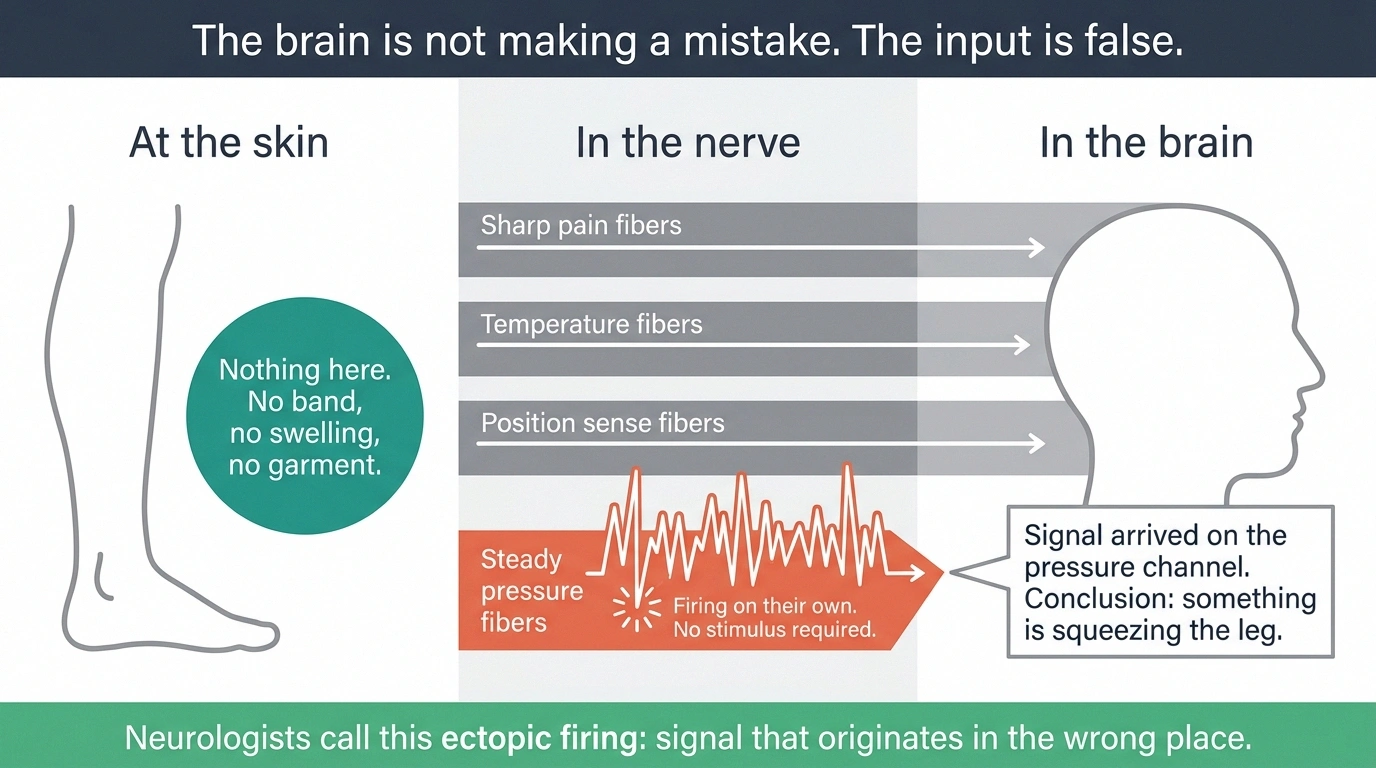
Sensory nerves are not passive wires. They generate electrical signals, and a healthy one only generates them when something real triggers it.
Damaged nerves lose that discipline. Injured sensory fibers become excitable and start firing on their own, with no stimulus at all. Neurologists call this ectopic firing, meaning signal originating in the wrong place. It is the same underlying process behind the burning, the pins and needles, the electric jolts and the phantom wetness that people with neuropathy describe. All of those are positive symptoms, meaning the nerve is producing too much signal rather than too little.
That distinction is useful. Numbness is a subtraction, a nerve that has gone quiet. A tight band is an addition, a nerve that has become noisy. The same leg often has both at once, which is why people say their foot is numb and painful in the same sentence and get puzzled looks.
So why pressure specifically, and not burning or stabbing?
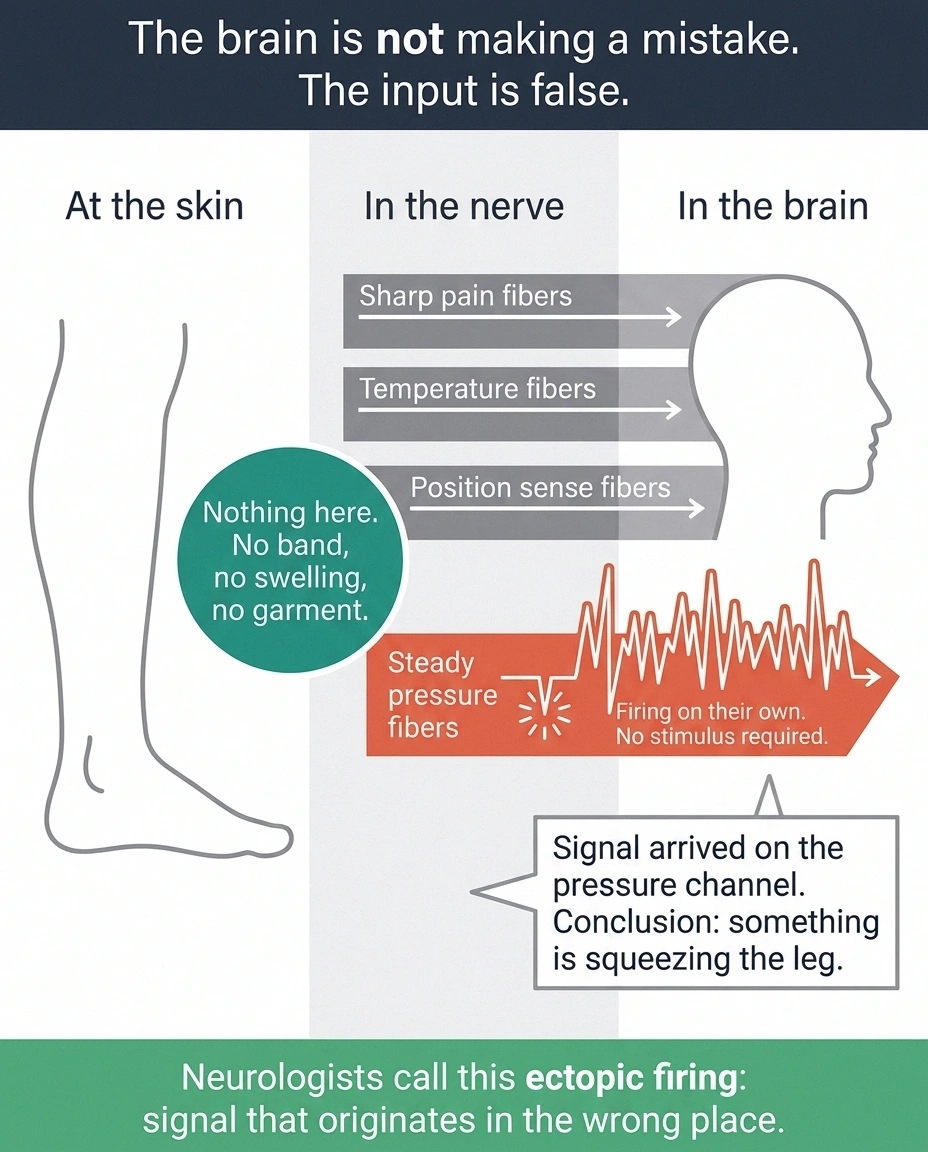
Because of which fibers are misfiring. Different nerve fiber populations carry different qualities of sensation. Some carry sharp pain. Some carry temperature. Some carry sustained mechanical deformation, the sensation of steady pressure against skin, the feeling of a waistband or a watch strap or a hand on your arm. When that particular population starts firing spontaneously, your brain receives traffic on the pressure channel and interprets it the only way it knows how. Something is pressing on the leg.
Your brain is not making a mistake. Given the input, it is drawing the correct conclusion. The input is simply false.
This is the same category of misfiring that produces the burning described in burning feet syndrome, and it frequently involves the same small nerve fibers discussed in small fiber neuropathy. Different quality of sensation, same broken machinery.
The Band Has an Edge, and the Edge Is a Map
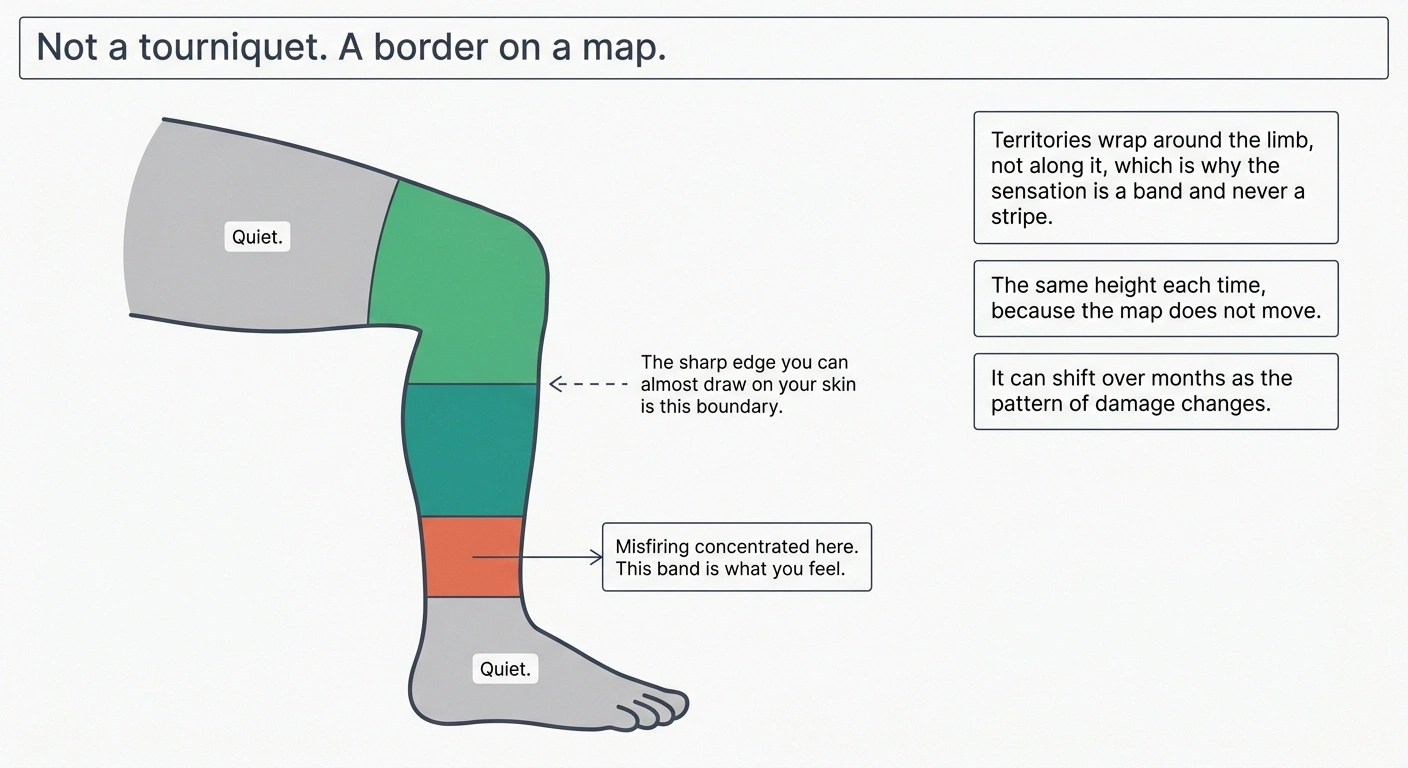
One detail people always mention: the band has a startlingly crisp top and bottom. Not a vague region of tightness, but a defined strip with an edge you could almost draw on the skin with a pen. Mid-calf. Just above the ankle. Across the ball of the foot. Around the arch.
That crispness feels like evidence of a physical object. It is actually evidence of anatomy.
Your skin is divided into territories, each served by a particular nerve or nerve root. The borders between those territories are reasonably consistent from person to person, and they run around the limb rather than along it, which is exactly the shape of a band. When misfiring is concentrated in one territory and quieter in the neighbouring ones, the boundary between them becomes the edge you feel.
So the band is not a tourniquet. It is a border on a map, made briefly visible by noise on one side of it.
This also explains why the band tends to sit at the same height every time it appears, why it can migrate slightly as the pattern of damage shifts over months, and why people with length-dependent neuropathy usually report it lower down first, then higher up over years. The progression follows the same route as the rest of the symptom set, described in the overview of the stages of neuropathy.
Why It Is Worse at Night
Almost everyone reports the same daily rhythm. Barely noticeable during a busy morning. Unmistakable in the evening. At its loudest in bed.
Two things are happening.
The first is competition. During the day your nervous system is handling a flood of real sensory input: the floor under your feet, shoes, movement, temperature, the general business of being upright. Spurious signal from a damaged nerve has to compete with all of that for attention, and it frequently loses. Lie down in a quiet dark room and the competition disappears. The signal has not increased. The background has dropped away.
The second is attention itself. There is nothing else to think about at 11pm, and a sensation you can attend to fully becomes a sensation that seems larger. This is not the same as imagining it, and the difference matters. The signal is real. Attention is an amplifier, not a source.
Nerve conduction also shifts slightly with the small overnight drop in body temperature, which some people notice as the band tightening as they warm the bed. The full picture of the nighttime pattern, which affects most neuropathy symptoms rather than this one alone, is covered in why neuropathy gets worse at night.
Look at Your Leg
Here is the single most useful thing in this article, and it takes fifteen seconds.
Signal or fluid: the check, with the timings that matter
Most versions of this advice say to look for swelling and stop there. The timings below are what actually separate the two, and they are the details people skip.
- Both socks off, both legs bare, good overhead light. One leg alone tells you almost nothing. The comparison is the whole test.
- Time the sock mark. A ring that fades within about 60 seconds is normal. A ring still clearly visible at 3 to 5 minutes indicates fluid.
- Press a thumb into the shin bone, hard, and hold for 5 full seconds. Count it out. Most people release after one second and see nothing. If the dent is still there 10 seconds after you let go, that is pitting edema.
- Check in the evening, not first thing. Fluid accumulates while you are upright. A morning check is the one most likely to miss it.
- Measure if you are unsure. A tape measure around both calves at the same height, marked with a pen so you use the same spot next week. A difference over roughly 1.5 cm is worth reporting.
Two normal legs and no lasting marks: you are dealing with a signal, and nothing you do to the surface of the leg will change it. Anything positive on this list: that finding belongs in your next appointment regardless of what the band sensation turns out to be.
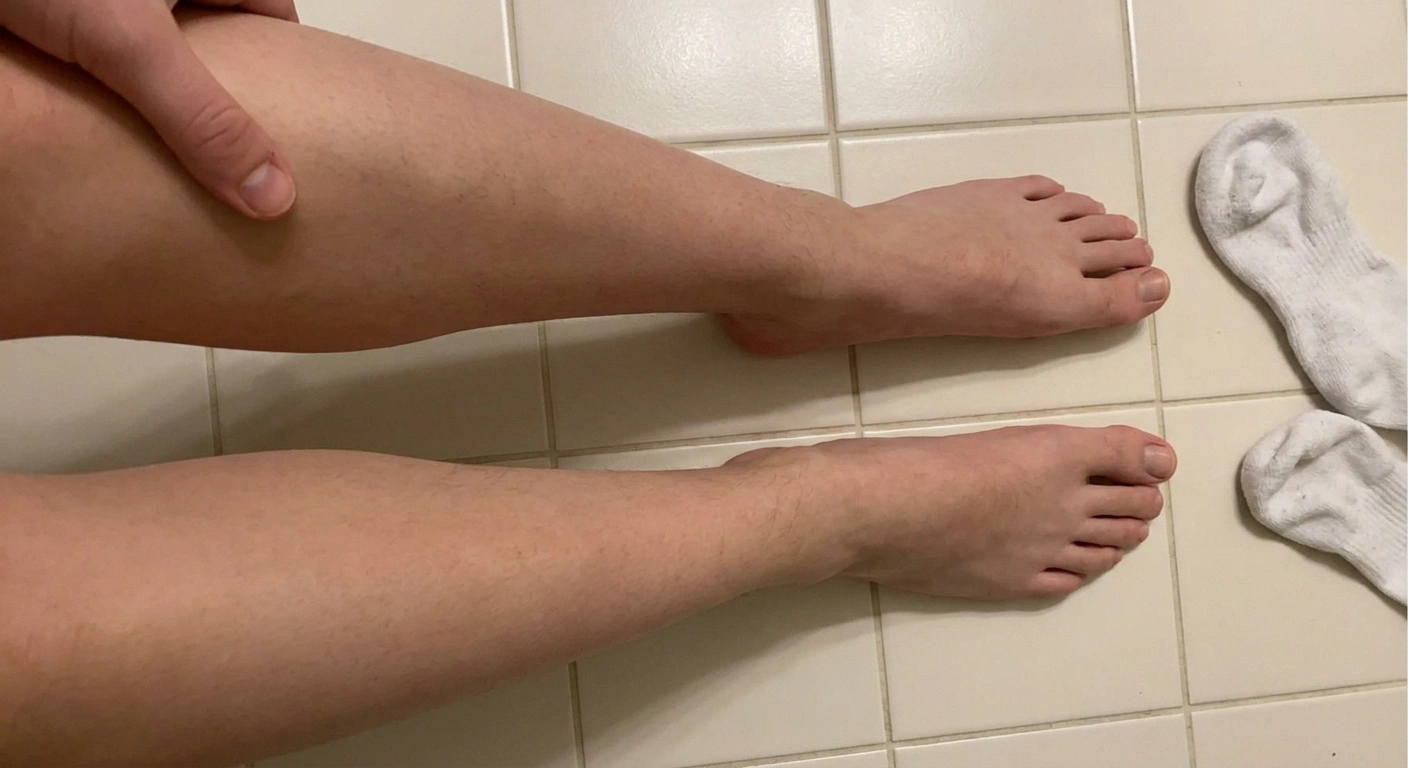
Sit down in good light, pull the sock all the way off, and compare the two legs side by side.
If the leg looks normal, same size as the other, same colour, no indentation left by the sock band after you remove it, then the tightness is a signal. There is no mechanical compression to find, and no amount of investigation of the leg’s surface will produce one.
If the leg does not look normal, that is different, and it changes what you are dealing with. Specifically:
- Visibly bigger than the other leg. Real swelling. The tightness may be genuinely mechanical.
- Sock marks that stay pressed into the skin for several minutes after the sock comes off. That is fluid, not nerves.
- Skin that dents and holds the dent when you press a thumb into the shin for five seconds. Pitting edema.
- Shoes that fit in the morning and do not by evening. A pattern that points at fluid rather than sensation.
- Colour change. Redness, a purple or brownish tinge around the ankle, or unusual paleness.
Any of those moves this out of the category of a misfiring nerve and into a conversation about circulation, veins, lymphatics, kidneys or heart. All treatable, none of them addressed by anything in the rest of this article.
The look-at-your-leg check is worth doing even if you are confident, because the two problems can coexist. Plenty of people have both a phantom band and genuine ankle swelling, and treating only one of them leaves half the problem in place.
One Leg or Both
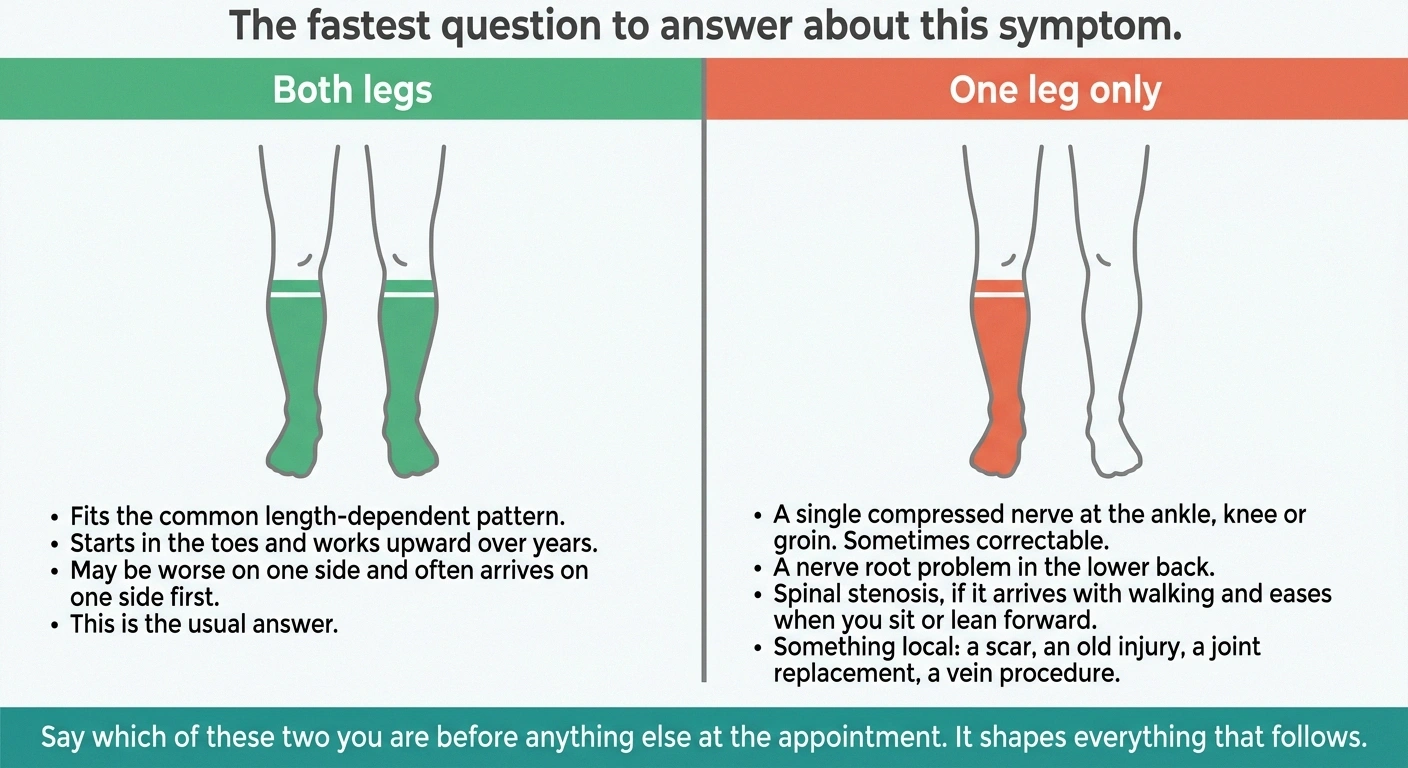
The second fast triage question, and it is nearly as informative as the first.
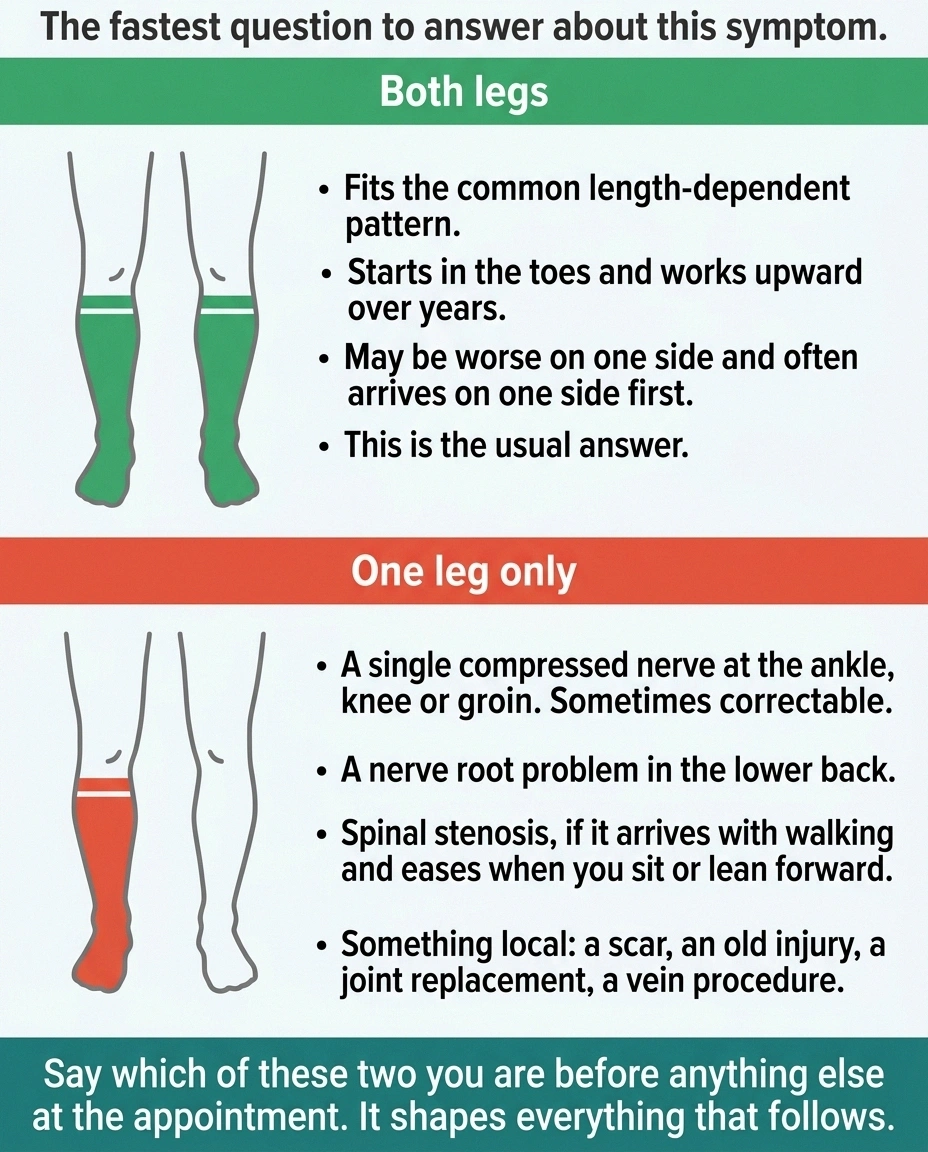
Length-dependent neuropathy, the common kind that starts in the toes and works upward, is fundamentally symmetrical. It may be worse on one side, and it often arrives on one side first, but over time both legs are involved. A band sensation that shows up in both legs at similar heights fits that picture comfortably.
A band in one leg only, with the other leg entirely unaffected, deserves a second look. Not because it is dangerous by default, but because the list of causes is different:
- A single compressed nerve. The tibial nerve at the inner ankle, the peroneal nerve at the outside of the knee, the lateral femoral cutaneous nerve at the groin. These produce localized symptoms in one limb, often reproducible by a particular position, and some are correctable.
- A nerve root problem in the lower back. Disc or arthritic change compressing a root produces symptoms in that root’s territory, which again is a band-shaped strip.
- Spinal stenosis. Worth its own paragraph, below.
- Something local: a scar, an old injury, a knee replacement, a vein procedure.
The single most useful sentence you can say to a doctor about this symptom is which of these two categories you are in. One leg or both, and at what height, said plainly at the start of the appointment, will shape everything that follows.
The Look-Alikes Worth Knowing
Most band sensations in someone with an established neuropathy diagnosis are the neuropathy. A few are not, and these are the ones worth being able to recognise.
Spinal stenosis and neurogenic claudication. The distinguishing feature is timing. Stenosis tightness arrives with walking or standing and eases when you sit down or lean forward over something. People notice they can walk much further pushing a shopping trolley than without one, because leaning forward opens the spinal canal. If your band appears after ten minutes upright and vanishes as soon as you sit, that pattern points toward the spine rather than toward the peripheral nerves in the leg.
Vascular claudication. Superficially similar, importantly different. It is worse walking uphill, it is not relieved by leaning forward, and it tends to come with cramping, coldness, or hair loss on the lower leg. The distinction between nerve-driven and circulation-driven leg symptoms is laid out in more detail in nerve pain versus vascular pain, which is worth reading if your symptoms are activity-dependent.
Venous insufficiency and lymphedema. Genuine mechanical tightness from fluid. Identified by looking, as above.
A band around the trunk rather than a limb. A tight squeezing sensation around the chest or abdomen is a recognised feature of central nervous system conditions, most familiarly multiple sclerosis, where people call it the hug. Not a peripheral neuropathy symptom, and it belongs to a different workup.
The Version That Needs a Call Today

Short section, and the reason this page can be trusted.
Four patterns that are not this article’s subject
Each of these has a distinguishing feature that the ordinary version never has. The feature, not the tightness, is what you are checking for.
- Clot. The feature is sudden and one-sided, with warmth, redness or calf pain. Often within days of surgery, illness, a long flight or bed rest.
- Compartment syndrome. The feature is tightness that keeps increasing after an injury, cast or hard exertion, with pain far out of proportion and severe pain when the muscle is stretched.
- Spinal cord compression. The feature is a band around the trunk plus new leg weakness, saddle numbness, or any bladder or bowel change.
- Arterial blockage. The feature is a leg that is cold, pale and pulseless.
The ordinary version, for comparison: gradual onset over weeks or months, both legs eventually, leg looks identical to the other, comes and goes, quiet during a busy day and loud in bed. If that is your description, none of the four above applies to you.
Almost all band sensations are chronic, gradual, and not urgent. A small number are the opposite. Treat the following as reasons to seek care the same day rather than at the next available appointment:
- Sudden onset in one leg with swelling, warmth, redness, or calf pain, particularly after surgery, illness, a long flight or a period of bed rest. That combination raises concern about a clot, which is time-sensitive.
- Tightness that keeps increasing after an injury, a cast, a hard workout, or a crush, especially with pain out of proportion to the injury and severe pain when the muscle is stretched. This is the presentation of compartment syndrome and it is a surgical emergency.
- A band around the trunk with new weakness in the legs, difficulty walking, numbness in the saddle area, or any change in bladder or bowel control. That combination points to spinal cord compression and needs immediate assessment.
- A leg that is cold, pale, and has no detectable pulse alongside the tightness. Arterial, and urgent.
Gradual, both legs, present for months, leg looks normal, worse at night: none of the above. That is the ordinary version, and it is what most readers of this page have.
What Helps
No treatment removes a band sensation reliably, and any page claiming otherwise is selling something. What follows are the levers people actually report as useful, roughly in order of how often they work.
Twenty-five minutes before bed, in this order
The order is doing real work here. Movement first floods the system with legitimate input, warmth second while that input is still fading, and the audio last so attention has somewhere to go at the moment the room finally goes quiet.
- Move, 10 minutes
- Twenty ankle circles each direction, twenty calf raises holding a counter, then a slow lap of the house. Real sensation competing with the false signal is the mechanism, so the walking matters more than the stretching.
- Temperature, 10 minutes
- Warm soak or a cool damp cloth over the band. Roughly half of people prefer each, so test both across two evenings rather than assuming. Test the water with a hand or elbow, never with the affected leg.
- Check, 2 minutes
- While the legs are already bare and the light is on, look the feet over. Between the toes, the heels, the outer edges. The nightly routine is easier to keep when it is attached to something you were doing anyway.
- Set up, 3 minutes
- Pillow positioned, bedding untucked at the foot end so nothing presses on the toes, audiobook queued and the sleep timer set. Attention amplifies this sensation, so give it a job before the room goes silent.
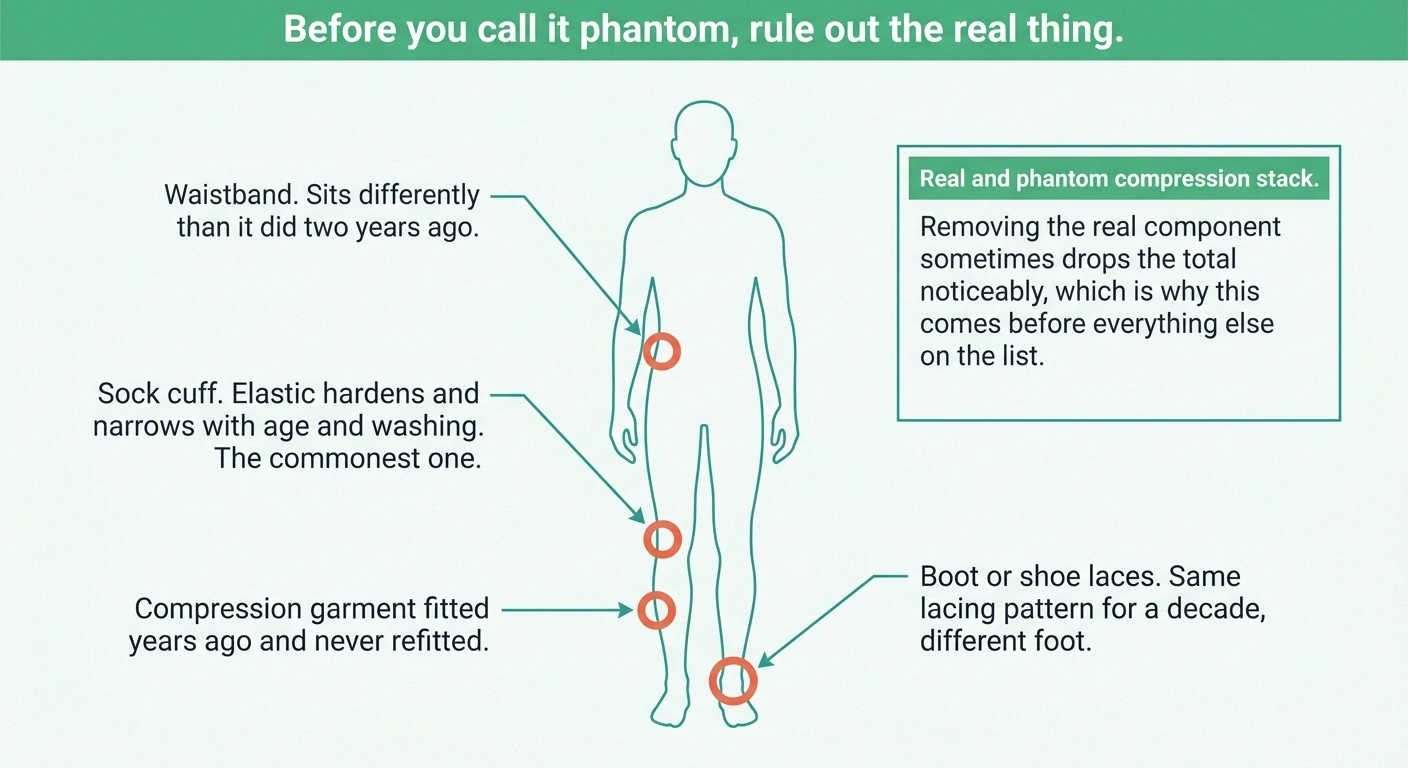
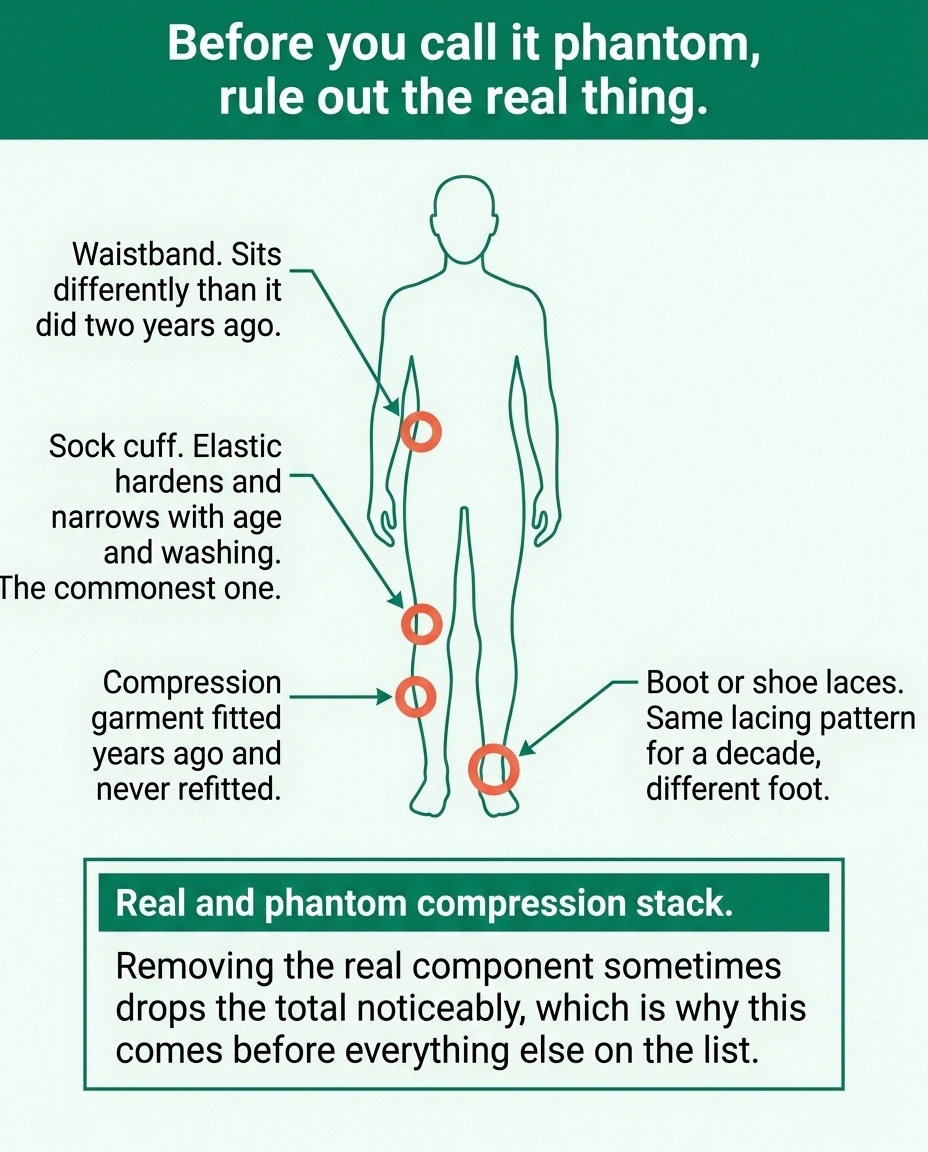
Find the real constriction first. Before dismissing all of it as phantom, check for genuine pressure that has gone unnoticed. Sock cuffs with tired elastic that has hardened. A waistband that sits differently now. Compression garments prescribed years ago and never refitted. Boots laced the same way for a decade. Real compression and phantom compression stack, and removing the real component sometimes reduces the total noticeably.
Movement, in short doses. Ankle circles, calf raises, ten minutes of walking. Movement floods the system with legitimate sensory input, which competes with the spurious signal in exactly the way daytime activity does. This is why the band often fades within a few minutes of getting up. It is also the least expensive intervention available.
Temperature, whichever direction works for you. Some people get relief from a warm soak, others from a cool cloth over the area, and it splits roughly evenly. Test both on separate evenings rather than assuming. With reduced sensation, temperature must be checked with a hand or an elbow rather than with the affected leg, and hot water is a genuine burn risk on skin that cannot report it accurately. Several practical approaches to this are collected in home remedies for neuropathy in the legs and feet.
Distraction that works, rather than distraction in general. Since attention is an amplifier, occupying it genuinely helps at night. Audiobooks and podcasts tend to work better than television, and both work better than lying still and monitoring the sensation.
Position. Some people find the band eases with the leg slightly elevated, others with the knee bent over a pillow. Worth ten minutes of experimentation once rather than years of accepting whatever position you fell into.
Medication, if it is bothering you enough. The medications used for other positive neuropathy symptoms act on the same misfiring, and there is no reason a constrictive sensation should respond differently to them than burning does. If the band is disrupting sleep, it is a reasonable thing to raise with whoever manages your neuropathy, and it should be described in terms of sleep lost rather than pain scored, because that is the version that gets taken seriously.
Compression Socks Cut Both Ways
This question comes up constantly and deserves a direct answer rather than a hedge.
The numbers on the packet, translated
Compression is sold by pressure at the ankle, measured in mmHg, and the packet rarely explains what the ranges mean. Most people with sensitive skin who buy these on their own buy far too much pressure, decide compression makes things worse, and never try again.
| Class | What it is for |
|---|---|
| 8 to 15 mmHg Light |
Tired, heavy legs and mild end-of-day puffiness. Start here if you are experimenting on your own and no one has told you otherwise. |
| 15 to 20 mmHg Moderate |
Visible ankle swelling, long flights, long days standing. The most commonly sold range, and more than many sensitive legs want. |
| 20 to 30 mmHg Firm |
Diagnosed venous disease or lymphoedema. This is a prescribed range, fitted rather than guessed, not a self-serve upgrade. |
| 30 mmHg and up Specialist |
Fitted and supervised only. Nothing in this range belongs in a self-directed experiment. |
Do not start any class on your own if
- arterial circulation in your legs has ever been raised as a question
- you have any open skin, however small, anywhere the garment would cover
- the leg is cold, pale, or the skin has changed colour
- you have uncontrolled heart failure
The practical routine, whichever class you land on: put them on before getting out of bed, while the leg is at its smallest, and take them off at night. Pulling a sock over an already-swollen ankle at four in the afternoon is the version that hurts and the version most people try first.
Compression socks help some people with this symptom significantly and make it distinctly worse for others. The split is not random, and you can usually predict which side you are on.
Likely to help if there is genuine swelling in the picture. Real fluid produces real tightness, compression manages the fluid, and the mechanical component of the sensation drops. Many people also report that steady, even, predictable pressure across the whole lower leg gives the nervous system something consistent to work with, which drowns out an inconsistent phantom band.
Likely to make it worse if the leg is not swollen and the skin is hypersensitive. Adding real pressure to a limb that is already reporting imaginary pressure is, for some people, exactly the wrong move. It is also worth noting that a compression sock with a tight top band can create a real constriction ring precisely where the phantom one sits, which is an unhelpful combination.
If you try them, the practical rules are to get the size right rather than guessing, start with the lightest compression class rather than the strongest, put them on first thing in the morning before any swelling develops, and take them off before bed. The fuller version, including sizing and when they are not appropriate, is in the guide to compression socks and gloves for neuropathy.
One caution that matters more than the rest: if circulation in your legs has ever been raised as a concern, compression is not a self-prescribed item.
How to Describe It So You Are Taken Seriously
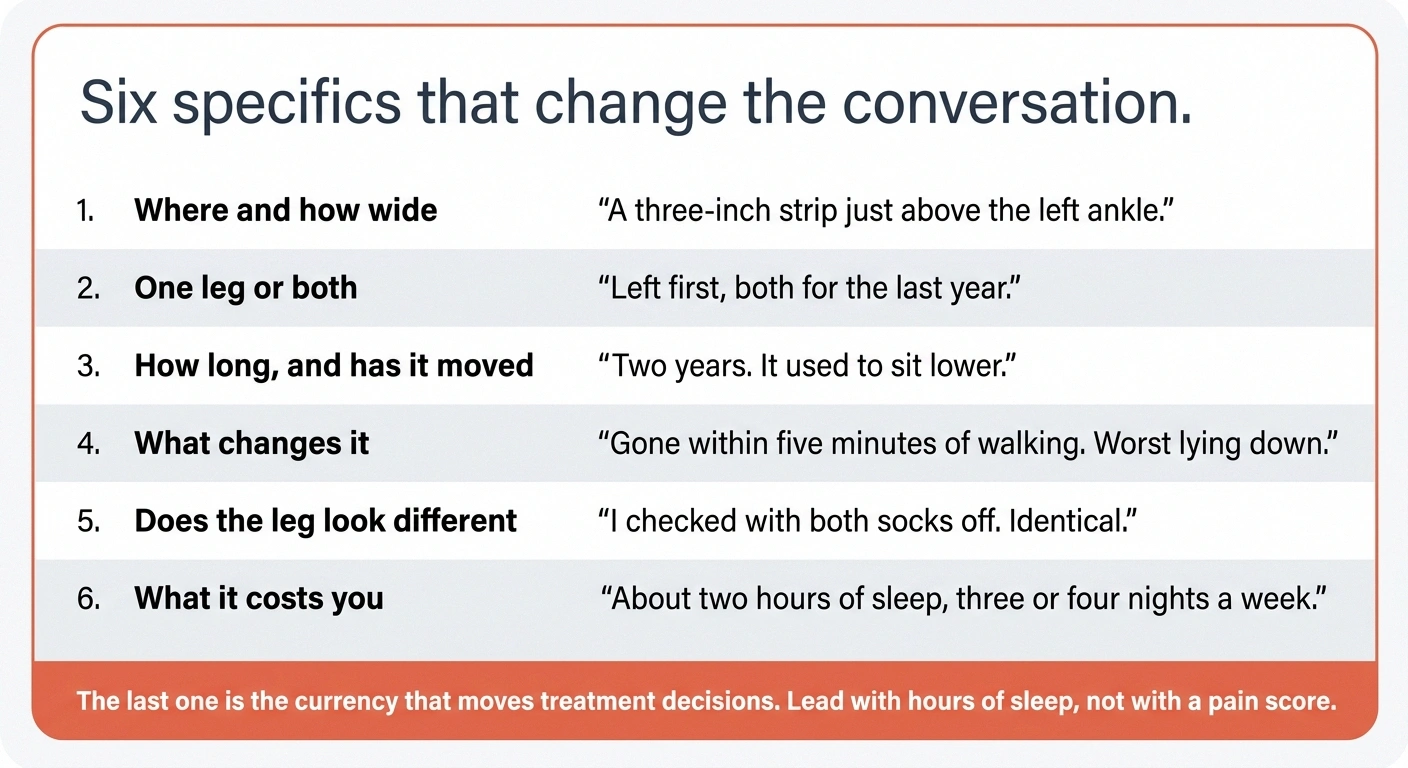
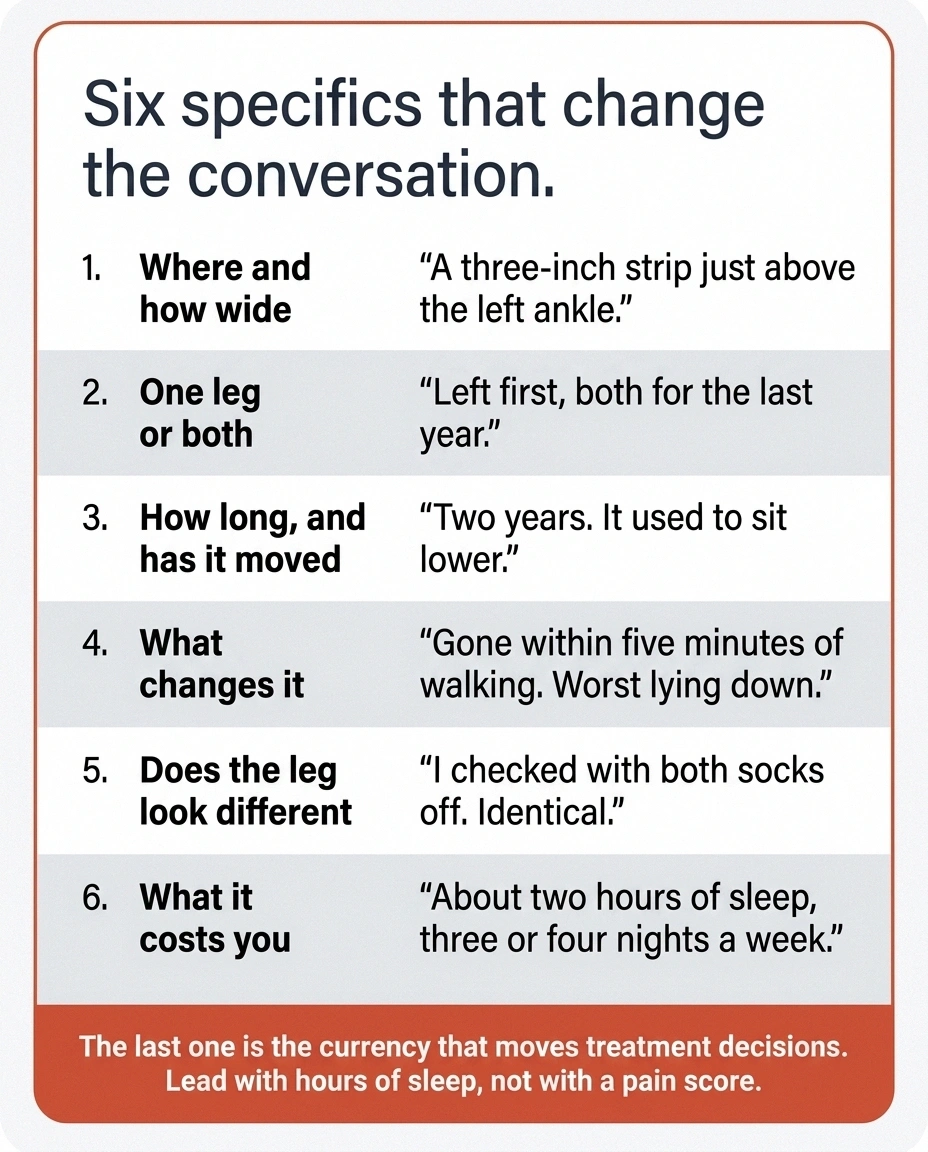
This symptom gets dismissed more than it should, mostly because “my leg feels tight” sounds like a complaint about a sock. Six specifics change the reception entirely:
- Where the band sits, and how wide it is. “A three-inch strip just above the left ankle” beats “my leg.”
- One leg or both, and which came first.
- How long it has been happening, and whether the height has moved.
- What changes it. Walking, sitting, lying down, standing for ten minutes, leaning forward.
- Whether the leg looks any different. Say explicitly that you have checked, because that answers the first question they were going to ask.
- What it costs you. Hours of sleep, specifically. That is the currency that moves treatment decisions.
If this is a new symptom rather than a familiar one, it is worth confirming what is behind it rather than assuming, particularly if you have not had a recent workup. What that involves is covered in the guide to neuropathy diagnosis and the tests your doctor may order.
The sensation is real. The band is not. Both of those statements are true at once, and holding them together is most of what makes this symptom livable.
Frequently Asked Questions
Why does it feel like something is wrapped around my leg?
Damaged sensory nerve fibers can fire spontaneously, without any real stimulus. When the fibers that normally report steady mechanical pressure are the ones misfiring, the brain receives signal on the pressure channel and interprets it as something pressing on the leg. The sensation is genuine, but there is no physical compression producing it.
Can neuropathy cause a tight band feeling around the ankle?
Yes. Band-like constriction is a recognised neuropathy symptom, commonly reported just above the ankle, around mid-calf, or across the ball of the foot. It is grouped with burning and tingling as a positive sensory symptom, meaning the nerve is generating excess signal rather than losing signal.
Why is the edge of the band so sharply defined?
Skin is divided into territories served by particular nerves and nerve roots, and those territories wrap around the limb rather than running along it. When misfiring is concentrated in one territory and quieter in the neighbouring ones, the boundary between them is felt as a distinct edge. The sharp line is anatomy rather than a physical object.
How can I tell if my leg is actually swollen or if it just feels tight?
Take the sock off in good light and compare both legs. Real swelling makes one leg visibly larger, leaves sock marks pressed into the skin for several minutes, and often dents when you press a thumb into the shin. If both legs look identical and no mark remains, the tightness is a nerve signal rather than fluid.
Should I be worried about a blood clot?
A clot presents differently: sudden onset in one leg, usually with swelling, warmth, redness or calf pain, often after surgery, illness, a long flight or bed rest. A gradual band sensation in both legs that has been present for months does not fit that pattern. If the onset was sudden and one-sided with any of those additional signs, that warrants same-day medical attention.
Do compression socks help with the tight band feeling?
It depends on whether there is real swelling. When genuine fluid is present, compression often reduces the sensation. When the leg is not swollen and the skin is sensitive, adding real pressure to a limb already reporting imaginary pressure frequently makes things worse. Start with the lightest compression class, and skip them entirely if arterial circulation has ever been a concern.
Why is the tightness worse at night?
Two reasons. During the day, spurious nerve signal competes with a constant stream of real sensory input from movement, shoes and standing, and it often loses that competition. At night that background disappears. Attention also has nothing else to occupy it after dark, and attention amplifies the sensation without being its cause.
Will the band sensation go away?
It commonly comes and goes over weeks and months, and its position can shift as the underlying pattern of nerve damage changes. Addressing the cause, blood sugar control in diabetes being the clearest example, gives the best chance of reducing symptoms overall. Medications used for other positive neuropathy symptoms act on the same misfiring and are a reasonable option when the sensation is costing you sleep.
About the Author