
Ninety-eight. Sitting on the couch, feet up, halfway through a crossword. Ninety-eight again an hour later. Ninety-six at bedtime.
For a lot of people that is how this starts. Not with a pounding chest or a scare, but with a small number on a watch face that keeps landing higher than it used to. You are not doing anything. You feel fine. The number says otherwise.
A resting pulse that has quietly moved up and settled there is one of the more overlooked signs of nerve damage, and it is one of the few you can see rather than feel. The explanation for it is genuinely interesting once someone lays it out, and it is almost never laid out. Medical articles on the subject are written for cardiologists. Symptom-checker pages tell you to see a doctor and stop there.
So let us go through what a fast resting heart rate actually means when neuropathy is in the picture, why it usually shows up without any sensation at all, and what is worth doing about it.
Your Heart Has a Brake, and It Wears Out First
Here is the piece that reframes everything.
The two inputs that set your resting pulse
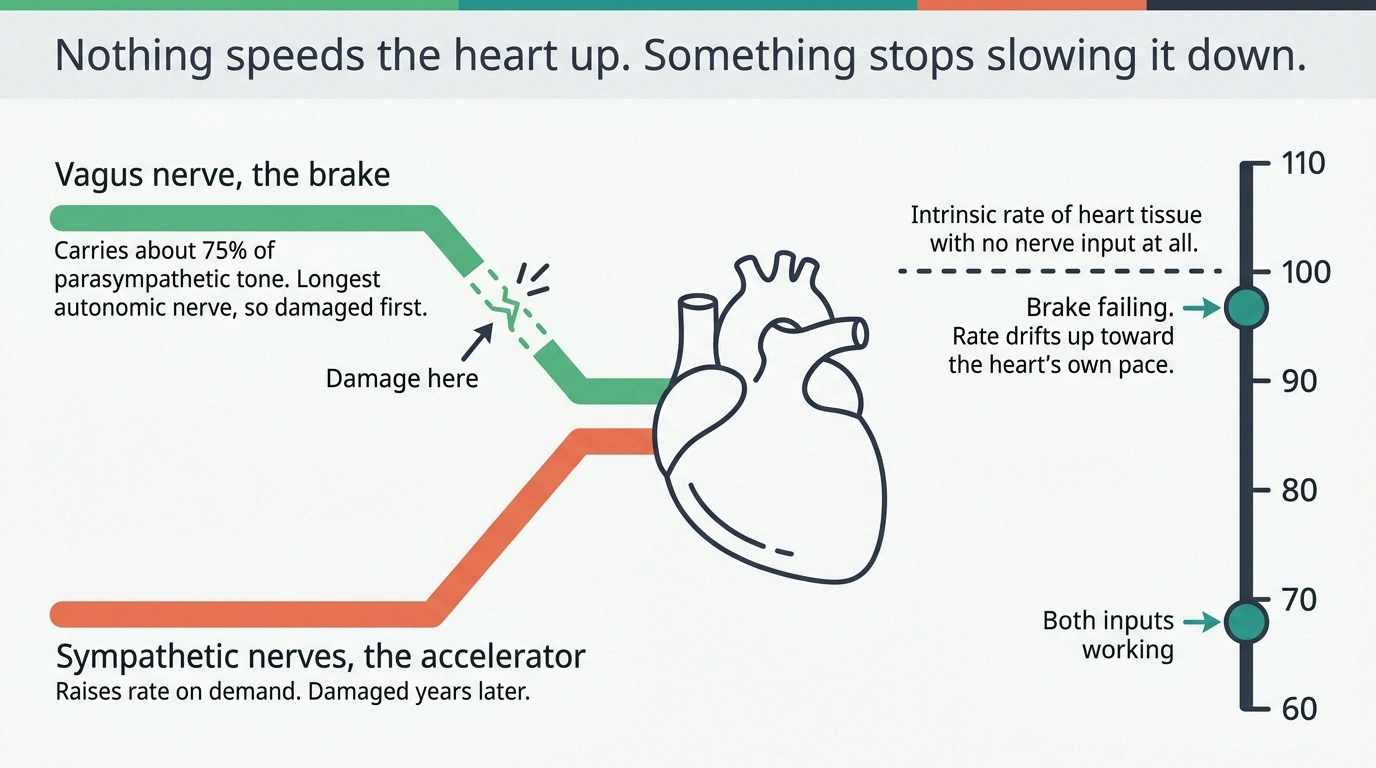
Isolated heart tissue beats at roughly 100 per minute on its own. Everything below that number is the nervous system pulling down.
The brake
Parasympathetic, via the vagus nerve
Carries roughly three quarters of parasympathetic tone to the heart. It is the longest autonomic nerve in the body, which is why length-dependent damage reaches it first.
Damaged first. Resting rate climbs toward 100.
The accelerator
Sympathetic cardiac fibers
Raises rate and force on demand: standing, stairs, stress, a sudden noise. Shorter path, damaged later, typically several years behind the vagus.
Damaged later. Rate stops responding at all.
Because the two are damaged years apart, the interval between them is diagnostically useful. A high but still-variable rate sits in a different place on this timeline than a rate that never moves.
Left completely alone, with no input from anywhere, heart muscle sets its own pace at roughly 100 beats per minute. That is the pacemaker tissue’s natural rhythm. Your resting pulse of 68 or 72 is not the heart’s own idea. It is the result of your nervous system holding it down.
The holding-down is done by the vagus nerve, which runs from the brainstem to the heart and gut and carries the large majority of the parasympathetic signal, the rest-and-digest side of things. Think of it as a foot resting on a brake pedal. The sympathetic nerves are the accelerator. Both are connected at all times, and your resting rate is the balance point between them.
Now add length-dependent nerve damage, the same process that takes your toes before your fingers. The vagus is the longest autonomic nerve in the body. It goes first.
Which means the brake fails before the accelerator does. Nothing is speeding your heart up. Something has stopped slowing it down. The rate drifts up toward the pacemaker’s own natural tempo, and it stays there, because the input that used to pull it back down is no longer arriving.
That single idea explains most of what follows. It explains why the number is high, why it is stubbornly consistent, and why it does not respond to the things that normally move a pulse around.
This is the cardiovascular branch of autonomic neuropathy, the part of the nervous system that runs the machinery you never think about. Clinicians call it cardiac autonomic neuropathy, or CAN. Same nerve damage you may already know about in your feet, different territory.
Why Nobody Feels Their Heart Racing
People expect a fast heart to feel like something. Pounding, fluttering, that unmistakable awareness of your own pulse in your throat.
Most people with this find out from a device.
The reason is straightforward and slightly unsettling. Sensation from the heart travels back to the brain along its own set of nerve fibers, and those fibers belong to the same family that is being damaged. The signal reporting how fast you are going is degraded along with the signal telling you how fast to go. Your heart is running at 100 and not filing a report about it.
So the usual discovery routes are a fitness tracker, a smartwatch, a blood pressure cuff at home that also displays pulse, or a nurse taking vitals who mentions it in passing. Occasionally it is a preoperative workup.
Which makes the wearable on your wrist genuinely useful here, with one important limit. Consumer devices are reasonably good at resting heart rate and much less reliable during movement, especially wrist-worn optical sensors on older or cooler skin. Treat the resting numbers as informative. Treat a single alarming spike during a workout as a measurement question until it repeats.
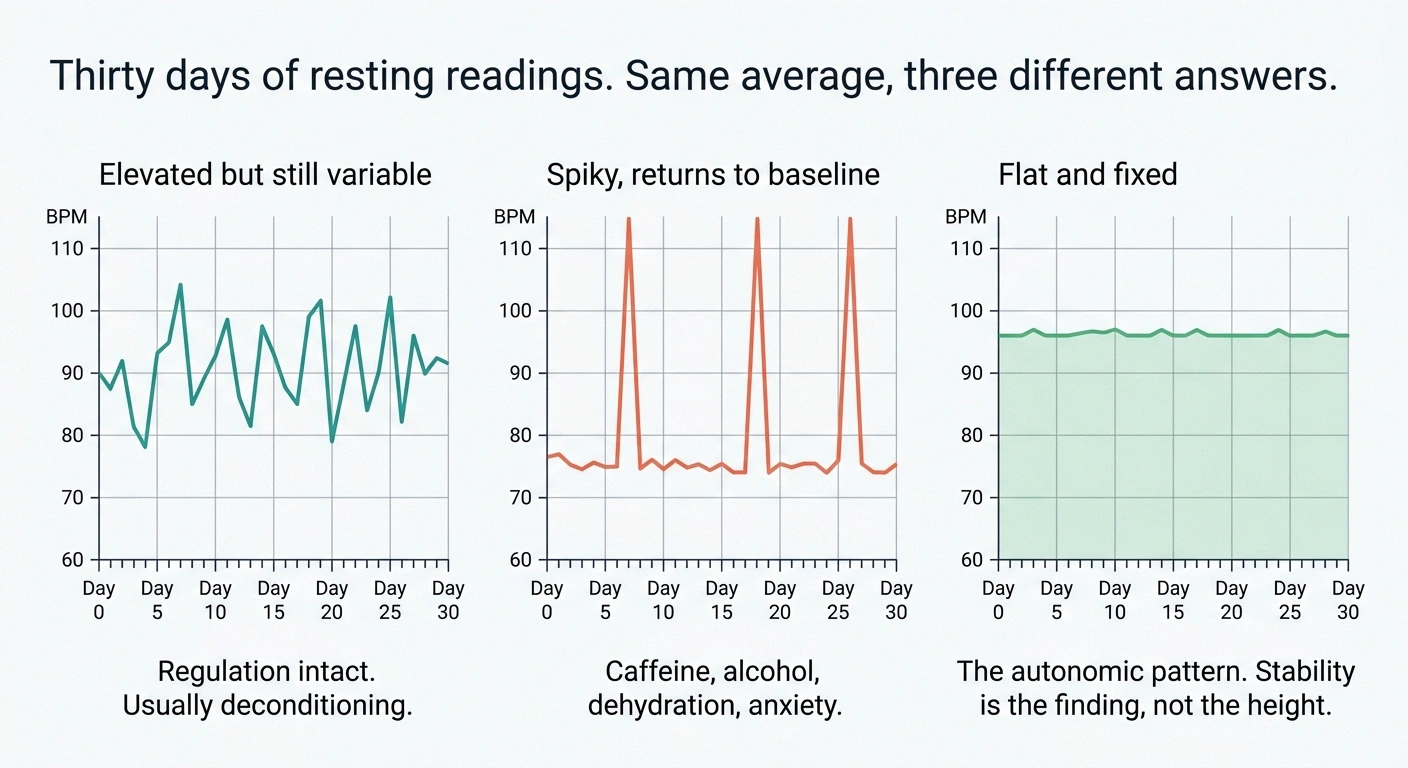
What is worth doing, if you have a device that logs this: pull up thirty days of resting heart rate and look at the shape. A flat line sitting at 95 tells a very different story from a jagged line averaging 95. Bring the graph to your appointment. It is more useful than any single reading you can describe from memory.
The Second Sign Is the One That Matters More

A high resting number is the sign people notice. The more telling one is what happens when the number should change and does not.
A healthy heart rate is not a setting. It moves constantly. It rises when you stand up, climbs when you carry laundry upstairs, drops in the deeper stages of sleep, jumps when the phone rings at 2am. That responsiveness is the nervous system doing its job minute by minute.
As autonomic damage progresses, the range narrows. The rate stops responding well to exertion, to stress, to sleep. Cardiologists describe this as a fixed heart rate, and it points to substantially more extensive damage than an elevated resting number alone. Clinically, it is understood to reflect a heart that has lost much of its nerve supply in both directions.
The practical shape of this is exercise intolerance that does not match your fitness. You climb a flight of stairs and you are winded and heavy-legged, and your pulse has gone from 96 to 104. It should have gone to 130. The heart cannot increase output the way the effort requires, so the effort feels enormous. People usually blame age, or weight, or being out of shape, and go on blaming those for years.
There is a rough sequence to how this unfolds, and it is worth knowing because it tells you where you sit. Reduced beat-to-beat variability comes first and is detectable in a lab long before anything is visible in a resting pulse. Elevated resting rate follows, once the parasympathetic side has taken real damage. Blunted response to exertion and a genuinely fixed rate come later, after the sympathetic side has been affected too, typically years further along. This staging mirrors what happens elsewhere in the body, which is covered in more detail in the overview of the stages of neuropathy.
Before You Assume It Is Nerve Damage
An elevated resting pulse is common, and neuropathy is well down the list of things that cause it. Working through the ordinary explanations first is not throat-clearing. It is the fastest route to the answer, and several of the items on this list are fixable in a way that nerve damage is not.
Same high number, four different shapes
A single reading cannot separate these. Two weeks of readings usually can, which is why the log matters more than the number.
| What the pattern looks like | Usually points to |
|---|---|
| High, but still swings 20+ beats across the day and climbs properly on stairs | Deconditioning, most often. The regulation works; the fitness does not. |
| Spikes in the 120s, settles back to the seventies within an hour | Anxiety, caffeine, alcohol the night before, or dehydration |
| Rose over a few weeks, alongside fatigue or feeling cold or unusually warm | Anemia or thyroid change. Both show on routine bloodwork. |
| Flat at 92 to 100 all day, every day, and barely moves for exertion or sleep | The autonomic pattern. Stability is the finding, not the height. |
Things that raise a resting heart rate:
- Deconditioning. The most common cause by a wide margin. A few months of reduced activity moves a resting pulse up by ten beats or more, and neuropathy tends to reduce activity.
- Anemia and thyroid problems. Both raise resting rate, both are found with routine bloodwork, and both are treatable.
- Dehydration. Underrated, extremely common in older adults, and it moves the number noticeably.
- Medications. Some inhalers, decongestants, thyroid replacement, certain antidepressants, and stimulants all push the rate up. So does stopping a beta blocker abruptly, which produces rebound tachycardia.
- Caffeine and alcohol. Alcohol in particular raises resting and overnight heart rate for many hours after the last drink, which is why weekend readings often look worse.
- Fever, infection, pain, and poor sleep. Any of these will lift the baseline temporarily.
- Anxiety. Real and common, and worth separating from the rest because anxiety-driven rates fluctuate rather than sitting flat.
The pattern that points toward autonomic involvement rather than any of the above is a rate that is elevated, stable, and unresponsive. Deconditioning gives you a high number that still moves. Anxiety gives you a number that spikes and settles. Nerve damage gives you a number that just sits there, hour after hour, day after day, whatever you are doing.
That distinction is worth making out loud at your appointment, because it is the kind of detail that redirects a workup.
How This Gets Checked
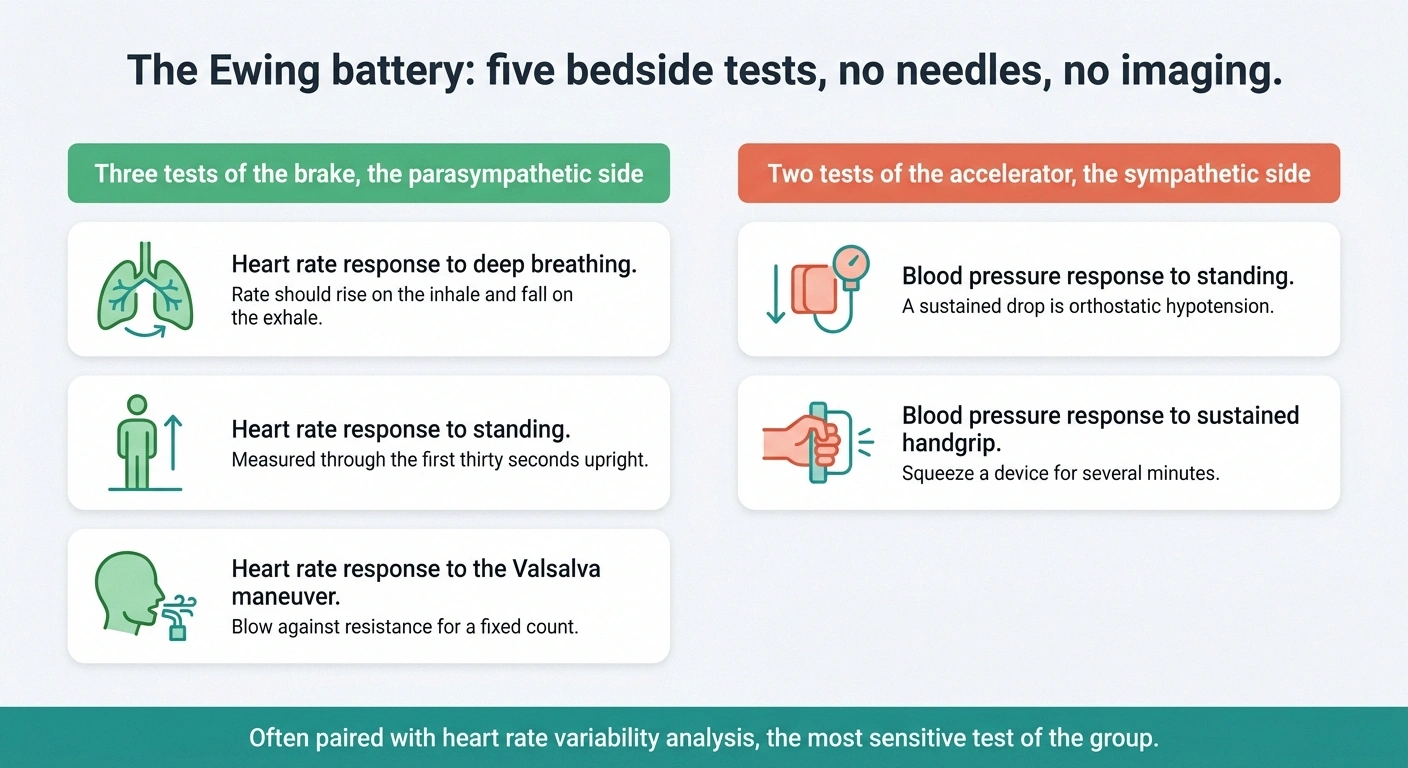
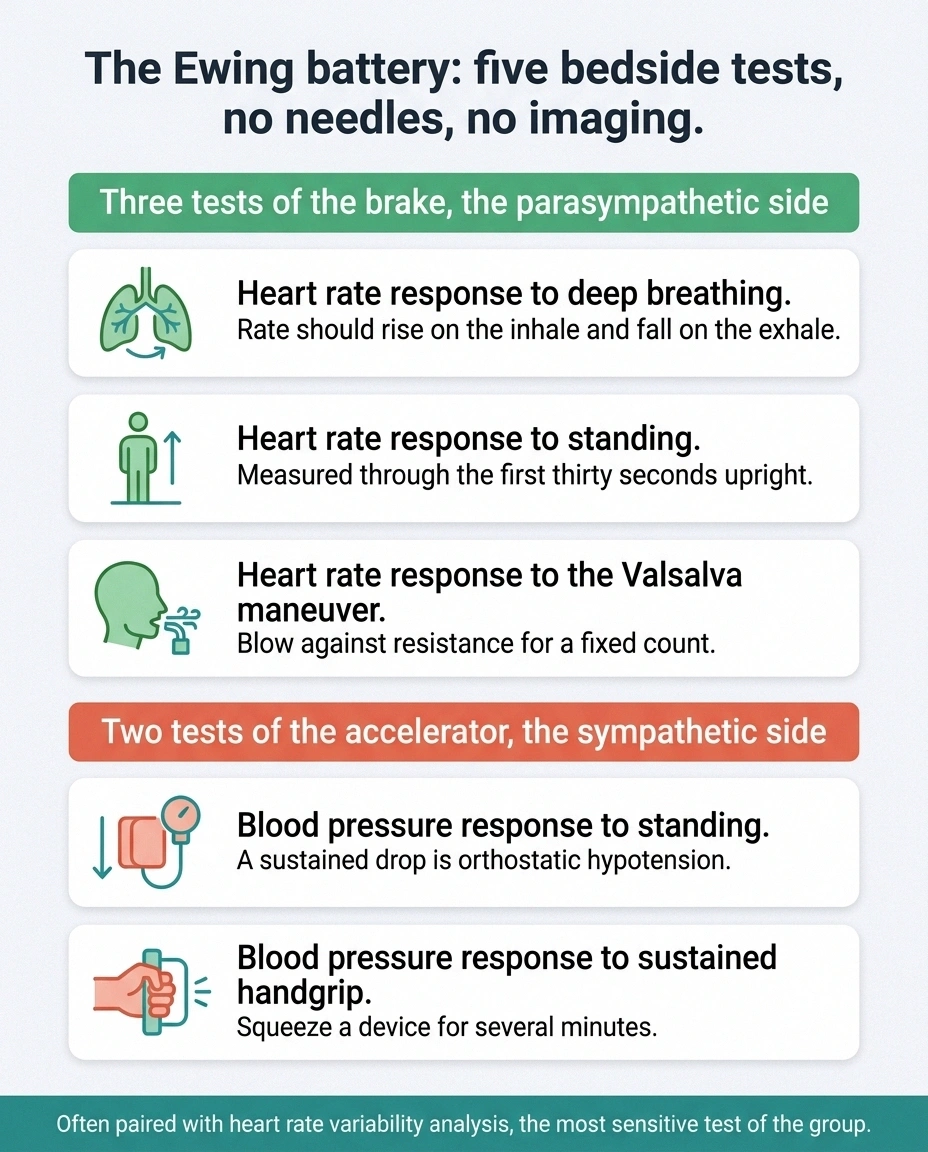
The testing for this is older, cheaper and less dramatic than most people expect. No imaging, no catheters, nothing invasive. A set of five bedside maneuvers, known collectively as the Ewing battery, has been the standard approach for decades.
Wording that gets autonomic testing considered
A fast pulse described in general terms is frequently attributed to nerves or weight. Naming the test and the pattern moves the conversation somewhere else. Say it in this order:
“My resting heart rate used to run in the sixties. For the past four months it has been sitting between 94 and 100, and it stays there whatever I’m doing. It only reaches about 105 when I climb the stairs. I also get lightheaded standing up. Given my neuropathy, would cardiovascular autonomic reflex testing be reasonable?”
The four elements doing the work: your old baseline, how long it has been elevated, that it does not vary, and one other autonomic symptom. Bring the readings on paper or on the phone screen.
If the answer is no, the useful follow-up question is what would need to change for it to become appropriate. That gets you a threshold instead of a dead end.
Three of the five look at the parasympathetic side, the brake:
- Heart rate response to deep breathing. You breathe slowly and deliberately at a set pace while the rhythm is recorded. In an intact system the rate rises visibly with each inhale and falls with each exhale. As vagal function declines, that swing flattens out.
- Heart rate response to standing. Rate is measured lying down, then through the first thirty seconds after standing. A healthy response has a characteristic overshoot and correction.
- Heart rate response to the Valsalva maneuver. You blow against resistance for a fixed count while the rhythm is recorded through the strain and the release.
Two look at the sympathetic side, the accelerator:
- Blood pressure response to standing. A sustained drop on standing is orthostatic hypotension, and it frequently travels with a fast resting rate.
- Blood pressure response to sustained handgrip. You squeeze a device for several minutes while pressure is monitored.
Heart rate variability analysis, which measures the tiny differences in time between consecutive beats, is often added, and it is the most sensitive of the group. It picks up changes long before a resting pulse looks abnormal.
None of this is ordered routinely. If you have diabetes or an established neuropathy diagnosis and your resting rate has moved, asking directly whether autonomic reflex testing is appropriate is a reasonable and specific request, and it is far more likely to produce action than describing the symptom in general terms. The broader picture of what a nerve workup involves is covered in the guide to neuropathy diagnosis and the tests your doctor may order.
The Real Reason This Is Worth Raising

Time to be direct about something, once, without dressing it up.
The nerve fibers that carry pain from the heart are part of the same population being damaged. When those fibers are compromised, a heart attack can happen without producing the chest pain that would normally send someone to an emergency room. Cardiac autonomic neuropathy is associated with silent myocardial ischemia for exactly this reason.
That is not a reason to be frightened by your pulse. It is a reason to know two things.
First, that you may not get the warning symptom you have been taught to expect, so the other symptoms matter more than usual: unexplained shortness of breath, sudden sweating, nausea, jaw or arm or upper back discomfort, sudden overwhelming fatigue. Any of those, taken seriously, without waiting for chest pain to confirm them.
Second, that an elevated resting heart rate in someone with neuropathy is a piece of cardiovascular information, not just a curiosity. It belongs in the conversation about blood pressure, cholesterol, and blood sugar rather than sitting in a separate box.
One more practical item that gets missed. If you are scheduled for surgery, tell the anesthesiologist about autonomic neuropathy specifically. Blood pressure and heart rate can behave unpredictably under anesthesia when autonomic reflexes are impaired, and it is genuinely useful information for the person managing your vitals. Say it during the pre-op call rather than assuming it carried over in your chart.
Exercising When the Numbers Lie

Standard exercise advice runs on heart rate. Target zones, percentages of maximum, staying under a ceiling. All of that assumes your pulse accurately reports your effort.
The effort scale, anchored to what you can say out loud
When a heart rate monitor has lost its reference, speech is the instrument that still works. Aim for the shaded band.
1 to 3 Singing is possible. Strolling to the mailbox. Too easy to build anything.
4 to 6 Full sentences, slightly breathy. You could hold a phone call but would not enjoy it.
This is the target for almost every session. Most of the cardiovascular benefit lives here.
7 to 8 Short phrases only. Fine in brief intervals if that has been discussed with whoever manages your care.
9 to 10 Single words. Stop. With a blunted rate the watch may still read 105 here, which is exactly the trap.
Cool down for a full five minutes rather than stopping where you finish. Blood pressure drops most often in the sixty seconds after exercise ends, not during it.
With a blunted or fixed rate, it does not. Your heart rate can look moderate while your body is working extremely hard, and a target-zone approach will push you well past where you should be.
Use effort instead of numbers:
- The talk test. Comfortable exercise means you can speak in full sentences. If you are down to three or four words at a time, ease off, whatever the watch shows.
- Perceived exertion. Rate the effort from one to ten by how it feels. Most days should sit around four to six. This is a more honest instrument than a heart rate monitor when the monitor has lost its reference.
- Warm up and cool down longer than feels necessary. Five to ten minutes at each end. An autonomic system that adjusts slowly needs the runway, and the cool-down matters most, because stopping abruptly is when blood pressure tends to drop.
- Stand up in stages. Sit on the edge of the bed or bench for a count of ten before rising, particularly after floor exercises. Orthostatic drops travel with this condition and this habit costs nothing.
- Watch the heat. Sweating is also autonomically controlled, and impaired sweating means impaired cooling. Hot rooms and hot weather are harder on this system than the effort itself.
None of that is an argument against exercising. It is an argument for changing the instrument you steer by. Regular movement remains one of the more useful things available for nerve health and for the vascular risk factors sitting underneath, and the case for the simplest version of it is laid out in the article on walking and neuropathy.
What Actually Helps
There is no medication that repairs autonomic nerve fibers. What exists is a set of levers that slow the process and manage the consequences, and they are unglamorous.
What each lever can and cannot do
The list in this section is not a menu of equals. Two of these carry most of the weight and the rest are supporting work, which matters when you are deciding where to spend limited effort.
Strongest evidence
Blood sugar control, where diabetes is the cause
Can: slow progression, and improve early heart rate variability. Cannot: restore a rate that has already gone fixed. Works far better as prevention than as repair, which is the whole argument for acting at 96 rather than waiting for 110.
Strong, and available to almost everyone
Aerobic conditioning
Can: measurably improve heart rate variability, and improve what the surviving fibers accomplish. Cannot: regrow lost fibers. Steer by the talk test rather than a target zone.
Counts double here
Blood pressure, lipids, smoking
Why double: these are ordinary cardiovascular risk factors for everyone, and they carry extra weight when the early-warning system that would normally flag trouble is impaired.
Quick win, frequently skipped
A pharmacist-led medication review
Costs one appointment. Decongestants, some inhalers and thyroid replacement all push resting rate up, and people rarely connect an over-the-counter item to a number on a watch. Bring the bottles rather than a list from memory.
Do not self-adjust
Beta blockers, and fluid or salt intake
Stopping a beta blocker abruptly produces a rebound faster than where you started. Fluid and salt cut both ways when supine hypertension sits alongside orthostatic drops, which is the situation in a good share of advanced cases.
Blood sugar control does the heaviest lifting. In diabetes, glycemic control is the intervention with the strongest evidence behind it for autonomic outcomes, and it works better as prevention than as repair. Early autonomic changes have more room to improve than a heart rate that has already gone fixed. That asymmetry is the reason to act on a number of 96 rather than waiting to see what happens at 110. The relationship between blood sugar and nerve damage generally is covered in the overview of diabetic neuropathy.
Aerobic conditioning improves heart rate variability in people who can do it, which is a real and measurable effect rather than a general wellness claim. It will not restore lost fibers. It does improve what the remaining ones accomplish.
The rest of the cardiovascular package counts double here. Blood pressure, lipids, and smoking are risk factors for everyone and carry additional weight when the early-warning system is compromised. An anti-inflammatory eating pattern supports both sides of this at once, and there is a practical version in the neuropathy diet guide.
Medication review. Worth going through the full list, including over-the-counter items, with a pharmacist. Decongestants and some inhalers push the rate up and people rarely connect them.
Hydration and salt. If orthostatic drops are part of your picture, fluid and sometimes sodium intake become part of management. This one needs individual guidance, because the same person often has supine hypertension alongside orthostatic hypotension, and the two pull treatment in opposite directions. If your doctor seems to be treating two contradictory problems, that is why.
What not to do: do not start or stop a beta blocker on your own reasoning. Stopping one abruptly causes a rebound faster than where you started, and starting one without supervision can worsen an orthostatic drop.
The honest answer on reversal is the same one that applies throughout this condition. Early damage sometimes improves with sustained control of the underlying cause. Established damage is generally managed rather than undone. The fuller version of that discussion is in can neuropathy be reversed.
What to Bring to the Appointment
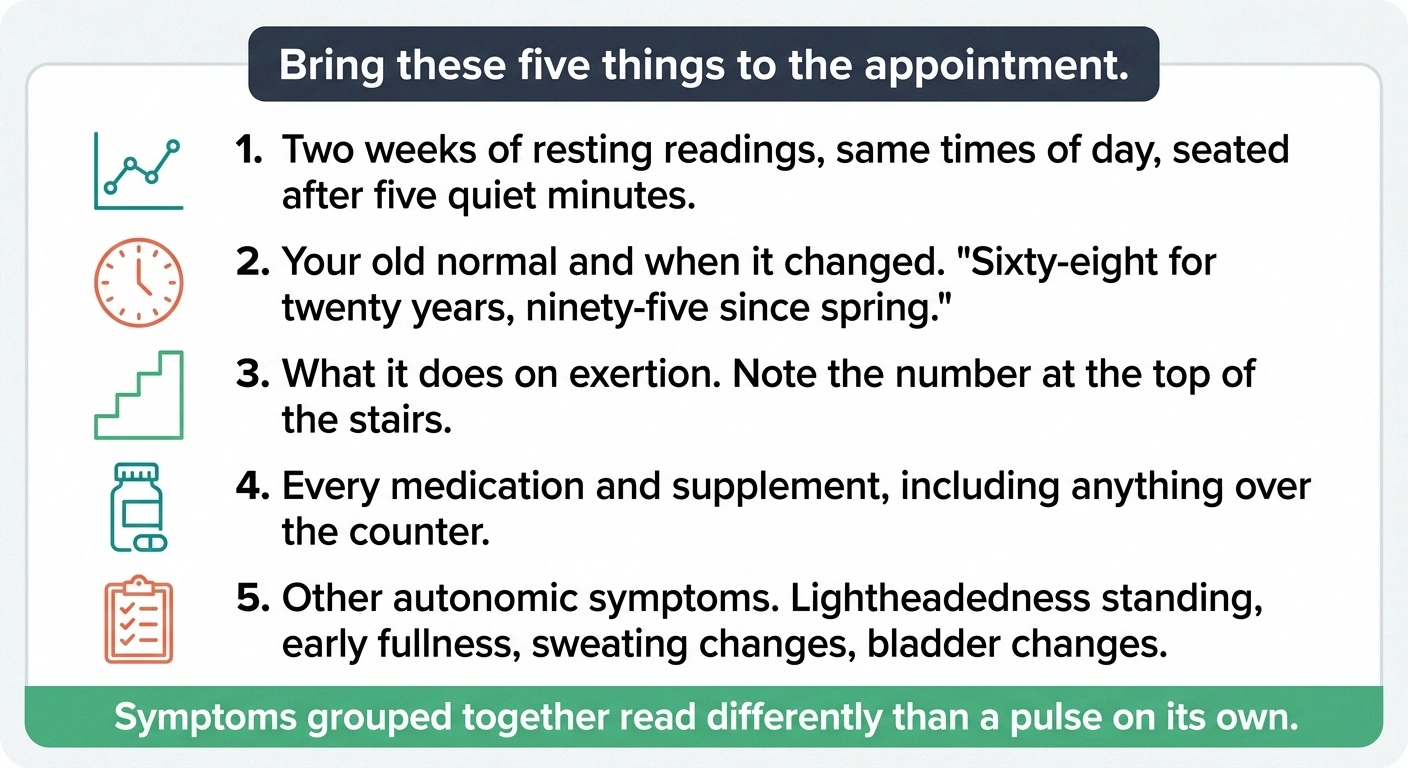
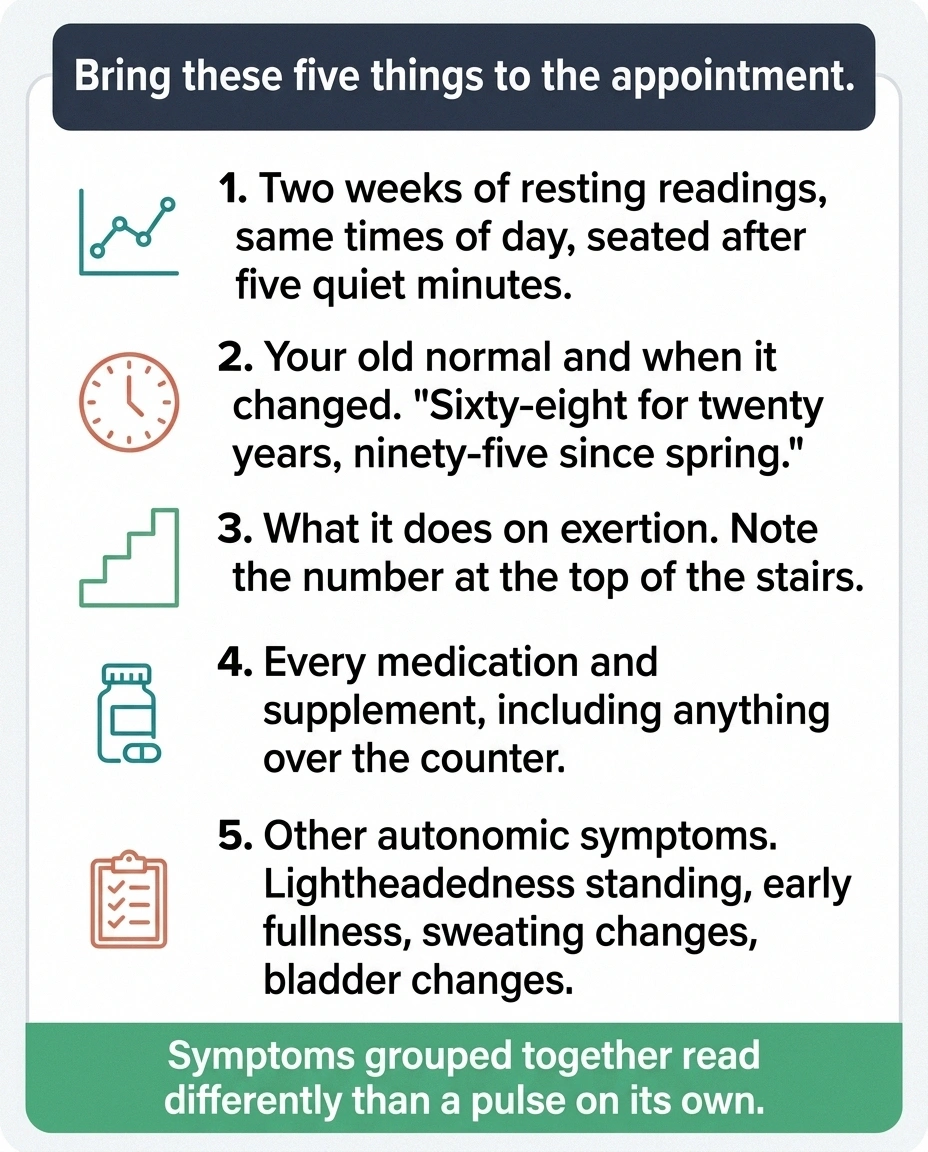
Appointments for this go badly when the symptom is described vaguely, because a fast pulse sounds like anxiety and gets filed accordingly. Specifics change that.
Bring:
- Two weeks of resting readings, taken at the same times of day, sitting, after five quiet minutes. Written down or exported from a device.
- The comparison to your old normal, if you know it. “This ran 68 for twenty years and it has been 95 to 100 since spring” is a far stronger statement than “my pulse seems high.”
- What it does during exertion. If climbing stairs moves it very little, say so plainly, because that observation is what distinguishes this from ordinary deconditioning.
- Your full medication and supplement list.
- Any other autonomic symptoms, even if they seem unrelated: lightheadedness on standing, early fullness after small meals, sweating changes, bladder changes, unusually dry or unusually clammy feet.
That last one matters more than people realize. Autonomic symptoms cluster, and a doctor looking at four of them together reaches a different conclusion than one looking at a pulse in isolation. The same fiber types are involved in small fiber neuropathy, which is why the feet and the heart often show changes in the same period.
The number on your wrist is not an emergency. It is information, and it has been sitting there being ignored, which is the only genuinely fixable part of the situation.
Frequently Asked Questions
Can neuropathy cause a fast heart rate?
Yes, when the damage involves the autonomic nerves that regulate the heart. The vagus nerve normally holds resting heart rate below the heart’s own intrinsic pace of about 100 beats per minute. When vagal fibers are damaged, that restraint weakens and the resting rate drifts upward. This is called cardiac autonomic neuropathy and it is most often seen in long-standing diabetes, though other causes of neuropathy can produce it.
What resting heart rate is considered too high?
Above 100 beats per minute at rest meets the technical definition of tachycardia. The more useful measure is change from your own baseline. A rate of 92 in someone who ran 62 for decades is a bigger signal than 92 in someone who has always been in the high eighties. Track your own trend rather than comparing yourself to a general range.
Why doesn’t my heart rate go up when I exercise?
A blunted rise during exertion is called chronotropic incompetence, and in autonomic neuropathy it reflects damage to the sympathetic nerves that would normally accelerate the heart under load. It produces exercise intolerance that feels disproportionate to fitness. It can also result from certain medications, particularly beta blockers, so a medication review is part of sorting it out.
Can cardiac autonomic neuropathy be reversed?
Early changes, particularly reduced heart rate variability, can improve with sustained blood sugar control and regular aerobic activity. Established damage, especially a heart rate that no longer responds to exertion or sleep, is generally managed rather than reversed. This is the main argument for taking an early elevated resting rate seriously instead of waiting.
How is autonomic neuropathy of the heart diagnosed?
Through a set of bedside cardiovascular reflex tests known as the Ewing battery: heart rate response to deep breathing, to standing, and to the Valsalva maneuver, plus blood pressure response to standing and to sustained handgrip. Heart rate variability analysis is frequently added. The testing is non-invasive and inexpensive, but it is not ordered routinely, so it usually has to be requested.
Is a fast resting heart rate dangerous with neuropathy?
The rate itself is not the danger. The concern is what it indicates, because cardiac autonomic neuropathy is associated with silent myocardial ischemia, meaning a cardiac event may occur without the usual chest pain. That makes the non-chest-pain symptoms more important to act on: unexplained breathlessness, sweating, nausea, or jaw, arm and upper back discomfort.
Should I stop wearing my fitness tracker if the numbers worry me?
Generally no. The trend data is the most useful thing you can bring to an appointment, and this symptom is otherwise invisible because impaired cardiac sensation means most people never feel it. If checking the number repeatedly becomes its own source of stress, a reasonable compromise is looking at weekly averages instead of live readings.
Does a high resting heart rate mean my neuropathy is getting worse?
It suggests the autonomic nerves are involved, which is a different territory rather than automatically a later stage of what is happening in your feet. Autonomic and sensory symptoms often progress on separate timelines. Deconditioning, anemia, thyroid problems, dehydration and several common medications also raise resting rate, so those are worth ruling out before drawing conclusions.
About the Author