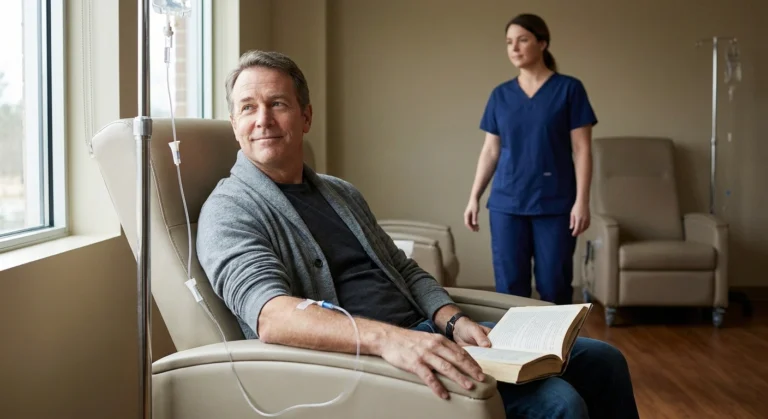
The referral gets handed over at the end of an appointment, usually without much explanation, and a lot of people read it as a verdict.
Sent to pain management. Which sounds like being told the problem is now permanent, that nobody is looking for the cause any more, and that from here on it is about coping rather than fixing. Some people file the slip in a drawer for six months because of that reading.
It is worth knowing what the referral actually means, because it is not that, and because there is a genuinely important question hiding inside it that almost nobody asks. The question is not whether to go. It is whether to go now.
What the Referral Actually Means
Pain medicine is a recognised subspecialty. Most practitioners come from anesthesiology, with others arriving from physical medicine and rehabilitation, neurology, or psychiatry. The training is in the assessment and treatment of pain as its own problem, using tools that a primary care office does not have.
The referral is usually triggered by one of two things. Either first-line medications have not worked well enough at tolerable doses, or the pain has moved past what a fifteen-minute appointment every three months can reasonably manage.
Neither of those is a statement that your nerve damage is permanent. It is a statement about workload and tools. Your primary care doctor has a toolbox with roughly four things in it for nerve pain, and if all four have been tried, sending you to somebody with twenty is a reasonable move rather than a resignation.
It helps to know what the specialty is not, too, because the name causes trouble. Pain management is not the same as palliative care, which is where a lot of the dread comes from. Palliative care is about comfort in serious or terminal illness. Pain medicine is a procedural and pharmacological subspecialty treating pain in people who expect to live another thirty years and would like to spend them walking. The two get confused constantly, including by people who work in healthcare, and the confusion is why so many referral slips sit in drawers.
It is also not a clinic for people who have run out of options. A meaningful share of the patients in any pain practice are there early, with a specific localised problem and a specific procedure that fixes it, rather than at the end of a long unsuccessful road.
What the referral genuinely does mean is that the emphasis is shifting from finding a cause to managing a symptom. That shift is appropriate at the right time. It is expensive at the wrong one, and that is the whole subject of the next two sections.
The Division of Labour Nobody Explains
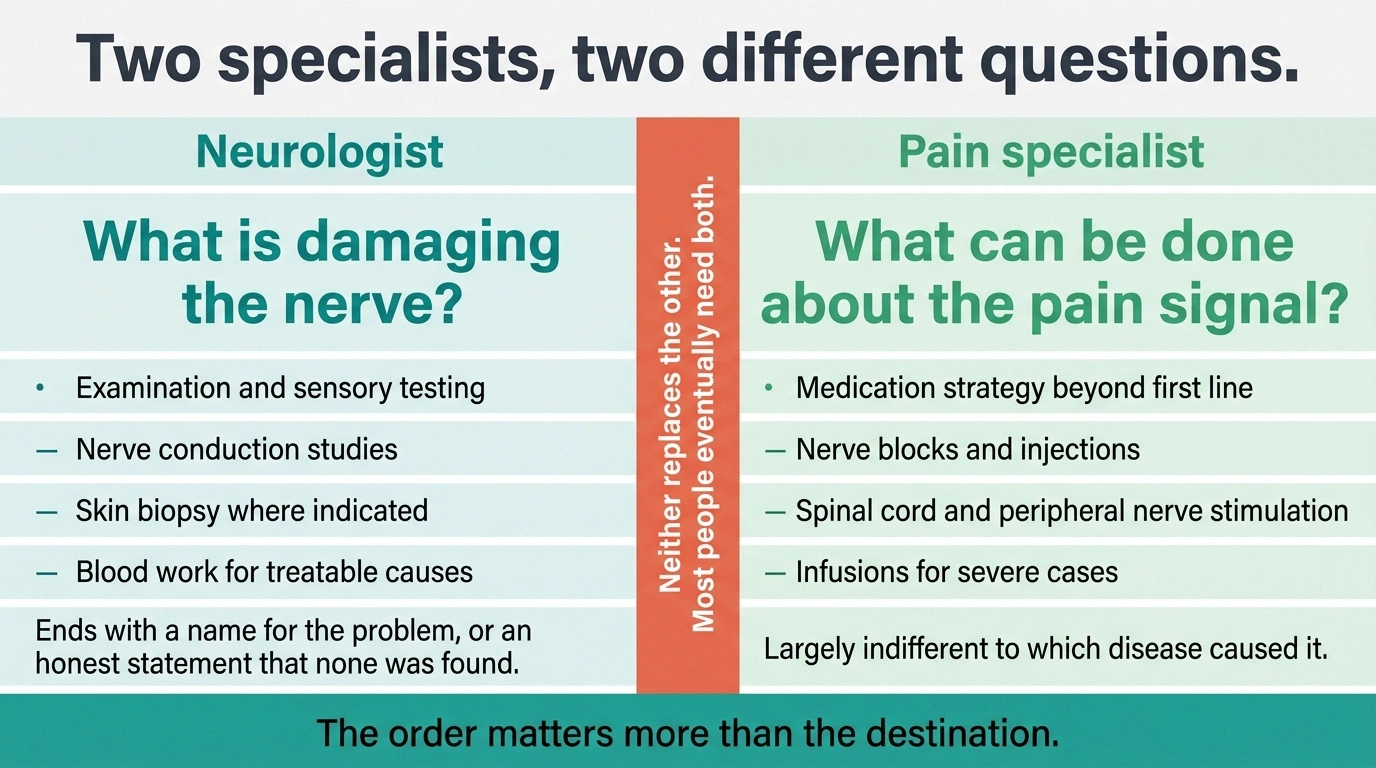
The most common confusion is between the neurologist and the pain specialist, and it produces a lot of wasted appointments.
They answer different questions.
The neurologist’s question is what is damaging the nerve. That work involves examination, nerve conduction studies, sometimes a skin biopsy, and a long list of blood tests looking for causes. It ends with a name for the thing, or with an honest statement that no cause was found, which is itself a finding.
The pain specialist’s question is what can be done about this pain signal, whatever is causing it. That work is largely indifferent to the underlying diagnosis. A nerve block does not care whether the nerve is inflamed because of diabetes or chemotherapy.
Neither replaces the other. A pain specialist will not run your diagnostic workup, and a neurologist will not implant a stimulator. Most people with persistent nerve pain eventually need both, and the order matters more than the destination.
There is a third role that gets left out of this comparison and should not be, which is your primary care doctor. They remain the person holding the whole picture, and specialists are notoriously poor at talking to one another without somebody insisting. A pain clinic can start a drug that interacts with something a cardiologist prescribed, and neither of them will necessarily notice. Whoever manages your overall care is the one who catches that, which is a reason to keep them updated even when the interesting decisions are being made elsewhere.
It also helps to know that the two specialties look at the same symptom through different instruments. A neurologist is interested in which fibres are failing and in what pattern, because pattern is what points to cause. Symmetrical, both feet, worst at the toes suggests one family of explanations. One limb, or a patchy distribution jumping between nerves, suggests something else entirely and often something more urgent.
A pain specialist is interested in a different question about the same symptom: where in the pathway the signal can be interrupted. At the nerve itself with a block, further up the spinal cord with stimulation, or centrally with medication that changes how the signal is processed once it arrives. Same foot, same burning, and a completely different set of questions asked about it.
Knowing which question you are walking in with makes both appointments shorter and considerably more useful.
If you have not yet had the diagnostic workup that names or excludes the common causes, you are being asked to skip a step. Sometimes that is deliberate and correct, because the pain is severe and cannot wait. Often it is nobody’s decision at all, just what happened.
The Order Mistake That Costs People Years

Here is the thing this page exists to say, and no clinic website will say it, because every clinic website is written by somebody with an appointment book to fill.
The causes worth confirming are ruled out before the pain stops being urgent
These share one feature: they are treatable, and the treatment works better the earlier it starts. Each has a window, and comfortable pain control tends to close it quietly rather than dramatically.
| Cause | How it is found | Why timing matters |
|---|---|---|
| B12 deficiency | Blood test | Damage becomes permanent if it runs long enough |
| Thyroid disease | Blood test | Correctable, and correcting it treats more than the nerves |
| CIDP | Nerve conduction studies | Responds to treatment, and progresses while untreated |
| Nerve compression | Examination and imaging | Often surgically fixable rather than merely manageable |
| A medication causing it | Medication review | Swapping the drug only helps if someone identifies it |
If all five have been checked, the timing objection on this page does not apply to you and you can skip it entirely. If you are not sure, that is the thing to ask before the referral rather than after.
Going to a pain specialist before the cause workup is finished is the common expensive mistake.
The mechanism is not sinister and nobody is doing anything wrong. It is this. Good symptom control removes urgency. When the burning drops from an eight to a three, the search for why it was an eight quietly stops. Referrals lapse. Follow-up appointments get rescheduled and then forgotten. Everyone, including you, moves on.
That is fine if the cause was idiopathic or irreversible. It is costly if the cause was one of the treatable ones, because those have a window.
B12 deficiency is correctable, and the nerve damage it causes becomes permanent if it runs long enough. Thyroid disease is correctable. CIDP is an autoimmune neuropathy that responds to treatment and does progressive damage while untreated. Nerve compression may be surgically fixable. A medication that is causing the damage can often be swapped for one that is not, and that swap only helps if somebody identifies the culprit. Every one of those is a case where masking the symptom well is worse than masking it badly, because badly is what keeps people asking questions.
So the useful question when the referral appears is not whether to accept it. It is one sentence, asked out loud in the room where you are handed the slip: have we finished looking for a cause, or are we managing the pain while that continues?
Both answers are legitimate. The point is that somebody should have decided, rather than the decision happening by default because a slip got printed.
Six Situations Where the Referral Is Clearly Right
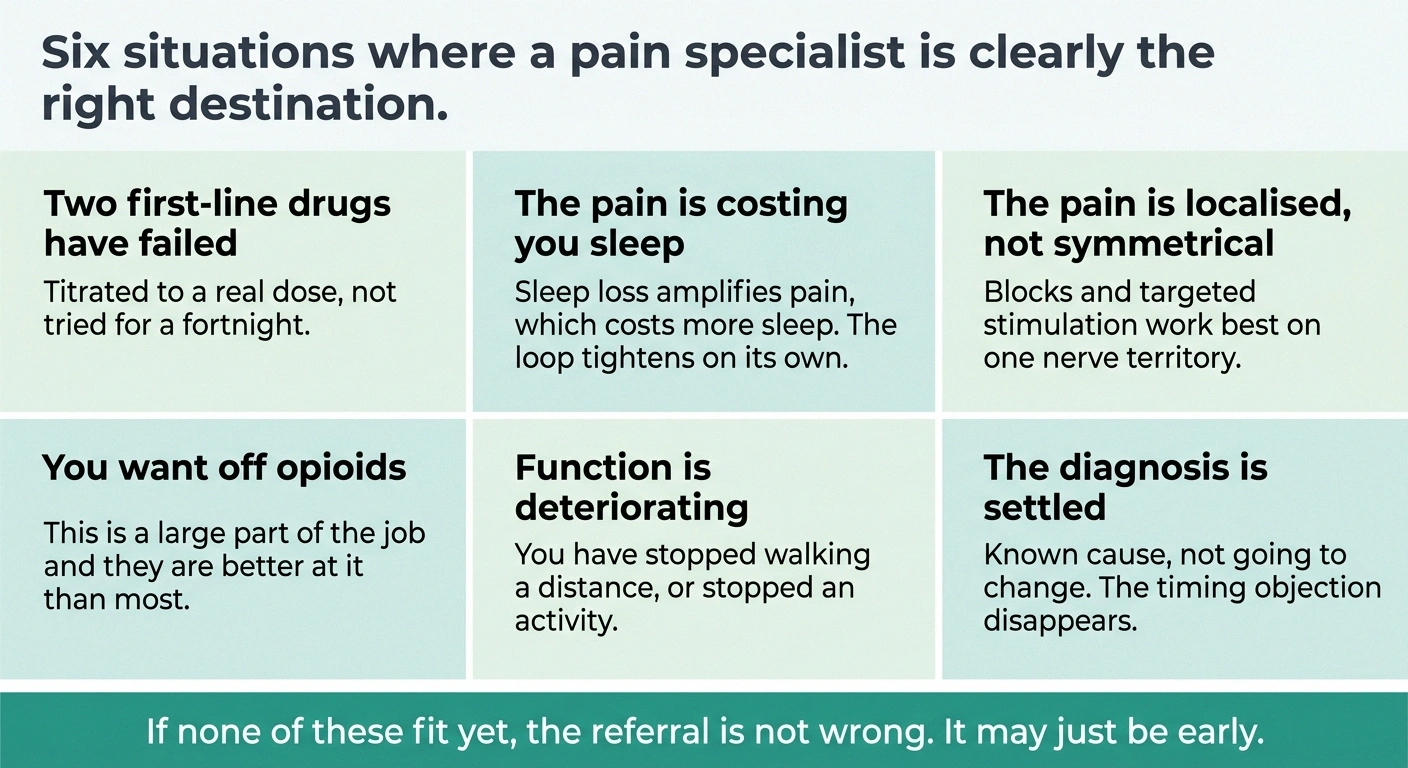
Set the timing caution aside. These are the situations where a pain specialist is straightforwardly the right destination.
Two or more first-line medications have failed at proper doses. Not tried for a fortnight and abandoned. Titrated to a reasonable dose and either ineffective or intolerable. If gabapentin, pregabalin, and duloxetine have all had a fair run, you have exhausted what most primary care can offer.
The pain is regularly costing you sleep. Sleep loss amplifies pain, which costs more sleep. That loop tightens on its own and it responds poorly to waiting.
The pain is localised rather than spread across both feet. This one is underappreciated. Interventional procedures target specific nerves. A pain confined to one nerve territory, one foot, or one region is far more amenable to a block or a targeted stimulator than symmetrical burning across both feet, which is the classic pattern of length-dependent neuropathy.
You are trying to stay off, or come off, opioids. Pain specialists do this constantly. It is a large part of the job and they are better at it than almost anyone else in the system.
Function is deteriorating. You have stopped walking the distance you used to, stopped an activity, started declining things. Function is a better trigger for escalation than a pain score, because it is harder to talk yourself out of noticing.
You have a diagnosis and it is not going to change. Established diabetic neuropathy, small fiber neuropathy with a known driver, or post-chemotherapy damage. When the cause is known and the cause is settled, the timing objection disappears entirely.
What They Actually Have in the Toolbox
Broadly four categories, and it is worth knowing which is which before you walk in, because the appointment moves quickly.
Medication strategy beyond the first line. Combination therapy at lower doses of each, rotation between drug classes, topical agents, and drugs that primary care rarely reaches for in nerve pain. This is the least glamorous part of the visit and for a lot of people it is the part that helps.
Injections and nerve blocks. Local anesthetic, sometimes with a steroid, placed near a specific nerve or group of nerves. Nerve blocks are established for several neuropathic conditions including diabetic neuropathy and CRPS. They are diagnostic as well as therapeutic: if blocking a specific nerve stops the pain, that tells everyone something useful about where the pain is generated.
Neuromodulation. Spinal cord stimulation and peripheral nerve stimulation, which use electrical current to interrupt pain signalling. This is the most substantial intervention on offer and gets its own section below.
Infusions. Intravenous lidocaine and ketamine among others, delivered in a monitored setting, generally for severe pain that has not responded to oral agents.
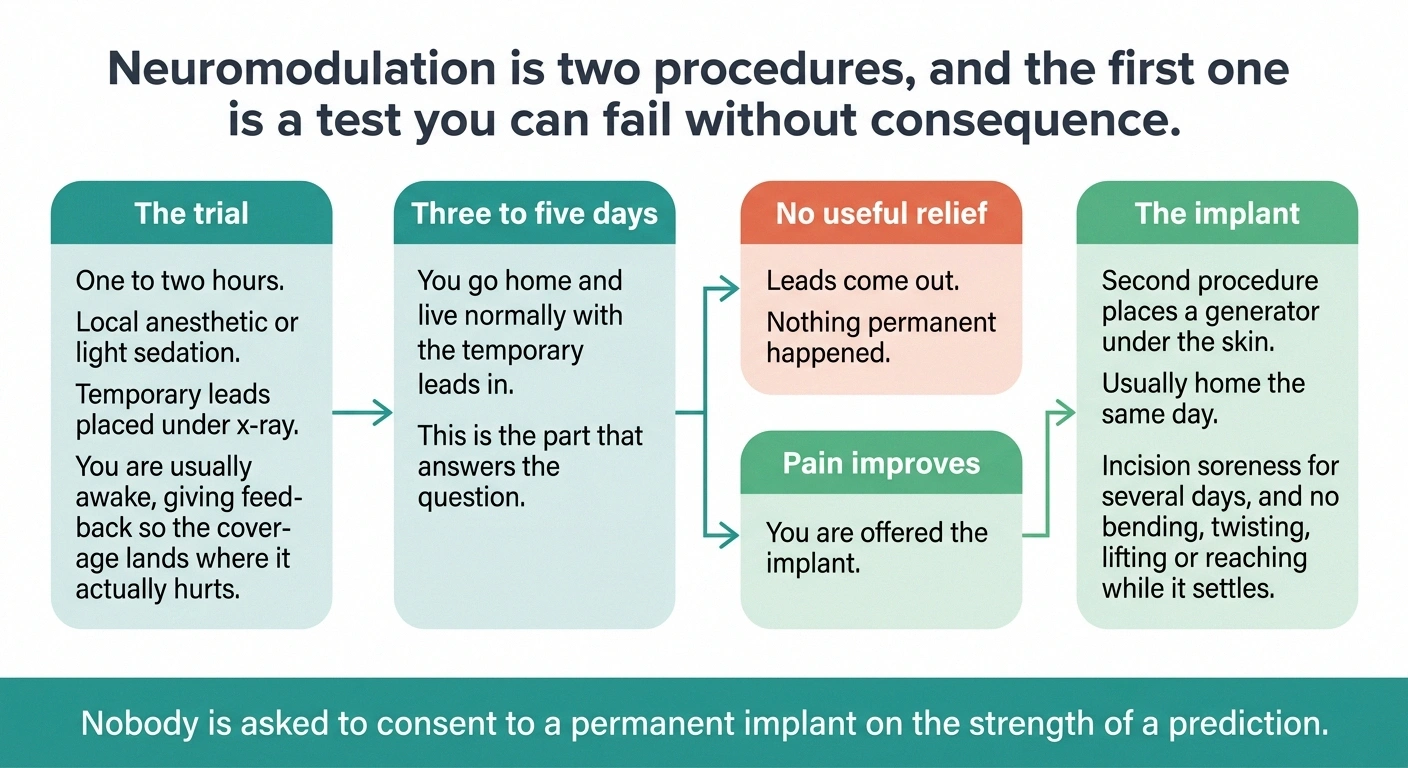
Worth understanding: spinal cord stimulation is not one procedure but two, and the first one is a test you can fail without consequence. A trial comes first. Temporary leads are placed in the epidural space under x-ray guidance, typically under local anesthetic or light sedation, in a one to two hour procedure. You are usually awake and giving feedback while the leads are positioned, so that the coverage lands on the area that actually hurts. The leads stay in for three to five days while you go about ordinary life and find out whether it helps. Only if it does are you offered the permanent implant, which places a generator under the skin at a second procedure. Most people go home the same day, with some incision soreness for several days and instructions to avoid bending, twisting, lifting, and reaching while things settle.
That trial-first structure is the single most reassuring fact about neuromodulation and it is rarely explained clearly. Nobody is asking you to consent to a permanent implant on the strength of a prediction.
What the First Appointment Looks Like

Expect it to be longer than you are used to and more thorough than you expect.
The folder that makes a first appointment worth twice as much
Records requests between health systems are slow, and a first visit spent waiting for a report to arrive is a first visit wasted. Everything here can be assembled the night before in about twenty minutes.
Including what you stopped, why, and roughly when
People leave these off. They belong on the same page
The report itself, not a summary of what you were told
Especially B12, A1C, thyroid and kidney function
Time of day, what you tried, what changed
Walk to the mailbox. Sleep through. Be specific
The last item does more work than the rest combined. A named function gives the clinic something to aim at and gives you something to measure against in three months, which a pain score out of ten never does.
A detailed pain history comes first: character, location, timing, what makes it worse, what you have tried and at what dose. Bring a written list of medications with doses and dates, because reconstructing that from memory in the room goes badly and it is the information the whole visit depends on.
A physical examination follows, usually including sensory testing, and often more careful than the one your primary care doctor has time for.
Then a review of imaging and prior test results, which is why bringing copies matters. Records requests between systems are slow and a first appointment spent waiting for a report is an appointment wasted.
Many clinics also ask you to complete questionnaires about mood, sleep, and function. This is not a suggestion that the pain is psychological. Chronic pain and its effect on mood and sleep run in both directions, and the questionnaires exist because treating one while ignoring the other produces worse results.
Most first appointments end with a plan rather than a procedure. If someone proposes an injection on day one without an examination and a records review, that is worth asking about.
Questions Worth Asking Before You Book

Interventional pain medicine is procedure-weighted in how it is reimbursed. That is a structural fact about how the specialty is paid rather than an accusation against anybody, and the reasonable patient response is a short list of questions rather than suspicion.
Which tool suits which pattern of pain
Not every tool fits every pattern, and knowing which is which before the appointment makes the conversation faster. The single biggest factor is whether the pain sits in one place or spreads symmetrically.
- Symmetrical burning in both feet
- Medication strategy first, and spinal cord stimulation is the interventional option with the most relevant evidence. Blocks aimed at a single nerve have little to target here.
- Pain confined to one nerve territory or one limb
- The best case for a nerve block, which is diagnostic as well as therapeutic. If blocking that nerve stops the pain, everyone has learned where it is generated.
- Severe pain not responding to anything oral
- Where infusions such as intravenous lidocaine or ketamine enter the conversation, delivered in a monitored setting rather than at home.
- Moderate pain, several drugs partly helping
- The least dramatic and most commonly useful answer: combination therapy at lower doses of each, which often beats maximising a single drug and carries fewer side effects.
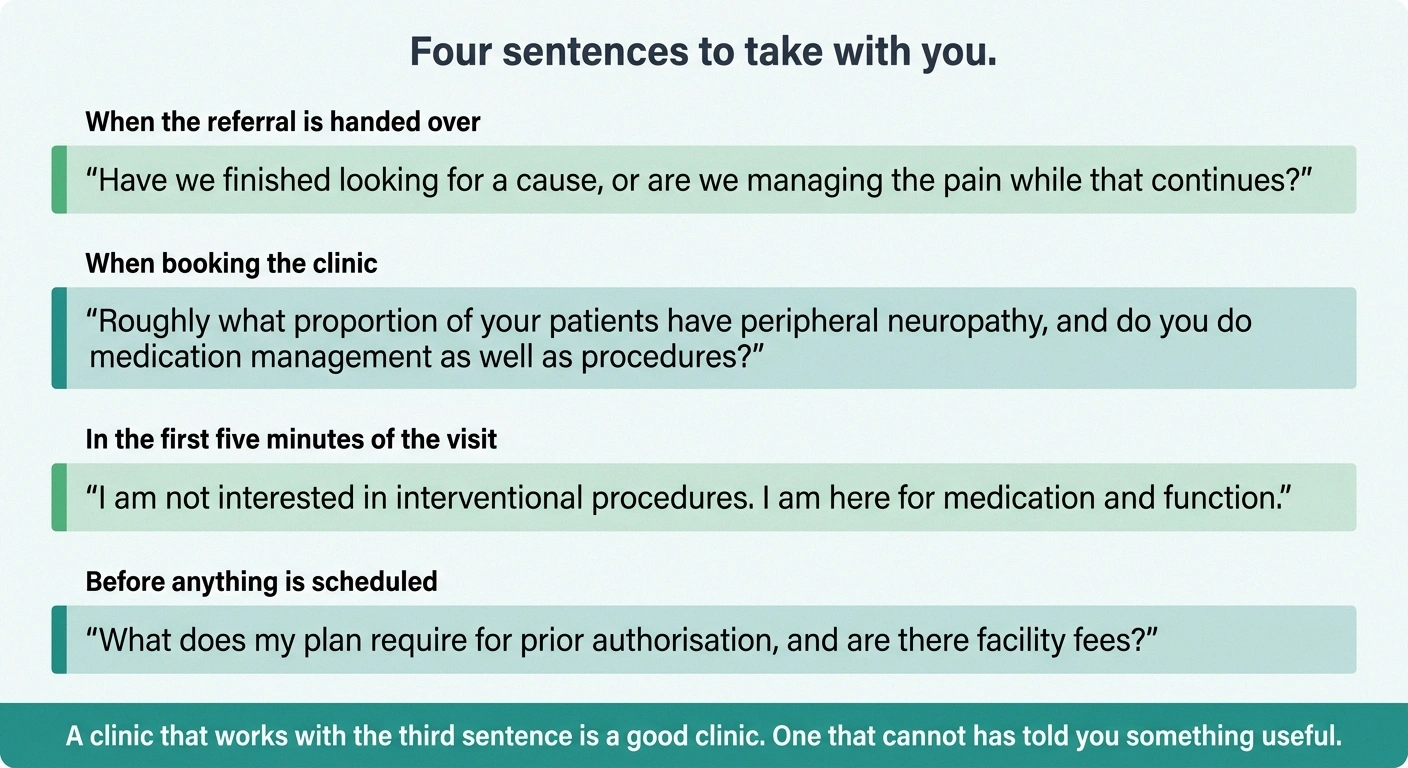
Ask what proportion of their patients have peripheral neuropathy specifically. A practice built around spine and back pain is a different practice from one that sees a lot of nerve damage, and both exist under the same specialty name.
Ask whether they do medication management as well as procedures, or procedures only. Some clinics send medication questions back to your primary care doctor, which is worth knowing in advance rather than discovering afterwards.
Ask whether they will communicate with your neurologist and your primary care doctor. Fragmented care is the default unless somebody insists otherwise.
Ask what happens if the first thing does not work. A clinic with one answer is a narrower resource than a clinic with a sequence.
And ask about cost and coverage before anything is scheduled. Interventional procedures carry facility fees that surprise people, and prior authorisation requirements vary enormously between plans.
If You Do Not Want the Procedures
Some people read this far and conclude the visit is not for them, because they do not want injections and they are not going to consider an implant.
What is still on the table if you decline everything sharp
People assume declining procedures means declining the specialty. It removes one of four categories. Here is what remains.
- Combination medication strategy. Two drugs at lower doses often beat one at maximum, with fewer side effects and better tolerability.
- Topical options beyond the pharmacy shelf. Including compounded formulations that primary care rarely reaches for.
- Drug classes not routinely tried in general practice. The list is longer than most people realise and it is used every day here.
- Attached physical and occupational therapy. Coordinated in one place rather than assembled by you across three.
- Pain psychology. Not a suggestion the pain is imagined. It is the discipline with the best evidence for the sleep and mood loop that makes everything else harder.
Say it in the first five minutes rather than at the end. It reframes the visit, costs you nothing, and tells you quickly what kind of practice you have walked into.
Go anyway, and say so at the start.
The medication expertise alone often justifies the appointment. Combination approaches at lower doses, better topical options, and drugs your primary care doctor does not routinely prescribe for nerve pain are all available without anything sharp being involved. Many pain clinics also have physical therapy, psychology, and occupational therapy attached, which is a coordinated resource that is hard to assemble on your own.
Saying “I am not interested in interventional procedures, I am here for medication and function” in the first five minutes reframes the entire visit and costs you nothing. A good clinic will work with that. A clinic that cannot has told you something useful.
None of this replaces the things that were already working, and it is not a reason to stop the home approaches you already rely on.It is one more set of tools, held by somebody who uses them all day, and the things that already help you get through an evening keep working alongside it.
Frequently Asked Questions
What does a pain management doctor do for neuropathy?
Four things, roughly. Medication strategy beyond the first-line drugs, including combinations and topical agents. Injections and nerve blocks targeting specific nerves. Neuromodulation, meaning spinal cord or peripheral nerve stimulation. And infusions such as intravenous lidocaine or ketamine for severe cases. Most also coordinate physical therapy and pain psychology.
Should I see a neurologist or a pain specialist for nerve pain?
They answer different questions. The neurologist works out what is damaging the nerve. The pain specialist works out what to do about the pain regardless of cause. If your cause has not been identified yet, the neurologist usually comes first, because good pain control can quietly remove the urgency to keep looking, and some causes are treatable only within a window.
Do pain clinics just give injections?
No, though the proportion varies a lot between practices. Ask directly whether a clinic does medication management as well as procedures before you book. If you do not want procedures, say so at the first appointment and the visit can be built around medication and function instead.
Will a pain specialist prescribe opioids for neuropathy?
Usually not as a first move, and often not at all. Opioids work poorly for neuropathic pain compared with how they work for other kinds, and pain specialists are typically the people helping patients come off them rather than start them. If you are on opioids and want to reduce or stop, this is one of the specialties best equipped to help.
What happens at a first pain management appointment?
A long pain history, a physical examination usually including sensory testing, a review of your prior imaging and test results, and questionnaires on mood, sleep, and function. Most first visits end with a plan rather than a procedure. Bring a written medication list with doses and dates, and copies of prior results.
Does a spinal cord stimulator get implanted right away?
No. There are two separate procedures. The first is a trial with temporary leads placed under x-ray guidance, usually under local anesthetic, lasting one to two hours, with you awake and giving feedback so the coverage matches your pain. The leads stay in for three to five days of ordinary life. Only if pain improves are you offered the permanent implant.
Does insurance cover pain management for neuropathy?
Consultations generally are covered. Individual procedures often require prior authorisation, and requirements vary widely between plans. Facility fees for interventional procedures catch people out. Ask the clinic’s billing staff what your specific plan requires before anything is scheduled.
Is being referred to pain management a sign my neuropathy is permanent?
No. It usually means first-line medications have not done enough, or that managing the pain has outgrown what short primary care appointments can handle. It is a statement about tools rather than about prognosis. The one thing worth confirming is whether the search for a cause is finished or still running, because those are two different situations wearing the same referral slip.
How long is the wait, and what should I do meanwhile?
Waits of several months are common. Use them: keep a simple record of pain by time of day, what you tried, and what changed. Bring that to the first appointment. It is the single most useful thing you can hand a new specialist, and it is worth more than any description reconstructed from memory in the room.
About the Author