If someone told you that looking at a mirror for fifteen minutes a day could reduce nerve pain, you would probably be skeptical. I was, the first time I read about it. There are no electrodes. No drugs. No machines. Just a mirror, your two hands or two feet, and a brain that turns out to be more tricked-able than we thought.
Mirror therapy started as a strange idea from one of the most creative minds in modern neuroscience, V.S. Ramachandran at UCSD, who in 1995 wanted to know whether the brain could be fooled into believing a missing limb was still there. The first patients to try it were amputees living with phantom limb pain — pain in a limb that no longer existed. Many of them, after a few weeks of mirror exercises, reported their phantom pain had eased or vanished entirely. The Lancet published the case series, and a quiet field of research began.
Thirty years later, mirror therapy is no longer fringe. It’s recommended in stroke rehabilitation guidelines, used routinely in some chronic regional pain syndrome (CRPS) clinics, and increasingly studied as a low-cost adjunct in peripheral neuropathy. It will not work for everyone, and it is not a replacement for medical treatment. But for the right person, it costs nothing to try and may help meaningfully.
How a Mirror Can Quiet Nerve Pain
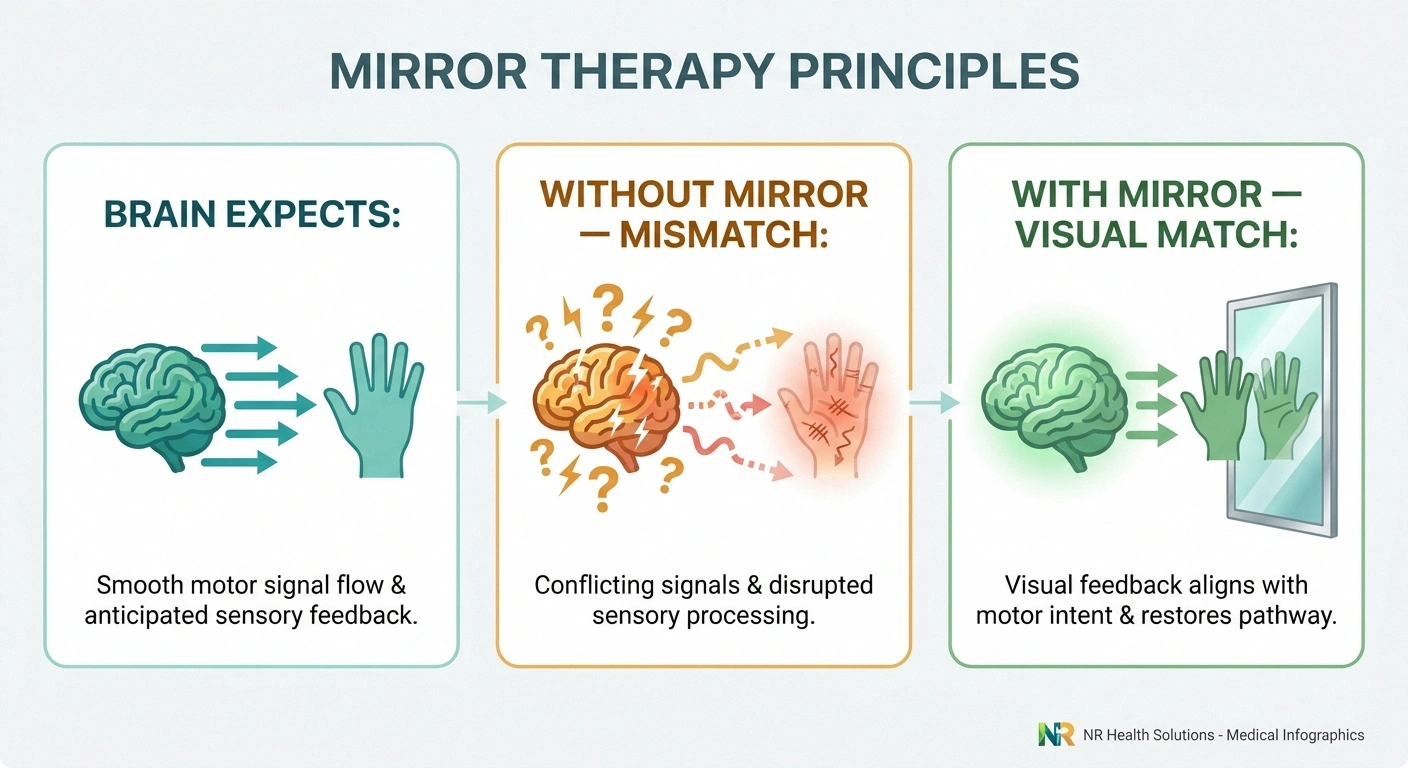
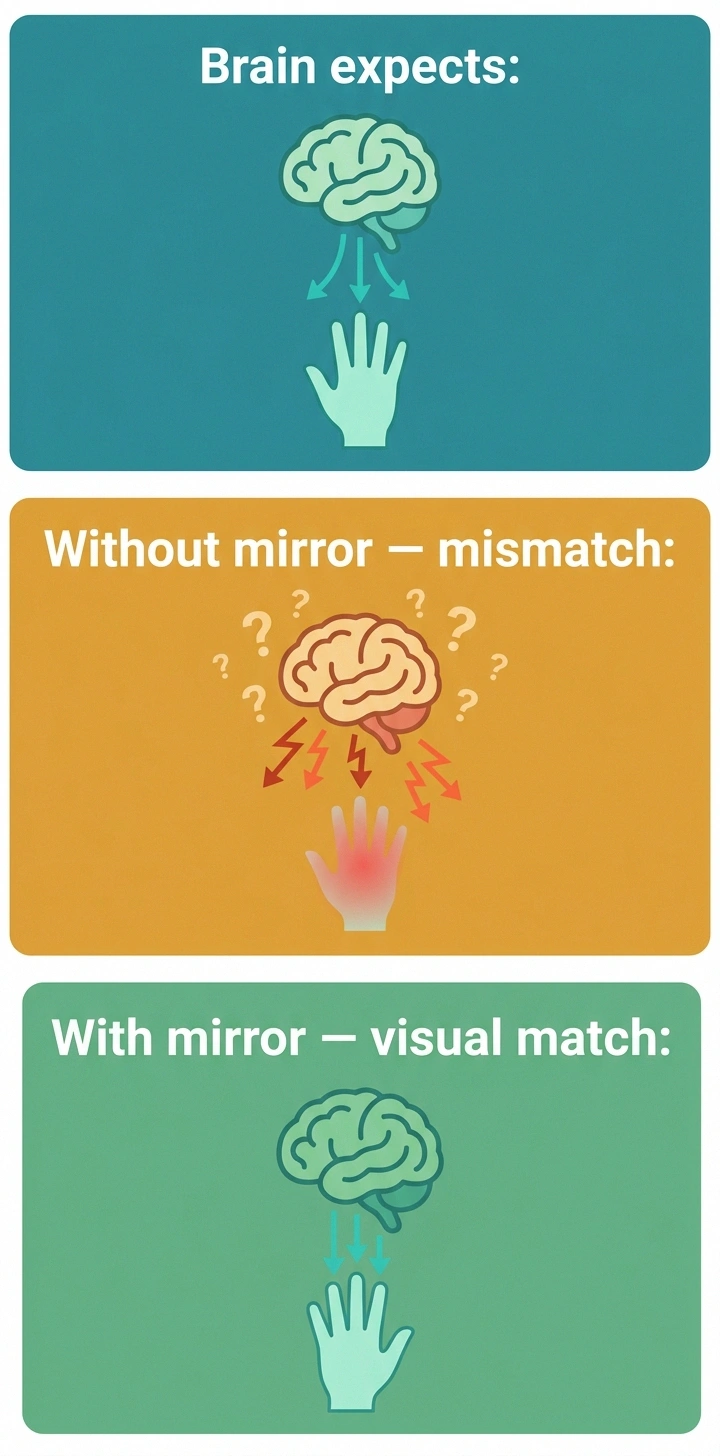
To understand why mirror therapy works at all, you have to understand that pain is not produced by your nerves alone. Pain is produced by your brain interpreting nerve signals. When the signals from a damaged or missing limb stop matching what the brain expects to receive, the brain doesn’t just go silent — it amplifies, fills in, and sometimes creates pain where no pain should be.
Pain is produced by your brain interpreting nerve signals — not by the nerves alone. When sensory and movement signals from a damaged limb stop matching what the brain expects, the brain often resolves the conflict by amplifying pain. A mirror lets the brain see what it expects (a normally moving limb), which partially overrides the underlying alarm signal. fMRI scans confirm real changes in motor cortex and pain-processing areas during sessions.
Researchers call this sensorimotor incongruence. Your brain has an internal model of where your limbs are and what they’re doing. That model is built from constant inputs: vision, proprioception (your sense of body position), touch, the muscle and joint signals that come from movement. When those inputs disagree — when the brain expects movement signals but doesn’t get them, or expects sensation from a limb that’s no longer firing properly — the system tries to resolve the conflict. Pain is often the way it does so.
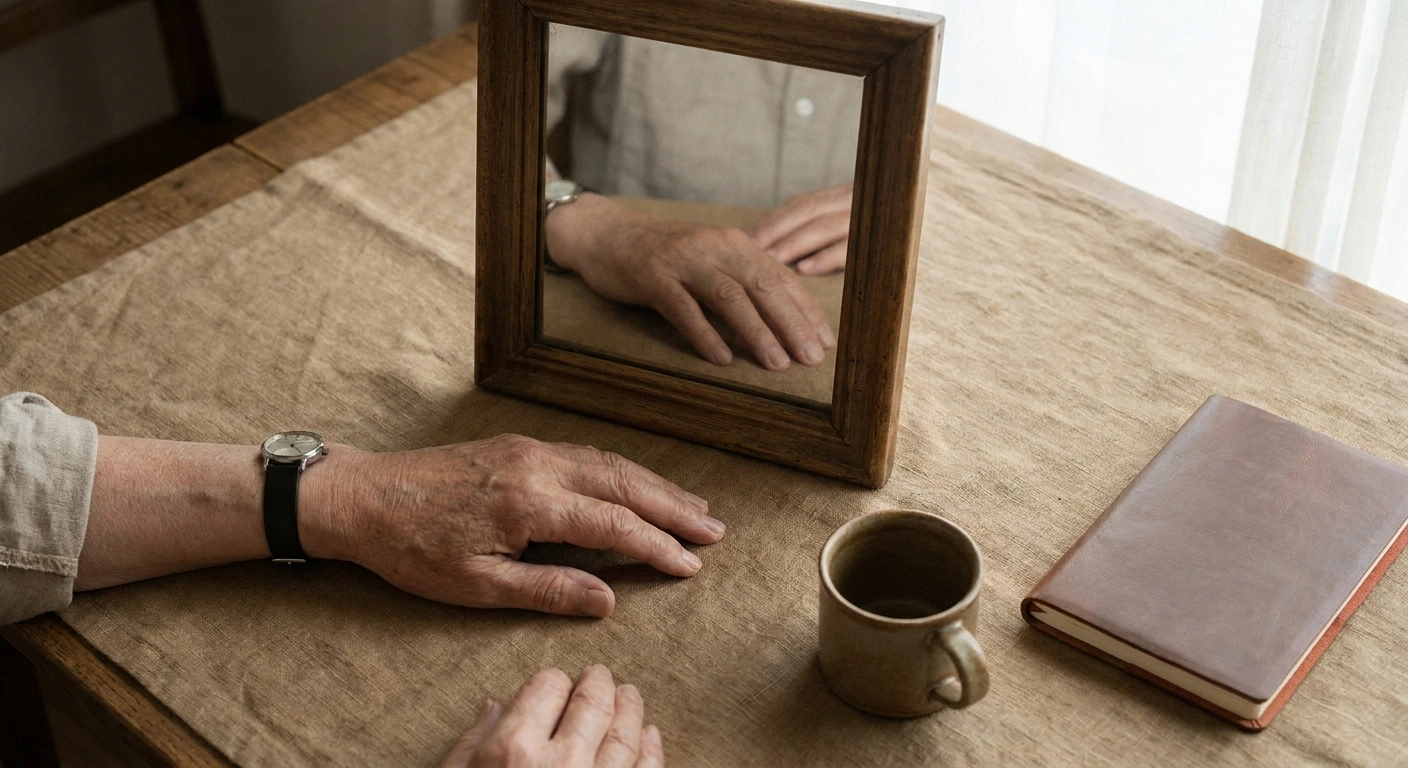
A mirror solves the conflict by showing the brain what it expects to see. If you place your good hand on one side of a mirror and your painful hand behind it, then move the good hand while watching the reflection, your brain perceives two intact, normally moving hands. The visual signal of normal movement coming from where the painful hand sits overrides — partially, sometimes substantially — the brain’s underlying alarm signal.
Imaging studies have confirmed real changes in brain activity during mirror therapy. fMRI scans show increased activation in the primary motor cortex, the supplementary motor area, and the insular cortex — areas involved in the perception of movement, ownership, and pain. The brain isn’t just being entertained by an optical illusion. It’s reorganizing.
Where the Evidence Is Strongest
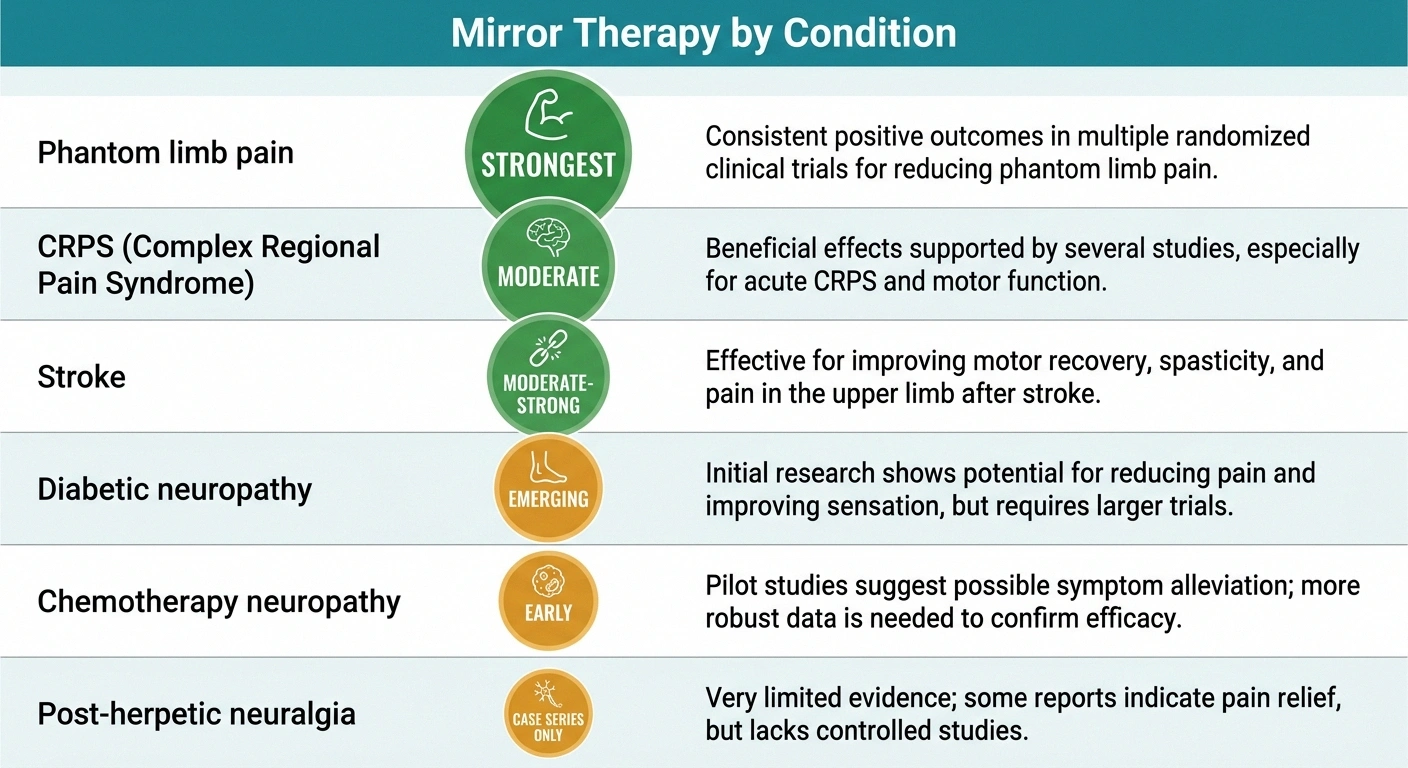
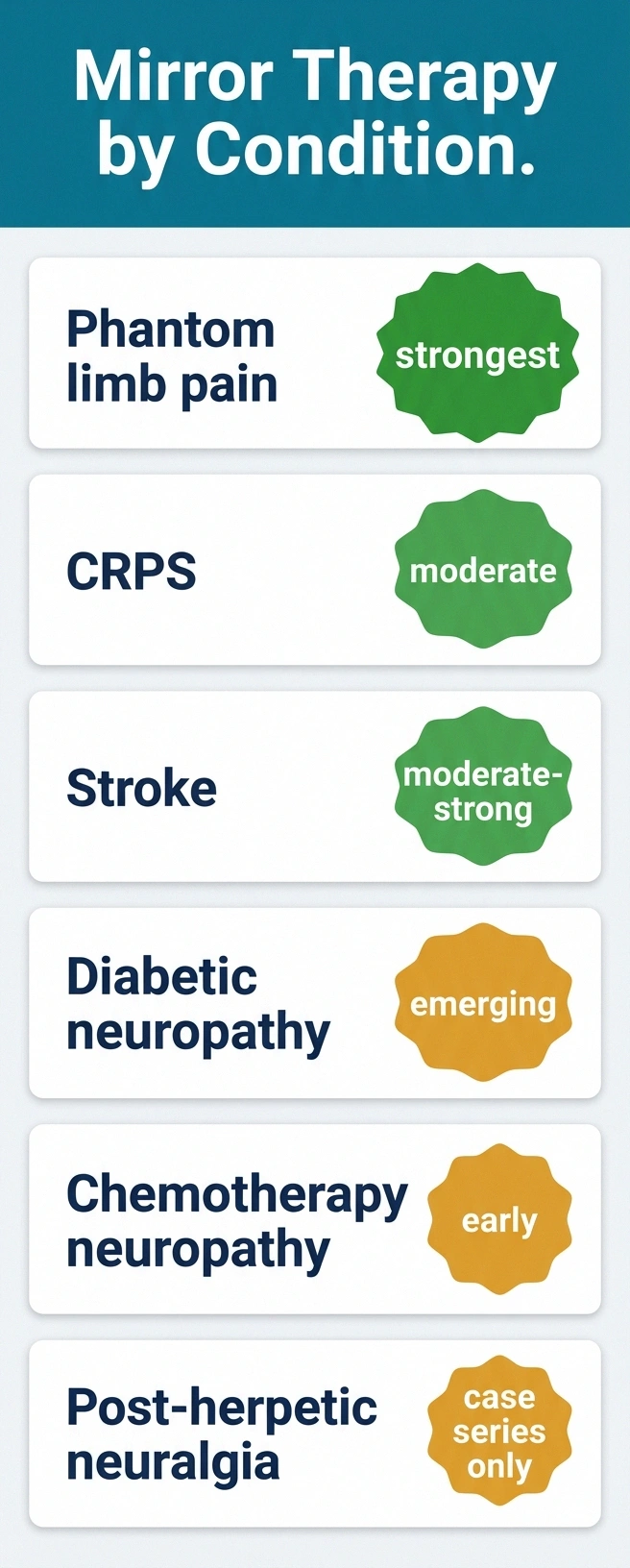
Mirror therapy has been studied across a range of pain conditions. The depth and quality of evidence varies considerably by condition.
2024 evidence summary by condition:
- Phantom limb pain: 2024 RCT — mirror therapy + PT outperformed PT alone for pain severity and adjustment
- CRPS: Graded motor imagery (mirror therapy in stage 3) — moderate evidence in multiple RCTs
- Stroke: Multiple meta-analyses support motor recovery + hemiplegic shoulder pain
- Diabetic foot neuropathy: 2020 pilot — improved pain intensity + QoL after 4 weeks daily practice
- CIPN: Early small-trial signal, promising but underpowered
Phantom limb pain (strongest evidence). The original use case, and still the best-supported. A 2024 systematic review and a 2024 randomized controlled trial both found that mirror therapy added to routine physical therapy outperformed physical therapy alone over four weeks. Effect sizes are moderate. Not every amputee responds, but a substantial minority report meaningful reductions in phantom pain and improvements in psychological adjustment.
Complex regional pain syndrome, Type I and II (moderate evidence). CRPS is a condition where pain dramatically outlives the original injury, often becoming chronic and disabling. Graded motor imagery — a structured protocol that progresses from laterality recognition to motor imagery to mirror therapy over six weeks — has the strongest evidence here. The mirror therapy step alone shows benefit in several randomized trials.
Stroke rehabilitation and post-stroke pain (moderate-to-strong evidence). Multiple meta-analyses support mirror therapy for motor recovery and hemiplegic shoulder pain following stroke. It’s recommended in several national stroke rehabilitation guidelines.
Diabetic peripheral neuropathy (emerging, limited evidence). This is where most readers of this article live. The evidence is genuinely promising but smaller in scale than the phantom limb literature. A 2020 pilot study in patients with diabetic foot neuropathy found improvements in pain intensity and quality of life after four weeks of daily mirror-box practice. Several small trials since then have echoed that signal. There is no large, definitive trial yet — but the mechanistic rationale and the absence of safety risk make this a reasonable thing to try.
Chemotherapy-induced peripheral neuropathy (early evidence). A handful of small studies have explored mirror therapy as an adjunct to standard CIPN management. Results are preliminary but encouraging in patients with hand-foot pain.
Post-herpetic neuralgia and other localized neuropathies. Case series and small studies; no large trials.
The honest summary: mirror therapy has the most solid evidence in phantom limb pain, CRPS, and stroke. Its application to peripheral neuropathy — diabetic, chemotherapy-induced, or otherwise — is plausible and being studied, but the evidence base is still building. That said, the safety profile is essentially perfect, the cost is essentially zero, and a four-to-six week trial costs you nothing but time.
Setting Up a Mirror Box at Home
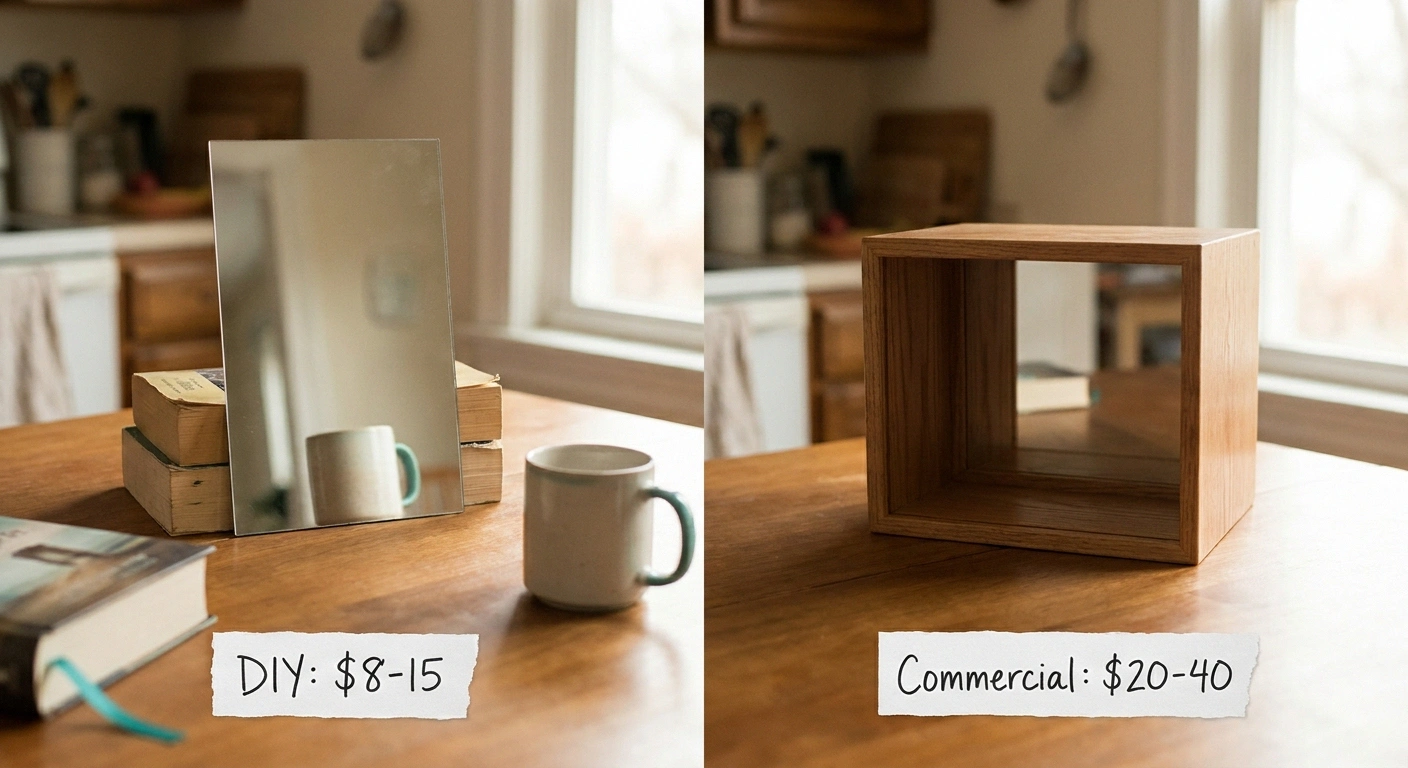
You don’t need to buy anything fancy. The setup is intentionally simple — that’s part of why it spread so quickly.
Tip: For foot work, use a larger mirror (18–24″ tall) and a seated position. Bright, even, indirect lighting; no glare on the mirror.
Option 1: A commercial mirror box. Search for “mirror therapy box” on Amazon or Etsy. Expect to pay $20 to $40. The benefits are sturdy construction and the right proportions out of the box. Most have an open end on each side where you slide your hands or feet in, and a vertical mirror in the middle.
Option 2: A DIY box from cardboard and a single mirror. A 12-inch by 12-inch unframed mirror from the craft store ($8 to $12), propped vertically in a cardboard divider with both sides open. This works fine. The mirror just needs to be large enough that, with one hand in front of it, the reflection fills your visual field on that side.
Option 3: A standalone vertical mirror. Even simpler — prop a vertical mirror on the table between you. Place your unaffected limb in front of the mirror, your affected limb behind it (out of your line of sight). Look only at the reflection.
For hand work, a tabletop mirror is enough. For foot work, you need a larger mirror (18 to 24 inches tall is ideal) and a seated position with both feet on the floor — one in front of the mirror, one tucked behind it so it’s hidden.
Lighting matters. Use bright, even, indirect light. Avoid glare on the mirror. The clearer the reflection, the better the illusion holds.
The Daily Protocol
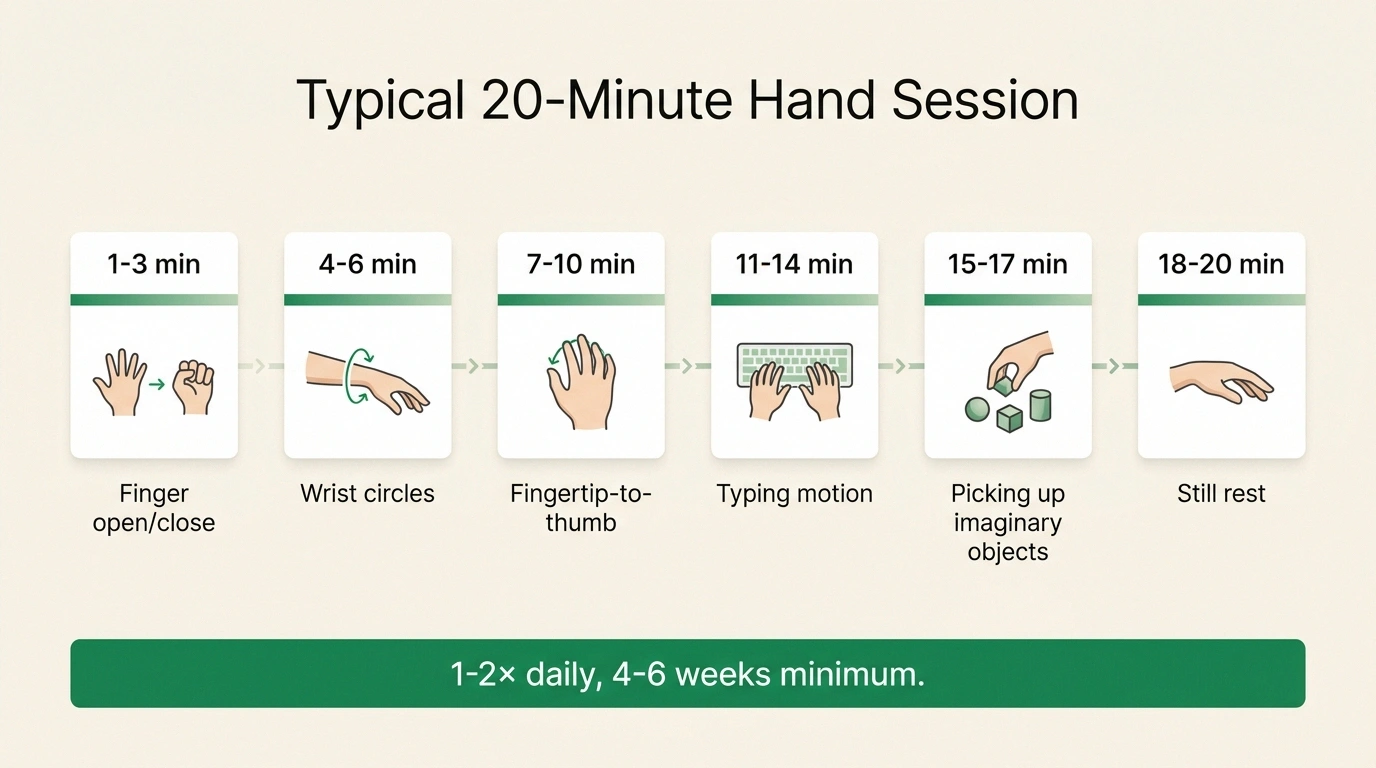
Most research studies use a structured daily protocol that you can replicate at home. The exact parameters vary, but the framework looks like this:
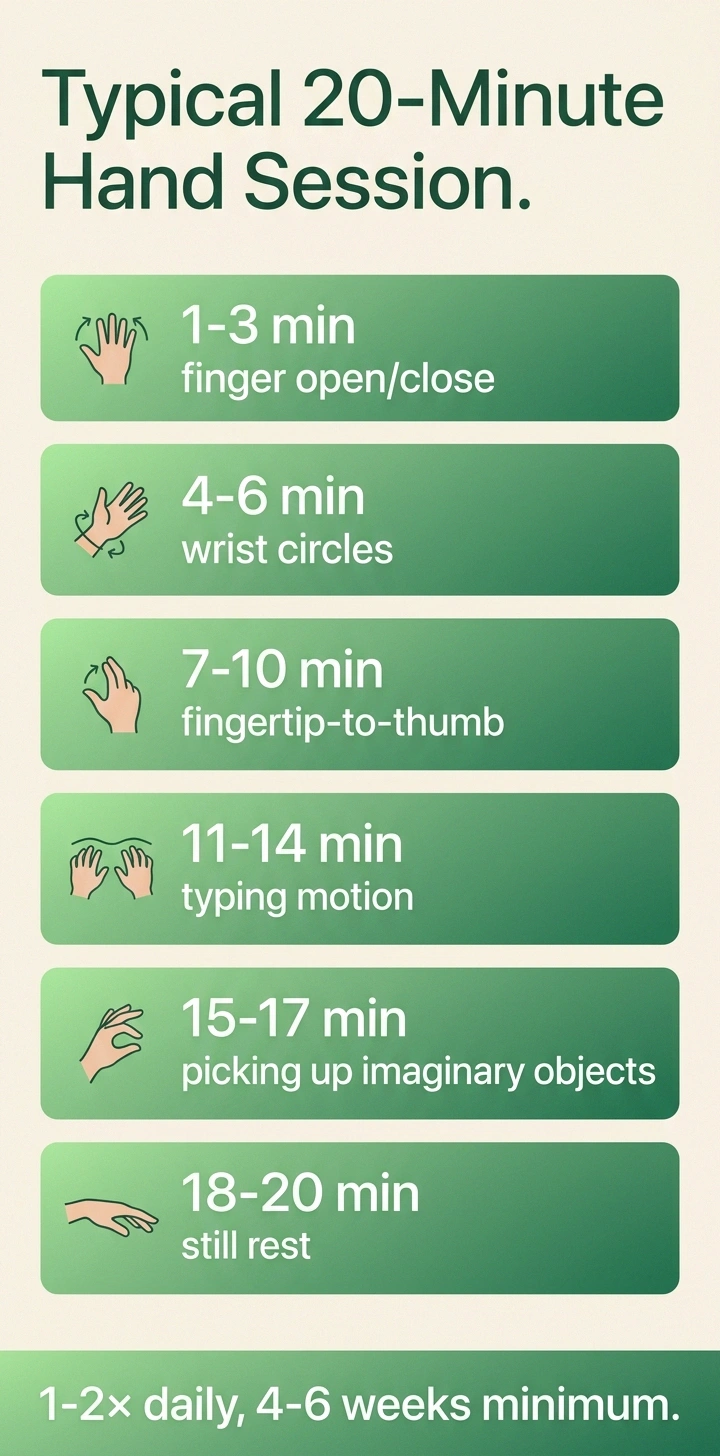
The one rule that matters: watch the reflection as if it is your real, intact limb. Don’t analyze the illusion.
- Session length: 15 to 20 minutes.
- Frequency: Once or twice daily.
- Total duration: 4 to 6 weeks minimum before you can fairly judge effect. Some patients need 8 to 12 weeks.
- What to watch: Only the reflection. Do not look at your affected limb. Some people find it helps to wear a slightly tinted lens or sit so the affected limb is in your peripheral vision but not your gaze.
- Movements: Slow, deliberate, symmetric. The brain responds better to smooth, intentional movement than to rapid or jerky motion.
A typical 20-minute session for hands might include:
- Minute 1–3: Open and close the fingers of your unaffected hand slowly, as smoothly as you can. Try to imagine your affected hand doing the same movement.
- Minute 4–6: Rotate the wrist in slow circles, clockwise then counter-clockwise.
- Minute 7–10: Touch each fingertip to the thumb, one at a time, in sequence.
- Minute 11–14: Pretend to type, or make piano-playing motions across the table surface.
- Minute 15–17: Pretend to pick up small objects (a marble, a coin) — even if no objects are present.
- Minute 18–20: Rest the hand in the reflected position; watch the reflection as if both hands belong to you.
For feet, a similar progression: ankle dorsiflexion and plantarflexion (lifting and pointing toes), ankle circles, toe spreading, heel tapping, and finally light steps in place while seated.
The single most important instruction in every protocol: watch the reflection as if it is your real, intact limb. Don’t analyze the illusion. Don’t think about whether it’s “really” your limb. Let your brain accept what it’s seeing for the duration of the session.
What to Realistically Expect
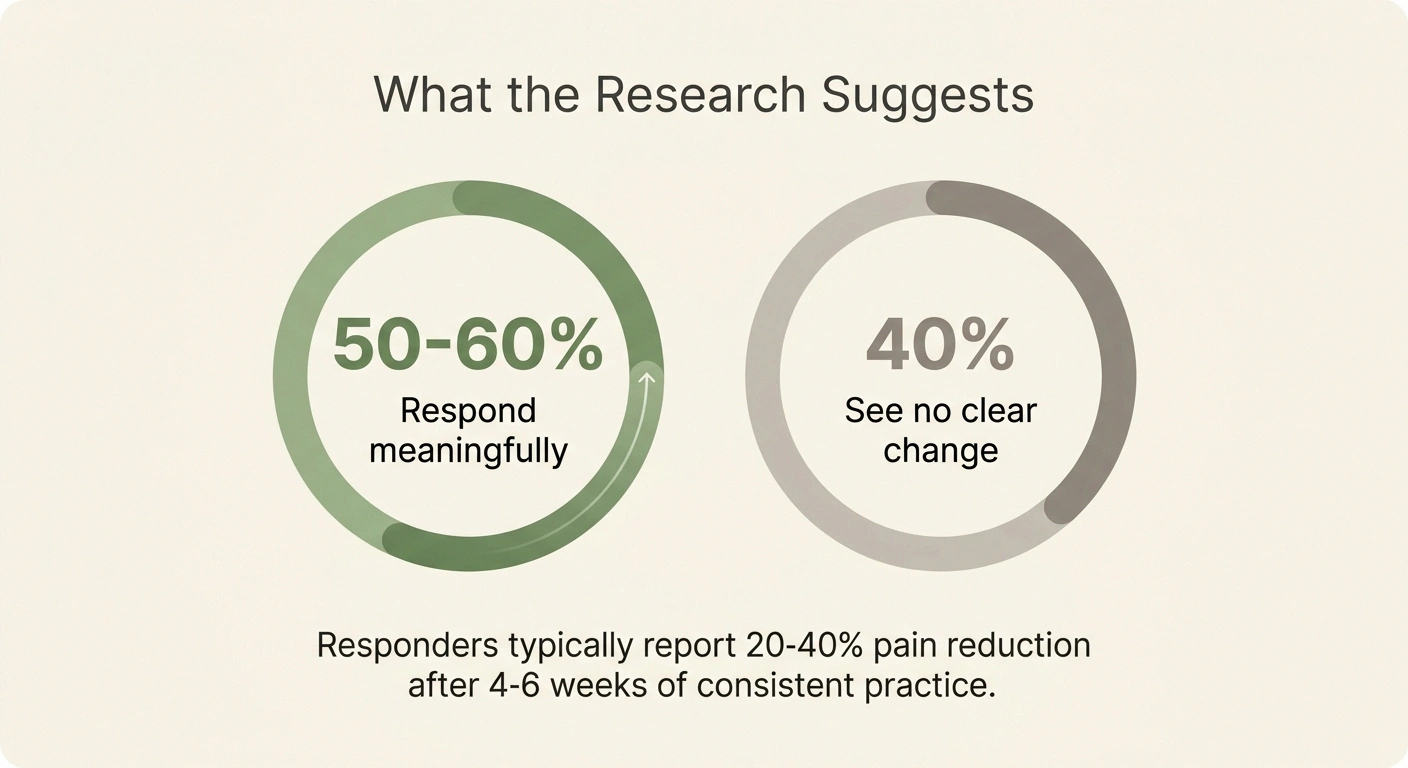
Mirror therapy is not magic. Here’s what the literature and clinical experience suggest about realistic outcomes:
- Responders typically report 20 to 40 percent reduction in pain intensity after 4 to 6 weeks of consistent practice. Some respond more dramatically; some not at all.
- Roughly 50 to 60 percent of patients in published trials are classified as “responders.” That leaves 40 percent who don’t notice meaningful change. Both groups still exist in real clinics.
- The first session can be strange. Some patients report mild disorientation, nausea, or briefly increased pain in the first session or two. This usually settles. If pain markedly worsens past the first week, stop and reassess.
- Effects build gradually. Don’t expect day-one results. Most published improvements emerge between weeks two and six.
- Gains can fade if practice stops. Many patients find they need to continue 2–3 sessions per week as maintenance once they’ve gotten the initial benefit.
- Mirror therapy works best alongside other treatments. It’s an adjunct, not a replacement for medications, physical therapy, blood sugar control, or any of the other elements of a real neuropathy plan.
The mental shift many patients describe is just as valuable as the pain reduction. After weeks of feeling like their painful limb is somehow not theirs anymore — a constant alien presence that hurts — many report feeling reconnected to it. That alone can change how the pain feels, separate from any change in intensity.
Combining Mirror Therapy with Other Approaches
Mirror therapy doesn’t conflict with anything else you’re doing for your nerves. If anything, it tends to amplify other approaches. Some practical combinations:
- Mirror therapy + gentle movement. Light daily exercise improves nerve blood flow and reduces pain on its own. Mirror sessions can be done immediately after a walk, when the nervous system is already in a calmer state.
- Mirror therapy + foot or hand massage. A brief self-massage of the affected limb before or after a mirror session can prime the sensory system and may help the brain reintegrate the limb.
- Mirror therapy + TENS. Some clinics use TENS on the affected limb during the mirror session, providing a gentle non-painful sensation that “matches” the visual signal.
- Mirror therapy + mental health support. Living with chronic pain takes a real psychological toll. Pain reduction from mirror therapy doesn’t replace the value of addressing the mental health side of neuropathy; the two work together.
- Mirror therapy + medication. No interactions. You can be on any neuropathy medication — gabapentin, pregabalin, duloxetine, a tricyclic — and use mirror therapy without changing anything.
When to Ask a Physical or Occupational Therapist for Help
You can do mirror therapy at home with no professional involvement. Many people do. But there are situations where a physical therapist or occupational therapist makes a real difference:
You can absolutely DIY this. But ask for a referral if:
- Severe allodynia (any touch is intensely painful) or CRPS — graded motor imagery is more effective than starting straight at the mirror
- Balance problems or recent falls — OT can integrate mirror therapy into a broader fall-prevention plan
- Four weeks of self-practice with no benefit — a therapist may catch subtle technique issues
- Recovery from amputation or major surgery — earlier integration produces better outcomes
- If your pain is from CRPS or you have severe allodynia (where any touch is intensely painful), starting with graded motor imagery under a trained therapist is more effective than jumping straight to mirror therapy. The therapist guides you through the early stages — laterality recognition and motor imagery — before introducing the mirror.
- If you have balance problems or have been falling. An OT can incorporate mirror therapy into a broader fall prevention plan and make sure your home setup is safe.
- If you’ve tried mirror therapy on your own for four weeks with no benefit. A therapist may identify subtle technique issues or recommend a different protocol.
- If you’re recovering from amputation or major surgery. Early integration of mirror therapy into rehabilitation produces better outcomes than starting it later. Ask your surgical team or rehab team to refer you.
Most insurance plans cover occupational and physical therapy for these indications. Medicare covers PT and OT for nerve pain with appropriate documentation.
The Cost
This is the easiest section to write in the entire article. Mirror therapy costs $0 to $40 in equipment, and zero per session forever after that.
- DIY mirror setup: $8–$15 (mirror) plus whatever you find around the house.
- Commercial mirror therapy box: $20–$40.
- Sessions with a trained therapist (if you want supervision): typically covered by insurance.
Compared to the cost of most things in chronic pain management — prescription medications, devices, procedures, specialist visits — this is essentially free.
Honest Limitations
Mirror therapy is one of those interventions where I want to be careful not to overpromise. Here are the limitations I’d want a friend to know about:
- It doesn’t regenerate nerves. If your neuropathy is from axonal damage that hasn’t healed, mirror therapy will not regrow nerves. It changes how your brain processes the pain, which is a real benefit, but it’s not the same as fixing the underlying damage.
- It may not work for everyone. Roughly 40 percent of trial participants don’t get meaningful benefit. Predicting in advance who responds is currently not possible.
- Some patients find it psychologically difficult. Watching a “phantom” or numb limb appear to move normally can be emotionally complex, especially after amputation. A therapist can help work through this.
- Evidence in peripheral neuropathy is still building. The strongest evidence is in phantom limb pain, CRPS, and stroke. Diabetic and chemo-induced peripheral neuropathy applications are promising but smaller in trial size.
- It requires consistency. A few sessions won’t tell you anything. Four to six weeks is the minimum honest trial.
None of these are dealbreakers. They’re just the honest framing.
A Six-Week Trial Plan
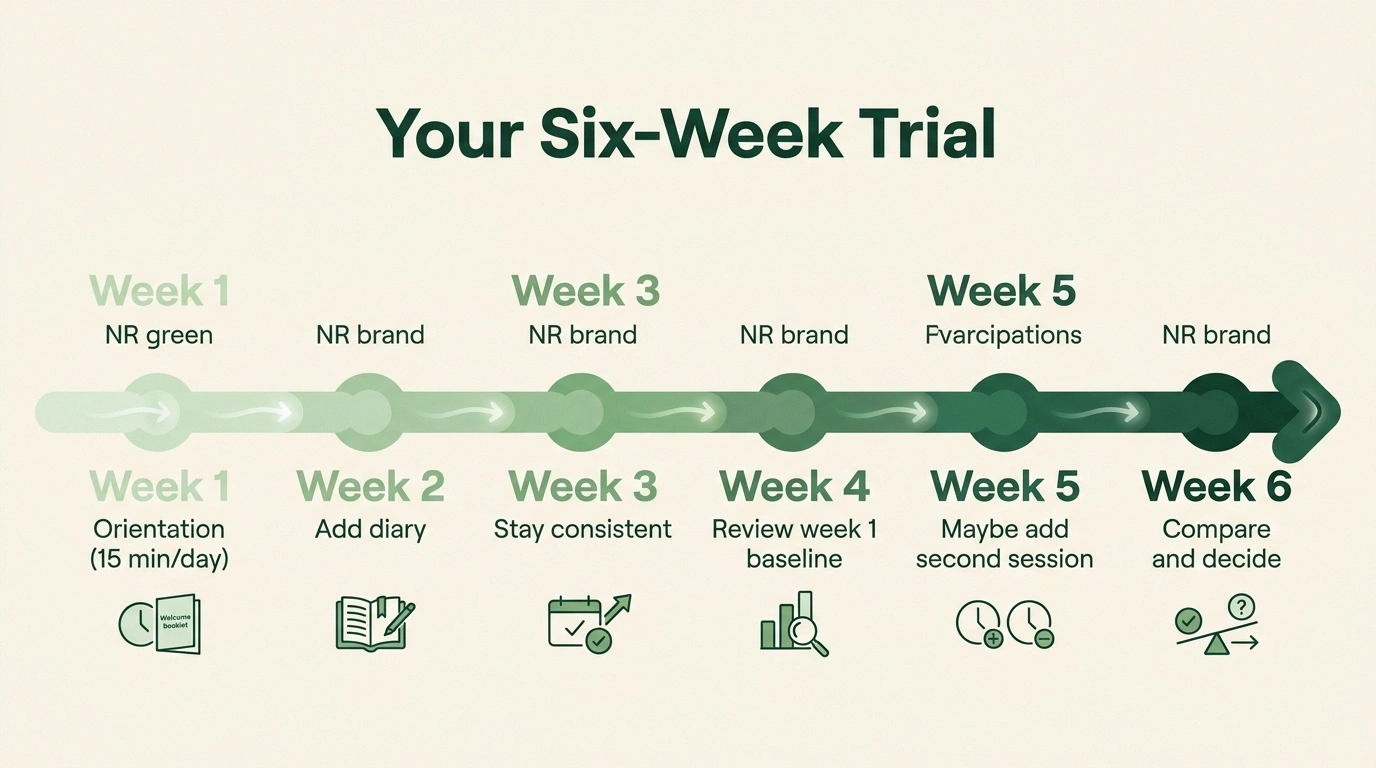
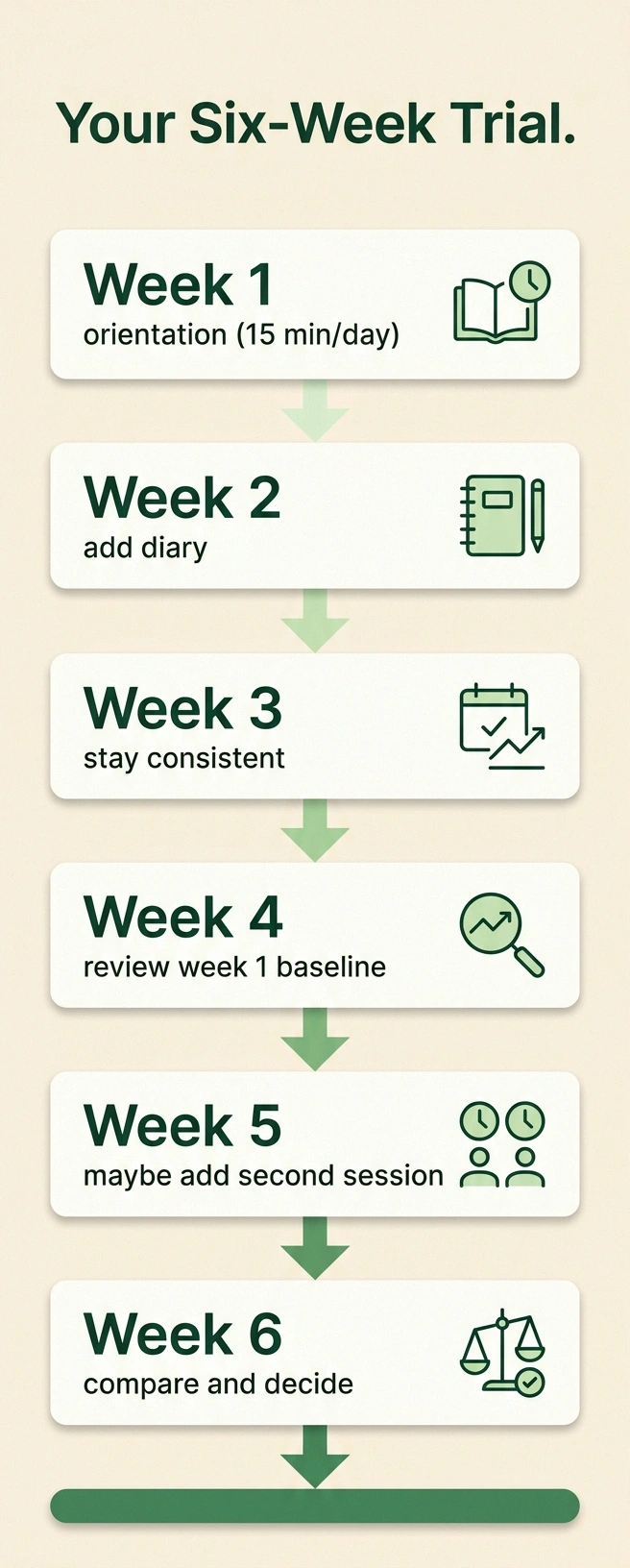
If you’re willing to give mirror therapy an honest shot, here’s a structure that mirrors what published trials look like:
- Week 1 (orientation). 15 minutes once daily. Get comfortable with the setup. Don’t worry about results — just get the routine going.
- Week 2. 20 minutes once daily, or 15 minutes twice daily if your schedule allows. Start a simple symptom diary: pain rating 0 to 10 first thing in the morning, last thing at night.
- Week 3. Same routine. Don’t analyze yet. Just keep going.
- Week 4. Same routine. Re-read your week-1 pain ratings and compare. Even modest improvement is signal.
- Week 5. If improving, continue. If no change yet, add a second session per day.
- Week 6. Compare your current symptom diary to baseline. Average reduction of 20% or more is a real signal — worth continuing as maintenance (2–3 sessions per week). Less than 10% — reasonable to stop and try something else.
The structured approach matters because mirror therapy benefits are gradual and easy to dismiss. A planned check-in date forces an honest comparison.
The Bottom Line
Mirror therapy is one of the strangest things in modern pain medicine — a treatment with no drugs, no devices, no electricity, and no side effects, that nonetheless produces real measurable changes in brain activity and self-reported pain in a substantial fraction of people who try it.
It is not a cure for neuropathy. It will not regenerate damaged nerves. It will not replace your medications. But for the cost of a $10 mirror and 20 minutes a day for six weeks, you can find out whether your brain is one of the ones that responds. That’s a remarkably good trade for the right person.
If you have phantom limb pain, CRPS, or post-stroke pain, mirror therapy has solid evidence behind it. If you have diabetic peripheral neuropathy or chemo-induced neuropathy, the evidence is smaller but encouraging. Either way, it’s a low-risk addition to a broader plan — not a replacement for the rest of your nerve-protection work.
Get a mirror. Set up a quiet corner. Give it six weeks. Then decide.
Frequently Asked Questions
Can I do mirror therapy with a regular bathroom or makeup mirror?
Yes, any flat mirror with a clear reflection works. The key constraint is size — the reflection needs to fill enough of your visual field to be convincing. A 12-inch square or larger mirror is usually enough for hand work. Foot work needs an 18-inch or larger vertical mirror.
Does mirror therapy work if I only have neuropathy on one side?
Yes, and that’s actually the easiest version. You use the healthy side as the model and place the affected side behind the mirror. Mirror therapy is harder to apply if both sides are equally affected, though some research uses a different protocol for bilateral cases.
What if both my feet hurt from diabetic neuropathy?
Bilateral neuropathy is a common scenario in diabetes. The standard mirror setup is harder here because there’s no “good side” to reflect. Some clinicians instead use motor imagery (visualizing pain-free movement) and graded movement protocols rather than mirror reflection. A physical or occupational therapist can adapt a protocol to your situation.
Should I see a therapist or just try it on my own?
You can absolutely try it on your own first. The technique is simple, low-risk, and free. If after four to six weeks of consistent practice you’ve seen no benefit, that’s the right time to ask your doctor for a referral to a physical or occupational therapist who can refine the protocol.
Is mirror therapy covered by insurance?
Mirror therapy itself is something you do at home, so there’s no charge to insure. Sessions with a physical or occupational therapist who incorporates mirror therapy into your rehabilitation plan are typically covered by insurance when prescribed by a doctor.
Why does mirror therapy work?
The current best explanation is that pain in damaged or missing limbs is partly produced by the brain trying to resolve mismatched signals between its internal model of the body and the inputs it receives. A mirror provides visual evidence that the affected limb is moving normally, which partially overrides the mismatch and reduces the pain signal. Brain imaging studies confirm real changes in motor cortex and pain-processing areas during mirror therapy.
How is mirror therapy different from graded motor imagery?
Mirror therapy is the third and final stage of graded motor imagery (GMI). The earlier stages are laterality recognition (training the brain to quickly identify left vs right limbs in photographs) and motor imagery (visualizing the affected limb moving normally without actually moving it). For severe pain conditions like CRPS, going through all three stages in order is more effective than skipping straight to the mirror.
Can I do mirror therapy after an amputation while my stump is still healing?
Yes, and the evidence suggests starting early is better than waiting. The brain begins reorganizing immediately after amputation, and mirror therapy may help that reorganization happen in a less painful direction. Coordinate timing with your surgical team to make sure the surgical site is stable enough.
Will mirror therapy help with numbness, or only with pain?
Most evidence is for pain reduction. Some patients report improved sensation as well, but this is less consistent. The intervention works primarily by modifying brain processing of pain signals, not by repairing the nerves that send sensation.
About the Author