
Somebody in our support group emailed me last week with a subject line that read, in all caps, “IS THIS THE ONE?” Inside was a link to a news article about a topical cream being studied for diabetic neuropathy — WST-057, made by a small biotech company called WinSanTor. She'd already talked to her husband about it. She wanted to know how to get on it.
I wrote back the way I always try to. Warmly, honestly, and slower than the hope wants to move. Because here's the truth I have to keep reminding myself and everyone in our circle: news about a promising drug and access to a promising drug are not the same thing. And a promising drug in a trial is not the same thing as a proven drug on a pharmacy shelf.
So let's sit down with a cup of coffee and go through what WST-057 actually is, what the researchers have found so far, where the clinical trials stand right now, and what all of this means for you if you're living with diabetic peripheral neuropathy and desperate for something new. I'll be honest about what's exciting and honest about what isn't yet.
What WST-057 Actually Is (in Plain Language)
WST-057 is the trial name for a topical liquid formulation of a drug called pirenzepine. Pirenzepine has been around for decades — it was used in Europe and Asia as a pill for peptic ulcer disease, well before the modern acid-blocker medications took over. It was safe, well-tolerated, and quietly retired when better ulcer options arrived.
Important: still investigational
WST-057 is not FDA-approved. It is not sold at pharmacies, cannot be legitimately compounded, and cannot be prescribed by your doctor for regular use. The only legal ways to access it today are enrollment in an active clinical trial listed on ClinicalTrials.gov or, in a limited number of U.S. states, participation in a right-to-try program if the sponsor is offering one there. Any website claiming to sell it is not a legitimate source.
So how did an old ulcer pill end up being studied for nerve regrowth in diabetic feet? The short story is that a research team looking at what happens to small nerve fibers in diabetes noticed something odd about a particular family of receptors on the nerves themselves — the muscarinic M1 receptors. When those receptors were blocked in laboratory studies, the small nerve fibers seemed to be protected. And, more remarkably, they seemed to regrow.
Pirenzepine, it turns out, is a very selective M1 receptor blocker. That old ulcer pill was suddenly being looked at with completely new eyes. The company WinSanTor took pirenzepine, reformulated it as a topical solution instead of a pill, and started testing it on the skin over the calves, ankles, and tops of the feet in people with diabetic peripheral neuropathy. That's what WST-057 is: pirenzepine, dissolved into a solution, applied to the skin once a day.
Two things worth saying up front. First, WST-057 is not FDA-approved. As of right now, you cannot walk into a pharmacy and get it. Your doctor cannot prescribe it. Your compounding pharmacy cannot legitimately make it for you. The only legal paths to it today are enrollment in an active clinical trial or, in a handful of U.S. states, participation in a right-to-try program if the company is offering it there.
Second, everything you're about to read about “how it works” is still being studied. The early results are exciting enough that I wanted to write about them at all. But excitement in phase 2 is not the same thing as an approved treatment on a pharmacy shelf. Hold both truths at once as we go through this.
How the M1 Muscarinic Idea Works (Translated)
Let me try to translate the mechanism into something we can actually picture, because I had to work through this myself several times before it clicked.
Your nerves have all kinds of tiny doorways on their surfaces called receptors. Different messengers in the body knock on different doorways to signal what a nerve should do. One family of doorways is called the muscarinic receptor family, and one specific member of that family is called M1. In healthy nerves, M1 activity is part of the normal background hum. It's fine.
In diabetic peripheral neuropathy, something appears to go wrong with that hum. Researchers studying diabetic mice noticed that when M1 receptors got over-activated in the small nerve fibers of the skin, those fibers seemed to shrivel back and die off. The nerves lost the fine, hair-like endings that let you feel a whisper of cotton on your foot. That loss of small-fiber endings is one of the reasons diabetic neuropathy feels the way it does — the burning, the numbness, the strange electric flickers — and it's the reason small fiber neuropathy has become such a focus in the research world.
Here's the interesting bet WinSanTor made. If M1 over-activation is helping to kill small fibers, then blocking M1 should stop the killing. And if you stop the killing, maybe the nerves get a chance to grow back. That's the whole hypothesis in one sentence.
Applying pirenzepine as a cream on the skin — instead of as a pill you swallow — was a smart engineering choice. The drug can reach the small nerve endings right there in the skin without saturating the whole body. That means fewer of the systemic side effects that come with oral medications, and a much better safety profile for a long-term daily use.
What the Research Actually Shows So Far
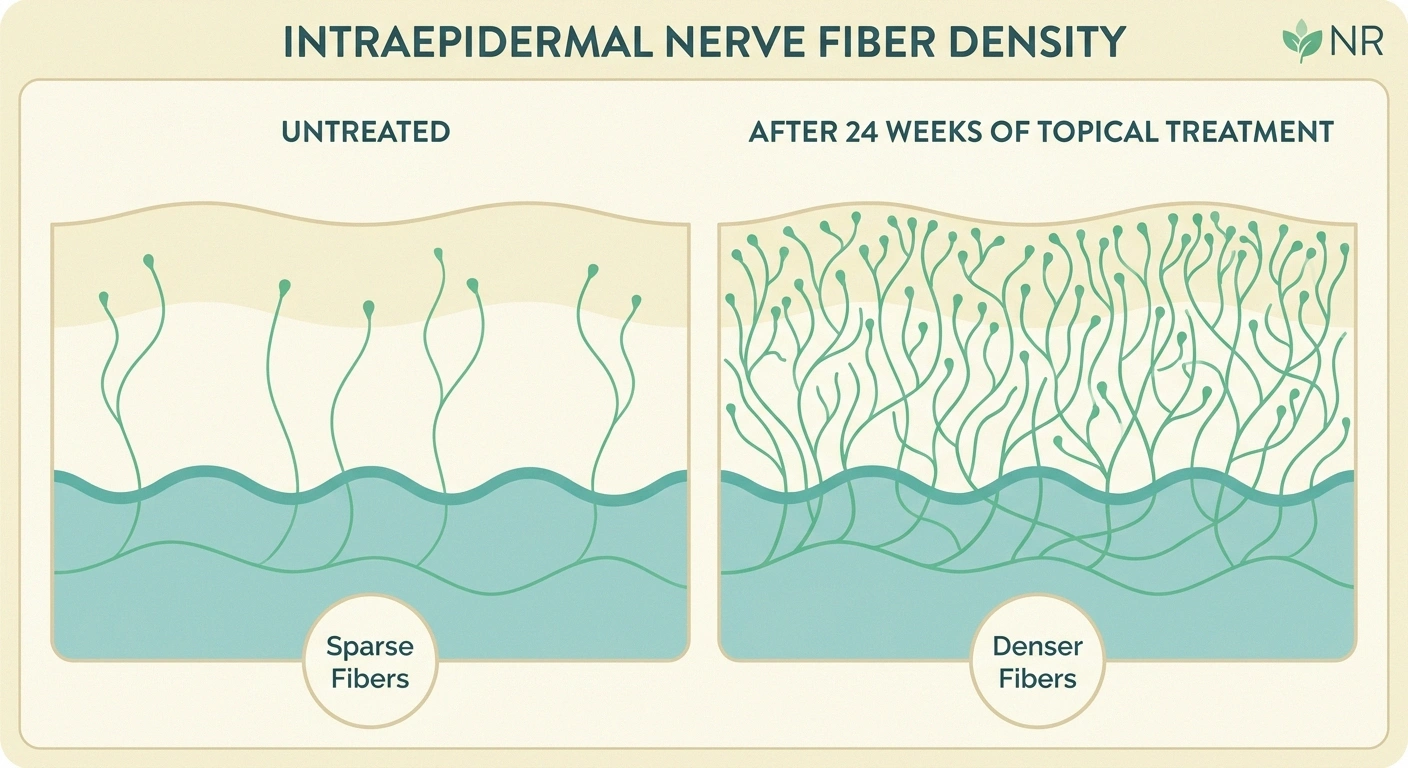
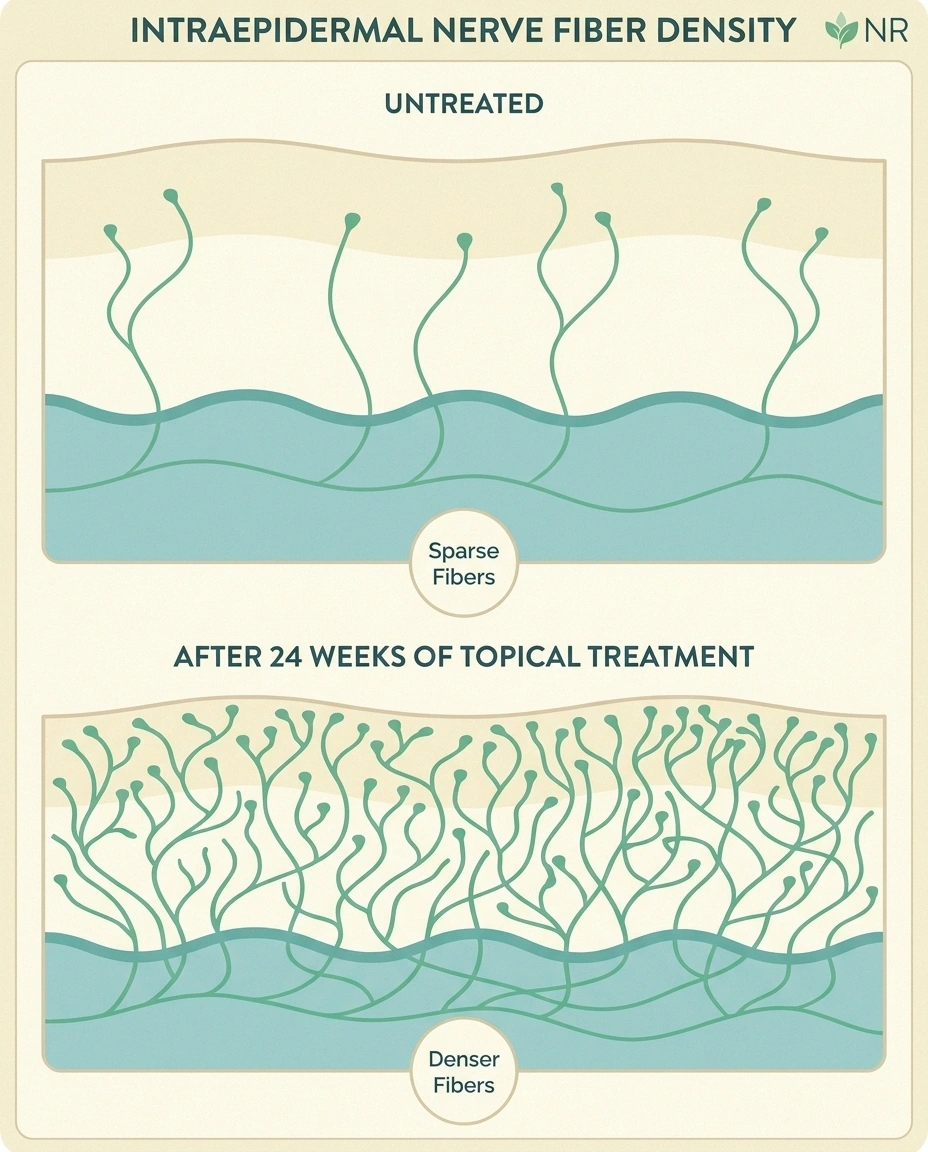
Now for the fun part, with hedging. In the preclinical animal studies, topical pirenzepine did what the researchers hoped it would do: it protected small nerve fibers in diabetic mice, and by some measures it appeared to promote regrowth of nerve fiber density in the skin. That's what earned the compound the right to enter human clinical trials.
Research says
In the phase 2a study of roughly 60 people with type 2 diabetes and peripheral neuropathy, participants on placebo lost intraepidermal nerve fibers over 24 weeks — the pattern expected from progressive diabetic neuropathy left to run its course. Participants on topical pirenzepine showed a statistically significant increase in nerve fiber density at the ankle over the same period, with a clean safety profile. Published in eBioMedicine (Lancet family), 2025.
The first meaningful human data came from a phase 2a study of about 60 people with type 2 diabetes and peripheral neuropathy. Participants were randomly assigned to placebo or one of two doses of the drug, applied once daily for 24 weeks. They came in for regular check-ins and, importantly, for skin biopsies that measured something called intraepidermal nerve fiber density, or IENFD — literally the count of tiny nerve endings per unit of skin, taken from a small biopsy at the ankle.
The results, published in the medical journal eBioMedicine, were meaningful for a couple of reasons. The people on placebo lost nerve fibers over the 24 weeks, which is what you'd sadly expect from progressive diabetic neuropathy left to run its course. The people on WST-057, by contrast, showed a statistically significant increase in nerve fiber density at the ankle. Some measures of larger-fiber function also improved. And the safety profile was clean — no big-ticket side effects, no reason to stop the program.
I want to be careful here. This was a small, early-phase study. Approximately 60 people is not thousands. Nerve fiber density is a biomarker; it tells us something is happening to the nerves themselves, but it doesn't automatically translate into “your feet won't burn at night” the way you'd hope. The next round of studies has to answer the question of whether the nerve regrowth actually leads to symptom improvement people can feel and outcomes people care about — less pain, better balance, fewer fall risks, delayed progression to ulcer.
Still — a candidate drug that appears to regrow the tissue diabetes is destroying, applied as a simple cream, with a clean safety profile in early testing? That is genuinely different from the treatment landscape we've had. Which brings us to the comparison question.
Where the Clinical Trials Stand Right Now

As of the publication of this article, the phase 2 program for WST-057 in diabetic peripheral neuropathy is complete and the results have been published in peer-reviewed literature. The company has communicated its intent to move into a larger phase 3 program, which is the pivotal-scale trial that regulators like the FDA typically require to approve a new drug for a new indication.
Phase 3 trials for a chronic condition like DPN generally involve hundreds to sometimes thousands of participants, spread across many sites, followed for a year or more. They take time to run, even after they're announced and open. Details of the phase 3 design — number of sites, primary endpoints, expected enrollment — are the things to watch for on public trial registries in the coming months.
If you or your care team want to check for open studies, the best public source is the U.S. government registry ClinicalTrials.gov. Searching for “pirenzepine” and “peripheral neuropathy” will pull up the WST-057 studies and any related work. Each listing shows the study status (recruiting, active but not recruiting, completed), the study sites and cities, the eligibility criteria, and a contact for the study coordinator. If a study is actively recruiting near you and you appear to meet the criteria, that contact is where you start.
Separately, WinSanTor has, on at least one occasion, worked with state-level right-to-try programs to make the drug available to certain patients outside of a formal trial. Right-to-try programs are legal in most U.S. states and allow terminally-ill or seriously-ill patients access to investigational drugs that have completed at least a phase 1 trial. Whether right-to-try applies to any given patient depends on the state, the sponsor's program at the time, and specific medical criteria. This is not a general workaround for the “not FDA-approved” problem — it's a specific and narrow pathway that requires physician participation and, typically, out-of-pocket cost.
How WST-057 Would Compare to Current DPN Treatments
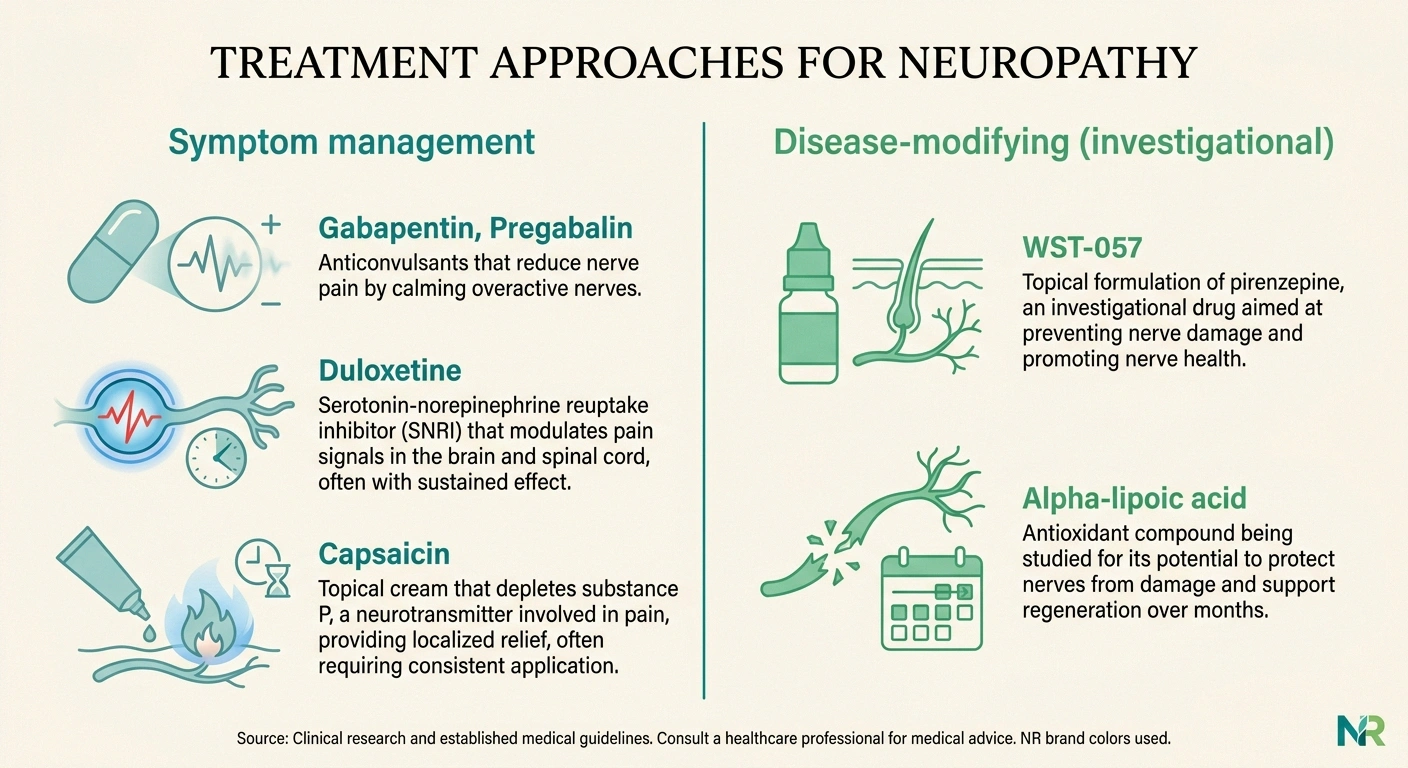
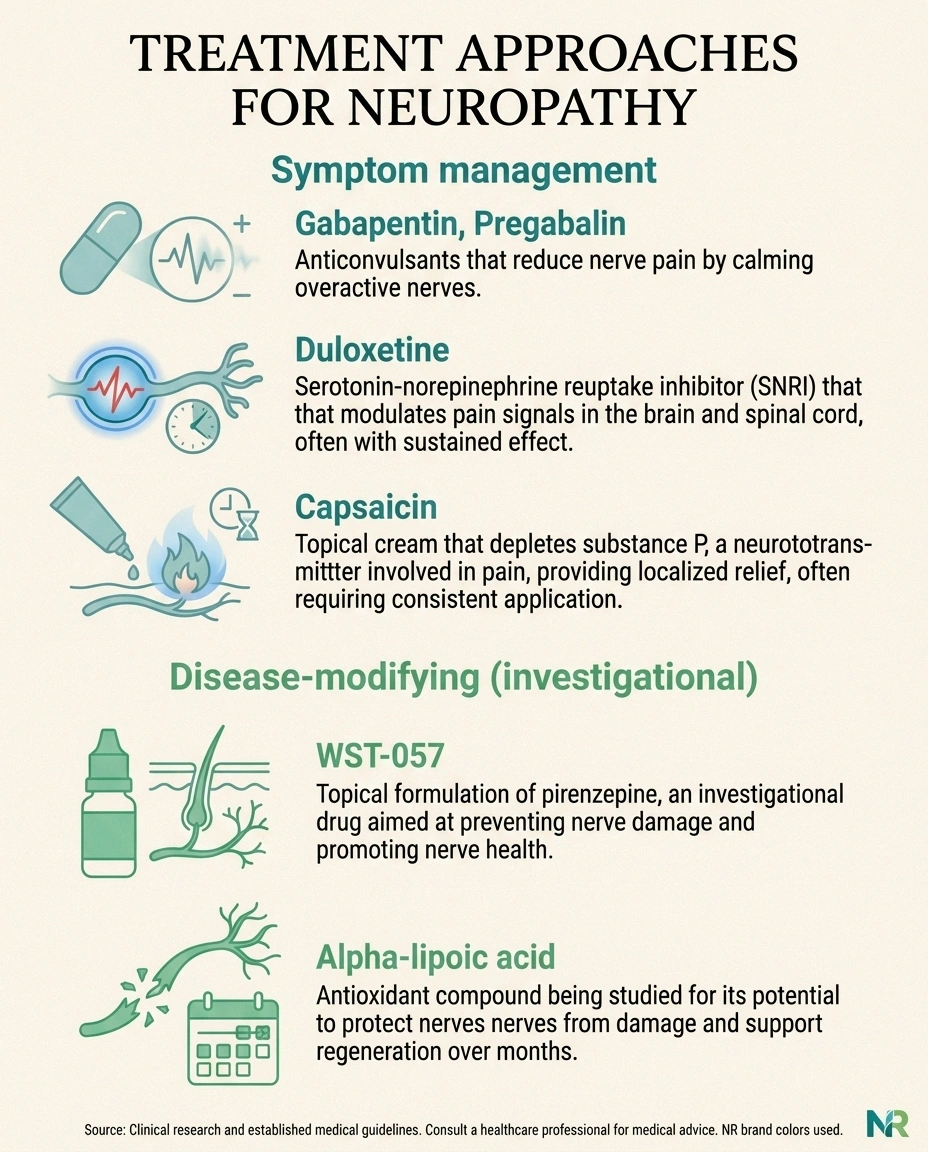
Here's an important honest distinction. The drugs we currently have for diabetic peripheral neuropathy are, almost without exception, treating symptoms — mostly pain. They don't stop the underlying nerve damage from getting worse. They just make the daily experience easier to live with while the damage keeps quietly progressing.
Key distinction: symptoms vs. underlying damage
Almost every drug currently approved for diabetic peripheral neuropathy — gabapentin, pregabalin, duloxetine, capsaicin, tapentadol — targets pain signaling, not the nerve damage itself. WST-057 is being studied in a different lane: as a candidate that may protect and potentially regrow the small nerve fibers diabetes is destroying. If that hope holds up in phase 3, it would represent a category shift in how DPN is treated, not just another entry in the pain-management drawer.
Gabapentin and pregabalin are anticonvulsants that dampen pain signaling. They help many people sleep through the burning at night. They come with tradeoffs — drowsiness, brain fog, weight gain, unsteadiness — and they don't affect the underlying nerve damage. Duloxetine is a serotonin-norepinephrine reuptake inhibitor originally developed for depression that turns out to be one of the more effective first-line pain treatments for DPN. It also has its own tradeoffs — nausea, blood pressure changes, discontinuation syndrome — and, again, doesn't change what's happening to the nerves themselves.
Topical treatments like capsaicin and lidocaine can help specific spots and specific pain types, and many people have found real relief exploring the landscape of neuropathy creams. They tend to be gentler on the whole body than the oral medications. But they, too, are treating what you feel, not what's happening to the nerve fibers under the skin.
One nutritional therapy that does sit closer to the “underlying cause” side of the ledger is alpha-lipoic acid. It's been studied for decades, particularly in Europe. The evidence is mixed but suggestive that ALA may modestly slow progression and improve some symptoms. It's the closest thing we have today to a widely available candidate for actually influencing nerve health rather than just muting the pain signal.
WST-057 is being positioned in a different lane entirely. The hope is that it works on the underlying nerve loss itself — that instead of just muting symptoms, it might actually protect and even regrow the tissue diabetes is destroying. That's what makes the early results interesting. It's also what makes the drug harder to evaluate: symptom-relief drugs can be judged in weeks, while a drug meant to protect and regrow nerve fibers has to be judged in many months, using biopsies and functional testing.
What It Would Mean If It Works
Let me put on my hopeful hat for a minute, then take it off. If WST-057 continues to perform in phase 3 the way it performed in phase 2, and if regulators eventually approve it, what would daily life with diabetic neuropathy look like?
Practically, it would be a once-a-day cream applied to the calves, ankles, and tops of both feet. Not a difficult routine. Something you'd add to the same window as your morning coffee or your evening sock change. It's not a pain patch — it's a disease-modifying application, and you'd have to be consistent about applying it over months to see any effect.
The bigger picture, if the drug works, is that people newly diagnosed with diabetic neuropathy would have something to do about the condition itself, not just the symptoms. Right now, when I talk to newly diagnosed folks in our support group, the conversation is largely about managing the pain, protecting the feet with careful foot care, and doing everything possible to control blood sugar so the damage progresses more slowly. Very often the whispered question underneath is “can any of this actually be reversed?” and the honest answer, today, is that meaningful reversal is possible in specific circumstances but not most. A drug that shifted that answer meaningfully would be a real change.
I want to be careful not to promise something that isn't promised yet. Even in the best-case scenario, we don't know how much nerve regrowth translates into daily-life symptom improvement, how many months of treatment it would take before people notice a difference, or how insurance would handle coverage for a first-in-class topical. Those are all real questions and none of them have final answers yet.
The Trial Pipeline Reality-Check

This is the paragraph I would want a trusted friend to write to me, so I want to write it for you.
Please don't put your treatment plan on hold
- Many phase 2 candidates do not succeed in phase 3. Base rates in neurology and CNS research are humbling.
- Even if phase 3 succeeds, FDA review and pharmacy availability typically add two to four years.
- Keep working your current pain-management plan with your prescribing doctor.
- Keep protecting your feet with daily inspection, good shoes, and regular podiatry care.
- Keep working on the metabolic drivers — blood sugar control, weight, activity — that pay off no matter what happens in the trial pipeline.
Many, many candidate drugs that look strong in phase 2 do not succeed in phase 3. Some fail because the effect gets smaller when the study population gets bigger. Some fail because a rare side effect becomes visible only when thousands of people are exposed. Some fail because the primary endpoint chosen for phase 3 turns out to be harder to hit than expected. Some fail because a placebo group in a large trial does surprisingly well and washes out the drug's advantage. In the neuropathy and central-nervous-system spaces specifically, phase 2 to phase 3 attrition is high. That's not pessimism. It's just what the base rates look like.
So please don't put your treatment plan on hold waiting for WST-057. If your neuropathy is causing you pain, keep working with your care team on the treatments available today. If your blood sugar isn't where your endocrinologist wants it to be, keep working on that. If your feet need daily inspection and better shoes and a regular podiatrist visit, keep doing those things. Those investments pay off no matter what happens in the WST-057 trial pipeline.
And if the phase 3 results are strong when they eventually arrive, we'll all be relieved, and I'll write about it here.
How to Follow the Research Yourself
If you want to stay informed without wading through press releases from every biotech in the space, here's the routine I use and recommend to our community members.
Your 5-step way to follow WST-057
ClinicalTrials.gov is the source of truth for trial status. Search “pirenzepine” or “WST-057” or “diabetic peripheral neuropathy” and bookmark the results page. The status field on each study tells you whether it's currently recruiting, whether it has completed enrollment, or whether results have been posted. You can subscribe to notification updates for specific studies.
The sponsor's own pipeline page is where announcements about new trial phases, new indications, and program updates typically go first. WinSanTor's pipeline page is the relevant one for WST-057.
Peer-reviewed journals are where the actual data lives. The 24-week phase 2a study was published in eBioMedicine, part of The Lancet family. When new results come out, they generally appear in journals like Diabetes Care, Diabetologia, The Lancet and its sister journals, or the neurology-specific literature.
Reputable patient organizations — the Foundation for Peripheral Neuropathy, the American Diabetes Association, the Neuropathy Action Foundation — often summarize new research in plain language and flag when a candidate drug reaches a meaningful milestone. Their newsletters are worth signing up for.
What I'd steer you away from: excited social-media posts, testimonials from unnamed patients, and any website suggesting they can sell you the drug or a compounded version of it. As of publication, no legitimate source is selling pirenzepine as a topical for neuropathy outside of a clinical trial or a state right-to-try program.
What to Talk to Your Care Team About

If WST-057 has caught your attention and you'd like to explore it responsibly, here's how I'd bring it up to my own doctors, based on how the conversations with mine have gone in the past.
With your primary care doctor or endocrinologist, ask whether they know of any active WST-057 trial sites in your area or in a city you could reasonably travel to. Ask them to help you evaluate the eligibility criteria for the trial. A good primary care doc will look at the ClinicalTrials.gov listing with you and give you an honest read on whether you're likely to qualify.
With your neurologist, if you have one, ask what markers of nerve function they've been tracking for you over time. A phase 3 trial that opens near you may want a recent nerve conduction study or a baseline symptom score. Having those on file already makes screening smoother if the opportunity comes up. Also ask their read on the phase 2 data — a neurologist who follows the DPN literature will have an informed view worth hearing.
With your podiatrist, keep doing what you're already doing: consistent exams, honest reporting of new symptoms, and prompt evaluation of anything that's changed. Nothing about a candidate drug in the pipeline changes what your feet need from you today.
And with your care team collectively, ask whether they can flag you if a study opens near you. Many academic medical centers keep an internal registry of patients interested in trial participation. A quick “I'd like to be on your radar for any peripheral neuropathy studies you hear about” can put you at the front of the line.
What I'll Be Watching

To close, here's what I personally will be watching for over the next couple of years, so you know the questions I'll be trying to answer for our community as new information comes out.
Two truths at once
A promising phase 2 result is worth paying attention to. A phase 2 result is also not the same thing as an approved treatment on a pharmacy shelf. Hold both truths at once. Manage the neuropathy you have today with the tools that exist today. Stay ready to add a new tool to your kit if and when the evidence catches up with the promise. That's the honest posture — informed patience, without letting hope get out over your headlights.
First, does WST-057 replicate its phase 2 signal in phase 3 at a larger scale? Nerve fiber density gains in 60 people do not automatically translate to nerve fiber density gains in 600 or 1,600 people. If they hold up, that's the biggest question answered.
Second, do the biopsy gains translate into meaningful symptom improvement — less burning, less numbness, better balance, better sleep, better quality of life? That's what matters at the kitchen-table level. A biomarker win with no lived-experience improvement would be a partial victory at best.
Third, what does long-term safety look like? Phase 2 safety was clean, but longer exposure in larger populations is where any rarer issues would show up.
Fourth, if it succeeds and gets approved, what happens with insurance coverage, out-of-pocket cost, and access for people who need it? A first-in-class topical with an unclear reimbursement pathway can be effectively out of reach for the people it would help most.
And fifth, would this apply beyond diabetic neuropathy? Small-fiber loss shows up in many other neuropathy types — chemo-induced, idiopathic, autoimmune. If the mechanism travels, the potential reach of a drug like this becomes much bigger.
None of these questions have answers today. That's okay. Research moves at the pace of research, and our job as patients and caregivers is to stay informed without letting hope get out over our headlights. Manage the neuropathy you have today with the tools that exist today, and stay ready to add a new tool to your kit if and when the evidence catches up with the promise.
Frequently Asked Questions
Can I buy WST-057 or topical pirenzepine somewhere right now?
No. WST-057 is an investigational drug being tested in clinical trials. It is not FDA-approved and is not available at pharmacies, through compounding pharmacies, or through international mail-order sources. Any website claiming to sell it is not a legitimate source. The only legal pathways to access it today are enrollment in an active clinical trial listed on ClinicalTrials.gov or, in a small number of U.S. states, participation in a right-to-try program if the sponsor is offering one there.
Will WST-057 cure my diabetic neuropathy?
We don't know yet, and honestly, the language of cure may not be the right frame. The early phase 2 results suggested the drug can slow the loss of small nerve fibers and appears to promote some regrowth over 24 weeks. Whether that translates into meaningful, lasting symptom improvement — and whether it holds up in a much larger phase 3 study — are the questions the ongoing research is designed to answer. Please don't put your current treatment plan on hold waiting for this drug to be approved.
How is WST-057 different from a cream like capsaicin or lidocaine?
Capsaicin and lidocaine creams are pain-relief creams. They dull the pain signal at the surface of the skin where you apply them, and their effect goes away when you stop using them. WST-057 is being studied as a disease-modifying candidate. The hypothesis is that it changes what's actually happening to the small nerve fibers under the skin, protecting and potentially regrowing them over months of use. Those are very different goals, even though all three are technically topical treatments.
Do I have to have type 2 diabetes to be eligible for a WST-057 trial?
The phase 2a trials required a diagnosis of type 2 diabetes with peripheral neuropathy. That may or may not remain the eligibility criteria for future studies. Some sponsors expand eligibility to include type 1 diabetes or other neuropathy causes as the drug moves through development, but that varies by study. The specific criteria for any active study are always listed on the ClinicalTrials.gov page for that study, and the study coordinator is the best person to walk you through them.
How long would I have to use WST-057 before I might notice something?
Based on the phase 2 trial design, the drug was applied once daily for 24 weeks — roughly six months — before nerve fiber density was re-measured. Even if the drug does eventually get approved, this is not a quick-relief product. It would be a slow, consistent daily application aimed at long-term nerve health, not immediate symptom relief. Any near-term pain would still be managed with the current standard treatments in parallel.
Is topical pirenzepine safe for long-term use?
The phase 2a study found the drug to be safe and well-tolerated over the study period, with no major safety signals. That is encouraging but not the final word. Longer-term and larger-population safety data will come from phase 3 and any post-approval studies. If you eventually gain access to the drug through a trial or a right-to-try program, your participating physician will monitor for any side effects during your use.
If phase 3 succeeds, when would WST-057 realistically be available at pharmacies?
It depends on when phase 3 begins, how long the trial runs, and how the FDA review process unfolds after data is submitted. As a rough guide, chronic-condition drugs often take two to four years to go from the end of successful phase 3 enrollment to FDA approval and pharmacy availability. Any specific timeline is speculative until phase 3 is well underway and interim data emerges.
Should I stop my gabapentin or duloxetine in anticipation of WST-057?
Absolutely not. Please don't change any of your current neuropathy medications based on news about a drug that is still in clinical development. Symptom-management medications are doing a real job for you today, and stopping them abruptly can cause withdrawal symptoms and a rebound in nerve pain. Any medication changes should always be planned with your prescribing doctor, based on evidence in front of you today, not hope about a candidate drug in trials.
About the Author