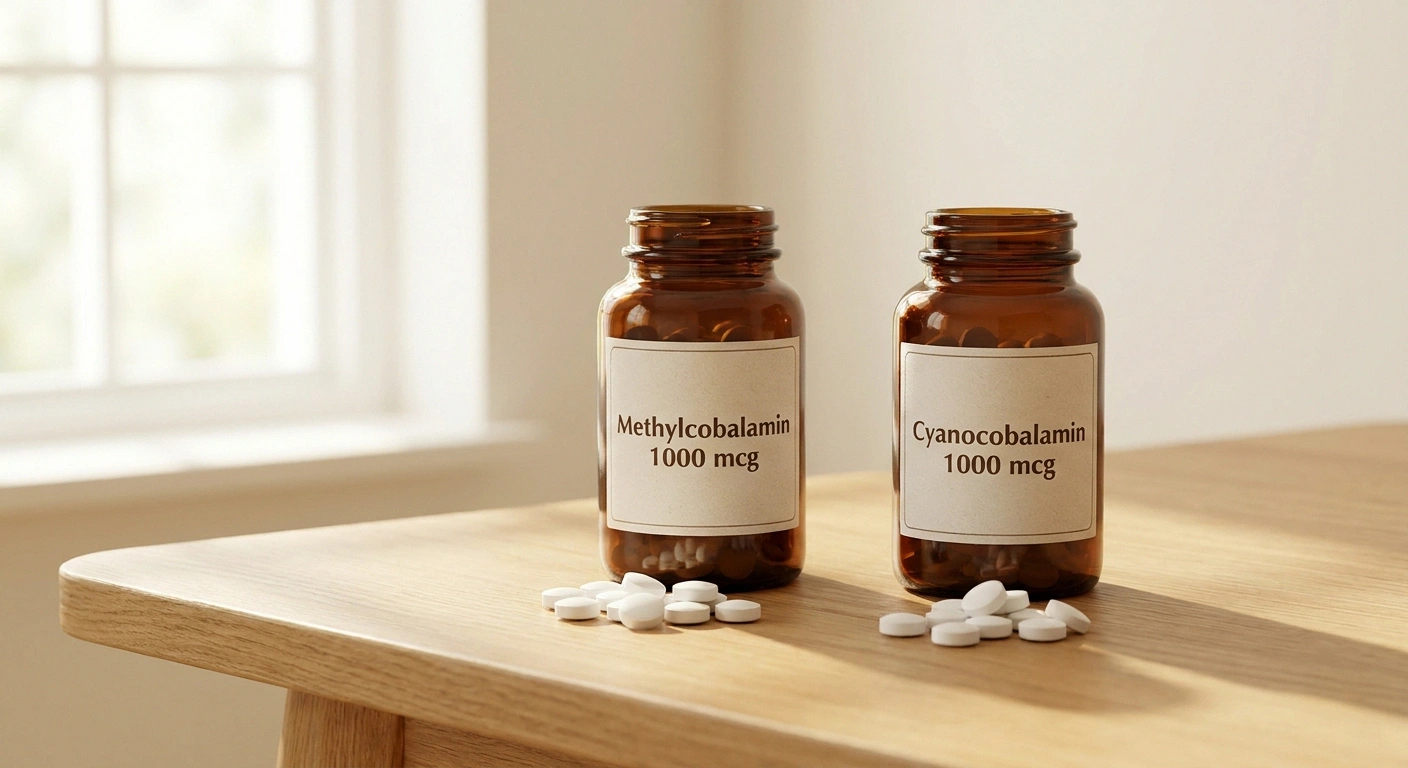
When I first started reading about B12 for nerve health, I assumed B12 was B12. Walk into any pharmacy or scroll any supplement aisle online, and you’ll see bottles that say “Vitamin B12 — 1000 mcg.” Pick one, pay your money, go home. Done.
Then I noticed something on the labels. One bottle said “methylcobalamin.” Another said “cyanocobalamin.” A third said “hydroxocobalamin.” They were all $10 to $25, all promised the same thing, and nobody at the store could tell me which one I should buy.
So I went down the rabbit hole. What I learned changed the bottle I bring home — and might change yours too. This isn’t a question of “are these vitamins fake or real.” They’re all real forms of B12. The question is which form your body, and especially your nerves, can actually use.
Let me walk you through it the way I wish someone had walked me through it.
The Short Answer Before We Dig In
For people specifically taking B12 to support nerve health, methylcobalamin is the form most often recommended by integrative neurologists and naturopathic doctors. It’s the form your nerve cells actually use, with no conversion required.
Cyanocobalamin is what your regular doctor almost always prescribes because it’s cheaper, more stable, and easier to manufacture. For most healthy people, the body converts it to the active form just fine.
For people with neuropathy, kidney disease, MTHFR genetic variants, advanced age, or who take certain medications like metformin or proton pump inhibitors, that conversion may not happen as smoothly. That’s the population for whom the form actually matters.
If you want the science, the dosing, and the honest tradeoffs, keep reading. I’ll show you how I think about the choice for myself and what I’ve watched other people in my support group try.
What B12 Actually Does Inside Your Nerves
Before we compare forms, let me share what convinced me to take B12 seriously in the first place.
Vitamin B12 is a cofactor your body needs for two specific jobs that matter enormously to nerve health. The first is myelin synthesis — myelin is the fatty insulation that wraps around your nerves, like the rubber coating on an electrical wire. Damaged or thinning myelin is part of why nerve signals start traveling slower, jumping the wrong way, or firing when they shouldn’t. The second job is methylation, a process your cells use to repair and regenerate. Without enough B12, both jobs run on fumes.
When B12 is genuinely low, the nervous system pays the price first. People can develop tingling in the feet, balance problems, memory fog, mood changes, and a particular type of nerve damage called subacute combined degeneration of the spinal cord. Vitamin deficiency neuropathy is a real and underdiagnosed cause of nerve symptoms, and B12 is the deficiency most likely to be missed.
That’s why anyone with unexplained neuropathy should have B12 checked before assuming the cause is something else. And that’s why the form you take, if you take any, deserves a few minutes of your attention.
The Four Forms of B12 You’ll See on Labels
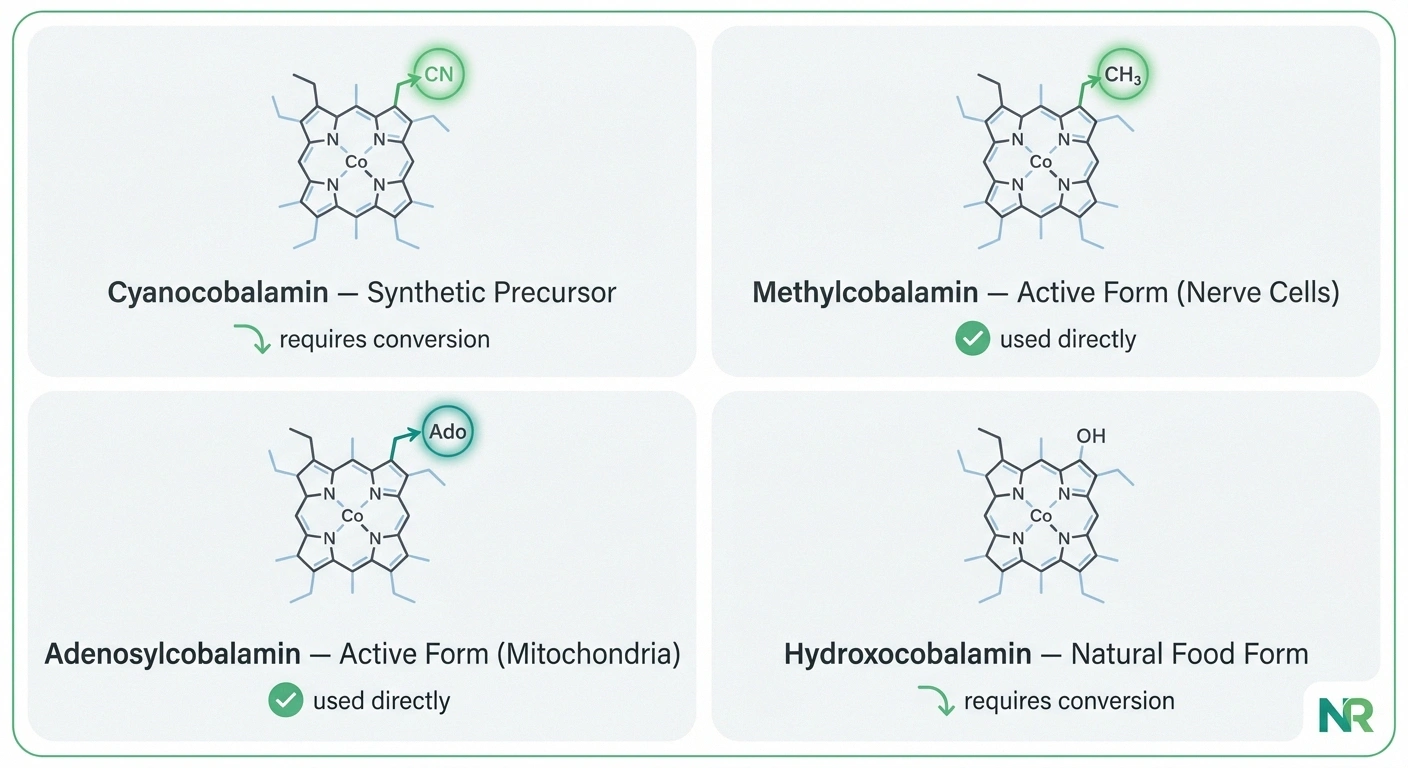
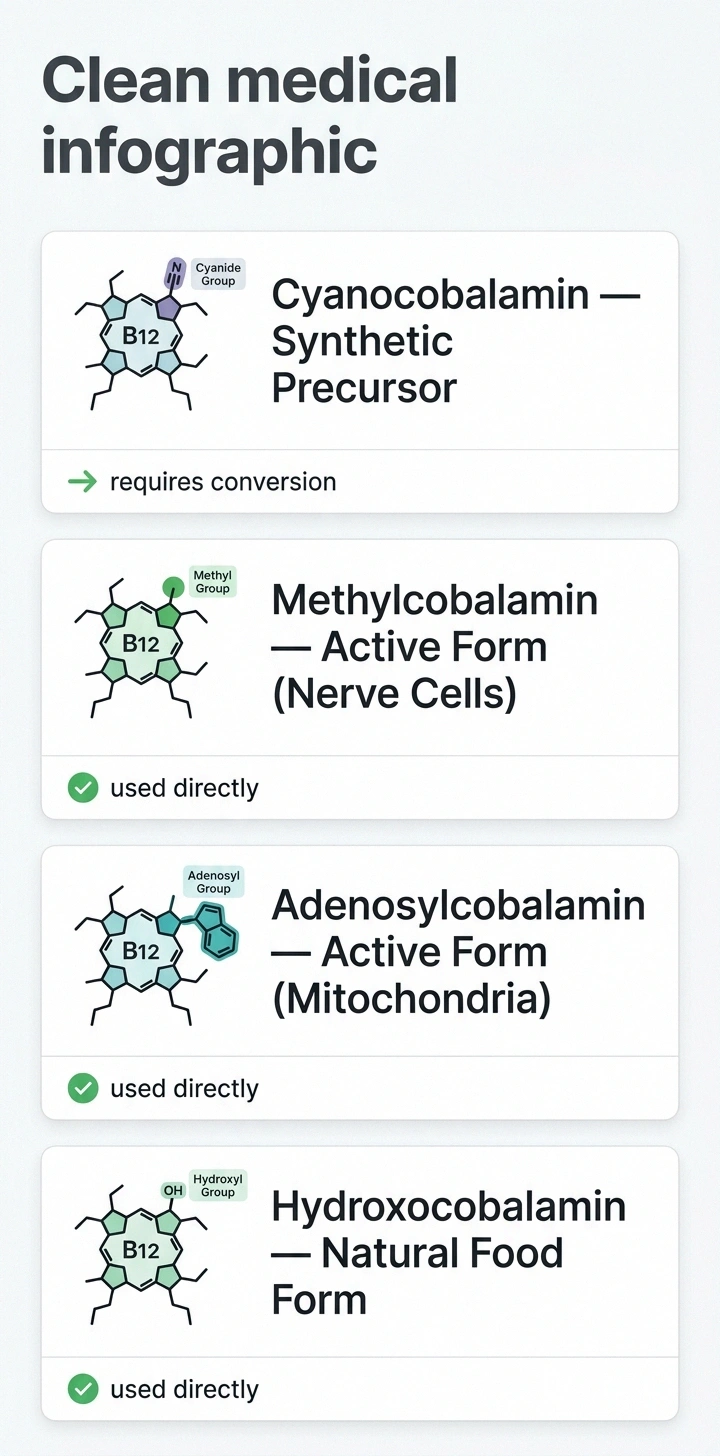
Here’s the part that nobody seemed to explain to me clearly. There are four forms of B12 you’ll encounter, and they’re not interchangeable in the way most people think.
| Form | Type | Conversion Needed? | Best Use |
|---|---|---|---|
| Cyanocobalamin | Synthetic precursor | Yes | Healthy adults, budget-conscious |
| Methylcobalamin | Active form (nerves) | No | Neuropathy, MTHFR, age 65+ |
| Adenosylcobalamin | Active form (energy) | No | Paired with methyl in dual formulas |
| Hydroxocobalamin | Natural food form | Some | Injections (Europe), versatile oral |
Cyanocobalamin
This is the synthetic form. It does not exist in nature. It was invented in a lab because it’s incredibly stable, cheap to produce, and easy to put in a pill. The “cyano” part refers to a cyanide molecule attached to the B12. Before you panic — the amount of cyanide is microscopic, well within the body’s normal capacity to clear it. Your body strips the cyanide off and replaces it with either a methyl group or an adenosyl group to make it usable.
That conversion step is the catch. Most healthy adults convert cyanocobalamin to its usable form without trouble. But the process is not perfect, and certain people convert it poorly.
Methylcobalamin
This is one of the two active forms — meaning your nerve cells use it directly with no conversion required. It’s the form your body uses for methylation reactions, which include the repair work your nerves are constantly trying to do.
Methylcobalamin is less stable than cyanocobalamin, which is why bottles often have a darker color or special packaging. It’s also a bit more expensive to produce. Most studies on B12 for nerve regeneration, particularly out of Japan and India, have used methylcobalamin.
Adenosylcobalamin
This is the second active form. Your mitochondria — the energy factories inside every cell — use it for energy metabolism. Some high-end nerve supplements pair methylcobalamin and adenosylcobalamin together, on the theory that you cover both the cell-repair pathway and the energy-production pathway.
Hydroxocobalamin
This is the form that exists naturally in food, and it’s the form most commonly used for B12 injections in Europe. The body converts it efficiently to both methyl and adenosyl forms. In the U.S., you’ll see it less often in oral supplements, but it’s gaining popularity, especially as an injectable.
If you take only one thing away from this section, take this: cyanocobalamin is a precursor that has to be converted. Methylcobalamin and adenosylcobalamin are already in the form your cells use.
Why Doctors Almost Always Prescribe Cyanocobalamin
If methylcobalamin is the active form, you might reasonably ask why your doctor wrote a prescription for cyanocobalamin instead. The answer is mostly historical and practical, not clinical.
Cyanocobalamin has been the standard B12 form in pharmaceuticals for decades. It’s cheaper. It has a longer shelf life. It’s stable at room temperature. Pharmacy benefits managers and insurance plans cover it as a generic with almost no friction. When your doctor writes “B12 1000 mcg daily,” the pharmacy fills cyanocobalamin because that’s what’s stocked.
For most patients with mild deficiency and normal kidneys, the conversion works fine and lab numbers come back into range. The system is not wrong — it’s just optimized for the average patient, not for the patient with neuropathy who has specific reasons to question the standard answer.
I’m not telling you your doctor is making a mistake by prescribing cyanocobalamin. I’m telling you that if you ask whether methylcobalamin might be a better fit for your situation, most doctors will say “either form will work” without strong opinion. That’s your opening to make an informed choice.
Who Should Care About Which Form They Take

For some people, the cyanocobalamin-to-methylcobalamin conversion happens efficiently, and choosing one form over the other probably doesn’t change much. For other people, the form matters quite a bit. Here’s how to figure out which camp you’re in.
- ✓ Have chronic kidney disease or are on dialysis
- ✓ Smoke or have heavy thiocyanate exposure
- ✓ Carry MTHFR genetic variants (homozygous)
- ✓ Are over age 65
- ✓ Take metformin for diabetes or prediabetes
- ✓ Use PPIs or H2 blockers long-term
- ✓ Already have established neuropathy symptoms
Kidney function. The conversion of cyanocobalamin requires the kidneys to clear the released cyanide molecule. People with chronic kidney disease, especially those on dialysis, may have a harder time with this. Many nephrologists now recommend methylcobalamin or hydroxocobalamin for patients with reduced kidney function.
Smoking. Smokers already have elevated thiocyanate levels in their blood from cigarette smoke. Adding more cyanide, even tiny amounts, is a theoretical concern that some clinicians take seriously. If you smoke, methylcobalamin or hydroxocobalamin is the safer choice.
MTHFR genetic variants. Roughly 40% of the population carries some version of an MTHFR gene mutation, which affects methylation. People with two copies of certain MTHFR variants may have a harder time using cyanocobalamin efficiently. A pre-methylated form bypasses that bottleneck.
Age over 65. Older adults absorb B12 less efficiently overall, and conversion enzymes may be sluggish. Methylcobalamin gives a more direct path.
Diabetes and metformin. If you take metformin for diabetes or prediabetes, you’re at elevated risk for B12 deficiency, and many endocrinologists now prefer methylcobalamin for this population because of its more direct uptake.
Acid-blocking medications. Proton pump inhibitors (omeprazole, esomeprazole) and H2 blockers (famotidine, ranitidine) reduce stomach acid, which you need to release B12 from food and from supplements. People on long-term acid blockers often benefit from a more active form.
Neuropathy itself. When you’ve already got nerve damage, the priority shifts toward giving your body the most usable form of any nutrient that supports nerve repair. Whether neuropathy can be reversed depends partly on giving the nerves what they need to regenerate, and the active form of B12 is part of that nutritional support.
What the Research Actually Says
The research on B12 forms specifically for neuropathy is uneven. Most of the rigorous studies have come out of Japan, where methylcobalamin has been used for decades as a prescription medication for diabetic and other peripheral neuropathies.
A handful of randomized trials have shown methylcobalamin improves nerve conduction velocity in diabetic neuropathy at doses of 500 mcg three times a day. A 2018 meta-analysis pooled data from 14 studies and found methylcobalamin led to small but statistically significant improvements in pain scores and nerve conduction compared to placebo. The effect size was modest — this isn’t a miracle cure. But for a supplement with no real side effects and a clear biological rationale, modest is meaningful.
Cyanocobalamin has also been studied in neuropathy, often as part of a B-complex with B1 and B6. Results are also positive but tend to be smaller and less consistent. The fairest read of the literature is that both forms can help, but methylcobalamin appears to have a slight edge for nerve-specific outcomes — and the bigger that conversion gap is in your particular body, the more that edge matters.
What the research is clear about: the form matters far less than actually taking B12 if you’re deficient. The worst choice is no B12 at all when your body needs it.
Dosing for Neuropathy: What I See Recommended Most
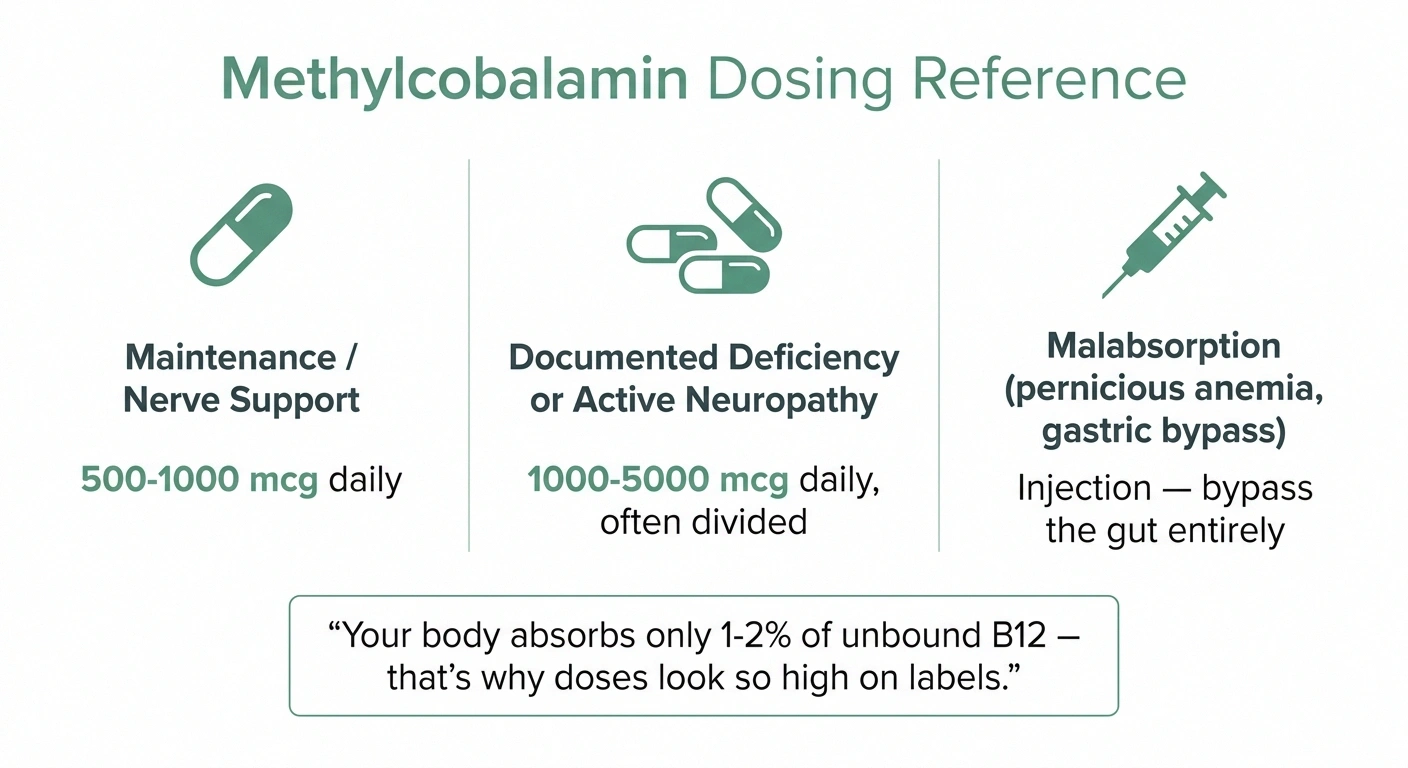
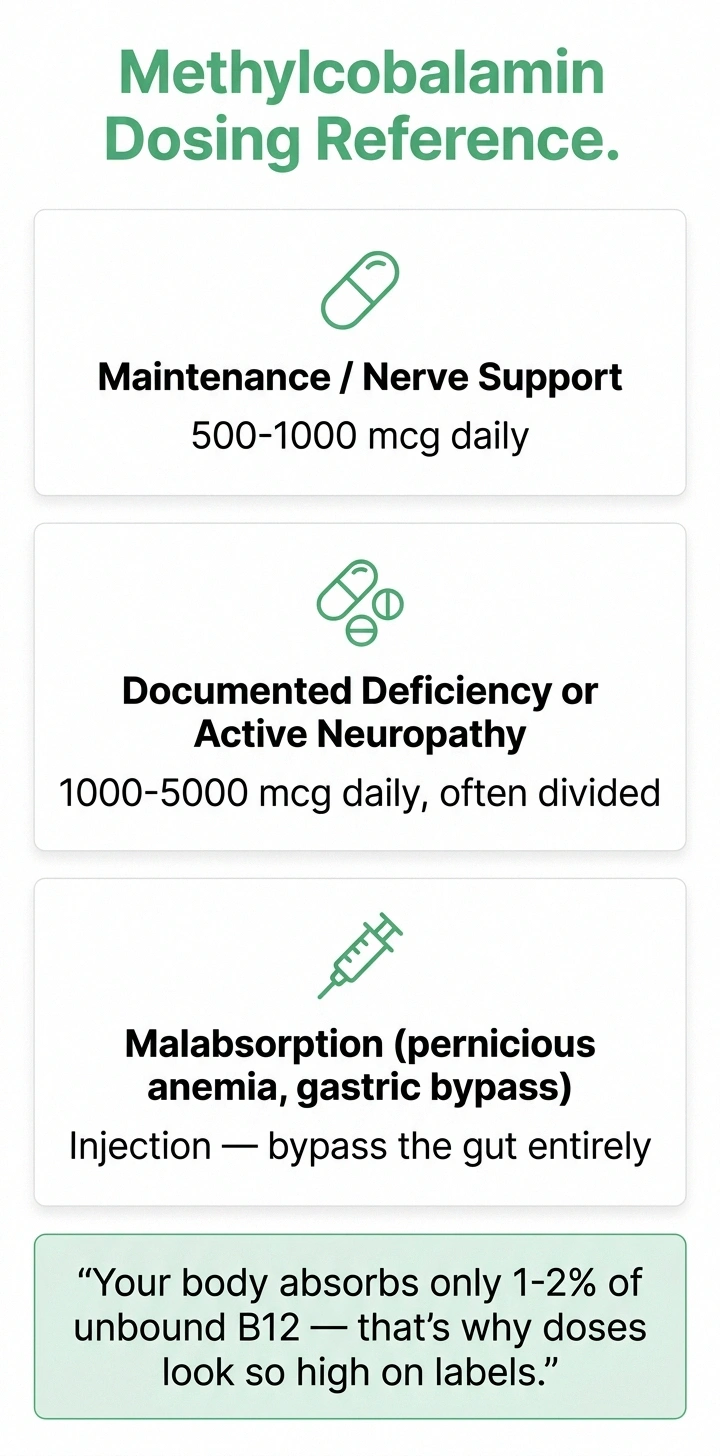
Dosing is where I had to do the most reading because the labels are all over the map. Bottles range from 100 mcg to 5000 mcg per pill, and the recommended daily intake from the National Institutes of Health is just 2.4 mcg. So why are supplements so massively over that?
The reason is absorption. B12 absorption is a tightly regulated process involving a stomach protein called intrinsic factor. Even when you take a high dose, your body absorbs only a small percentage — perhaps 1% to 2% of the unbound portion. So a 1000 mcg supplement may deliver only 10 to 20 mcg into your bloodstream, which is plenty for nutritional purposes but explains why doses look so high on the label.
For maintenance and general nerve support, most integrative practitioners recommend 500 to 1000 mcg of methylcobalamin daily, taken any time of day with or without food.
For documented deficiency or active neuropathy treatment, doses of 1000 to 5000 mcg daily are common, sometimes divided into two or three doses to take advantage of absorption windows.
For people with absorption problems — pernicious anemia, gastric bypass, severe Crohn’s, advanced atrophic gastritis — oral B12 of any form may not work well enough. B12 injections versus oral supplements is a real comparison worth understanding, and for true malabsorption, injections bypass the broken gut step entirely.
Sublingual lozenges and dissolvable tablets get marketed as superior because they “absorb under the tongue.” The evidence for this is actually weaker than the marketing suggests. For most people, a swallowed tablet and a sublingual tablet end up with similar B12 levels at 4 to 8 weeks. The exception is when stomach absorption is genuinely impaired, in which case sublingual or nasal forms may help.
What About Hydroxocobalamin?
Hydroxocobalamin gets less attention in the U.S. supplement market, but it deserves a mention. It’s the form most commonly used for B12 injections in Europe and increasingly in the U.S. Hydroxocobalamin binds tightly to plasma proteins, so injected B12 lasts longer in the body — injections may only be needed every 2 to 3 months once levels are restored, compared to monthly with cyanocobalamin.
For oral supplements, hydroxocobalamin is harder to find and a bit more expensive than methylcobalamin. Some people prefer it because the body can convert it to both active forms (methyl and adenosyl) as needed, rather than committing to one path. If you’re shopping for an oral B12 and find a good hydroxocobalamin option, it’s a reasonable choice.
How Long Before B12 Helps Your Nerves

This is the question I most want to answer honestly, because the expectation gap is real.
B12 is not a painkiller. You will not take a pill and feel different tomorrow. Even for true deficiency, where nerve damage is partly reversible, the timeline runs in weeks and months, not days.
What I see in practice and in the studies:
- Weeks 1 to 4: Blood B12 levels climb, methylmalonic acid and homocysteine markers improve. You typically don’t feel anything different yet.
- Weeks 4 to 12: Some people notice less tingling, slightly better sensation, less brain fog. The first symptoms to improve tend to be the most recent ones.
- Months 3 to 6: If a deficiency was driving symptoms, you should see steady, measurable improvement. If B12 wasn’t the limiting factor, you may not see much.
- Months 6 to 12: Maximum benefit. Whatever nerve regeneration is going to happen with B12 support has mostly happened by this point.
If you’ve been on B12 for six months at a reasonable dose and seen zero improvement, B12 was probably not your bottleneck. That’s useful information too. Looking at the broader picture of nerve-support nutrients — alpha lipoic acid, acetyl-L-carnitine, omega-3s, magnesium — might point you toward the next thing to try.
The Cost Reality
Let me be transparent about the price gap because it surprises people.
A 90-day supply of cyanocobalamin 1000 mcg from a reputable brand runs about $8 to $15. The same supply of methylcobalamin 1000 mcg runs about $15 to $30. Hydroxocobalamin is harder to find and may run $25 to $40 for the same supply.
If you’re on a tight budget and your conversion is efficient — meaning you have decent kidney function, you’re not on metformin, you don’t smoke, and you don’t have an MTHFR mutation — cyanocobalamin is a perfectly reasonable choice. Don’t let perfect become the enemy of good.
If you can afford the upgrade to methylcobalamin and your situation falls into one of the “form matters more” categories from earlier, the extra few dollars a month is well spent. This is one of the rare places in supplementation where a marginally more expensive product has real biological reasoning behind it.
What to Ask Your Doctor

If you’re working with a doctor — and I hope you are if you have neuropathy — these are the questions that move the conversation forward:
- Have my B12 levels been checked recently? Specifically ask for serum B12 plus methylmalonic acid (MMA) and homocysteine. Standard B12 alone misses functional deficiency.
- Am I on any medications that deplete B12? Metformin, PPIs, H2 blockers, methotrexate, nitrous oxide exposure all reduce B12.
- Would methylcobalamin make more sense for me than cyanocobalamin? If you have any of the risk factors discussed earlier, this is a fair question to raise.
- Should I consider injections instead of oral B12? If you have malabsorption, the answer may be yes.
- How will we know if it’s working? Repeat labs at 6 to 12 weeks plus symptom tracking gives you objective data.
Most doctors will be open to these questions. A good neuropathy workup includes B12 testing as a baseline, and if you’ve never had it done, that’s the first step.
Safety, Side Effects, and What to Watch For
B12 has the safest profile of almost any supplement. It’s water-soluble, your body excretes what it doesn’t use, and there’s no established upper limit for toxicity. Tens of thousands of people take 5000 mcg daily without incident.
- High-dose B12 can mask folate deficiency — get folate checked alongside B12
- Cyanocobalamin is specifically contraindicated in Leber hereditary optic neuropathy
- Pernicious anemia and severe malabsorption require injections, not oral supplements
- Look for USP, NSF, or ConsumerLab third-party verification on the label
That said, a few honest cautions:
High-dose B12 can mask folate deficiency. If you’ve been low on folate too, B12 supplementation alone might fix some symptoms while folate-related problems quietly progress. Get folate checked alongside B12.
If you have Leber hereditary optic neuropathy — a rare mitochondrial condition — cyanocobalamin is specifically contraindicated. This is one place where the form genuinely matters for safety, not just efficacy.
Acne flare-ups have been reported with high-dose B12, especially in younger people. The mechanism isn’t fully understood. If you notice this, dropping to a lower dose usually resolves it.
Some people feel “wired” or energized on high-dose methylcobalamin, especially if taken late in the day. Try morning dosing if this affects sleep.
Quality matters. Look for supplements that have been third-party tested — USP, NSF, ConsumerLab certification on the label. Cheap B12 from unverified sources may have less of what’s claimed.
How I Choose for Myself
I’ll tell you what I do, with the understanding that what I do is informed by my specific situation and shouldn’t be a prescription for yours.
I take 1000 mcg of methylcobalamin daily, as a sublingual tablet, taken with breakfast. I chose methylcobalamin because I’m over 55, I take an acid-reducer for occasional reflux, and I figure the few extra dollars a month buys me peace of mind on the conversion question. I have my B12, MMA, and homocysteine checked annually. So far, my numbers have been beautiful — well within range — and my neuropathy symptoms have been stable.
I also take alpha-lipoic acid and acetyl-L-carnitine, both of which are well-studied in the neuropathy literature. Alpha-lipoic acid has its own evidence base and pairs nicely with B12 for antioxidant nerve support. Acetyl-L-carnitine works on the energy side of the nerve repair equation.
None of these are miracle pills. Together they’re part of a strategy. The strategy includes good blood sugar control if diabetes is in the picture, regular walking, decent sleep, and the avoidance of nerve-damaging things like alcohol in excess and certain medications when possible. For diabetic neuropathy specifically, the combination of B12 with glycemic control matters more than any single supplement.
Bottom Line: Which Form Should You Buy?
If I had to compress this whole article into one paragraph, here it is.
For most healthy adults with no special risk factors, cyanocobalamin works fine and saves money. For anyone with neuropathy, kidney issues, smoking history, MTHFR variants, metformin or PPI use, or who is over 65, methylcobalamin is the more thoughtful choice and the extra cost is small relative to the potential benefit. Hydroxocobalamin is a fine alternative if you can find it. For true malabsorption — pernicious anemia, post-gastric-bypass — none of the oral forms work as well as injections. Get your levels checked first. Set realistic timeline expectations of three to six months for nerve symptoms to start moving. And combine B12 with the rest of your nerve-support strategy rather than expecting it to do everything alone.
The form isn’t a magic answer. It’s a thoughtful detail in a longer journey. But it’s a detail worth getting right.
Frequently Asked Questions
Is methylcobalamin really better than cyanocobalamin for neuropathy?
For nerve health specifically, methylcobalamin has a slight edge in the research because your nerves use it directly without needing a conversion step. The advantage is most meaningful for people with kidney issues, MTHFR variants, smokers, those over 65, or anyone on metformin or acid-blocking medications. For healthy adults with efficient conversion, the difference is small. Either form is better than no B12 when you need it.
How much methylcobalamin should I take for nerve pain?
Common doses range from 500 to 5000 mcg daily, with 1000 mcg being a reasonable starting point for most adults. Studies showing benefit in diabetic neuropathy have used 500 mcg three times a day. For documented deficiency, your doctor may recommend higher doses for the first few months, then a maintenance dose afterward. Always confirm dosing with the prescriber who knows your full medical picture, especially if you have kidney issues.
Can cyanocobalamin be harmful?
For most people, no. The cyanide molecule in cyanocobalamin is present in very small amounts and is easily cleared by healthy kidneys. The two exceptions worth knowing about are people with advanced chronic kidney disease or on dialysis, where clearance is reduced, and people with Leber hereditary optic neuropathy, where cyanocobalamin is specifically contraindicated. Heavy smokers may also prefer methylcobalamin to avoid adding any cyanide load.
How long does B12 take to repair nerves?
Expect a slow timeline. Blood levels normalize within 4 to 8 weeks. Subjective symptom improvement often starts at 6 to 12 weeks. Maximum benefit accumulates over 6 to 12 months. If a B12 deficiency was driving your nerve symptoms, you should see steady improvement during that period. If symptoms haven’t changed at all after six months of consistent supplementation, B12 was probably not the limiting factor for your situation.
Should I take B12 with other supplements like alpha-lipoic acid?
Yes, in most cases this combination is reasonable and well tolerated. B12, alpha-lipoic acid, acetyl-L-carnitine, and benfotiamine are often combined in “nerve support” formulas because they work on different parts of nerve repair and energy metabolism. They don’t compete with each other or interact negatively. The combined daily routine is what builds the foundation, not any single supplement.
Why do doctors usually prescribe cyanocobalamin instead of methylcobalamin?
Mostly history and logistics. Cyanocobalamin has been the pharmaceutical standard for decades because it’s cheaper, more stable on the shelf, and easier to manufacture. Insurance coverage is automatic. For the average patient with mild deficiency and good kidney function, it works perfectly well. If you want methylcobalamin instead, you’ll usually need to buy it over the counter rather than fill a prescription. That doesn’t mean your doctor is wrong — it means the system is optimized for the average case, and you may have reasons to make a different choice.
Can you take too much methylcobalamin?
The National Institutes of Health has not established an upper limit for B12 because excess is excreted in urine with no documented toxicity in healthy adults. People routinely take 5000 mcg daily without problems. The practical issues at very high doses are acne flare-ups in some people, and rarely a “wired” feeling that affects sleep. If either happens, just lower the dose. There’s no medical reason to take more than 1000 to 2000 mcg daily for maintenance.
Will B12 supplementation cure my neuropathy?
Honestly, almost certainly not on its own. B12 can produce meaningful improvement if a deficiency was contributing to your nerve damage and if the damage is partly reversible. For nerve damage from chemotherapy, advanced diabetes, alcoholism, or other long-standing causes, B12 is one supportive piece of a broader strategy that includes the underlying condition, lifestyle factors, and often medications. Set realistic expectations: B12 may help, often modestly, as part of a complete approach.
About the Author