The first time someone in my support group brought up boswellia, she pulled a small bottle out of her purse and asked, with that mix of hope and skepticism I’ve come to recognize, “Is this real, or is it just another expensive bottle?” Frankincense — boswellia’s older, more poetic name — has been showing up more and more in supplement recommendations for nerve pain, often paired with curcumin or marketed as a “natural anti-inflammatory” for neuropathy. The question deserves a careful answer, because the truthful one is more nuanced than either the marketing copy or the dismissive skepticism would suggest.
Here’s the honest summary I’d give in five seconds before getting into the details: boswellia has a real, well-studied anti-inflammatory mechanism, a long safety record, and a small but growing body of evidence for nerve-pain conditions — but most of that direct nerve-pain research uses boswellia in combination with other extracts, not solo, and the strongest human trials are in joint conditions like osteoarthritis and rheumatoid arthritis rather than peripheral neuropathy specifically. Whether it’s worth adding to your routine depends on what you mean by “worth it,” and on a few practical realities I’ll walk through below.
What Boswellia Is and Where It Comes From
Boswellia is the resin of the Boswellia serrata tree — a scrubby, gnarled-looking tree native to the dry hill country of India, the Middle East, and parts of Africa. The resin has been harvested for thousands of years by scoring the bark and collecting the gum that weeps out. You probably know it under its older name, frankincense, which is a slight oversimplification: there are several Boswellia species, and the medicinal extracts you’ll see at the supplement counter — especially the standardized ones — almost always come from Boswellia serrata or Boswellia carterii.

What modern science has spent the last twenty years figuring out is which specific compounds in that resin do the heavy lifting. The answer is a group of molecules called boswellic acids, and within that group, one in particular keeps showing up in the most interesting research: AKBA, which is shorthand for 3-O-Acetyl-11-keto-β-Boswellic Acid. AKBA is the reason supplement labels now advertise “standardized to X% AKBA” instead of just “boswellic acids.” It’s the most potent of the boswellic acids for the mechanism that matters most for nerve and joint pain.
That mechanism is what makes boswellia interesting for people like us — for anyone living with a condition that involves chronic inflammation, even when “inflammation” isn’t the word the doctor used.
How Boswellia Works in the Body
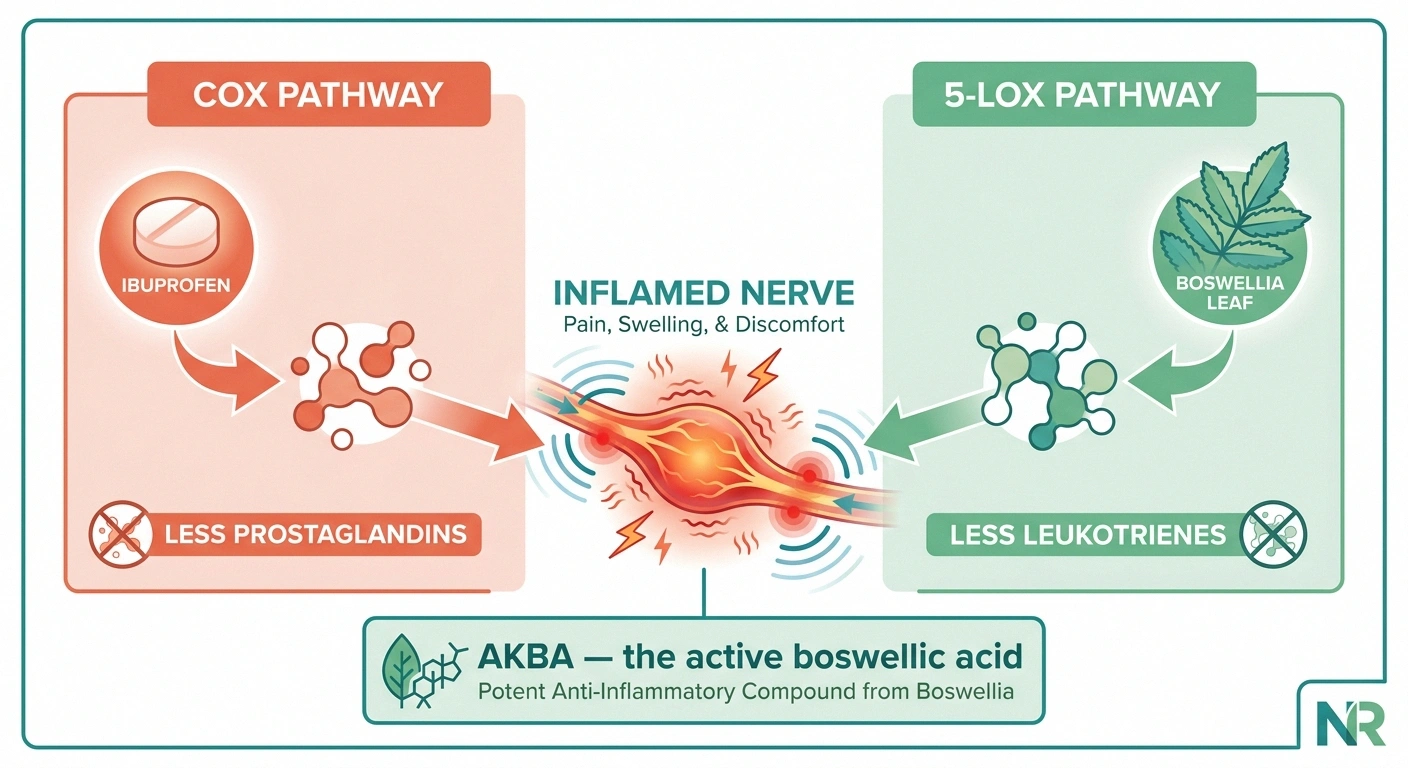
The clearest way to explain boswellia’s mechanism is to compare it to drugs you might already know. Common over-the-counter anti-inflammatories like ibuprofen and naproxen work on an enzyme called COX — cyclooxygenase — to reduce a particular family of inflammatory chemicals called prostaglandins. That’s useful for headaches, sprains, and arthritis flares, but it’s only half of the inflammation story.
Two Halves of Inflammation
The other half runs through a different enzyme called 5-LOX — 5-lipoxygenase — which produces a family of inflammatory chemicals called leukotrienes. Leukotrienes drive a lot of the longer-lasting, smoldering kind of inflammation, the kind that shows up in chronic conditions including some types of nerve pain. Boswellic acids — and AKBA in particular — selectively inhibit 5-LOX, which means they tamp down leukotriene production. Laboratory studies put AKBA’s potency in this role at an IC50 of about 1.5 micromolar, which in plain language means it’s effective at concentrations that are achievable with oral supplementation.
Boswellia doesn’t stop there. It also appears to reduce activity of NF-κB, a master switch that turns on inflammation throughout the body, and it downregulates several other inflammation-related signals, including TNF-alpha and certain matrix metalloproteinases that break down tissues during chronic inflammation. For our purposes, the takeaway is that boswellia isn’t a one-trick molecule. It interrupts the inflammatory cascade at several different points, which is why its effects can show up across several different conditions — joint pain, gut inflammation, asthma, and now, possibly, certain types of nerve pain.
One thing worth noting: boswellia is not a sodium-channel blocker, like gabapentin or carbamazepine. It’s not a GABA-system drug. It doesn’t quiet overactive nerves directly. What it does is reduce the inflammatory environment those nerves are sitting in, which can — in theory — make them less irritable, less reactive, and less prone to firing pain signals. That distinction matters because it tells you what to expect: boswellia, if it helps, helps gradually, by addressing background inflammation. It is not the supplement to reach for when you want fast relief from a sharp shock of nerve pain. For more on how an anti-inflammatory approach fits into a broader plan, our overview of natural remedies for peripheral neuropathy pain walks through the full ecosystem.
The Direct Nerve-Pain Evidence: A Careful Look
Here’s where I have to be careful, because the evidence for boswellia in neuropathy specifically is real but thin — and the marketing copy on supplement bottles tends to make it sound thicker than it is. Let me walk through what we actually have.
The most cited preclinical work is a 2023 study published in a peer-reviewed pharmacology journal, which looked at a combination of Boswellia serrata extract and Acmella oleracea — a different herb sometimes called toothache plant — in a rat model of spared nerve injury, which is one of the standard laboratory models for studying neuropathic pain. The combination showed synergistic effects: better pain relief together than either extract produced alone. That’s encouraging mechanistically, but it’s a rat model, and it’s a combination — neither of which transfers cleanly to “take boswellia for your neuropathy” advice.
A separate 2024 preclinical study looked at boswellia and curcuma (turmeric) for oxaliplatin-induced peripheral neuropathy — the chemotherapy-induced nerve damage that affects a meaningful percentage of people treated for colorectal and certain other cancers. The combination reduced inflammation markers and lessened nerve damage in the animal model, working through NF-κB modulation. Again, that’s mechanistically reasonable but still in animal models, and it’s a combination. If you’ve experienced or are concerned about chemo-induced nerve damage, our piece on chemotherapy-induced peripheral neuropathy is worth reading alongside this one.
On the human side, the most relevant study I’m aware of is a 2024 observational study from Italy that enrolled 103 patients with chronic low back pain — many of whom had a neuropathic-pain component — and gave them a standardized boswellia plus Acmella extract as add-on therapy to whatever they were already taking for eight weeks. Patients reported meaningful reductions in pain and improvements in function. It’s an observational study (no placebo, no blinding), it’s a combination product, and the patients weren’t all “pure” neuropathy cases, but it’s the strongest direct human signal we have for this kind of indication.
Beyond that, the human evidence for boswellia shifts to related conditions — osteoarthritis, rheumatoid arthritis, ankylosing spondylitis, inflammatory bowel disease, and asthma. In those, the evidence is genuinely solid. Multiple randomized controlled trials of standardized boswellia extracts have shown pain and function improvements in knee osteoarthritis, including a 2023 trial combining boswellia with omega-3s. A 2025 randomized double-blind placebo-controlled trial in mild-to-moderate spondylitis using a full-spectrum boswellia extract with curcumin showed significant improvements in pain severity and joint stiffness over 90 days. This evidence is what gives us confidence in boswellia’s anti-inflammatory effects in humans in general. The leap from “works in inflammatory joint conditions” to “works in peripheral neuropathy” is reasonable but it’s still a leap.
So when someone asks me, “Should I take boswellia for my neuropathy?” the honest answer is: it’s a defensible adjunct for someone with an inflammation-driven nerve-pain picture, especially if you’re already exploring other anti-inflammatory approaches, but it should not be your primary nerve-pain treatment and it shouldn’t replace anything your doctor has prescribed.
What Forms and Doses the Research Actually Uses
If you go to a vitamin aisle or scroll through Amazon, you’ll find dozens of boswellia products, and they’re not interchangeable. The differences in extract standardization, dose, and formulation can be the difference between a supplement that does something and one that does nothing — even with the same plant on the label.
Typical Research Doses
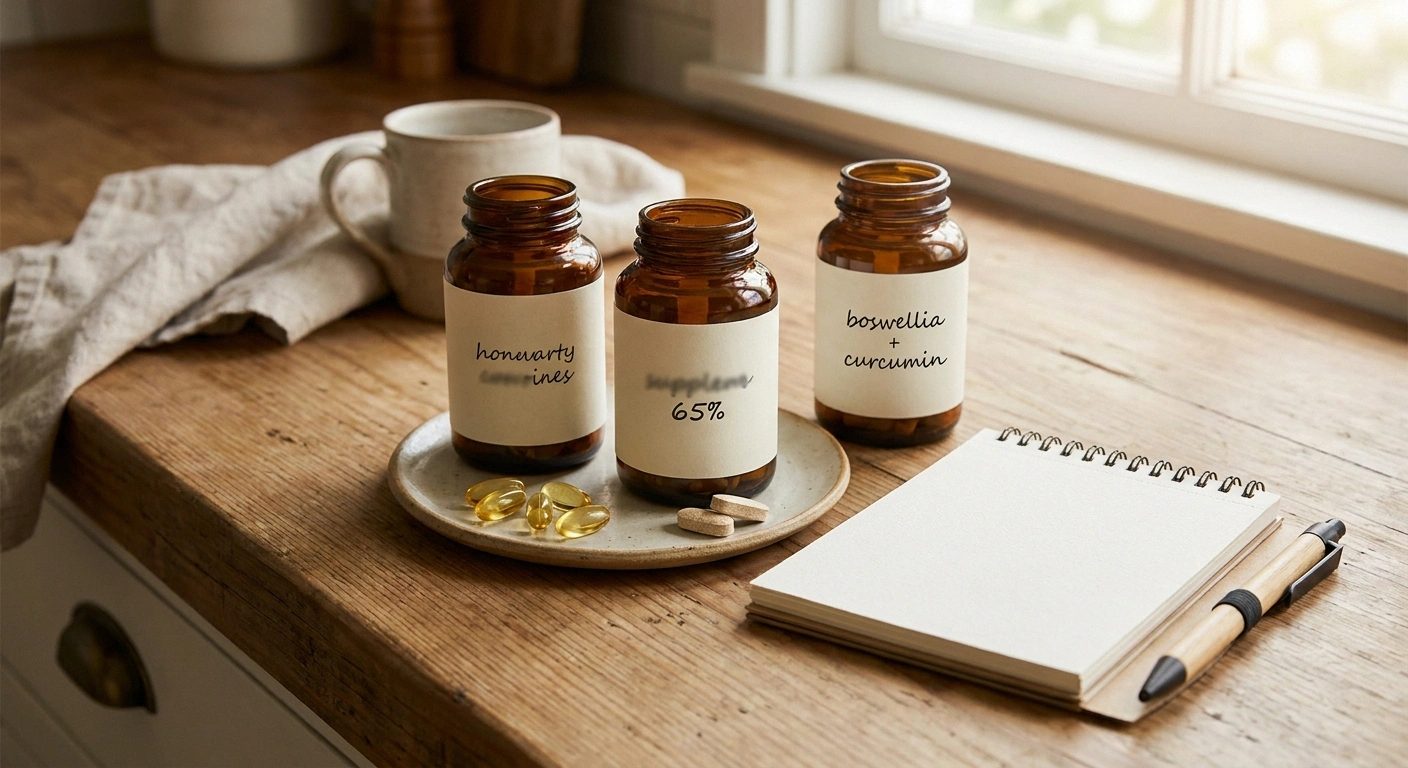
Look for AKBA standardization. The most rigorously studied extracts are standardized to a specific AKBA percentage — the active boswellic acid. Branded extracts like 5-Loxin (30% AKBA) and ApresFlex (also called Aflapin, a 5-Loxin variant with enhanced bioavailability) have the bulk of the clinical research behind them. If a label just says “boswellic acids 65%” without specifying AKBA content, it tells you less about how the product will perform.
Bioavailability matters. Boswellic acids are not particularly well absorbed from a plain powder. Newer formulations — phytosomal boswellia (bound to phospholipids for better absorption), enhanced-bioavailability extracts, and combination products that pair boswellia with curcumin and a piperine-based delivery system — generally achieve higher blood levels at the same oral dose. If you’re comparing two products at similar prices, the bioavailability-enhanced one usually wins.
Typical research doses. The standardized 30% AKBA extracts used in joint-pain trials generally dose 100 to 250 milligrams per day, often split into two doses. Less-standardized “boswellic acids 60–65%” extracts dose higher — usually 300 to 1,200 milligrams per day. Higher doses aren’t automatically better; what matters is the AKBA dose you’re actually getting and how well it’s absorbed.
Combination products may make sense. The direct nerve-pain evidence, such as it is, runs through combinations — boswellia plus Acmella, boswellia plus curcumin. If you’re trying to target inflammation-driven nerve pain rather than joint pain, a combination product with boswellia and curcumin (turmeric) may be a more evidence-aligned choice than boswellia alone. Our piece on turmeric and curcumin for nerve pain covers the curcumin side of that equation.
Onset is gradual. Studies that have looked at onset of effect have generally seen meaningful changes by week 4 to week 6 of consistent daily use, with some early hints of improvement at 7 to 14 days. Boswellia is not a single-dose painkiller. If you try it for a week and quit, you have not given it a fair trial. Plan for at least an eight-week test, document your symptoms in a symptom journal before and during, and then make a decision based on whether it actually moved your numbers.
Safety, Side Effects, and Who Should Not Take It
The safety record of boswellia in human use is, broadly, very reassuring. Toxicology studies in animals have shown an extremely high safety margin — LD50 values well above 5,000 milligrams per kilogram in standardized AKBA-rich extracts, with no organ toxicity in long-term feeding studies. Human studies of standardized extracts at typical doses for up to a year have shown few serious adverse events. Most of what people report is mild and reversible.

- Are pregnant or breastfeeding
- Take a blood thinner (warfarin, Eliquis, Xarelto, Plavix, daily aspirin)
- Are receiving active chemotherapy
- Take immunosuppressants (methotrexate, biologics, transplant meds)
- Have surgery scheduled in the next two weeks
- Are in an active inflammatory bowel disease flare
The most common side effects are gastrointestinal — nausea, mild stomach discomfort, acid reflux, occasional diarrhea, and rarely constipation. These tend to be dose-related and often resolve if the dose is taken with food, split through the day, or reduced. Allergic skin reactions are uncommon but possible, particularly in people with sensitivity to other resinous plants.
That said, there are real cautions worth taking seriously:
- Pregnancy and breastfeeding. Boswellia is not recommended during pregnancy because of historical concerns about uterine effects (the resin has emmenagogue history in folk medicine). Breastfeeding data is also limited. The safe choice during either is to wait.
- Blood thinners. Boswellia has some platelet-modulating effects in laboratory studies. While clinical bleeding events have not been clearly tied to standardized extracts at typical doses, if you take warfarin, Eliquis, Xarelto, Plavix, daily aspirin, or any other anticoagulant, talk to your prescriber before adding boswellia.
- Active chemotherapy. Some chemotherapy agents are processed through liver enzyme systems (particularly CYP3A4) that boswellia may modestly affect. This is mostly theoretical, but adding any new supplement during active cancer treatment is something to clear with your oncologist first.
- Immunosuppressants. If you take immune-modulating drugs for autoimmune disease (methotrexate, biologics, prednisone in higher doses) or after an organ transplant, the same principle applies: clear it with your prescriber.
- Surgery scheduled in the next two weeks. Most surgeons ask patients to stop herbal supplements one to two weeks before a procedure, especially anything with potential effects on bleeding or liver enzymes. Add boswellia to that list when planning.
- Inflammatory bowel disease flare. Boswellia has actually been studied for inflammatory bowel disease and showed positive effects, but during an active flare, any new oral supplement can complicate things. Coordinate with your gastroenterologist.
One more piece of caution: boswellia, like all over-the-counter supplements, is regulated less strictly than prescription medications in the U.S. That means the bottle in your hand may not contain exactly what the label claims. Third-party testing labels — USP Verified, NSF Certified for Sport, ConsumerLab tested, Informed Choice — are worth looking for. They confirm the product contains the listed extract at the listed dose, without contaminants. The boswellia category has had some lower-quality products in the past, so quality marks matter more here than for some other supplements.
How Boswellia Fits Into a Bigger Picture
Here’s where I want to step back and zoom out, because the most important thing I can say about boswellia for neuropathy isn’t “yes, take it” or “no, don’t” — it’s about where it fits. Supplements like boswellia work best as adjuncts to a thoughtful overall plan, not as replacements for the things that are doing the heavier lifting.

The heavy lifting in neuropathy treatment, depending on cause, usually comes from controlling the underlying driver: blood sugar in diabetic neuropathy (the single most evidence-backed lever for many neuropathy patients), alcohol cessation in alcoholic neuropathy, vitamin replacement in B12 or thiamine deficiency, immunomodulation in autoimmune neuropathies, treatment changes in medication-induced neuropathy. None of that is replaced by a supplement.
On top of that, the prescription medications for nerve-pain symptoms — gabapentin and pregabalin, duloxetine, amitriptyline and nortriptyline, occasionally topical lidocaine or capsaicin — have decades of evidence and dozens of trials behind them. They’re not perfect, and many of us tolerate them imperfectly, but they’re the foundation.
Where boswellia might fit is the third layer: a thoughtful, evidence-aligned supplement stack that complements the foundation. The supplements with the most direct neuropathy evidence — alpha-lipoic acid, acetyl-L-carnitine, B vitamins (especially B1, B6, and B12), magnesium, and certain anti-inflammatory agents like curcumin, NAC, and PEA — have stronger nerve-specific data than boswellia does. Our overview of the best neuropathy supplements compares these head-to-head.
So I’d think of boswellia this way: if your neuropathy has a meaningful inflammatory or autoimmune component (your doctor has used words like inflammation, autoimmune, vasculitic, paraneoplastic, post-viral, or post-chemo), if you’ve already got the foundation in place, and if you’re comfortable with the safety profile and the cautions above, adding a standardized boswellia or a boswellia-curcumin combination is a reasonable and defensible add-on to discuss with your provider. If your neuropathy is purely diabetic and your blood sugar isn’t yet well controlled, your supplement money would do more in other places. The piece on the autoimmune side of neuropathy can help you think about whether the inflammatory framing fits your case.
How to Run a Fair 8-Week Trial
If, after all of that, you decide boswellia is worth trying, here’s how to do it in a way that actually answers the question for you, rather than letting a vague impression of “I think it helped” drive a six-month spend.

A Fair 8-Week Trial
Before you start. Talk to your doctor or pharmacist, especially if you take blood thinners, immunosuppressants, chemotherapy, or are pregnant or breastfeeding. Get a green light, or a “let’s monitor X” conversation, before adding anything.
Pick the product carefully. Standardized to AKBA percentage, third-party tested if possible, from a reputable manufacturer. If your nerve-pain picture is inflammation-driven, consider a boswellia-curcumin combination rather than boswellia alone.
Document your baseline. Two weeks of symptom journaling before you start — pain scores morning and evening, hours of disrupted sleep, “bad day” frequency, any breakthrough symptoms. This is the data you’ll compare against.
Take it consistently. Daily, with food, at the dose the product label recommends or that you and your provider agreed on. Don’t skip doses; don’t run out for a week and resume.
Re-evaluate at weeks 4 and 8. Compare your symptom journal numbers. Look for genuine improvement, not just hope. Side effects? Cost? Quality of life impact? Decide based on the data, not the placebo of “I bought it so it must be working.”
If it helps, keep going. If it doesn’t, stop. There’s no addiction, no withdrawal, no reason to continue paying for something that didn’t deliver. Cycle to the next defensible adjunct on your list, or use the money to upgrade something that’s been doing the real work.
Frequently Asked Questions
Does boswellia actually help neuropathy?
The honest answer is: possibly, especially when neuropathy has a meaningful inflammatory component, but the direct human evidence for neuropathy specifically is limited. The strongest evidence is for joint conditions like osteoarthritis and ankylosing spondylitis. The nerve-pain evidence comes mostly from preclinical animal studies and combination products with Acmella or curcumin. It’s a defensible adjunct, not a primary treatment.
How long does it take for boswellia to work?
Boswellia works gradually, by reducing background inflammation. Most studies see meaningful effects by week 4 to 6 of consistent daily use, with early signs sometimes appearing at 1 to 2 weeks. It is not a fast-acting painkiller. Plan for at least an 8-week trial before judging whether it’s helping you.
What’s the difference between boswellia and frankincense?
They refer to the same family of plant resins, but in slightly different contexts. “Frankincense” is the older, traditional name used in spiritual, aromatic, and historical contexts. “Boswellia” is the genus name used in scientific and medical contexts. The medicinal supplement extracts almost always come from Boswellia serrata or Boswellia carterii. Essential oil “frankincense” used in aromatherapy is a different product than the oral capsule extracts used in clinical research.
Can I take boswellia with my gabapentin or duloxetine?
There are no major known interactions between boswellia and gabapentin, pregabalin, or duloxetine at typical doses. That said, every individual situation is different, and a quick conversation with your prescribing doctor or pharmacist is always wise before adding any supplement to a prescribed regimen. Bring the bottle to your next appointment.
What does “standardized to AKBA” mean and why does it matter?
AKBA — 3-O-Acetyl-11-keto-β-Boswellic Acid — is the most potent of the active compounds in boswellia. A product “standardized to AKBA 30%” guarantees a specific concentration of that active compound per capsule. Products that only specify “boswellic acids 65%” don’t tell you how much of that 65% is the most potent form. For consistency between products and predictability of effect, AKBA standardization is the clearer specification.
Are there interactions I should watch for?
The main areas to discuss with your provider are blood thinners (warfarin, Eliquis, Xarelto, Plavix, daily aspirin), active chemotherapy regimens, immunosuppressants, and any drug heavily metabolized by liver CYP3A4 enzymes. Boswellia’s interactions are mostly theoretical at standard doses, but the situations where they would matter most are the ones to clear in advance.
Is boswellia safe to take long-term?
Available human studies of standardized boswellia extracts at typical doses have shown a good long-term safety profile, with most data extending out to 6 to 12 months. There is no strong reason to think long-term use at recommended doses is harmful in healthy adults, but the practical recommendation is to do a periodic check-in with your doctor about everything you’re taking, including supplements, and to stop temporarily before any surgery.
Should I take boswellia alone or with curcumin?
The direct nerve-pain evidence, though limited, runs through combinations more than through boswellia alone. The boswellia-plus-curcumin combination has the most relevant human studies for inflammatory pain conditions, and the two have complementary mechanisms — curcumin works primarily through different anti-inflammatory pathways. If your goal is targeting inflammation-driven nerve pain, a combination product is generally a more evidence-aligned choice than boswellia by itself.
About the Author