If you or someone you love is heading into a chemotherapy regimen that includes vincristine, or if you’re already a few cycles in and starting to notice tingling fingers, a strangely sore jaw, or a body that suddenly refuses to have a normal bowel movement, I want you to know two things right up front. First, what you’re experiencing has a name, and it’s expected enough that your oncology team has been quietly watching for it since day one. Second, most of it gets better. Not all of it, not always, and not on a schedule anyone can promise you, but the majority of people who develop vincristine neuropathy see meaningful improvement in the months and years after treatment ends.
I write these guides as a patient advocate, not a doctor. I’ve spent years walking beside people navigating nerve pain, including the very specific and often-blindsiding kind that comes from cancer treatment. What I’ve learned is that a huge portion of the fear around chemo neuropathy comes from not knowing what’s normal, what’s a red flag, and what to actually do about it. My goal today is to give you the honest picture, grounded in the current research, in the kind of language I’d use if we were sitting across a table with coffee between us.
One thing before we go further. This is chemotherapy we’re talking about. Every symptom shift, every new numbness, every constipation streak that goes past a couple of days, gets reported to your oncology team before your next infusion. Nothing in this guide replaces that conversation. Please read this as background that helps you have a better conversation, not as instructions that let you skip one.
What Is Vincristine and Why Does It Damage Nerves?
Vincristine is a chemotherapy drug in a family called vinca alkaloids, originally derived from the Madagascar periwinkle plant. Doctors have been using it since the 1960s because it does something specific that cancer cells hate: it binds to a protein called tubulin and stops it from assembling into microtubules. Microtubules are the internal scaffolding cells use to pull their chromosomes apart during division, so when vincristine blocks that scaffolding, dividing cells (including cancer cells) get stuck mid-split and die.
Key Takeaway
Vincristine damages nerves by blocking microtubule assembly, the same mechanism that makes it effective against cancer. Because peripheral nerves rely on microtubules to ship supplies down the length of the axon, they’re particularly vulnerable. Neuropathy from vincristine is not a sign the drug is doing something wrong. It’s a known, monitored, and largely recoverable side effect of one of the most useful chemotherapy drugs oncologists have.
The problem is that our nerve cells rely on microtubules too, not for dividing but for shipping proteins, mitochondria, and other cargo down the length of the axon from the cell body to the nerve ending. When vincristine interferes with microtubule function in a long peripheral nerve, that shipping lane slows down or stops. The nerve ending, cut off from resupply, starts to falter. That’s the biological engine behind what patients feel as tingling, numbness, muscle weakness, and the various autonomic symptoms we’ll cover in a minute.
Vincristine shows up in a lot of cancer regimens. In pediatric oncology, it’s a cornerstone of treatment for acute lymphoblastic leukemia (ALL), Wilms tumor, neuroblastoma, and rhabdomyosarcoma. In adults, it’s the “O” in CHOP and R-CHOP for non-Hodgkin lymphoma, part of ABVD for Hodgkin lymphoma, and appears in older multiple myeloma regimens. Because it works so well against so many cancers, oncologists work hard to keep patients on it despite the nerve toxicity. That’s a big part of why understanding, monitoring, and managing vincristine neuropathy matters so much. This is a drug people generally cannot afford to walk away from.
If you want a wider view of how different chemotherapy drugs damage nerves in different ways, our overview of chemotherapy-induced peripheral neuropathy lays out the landscape. Vincristine has its own distinct pattern, which we’re about to unpack.
The Symptoms — What Vincristine Neuropathy Actually Feels Like
Here’s where vincristine surprises people. Most patients arrive expecting the classic chemo-neuropathy picture of numb toes and tingling fingers, and while that shows up, vincristine reaches further than that. It’s what neurologists call a mixed sensorimotor and autonomic neuropathy, and each of those three categories brings its own signature.
The Vincristine Symptom Triad
SENSORY
Tingling and numbness in fingers and toes. Burning or shooting pain. Loss of ankle reflex. The distinctive early jaw pain along the trigeminal nerve.
MOTOR
Fine-motor weakness in hands (buttons, jars, keys). At higher cumulative dose, foot drop and difficulty walking. Fall risk climbs.
AUTONOMIC
Constipation (often severe). Orthostatic drops in blood pressure. Urinary retention. Occasional bradycardia. Frequently missed as “vincristine” symptoms.
Sensory symptoms
The sensory changes usually start in the fingers and toes with a “pins and needles” tingling (paresthesia), progressing to numbness, and sometimes to burning or shooting pain. Reflexes go quiet, particularly the ankle jerk, which is often the earliest objective sign a neurologist can measure. Some people describe the sensation as walking on rocks, or as gloves and socks they can’t take off.
Vincristine has one very particular sensory hallmark that catches almost everyone off guard: jaw pain. Because vincristine can irritate the trigeminal nerve, a lot of patients wake up a few days after their first or second infusion with a deep, aching, sometimes electric pain along the jaw. It typically arrives in the first two cycles, lasts a few days, and resolves on its own. It is not a dental problem, it is not the cancer spreading, and it is not something you did wrong. Tell your oncology team so they can log it, because it’s real data about how you’re responding.
Motor symptoms
Motor changes show up as weakness in the small muscles of the hands and feet. Buttons get harder. Jar lids feel welded on. Keys are harder to fish out of a pocket. If treatment continues at high cumulative dose, patients can develop foot drop (difficulty lifting the front of the foot when walking), which raises fall risk and needs to be flagged to your team quickly.
Autonomic symptoms
This is the category patients rarely see coming. Vincristine can affect the autonomic nerves that regulate involuntary body functions, producing:
- Constipation. Extremely common with vincristine, sometimes severe enough to progress to ileus (the bowel essentially stops moving). This is why aggressive constipation prevention is standard from cycle one.
- Orthostatic hypotension. Blood pressure drops on standing up, causing lightheadedness or actual fainting. If you stand up and see stars for a beat, that’s data.
- Urinary retention. Trouble starting or fully emptying the bladder.
- Occasional bradycardia. Slow heart rate, usually mild and asymptomatic but worth reporting.
If a lot of these autonomic descriptions are ringing bells, our broader piece on autonomic neuropathy goes deeper into how these systems misfire and what helps.
Report Every Change to Oncology Before Your Next Infusion
Any new numbness, worsening weakness, jaw pain, severe constipation, fainting, or difficulty urinating gets reported to your oncology team before your next vincristine dose, not after. Only your oncologist can decide whether to hold, reduce, or continue treatment, and those decisions rest on the data you report. Never skip a dose, delay a dose, or modify a dose on your own. That is a decision made in the clinic, not at home.
Timeline — When Symptoms Appear and When They Fade
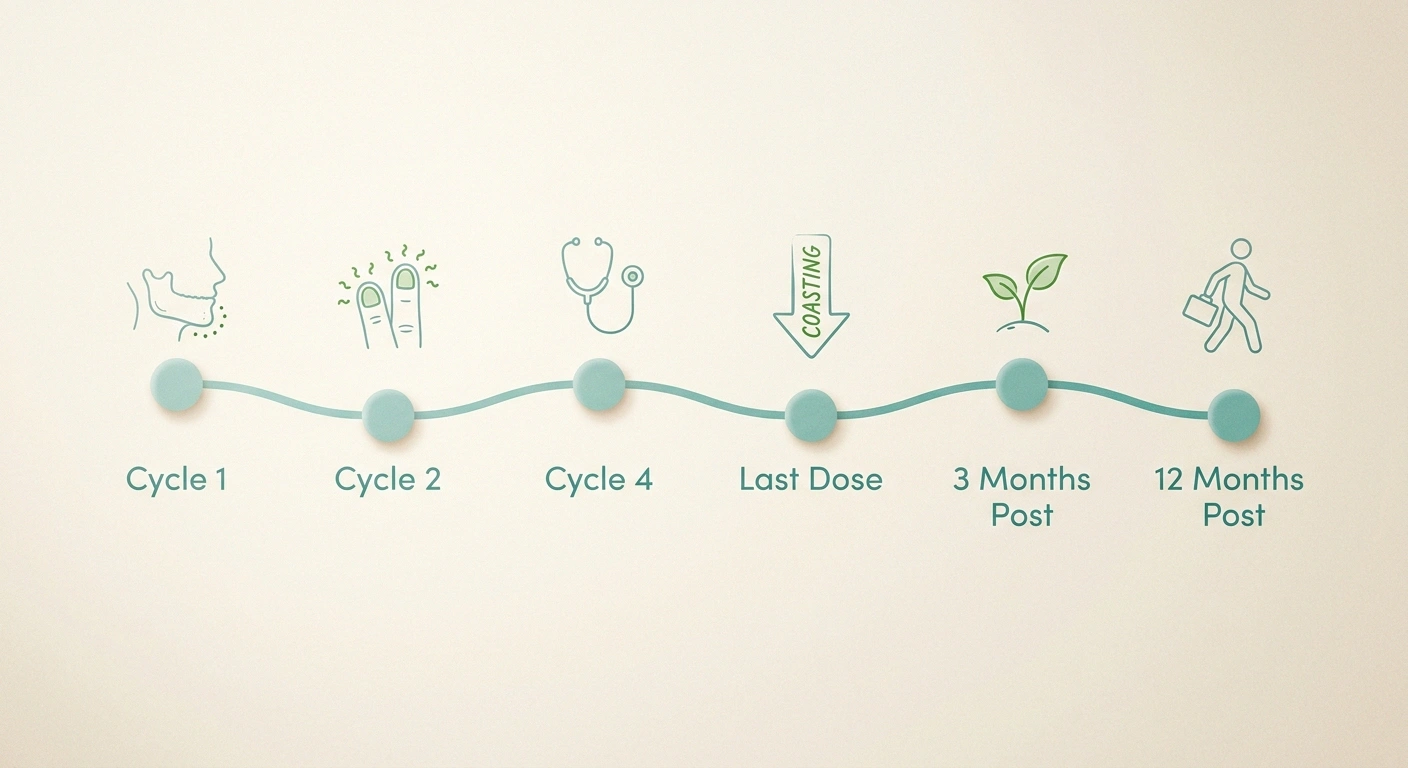
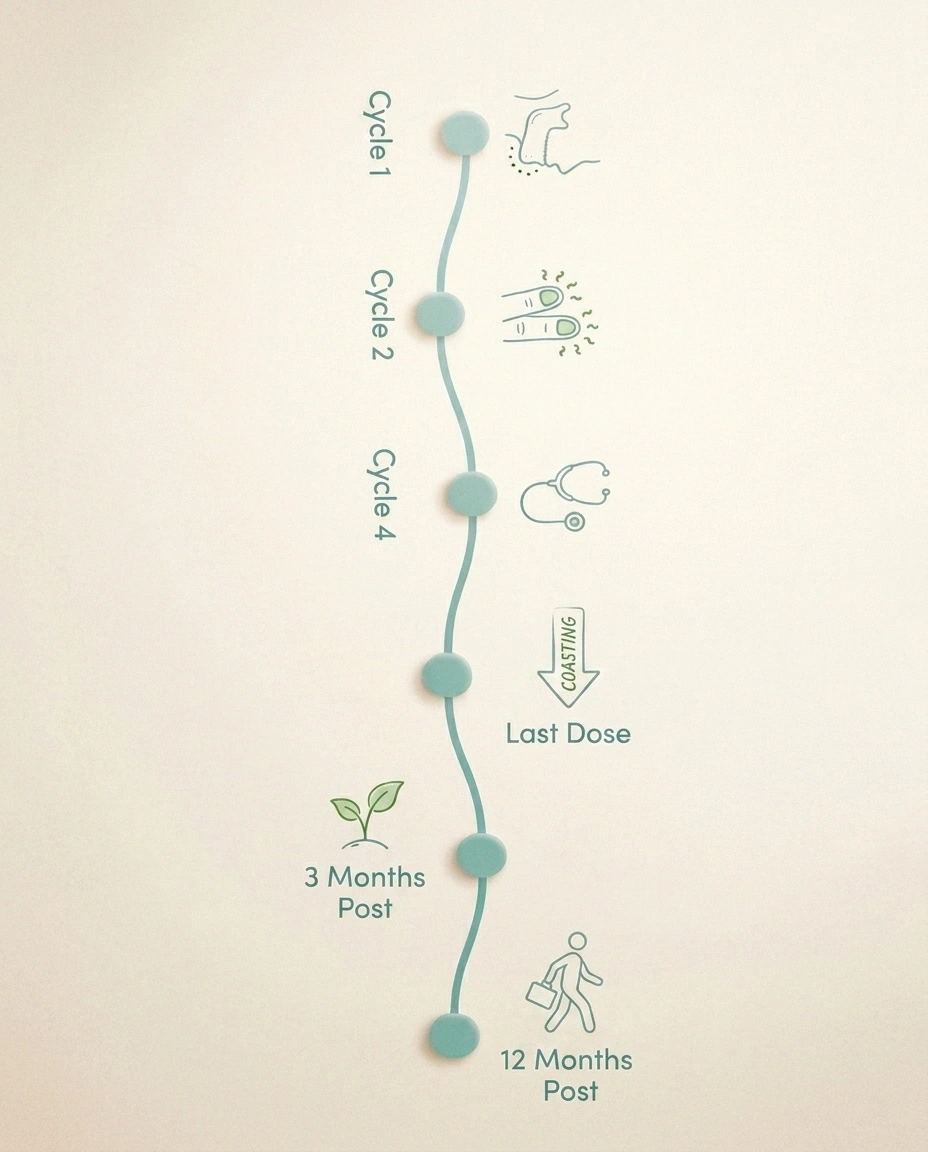
The timing of vincristine neuropathy is one of the most predictable things about it, which is actually good news. Knowing what typically happens when helps you separate “this is on schedule” from “this needs an urgent call.”
Vincristine Neuropathy Timeline
CYCLES 1-2
Jaw pain, first tingling, mild constipation, softening reflexes
CYCLES 2-4
Consistent numbness, absent ankle jerks, fine-motor tasks harder
CYCLE 4+
Motor weakness, gait issues, dose modifications considered
POST-TREATMENT
Coasting phenomenon: symptoms may briefly worsen for weeks
3-24 MONTHS
Gradual recovery for most; ~10-30% left with some persistent symptoms
- Cycles 1 to 2: Jaw pain, occasional finger or toe tingling, mild constipation. Reflexes may already be softening on exam.
- Cycles 2 to 4: Numbness and paresthesias in fingers and toes become more consistent. Ankle jerks often absent. Constipation more pronounced. Fine motor tasks (buttons, jars, texting) start feeling awkward.
- Cycles 4 and beyond: If treatment continues, more distal sensory involvement, motor weakness that can affect walking, and greater autonomic burden. This is where oncologists most often consider dose modifications.
Then treatment ends, and something surprising can happen. Symptoms may briefly get worse before they get better. This is called the coasting phenomenon, and it’s specific to vincristine and a few other chemotherapy drugs. The nerves are still processing the last several doses, and for a few weeks to a few months after your final infusion, you might feel MORE numbness, tingling, or weakness rather than less. This is expected, it does not mean the cancer is back, and it does not mean something new is wrong.
After the coasting settles, recovery generally begins. Studies of adult and pediatric vincristine survivors show significant improvement in the first three months post-treatment, ongoing improvement over 6 to 12 months, and continuing (though slower) gains out to 24 months. In one adult lymphoma follow-up cohort, about half of patients still reported some VIPN at three months post-completion but with meaningful improvements on functional testing. Most people get much of themselves back. A minority, roughly 10 to 30 percent depending on the study, are left with some persistent symptoms, more likely in patients who received high cumulative doses or who carry certain genetic variants. Our companion piece on whether neuropathy can be reversed talks through what “recovery” realistically looks like across nerve conditions.
Who’s at Higher Risk

Not everyone on vincristine develops the same severity of neuropathy, and researchers have been working hard to figure out why. A few factors stand out.
Research Says
A landmark 2015 St. Jude Children’s Research Hospital and Children’s Oncology Group study of pediatric ALL patients found that children carrying the TT genotype at CEP72 rs924607 developed grade 2-4 vincristine neuropathy at roughly 55 percent, compared with about 20 percent in those with the CC or CT genotype.
Diouf et al., JAMA 2015. Some follow-up populations have not fully reproduced the association, but the CEP72 finding continues to shape pharmacogenomic research in vincristine dosing.
Cumulative dose matters. More doses over time equals more exposure equals more risk. Regimens with prolonged vincristine (some ALL protocols, CHOP for aggressive lymphomas) drive incidence up. Adult regimens typically cap each dose at 2 mg IV to limit toxicity, though newer pediatric protocols use higher weight-based dosing under close monitoring.
CEP72 rs924607 (a genetic variant). A landmark 2015 study at St. Jude Children’s Research Hospital and the Children’s Oncology Group found that a variant in the CEP72 gene, which codes for a protein involved in microtubule assembly, is associated with higher rates of vincristine neuropathy in pediatric ALL patients. Children who carried the TT genotype at rs924607 had roughly 55 percent grade 2-4 neuropathy versus 20 percent in those without. This finding has been reproduced in some populations and not in others, but it’s shaping how researchers think about pharmacogenomic screening.
CYP3A5 non-expresser status. CYP3A5 is a liver enzyme that helps metabolize vincristine. People who don’t express functional CYP3A5 (a common genotype in patients of European descent) clear vincristine more slowly, leading to higher exposure and higher neuropathy risk. This is one of the reasons vincristine can hit people so differently on the same regimen.
Concurrent azole antifungals (a big one). Antifungal drugs like itraconazole, voriconazole, and posaconazole are potent CYP3A inhibitors. When given alongside vincristine, they can dramatically raise vincristine blood levels and trigger severe neuropathy, sometimes with central nervous system effects. A Kaiser Northern California case series documented multiple patients hospitalized after this interaction. Fluconazole is a safer alternative in most cases. Your oncology pharmacist watches this interaction carefully, but if you’re prescribed a new antifungal from an urgent care or ER during treatment, flag it back to oncology immediately.
Pre-existing neuropathy or Charcot-Marie-Tooth disease. If you have any underlying peripheral neuropathy (from diabetes, alcohol, prior chemo, or hereditary conditions like CMT), vincristine can be markedly harder to tolerate. There are case reports of vincristine unmasking previously undiagnosed CMT in pediatric ALL patients. Tell your oncology team about any family history of neuropathy before starting.
The broader universe of medications that cause neuropathy covers what else to watch out for during and after treatment.
What Your Oncology Team Watches For

Vincristine neuropathy is a dose-limiting toxicity, meaning it’s usually the reason a regimen has to be modified, not the cancer response. Your oncology team is monitoring for it whether they say so out loud or not. Here’s what they’re doing behind the scenes.
up to 75%
of non-Hodgkin lymphoma patients treated with CHOP or R-CHOP develop some vincristine neuropathy
Overall incidence across all vincristine regimens sits around 30 to 50 percent, with the higher end seen in prolonged or intensified dosing schedules.
Neurologic exam at each cycle. Reflexes (especially ankle jerk), muscle strength testing, sensation testing with a tuning fork or monofilament, gait observation. If you notice your appointments include “walk down the hall for me” or a little rubber-hammer moment, that’s the neuropathy check.
Symptom scoring. Many centers use standardized scales like the CIPN-PRO (Patient-Reported Outcome) or the Total Neuropathy Score-Pediatric Vincristine for children. These aren’t busywork. They generate objective numbers your oncologist tracks over cycles to spot escalating toxicity.
Grading against CTCAE. The Common Terminology Criteria for Adverse Events grade neuropathy from 1 (mild, no interference with function) to 4 (severe, disabling, life-threatening). Grade 2 typically triggers a conversation about dose. Grade 3 usually triggers a hold or dose reduction. Grade 4 typically means stopping vincristine.
Dose decisions. If grade 2-3 neuropathy develops, your oncologist may reduce the next dose (commonly by 50 percent), hold vincristine for a cycle, or replace it altogether in some regimens. These are hard calls because vincristine drives cancer response, and reducing or omitting doses can theoretically affect efficacy. That’s why the decision belongs to your oncologist, not to your friend on Facebook, not to a supplement salesperson, and not to a well-meaning article on the internet including this one.
If you’re new to how neuropathy is worked up in general, our overview of neuropathy diagnosis explains the tests and terminology.
Managing Symptoms During Treatment

You can’t prevent vincristine neuropathy outright. No supplement, no cream, no protocol reliably stops it from developing. What you CAN do is manage the symptoms as they show up, reduce fall risk, protect your bowel, and give your nervous system the best possible conditions for recovery.
Watch the Antifungal Interaction
Azole antifungals (itraconazole, voriconazole, posaconazole) block the liver enzyme that clears vincristine, which can push blood levels dangerously high and trigger severe neuropathy. Fluconazole is generally safer. If any provider outside your oncology team prescribes a new antifungal, contact your oncology pharmacist before you fill it. This interaction has hospitalized patients and is one your oncology team is actively watching.
Constipation prophylaxis from dose one. This is non-negotiable. Vincristine slows the gut, and severe constipation on top of chemo is genuinely dangerous. Your oncology team will typically prescribe a stimulant laxative (like senna) with a stool softener (like docusate) starting the day of your first infusion, not “if needed.” Take it as prescribed even on days you don’t feel constipated. Add water. Add fiber. Move if you can. If you go more than 48 hours without a bowel movement, call the clinic.
Fall prevention. Numb feet and weak ankles mean higher fall risk. Clear tripping hazards from your floors. Add nightlights. Grab bars in the bathroom are inexpensive and worth it. If foot drop or serious balance issues are developing, ask for a PT referral early.
Occupational therapy for hands. If buttons, jars, and utensils are getting frustrating, an OT can teach adaptations and provide gadgets that make life meaningfully easier. This is not “giving up.” It’s protecting your independence while your nerves recover.
Foot care. Because sensation is dulled, small foot injuries can go unnoticed and get infected. Look at your feet daily. Well-fitting shoes. No barefoot walking outside. Trim toenails carefully or have someone help.
Gentle daily movement. Walking, stretching, gentle yoga, or a stationary bike keep circulation going and preserve strength. High-impact exercise or anything that risks a fall is off the table while balance is compromised.
Warm foot soaks and gentle massage. Not proven to change the course of the neuropathy, but many patients find them soothing and they don’t harm anything.
Treating the Pain

When neuropathic pain is significant, medication becomes part of the picture. Here’s an honest look at what has evidence and what doesn’t, specifically in the vincristine context.
Research Says
The CALGB 170601 trial tested duloxetine 60 mg daily against placebo in patients with painful CIPN from taxanes and platinum agents and showed clinically meaningful pain reduction. ASCO CIPN guidelines recommend duloxetine as the first-line pharmacologic option for CIPN pain, extended in practice to vincristine-related pain.
Smith et al., JAMA 2013. Trial did not primarily include vincristine patients; use in VIPN is by clinical extrapolation, not direct trial evidence.
Duloxetine (Cymbalta). The strongest evidence for chemotherapy-induced neuropathic pain overall comes from the CALGB 170601 trial, which showed that duloxetine 60 mg daily reduced pain in patients with painful CIPN from taxanes and platinum drugs. The trial did not primarily study vincristine, but ASCO’s CIPN guidelines recommend duloxetine as the first-line pharmacologic option for CIPN pain broadly, which extends to vincristine in clinical practice. Side effects (fatigue, nausea, dry mouth) are common but usually manageable. If your oncologist or palliative team recommends it, our page on duloxetine for neuropathy covers what to expect.
Gabapentin and pregabalin. Gabapentinoids have less direct CIPN evidence than duloxetine but are widely used for neuropathic pain in general and are reasonable options when duloxetine isn’t tolerated or is contraindicated. Dose-titration matters here (start low, go slow to minimize sedation).
Topical agents. Lidocaine patches, capsaicin cream, and compounded amitriptyline/ketamine creams can help focal areas without systemic side effects. Best for a specific painful patch rather than diffuse numbness.
What has WEAK evidence in vincristine. Here’s where I want to be careful with you. Glutamine was studied in a large randomized pediatric prevention trial and did not significantly reduce neuropathy compared to placebo. Vitamin E has been studied in CIPN broadly with negative results. L-carnitine has been studied in some CIPN populations, but a large trial in taxane-treated patients found it may actually WORSEN neuropathy. Alpha-lipoic acid has some evidence in diabetic neuropathy but very limited support in CIPN. The honest bottom line for vincristine: nothing over-the-counter has strong prevention evidence, and a few things (L-carnitine in some contexts) may not be neutral.
Interventions with more general natural-remedy support. Some patients find modest relief from acupuncture, TENS units, mindfulness-based stress reduction, and cognitive behavioral therapy for chronic pain.
Living Well After Vincristine

When treatment ends and the coasting settles down, most people begin a gradual recovery. That recovery is often uneven. You might notice hand strength coming back faster than foot sensation, or vice versa. You might have a good month followed by a plateau. This is normal. Nerves regenerate slowly (they grow back at roughly 1 mm per day in the best conditions), which means recovery is measured in months, not weeks.
Recovery Reality Check
Peripheral nerves regenerate at roughly 1 mm per day under good conditions. That means recovery from vincristine neuropathy is measured in months, not weeks, and it is usually uneven, with hand strength returning at a different pace than foot sensation. Meaningful improvement typically appears in the first three months post-treatment, with continued gains out to a year or two. Adaptive equipment, PT, OT, and pain management are not signs of defeat. They are tools that protect your independence while your nervous system does the slow work of healing.
Physical and occupational therapy remain valuable in the recovery phase. A PT can rebuild gait, balance, and strength. An OT can help with fine motor recovery and adaptations for anything that doesn’t come all the way back.
Nutrition supports nerve health. B vitamins (especially B12 if you’re low), adequate protein for tissue repair, and general anti-inflammatory eating are the basics worth getting right during recovery.
The mental health piece is real. Nerve pain that outlasts treatment, or numbness that doesn’t fully resolve, can grind down your mood. This is common enough that oncology psychology and palliative care services exist for exactly this reason. If you’re struggling, please read our page on neuropathy and mental health and reach out. You are not weak. You are healing from a treatment that saved your life.
Adaptive equipment isn’t defeat. Ankle-foot orthoses (AFOs) for foot drop, canes or trekking poles for balance, jar openers, button hooks, thick-handled utensils. These tools protect your independence and let you get on with the parts of life that matter. Use what helps.
Check in with your oncology team about persistent symptoms. If numbness, weakness, or pain is still significant a year out, ask about a neurology referral. Some late-effects clinics specialize in cancer survivors, and they know this territory.
Frequently Asked Questions
Does vincristine neuropathy go away completely?
For most people, most of it does. Studies show significant improvement in the first three to twelve months after treatment ends, with continuing (slower) gains out to 24 months. Roughly 10 to 30 percent of patients are left with some persistent symptoms, more commonly in those who received high cumulative doses, have genetic risk factors like the CEP72 variant, or had pre-existing nerve issues. Full recovery is possible but not guaranteed.
Why does vincristine cause jaw pain?
Vincristine can irritate the trigeminal nerve, which supplies sensation to the face and jaw. The result is a deep aching or electric-shock pain along the jaw, typically in the first or second cycle. It usually lasts a few days and resolves on its own. It is a known vincristine effect, not a dental problem or a sign the cancer has spread. Report it to your oncology team so it’s documented, but it’s rarely a reason to change treatment.
Why is constipation so bad on vincristine?
Vincristine slows the autonomic nerves that drive the gut, which can produce constipation ranging from mild to severe ileus (bowel movement essentially stops). This is why oncology teams start patients on a stimulant laxative plus stool softener from dose one, not “if needed.” Take the bowel regimen as prescribed even on good days, and call the clinic if you go more than 48 hours without a bowel movement.
Can vincristine neuropathy be prevented?
There is no proven prevention. Glutamine was studied in a large pediatric randomized trial and did not significantly reduce neuropathy. Vitamin E is negative. Alpha-lipoic acid and L-carnitine lack strong evidence and L-carnitine in one taxane trial may have worsened neuropathy. What DOES help is aggressive constipation prophylaxis, close monitoring, dose modifications when appropriate, and avoiding drugs that raise vincristine levels (particularly azole antifungals like itraconazole, voriconazole, and posaconazole).
Is vincristine ever given by spinal injection?
No. Vincristine is given intravenously only. When given intrathecally (into the spinal fluid), it is uniformly fatal, which is why hospital chemotherapy pharmacies use dedicated labeling, minibag-only dispensing, and independent double-checks to prevent that mistake. If you or a family member ever notice a vincristine syringe being prepared for anything other than IV administration, speak up immediately. Modern oncology safety systems are built specifically to catch this before it can happen.
What’s the strongest medication for vincristine nerve pain?
Duloxetine has the strongest evidence for chemotherapy-induced neuropathic pain overall (CALGB 170601 trial), and ASCO guidelines recommend it as first-line for CIPN pain. Gabapentin and pregabalin are commonly used alternatives. Topical lidocaine or compounded creams can help focal painful areas. Any of these decisions belongs to your oncologist or a pain specialist working with them.
Are there genetic tests that predict who gets vincristine neuropathy?
Research is moving in this direction but genetic testing is not yet standard of care. The CEP72 rs924607 variant and CYP3A5 non-expresser status have been linked to higher neuropathy risk in pediatric ALL populations. Some academic centers offer research testing, but most patients today are monitored clinically rather than genetically. This will likely change over the next several years as pharmacogenomic testing becomes more accessible.
You Are Not Alone in This
If there is one thing I hope you take from all this, it’s that vincristine neuropathy is a known, monitored, and largely recoverable side effect of a chemotherapy drug that is doing important work in your body. The tingling, the jaw ache, the maddening constipation, the numb toes, they are all part of a pattern your oncology team has seen many times and knows how to manage. Report every symptom shift before every infusion. Take the bowel regimen. Ask for PT and OT early. Push back gently but firmly when a pharmacist or urgent care doctor tries to add an azole antifungal without checking with your oncology pharmacist first.
And when treatment ends, be patient with your body. Nerves take their time. Most of what you’re going through will fade over months, though not on a schedule you or I can predict. What doesn’t fully fade can usually be adapted around. If you want to understand where vincristine neuropathy sits in the broader picture of nerve conditions, our overview of the stages of neuropathy is a good next read.
You are getting through something hard. You are not exaggerating what you feel. You are not weak for asking for help with pain, or with sleep, or with the mental weight of any of this. Advocate for yourself in the oncology clinic. Bring a written list of symptoms. Bring a person to appointments if you can. And know that on the other side of this treatment, most people find their way back to a life that fits them again.
About the Author