It starts somewhere behind your knee. A single cool drop, unmistakably liquid, sliding slowly down the back of your calf toward your ankle.
You reach down. Dry. You look. Nothing. The sensation is still happening while your fingers are sitting on perfectly dry skin.
People find this one unusually unsettling, and I think the reason is that most nerve symptoms announce themselves as symptoms. Burning feels like a malfunction. Tingling feels like a malfunction. A drip of water feels like an event in the world, something that should have a cause you can point at. When there is nothing to point at, the mind goes somewhere darker than it does with ordinary pins and needles.
So let me put the reassuring part up front. This sensation has a name, it is well documented, it is common in nerve conditions, and on its own it is not dangerous. It is called phantom wetness, and it belongs to the family of symptoms clinicians group under paresthesia: sensations generated by the nervous system with no external stimulus behind them.
There is one version of this that is not phantom and does need attention promptly, and I will come to it directly rather than burying it. Everything else here is explanation and management.
Reach Down and Check
Before reading further, do the obvious thing, because it splits the whole question in about ten seconds.
The ten-second check, and where each answer sends you
Put your hand flat on the exact spot while the sensation is happening.
Look at the skin, the sock and the trouser leg. Reduced sensation makes real fluid genuinely easy to miss by touch alone, so use your eyes as well as your fingers.
Dry
A sensory event. Everything else on this page applies, and none of it is urgent on its own.
Genuinely wet
A different question entirely. Usual answers: urinary leakage, pooled sweat, an unnoticed weeping blister or wound, or fluid from swollen tissue.
Touch the spot. Look at your skin, your sock, your trouser leg. If everything is dry, you are dealing with a sensory event and the rest of this article applies to you. If there is genuinely liquid there, you have a different problem, and it is worth knowing which kind before you go further.
Real wetness in that location usually means one of a small number of things: urinary leakage, sweat pooling, a weeping wound or blister you had not noticed, or fluid from swollen tissue. Reduced sensation makes all of those easy to miss, which is exactly why people with nerve conditions sometimes cannot tell the difference without looking.
Most readers, having checked, find dry skin. That answer moves us on.
Your Body Has No Wetness Sensor
This is the fact that makes the whole symptom make sense, and almost nobody knows it.
Your skin contains receptors for temperature, for pressure, for stretch, for vibration, and for tissue damage. It contains no receptor for wetness. None. There is no such nerve ending anywhere in human skin.
Which raises an obvious question: how do you know when you step in a puddle?
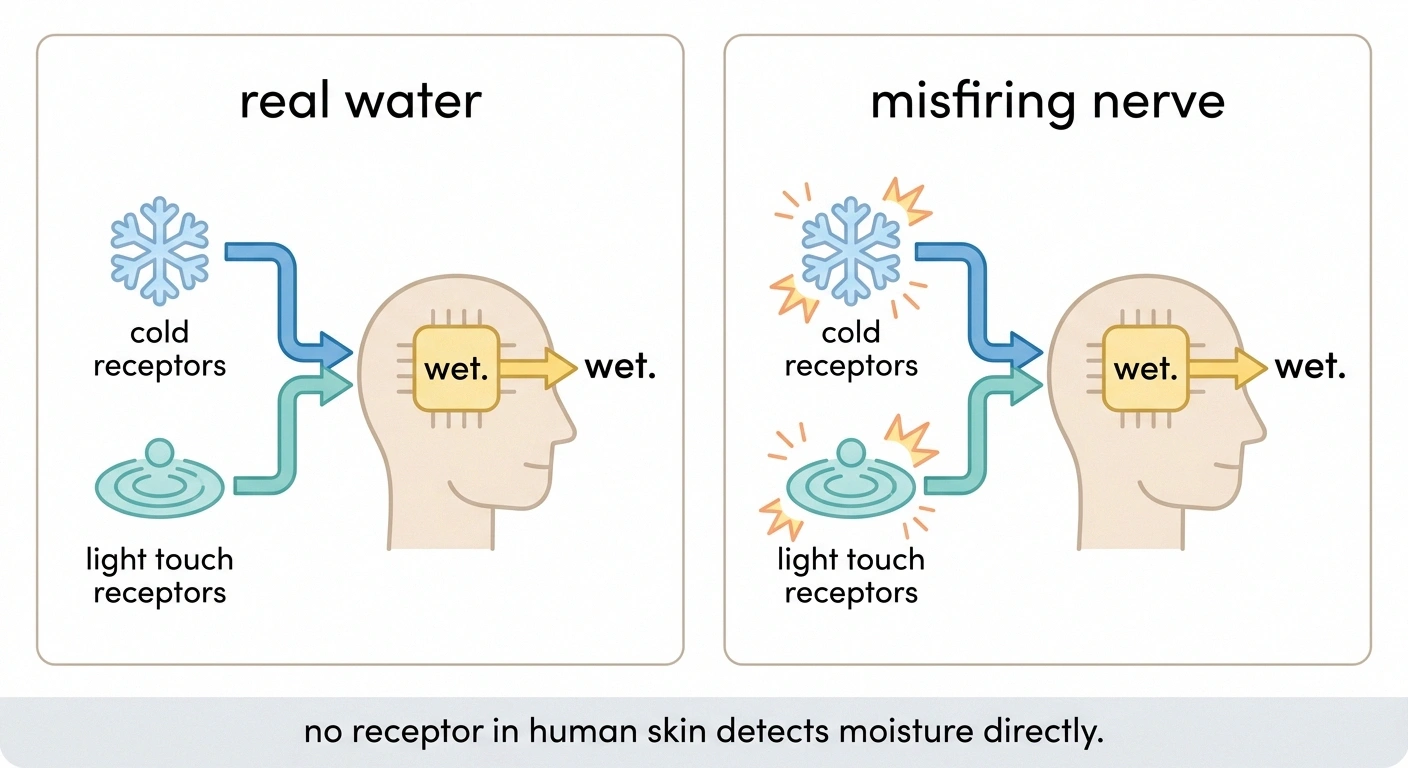
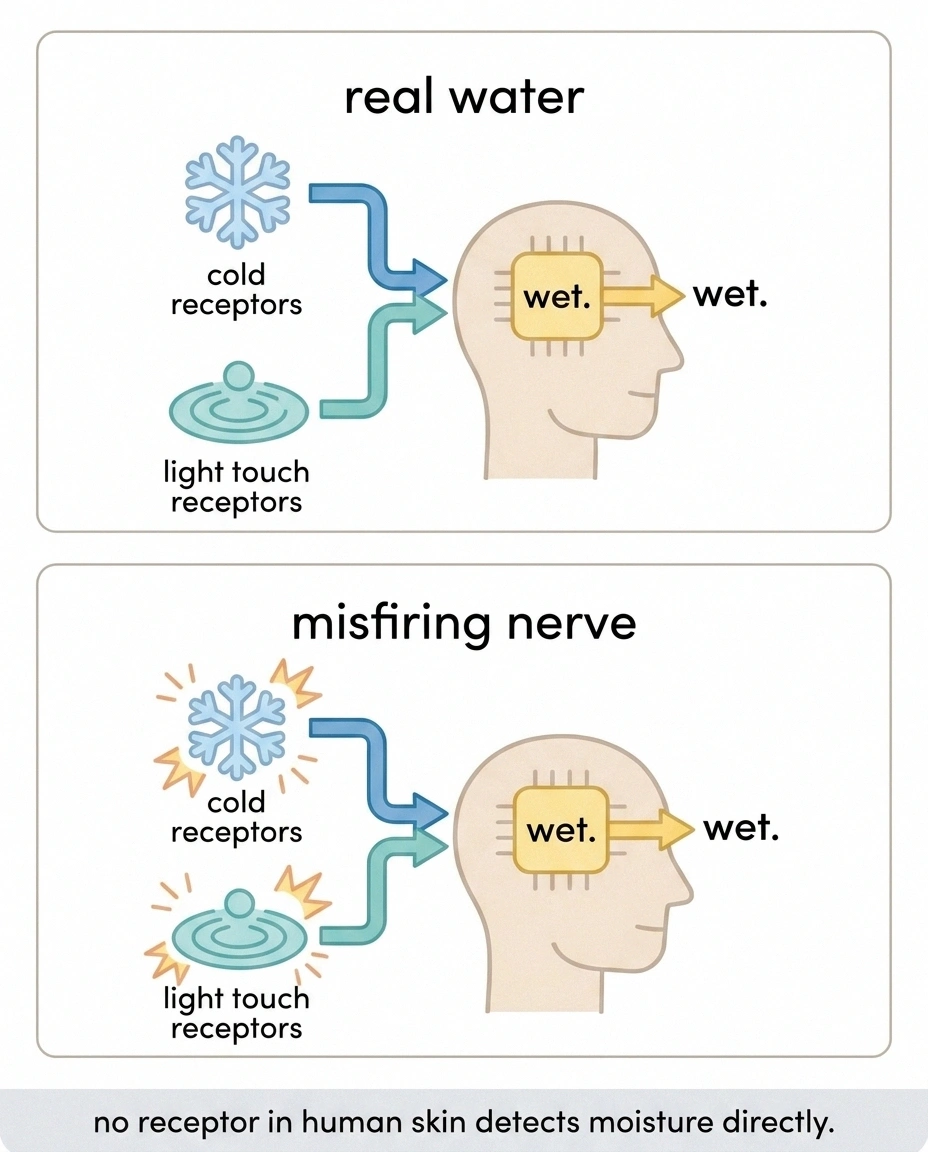
You infer it. Your brain takes two signals arriving together, a drop in skin temperature and a light mechanical sensation moving across the surface, and concludes that liquid is present. That conclusion is so reliable in ordinary life that it feels like direct perception. It is not. It is a calculation your brain runs constantly and almost always gets right.
Why Cold Plus Pressure Reads as Liquid
Now the malfunction becomes obvious.
The same arithmetic, run on two different inputs
Stepping in a puddle
Cold receptors fire. Light-touch receptors fire. Both at once, in the same patch of skin.
Brain concludes: liquid. Correct.
Damaged fibers misfiring
Cold receptors fire. Light-touch receptors fire. Both at once, from nothing.
Brain concludes: liquid. Same conclusion, no puddle.
Worth sitting with: there is no receptor anywhere in human skin that detects moisture directly. Wetness has always been a calculation. This symptom is that calculation running correctly on faulty data.
If damaged sensory fibers fire spontaneously, and if the ones that happen to fire are cold fibers and light-touch fibers at roughly the same moment, your brain receives exactly the input pattern that water produces. It has one interpretation available for that combination, and it delivers it with full confidence.
The sensation is not imagined and it is not exaggerated. Your brain is doing precisely what it always does with that signal. The signal is simply arriving from the wrong place, generated by nerves rather than by the world.
In conditions involving demyelination, the mechanism is easier still to picture. Myelin is insulation around a nerve fiber, and when it wears thin, signals leak and cross the way current does in a frayed cord. The brain gets scrambled input and matches it to the nearest familiar sensation in its catalogue: being squeezed, being burned, being wet.
What People Actually Describe
The descriptions cluster tightly, which is one reason clinicians recognize it quickly when a patient gives a good account.
A single drop tracking slowly down the calf or the thigh. Water trickling steadily, as though a tap were running somewhere above. A cold splash landing on the shin. Blood running down the leg, which people report with real alarm. A patch of skin that simply feels damp and stays that way. Occasionally the opposite: a sensation of something warm spreading, which readers find more frightening because it maps onto incontinence.
Duration ranges from a couple of seconds to hours. Some people get it once a month and forget about it. Others get it several times a day and find it genuinely intrusive, more for its strangeness than for any discomfort, because in most cases it does not actually hurt.
Where on the Body It Shows Up
The legs dominate by a wide margin. Below the knee is the single most common location, with the thigh next, and the arms and torso well behind.
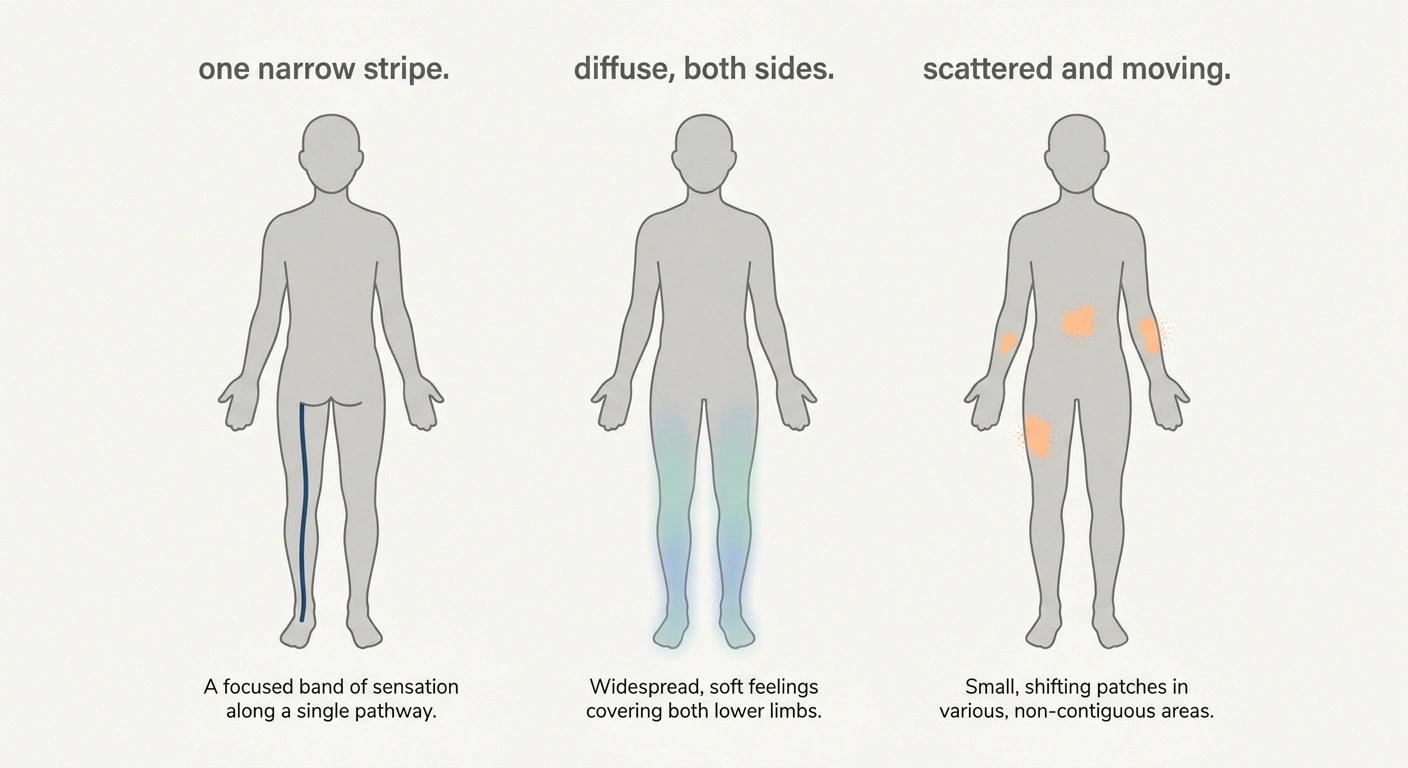
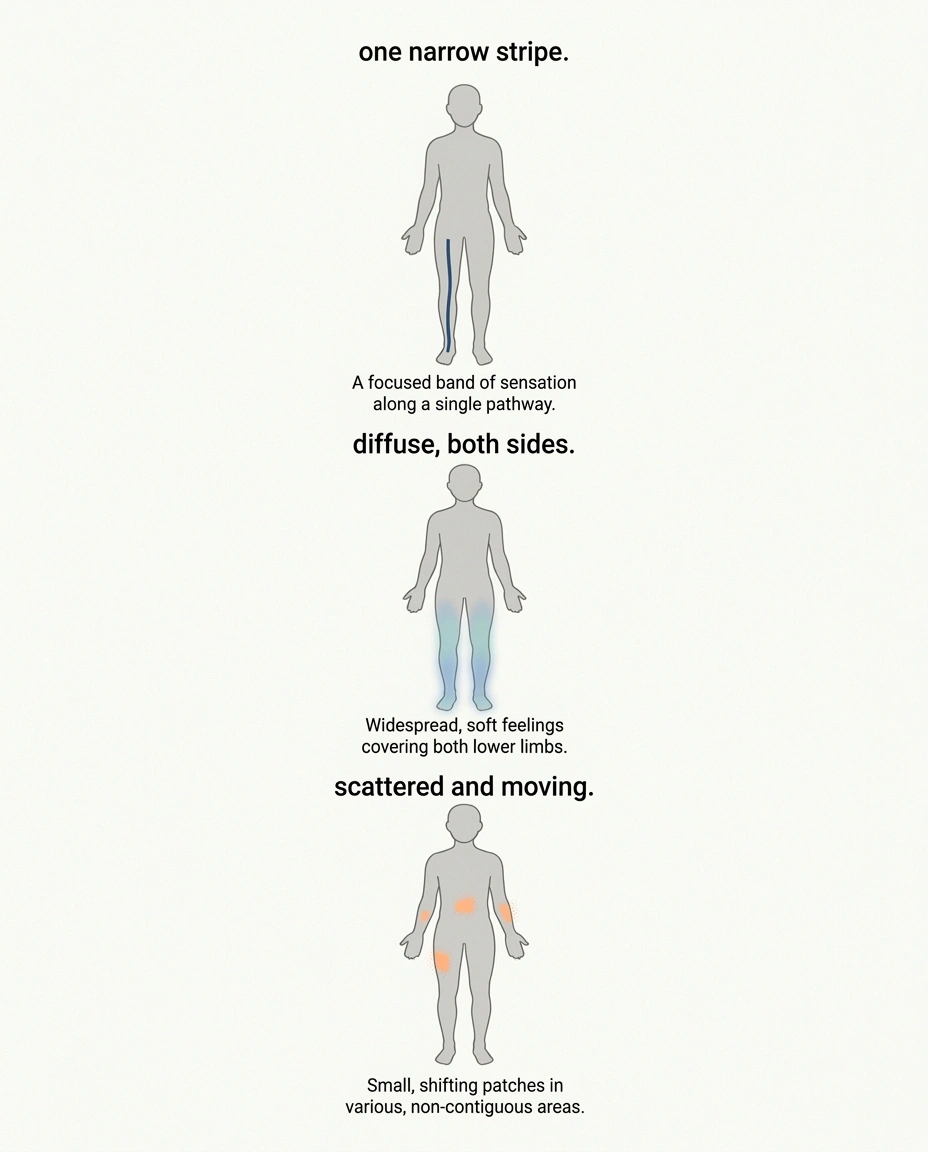
Three shapes, three different searches
A narrow stripe, one leg
Same route each time, often changes with sitting or bending. Points toward an irritated nerve root in the lower back.
Diffuse, both legs, no edges
Roughly symmetric, worst below the knee. Points toward small fiber polyneuropathy, and toward a blood panel.
Scattered, moves around
A leg one week, an arm or the trunk the next. Fits a central process better than a peripheral one, particularly alongside other neurological changes.
Sketch yours on a body outline over two weeks. Repetition of the same route is itself diagnostic information, and it is the detail memory loses first.
That distribution is a clue rather than a coincidence. Nerve symptoms concentrate in the legs for the same reason nerve symptoms always do: the fibers running there are the longest in the body and the most vulnerable to almost any process that damages nerves. Our overview of how neuropathy progresses through its stages covers why symptoms travel upward from the feet over time.
When phantom wetness shows up on the trunk or the face instead, or when it appears on one side only, the reasoning changes and the search widens.
The Multiple Sclerosis Connection

This symptom has been studied most carefully in multiple sclerosis, and the findings are worth knowing whether or not MS is on your list of concerns.
In a patient-centred survey of people with MS, phantom skin wetness was reported by close to a third of respondents. It was most often experienced as water trickling on the skin of the lower limb. Women were roughly 2.17 times as likely as men to report it, and people with relapsing-remitting MS about 1.73 times as likely as those without that form.
Two things follow. First, this is not a rare or exotic complaint, and anyone who has been made to feel odd for describing it has been badly served. Second, and more importantly: prevalence in MS does not mean the symptom implies MS. Phantom wetness in isolation, with no other neurological findings, is a weak signal on its own. MS presents with a constellation, not a single strange sensation.
If the wetness is arriving alongside optic symptoms, new weakness, coordination problems, or symptoms that clearly worsen with heat, that combination is the thing to report, not the drip by itself.
When Peripheral Neuropathy Is the Cause
For readers of this site, peripheral neuropathy is the more likely explanation, and the small nerve fibers are usually the ones responsible.
Small fibers are the ones carrying temperature and pain. Light mechanical touch travels on larger, faster fibers. The wetness inference needs both channels, which is why this symptom turns up in so many different situations, but the temperature half is the one small fiber damage disrupts most, and a spurious cold signal is enough to tilt the calculation on its own. Damage them and you get the whole catalogue of odd thermal sensations: burning, ice-cold feet in a warm room, the feeling of standing in cold water, and phantom drips. Our article on small fiber neuropathy explains why these fibers can be badly affected while standard nerve tests come back clean.
The underlying causes are the familiar ones. Diabetes and prediabetes lead the list. B12 and other nutritional deficiencies follow, and those are worth finding because correcting them changes the trajectory. Thyroid disease, autoimmune conditions, alcohol, chemotherapy, and shingles that has left lingering nerve irritation all belong on the list.
When the drip sensation arrives in someone whose feet already burn at night, no further explanation is usually needed. It is the same process, expressing itself in a different way.
When It's Coming From Your Lower Back
A meaningful share of these sensations never involve the leg's nerves at all. They start where those nerves exit the spine.
An irritated nerve root in the lower back, from a bulging disc or from arthritic narrowing, generates signals that the brain places wherever that root ends. The root does not know it is being pinched near the spine. The brain only knows which patch of skin that fiber normally reports on, so that is where the sensation appears.
The clue is the shape. Root problems produce a stripe: a long, narrow band running down one leg along a consistent path, often the same path every time. They frequently come with back pain, though not always, and they often change with position. Sitting, standing, bending forward, or coughing can turn the sensation on or off.
People with this version can often reproduce it deliberately once they notice the pattern, which is a genuinely useful thing to be able to demonstrate.
Reading the Shape of It
Take a moment and map your own. Where exactly does it start, where does it end, and is it the same route each time?
A narrow stripe down one leg, following the same line repeatedly, points toward a nerve root. A diffuse sensation across both feet and lower legs, without clear edges, points toward polyneuropathy. Scattered patches that turn up in different places on different days, sometimes on an arm, sometimes on the trunk, fit a central process better than a peripheral one.
Nobody expects you to arrive at a diagnosis from this. But arriving at an appointment able to say “same narrow stripe down the back of my right calf, three or four times a week, worse when I sit for a long stretch” is worth considerably more than “my leg feels wet sometimes.”
Write it down when it happens. Memory smooths these details out within a day.
Why It's Worse at Night

Almost everyone reports that this is worse in bed, and there is a straightforward reason.
During the day, your nervous system is flooded with sensory input. Clothing shifts, floors press back, your body is in motion. A small spontaneous signal from a damaged fiber gets lost in that traffic. Lie still in a dark quiet room and the traffic stops, leaving the spurious signal alone in an empty channel with your full attention on it.
Skin temperature also drops slightly at night, which nudges the cold fibers that feed the wetness inference. Combine falling skin temperature with a quiet sensory background and you get the classic report: the drips start when the lights go out.
This is the same mechanism behind most nerve symptoms getting worse at night, and the same countermeasures help. Light background sound, keeping the legs neither cold nor overheated, and giving the sensory system something else to process all reduce how loud the signal feels.
The One Version That Is Not Phantom
Here is the exception I promised, stated plainly.
Stop reading and call today if any of these are also true
- Numbness across the inner thighs or the area you sit on
- New trouble controlling your bladder or bowels
- Genuine unexplained leakage rather than a phantom sensation
- New weakness in one or both legs
That combination points toward compression of the nerve bundle at the base of the spine. It is uncommon, and unlike everything else described here, the outcome depends on how quickly the pressure is relieved. Hours matter; a next-available appointment does not serve you.
If the wet feeling comes with any of the following, it is no longer a curiosity and needs same-day evaluation: numbness across the inner thighs and the area you would sit on, new difficulty controlling your bladder or bowels, genuine unexplained leakage, or new weakness in one or both legs.
That combination can indicate compression of the bundle of nerves at the base of the spine, a condition called cauda equina syndrome. It is uncommon. It is also time-sensitive in a way that almost nothing else on this page is, because outcomes depend heavily on how quickly pressure is relieved.
Two other situations are worth naming. Clear fluid draining from the nose or ear together with a headache that improves when you lie flat, in the weeks after a spinal injection or procedure, needs assessment rather than observation. And any sensation that is unmistakably real fluid, particularly if a wound might be involved, should be looked at rather than reasoned about.
Beyond those, phantom wetness by itself is not an emergency, and it does not become one by being frequent.
Things That Seem to Set It Off

Triggers vary between people, but the same handful come up often enough to be worth testing against your own experience.
Temperature change is the most consistent. Stepping out of a warm shower, a draught across bare legs, air conditioning, getting into cold sheets. Anything that shifts skin temperature quickly can start it, which fits the mechanism neatly.
Sustained position comes second. Long stretches sitting, especially in a car, especially with a wallet in a back pocket. Crossing the legs. Standing still.
Then the general amplifiers: fatigue, poor sleep, stress, and for people with a demyelinating condition, being overheated. Some people find their episodes cluster around blood sugar swings, which is a reason to note the timing if you track glucose.
Keep a rough log for two weeks. Patterns that feel random usually are not.
What Actually Reduces It
No treatment targets phantom wetness specifically, because it is a symptom rather than a condition. What reduces it is whatever reduces the nerve irritation producing it.
A log worth keeping for fourteen days
Five columns, one line per episode. Most people who think their episodes are random discover a temperature or position trigger inside two weeks.
| Time | Where it ran | How long | Just before it started | Anything else off |
|---|---|---|---|---|
| 10:40 pm | Back of right calf, knee to ankle | About 40 seconds | Got into cold sheets | No |
The last column earns its place. An episode that arrives alongside new weakness, a vision change or a coordination problem is a different report than one that arrives alone, and only a log will tell you which you have been having.
If the cause is a treatable deficiency, correcting it is the single highest-value move available, and it can change the symptom within months. If blood sugar is involved, tighter control does more for nerve outcomes than anything sold in a bottle. If a spinal nerve root is the source, physical therapy and position changes often quiet the whole territory that root serves.
Layering on top of that, the practical measures are unglamorous and do help. Keeping the legs at a steady temperature reduces episode frequency for many people. Compression, for those who tolerate it, provides constant low-level input that seems to crowd out the spurious signal. Moving position before the sensation gets going interrupts it more effectively than waiting it out.
For people whose episodes are frequent and genuinely distressing, the medications used for neuropathic symptoms generally are an option worth raising, since they act on the misfiring itself rather than on any particular flavour of it.
And there is one intervention with no downside: knowing what it is. Several people have told me the symptom stopped bothering them the day it stopped being mysterious, without changing in frequency at all.
How to Describe This So You're Believed

People report being dismissed when they raise this, and usually the problem is the phrasing rather than the listener.
“It feels like water is running down my leg” invites a puzzled pause. “I get a paresthesia that presents as cold liquid trickling down the back of my right calf, four or five times a week, mostly at night” gets written in the notes.
You do not need the vocabulary. What you need is the shape: where it starts, where it goes, how long it lasts, how often, what brings it on, and whether anything else has changed. Add the fact that you checked and the skin was dry, because that single detail tells a clinician immediately which kind of problem this is.
If it helps, say the words phantom wetness. It is a recognized description and it signals that you have already ruled out the obvious.
What Testing Looks Like

Investigation depends on what else is going on rather than on the sensation itself, which is not specific enough to test for directly.
Blood work comes first in nearly every case: glucose and A1C, B12 with follow-up markers if it sits low-normal, thyroid function, kidney function, and inflammatory markers as the history suggests. Those account for a large share of findable causes and they are inexpensive.
Nerve conduction studies assess the large fibers. They are useful, and they frequently come back normal in exactly this situation, because the fibers generating temperature-related sensations are too small to register. A normal study does not mean nothing is wrong, and being told otherwise is a common and demoralizing experience. Skin biopsy or specialized small-fiber testing fills that gap where it is available.
Imaging of the lower spine makes sense when the pattern is a one-sided stripe with back involvement. Brain and spinal cord imaging enters the picture when other neurological findings accompany the sensation, not when it appears alone. Our walkthrough of the neuropathy diagnostic process covers what each test can and cannot show.
Frequently Asked Questions
Why does it feel like water is running down my leg when nothing is there?
Human skin has no receptor dedicated to detecting wetness. The brain infers wetness by combining a cold signal with a light moving-touch signal. When damaged sensory nerves fire spontaneously and produce that combination on their own, the brain applies its only available interpretation and reports liquid on the skin. The sensation is generated internally but processed through completely normal channels, which is why it feels so convincingly real.
Is a phantom wet feeling a sign of multiple sclerosis?
Not by itself. Phantom skin wetness was reported by close to a third of people with MS in a patient survey, most often as trickling on the lower limb, so it is genuinely common in that population. But it also occurs in peripheral neuropathy, in nerve root irritation from the lower back, and in people with no identified condition at all. MS is suggested by a pattern of neurological symptoms over time, not by one unusual sensation.
Can diabetes cause the sensation of water dripping on the skin?
Yes. Diabetic neuropathy damages the small nerve fibers that carry temperature, and temperature is one of the two inputs the brain combines to detect wetness, the other being light mechanical touch. A spurious cold signal alone is often enough to tip that calculation. Phantom drips, feeling like you are standing in cold water, and burning that alternates with icy sensations all come from the same fiber damage. These symptoms can appear during the prediabetic years, before a formal diagnosis.
Should I worry about a wet sensation on my leg?
On its own, no. It becomes urgent when it arrives with numbness across the inner thighs and the sit-bone area, new bladder or bowel changes, genuine unexplained leakage, or new leg weakness. That combination can indicate compression of the nerve bundle at the base of the spine and should be evaluated the same day rather than at the next available appointment.
Why is the wet feeling worse at night?
Two reasons stack. Daytime sensory input is heavy enough to drown out small spurious signals, and lying still in a quiet dark room removes that competition entirely, leaving the misfire with your full attention. Skin temperature also falls slightly at night, which stimulates the cold-sensing fibers that feed the wetness inference in the first place.
Does phantom wetness ever go away?
Often, yes. When it stems from a correctable cause such as a B12 deficiency or poor glucose control, it can fade as the underlying problem is addressed. When it stems from nerve root irritation, it typically settles as that irritation settles. In long-standing neuropathy it tends to persist but fluctuate, with stretches of weeks where it disappears entirely and then returns.
What is the medical term for feeling water on dry skin?
The general term is paresthesia, meaning an abnormal sensation arising without an external stimulus. When the sensation is unpleasant rather than merely strange, it is called dysesthesia. Researchers studying this specific symptom use the term phantom skin wetness, which is worth using at an appointment because it is recognized and precise.
Can anxiety cause a wet or trickling sensation on the skin?
Heightened attention to bodily sensation makes existing paresthesias far more noticeable, so anxiety can amplify the symptom considerably. It is not a satisfying explanation for a sensation that arrives out of nowhere in a calm moment, and treating it as purely psychological means missing correctable causes that a simple blood panel would find.
About the Author