
The first time a new neurologist asked me what my nerve conduction study had shown, I said, “It was abnormal.” She waited. I waited. Then she asked which nerves, how slow, and whether the amplitudes were reduced — and I realized I had never actually seen the report. I'd been told the result on the phone two years earlier and written “abnormal” on a sticky note.
We spent the first twenty minutes of that appointment trying to get the report faxed over from another health system. It never arrived. She ordered a repeat test — another round of shocks and needles I hadn't needed.
That was the day I started keeping my records properly, and it's saved me more time, avoidable repeat tests and frustration than almost anything else I've done for my neuropathy. You don't need to be organized by nature. You need one afternoon, a binder or a folder on your computer, and a short list of what actually matters. Here's that list, and the system that's worked for me and for a good number of people in my support group.
The Five Documents That Matter Most
You could keep every piece of paper a clinic has ever handed you, and some people do. But for neuropathy, a handful of documents do most of the work. These are the ones a new doctor will ask about, and the ones that most often spare you an unnecessary repeat test.
1. Your full nerve conduction study and EMG report. Not the one-line summary. The full report includes tables of numbers for each nerve tested: how fast the signal traveled, how strong it was, and what the needle part of the test showed in each muscle. A new neurologist can compare those numbers with a future test to see whether things are stable, better or worse. Without them, “abnormal” tells them almost nothing. If you want to understand what's in yours, our guides to the EMG and nerve conduction study and how to read EMG results walk through it.
2. Any skin biopsy report. If you've been tested for small fiber neuropathy, the report gives a number, your nerve fiber density, compared with a normal range for your age and sex. Keep the number, the normal range, and the name of the lab — all three, because the number alone can't be compared. Different labs use slightly different reference values.
3. Your neuropathy blood work. The core panel usually includes a blood sugar measure (A1c, fasting glucose, or a two-hour glucose tolerance test), vitamin B12 and sometimes methylmalonic acid, thyroid function, kidney function, and serum protein electrophoresis with immunofixation. That last one looks for abnormal proteins that can damage nerves. Keep the actual values and dates, not just “normal.” A B12 at the bottom edge of normal means something different from one in the middle. Our piece on interpreting neuropathy blood test results explains what each one is looking for.
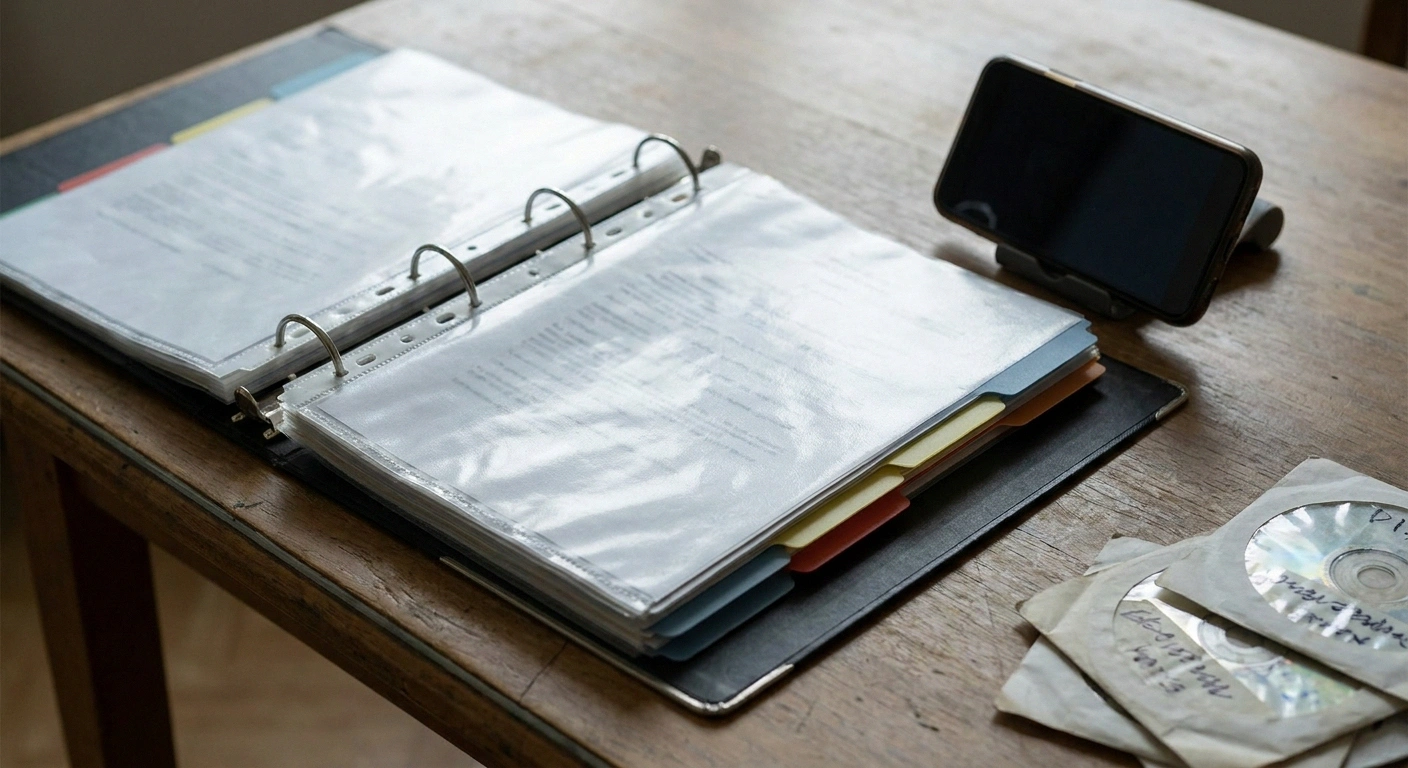
4. Imaging reports, and the images themselves for the spine. If you've had an MRI of your back or neck, keep the written report. Also ask for the images, on a disc or through a download link, because specialists often want to look for themselves.
5. Your medication history. This one gets its own section, because it's the most valuable page you'll ever make.
The One Page Worth More Than the Rest

Ask anyone who's had neuropathy for a few years how many nerve pain medicines they've tried. Most can't remember exactly. And that's a real problem.
An illustrative example, not anyone's real record. Notice how the second row flags a trial that never reached a full dose.
| Treatment | Top dose | Dates | Helped (0 to 10) | Why stopped |
|---|---|---|---|---|
| Nortriptyline | 50 mg nightly | Jan to Aug 2023 | 4 | Constipation, dry mouth |
| Gabapentin | 300 mg twice daily | Sep 2023, 10 days | 1 | Dizzy; never titrated up |
| Lidocaine 5% patch | 2 patches, 12 hrs on | Oct 2023 to now | 5 | Still using |
| Duloxetine | 60 mg daily | Feb 2024 to now | 6 | Still using |
Here's why. A lot of nerve pain drugs only work at a proper dose, reached slowly over weeks. If you tried gabapentin for ten days at a low dose, felt dizzy and stopped, that isn't the same as a full trial. A new doctor who knows that might suggest trying again more slowly. A new doctor who only hears “gabapentin didn't work” crosses it off forever. Or the opposite happens. You get restarted on a drug that genuinely failed you at a high dose three years ago, and lose two months finding that out again.
A medication history fixes both. For every nerve pain medicine you've taken, write down:
- The name and the highest dose you reached
- When you started and stopped (month and year is fine)
- How much it helped, on a 0 to 10 scale
- Side effects, and how bad they were
- Why you stopped: didn't help, side effects, cost, or the doctor changed it
Include creams, patches, supplements and procedures too: lidocaine patches, capsaicin, B12 shots, physical therapy, nerve blocks. One line each.
When I made mine, I found I'd been started on the same drug twice by two different doctors, three years apart. Nobody had caught it — including me.
Getting Copies Without a Fight

Many people assume their records belong to the clinic. The information in them is yours to see and copy, and U.S. law backs you up on that.
- Your full name, date of birth, and any former names on file
- The exact documents and date range you want
- The format: PDF by secure email, portal upload, disc, or paper
- Where to send it, or whether you'll pick it up
- Your signature and the date
- A phone number for questions, so a small snag doesn't restart the 30-day clock
Keep a copy of the request with the date you sent it. If day 30 passes with no reply and no extension letter, a polite call referencing that date usually moves things along.
Start with your patient portal. Since April 2021, under a federal rule that came out of the 21st Century Cures Act, most test results and many kinds of clinical notes have to be released to patients without delay, usually through the online portal. That's why lab results sometimes show up in your portal before the doctor has called. Portal access has to be free. Log in, find the “test results,” “documents” or “visit notes” sections, and download or print what's on the list above.
If it's not in the portal, make a written request. Under HIPAA, the health privacy law, a provider has 30 days to give you copies of your records, and can take one 30-day extension if they tell you in writing why. Most clinics have a records request form on their website or at the front desk. Be specific. “The complete nerve conduction and EMG report from March 2024, including the data tables” gets a better result than “my records.”
About fees. Providers may charge a reasonable, cost-based fee for copies, covering things like staff time, supplies and postage. They can't charge a per-page fee for electronic copies of records they keep electronically, and many offer a flat fee of $6.50 or less for those. If a quote seems high, asking for an electronic copy instead of paper often brings it down.
If something in your record is wrong, you can ask for it to be corrected. HIPAA gives you the right to request an amendment in writing, and the provider generally has 60 days to respond. They may agree and fix it, or decline if they believe the record is accurate — in which case you can submit a short statement of disagreement that stays attached to your file. I've seen this matter for things like a wrong diabetes diagnosis carried forward from an old visit, or a drug allergy that was never real. Errors like those tend to get copied from one system to the next, so catching them early spares you years of explaining.
For imaging, contact the radiology department directly and ask for the images on a disc or through a sharing link, plus the written report. Label the disc with the date and body part the day it arrives. Unlabeled discs are how imaging gets lost.
A small tip from experience — request records from each specialist within a week of the visit, while it's fresh and before anyone's changed systems.
Paper, Digital, or Both
There's no right answer here — just whatever you'll actually keep up with. I use both, and so do most people I know who've stuck with it.
- 2023-06-02 Skin biopsy IENFD report
- 2024-03-12 NCS EMG full report Dr Patel
- 2024-03-20 Labs A1c B12 MMA TSH SPEP
- 2024-05-08 MRI lumbar spine report
- 2025-01-15 Neurology visit summary
Year, month, day, then what it is, then who. Leading zeros matter: “2024-3-5” sorts out of order, “2024-03-05” doesn't. Adding the test abbreviations makes the folder searchable too.
A paper binder works well for appointments. It needs no battery and no Wi-Fi, and doctors are happy to flip through it. A two-inch ring binder with tabbed dividers is plenty. My sections are:
- One-page summary (more on this below)
- Medication history and current medication list
- Nerve tests: EMG/NCS and skin biopsy
- Blood work, newest first
- Imaging reports
- Visit summaries, by specialist
- Symptom diary summaries
- Insurance, contacts and referrals
A digital folder is better for backup and for sharing. Save everything as PDFs in one folder on your computer or a cloud service, and name each file starting with the date, year first: “2024-03-12 NCS EMG report Dr Patel.pdf”. Named that way, files sort themselves into order automatically, which is half the organizing done for you. If a document is only on paper, a phone photo or a free scanning app turns it into a PDF in a few seconds.
Plan for the day you can't. If a spouse, adult child or friend helps with your care, make sure they know where the binder lives and how to open the digital folder. Keep a copy of your one-page summary in your wallet or on your phone. If you ever end up in an emergency room, that page does the talking for you.
If handling paper is getting harder because your fingers are numb, sheet protectors and binders with easy-open rings make a real difference. So does a phone scanning app with a large capture button. And if your current medication list lives mostly in your pill organizer, pair the two: the weekly fill is a natural moment to check the list still matches what's actually in the boxes. Our piece on setting up a pill organizer system covers that side.
Building Your One-Page Summary
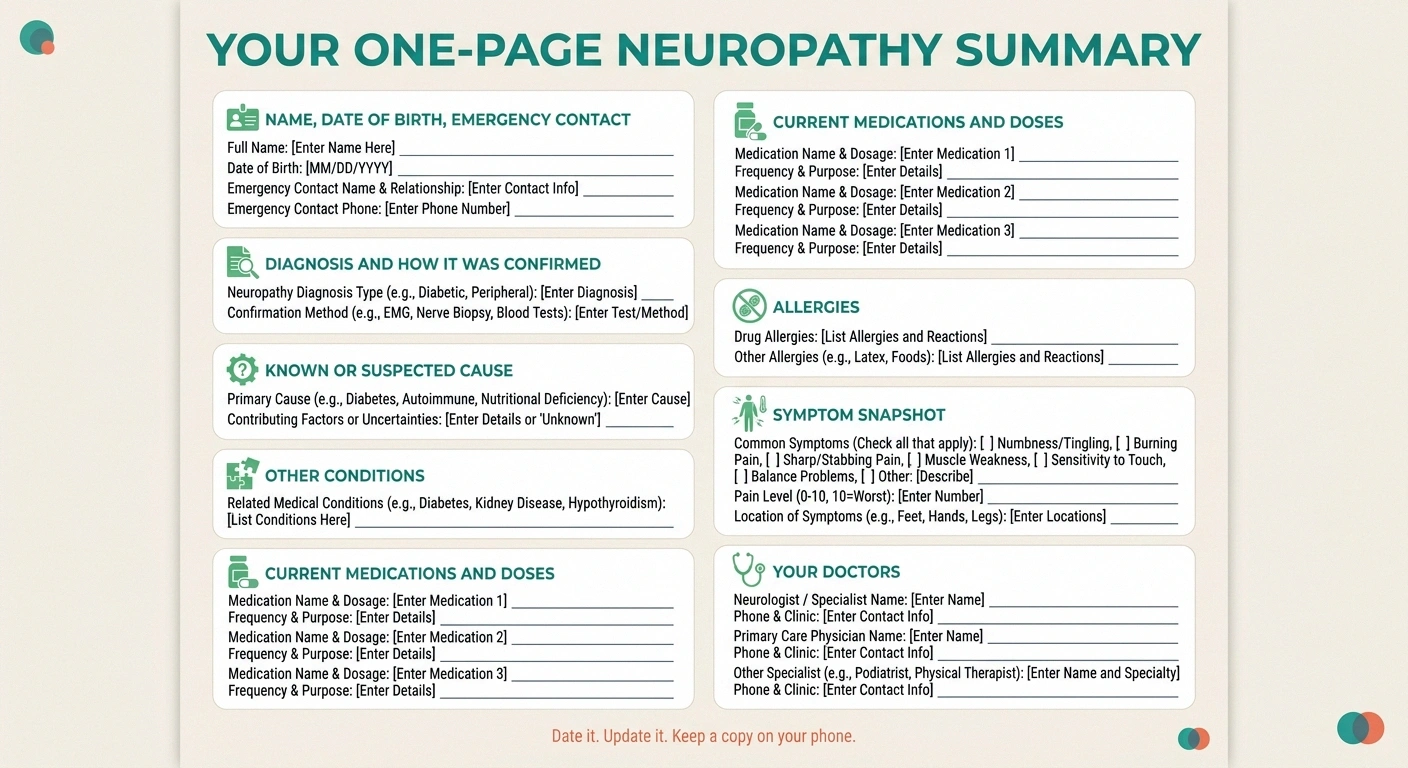
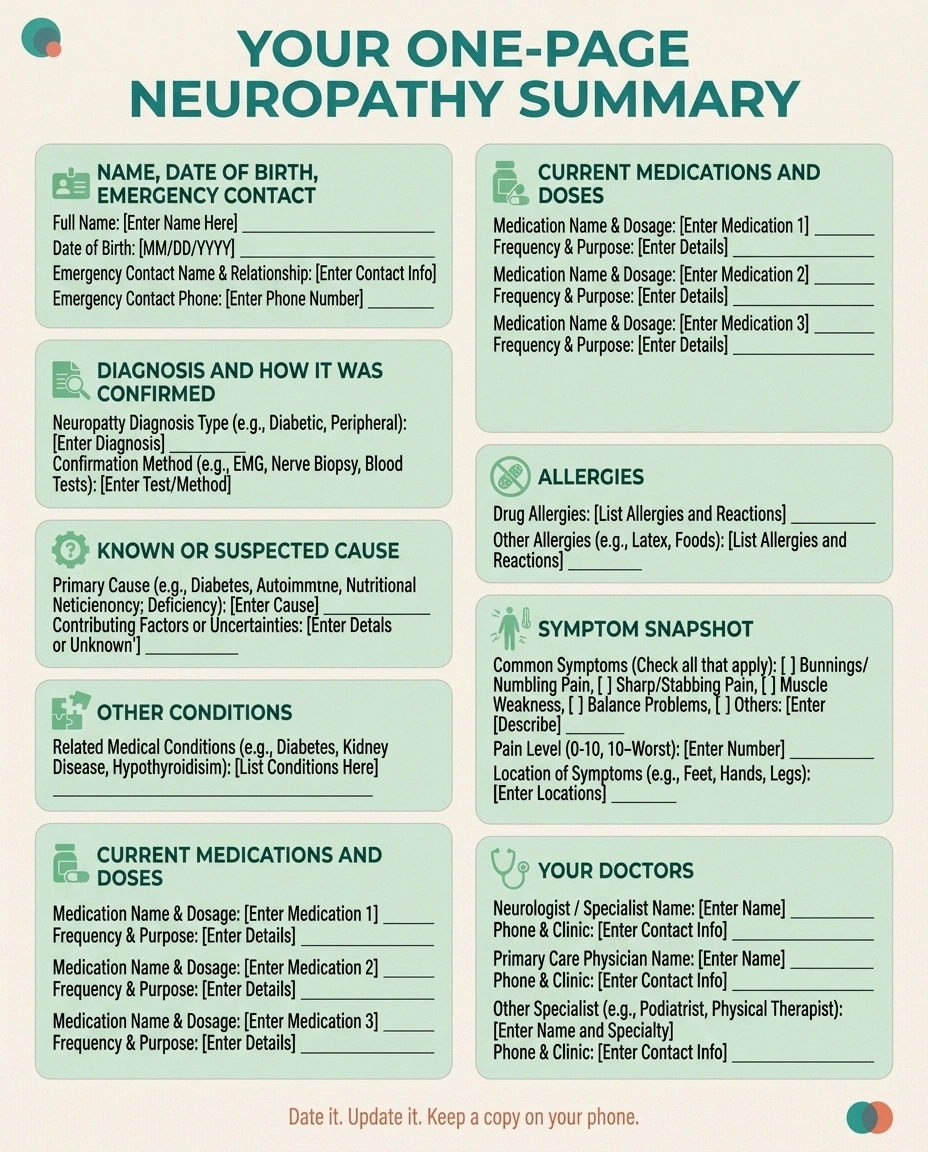
This is the page that goes at the front of the binder and the one you hand across the desk to any new doctor. It should fit on a single side of paper. Include:
Diagnosis. Length-dependent sensory polyneuropathy, NCS 2022, skin biopsy 2023 (small and large fiber).
Suspected cause. Prediabetes (A1c 6.1%); B12 low-normal, now supplemented.
Other conditions. High blood pressure, knee osteoarthritis.
Current meds. Duloxetine 60 mg daily; lisinopril 10 mg; lidocaine 5% patch; B12 1,000 mcg.
Allergies. Sulfa (rash).
Symptoms now. Burning both soles, worse at night, 5/10 average; numbness to mid-shin, unchanged over 12 months.
- Your name, date of birth, and emergency contact
- Your diagnosis in plain words, and when and how it was made: “Length-dependent sensory polyneuropathy, confirmed by NCS in 2022 and skin biopsy in 2023”
- The known or suspected cause, if there is one
- Other major conditions: diabetes, kidney disease, heart problems and so on
- Current medications with doses, including supplements
- Allergies and serious past drug reactions
- A two-line symptom snapshot: where, what it feels like, and how it's changed over the past year
- Your doctors and their phone numbers
Update it whenever something changes, and put the date at the top. An old summary with a medication you stopped last year can cause more confusion than no summary at all.
If you keep a symptom diary, a short monthly roll-up belongs in the binder too: your average pain score, your worst days, and anything new. Our guide to keeping a neuropathy symptom diary includes a simple template.
Before, During, and After Each Appointment

A good system earns its keep around appointments. Here's the rhythm that works for me.
Two weeks before a new specialist, call their office and ask if they'd like records sent ahead. Many do, and they may not ask unless you offer. Make sure your newest test results are in the binder. If you're going for a first neurology visit or a second opinion, our pieces on preparing for a neurology appointment and getting a second opinion cover what else to bring.
The day before, write your top three questions on a single card and clip it inside the front cover. Appointments move fast, and three focused questions get better answers than ten scattered ones.
During the visit, hand over the one-page summary first. Take notes, or bring someone to take them. It's perfectly fine to ask, “Could you spell that?” or “Is that something I'll see in my portal?”
Within a day or two after, spend fifteen minutes on three things. File the visit summary. Update your medication list if anything changed. Add any new test orders to your to-do list, with the date you should expect results. That fifteen minutes is what keeps the whole system from turning into a pile.
Keeping It Up Without It Taking Over

The biggest risk to any records system isn't doing it badly. It's doing it perfectly for three months and then abandoning it.
A few habits keep it light:
- Pick one place things land. A tray, an envelope, or a single “to file” folder on your computer. Anything new goes there until your next filing session.
- File monthly, not constantly. A standing date on the calendar is easier than remembering after every piece of mail.
- Prune once a year. Old insurance explanations of benefits and duplicate printouts can go. Test reports, imaging, and your medication history stay for good.
- Keep it boring. Plain folders and consistent file names beat a clever app you'll stop opening.
Neuropathy asks a lot of us — the appointments, the tests, the trial and error with medicines. A binder won't fix any of that. But it means that every time you walk into a new office, you walk in with your whole story, told accurately, on your own terms. After that phone-call “abnormal,” I can tell you it feels very different.
Frequently Asked Questions
What medical records should I bring to a neuropathy appointment?
Bring your full nerve conduction study and EMG report, any skin biopsy report, recent blood work including blood sugar, B12, thyroid and kidney tests, spine imaging reports, a current medication list, and a history of nerve pain medications you have tried with doses and results. A one-page summary at the front makes the visit faster.
How long does a doctor's office have to give me my medical records?
Under HIPAA, a provider must act on your request within 30 days and may take one additional 30-day extension if they explain the delay in writing. Many results and notes are also available immediately through patient portals under federal information-blocking rules in effect since April 2021.
Can a clinic charge me for copies of my medical records?
Yes, but only a reasonable, cost-based fee for labor, supplies and postage. Portal access must be free, and per-page fees are not allowed for electronic copies of electronically stored records. Many providers charge a flat fee of up to $6.50 for electronic copies.
Should I keep paper or digital medical records?
Many people use both: a paper binder for appointments and a digital folder of PDFs for backup and sharing. Naming digital files with the date first, year then month then day, keeps them in order automatically.
Why does a neurologist want my full nerve conduction report instead of the summary?
The full report contains the measurements for each nerve, such as conduction speed and signal size. Comparing those numbers with a later test shows whether neuropathy is stable or progressing, and can prevent an unnecessary repeat study.
What is a medication history and why does it matter?
It is a list of every nerve pain treatment you have tried, with the highest dose, dates, benefit, side effects and reason for stopping. It helps doctors avoid repeating failed treatments and spot medicines that were stopped before reaching an effective dose.
About the Author