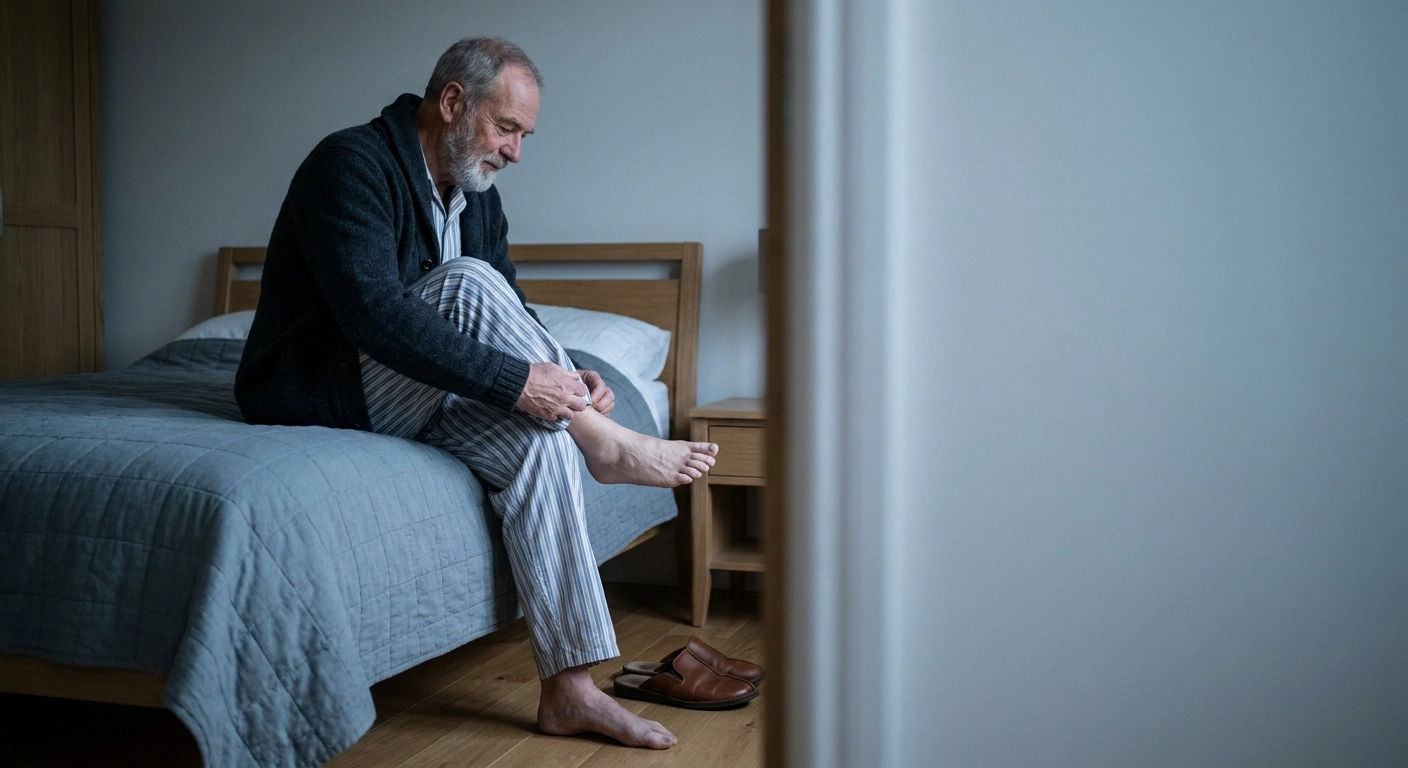
There is a specific kind of confusion that shows up when someone has both gout and nerve trouble, and it usually sounds like this: my big toe was on fire in March, the doctor called it gout, I took the pills, the swelling went down, and my foot never really went back to normal.
Two different things are happening in that story. The March episode was almost certainly gout. Whatever is left over may not be.
Gout and peripheral neuropathy overlap in the same feet, in the same people, at roughly the same stage of life, and they get tangled together constantly. Untangling them matters, because one of them responds to a completely different treatment than the other, and because in a small number of cases the connection between them is real, physical, and correctable by a surgeon.
Here is what the evidence actually supports, what it does not, and how to tell which pain you are dealing with.
Two Different Pains, Both in the Big Toe
A gout attack is an inflammatory event. Uric acid crystallizes inside a joint, the immune system treats those crystals as an invasion, and the joint fills with the full inflammatory response. The classic picture is the base of the big toe, though gout also hits the midfoot, ankle, knee, wrist and fingers.
Six questions that separate a flare from nerve damage
| Question | Points to gout | Points to neuropathy |
|---|---|---|
| How fast did it arrive? | Hours, often overnight | Months to years, creeping upward |
| One foot or both? | One joint, usually one side | Both feet, roughly matching |
| Is there anything to see? | Red, hot, swollen, shiny skin | Nothing visible at all |
| Any numbness? | No. Gout does not numb. | Common, and the single best clue |
| Does it fully resolve? | Yes, over about a week | No. There is no “between.” |
| What helps it? | Anti-inflammatories, colchicine, steroids | Those do essentially nothing |
Having both is common. The point of the table is to stop one diagnosis from absorbing the other.
What it feels like: sudden, often overnight, with the joint visibly red, swollen and hot to the touch. The skin over it may look shiny or start to peel as the attack resolves. The weight of a bedsheet is genuinely unbearable. It peaks over hours to a day or two, then fades over a week or so, and between attacks the joint may feel completely normal.
Nerve pain does not behave that way. It is usually symmetrical, present in both feet, and it starts in the toes and works upward rather than centering on one joint. It comes with sensations that inflammation does not produce: pins and needles, numbness, the feeling of walking on a folded sock, cold that will not warm up. It is worse when you are still, which is why so many people first notice it in bed. It does not swell, and it does not go away between episodes because there are no episodes.
The overlap that trips people up is this: gout attacks can leave a joint sore and hypersensitive for weeks afterward, and a foot that has been immobilized during an attack often feels strange when you start using it again. That is not neuropathy. If it settles over a few weeks, it was the aftermath of inflammation. If it is still there in three months and slowly involving more of the foot, something else is going on, and our guide to burning feet syndrome covers the other candidates worth considering.
What High Uric Acid Actually Is
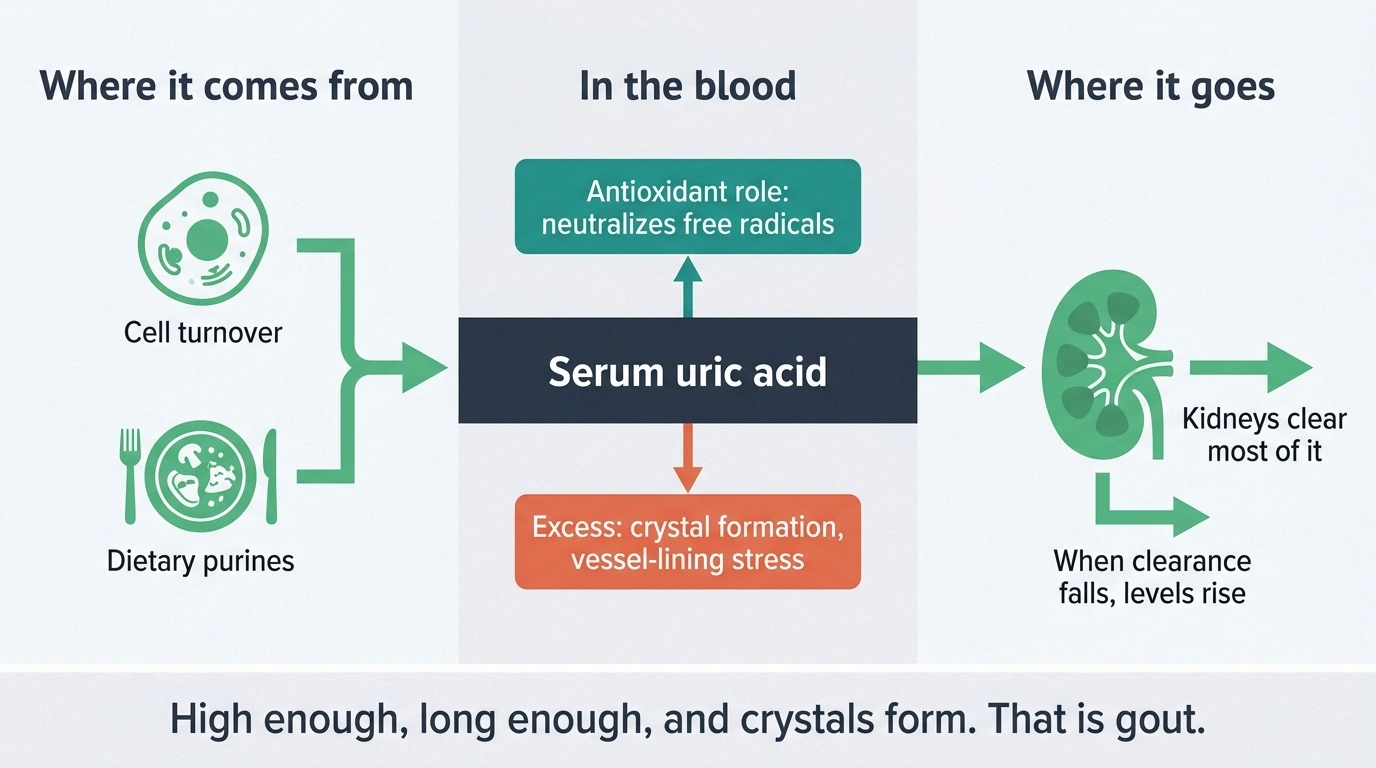
Uric acid is the end product of purine breakdown. Purines come from your own cell turnover and from food, and the kidneys clear most of the resulting uric acid. When production outruns clearance, blood levels rise. That state is called hyperuricemia.
Two things about it are worth holding onto.
First, hyperuricemia and gout are not the same thing. Plenty of people walk around with elevated uric acid for decades and never have a single attack. Gout is what happens when those levels stay high enough, long enough, for crystals to form and for the immune system to find them.
Second, uric acid is not purely a waste product. It is one of the more significant antioxidants circulating in human blood. That fact turns out to matter a great deal once you start asking whether it damages nerves.
Does High Uric Acid Quietly Damage Nerves?
This is the question people are really asking, and the honest answer has three parts.
There is a real association, mostly studied in diabetes. A number of observational studies have found that people with diabetic peripheral neuropathy tend to have higher serum uric acid than people with diabetes who do not have neuropathy. A 2024 systematic review and meta-analysis pooling this work reached the same conclusion. One study found the association was particularly visible in slowed motor conduction velocity of the tibial nerve.
There is a plausible mechanism. High uric acid appears to interfere with endothelial function, reducing nitric oxide availability and altering the behavior of vascular smooth muscle. Peripheral nerves are fed by a network of very small blood vessels called the vasa nervorum, and those vessels have no reserve capacity to spare. Anything that degrades small-vessel function has a route to degrade nerve function, which is the same pathway that makes diabetic neuropathy a microvascular disease as much as a metabolic one.
And the evidence stops well short of causation. Almost all of this work is in diabetes cohorts, not gout cohorts. It is observational. Uric acid rises when kidney function falls, and kidney disease is itself a well-established cause of neuropathy, so the association may partly be kidney disease wearing a different hat. Nobody has run the trial that would settle it.
There is one intriguing case in the older neurology literature of a patient with gout whose neuropathy improved as their uric acid was brought down. A single case is a reason to stay curious. It is not a reason to expect the same outcome.
Why Driving Uric Acid to the Floor Is Not the Answer

If high uric acid is associated with worse nerve function, the obvious move is to push it as low as possible. Several research groups have looked at that idea and come away calling uric acid a double-edged sword.
The reasoning goes back to the antioxidant point. Oxidative stress is one of the central mechanisms of nerve damage, particularly in diabetes. Uric acid is part of the body's antioxidant capacity. Sustained very low levels have been associated with worse outcomes in several neurological conditions, which suggests there is a floor below which you are trading one problem for another.
The practical version: your uric acid target should be set by your gout, your kidneys and your rheumatologist, using the numbers that prevent attacks and dissolve deposits. It should not be adjusted downward in the hope of protecting nerves. That trade has not been shown to pay.
When a Tophus Presses on a Nerve
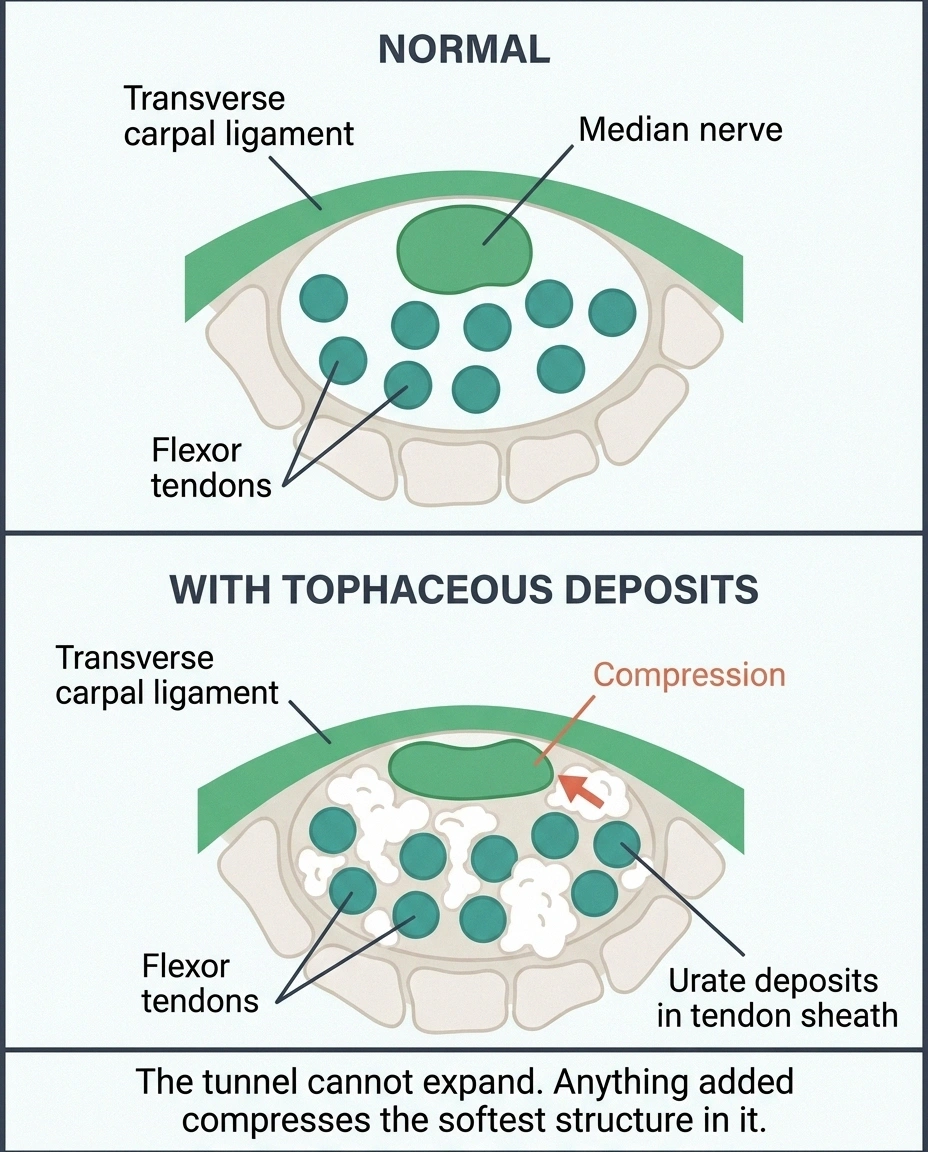
This is the part of the gout and neuropathy connection that is genuinely causal, genuinely documented, and genuinely fixable, and almost nobody knows about it.
Three findings that move this from “watch it” to “image it”
Compression neuropathy from a tophus behaves nothing like metabolic neuropathy. If all three of these are true at once, ask for a nerve conduction study and imaging rather than a prescription.
- It is one-sided. Metabolic nerve damage arrives in matching pairs. A single numb hand is a mechanical problem until proven otherwise.
- It follows one nerve's map. Median nerve territory is the thumb, index, middle and half the ring finger. Ulnar is the little finger and the other half of the ring. A pattern that stops mid-finger is anatomy talking.
- There is a lump you can find. A firm nodule near the affected wrist, elbow or ankle, in someone with years of gout, is the piece that connects the story.
Roughly 0.6% of carpal tunnel cases trace back to tophaceous gout. Small share, large consequence, because this version is surgically correctable.
In long-standing gout, urate crystals accumulate into visible chalky deposits called tophi. They form in and around joints, in tendon sheaths, in the olecranon bursa at the elbow, along the fingers, in the ear cartilage. Anywhere they form, they take up space.
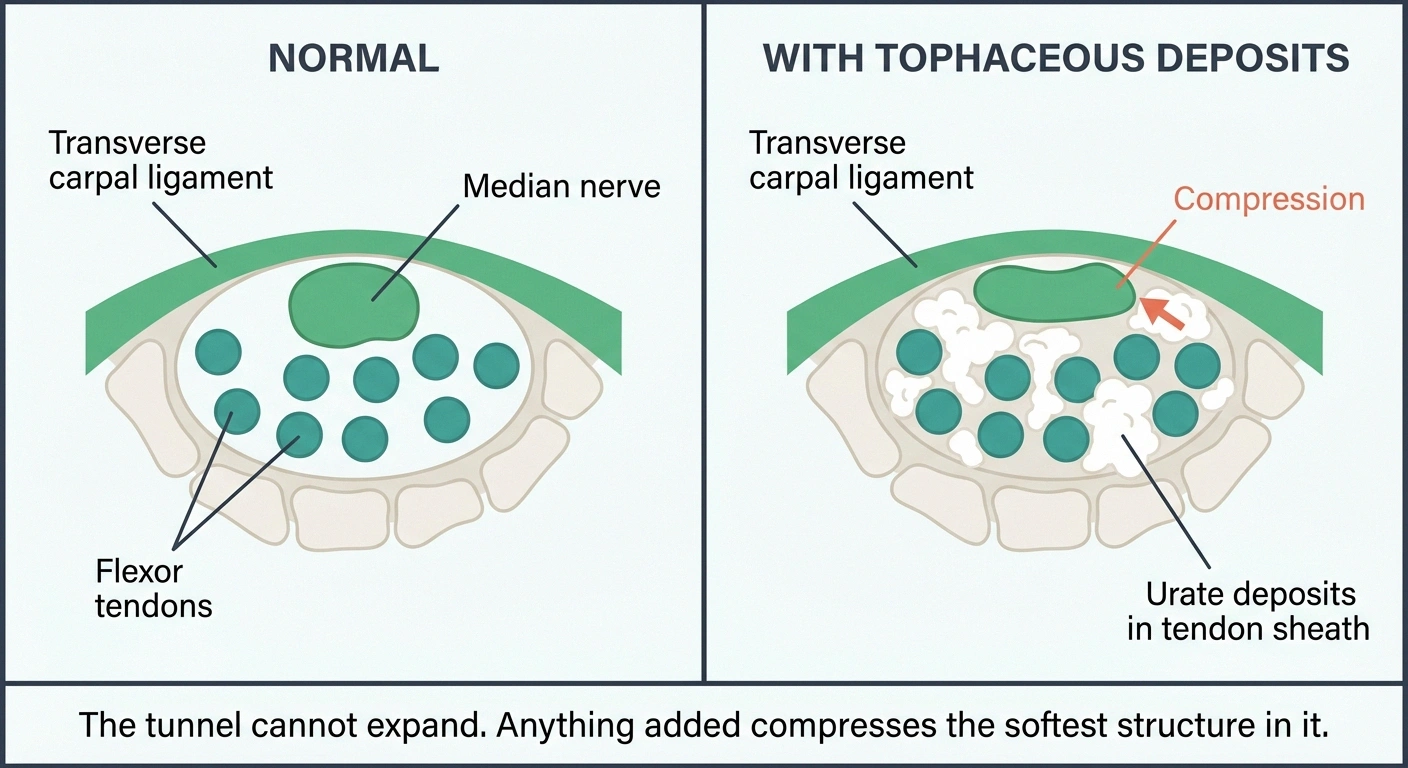
Some nerves travel through passages that have no spare space. The carpal tunnel is the famous one: the median nerve shares a rigid canal at the wrist with nine flexor tendons and their sheaths. When urate deposits build up in that tenosynovium, the tunnel's contents grow and the nerve is the softest thing in there.
Tophaceous gout is an established cause of carpal tunnel syndrome, accounting for an estimated 0.6% of cases. Imaging series have documented the CT and MRI appearance across groups of patients. In one surgical case report, tophi were found deposited underneath the epineurium, the outer sheath of the median nerve itself.
The same principle applies wherever a nerve runs through a tight space alongside tendons: the ulnar nerve at the wrist and elbow, and the tarsal tunnel on the inner ankle, where compression produces burning in the sole that is easily mistaken for ordinary small fiber neuropathy.
What makes this worth knowing is the treatment. Compression from a tophus is not managed with nerve pain medication. It is managed by taking the pressure off, which usually means surgical release of the tunnel plus debulking of the deposit and removal of the inflamed tendon sheath. People get function back.
The tell is asymmetry. Metabolic neuropathy is symmetrical and starts distally. If your numbness is in one hand, follows the territory of a single nerve, and you have visible tophi, that combination deserves imaging and a nerve conduction study rather than a prescription. Our overview of neuropathy in the hands walks through how the different hand nerves map to different fingers.
The Company These Two Conditions Keep

Here is the explanation that fits most people who have both, and it is less dramatic than either of the above.
Gout and peripheral neuropathy share almost their entire risk-factor list. Type 2 diabetes. Chronic kidney disease. Metabolic syndrome. Obesity. Heavy alcohol use. Thiazide and loop diuretics. Age. Any one of those raises the odds of both conditions independently.
So when someone has gout and burning feet, the most likely relationship is not that the gout caused the neuropathy or that the uric acid did. It is that both are growing out of the same soil.
That sounds like a downgrade. It is actually useful, because it points at what is worth working on. The things that lower uric acid over time overlap heavily with the things that protect nerves: steadier blood sugar, less alcohol, better kidney protection, weight change where it is achievable, and an eating pattern that is not built on fructose-sweetened drinks and heavy purine loads. Our neuropathy diet guide and standard gout dietary advice do not conflict much, which is convenient when you are managing both.
Gout Medications and Your Nerves
One gout drug has a documented nerve signal, and it is not the one most people worry about.
Who actually gets colchicine myoneuropathy
- The setting
- Daily colchicine taken for months, not a short flare course. It is a cumulative exposure problem.
- The main risk factor
- Reduced kidney function. Colchicine is cleared renally, so a falling eGFR quietly raises the dose your muscles and nerves actually see.
- The drugs that stack the risk
- Statins, clarithromycin, cyclosporine, and other inhibitors of colchicine clearance. Statins are the common one, because plenty of people with gout are on both.
- What it looks like
- Weakness getting out of a chair or climbing stairs, more than pain. Sensory symptoms are usually mild. Creatine kinase on a blood test is elevated.
- Why it matters
- It reverses after stopping the drug. Which means every month it gets filed as ordinary aging is a month of recovery not happening.
Colchicine. Long-term colchicine can cause a myoneuropathy: proximal muscle weakness with a mild sensory axonal neuropathy, and a creatine kinase level that is elevated on blood work. It shows up almost exclusively in people with reduced kidney function or those taking drugs that block colchicine's clearance, including statins, clarithromycin, and cyclosporine. It is reversible when the drug is stopped, but it is regularly misread as ordinary age-related weakness for months first. If you take colchicine daily, have kidney impairment, and have noticed trouble rising from a chair or climbing stairs, that combination is worth raising specifically.
Allopurinol and febuxostat. These are the urate-lowering drugs most people with gout end up on long term, and neither is an established cause of peripheral neuropathy. Allopurinol has its own list of things to watch, particularly a rare severe hypersensitivity reaction, but nerve damage is not on it.
NSAIDs. No direct nerve toxicity. The indirect concern is kidney function, and kidney disease is a genuine cause of neuropathy, so long-term high-dose use matters more for someone already managing nerve symptoms.
Steroid bursts. Prednisone shuts down a gout flare efficiently and raises blood glucose while it does. In someone with diabetes, repeated courses are worth accounting for. Our roundup of medications that can cause neuropathy covers the wider list of drugs with nerve effects.
Telling the Two Apart at Home
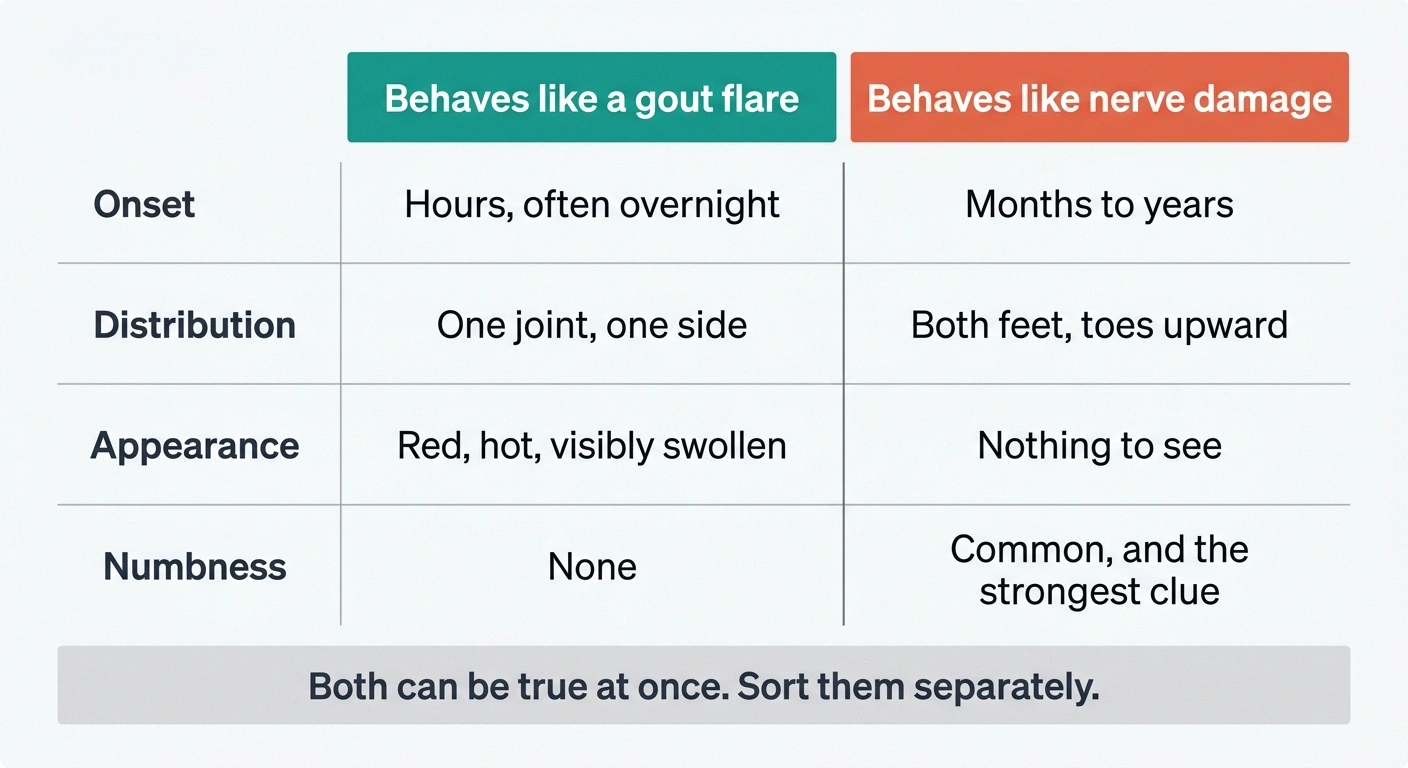
Before your appointment, it helps to have sorted your own symptoms into categories. Ask these questions about the pain you are trying to describe.
Is it one spot or a region? Gout is a joint. Neuropathy is a territory, usually both feet, usually starting at the toes.
Is there anything to see? Redness, heat and visible swelling point to inflammation. Nerve pain is invisible, which is exactly why it is so hard to get taken seriously.
Does it have a beginning and an end? Attacks that build over hours and resolve over days behave like gout. Symptoms that have been slowly recruiting more of your foot over a year behave like neuropathy.
What does it do at night? Both are worse at night, so this one does not separate them. It does tell you something about how much sleep you are losing.
Is there numbness? This is the most useful single question. Gout does not cause numbness. If parts of your feet have gone quiet, if you cannot feel the floor properly, if you have stopped noticing small injuries, that is nerve territory and it needs its own workup rather than being folded into the gout file.
It is also worth ruling out circulation, because reduced blood flow to the legs produces its own pattern of pain that is different from both. The distinctions are laid out in our comparison of nerve pain and vascular pain.
What to Bring Up at Your Next Appointment

Gout is usually managed by primary care or rheumatology. Neuropathy workups often need a different door. If you suspect both, the goal is to keep the second one from being absorbed into the first.
Say these out loud, in this order
Appointments for gout run on a script. These five sentences interrupt it long enough for the nerve question to get its own answer.
- 1.“Separate from the flares, I have constant numbness in both feet, and it has been spreading.”
- 2.“I would like the standard neuropathy blood work, not just a uric acid level.”
- 3.“How is my kidney function trending, and does that change anything I am taking?”
- 4.“I have a lump here, and the numbness is in this hand.” Point at both.
- 5.“I take colchicine daily. Should we be checking a CK level?”
Say the numbness out loud, separately from the gout. “Separate from the flares, I have constant numbness in both feet that has been spreading” is a different sentence from “my gout foot still bothers me,” and it triggers a different response.
Ask for the basic neuropathy blood panel rather than assuming uric acid explains it. A1c or fasting glucose, B12, thyroid function, kidney function, and a serum protein electrophoresis are the usual starting set. Our walkthrough of neuropathy diagnosis covers what each test is looking for.
Bring up colchicine specifically if you take it daily and have any kidney impairment.
Mention any tophi you can see or feel, and say where. If you have numbness in one hand and a lump near that wrist, connect the two in the same sentence so nobody has to notice it on their own.
Ask about kidney function in both directions. It drives uric acid up and it damages nerves, so it sits at the center of this whole picture.
The Short Version
Gout does not cause peripheral neuropathy in the ordinary sense. High uric acid is associated with worse nerve function in studies of people with diabetes, the mechanism through small blood vessels is believable, and causation has not been established. Pushing uric acid unusually low is not a nerve strategy and may backfire.
The one clean causal link is mechanical: tophi in a tight passage compressing a specific nerve, most often the median nerve at the wrist. That version is asymmetric, follows a single nerve's territory, and is treated surgically rather than medically.
For most people carrying both diagnoses, they are two branches from the same trunk, and the trunk is metabolic. Which means the unglamorous work of managing blood sugar, kidneys, alcohol and weight is doing double duty, even on the days it feels like it is doing nothing at all.
Frequently Asked Questions
Can gout cause permanent nerve damage?
A gout attack itself does not damage nerves. The exception is mechanical: if a tophus grows in a confined space like the carpal tunnel and compresses a nerve for long enough, that compression can cause lasting damage, which is why persistent numbness alongside visible tophi should be evaluated rather than watched.
Does lowering uric acid improve neuropathy symptoms?
There is no good evidence that it does. One older case report described improvement in a patient with gout as their uric acid came down, but no trial has tested this. Urate-lowering therapy is worth taking for gout reasons on its own merits.
Why does my foot still burn weeks after the gout attack ended?
A joint that has been through an intense inflammatory event stays sore and hypersensitive for a while, and a foot you have been favoring feels strange when you start loading it normally again. That usually settles within several weeks. Burning that persists for months, involves both feet, or comes with numbness is pointing somewhere else and deserves its own assessment.
Is gout pain the same as nerve pain?
No. Gout pain is inflammatory pain from crystals in a joint, with visible redness, heat and swelling. Nerve pain comes from damaged nerves and produces burning, tingling, numbness and hypersensitivity without visible swelling. They can feel similarly severe and they respond to entirely different treatments.
Can colchicine cause neuropathy?
Long-term colchicine can cause a myoneuropathy, meaning muscle weakness combined with a mild sensory neuropathy. It occurs mainly in people with impaired kidney function or those taking medications that slow colchicine clearance, such as statins, clarithromycin or cyclosporine. It typically reverses after the drug is stopped, so it is worth mentioning to your prescriber rather than ignoring.
I have gout and diabetes. Which one is causing my numb feet?
Diabetes is by far the more likely culprit. Diabetic peripheral neuropathy is one of the most common causes of numb feet worldwide, and it produces exactly the symmetrical, toes-upward pattern most people describe. High uric acid may be an aggravating factor in that setting, but it is not the primary driver.
Should I ask for a nerve conduction study?
It is reasonable to ask, particularly if your numbness is one-sided, confined to one hand or foot, or accompanied by weakness. Standard nerve conduction studies test the large nerve fibers and can identify compression at a specific site, which is the finding that changes the plan when a tophus is involved.
Does a low-purine diet help nerve symptoms?
Not directly. A low-purine eating pattern lowers uric acid and reduces gout attacks. Where it may help nerves is indirectly, because gout-friendly eating overlaps substantially with nerve-friendly eating: less alcohol, fewer sweetened drinks, more whole foods, and steadier blood sugar as a result.
About the Author