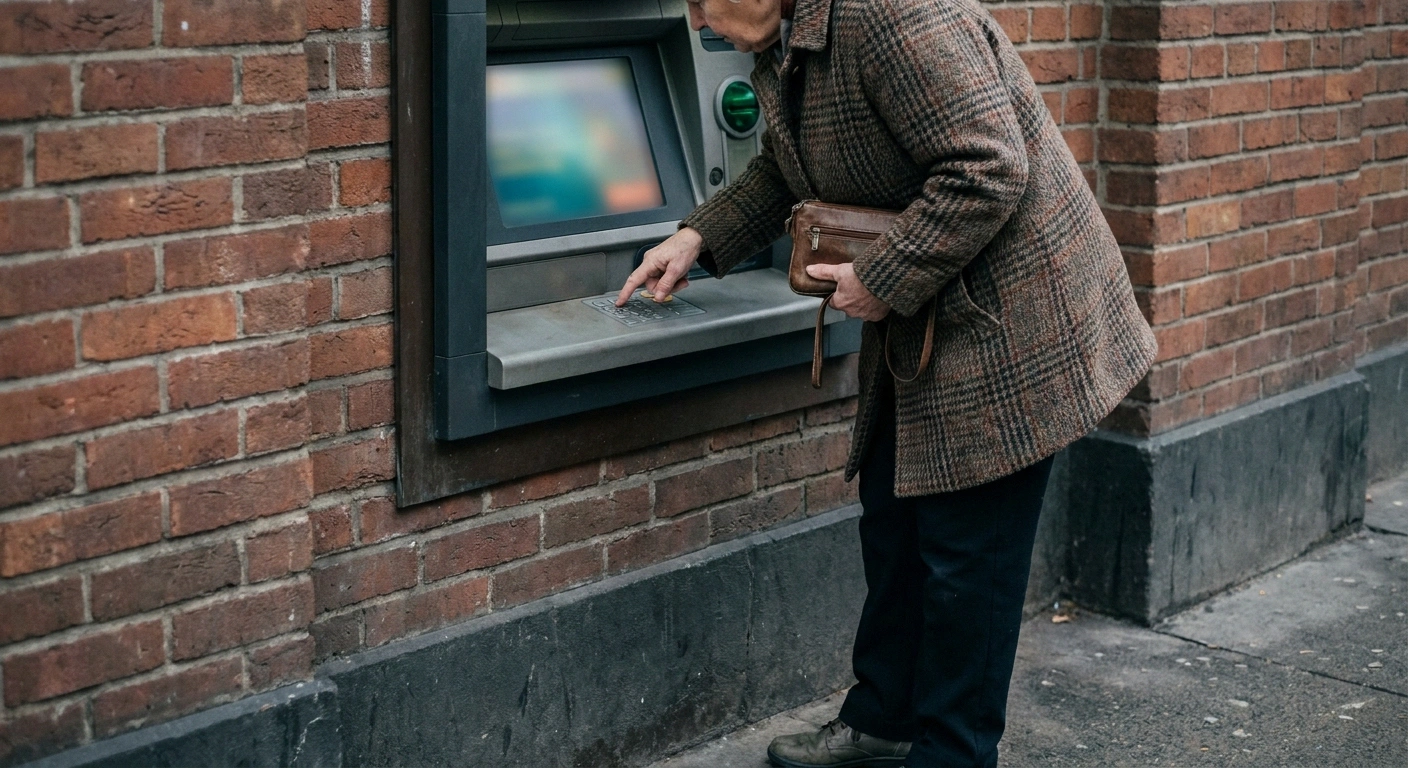
Count the small hand jobs in one trip to the ATM. Fish the card out of a snug wallet slot. Turn it the right way up and push it in. Press four PIN keys you can barely feel, then the amount, then Enter. Pull the card back out, then the cash, then the receipt, and tuck it all away before the person behind you starts shifting their weight. That's about ten little grips and presses for a two-minute errand.
With numb fingertips, any one of them can go sideways — a card that slips, a key pressed twice, a bill that won't slide back into the wallet. Add sore feet, a curb, and a cold wind, and it's no wonder so many of us start putting the bank off.
A lot of those steps are optional now, though, and some of the rest are covered by federal accessibility rules almost nobody reads. I went through them for this guide, along with what three big banks say their tap and phone features do as of October 2026, how to bank from the kitchen table, and how to keep your money safe when your hands don't send back the signals they used to. I'm no banker or lawyer, just a patient advocate who reads the fine print, so treat anything bank-specific as a starting point to confirm with your own bank.
Why a Two-Minute Errand Gets Harder
Peripheral neuropathy may leave your hands or feet numb, and the National Institute of Diabetes and Digestive and Kidney Diseases (NIDDK) adds that “You may also have problems sensing pain or temperature in these parts of your body.” Its list also includes loss of balance and weaker muscles in the hands and feet. The National Cancer Institute describes weak or achy muscles that can make it hard to button shirts or open jars, and pulling a card from a slot is the same kind of small, pinching job.
One caution first: numbness that comes on suddenly, especially on one side of the body or with a drooping face or trouble speaking, isn't neuropathy behaving as usual — call 9-1-1. None of that everyday numbness makes you less capable of running your own money. It just means the tools should do more of the work. If your hands are the main problem, my page on neuropathy in your hands covers the symptoms in more depth.
What the ADA Requires of an ATM
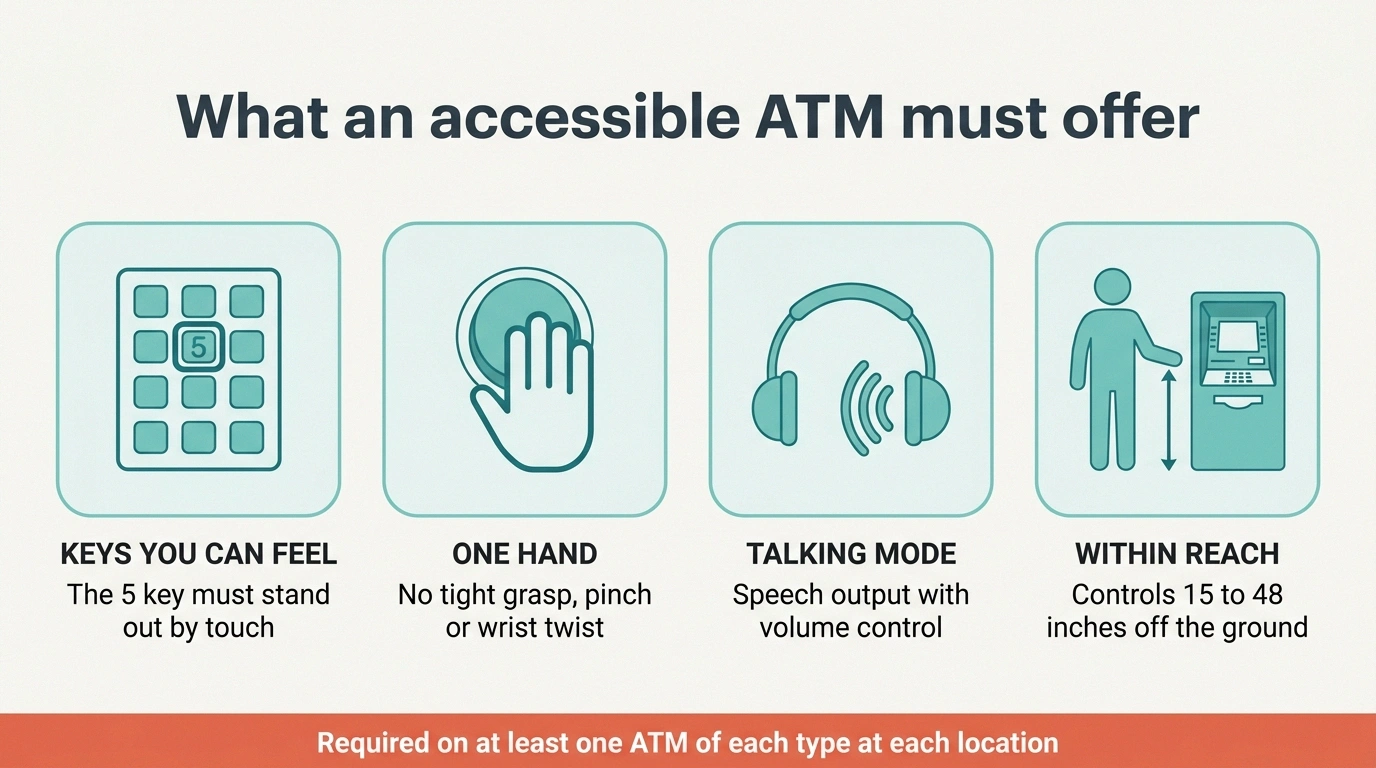
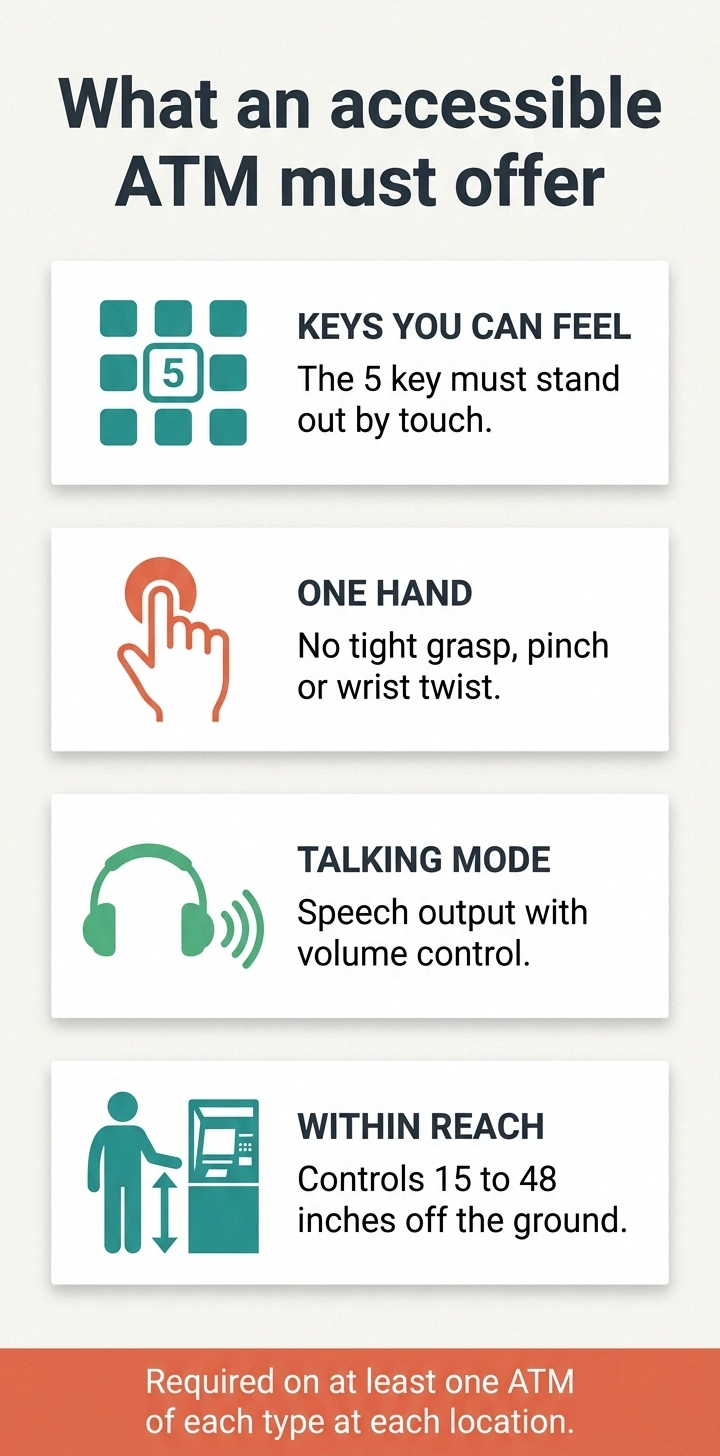
The 2010 ADA Standards for Accessible Design, adopted by the Justice Department, set the rules for ATMs. They don't make every machine accessible, and the graphic above sums up what the accessible one has to offer. Wherever ATMs are provided, “at least one of each type provided at each location shall comply,” and an advisory note adds that a bank's inside and outside ATMs count as separate locations.
- Older branches
- The 2010 rules apply where the building permit application was completed on or after March 15, 2012. Older sites may follow the 1991 Standards instead.
- Your card
- The U.S. Access Board notes that cards and keys you carry aren't covered by the rules for operable parts. The no-pinch, 5-pound limits apply to the machine's controls, not to pulling your card out.
- The screen
- On an accessible machine, on-screen characters must be at least 3/16 inch tall in a sans serif font.
- Privacy
- You're owed the same privacy as anyone else, and an advisory note suggests letting talking-mode users blank the screen.
That accessible machine has to be usable by hands like ours. “Operable parts shall be operable with one hand and shall not require tight grasping, pinching, or twisting of the wrist,” the Standards say, and pressing a control can't take more than 5 pounds of force. The controls have to sit between 15 and 48 inches above the ground when nothing is in the way, so you shouldn't have to stretch overhead or stoop to your knees.
The keys have to be findable by touch, too. “At least one tactilely discernible input control shall be provided for each function,” and the number keys follow a 12-key telephone layout in which “The number five key shall be tactilely distinct from the other keys.” The function keys get raised symbols as well: “Enter or Proceed key: raised circle; Clear or Correct key: raised left arrow; Cancel key: raised letter ex.”
Then there's the feature most people never use. “Machines shall be speech enabled,” the Standards say, with the speech delivered through “an industry standard connector or a telephone handset,” plus volume control and a way to repeat. The talking mode has to read out your balance, error messages and the rest of the receipt information. Its braille start-up instructions make clear who it was designed for — but I think it's worth trying when your fingertips can't feel the raised marks. Nobody has studied that idea, so treat it as an experiment.
Less Finger Work at the Machine
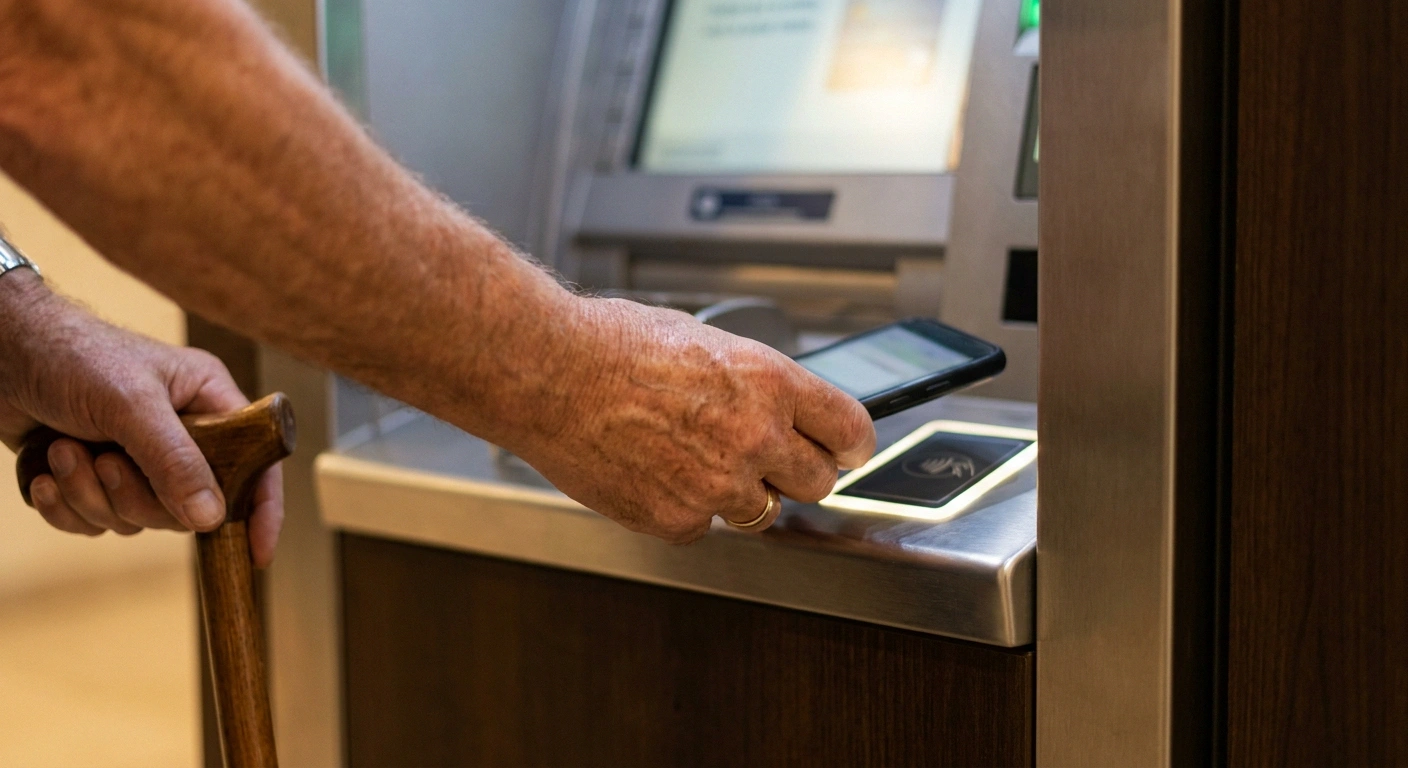
The biggest change in the last few years is that some ATMs no longer need your card inside them at all. Instead of inserting and pulling, you tap a contactless debit card or hold your phone's digital wallet to the machine's contactless symbol, then enter your PIN as usual. That cuts out the two pinchiest steps of the whole visit.
| Bank | What it describes | Worth knowing |
|---|---|---|
| Chase | At an eligible Chase ATM, open your phone's mobile wallet, tap it on the contactless symbol, and enter your debit card PIN | After that, the transaction works the same as with your physical card |
| Wells Fargo | Tap a contactless debit card, plus your PIN, at any Wells Fargo ATM | Most other banks' ATMs aren't set up for its tap; existing customers get a contactless card when theirs is replaced or reissued |
| Bank of America | A tap-to-pay card or a smartphone at its cardless ATMs, including drive-thru machines listed on its locator pages | You still enter your PIN before the transaction starts |
Features change and vary by machine. These are examples from each bank's own pages, not recommendations; check your own bank's app or website.
There are catches. You still need your PIN. Tap access mostly works at your own bank's machines, and a contactless symbol on another bank's ATM is no guarantee your card will work there. If your card is an older one without the tap feature, ask your bank about a contactless replacement.
Beyond that, the hand tips are trial and error. Some people press keys with a knuckle or the side of a finger, keep the card in a sleeve that leaves an edge to pinch, or plug wired earbuds into the talking mode to hear each key confirmed. None of those has been tested on ATMs that I could find. If your grip is getting harder to trust, an occupational therapist can watch how you use your hands and suggest tools — the therapists who wrote a 2020 device guide for the Foundation for Peripheral Neuropathy say the right device is best chosen with a rehabilitation professional.
Drive-Up ATMs: Handy, With a Catch
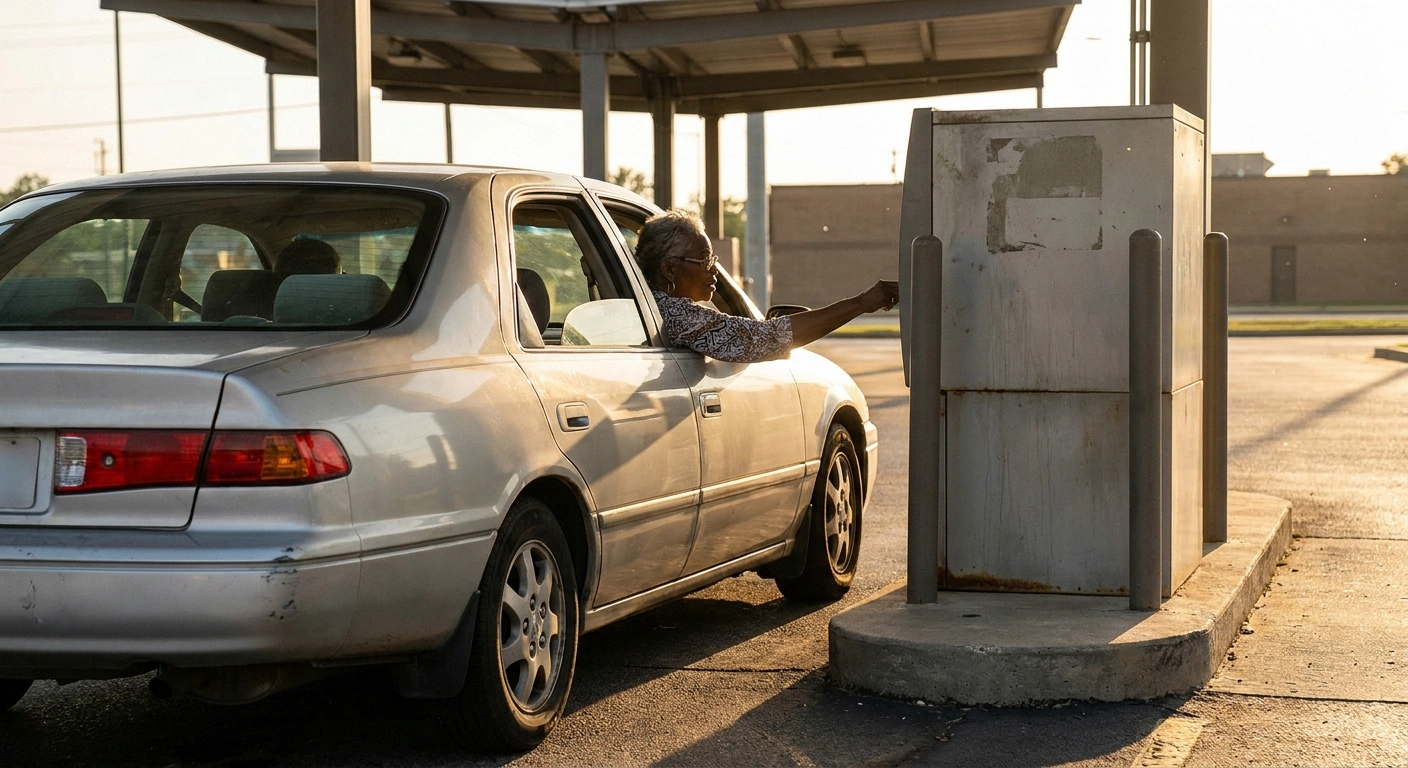
A drive-up ATM saves the walk across the lot, the curb and the wind. The catch is in the fine print of the Standards: drive-up-only machines don't have to meet the floor-space, reach-height or screen-visibility rules that walk-up machines follow. So the keypad may sit farther from your window than you'd like. Pull in close, stop fully and put the car in park before you reach, and don't lean far out of the window; if the keypad is still a stretch, use another machine. All of this assumes driving is still safe for you, since numb feet on the pedals are their own question.
Pair the drive-up lane with tap access and you may never handle the card at all. Bank of America's ATM locator pages, for example, describe tapping a card or phone at its drive-thru cardless ATMs: “hold your phone to the contactless reader, enter your PIN and start your transaction.” There's a safety bonus, too. The U.S. Secret Service lists ATMs “closest to the drive-up window” among the harder targets for criminals.
At the Counter, You Can Ask
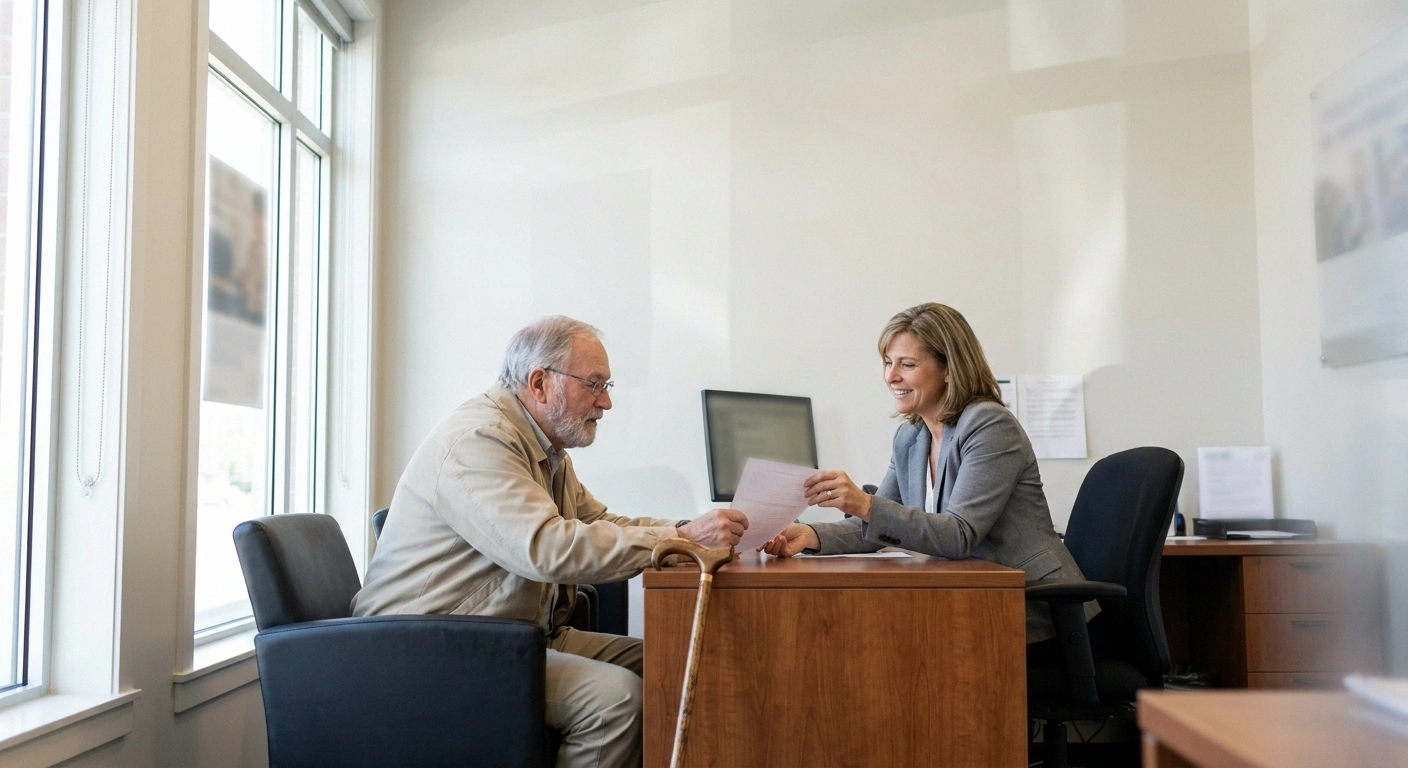
Banks are on the Justice Department's list of public accommodations under Title III of the Americans with Disabilities Act. Under the Justice Department's rules, that means a bank has to make reasonable changes to its policies and procedures when a customer with a disability needs them, unless a change would fundamentally alter what it offers. Every request is judged on whether it's reasonable, so this is a door that opens, not a guarantee.
- Which ATM here has the talking mode, and does it take a headphone plug or a handset?
- Can I tap my card or my phone at your machines, including the drive-up?
- Is there a seat I can use while I wait, or a desk where I can sit down with someone?
- Can I sign forms electronically here?
- Do you offer convenience accounts, or a way to name a trusted contact?
- Can I get a contactless replacement card?
Old Justice Department guidance even gives a banking example. In its 1990s technical assistance manual, the department says the limit on “services of a personal nature” doesn't cover minor help, and it lists “a bank's filling out a deposit slip” among the things that wouldn't count as a personal service. In the department's own fitting-room example, a store lets a customer's companion come along to help — and the same thinking supports bringing a family member to the teller window with you.
The counter itself has rules. Part of a teller or service counter has to be no higher than 36 inches, and where security glass separates you from the teller, there has to be a way to talk through it. Nothing in the rules names a chair, but asking for one while you wait is exactly the kind of small change the law contemplates. My tips for standing in line with neuropathy help with the wait itself.
When Your Signature Changes
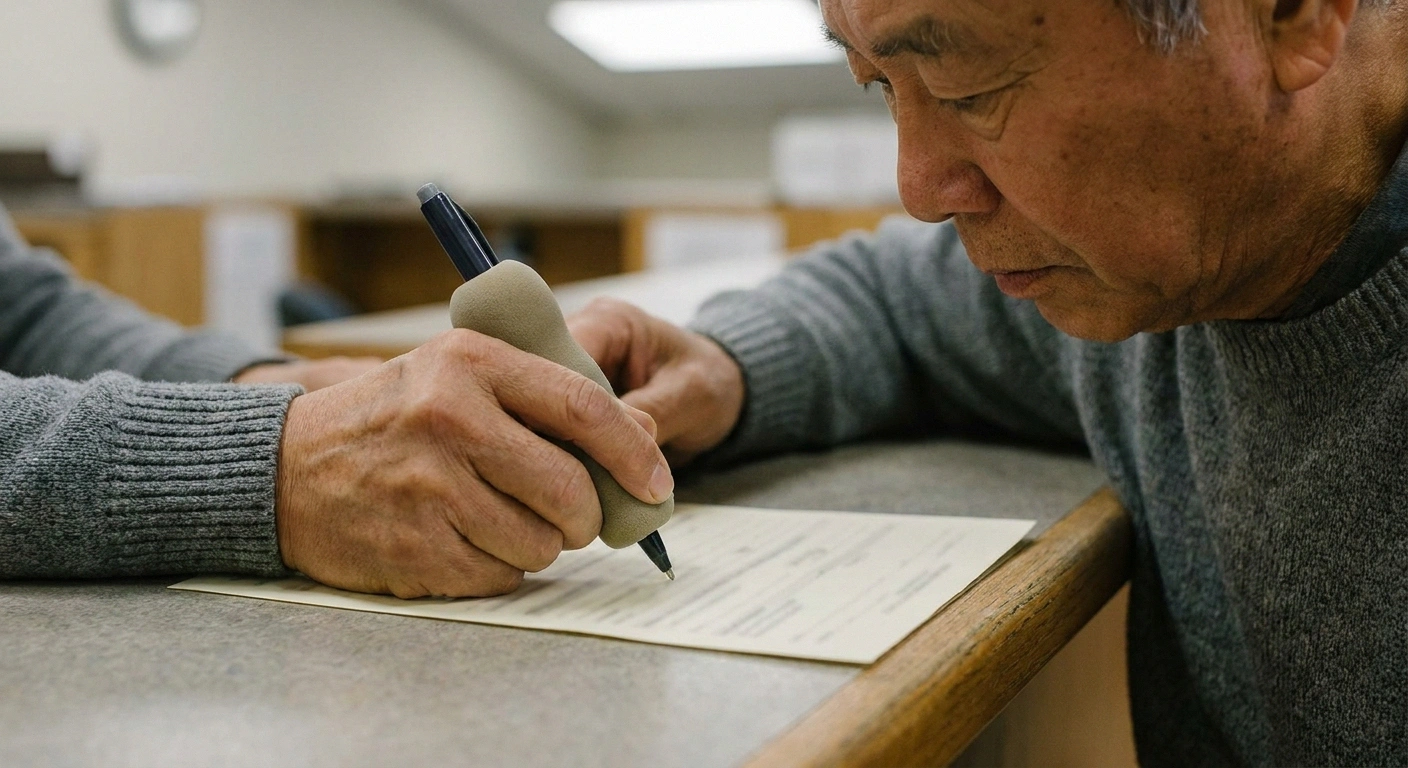
A signature that wobbles, or one you can't manage at all anymore, is one of the most unsettling parts of hand neuropathy. Small tools come first. The occupational and physical therapists behind that Foundation for Peripheral Neuropathy guide list pen grips among the devices for daily tasks, and you'll find more ideas in my guide to assistive technology for neuropathy.
Electronic signatures can help, with one caution. The federal ESIGN Act says a signature “may not be denied legal effect, validity, or enforceability solely because it is in electronic form,” and it defines an electronic signature broadly enough to include a sound, a symbol or a click-to-sign process. But the same law says it doesn't “require any person to agree to use or accept electronic records or electronic signatures.” In plain words, your bank can offer e-signing, and it doesn't have to.
If you can't sign at all, there's a 1994 Justice Department letter worth knowing about. It says a bank policy of refusing to do business with people who can't sign their own names “would be subject to the reasonable modification requirement,” and that a bank would have to let someone with a valid power of attorney sign for a customer who can't, if that change is reasonable. It's an informal letter, not a regulation. I couldn't find any official source on signing bank papers with an X or with a witness — that depends on your bank and your state — so ask before you need it.
Letting Someone Help Without Handing Over Everything
The Consumer Financial Protection Bureau (CFPB) lays out several ways a family member or friend can help, and they're not interchangeable. The table below sets the four formal options side by side, because each one changes who can touch your money and who gets it later.
| Option | Whose money is it? | Can the helper move money? | Keep in mind |
|---|---|---|---|
| Convenience (agency) account | Still yours, and it doesn't go to the helper when you die | Yes: deposits, withdrawals, checks | The helper could withdraw money for their own use |
| Joint account | Owned by both of you | Yes | Most joint accounts carry survivorship rights, so the other owner gets the money when you die |
| Power of attorney | Still yours; the account can stay in your name only | Yes, as your agent | The CFPB says banks should honor it, and urges real thought first, since an agent could withdraw money without your permission |
| Trusted contact | Still yours | No | Your bank can reach this person if it sees signs of exploitation; not every bank offers it yet |
Sources: Consumer Financial Protection Bureau; FDIC (joint accounts). General information, not legal advice.
The lightest touch isn't in the table at all. Someone simply sits with you, goes through the bills, and helps you decide what to pay. As the CFPB puts it, “Under this arrangement, you still sign your checks, and no one else is authorized to make account transactions.” For a lot of us, that's where help starts.
One practical warning from the CFPB stuck with me: “Often bank employees don't mention these options or know they exist. You may need to speak with a manager.” If you're the one doing the helping, the CFPB also publishes free guides for people managing someone else's money, including power of attorney agents and Social Security representative payees. The bureau notes they aren't legal advice, and for anything permanent, a lawyer is the right call.
Federal Benefits Are Electronic Now
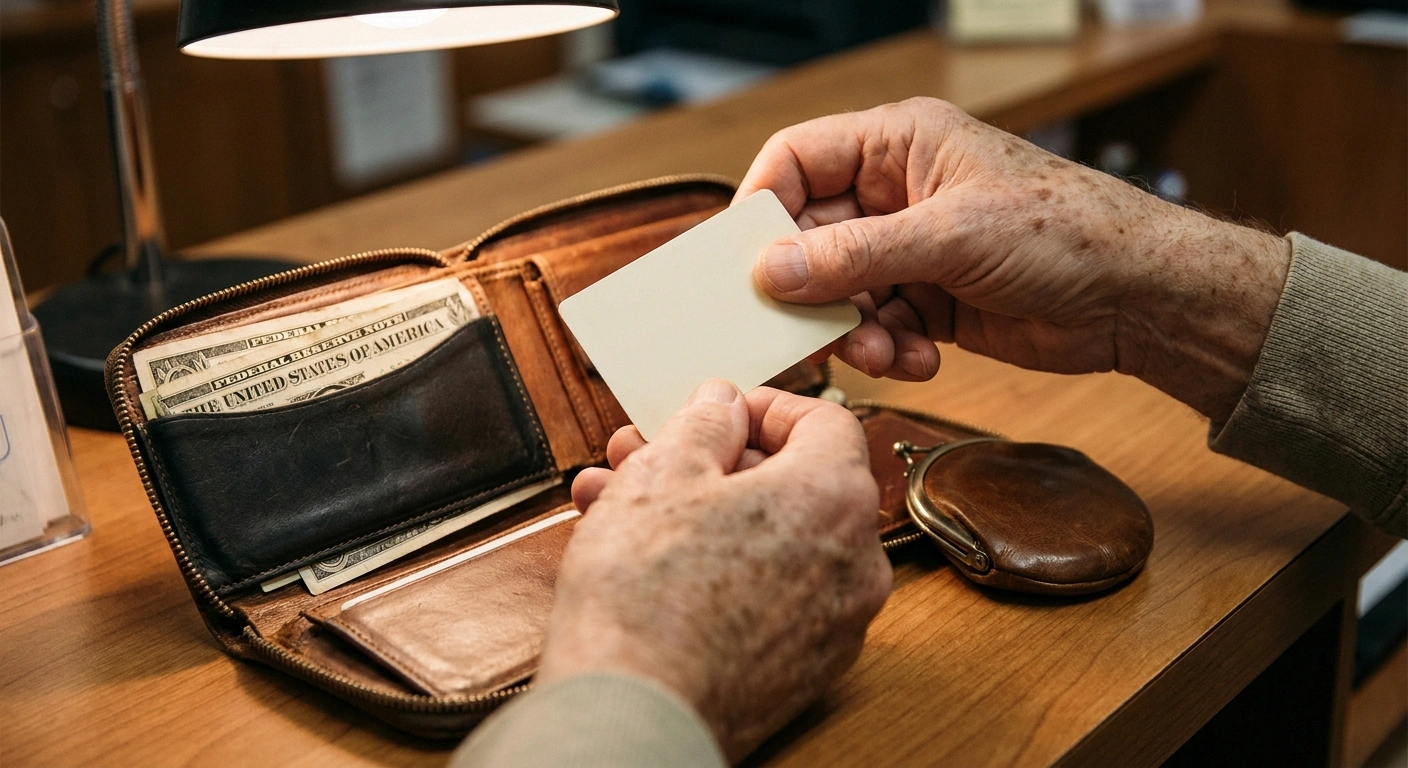
If you still got a paper Social Security or VA check last year, that has changed. The Treasury Department stopped issuing paper checks for most federal payments on September 30, 2025. Its Bureau of the Fiscal Service says existing waiver procedures “remain in effect until further notice,” but the waivers written into the regulation cover things like a mental impairment or living somewhere without the infrastructure for electronic payments. Trouble with your hands isn't among them, so if electronic payment truly doesn't work for you, ask the agency that pays you what options remain.
For people without a bank account, the Direct Express prepaid card is the government's answer, and it has a hand-friendly feature. According to Treasury's page, updated September 1, 2026, there's “No fee to get cash from a bank or credit union,” which means a teller can hand you cash without a keypad. You also get one free ATM withdrawal for each deposit posted each month, though an ATM outside the card's network may charge its own fee. Treasury lists Fifth Third Bank as the card's issuer, and its Fiscal Service warns, “Beware of government impersonation scams.” If disability income is part of your picture, my page on disability benefits for neuropathy is a good companion.
Banking From the Kitchen Table
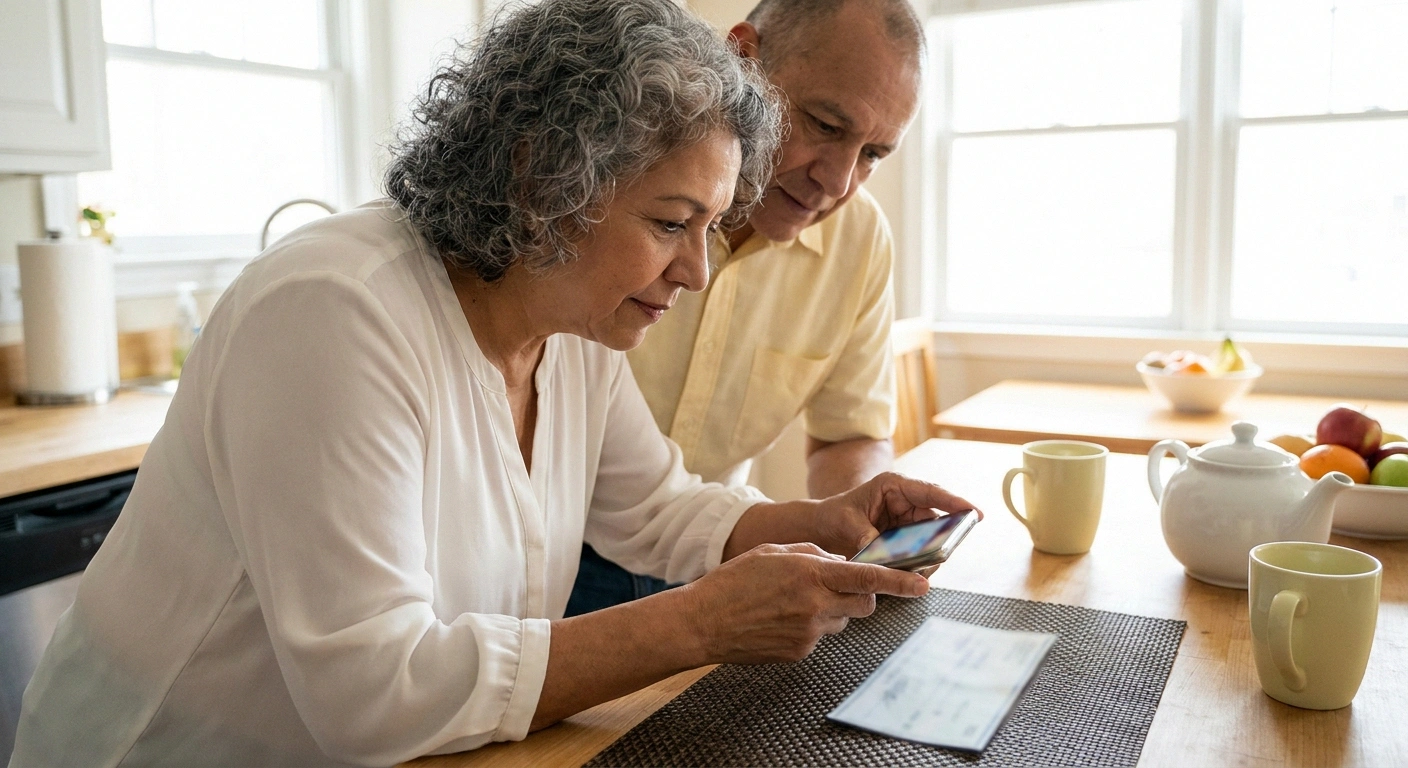
Every trip you skip is a trip your feet don't have to make. “Most banks and credit unions will allow you to deposit checks using your smartphone and a mobile app,” the CFPB says, though not every kind of check can go through that way. The Federal Deposit Insurance Corporation (FDIC) suggests writing the date you deposited it on the front of the paper check and holding on to it until the money is in your account. After that, the CFPB says to destroy it by shredding or tearing it up.
The same apps handle a lot of other errands: paying most bills, setting alerts, and turning off your debit card if you suspect fraud. If the screen itself is the hard part, my smartphone tips for numb fingers make tapping easier, and the therapists' device guide mentions leaning on a phone's voice assistant.
If you still prefer a real person, you're far from alone. In the FDIC's 2023 national survey, 30.4% of households headed by someone 65 or older used a bank teller as their main way to reach their account, compared with 19.3% who mainly used mobile banking. That mobile share was 8.3% in 2019, so it's growing fast. Among households headed by someone with a disability between ages 25 and 64, 47.4% mainly used mobile banking.
Keeping Your Card and Cash Safe
If a card goes missing, speed matters, because your share of any loss on a debit card depends on how quickly you report it. The table below shows the tiers, and the credit card rule for comparison.
| Debit card reported before anyone uses it | $0 |
| Debit card reported within 2 business days after you learn of the loss | Up to $50 |
| Debit card reported later, but within 60 calendar days after your statement is sent | Up to $500 |
| Debit card reported more than 60 calendar days after your statement | Everything taken, possibly more |
| Credit card, unauthorized charges before you report it | Up to $50 |
One detail most guides skip: under the official interpretation of the rule, a bank has to extend those deadlines for extenuating circumstances, and “extended travel or hospitalization” is one of its examples. After you report a problem, the CFPB says the bank generally has ten business days to investigate. And never write your PIN on the card, however tempting it is when the keys are hard to work. The Federal Trade Commission (FTC) and the CFPB both warn against it.
Card skimmers are the worry everyone has heard of, and the Secret Service's advice is sobering: skimming devices “are usually impossible to detect from the ATM's exterior.” It recommends ATMs inside financial institutions or in interior bays with security cameras, and looking for loose edges, raised PIN pads or stickers in odd places. It also says, “Always shield your PIN entry with another hand as much as possible.” If your free hand is busy steadying you, a coat flap or your own body can block the view — that one's my workaround, not theirs.
Hands that can't sign the way they used to can also make someone else's signature harder to spot. The CFPB's guide for families lists red flags such as checks signed after a person can no longer write and “a signature that was shaky is suddenly firm,” and the Justice Department adds ATM withdrawals made without the owner's permission. If someone is in immediate danger, call 9-1-1 first. Otherwise, if you suspect financial abuse, the CFPB says to “contact APS and law enforcement first to file a report,” meaning Adult Protective Services, and to report scams to the FTC at reportfraud.ftc.gov.
Getting There and Back on Sore Feet
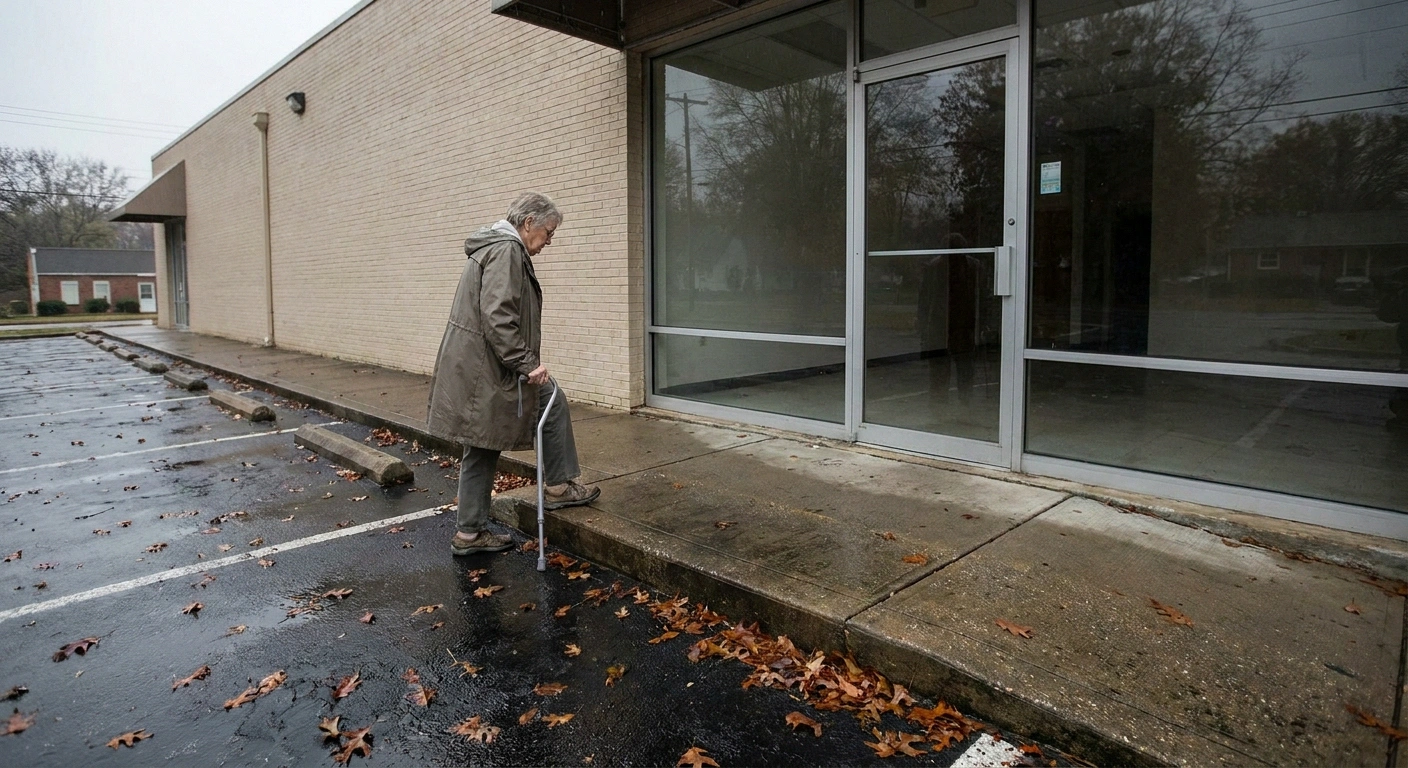
The walk from the car is often the riskiest part of the errand. Over a quarter of people 65 and older fall every year, the CDC reports, and one fall doubles the odds of another. About 37% of those who fall are hurt badly enough to need treatment or cut back on activity for at least a day. Trouble with walking and balance, foot pain and poor footwear are all on its list of risk factors. If you do fall, check your feet and skin afterward, because numb feet can hide an injury, and get urgent care for a head injury, new weakness, or pain that keeps you from putting weight on a leg.
A few habits help. Park as close to the door or the drive-up lane as you can, and use a disability parking placard if you qualify. Go when you're fresh, not at the tail end of a long day of errands. In winter, the CDC's storm advice applies: keep trips outside as brief as possible, and remember that falls on icy sidewalks, steps and driveways cause many cold-weather injuries.
The CDC also says mittens are warmer than gloves — a real dilemma when you need bare fingers for a keypad. Tapping a card from a mitten-warmed hand, or staying in a warm car at the drive-up, shortens the time your fingers are exposed. Numb fingers may not register how cold they're getting, so check their color once you're back in the car. My guide to walking on ice and snow with neuropathy covers the rest of the trip.
Frequently Asked Questions
Do ATMs have to be accessible for people with disabilities?
Under the 2010 ADA Standards, at least one ATM of each type at each location must be accessible, and a bank's inside and outside machines count as separate locations. Accessible machines need keys you can find by touch, controls you can work one-handed with no tight grip or pinch, and a talking mode. Branches built or altered before March 15, 2012 may follow the older 1991 rules.
Can I use an ATM without inserting my card?
Often, yes, at your own bank's machines. Chase, Wells Fargo and Bank of America describe tap or phone-wallet access at their ATMs, and you still enter your PIN. Another bank's ATM may not accept your tap even if it shows the contactless symbol.
Can my bank refuse to help me if I can't sign my name?
Banks are public accommodations under the ADA and must make reasonable changes to their policies for customers with disabilities. A 1994 Justice Department letter said a bank's refusal to serve people who can't sign would fall under that rule, including letting someone with a valid power of attorney sign. Each request is judged on whether it's reasonable.
Can someone do my banking for me without owning my money?
Yes. The CFPB describes a convenience or agency account, where a helper can deposit and withdraw but the money stays yours, and a power of attorney, where an agent can handle transactions for you. A joint account is different, because the other person co-owns the money. Many bank employees don't know about convenience accounts, so you may need to ask a manager.
What happens if my debit card is lost and someone uses it?
Report it right away. If you report it before anyone uses it, you owe nothing. Within two business days of learning about the loss, your share is capped at $50, and it can rise to $500 or more the longer you wait. Hospitalization can extend those deadlines.
Can I still get my Social Security benefits by paper check?
Most federal payments, including Social Security, moved to electronic payment on September 30, 2025. Treasury says existing waiver procedures remain in effect until further notice, but the waivers cover narrow situations. The Direct Express card is an option if you don't have a bank account.
About the Author