Bite into a chili pepper and your mouth reports a burn. Nothing is actually burning. The temperature of the pepper is room temperature, no tissue is damaged, and yet the sensation is close to identical to touching a hot mug.
That is not a quirk of taste. It is one protein doing exactly what it was built to do, and it happens to be the same protein at the center of a great deal of nerve pain research.
Its name is TRPV1. If you have ever wondered why a warm shower feels like scalding water on your feet, why capsaicin cream burns for a week before it helps, or how a single 30-minute patch can quiet pain for three months, all three answers run through this one channel.
The Sensor That Cannot Tell Peppers From Fire
TRPV1 stands for transient receptor potential vanilloid 1. Underneath the mouthful is a simple idea: it is a tiny gated pore sitting in the membrane of certain nerve endings, and when it opens, charged particles rush in and the nerve fires.
What opens it is the interesting part. TRPV1 responds to heat above roughly 43 degrees Celsius, about 109 Fahrenheit. That is not a random number. It is close to the temperature at which tissue actually starts to be damaged, which tells you what this channel is for. It is a smoke detector for your skin.
It also opens in response to acid, which is why inflamed tissue hurts, and to a handful of molecules your own body produces during injury.
And it opens in response to capsaicin, the compound that makes chili peppers hot. The pepper plant stumbled onto a molecule that fits the heat sensor’s lock. Your nerve cannot distinguish the two inputs, so it sends the only message it has: this is burning.
One clarification that saves confusion later. TRPV1 is one channel in a family. Its relatives handle other jobs: TRPM8 responds to cold and to menthol, which is why a menthol rub produces a cooling sensation with no change in temperature, and TRPA1 responds to mustard oil, cinnamon, and a long list of environmental irritants. They come up together in research papers, and only TRPV1 is the heat and capsaicin channel.
The channels live on the smallest, slowest nerve fibers you have. C-fibers, mostly, plus some A-delta fibers. These are the same fibers that carry aching, burning, and poorly located pain, and they are the fibers that go first in most cases of small fiber neuropathy. That overlap is not coincidental, and it is where this stops being trivia.
How a Heat Detector Starts Reporting False Alarms
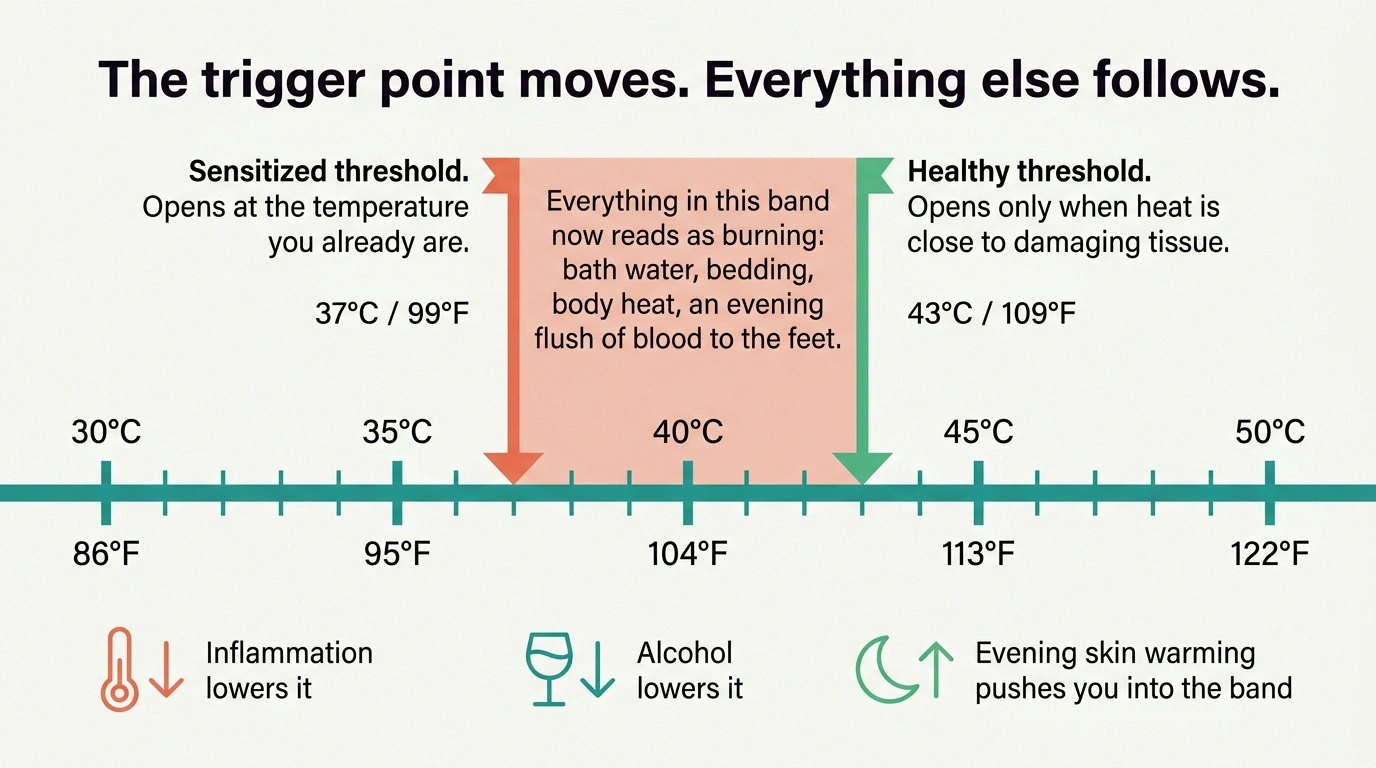
A smoke detector has a threshold. Set it correctly and it ignores toast and screams at a house fire. Lower that threshold far enough and it screams at toast.
TRPV1 has a threshold too, and the threshold moves.
When tissue is injured or inflamed, a crowd of chemical messengers arrives. Nerve growth factor, bradykinin, prostaglandins, several others. These do not open TRPV1 directly. Instead they attach small chemical tags to it, a process called phosphorylation, and those tags change the shape of the channel enough that it now opens at a lower temperature.
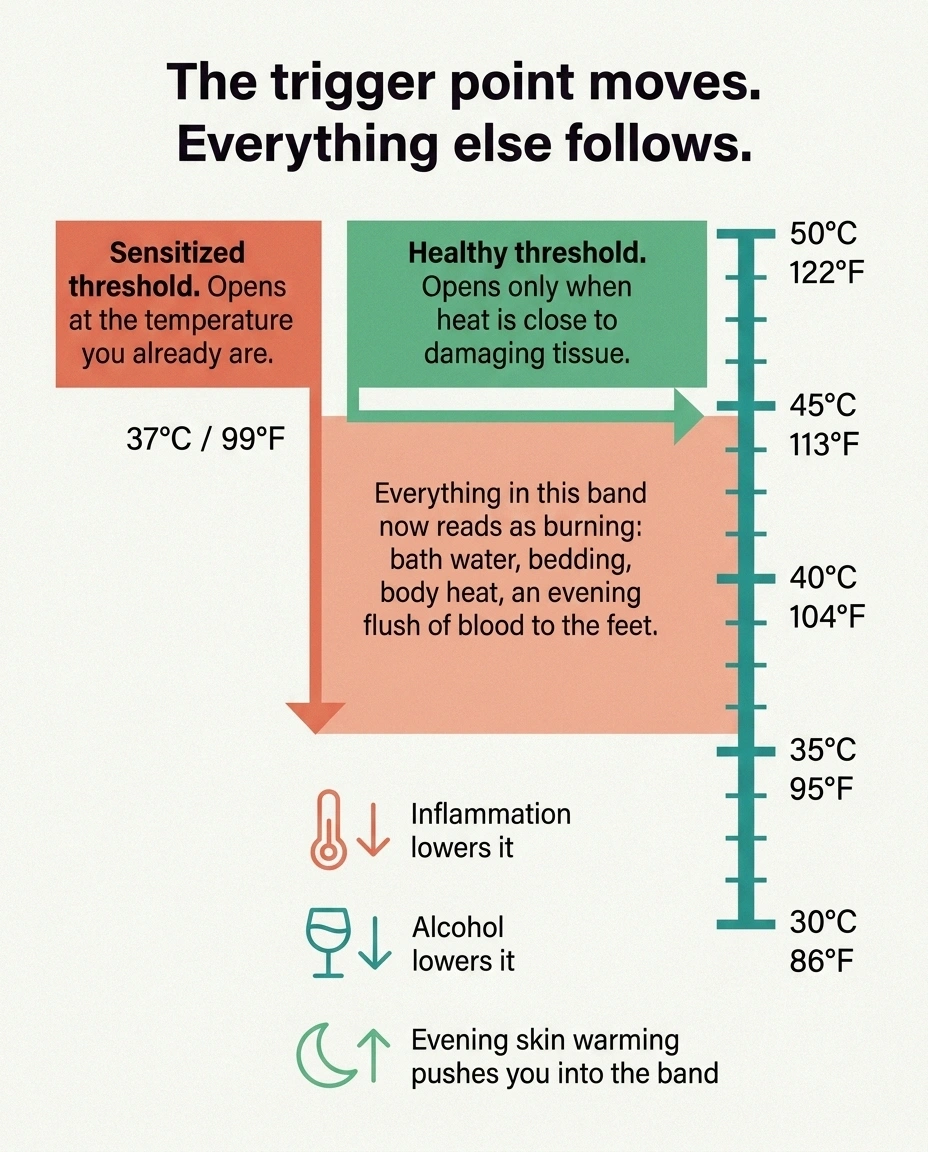
The number sometimes quoted is a drop from about 43 degrees down toward normal body temperature. Sit with that for a second. If the threshold falls to around 37 degrees, the channel is no longer a heat detector at all. It is open at the temperature you already are.
Now the everyday consequences make sense:
- Warm bath water reads as scalding, because the sensor’s alarm point now sits below the water temperature.
- Feet burn at rest with no external heat source at all, because body heat alone is sufficient to keep sensitized channels firing.
- Symptoms flare in the evening, when skin temperature naturally rises and blood flow to the feet increases. That is one of several reasons neuropathy gets worse at night.
- A glass of wine makes it noticeably worse for some people. Ethanol lowers the TRPV1 activation threshold directly, independent of any effect on blood sugar or sleep.
None of this means the burning is imaginary. It means the burning is a measurement error in a real instrument, and the instrument is reporting honestly on a threshold that has been moved.
The Finding That Sounds Backwards
Here is where the research gets genuinely strange, and where a lot of confusing advice comes from.
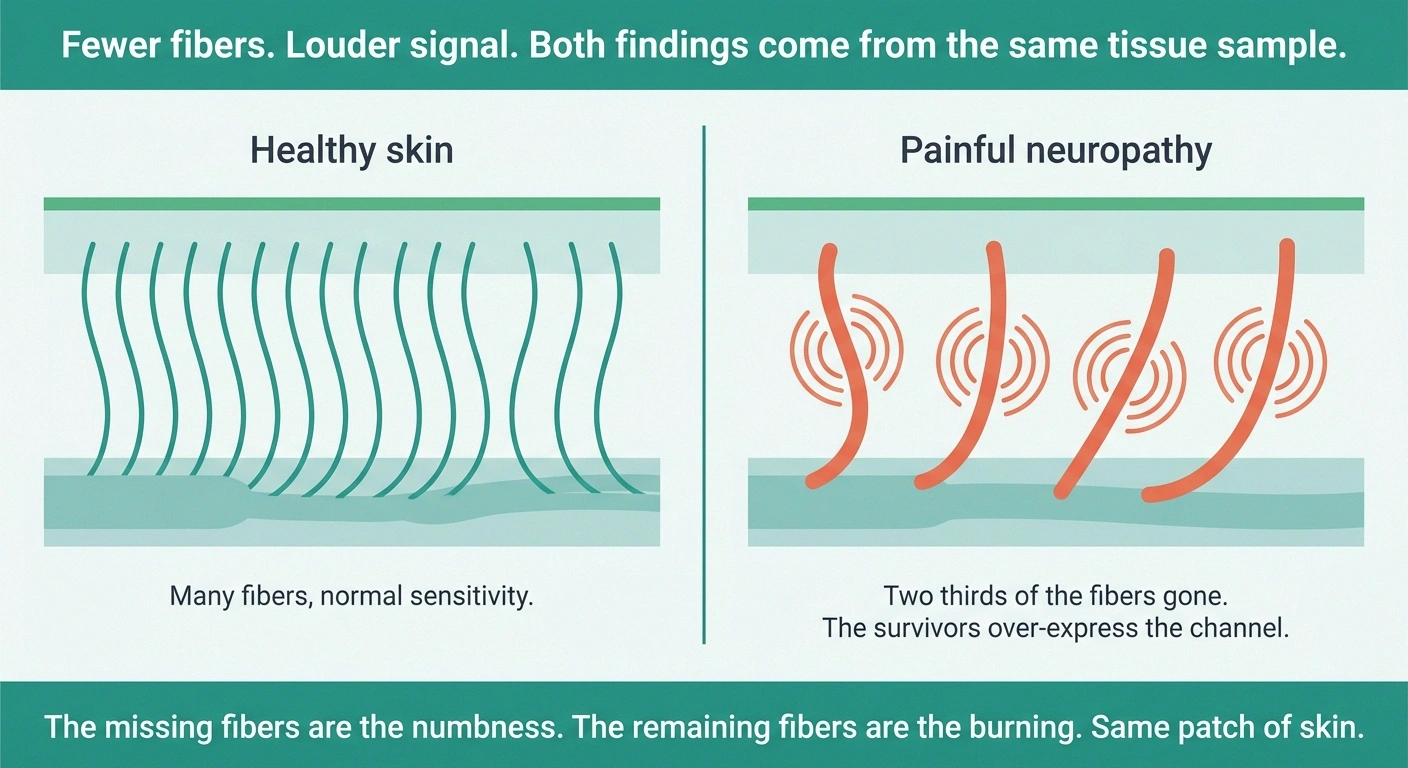
You would expect painful neuropathy to show more of these channels. More burning, more sensors, more alarm bells. When researchers took nerve and skin samples from people with painful neuropathies, they found something closer to the opposite: a diffuse loss of TRPV1-positive fibers in both the sural nerve and the skin.
Fewer fibers. More pain.
The resolution is that the surviving fibers change character. Studies of human tissue in traumatic and diabetic neuropathy found increased TRPV1 expression on the nerve fibers that remain, particularly on sprouting and regenerating ones. The population shrinks while the individual members get louder.
Think of a choir that loses two thirds of its members, and the remaining third responds by singing at the top of their lungs into microphones. The sound is smaller in one sense and far more painful in another.
This explains a symptom pattern that otherwise makes no sense: an area of skin that is simultaneously numb and burning. Patients describe this constantly and it sounds like a contradiction. It is not. The numbness is the missing fibers. The burning is what is left, sensitized and over-expressing. It is also part of why a nerve conduction study can come back clean while your feet are on fire, since standard testing measures large fibers and this is entirely a small-fiber story. That distinction matters when you are reading your test results.
Desensitization: Exhausting a Channel Instead of Blocking It
Most pain drugs work by blocking something. TRPV1 turns out to be treatable by the opposite approach, and this is the single most useful idea on this page.
Defunctionalization is four things happening at once
The word gets used as though it means one event. It describes four, and they run on different clocks, which is why relief arrives later than the burning does.
- Channel desensitization
- The pore stops responding. Onset: minutes. This is the part that happens while you are still in the chair.
- Loss of membrane potential
- Calcium influx overwhelms the ending and it can no longer hold the electrical charge needed to fire. Onset: hours.
- Disrupted transport along the fiber
- Neurotrophic factors stop moving up and down the axon, which changes the fiber’s behavior rather than only its signal. Onset: days.
- Retraction of the skin endings
- The fine terminals in the epidermis physically pull back, then regrow over roughly 8 to 12 weeks. Reversible by design. This is the one the durable pain relief tracks with, and it is why the benefit is often larger at week six than at week one.
Open TRPV1 briefly and you get burning. Open it hard and keep it open, and something else happens. Calcium floods into the nerve ending in quantities the cell was never designed to handle. The channel stops responding. The nerve ending goes quiet, and it stays quiet long after the capsaicin is gone.
This is called desensitization, and at high enough doses the term researchers use is defunctionalization. The nerve terminal is not destroyed in a permanent sense, but it is temporarily taken offline in four ways at once: the channel is desensitized, the membrane loses its normal electrical potential, transport of nutrients along the fiber is disrupted, and the fine endings in the skin physically retract.
That last one is worth reading twice. The nerve fibers in the epidermis pull back. Then, over weeks to months, they grow back.
One review of the process described the early stage as deep pruning of the pain fibers, which is a good image for it. You cut a shrub back hard, it looks bare, and it returns better organized than it was. The pain relief is not primarily the channel being blocked while the drug is present. It is the fiber being rebuilt after the drug is gone.
The 8% Patch: What Happens in Those 30 Minutes
The clinical version of this idea is the capsaicin 8% patch, sold as Qutenza. The concentration is the whole story. Pharmacy creams sit between 0.025% and 0.1%. This patch is 8%, roughly a hundred times stronger than the strongest tube on the shelf, and that is why it cannot be sold to you directly.
Same molecule, two products, roughly a hundredfold apart
| Pharmacy cream | 8% patch | |
|---|---|---|
| Capsaicin | 0.025% to 0.1% | 8% |
| Applied by | You, at home | Trained staff, in clinic, with skin pre-numbing |
| How often | 3 to 4 times daily, for weeks, without gaps | 30 minutes on the feet, repeatable at about 2-month intervals |
| Biological effect | Partial, temporary desensitization | Full defunctionalization and fiber regeneration |
| If you skip 2 days | Sensitization resets. Start over. | Irrelevant. Nothing to skip. |
The adherence line is the one that decides most outcomes. A cream used twice a day when it needed four is not a weaker version of the treatment, it is a different treatment that does not reach the mechanism.
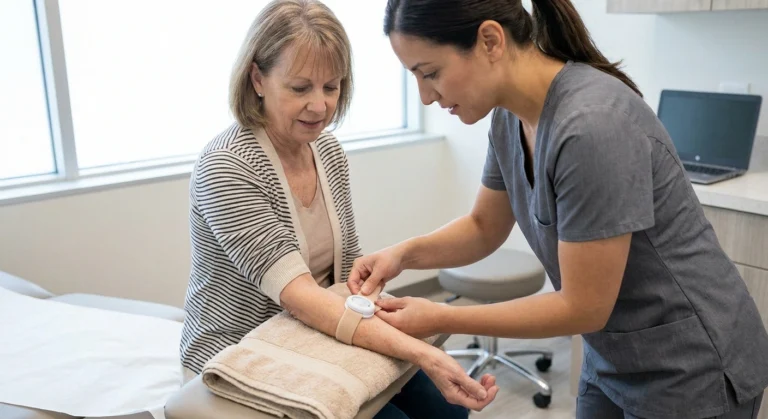
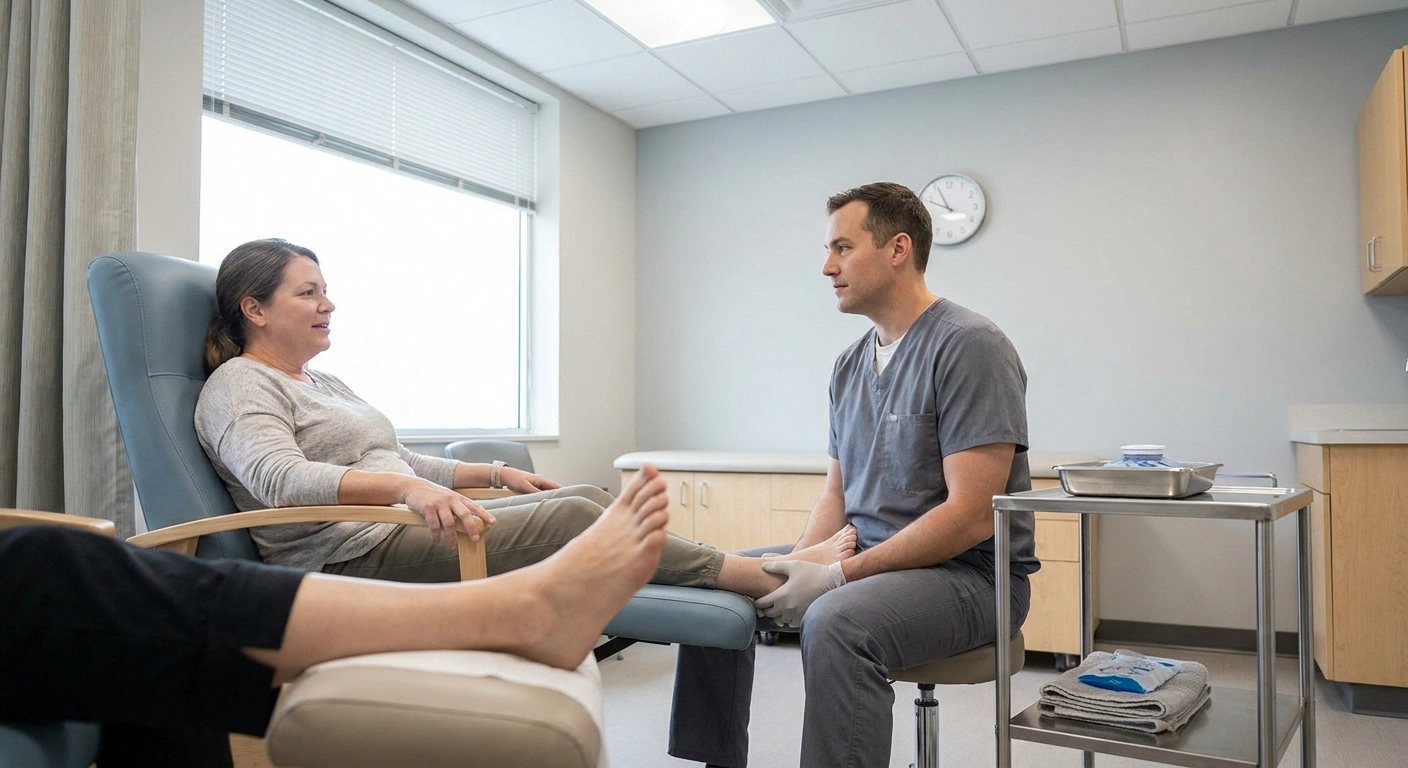
It is applied in a clinic. For the feet the application time is 30 minutes. The skin is usually numbed first, the patch goes on, a nurse stays with you, and the area is cleaned afterward with a gel that removes residual capsaicin.
It is uncomfortable. Nobody involved pretends otherwise. Burning during application and for a few hours afterward is expected, cooling packs are standard, and a transient rise in blood pressure from the pain response is monitored for. That is the honest price of the mechanism.
What you get in exchange: relief that can last for months from a single application, with repeat applications studied at roughly two-month intervals over a year. It is FDA-approved for post-herpetic neuralgia and for painful diabetic peripheral neuropathy of the feet, which are the two conditions where the trial evidence is strongest.
Not everyone is a candidate. The patch is applied to intact skin only, so active ulceration, open cracks, or infection in the treatment area rules it out until those heal. Uncontrolled hypertension is a practical barrier because of the transient blood pressure rise. And if your pain is not primarily in the feet, the approved indication and the trial evidence may not cover where you actually hurt, which is a conversation to have before you travel to a clinic for it.
The more interesting claim, and the one still being argued, is disease modification. A 2022 review in Frontiers in Neurology gathered evidence that after the fibers regenerate, intraepidermal nerve fiber density and some measures of sensory function improve rather than simply returning to baseline. If that holds up in larger studies, the patch would be doing something no oral neuropathy drug does: changing the nerve rather than dampening the signal from it. The evidence is promising and it is not yet settled, and the distinction between those two states is worth keeping straight when a clinic markets it to you.
Why the Pharmacy Cream Is a Different Product

People read about the patch, walk into a drugstore, buy a 0.075% capsaicin cream, and expect a version of the same result. That expectation is the source of a lot of disappointment.
Low-concentration capsaicin works on the same channel, but it never reaches defunctionalization. It produces partial, temporary desensitization only, and only if you apply it three to four times a day, every day, for several weeks without a gap. Miss two days and the sensitization resets. Systematic reviews of the low-dose creams have been consistently lukewarm, and the evidence quality is low.
There are also two practical traps. Capsaicin transfers to fingers and then to eyes with remarkable efficiency, so gloves or immediate hand washing are not optional. And it should never go on broken skin, which is a real consideration if you have any foot ulceration or cracked heels. Regular foot care and daily skin checks come before any topical.
None of that makes the cream worthless. If burning is patchy and localized, it is cheap, it is available today, and the mechanism is real. Just calibrate the expectation: it is a maintenance product requiring rigorous consistency, not a scaled-down patch. Our roundup of topical creams for neuropathy covers how it compares to lidocaine and menthol formulations, which act on completely different targets.
The Blocker Pill That Keeps Not Working
If a sensitized TRPV1 channel causes burning pain, the obvious drug is one that blocks it. Pharmaceutical companies reached that conclusion decades ago and have spent an enormous amount of money on it.
Why this failure mode is worse for you than for a healthy volunteer
In the trials, healthy participants who lost heat detection were in a controlled setting with staff watching. The population a TRPV1 blocker would actually be prescribed to already has reduced protective sensation in the feet, already has elevated ulcer risk, and is already advised never to test bath water with a foot. Adding a drug that further blunts heat detection stacks two deficits on the same limb.
The practical takeaway is not about a drug that does not exist. It is that the safety rule you have already been given, use a hand or elbow to check water temperature and never a foot, exists because your heat detector is already compromised. That rule holds on any treatment.
The first generation of TRPV1 antagonists ran into two problems that were not obvious from the biology on paper.
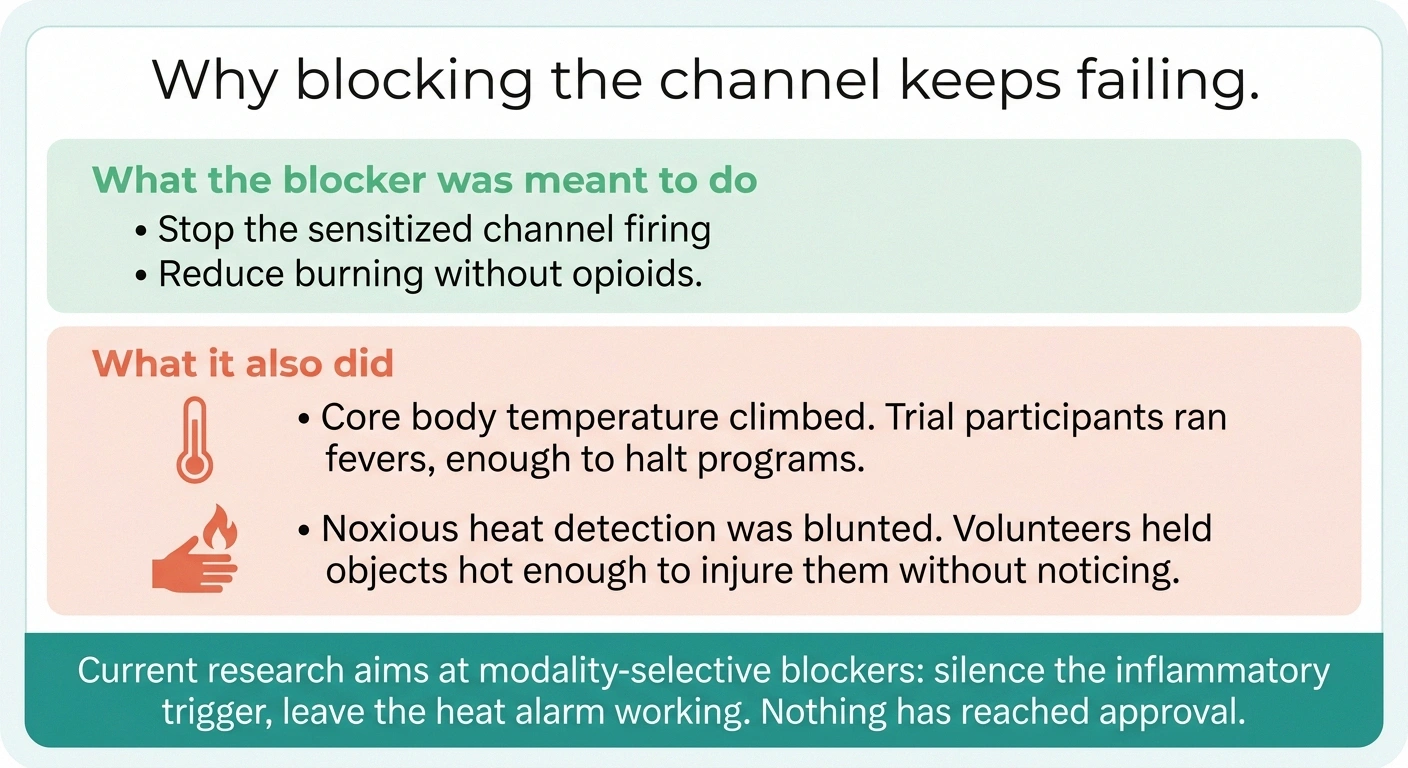
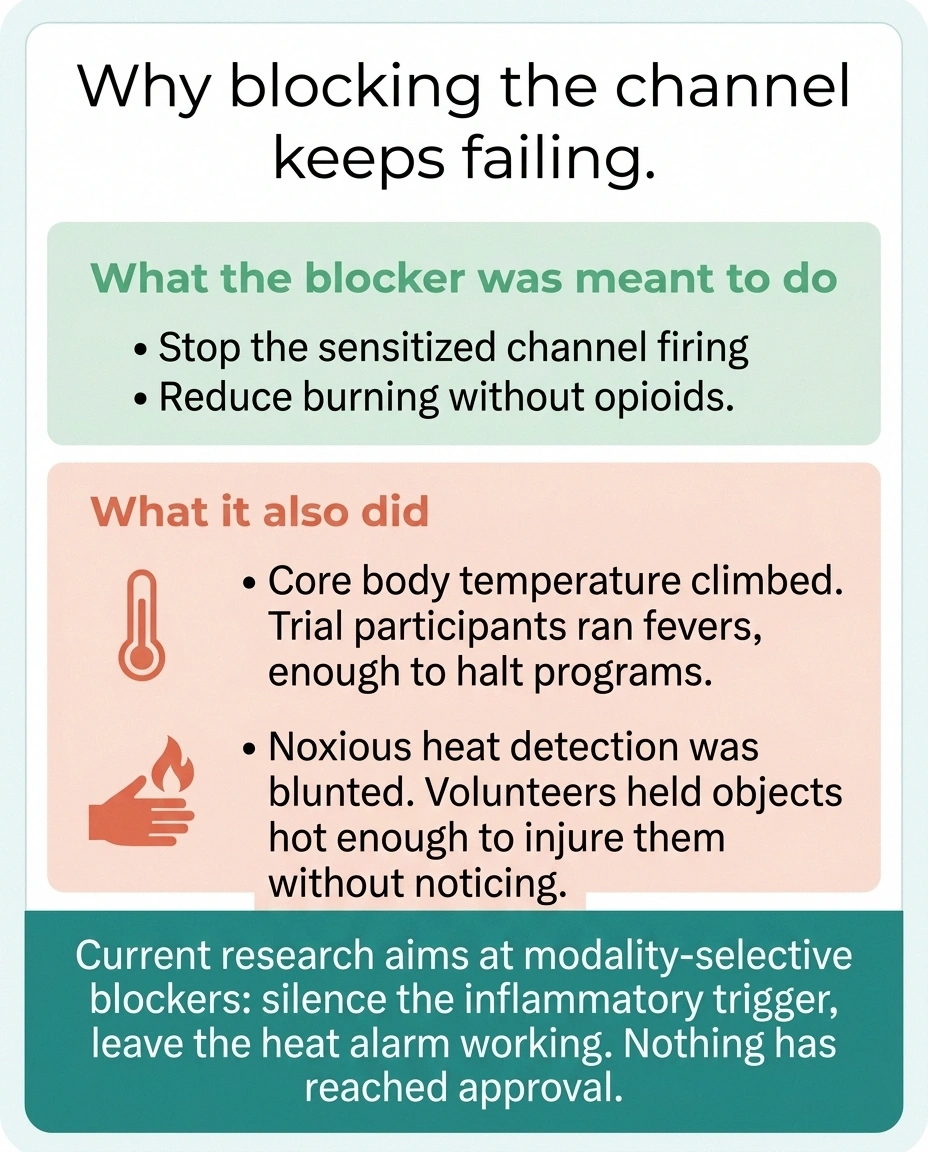
Body temperature. TRPV1 helps regulate core temperature. Block it broadly and body temperature climbs. Trial participants ran fevers, in some cases enough to halt the program.
Burn risk. The channel is a genuine safety mechanism. Block it and people lose the ability to detect dangerous heat. Volunteers could hold objects hot enough to injure them without registering that anything was wrong. In a population that already has reduced foot sensation and elevated ulcer risk, a drug that further removes heat protection is not a small side effect.
Current research is aimed at antagonists that are selective by modality, blocking the channel’s response to acid and inflammatory chemicals while leaving heat detection and temperature regulation intact. That is a much harder molecule to design, and it is why there is still no TRPV1 pill on the pharmacy shelf while the crude approach of overwhelming the channel with capsaicin has been on the market for years.
What This Changes About How You Think About Burning Feet
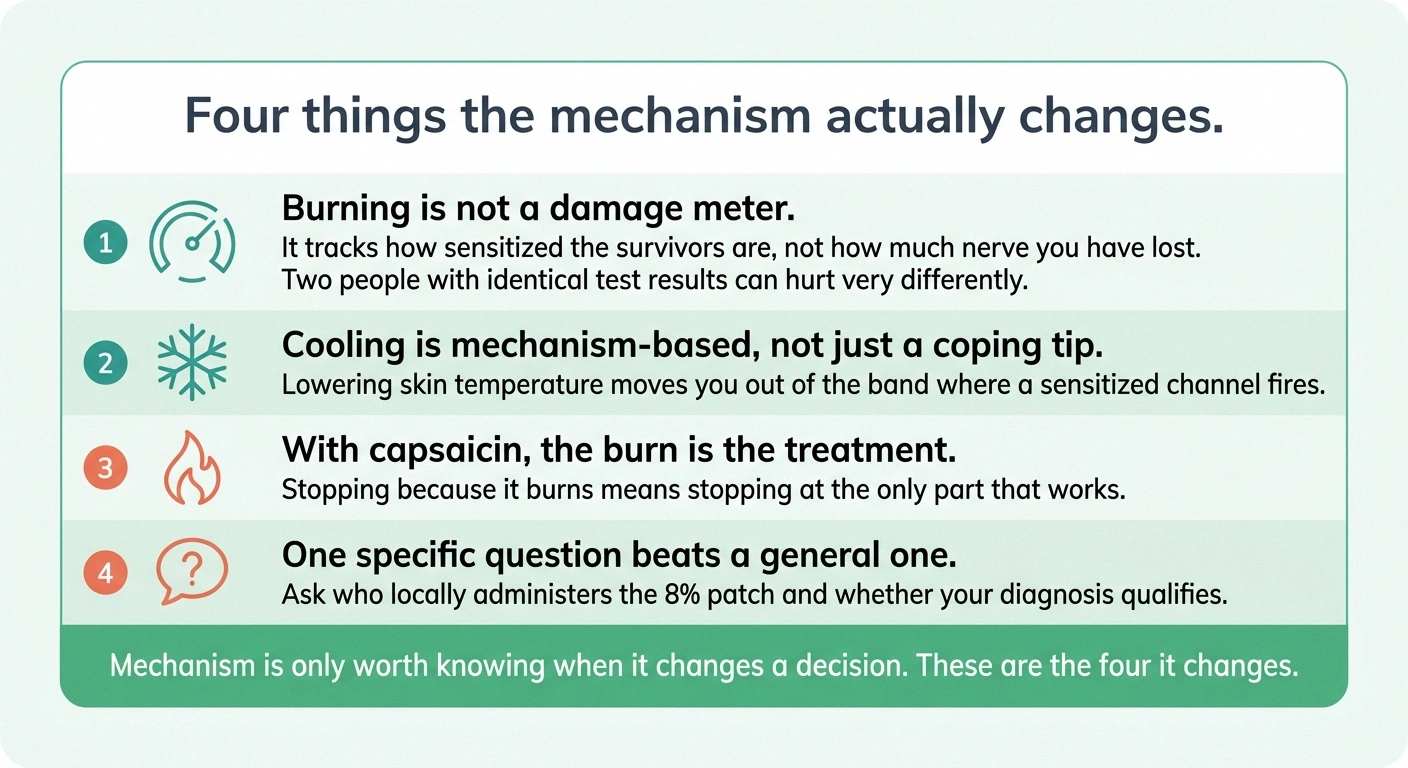
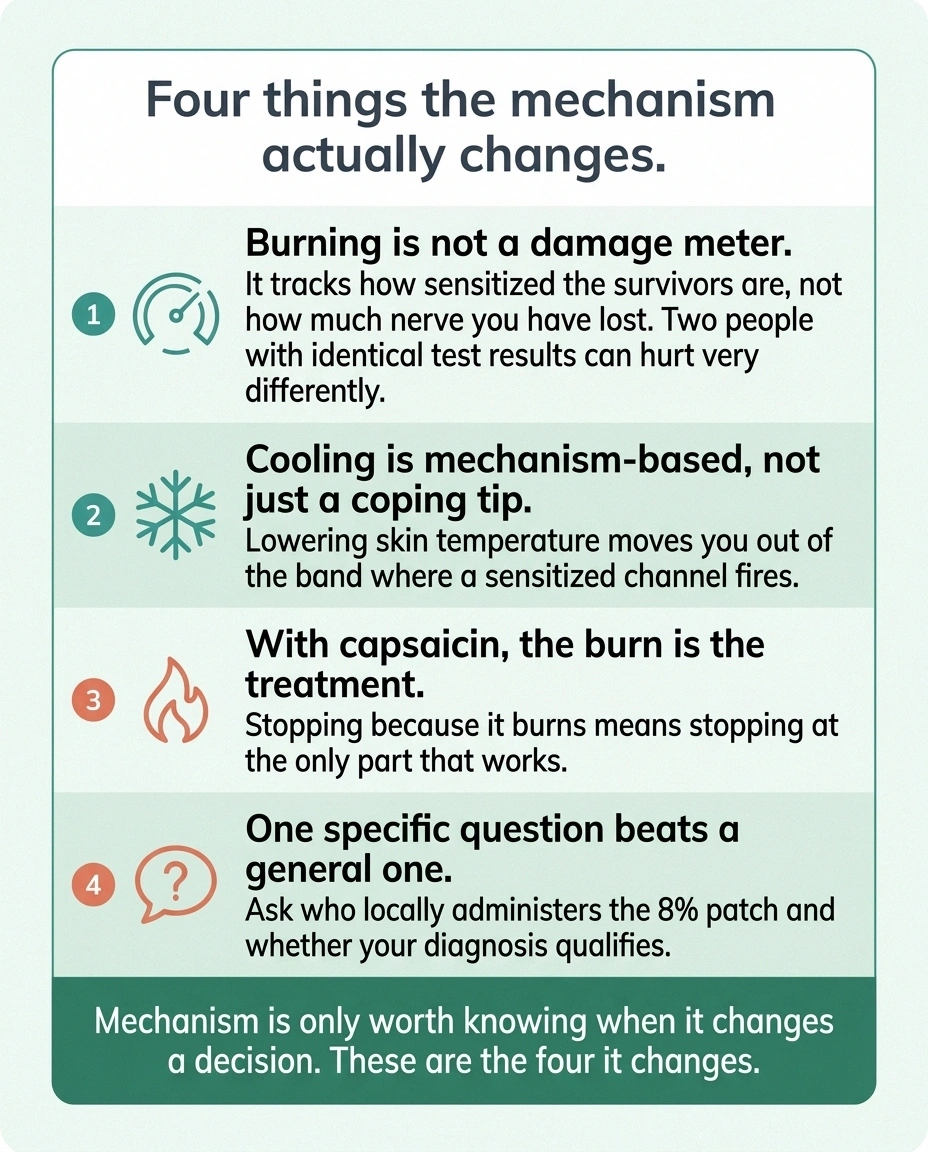
Mechanism is only worth knowing if it changes a decision. Here is what this one actually changes.
Three questions that get a different answer than “my feet burn”
Specific questions name a mechanism and an option. General ones get a medication increase.
- “Does anyone locally administer the 8% capsaicin patch, and would my diagnosis qualify?” Pain clinics and some dermatology and neurology practices offer it. Primary care usually does not, and often does not know who does.
- “Is my burning coming from small fibers, given my nerve conduction study was normal?” A normal study rules out large-fiber problems and says nothing about the fibers that carry burning. Skin biopsy or QSART answers the actual question.
- “Which of my current medications work on this mechanism, and which do not?” Gabapentinoids, duloxetine, and topical capsaicin act on three unrelated targets. Knowing that stops you from stacking two drugs that do the same job and calling it a combination.
It reframes what burning feet mean. Burning is not proportional to how much nerve damage you have. It reflects how sensitized the surviving fibers are. Two people with identical nerve conduction results can have entirely different pain levels, and neither of them is exaggerating.
It explains why heat management is a legitimate strategy rather than avoidance. Cooling the feet does not treat neuropathy, but it moves skin temperature away from the threshold of a sensitized channel. That is a real physical intervention with a real mechanism, which is why cool water and breathable bedding help some people so much more than the advice sounds like it should. It is also why testing bath water with a hand or an elbow, never a foot, is a rule worth keeping, since a burning sensation tells you nothing reliable about actual water temperature.
It sets your expectations for capsaicin honestly. With the pharmacy cream, a mild to moderate burn in the first days is expected rather than a sign the product is wrong for you, and quitting on day three means quitting before the mechanism has had a chance to engage. That is not the same as pushing through anything. Stop and speak to someone if the burning is severe rather than uncomfortable, if it is still escalating after a week or two, if the skin blisters, breaks, or stays red between applications, or if you develop swelling or a rash. On a foot with reduced sensation those signs matter more than they would on anyone else, because the usual pain feedback that would stop you sooner is exactly what is missing. The clinic patch is a different situation entirely: staff are present, the skin is numbed first, cooling is on hand, and blood pressure is monitored, so the discomfort is managed rather than endured.
And it gives you a specific question worth asking, which is more useful than a general one. If you have post-herpetic neuralgia or painful diabetic neuropathy of the feet and oral medications have not done enough, the high-concentration patch is an approved option with a mechanism entirely different from gabapentinoids or duloxetine. It is worth asking whether a pain clinic near you administers it. Many people who would qualify have simply never heard of it, which is a poor reason not to have it.
Frequently Asked Questions
What does TRPV1 actually do in a healthy person?
It is a heat and irritant detector on your smallest sensory nerve endings. It opens at temperatures above roughly 43 degrees Celsius, at acidic pH, and in response to capsaicin from chili peppers. Its job is to warn you before heat damages tissue, which is why blocking it broadly turns out to be dangerous.
Why does capsaicin help pain when it causes burning?
Because sustained activation exhausts the channel rather than stimulating it. A brief exposure produces burning. Prolonged or high-concentration exposure floods the nerve ending with calcium, shuts the channel down, and causes the fine nerve endings in the skin to temporarily retract. The relief comes as those fibers regenerate over the following weeks.
Is the 8% capsaicin patch the same as capsaicin cream?
No. Pharmacy creams contain 0.025% to 0.1% capsaicin and are applied by you three to four times daily for weeks. The patch is 8%, roughly a hundred times more concentrated, applied once in a clinical setting for 30 minutes on the feet, with pre-treatment numbing and monitoring. They produce different biological effects and are not substitutes for each other.
Why do I have numbness and burning in the same patch of skin?
Because they come from different fibers. Painful neuropathies show a loss of TRPV1-carrying nerve fibers alongside increased TRPV1 expression on the ones that survive. The missing fibers produce the numbness. The remaining sensitized fibers produce the burning. Both findings are present in the same tissue samples.
Is there a pill that blocks TRPV1?
Not on the market. Early antagonists raised core body temperature and impaired the ability to detect dangerous heat, which caused burn injuries in trial volunteers. Research continues on more selective compounds that would block inflammatory activation without touching heat detection, but nothing has reached approval.
Does alcohol really make burning feet worse through this channel?
Ethanol lowers the activation threshold of TRPV1, so it can intensify burning independently of its effects on blood sugar, sleep, or nutrition. That is a direct pharmacological effect on the channel, which is one reason the flare can appear within an hour rather than the next day.
Does knowing the mechanism change my treatment options today?
Mainly in two ways. It makes cooling and heat avoidance a mechanism-based strategy rather than a coping tip, and it makes the high-concentration patch a specific option worth raising if you have post-herpetic neuralgia or painful diabetic neuropathy of the feet and current medications are not enough. Most other neuropathy treatments act on entirely different targets, which is also why combining approaches tends to work better than escalating a single one.
About the Author