
There is a bottle in the supplement aisle that costs three times what the bottles beside it cost, and the label says pine bark.
That combination invites a fair question. Bark is not rare. Pine trees are not rare. So what exactly is being priced, and does any of it reach your feet?
The short version is that there is real research here, more than most neuropathy supplements can claim, and that the research measures something slightly different from what the bottle is usually sold for. That gap is the whole story, and once you see it, the decision about whether to spend the money gets much easier.
What Pycnogenol Is, Precisely
Pycnogenol is a trademarked extract of the bark of the French maritime pine, Pinus pinaster, harvested from a single managed forest region in southwest France called the Landes de Gascogne.
The trademark part matters more than it usually does. Most supplement branding is marketing. In this case the branded product is standardized to a defined composition, roughly 65 to 75 percent procyanidins, and essentially every trial you will read about used that specific standardized material at a specific dose.
Procyanidins are a family of plant compounds in the flavonoid group. You have eaten them, in grape skins, apple peel, cocoa, and red wine. What the extraction does is concentrate them to a level and consistency you would never reach through diet.
Now the trap. A bottle labelled “pine bark extract” at a third of the price may contain a different species, a different extraction method, and a completely unspecified procyanidin content. It is not a generic version of a drug, where the active molecule is identical by law. Botanical extracts vary by source, season, and process. If you decide to try this based on the trials, the trials were not run on the cheaper bottle.
That is not an argument that the branded version is worth the premium. It is an argument that if you buy the cheap one, you have stopped being able to reason from the research, and you are back to hoping.
One more piece of housekeeping before the evidence. You will see this compound sold under several names on the same shelf: French maritime pine bark extract, maritime pine extract, OPC, and oligomeric proanthocyanidins. Grape seed extract sits in the same chemical family and is frequently marketed as interchangeable. It is a reasonable cousin, and it has its own separate research, but it is not the material any of the studies below used.
Why a Circulation Supplement Enters a Nerve Conversation
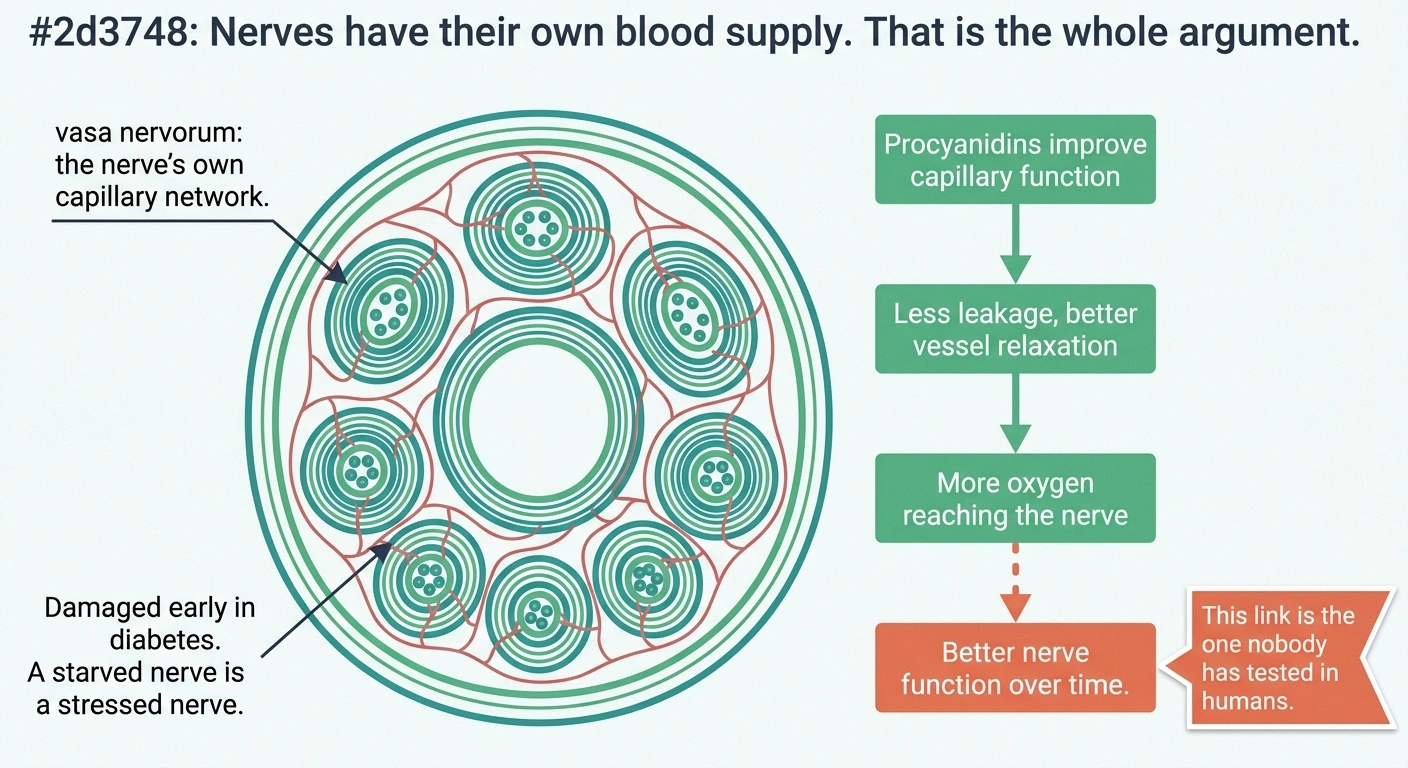
Pine bark extract is, mechanistically, a blood vessel supplement. Understanding why that ends up in neuropathy discussions requires one anatomical fact that gets skipped surprisingly often.
Your peripheral nerves have their own blood supply. A network of tiny vessels called the vasa nervorum runs along and into each nerve trunk, delivering oxygen to tissue that is metabolically demanding and physically long. The nerve running to your big toe is among the longest single cells in your body, and every millimeter of it needs feeding.
In diabetes and several other conditions, the smallest vessels are damaged first. That is what microangiopathy means: disease of the tiny vessels. When the vasa nervorum are compromised, the nerve is being starved as well as chemically stressed, and that ischemic component is now considered a genuine contributor to nerve damage rather than a bystander.
The proposed mechanism has three parts, and they are worth naming because each one predicts a different symptom. Procyanidins act as antioxidants, mopping up the reactive molecules that high blood sugar generates. They increase the production of nitric oxide in the lining of blood vessels, which relaxes those vessels and widens them. And they appear to tighten the capillary wall itself, reducing how much fluid leaks out into surrounding tissue.
So the logic runs: improve microcirculation, feed the nerve better, slow the damage. It is a coherent chain of reasoning and it is the honest basis for interest in this compound.
It is also a chain with an untested link. Every step has evidence except the one that matters most to you, which is whether better capillary function translates into better nerve function in a human being over a meaningful period. Nobody has shown that. This is a good moment to be clear that circulation problems and nerve problems produce overlapping symptoms and require different treatments, a distinction covered in our guide to telling nerve pain from vascular pain.
What the Trials Actually Measured
Here is where most articles about this supplement quietly blur things. The trials are real. What they measured is narrower than the headlines suggest.
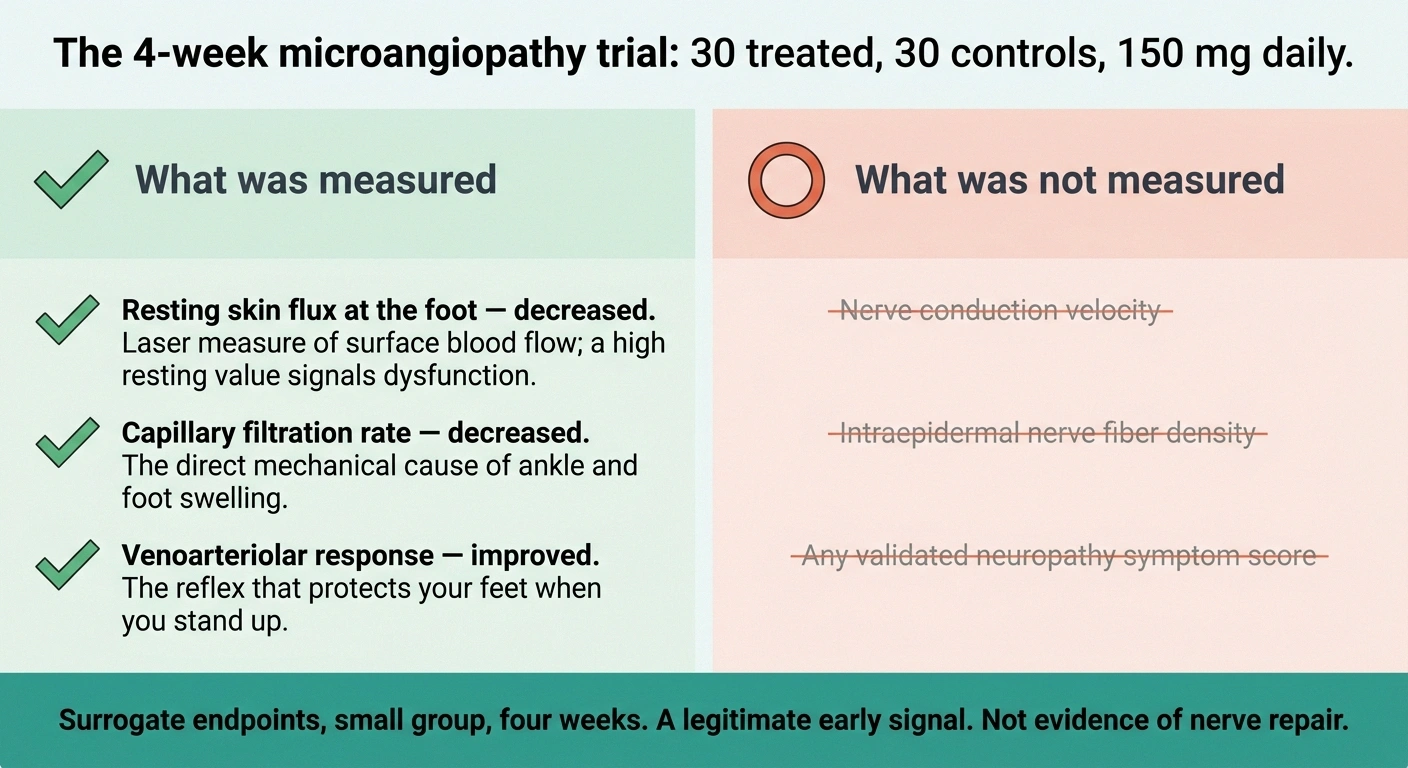
The most cited study on diabetic microangiopathy took 30 people with signs and symptoms of small-vessel diabetic damage, average diabetes duration seven and a half years, gave them 150 milligrams daily as three 50-milligram doses for four weeks, and compared them against 30 similar people who did not take it. Everybody completed the study.
Three findings came out of it, and all three are vascular measurements:
- Resting skin flux at the foot decreased. Skin flux is a laser measurement of blood flow at the skin surface. Counterintuitively, an elevated resting flux is a sign of dysfunction in diabetic microangiopathy, so a decrease here is an improvement.
- Capillary filtration rate decreased significantly. This is the rate at which fluid leaks out of capillaries into surrounding tissue, and it is the direct mechanical cause of swelling in the ankles and feet.
- Venoarteriolar response improved. This is the reflex that constricts small arteries when you stand up, protecting the feet from a flood of pressure. It commonly fails in diabetes.
Read that list again and notice what is not on it. No nerve conduction velocity. No intraepidermal nerve fiber density. No validated neuropathy symptom score. A companion report from the same journal and the same research world described improved symptoms and microcirculation in diabetic patients with neuropathy, but the microcirculatory endpoints remain the substance of what was measured.
These are surrogate endpoints. They measure something plausibly upstream of what you care about, in a small group, over four weeks. That is a legitimate early signal. It is not evidence of nerve repair, and any page telling you otherwise is filling in a blank the research left empty.
The Blood Sugar Result, Kept in Proportion
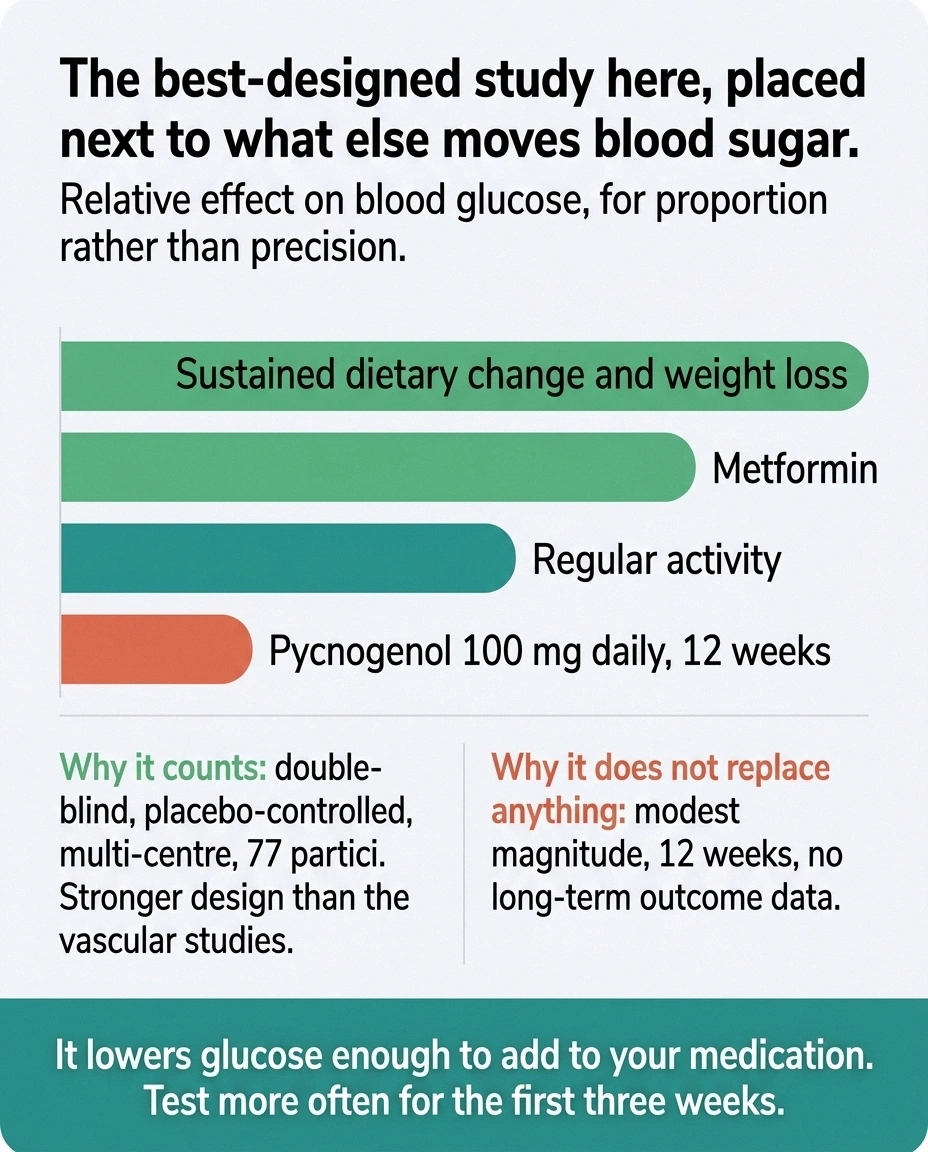
A separate line of research is more interesting than it first appears, because it is better designed.
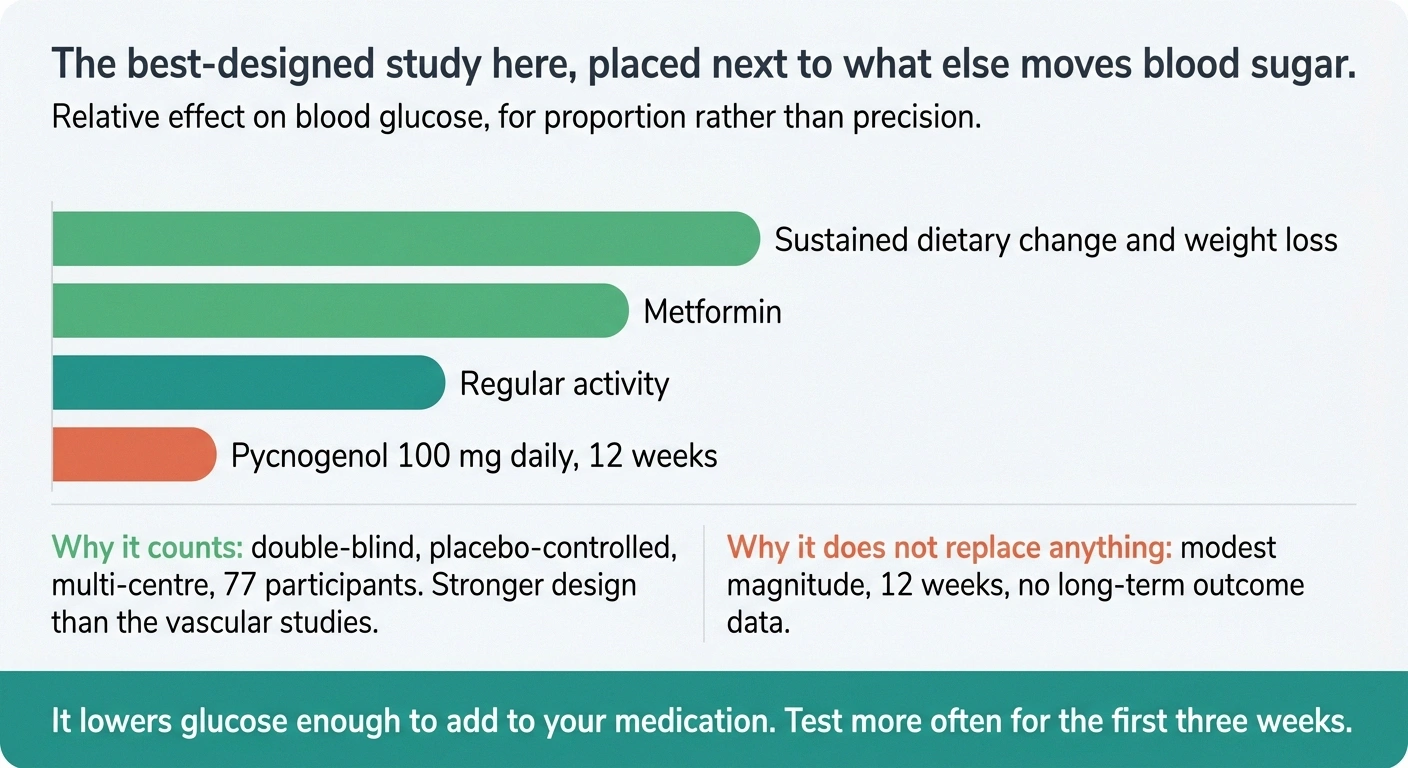
A double-blind, placebo-controlled, multi-center trial gave 77 people with type 2 diabetes 100 milligrams of Pycnogenol daily for 12 weeks and found significantly lower plasma glucose compared with placebo.
Double-blind, placebo-controlled and multi-center matters. That is a stronger design than the microcirculation studies, and 77 participants over 12 weeks is a more serious piece of work than 30 over four weeks.
For a neuropathy audience this deserves careful proportion, in both directions.
The optimistic reading: glucose control is the single most established lever on the progression of diabetic neuropathy. Anything that genuinely nudges it is acting on the mechanism that actually matters, not on a symptom.
The sober reading: the magnitude was modest, it was measured over 12 weeks, and it does not remotely approach what metformin or a change in diet will do. Nobody should treat this as a glucose medication or adjust anything based on it.
There is also a practical consequence that gets missed. If a supplement lowers blood glucose and you are already on medication that lowers blood glucose, those effects add. That is not a reason to avoid it. It is a reason to test more often for the first few weeks, which costs you nothing and catches the only realistic problem.
Who Ran These Studies, and Why You Should Ask
This is the part that tends to get left out of supplement articles, and leaving it out is how readers end up over-trusting a body of research.
A four-question filter you can run on any supplement, in about a minute
Counting studies is the wrong instinct. These four questions separate twenty papers that say one thing from four papers that say four things.
- How many separate research groups? Ten papers from one team is one finding, repeated. Two papers from two unrelated teams is stronger.
- Placebo or just a comparison group? If participants knew what they were taking, subjective endpoints carry very little weight.
- Did it measure the thing you want, or something upstream of it? Blood flow is upstream of nerve function. Upstream measurements are a signal, not a result.
- Who paid, and did they choose the endpoints? Industry funding is normal and not disqualifying. Industry funding plus a single research group plus surrogate endpoints is three yellow flags at once.
Run this on the next three bottles you are considering. It will usually reorder them.
A large proportion of the vascular and microcirculatory work on Pycnogenol comes from one closely connected Italian research group, publishing repeatedly in a small number of journals, studying a branded commercial ingredient. Several trials used a comparison group rather than a placebo, which means participants knew what they were taking.
None of that makes the findings wrong. Concentrated expertise in one group is normal in a narrow field, and industry funding is how most supplement research gets done at all. But it does change how much weight a single result can bear.
The standard that matters is independent replication: a different team, in a different country, with no commercial relationship, finding the same thing. For the microcirculatory endpoints, that replication is thinner than the sheer number of published papers makes it look. Counting studies is not the same as counting independent confirmations, and a supplement with twenty papers from three affiliated groups is in a weaker position than one with four papers from four unrelated ones.
Apply that lens across the whole shelf and it changes what you buy. It is the same reason alpha-lipoic acid occupies a different tier: its neuropathy trials are larger, longer, run by multiple independent groups, and they measured nerve symptoms directly.
Dose, Cost, and Running the Numbers Honestly
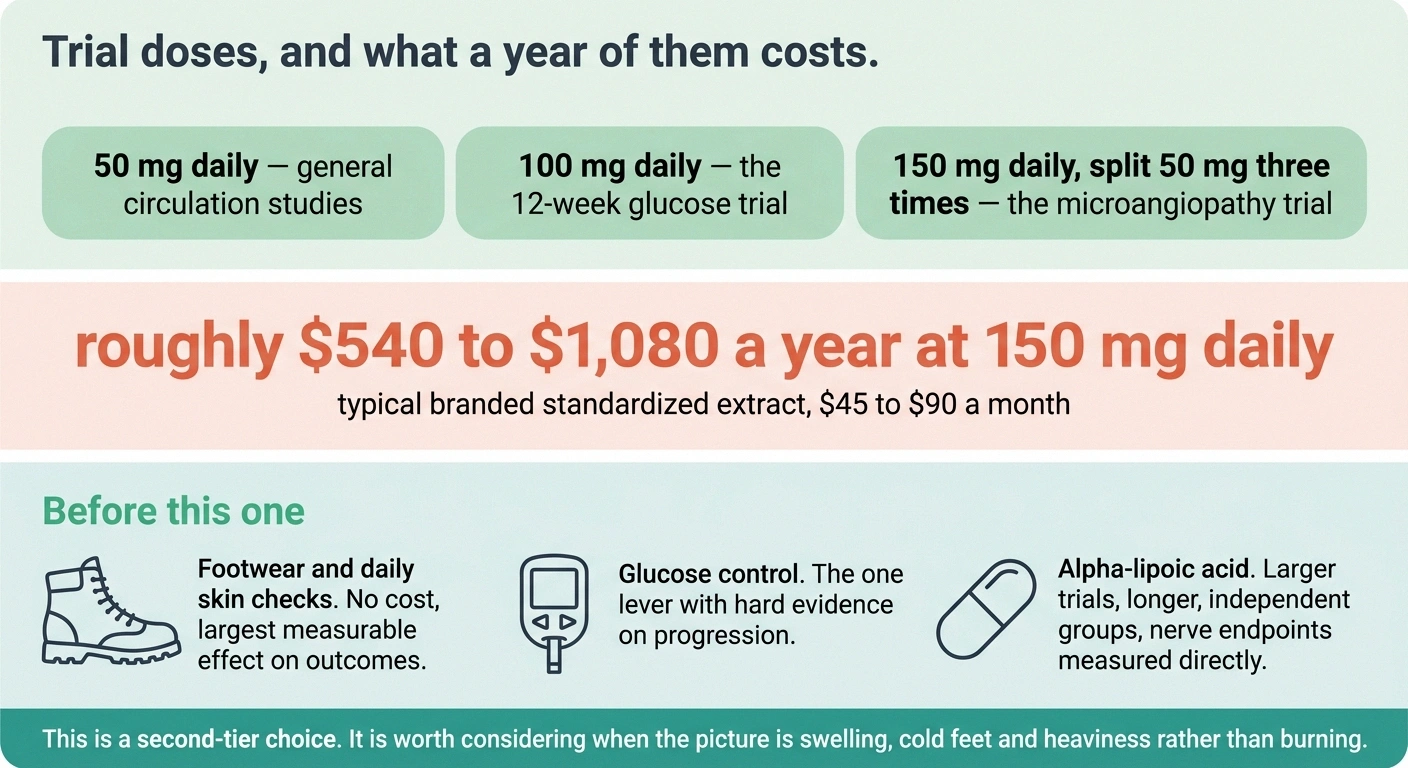
Trial doses cluster in a narrow range, which at least makes this straightforward.
Write the stopping rule on the bottle before you open it
The reason people keep buying supplements that never worked is that the decision point never arrives. Deciding in advance is the whole trick, and a sticker on the lid outlasts the intention.
Start date: _______ Review date, 12 weeks on: _______
Week 0 numbers: sock ring _____ minutes to warm feet _____ blocks before heaviness _____
If fewer than two of the three have improved by the review date, I stop.
Change nothing else during those twelve weeks. Adding a second supplement in week five means you finish the trial unable to attribute anything to anything.
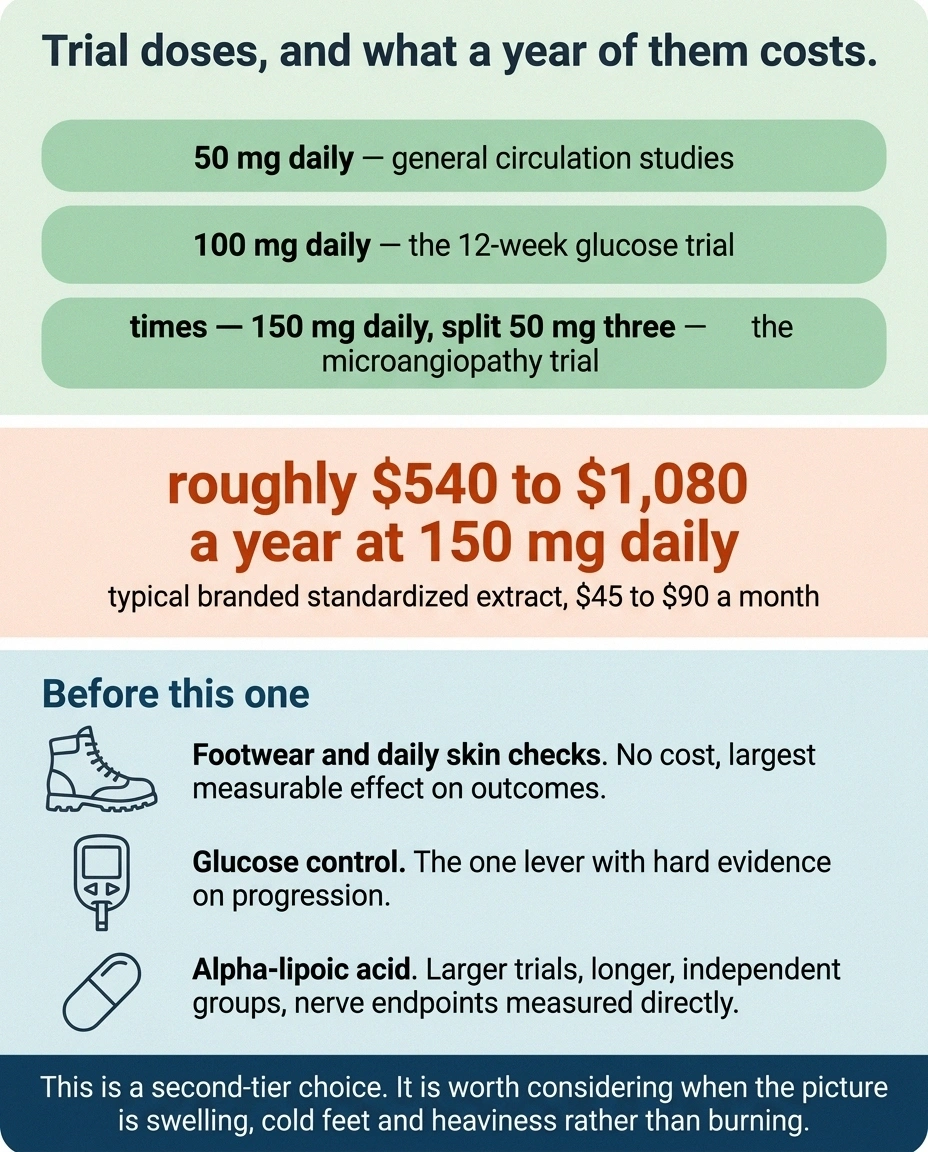
The microcirculation work used 150 milligrams daily, split into three 50-milligram doses. The glucose trial used 100 milligrams daily. General circulation studies commonly sit between 50 and 150 milligrams. There is no evidence supporting higher, and the split dosing in the vascular trials is worth copying since these compounds clear quickly.
Now the arithmetic that decides most of these choices. At 150 milligrams daily of a branded standardized extract, you are typically looking at somewhere in the range of 45 to 90 dollars a month depending on brand and source. Call it 600 dollars a year at the middle of that range.
That number deserves to be said out loud, because supplement decisions are usually made one bottle at a time and evaluated as though they cost thirty dollars. They cost thirty dollars twelve times, and most people take four or five things.
A reasonable way to think about it: this is not a first supplement. If you are not already doing the things with stronger evidence and lower cost, spending here first is out of order. Our roundup of supplements for nerve health lays out that ordering, and pine bark extract sits in the second tier, worth considering once the basics are handled and specifically if your symptom picture is vascular rather than purely neuropathic.
Safety, and Two Groups Who Need to Be Careful

The safety record across trials is genuinely reassuring. Pycnogenol has been well tolerated in study after study, with occasional stomach upset as the most common complaint, usually solved by taking it with food.
Two situations need more than a shrug.
If you take blood thinners or daily aspirin. Procyanidins have mild antiplatelet activity, and the theoretical concern is an additive effect with warfarin, clopidogrel, apixaban, or aspirin. The evidence for a clinically meaningful interaction is weaker here than it is for ginkgo, but the mechanism is plausible and the consequence of being wrong is a bleed. This belongs on the list you hand your pharmacist. Ahead of any surgery or dental extraction, name it to the person doing the procedure and ask whether they want it stopped and how far in advance, rather than deciding either way yourself.
If you take diabetes medication. As above, the glucose-lowering effects stack. Check more often than usual for the first two to three weeks and know what your own low-blood-sugar symptoms feel like, which is a live concern if reduced sensation has already blunted some of your usual warning signs.
Two smaller notes. Pycnogenol appears to stimulate certain immune activity, so anyone with an autoimmune condition or on immunosuppressants should raise it before starting. And there is no meaningful safety data in pregnancy, which is the standard reason to skip it there.
How to Test This on Yourself Without Fooling Yourself

Most people try a supplement, feel uncertain after six weeks, and keep buying it anyway. A little structure prevents that, and this compound is unusually well suited to a fair test because its plausible effects are physical and observable.
Match the measurement to the mechanism, or the trial tells you nothing
Every symptom below is real. Only the ones on the left are produced by the system this compound acts on, which is why they are the only fair test of it.
Fair test: capillary symptoms
Ankle swelling. Measure sock ring depth at 8pm, same socks, same chair.
Cold feet. Minutes from getting into bed to feet feeling warm.
Leg heaviness. Blocks or minutes walked before heaviness starts.
Unfair test: nerve symptoms
Burning and shooting pain. Generated by sensitized nerve fibers. Different system entirely.
Numbness. Reversing it needs fiber regrowth. No trial has shown any.
Balance. Depends on position sense, which is a large-fiber job.
If burning improves and swelling does not, something other than this supplement changed. That is worth knowing too, so write down what else moved that month.
Before any of that, one thing has to be ruled out, because the symptoms this section asks you to track are the same symptoms several serious conditions announce themselves with. Swelling that is new, sudden, or worse in one leg than the other needs evaluating rather than tracking, because that pattern can mean a clot. Swelling in both legs that arrives alongside breathlessness or rapid weight gain belongs to the heart and kidneys until proven otherwise. Cold, pale, or discoloured feet with cramping pain that comes on when you walk and stops when you rest points toward peripheral artery disease, which is checked with a simple ankle blood pressure measurement and treated in a completely different way. And any warmth, redness, or broken skin on a foot with reduced sensation is a same-week phone call, not an experiment. None of these are reasons to be alarmed by ordinary end-of-day puffiness. They are the specific patterns that mean the answer is an appointment rather than a supplement.
With that cleared, the central trick is to pick endpoints that match the mechanism. If the extract does anything, it acts on capillaries. So measure capillary things.
Worth tracking:
- Ankle and foot swelling. Capillary filtration rate is the one endpoint with the most direct evidence behind it. Sock indentation depth measured each evening is a crude but genuinely usable measure, and it is more reliable than memory. If you already wear compression socks, keep that constant during the trial rather than changing two things at once.
- Cold feet and how long they take to warm. A vasodilatory effect should show up here if it shows up anywhere.
- Heaviness and walking distance. How far before your legs feel heavy, measured as blocks or minutes rather than a feeling.
Worth being skeptical about:
- Burning and shooting pain. These are generated by sensitized nerve fibers, which is not this compound’s mechanism. Improvement here is possible but it is the least likely result and the most likely to be placebo.
- Numbness. Restoring lost sensation would require nerve regeneration, and there is no evidence of that from any of this research.
Give it 8 to 12 weeks at a trial dose, change nothing else during that window, write down three numbers weekly, and set the decision rule before you start rather than after. If the numbers have not moved by week 12, stop. The money is better spent on something that did move, and there is more evidence behind the basic non-supplement approaches than behind most of the shelf.
Frequently Asked Questions
Does Pycnogenol repair nerve damage?
There is no evidence that it does. The trials measured blood flow at the skin, capillary leakage, the standing blood pressure reflex, and blood glucose. None measured nerve conduction, nerve fiber density, or nerve regeneration. Marketing that implies nerve repair is going beyond what the research shows.
Is generic pine bark extract the same thing?
Not necessarily. Pycnogenol is a specific standardized extract of French maritime pine bark, standardized to roughly 65 to 75 percent procyanidins, and it is the material used in the published trials. A cheaper bottle labelled pine bark extract may use a different species, extraction method, or concentration. If you buy the generic, you can no longer reason from the trial results.
How much should I take, and when?
Trial doses ran from 50 to 150 milligrams daily. The microcirculation studies used 150 milligrams split into three 50-milligram doses, and the glucose study used 100 milligrams daily. Splitting the dose matches how the trials were run. Taking it with food reduces the stomach upset that is the most common complaint.
Can I take it with blood thinners?
Raise it with your pharmacist first. Procyanidins have mild antiplatelet activity that could add to warfarin, clopidogrel, apixaban, or daily aspirin. The interaction evidence is weaker than for ginkgo, but the mechanism is real and the downside of being wrong is bleeding. It should also be stopped before surgery or dental extractions.
Will it lower my blood sugar?
Possibly, modestly. A double-blind trial of 77 people with type 2 diabetes found significantly lower plasma glucose after 12 weeks at 100 milligrams daily. The effect is nowhere near medication strength, but it does add to medications that lower glucose, so test more frequently for the first few weeks after starting.
How long before I would know if it works?
The vascular trials showed measurable changes at four weeks and the glucose trial at 12. A personal trial of 8 to 12 weeks is reasonable. Track swelling, foot temperature, and walking distance rather than burning pain, because those are the outcomes the mechanism actually predicts.
Is it better than alpha-lipoic acid?
For neuropathy specifically, alpha-lipoic acid has the stronger case: larger trials, longer durations, multiple independent research groups, and endpoints that measured nerve symptoms directly. Pine bark extract is worth considering when the picture includes swelling, cold feet, and heaviness, which are circulation symptoms rather than nerve symptoms.
About the Author