
The question I get asked more than any other, in the support group and in my inbox, is some version of this: “Is this going to keep getting worse?”
I remember asking it myself, sitting in a paper gown on an exam table, about eight months after the tingling in my toes stopped being an occasional thing and became a permanent thing. The neurologist gave me an answer that was honest and completely unsatisfying: “It depends on the cause, and it depends on what you do next.”
I hated that answer at the time. I have come around to it since, because it turns out to be true, and because the second half of it is the part with your name on it. Some of what happens to your nerves is out of your hands. A meaningful amount of it is not.
What I want to do here is lay out what actually slows neuropathy down, ranked honestly by how much evidence stands behind each one, and separated into two piles that most articles mash together. Because there is a real difference between things that change the disease and things that change how you feel, and knowing which is which changes how you spend your energy.
The Two Different Goals Nobody Separates
Here is the distinction that reorganized how I think about all of this.
Feeling better and slowing the disease are two different projects with two different scorecards. You can feel better while nerve damage continues, and you can do everything right for your nerves and still have a painful week. Judge each effort by the standard that belongs to it.
Symptom modification means feeling better. Less burning tonight, fewer electric jolts, better sleep. Gabapentin does this. A foot soak does this. A good pair of shoes does this. These are worth doing — living in less pain is not a lesser goal, and anyone who implies otherwise has never had a bad night.
Disease modification means changing the trajectory. Fewer nerve fibers dying this year than would have died otherwise. This is a different list, and it is a much shorter list.
The reason this matters practically: it is entirely possible to feel better while the underlying nerve damage continues, and it is equally possible to do everything right for your nerves and still have a rough pain week. If you judge your disease-modifying efforts by how your feet feel on a given Tuesday, you will draw the wrong conclusion and quit the things that were working.
So: two goals, two scorecards, two sets of expectations. Let's go through the levers that actually belong in the second pile.
Lever One: Find and Treat the Cause
This is the whole ballgame, and it comes first for a reason. Neuropathy is not one disease. It is a symptom pattern with somewhere north of a hundred possible causes, and the single biggest determinant of whether yours progresses is whether the thing causing it is still happening.
If your nerves are being damaged by high blood sugar, and your blood sugar stays high, the damage continues. If your nerves are being damaged by a B12 deficiency, and the deficiency persists, the damage continues. If a medication you take every morning is neurotoxic and you keep taking it, the damage continues. In each case, the intervention that matters most is not a supplement or a cream. It is removing the ongoing insult.
Which is why, if you do not have a confirmed cause, getting one is your highest-value next move — higher than any product you could buy. A thorough workup checks blood sugar and A1C, B12 with methylmalonic acid, folate, thyroid function, kidney and liver function, protein electrophoresis, inflammatory markers, and depending on your history, autoimmune and genetic testing. Our guide to neuropathy diagnosis and the tests your doctor may order walks through what each one is looking for.
About a quarter to a third of people end up with no identified cause after a good workup. That is called idiopathic neuropathy, and I want to be straight with you: the lever set is smaller when nobody can find the driver. It is not zero, and the rest of this article still applies. But the honest version of this advice acknowledges that some people are working with fewer tools than others, and it is not because they tried less hard.
Lever Two: Blood Sugar, and the Nuance Nobody Mentions
Diabetes is the most common cause of peripheral neuropathy in the United States, so glucose control gets top billing everywhere. It deserves the billing. It also comes with a nuance that most articles skip, and skipping it does readers a disservice.
Type 1 diabetes: intensive glucose control cut the risk of developing clinical neuropathy by roughly 60% in the DCCT. In the EDIC follow-up 13–14 years later, the former intensive group still had lower neuropathy rates (about 22% vs 28%) — the “metabolic memory” effect.
Type 2 diabetes: the same benefit has not been demonstrated. Multiple trials and reviews find intensifying glucose control does not clearly reduce peripheral neuropathy, and nerve measures generally don't improve unless glucose approaches normal. Control still protects eyes, kidneys, heart and circulation — but the nerve-specific promise is weaker than you've been told.
In type 1 diabetes, the evidence is genuinely strong. The landmark Diabetes Control and Complications Trial found that intensive glucose control reduced the risk of developing clinical neuropathy by roughly 60 percent compared with conventional treatment. Better still, the follow-up study tracked those same participants for another 13 to 14 years and found the former intensive-control group still had lower neuropathy rates — about 22 percent versus 28 percent — long after the trial itself ended and glucose control between the groups had evened out. Researchers call this metabolic memory. Control you achieve early keeps paying you back years later.
In type 2 diabetes, the picture is more complicated, and I would rather tell you than let you find out from a disappointed doctor. Multiple trials and systematic reviews have found that intensifying glucose control does not produce the same clear reduction in peripheral neuropathy that it does in type 1. Nerve testing measures generally do not improve unless glucose gets close to normal — not just better, but close to normal.
Does that mean type 2 glucose control is pointless? Absolutely not. It protects your eyes, your kidneys, your heart, and your feet from the vascular side of the problem. But it is more honest to say “this is important and the neuropathy benefit is less certain than you have been told” than to promise a 60 percent reduction that came from a different population. If you have diabetic neuropathy, glucose control belongs in your plan alongside the other levers, not as the only one.
One bright spot: in prediabetes and early metabolic-syndrome neuropathy, weight loss and glucose normalization can sometimes stabilize and partially improve small-fiber involvement. Earlier is dramatically better than later. That is the recurring theme of this entire subject.
Lever Three: Correct Any Deficiency, Then Stop
Nutritional deficiency neuropathies are among the few genuinely reversible ones, and correcting them is straightforward, cheap, and criminally under-checked.
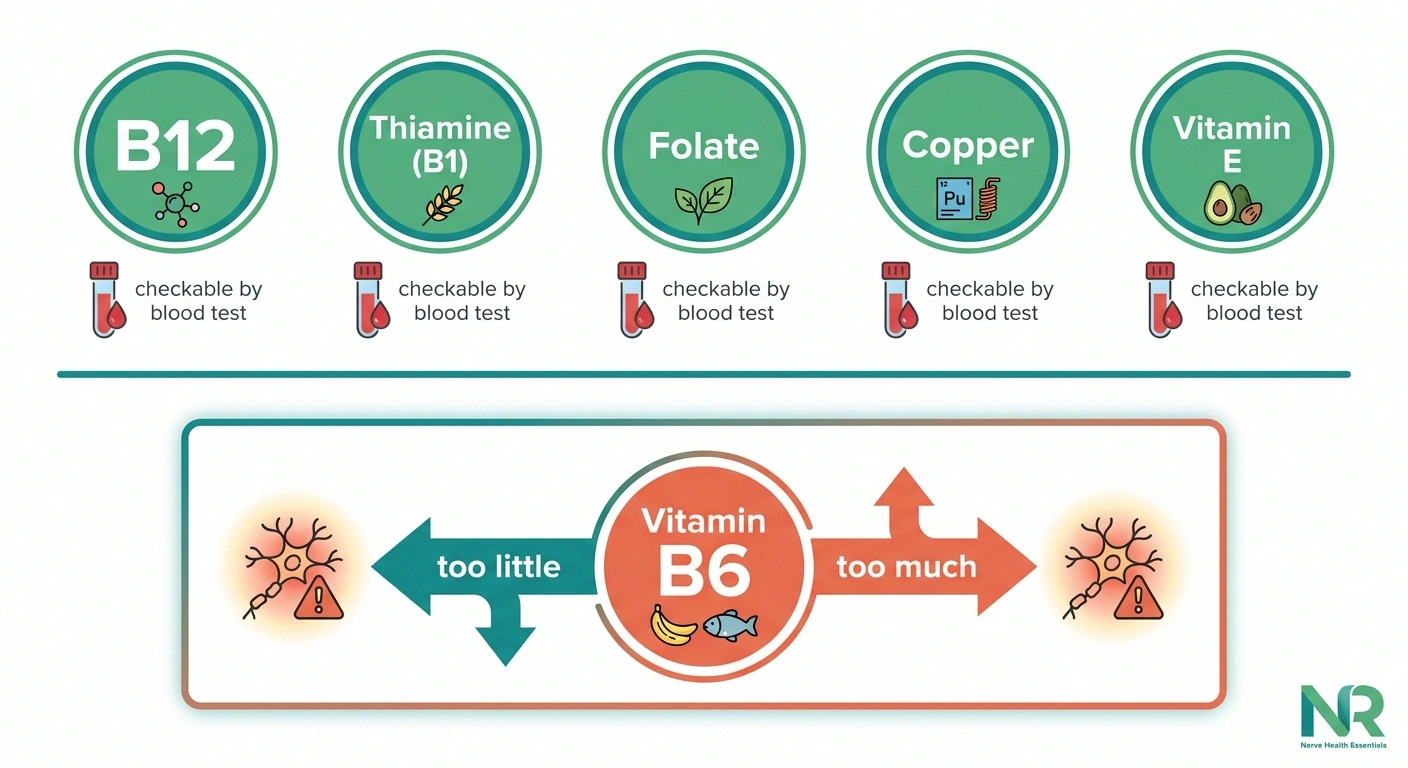
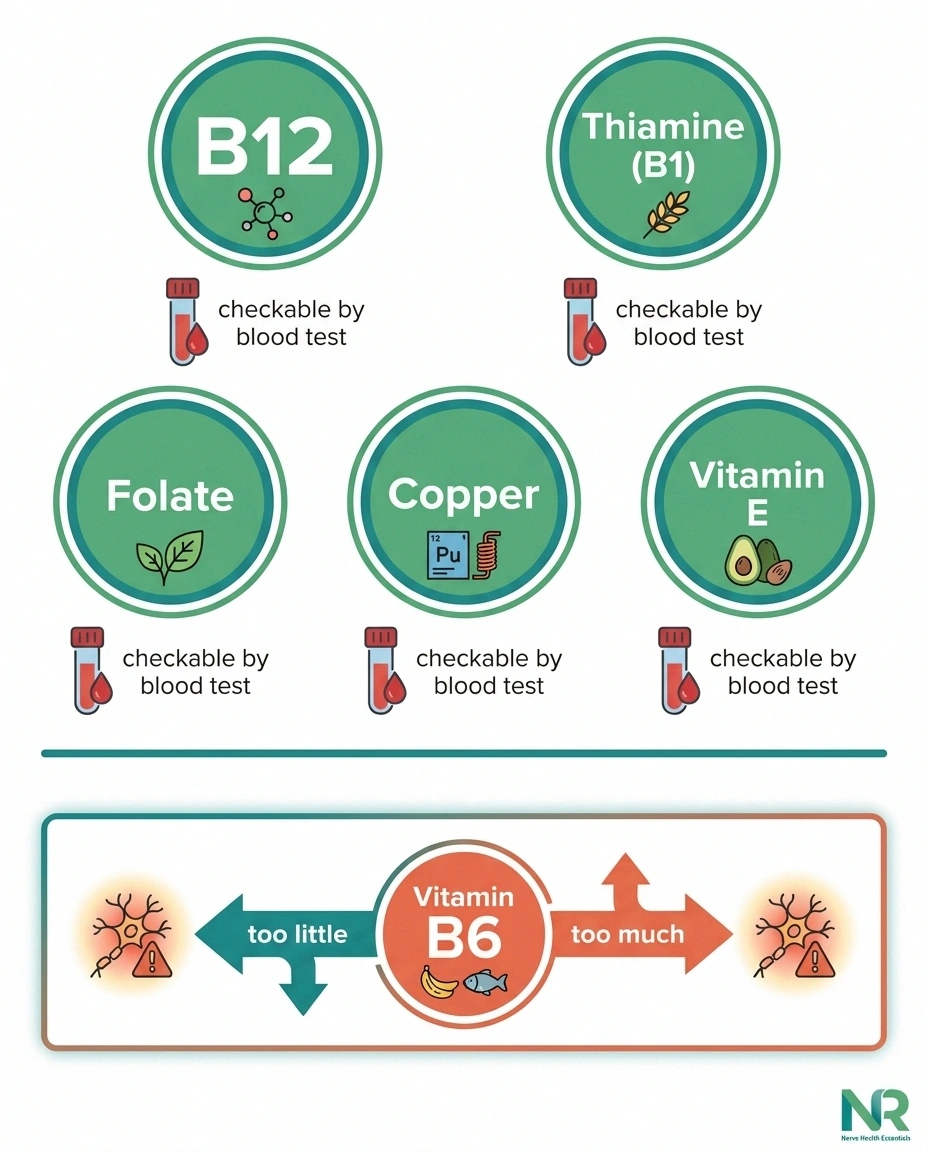
Vitamin B6 damages nerves from both directions.
Too little causes neuropathy. Chronic high intake also causes neuropathy — and it is one of the more common self-inflicted causes, usually from a “nerve support” formula stacked on top of a multivitamin and an energy drink. Add up every source of B6 you take and bring the total to your doctor. More is not better here.
The main players are vitamin B12, thiamine (B1), folate, copper, and vitamin E. B12 is the most common and the most consequential — it damages nerves and, if it goes on long enough, the spinal cord too. If your B12 is borderline, ask for a methylmalonic acid level, which catches functional deficiency that a normal-range B12 can hide. Our overview of which vitamin deficiencies cause neuropathy covers each one and how it gets tested.
Now the part that surprises people. Vitamin B6 causes neuropathy from both directions. Too little damages nerves. Too much also damages nerves — chronic intake well above the recommended amount is directly neurotoxic, and it is one of the more common self-inflicted causes I hear about, usually from someone taking a “nerve support” formula that stacks B6 on top of a multivitamin on top of an energy drink. If you are taking supplemental B6, add up every source and talk to your doctor about the total. More is not better here; more is a known injury mechanism.
The general rule with deficiency correction: fix a documented deficiency, confirm it corrected, then stop chasing. Loading up on vitamins you are not short of has never been shown to protect nerves, and in B6's case it does the opposite.
Lever Four: Audit Every Medication You Take
This one costs nothing, takes one appointment, and I have seen it change someone's trajectory more than once.
Never stop a prescribed medication on your own because you read it can affect nerves.
Several drugs on the neurotoxic list treat conditions considerably more dangerous than neuropathy. Stopping an antibiotic mid-course or an antiarrhythmic without a plan can cause serious harm. Bring the written list to your prescriber and ask about alternatives. The move is the conversation, not the unilateral decision.
A number of common medications are known to cause or worsen peripheral neuropathy: certain chemotherapy agents, metronidazole, isoniazid taken without B6 protection, nitrofurantoin with prolonged use, amiodarone, linezolid, some HIV medications, and high-dose B6 as discussed. Our list of medications that can cause neuropathy is a reasonable starting point for the conversation.
Here is how to do this well. Write down every prescription, over-the-counter product, and supplement you take, with doses. Bring the actual list — not from memory, because nobody remembers accurately. Ask your prescriber directly: “Is anything on this list associated with nerve damage, and if so, is there an alternative?”
And then the part I have to say clearly: do not stop anything on your own. Some of these drugs are treating conditions considerably more dangerous than neuropathy, and stopping an antibiotic mid-course or an antiarrhythmic without a plan can hurt you badly. The move is the conversation, not the unilateral decision.
Lever Five: Alcohol, Honestly

Alcohol damages peripheral nerves two ways at once — directly, as a neurotoxin, and indirectly, by depleting thiamine and displacing nutrition. Both mechanisms are well established. Alcoholic neuropathy is one of the clearer cause-and-effect relationships in the whole field.
The practical implication is uncomfortable but simple: if alcohol is contributing to your neuropathy, reducing or stopping is genuinely disease-modifying. Nerve symptoms often stabilize after cessation, and with good nutrition some people see partial improvement over months to years.
I am not going to lecture anyone. I will say that this is one of the few levers where the evidence is unambiguous, and that if you suspect it applies to you, that is a conversation worth having with your doctor rather than with your own guilt. There is real help available and it works better than willpower alone.
Lever Six: Movement, With Realistic Expectations
Exercise gets recommended for neuropathy constantly, and I want to be accurate about what it does and does not do.
What it clearly does: improves glucose control, improves circulation, preserves muscle and balance, reduces fall risk, and improves mood and sleep. Those are substantial, verifiable benefits, and the fall-risk piece alone justifies it — falls do far more damage to more people with neuropathy than the neuropathy itself does in any given year.
What the evidence suggests but has not nailed down: direct preservation of nerve fibers. Some studies in diabetic neuropathy have shown improvements in nerve fiber measures with sustained exercise programs, and the mechanistic case is plausible. But this is a “promising and reasonable” recommendation, not a “proven to stop progression” one, and you deserve the accurate version.
Practically: walking is the most accessible option and walking does help neuropathy for most people who can do it safely, with the caveat that numb feet plus long distances is how blisters become ulcers. Non-weight-bearing options — stationary cycling, swimming, chair-based routines — take pressure off insensate feet entirely. Balance work matters more than most people give it credit for.
Lever Seven: Feet, Because Complications Outrank Progression

This one is not about slowing nerve damage at all. It is here because it prevents the outcome that actually harms people.
Ninety seconds a day, every day:
- Look at all surfaces of both feet, including between the toes (mirror or phone camera if you can't reach)
- Shake out both shoes before putting them on
- Never go barefoot, indoors or out
- Call the same day for any wound, redness, warmth, or swelling
When sensation goes, the warning system goes. A pebble stays in the shoe. A blister forms and gets walked on. A small wound gets infected because nobody felt it. That chain — unfelt injury to ulcer to infection — is responsible for an enormous share of the serious harm attributed to neuropathy, and it is substantially preventable with a daily habit that takes ninety seconds.
Look at your feet every single day. All surfaces, between the toes, with a mirror or a phone camera if you cannot reach. Shake out your shoes before putting them on. Never go barefoot. Get properly fitted footwear. Our neuropathy foot care guide covers the full routine, and it is the single highest-return habit on this page relative to effort.
Lever Eight: Smoking, Blood Pressure, and the Plumbing
Peripheral nerves are fed by a network of tiny blood vessels. Damage the plumbing and you starve the nerve regardless of what else you are doing right.
Smoking constricts those vessels and accelerates microvascular disease. Uncontrolled blood pressure and unmanaged cholesterol do similar work over a longer timeline. In people with diabetes, the vascular and metabolic mechanisms compound each other.
The direct trial evidence for “quitting smoking slows neuropathy specifically” is thinner than the evidence for glucose control, but the mechanism is solid, the benefit to everything else is enormous, and there is no scenario where continuing helps your nerves. Treat cardiovascular risk factors as part of the nerve plan.
What Actually Doesn't Change the Trajectory
An honest article has to include this section.
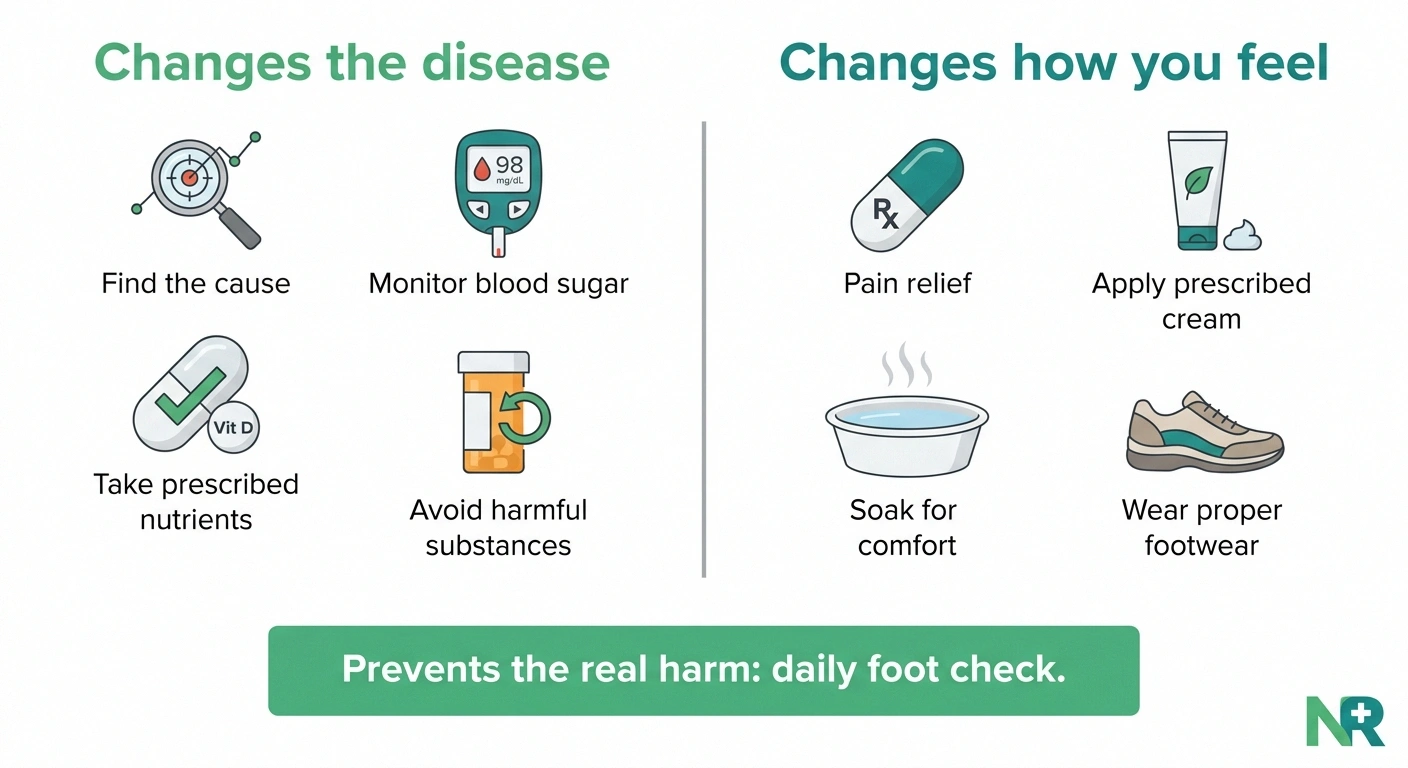
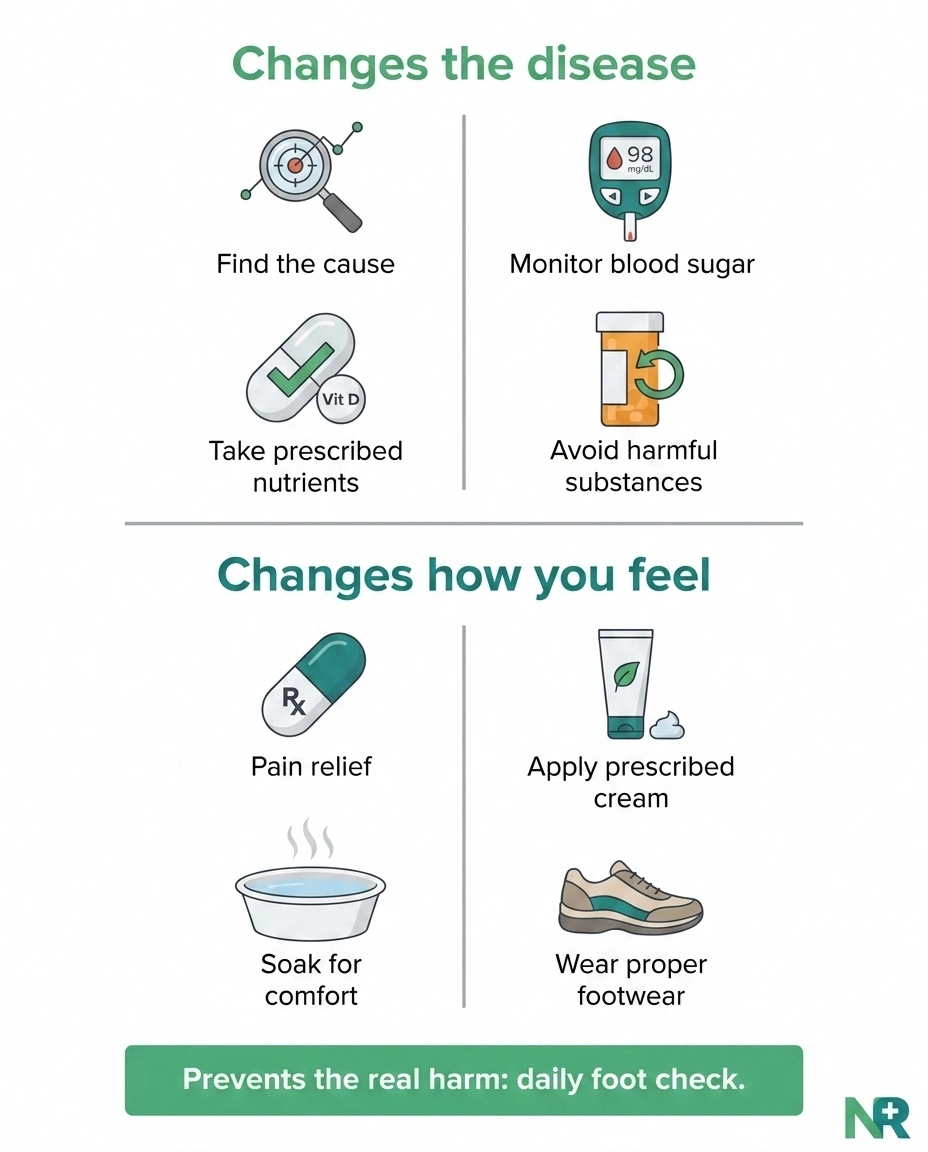
Changes the disease
- Treating the underlying cause
- Glucose control (strongest in type 1)
- Correcting a documented deficiency
- Removing a neurotoxic medication
- Stopping alcohol
Changes how you feel
- Gabapentin, pregabalin, duloxetine
- Topical creams and patches
- Foot soaks and massage
- Better footwear
- Most supplements
Prevents the real harm
- Daily foot inspection
- Properly fitted footwear
- Balance and strength work
- Home fall-proofing
All three piles are worth your time. They just answer different questions, and mixing up the scorecards is how people quit something that was working.
Most supplements have not been shown to slow progression. Some have reasonable symptom evidence — alpha-lipoic acid has the best-studied case for symptom improvement in diabetic neuropathy, and there are others with plausible mechanisms. But “may reduce burning” and “preserves nerve fibers over years” are different claims, and the marketing routinely swaps one for the other.
Pain medications do not protect nerves. Gabapentin, pregabalin, duloxetine, and topical agents change signaling. They are valuable. They are not disease-modifying, and taking them is not a substitute for addressing the cause.
Anything sold with the word “reverse” and a countdown timer deserves your skepticism. Whether neuropathy can be reversed has a real answer, and the real answer is nuanced and cause-dependent — not a package deal.
None of this means don't try things. It means keep a clear head about which pile each thing belongs in, so you can judge it by the right standard.
How Fast Does Neuropathy Usually Progress?
This varies enormously by cause, and averages will mislead you. But some general patterns hold.
Most length-dependent neuropathies — the common stocking-glove kind — progress slowly, over years, not months. Numbness that started in the toes may take several years to reach mid-calf. That slow pace is genuinely good news and it is the most common trajectory.
Faster progression, or an unusual pattern, is a signal rather than a verdict. Weakness developing over days to weeks, symptoms that are markedly asymmetric, involvement that starts in the hands before the feet, or rapid ascent up the legs — these patterns suggest a different underlying process than ordinary length-dependent neuropathy, and some of those processes are treatable and time-sensitive.
Our overview of the stages of neuropathy lays out the typical course in more detail, which helps calibrate whether what you are experiencing is the expected slow creep or something worth flagging.
Tracking Whether It's Actually Getting Worse

Memory is a terrible instrument for this. Pain is state-dependent, so a bad week reads as deterioration and a good week reads as improvement, and neither is reliable.
What works better is a small number of stable, objective markers checked at intervals:
- The numbness line. Once a month, note where the loss of normal sensation ends — mid-foot, ankle, mid-calf. Use the same landmark each time. This is the clearest single indicator of length-dependent progression.
- Function, not feeling. Can you still feel a coin in your pocket? Fasten a button in the dark? Feel the pedal? Function changes are more meaningful than pain scores.
- Balance. How long can you stand on one foot near a counter? Track the number.
- Falls and near-falls. Count them. This is the number your doctor will care most about.
Check monthly, not daily. Daily tracking measures the weather; monthly tracking measures the climate.
When to Call Your Doctor Rather Than Wait
Slow change gets discussed at your next appointment. These do not wait:
- New or worsening weakness, especially over days to weeks
- Symptoms climbing rapidly up the legs, or jumping to the hands
- Markedly one-sided symptoms
- Any foot wound, ulcer, redness, warmth or swelling — same-day call
- New bladder or bowel changes, or band-like tightness around the torso
- Difficulty breathing, swallowing or speaking
- A fall with injury, or repeated near-falls
None of these mean something catastrophic is happening. They mean the pattern changed, and changed patterns deserve fresh eyes rather than a wait-and-see.
- New or worsening weakness, especially if it is developing over days to weeks
- Symptoms climbing rapidly up the legs, or moving from feet to hands quickly
- Markedly one-sided symptoms, or symptoms in a single nerve pattern
- Any wound, ulcer, redness, warmth, or swelling on the foot — same-day call
- New bladder or bowel changes, or a band-like tightness around the torso
- Difficulty breathing, swallowing, or speaking
- A fall that resulted in injury, or repeated near-falls
None of these mean something catastrophic is happening. They mean the pattern has changed, and changed patterns deserve fresh eyes rather than a wait-and-see.
Building Your Own Short List
Eight levers is too many to act on at once, and most of them do not apply to any one person. Here is how I would narrow it.
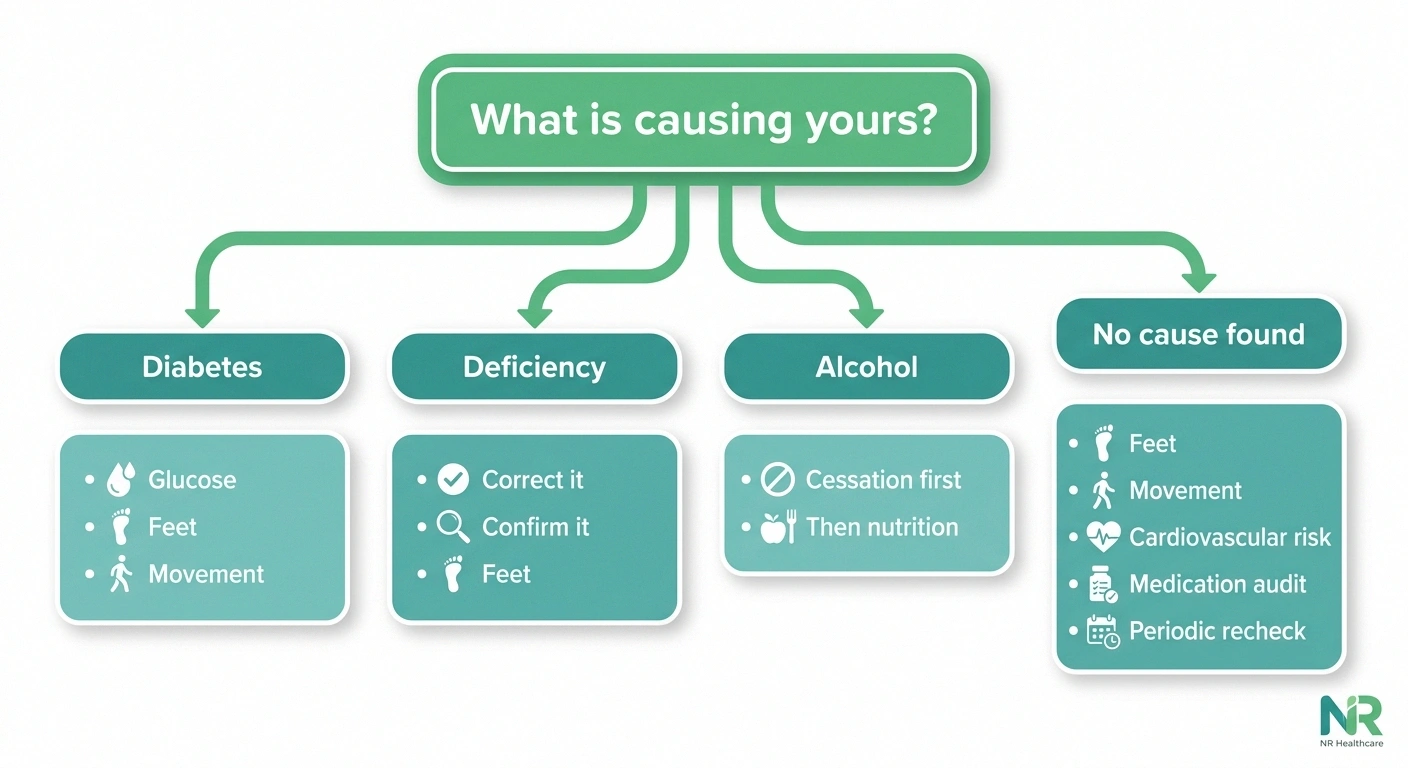
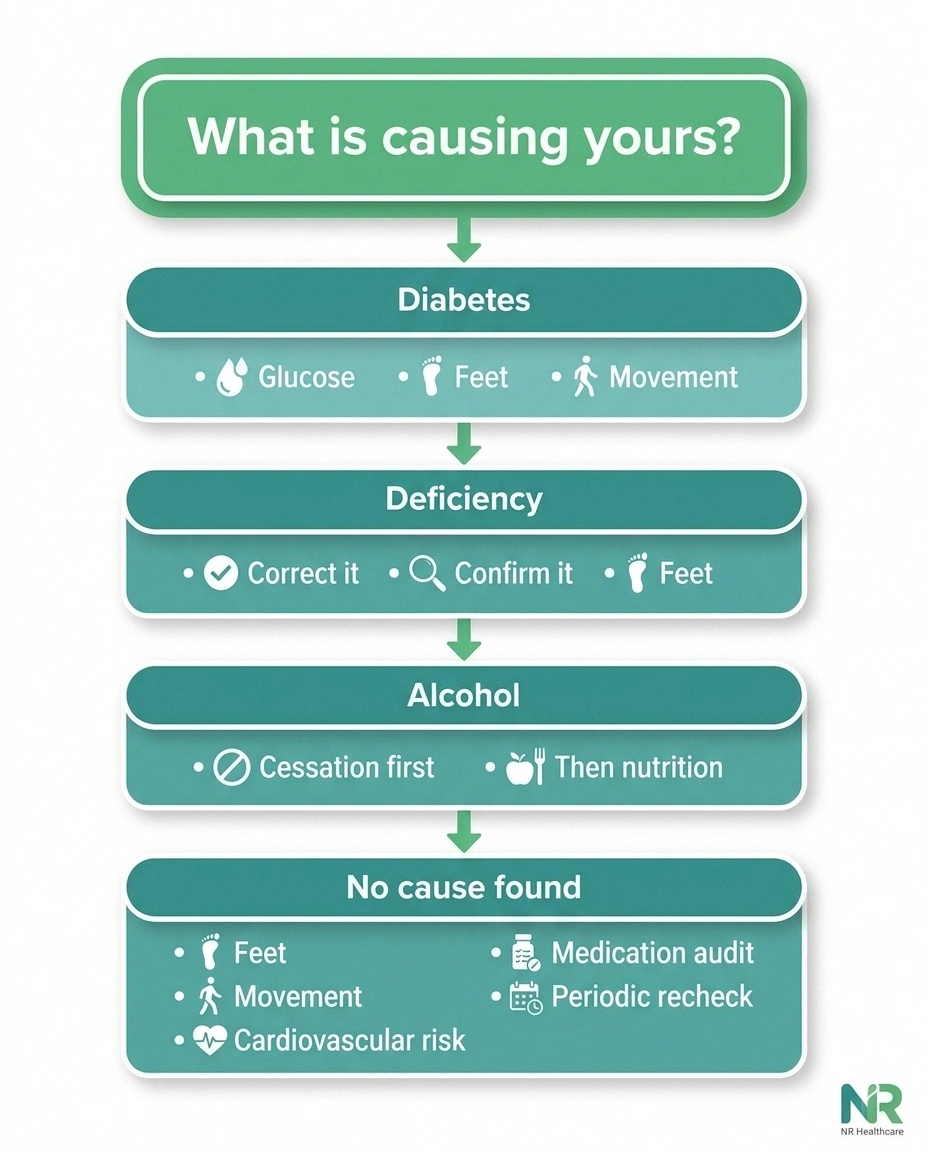
Start by identifying your cause, or confirming that a real search has been done. Then pick the two or three levers that map directly onto that cause. If you have diabetes: glucose, feet, movement. If you have a B12 deficiency: correct it, confirm the correction, then feet and movement. If alcohol is in the picture: that is your first lever and the others come after. If you are idiopathic: feet, movement, cardiovascular risk factors, medication audit, and a periodic recheck for causes that sometimes surface later.
Then give it time. Nerve fibers change over months and years, not weeks. Judging a disease-modifying effort by six weeks of symptoms is the most common way people abandon something that was working.
What I've Come to Believe About the Question
Is it going to keep getting worse? For most people, the honest answer is: probably somewhat, slowly, and considerably less than you fear if you address the cause and stay ahead of the complications.
Peripheral nerves have limited capacity to regenerate, which is why the realistic goal for many of us is to arrest rather than reverse. I know that sounds like a downgrade. It stopped sounding like one to me when I did the math: the woman who stabilizes at mild numbness in her toes and the woman who progresses to mid-calf numbness with balance loss and a foot ulcer are living genuinely different lives, and a meaningful part of the gap between those two outcomes is made up of the boring, unglamorous things on this page.
Not all of it. Some of this is luck and biology and things nobody chose. But enough of it is yours to influence that it is worth taking seriously — and taking seriously mostly means doing a small number of dull things consistently, for a long time, without dramatic feedback telling you it is working.
That is a hard ask. It is also, as far as I can tell, the actual answer.
Frequently Asked Questions
Can neuropathy be stopped from getting worse?
In many cases progression can be substantially slowed, and in some cases stopped, but it depends heavily on the cause. Neuropathy from a correctable driver such as a vitamin B12 deficiency, alcohol use, or a neurotoxic medication often stabilizes once that driver is removed. Neuropathy from diabetes typically slows with good metabolic control, most convincingly in type 1 diabetes. Idiopathic neuropathy, where no cause is found, usually progresses slowly, and management focuses on preventing complications and preserving function. The realistic goal for most people is to arrest progression rather than reverse existing damage, because peripheral nerves have a limited capacity to regenerate.
How fast does peripheral neuropathy usually progress?
Most common length-dependent neuropathies progress slowly, over years rather than months. Numbness that begins in the toes may take several years to reach the mid-calf. Rapid progression over days to weeks, weakness developing quickly, markedly one-sided symptoms, or symptoms starting in the hands before the feet are all patterns that suggest a different underlying process and should be evaluated promptly rather than assumed to be ordinary progression.
What makes neuropathy get worse faster?
The main accelerators are ongoing exposure to whatever is causing the damage. That includes persistently high blood sugar, continued alcohol use, an uncorrected nutritional deficiency, and continuing to take a medication known to be neurotoxic. Smoking and uncontrolled blood pressure damage the small blood vessels that supply nerves. Untreated foot injuries do not accelerate nerve damage itself but cause the serious complications, such as ulcers and infections, that do the most harm.
Does tight blood sugar control really stop diabetic neuropathy?
The evidence differs sharply between the two types of diabetes. In type 1 diabetes, intensive glucose control reduced the risk of developing neuropathy by roughly 60 percent in the landmark Diabetes Control and Complications Trial, and follow-up showed the benefit persisted more than a decade later. In type 2 diabetes, multiple trials and reviews have found that intensifying glucose control does not produce the same clear reduction in neuropathy, and nerve measures generally do not improve unless glucose approaches normal levels. Glucose control remains important for eyes, kidneys, heart, and circulation regardless, but the neuropathy-specific benefit in type 2 is less certain than commonly stated.
What is the single most important thing I can do?
Identify and treat the underlying cause, if one can be found. Every other intervention is secondary to removing the ongoing source of nerve damage. If you do not have a confirmed cause, obtaining a thorough workup is the highest-value next step, ahead of any supplement or device. If your cause is known and being addressed, the highest-return daily habit is a foot inspection, because unfelt injuries cause more serious harm than progression itself does in any given year.
Do supplements slow neuropathy progression?
Most supplements have not been shown to slow the progression of nerve damage. Some, such as alpha-lipoic acid, have reasonable evidence for reducing symptoms in diabetic neuropathy, but symptom relief and disease modification are different claims that marketing frequently blurs. Correcting a documented deficiency, such as vitamin B12 or thiamine, is genuinely disease-modifying. Taking vitamins you are not deficient in has not been shown to protect nerves, and in the case of vitamin B6, chronic high doses are themselves a known cause of nerve damage. Discuss any supplement with your doctor, especially if you take prescription medications.
Does exercise stop neuropathy from progressing?
Exercise has clear, well-documented benefits for glucose control, circulation, muscle preservation, balance, fall prevention, mood, and sleep. Whether it directly preserves nerve fibers is supported by some studies in diabetic neuropathy but is not yet firmly established. It is a strongly reasonable recommendation on the strength of its other benefits alone, particularly fall prevention. If you have reduced sensation in your feet, choose activities that limit repetitive impact on insensate feet, inspect your feet after every session, and wear properly fitted footwear.
How do I tell whether my neuropathy is actually getting worse?
Track a small number of stable markers monthly rather than judging by daily pain, which fluctuates too much to be informative. Note where the boundary of reduced sensation sits using the same landmark each time, such as mid-foot, ankle, or mid-calf. Track specific functions like feeling a coin in your pocket or fastening a button without looking. Time how long you can balance on one foot near a counter. Count falls and near-falls. Function and boundary changes over months are far more meaningful than pain scores, and they give your doctor something concrete to work with.
About the Author