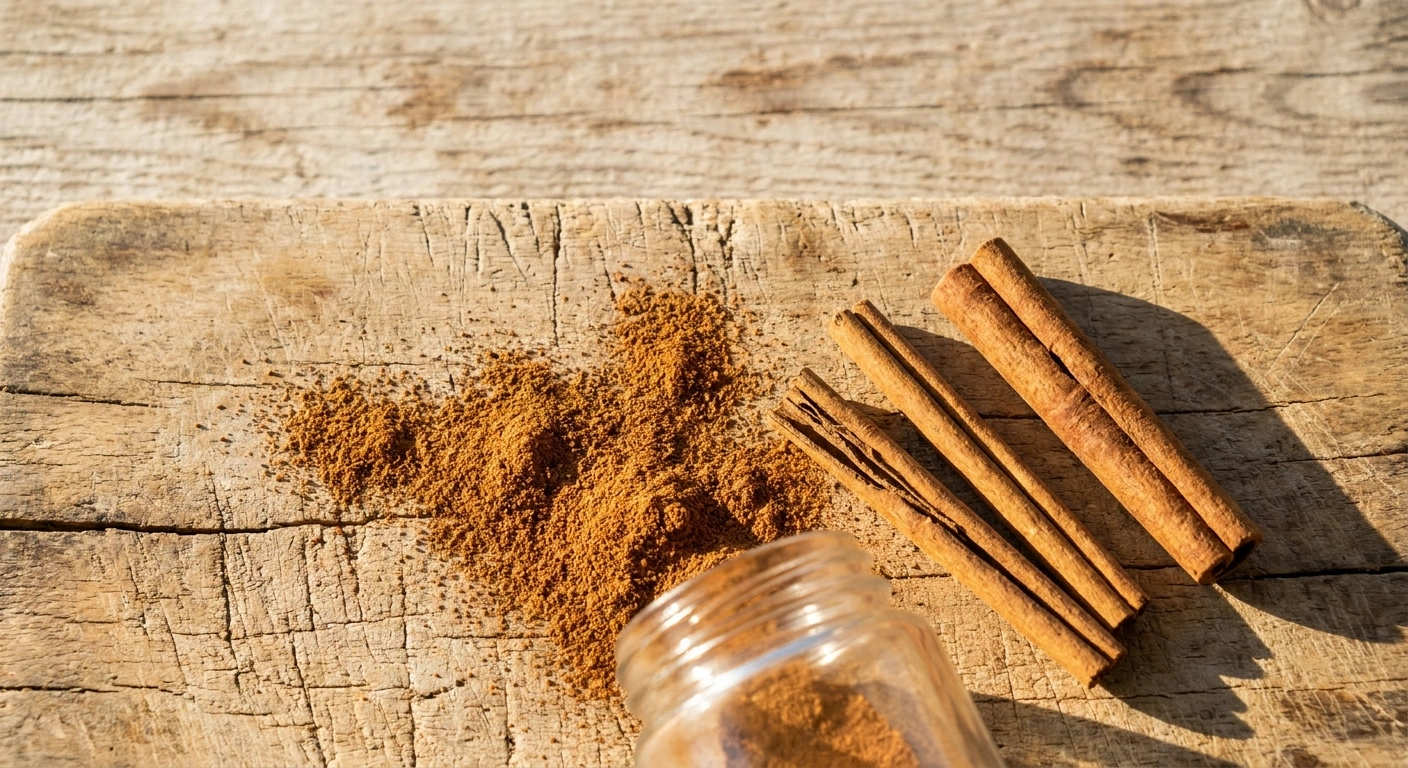
Cinnamon is the cheapest thing anyone will ever recommend to you for nerve damage. It costs about four dollars, it is already in the cupboard, and nobody has to prescribe it.
That is most of why the question keeps coming up. The rest is a chain of reasoning that sounds airtight when you say it out loud: cinnamon lowers blood sugar, high blood sugar damages nerves, therefore cinnamon protects nerves.
Each link in that chain is worth pulling on separately, because one of them is much weaker than the other two, and there is a fourth issue underneath all of it that almost nobody discusses. It has nothing to do with whether cinnamon works. It has to do with which cinnamon you bought.
What Cinnamon Actually Does to Blood Sugar
Start with the link that has the most research behind it, because it is also the one people overstate.
A 2019 systematic review looking at people with type 2 diabetes and prediabetes found that cinnamon significantly reduced fasting blood sugar and insulin resistance compared with placebo. One randomized controlled trial in 109 people with poorly controlled type 2 diabetes reported an average drop in HbA1c of 0.83 percent, which lands in the same range as some prescription medications. Those are real numbers from real trials.
Then there is the Cochrane review, which pooled the available trials and concluded that the evidence is insufficient to support cinnamon for type 1 or type 2 diabetes. Fasting glucose results were inconclusive. No statistically significant difference appeared in HbA1c, serum insulin, or post-meal glucose between cinnamon and control groups.
Both of those summaries are honest. They disagree because the underlying trials disagree with each other, and they disagree because the trials used different species of cinnamon, different doses, different durations, and different starting populations. When a body of evidence is that scattered, the pooled answer depends heavily on which studies you let in.
One pattern is worth pulling out of the mess, because it predicts who tends to respond. The trials reporting the largest effects were generally the ones enrolling people whose blood sugar was furthest from target to begin with. The trials in people already well controlled tend to show close to nothing. That is the shape you see with a lot of mild glucose-lowering interventions, and it means the person most likely to notice anything from cinnamon is the person whose numbers are bad enough that cinnamon is nowhere near the most important thing they should be doing.
The practical translation is this. Cinnamon probably does something to blood sugar in some people. That something is small, inconsistent, and nowhere near the size of the effect you get from the boring interventions: medication adherence, carbohydrate load, sleep, and movement after meals. If your overall eating pattern is not settled, cinnamon is not the variable to change first.
The Gap Nobody Names
Here is the sentence that should appear on every page about this topic and appears on almost none of them.
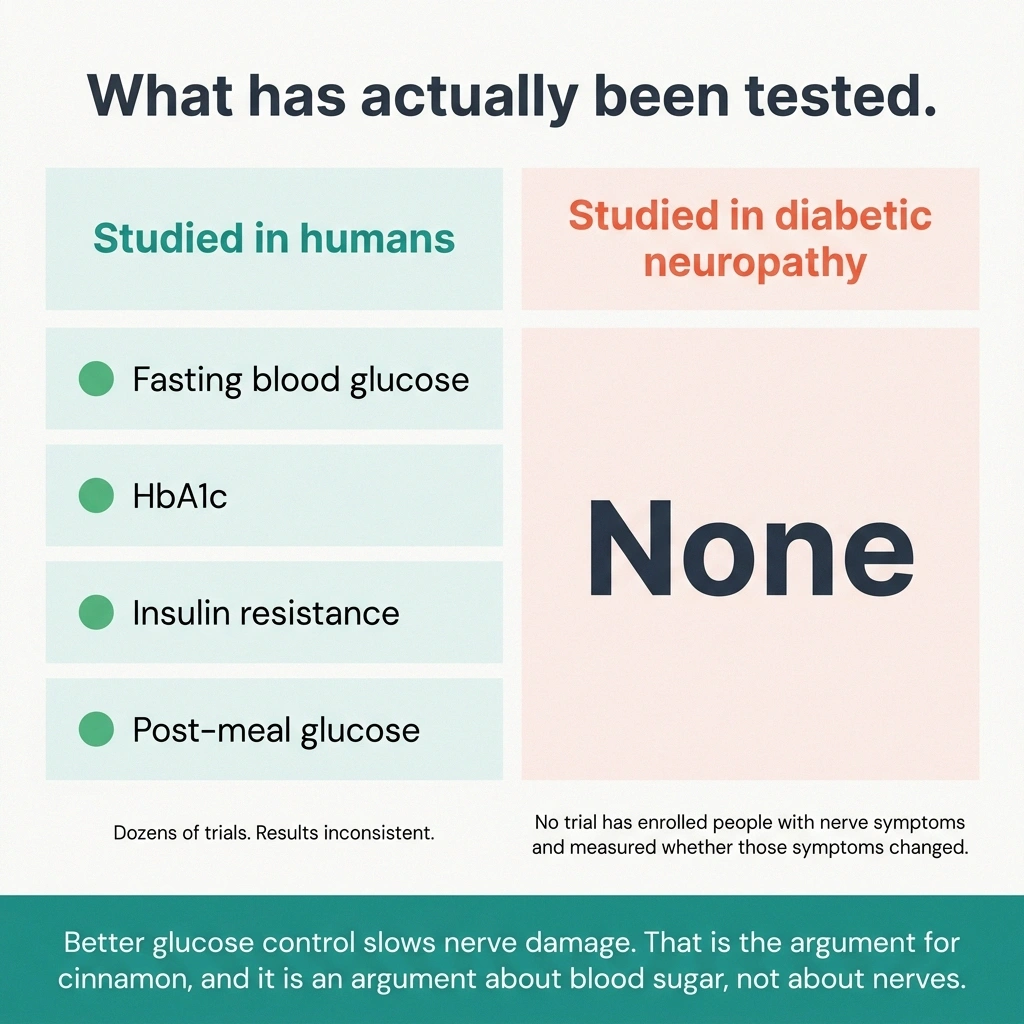
There are no human trials of cinnamon in diabetic peripheral neuropathy.
Not weak ones. Not small ones. None. Search the literature for cinnamon studies and you will find dozens of papers on glucose, insulin sensitivity, lipids, and inflammatory markers. Search for a trial that enrolled people with nerve symptoms, gave half of them cinnamon, and measured whether their feet felt any different afterward, and the result set is empty.
This matters more than it sounds, because the second link in the chain is not automatic either. Better glucose control slows nerve damage. That is well established and it is the entire reason blood sugar management sits at the center of every serious neuropathy plan. But slowing damage and relieving existing symptoms are different outcomes on different timelines, and a supplement that produces a modest, inconsistent glycemic effect over twelve weeks is being asked to do something the underlying evidence never tested.
Compare that with alpha-lipoic acid, which has multiple randomized trials that enrolled people with diabetic neuropathy specifically and measured symptom scores as the primary outcome. You can argue about how impressive those results are. You cannot argue that the trials exist, because they do. That is the difference between an option with direct evidence and an option with adjacent evidence.
The Rat Studies, and What They Can Fairly Claim

The animal work is where the neuropathy claims actually come from, so it deserves a fair reading rather than a dismissal.
A quick way to grade any animal study you see cited
You do not need to read the paper. Three questions tell you how far the result travels, and you can answer them from the abstract in under a minute.
- Which tissue? The most-cited cinnamon nerve study looked at hippocampal tissue, which is brain. Diabetic neuropathy happens in the longest nerves in the body, running to your feet. Same disease, different failure.
- What dose, scaled to a person? Rodent studies routinely use amounts that translate to many grams a day in a human. If the abstract does not say, assume it was high.
- Prevention or repair? Almost every positive animal result is a prevention study, with the compound given before or alongside the injury. Repairing existing damage is the harder question and it is the one you are actually asking.
Question three alone disqualifies most supplement claims. It is worth running on the next three things you read about.
Diabetic rats given cinnamon showed reduced inflammatory markers and less degenerative structural change in nerve tissue compared with untreated diabetic rats. The mechanism proposed is plausible: cinnamon contains polyphenols with genuine antioxidant activity, oxidative stress is one of the pathways through which high glucose injures nerves, and reducing that stress in a rat produced measurable tissue-level differences.
Three things constrain how far that travels.
The most-cited work of this kind looked at hippocampal tissue. The hippocampus is in the brain. Diabetic peripheral neuropathy happens in the longest nerves in the body, the ones running to your feet, and those nerves fail for reasons that overlap with but do not equal what happens centrally.
The rodent doses, scaled to a human, tend to land well above what anyone would eat or take in a capsule. This is normal in animal pharmacology and it is also the reason animal results so rarely survive translation.
And these were prevention studies. The cinnamon went in alongside or before the injury. Almost nobody tests whether a compound repairs damage that already exists, which is the thing a person with numb feet actually wants to know.
Cassia or Ceylon: the Fork That Decides Most of This
Now the part that changes the answer for a large number of readers, and it is not about efficacy at all.
The word cinnamon covers several different plants. Two matter here.
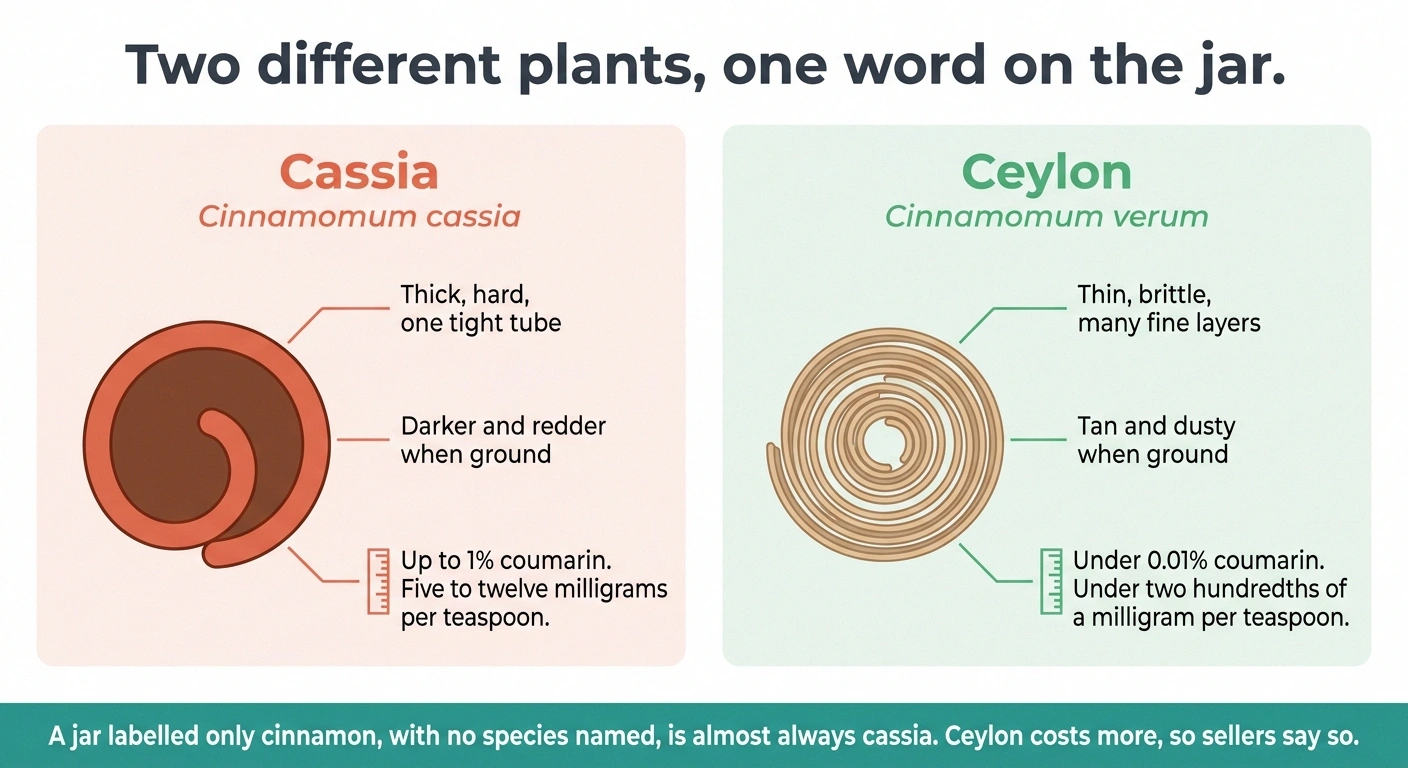
Cassia (Cinnamomum cassia) is what is in the supermarket jar, in cinnamon rolls, in most of the cheap capsules, and in nearly all of the clinical trials. Ceylon (Cinnamomum verum), sometimes sold as true cinnamon, is lighter in colour, milder, more expensive, and comes mainly from Sri Lanka.
The difference that matters is a compound called coumarin. Cassia carries up to about one percent coumarin by weight. Ceylon carries under 0.01 percent. In kitchen terms, a teaspoon of cassia holds somewhere between five and twelve milligrams of coumarin, and a teaspoon of Ceylon holds under two hundredths of a milligram.
Telling them apart without a label is easier than people expect. Cassia sticks are thick, hard, and roll into a single tight tube like a scroll. Ceylon sticks are thin, brittle enough to crumble in your fingers, and made of many fine layers rolled together like a cigar. Ground, cassia is darker and redder, Ceylon is tan and dusty. The smell is the giveaway once you have compared them side by side: cassia is hot and sharp, Ceylon is closer to sweet and floral. Most jars labeled simply cinnamon, with no species named anywhere on the packaging, are cassia. Ceylon costs more, so anyone selling it says so.
Coumarin is hepatotoxic at sufficient cumulative dose. The European Food Safety Authority sets a tolerable daily intake of 0.1 milligrams per kilogram of body weight, which works out to roughly seven milligrams a day for a 70 kilogram adult. Germany’s federal risk assessment body has noted that particularly sensitive individuals may show liver effects at comparatively small amounts. Case reports of coumarin-related liver injury from high cumulative cassia intake exist in the clinical literature.
Sprinkling cassia on oatmeal is not the concern. A quarter teaspoon in a bowl of porridge is a rounding error. The concern begins when somebody decides cinnamon is medicine and starts taking grams of it daily for months.
The Dose Problem Sitting in the Middle of This
Put the last two sections side by side and something uncomfortable falls out.
The same arithmetic, in teaspoons instead of milligrams
Coumarin limits are published in milligrams per kilogram of body weight, which is useless standing at a kitchen counter. Converted, using the EFSA figure of 0.1 mg per kg per day, here is roughly where the line falls for cassia.
| Body weight | Daily coumarin ceiling | Roughly, in cassia |
|---|---|---|
| 130 lb / 59 kg | 5.9 mg | Under one teaspoon |
| 155 lb / 70 kg | 7.0 mg | About one teaspoon |
| 200 lb / 91 kg | 9.1 mg | About one and a quarter teaspoons |
A teaspoon of cassia carries somewhere between five and twelve milligrams of coumarin, so the range overlaps the ceiling rather than sitting cleanly under it. With Ceylon the same teaspoon carries under two hundredths of a milligram, and the table stops mattering. This is a daily-for-months question, not a cinnamon-roll question.
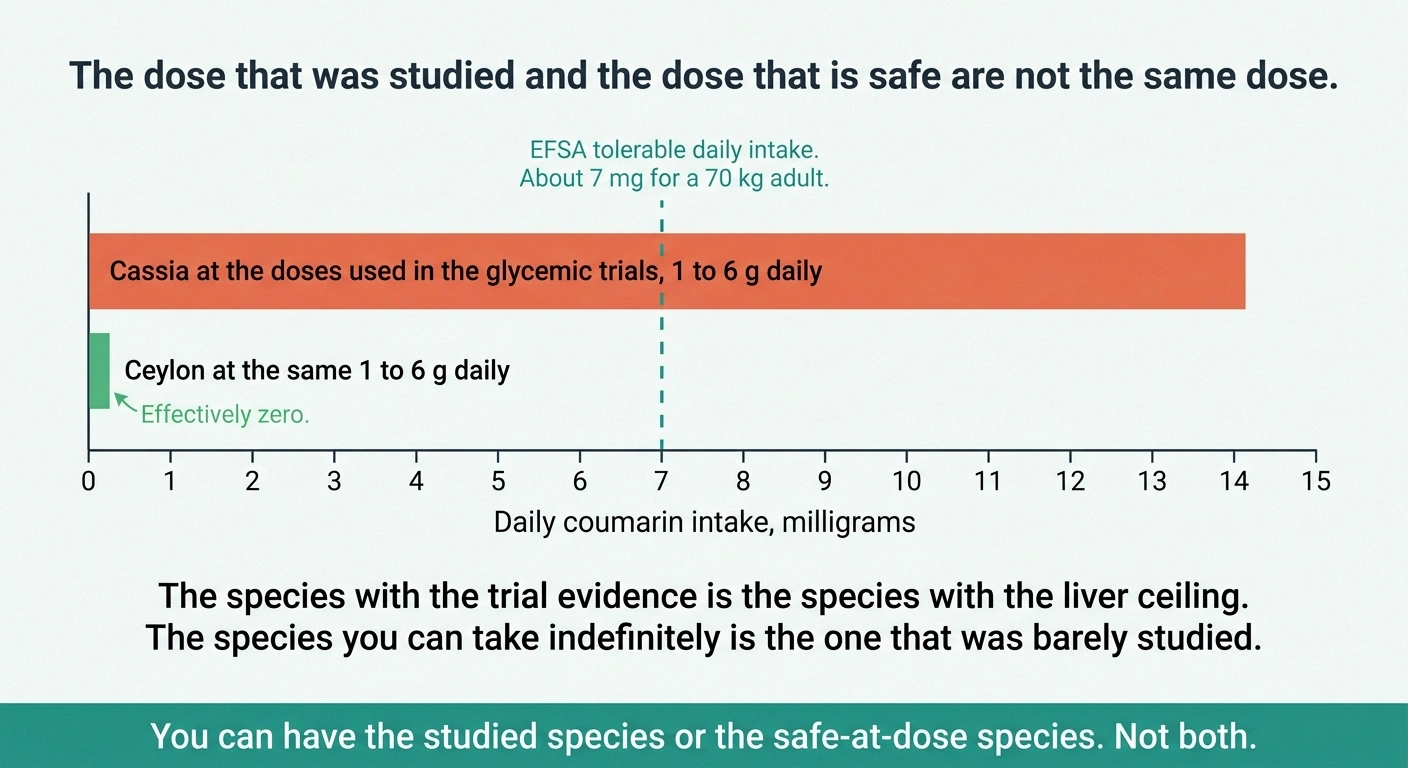
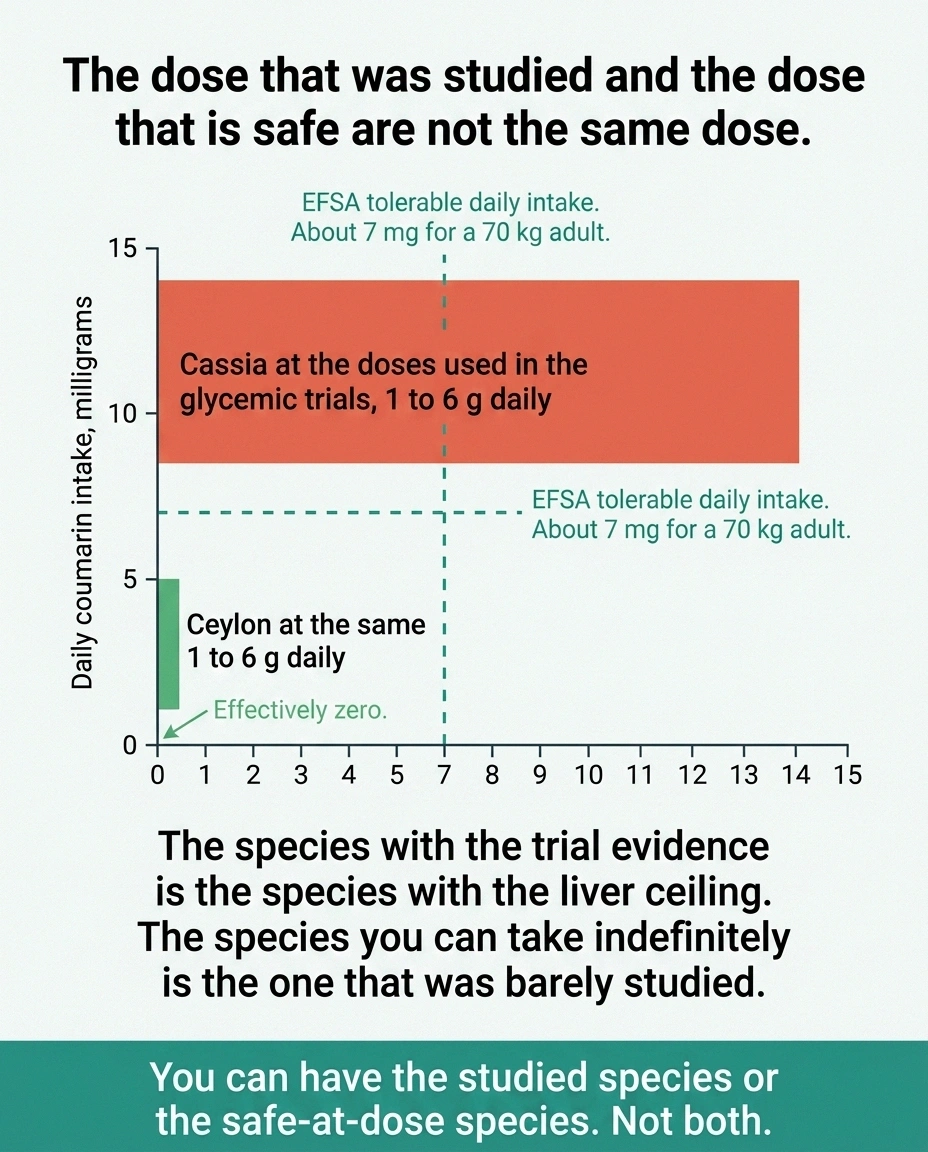
The trials that produced a glycemic signal mostly used cassia, at gram-level doses, typically in the range of one to six grams a day, sustained for weeks. At six grams a day of cassia for four weeks, total coumarin intake exceeds the EFSA tolerable daily intake. At the same dose of Ceylon, it does not come close.
So the species with the trial evidence behind it is the species with a liver ceiling. And the species you can take indefinitely without thinking about coumarin is the one that was barely studied.
You can have the studied species or the safe-at-dose species. Not both.
Most articles resolve this by recommending Ceylon, which is reasonable advice and quietly abandons the evidence base while sounding like it is honouring it. It is worth saying out loud rather than sliding past: choosing Ceylon means choosing a product that was mostly not the one in the studies. That may still be the right call. It is just not the free lunch it gets presented as.
Interactions Worth Naming Before the First Capsule

Cinnamon at culinary amounts interacts with nothing. Cinnamon at supplement doses has a short list worth knowing, and the list gets longer the more medication you take.
Who needs to watch their numbers more closely for the first fortnight
Additive glucose lowering matters more on some medications than others, because only some of them can drive you into a genuine low on their own.
Check more often
Insulin, sulfonylureas such as glipizide or glyburide, warfarin. These carry a real downside if something shifts and you do not notice.
Business as usual
Metformin alone, GLP-1 agonists alone, no diabetes medication at all. Additive in theory, rarely enough to produce a low by itself.
Two weeks is long enough to see a pattern and short enough that nobody abandons it. If nothing has moved by then, nothing is going to.
Glucose-lowering medication. If cinnamon has any glycemic effect at all, it is additive to metformin, sulfonylureas, insulin, and GLP-1 agonists. Sulfonylureas and insulin are the two that can drop you into a genuine low. Anyone on either who starts a daily cinnamon supplement should be checking more often than usual for the first couple of weeks, not less.
Warfarin and anticoagulants. Coumarin affects the drug-metabolizing enzymes CYP2D6 and CYP3A4. The theoretical concern is that interfering with warfarin’s metabolism leaves more drug in circulation than intended. Interaction databases currently list no confirmed clinical interaction, which is genuinely reassuring and is also not the same thing as ruling it out. If you are on warfarin, this belongs in the conversation before you start, not after an INR surprises somebody.
Blood pressure medication. Cinnamaldehyde has some blood-pressure-lowering activity, which is additive to whatever you are already taking.
Existing liver disease. Fatty liver is extremely common in type 2 diabetes. If your liver enzymes already run high, a compound with a documented hepatotoxic ceiling is a poor place to experiment.
Where This Sits Against Options With Nerve Evidence

The useful comparison is not cinnamon versus nothing. It is cinnamon versus the other things competing for the same shelf space and the same monthly budget.
Against the supplements with direct neuropathy trials, cinnamon comes last on evidence. Alpha-lipoic acid has symptom-score trials. B12 has a clear mechanism and a clear deficiency state that produces real nerve damage. Even turmeric, which is also mostly working from animal data, has been studied in more pain-relevant models.
Against the non-supplement levers, it is not close. Post-meal walking, sleep, and consistent medication timing move glucose more than any spice does, and they do it in every study rather than in some of them. If you have not read what the progression of nerve damage actually looks like over time, that context makes the priority order obvious in a way no supplement comparison can.
There is one situation where cinnamon earns its place without any of this argument, and it is worth naming because it gets lost in the supplement framing. If cinnamon on plain yogurt is what makes you eat plain yogurt instead of the flavoured kind with fourteen grams of added sugar, that swap is doing more for your nerves than any capsule in the aisle. The spice is not the active ingredient there. It is the thing that makes a better habit tolerable, and habits are what actually move glucose over years.
None of which makes cinnamon useless. It makes it a garnish on a plan, not the plan. The failure mode this article exists to prevent is the person who buys cinnamon capsules, feels they have addressed their neuropathy, and postpones the appointment where somebody would have found the actual driver. That is the window where reversible causes are still reversible, and it does not stay open forever.
A Sane Way to Try It Anyway
If you have read all of that and still want to run the experiment, there is a version of it that costs you nothing and teaches you something.
Write the stopping rule before day one, not at week eleven
A stopping rule decided in advance is the only thing that stops a supplement trial from turning into a permanent habit nobody ever evaluated. Fill in the blanks on paper, in pen, before the first dose.
- Start date and end date
- Twelve weeks apart. Put the end date in your phone now, because you will not remember in November what you started in August.
- The one number
- Average fasting glucose across the last two weeks, or time in range if you wear a monitor. Record your current baseline before you start or you have nothing to compare against.
- The threshold that counts as working
- Decide the size of change that would justify continuing, and write it down. Anything smaller than day-to-day variation is not a result.
- What you will stop if it works
- Shelf space and monthly spending are finite. If cinnamon earns a place, something else should be leaving.
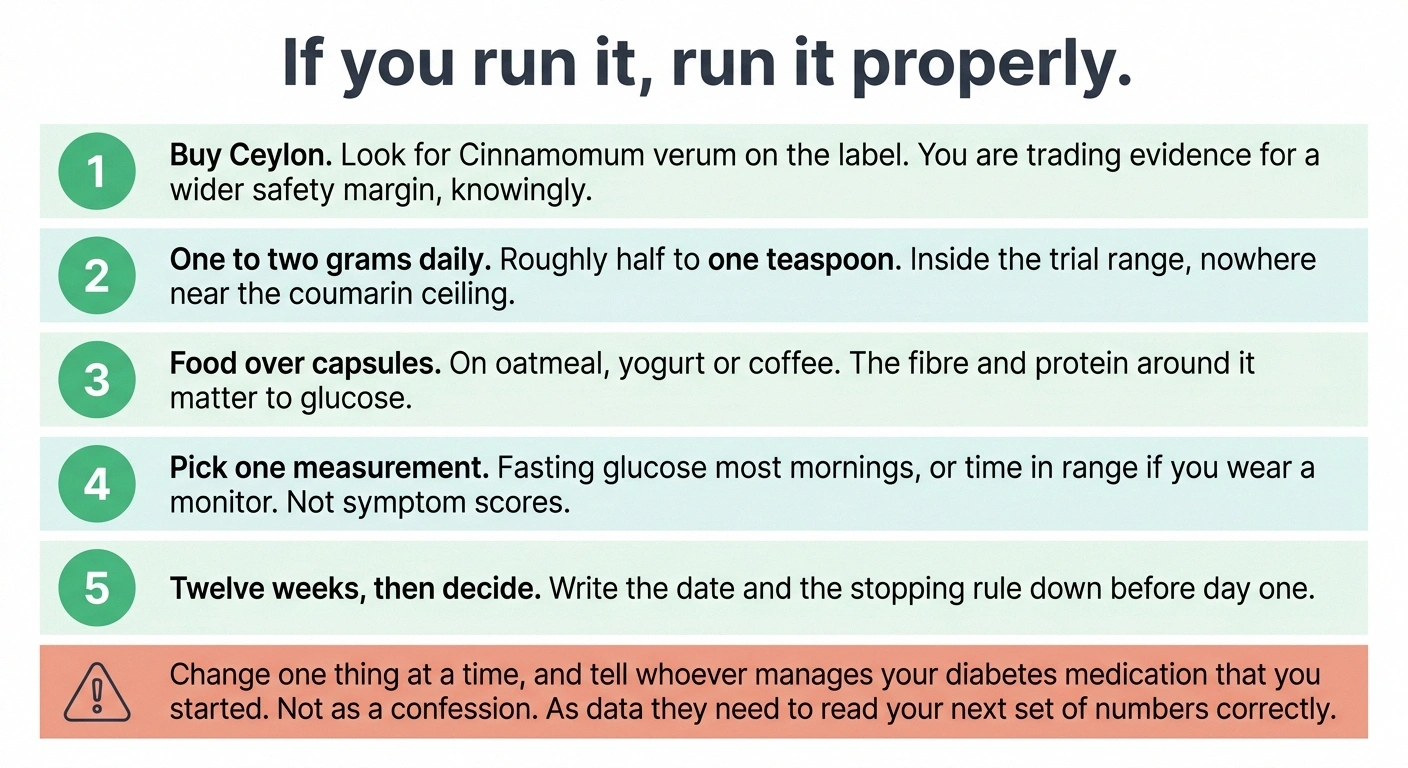
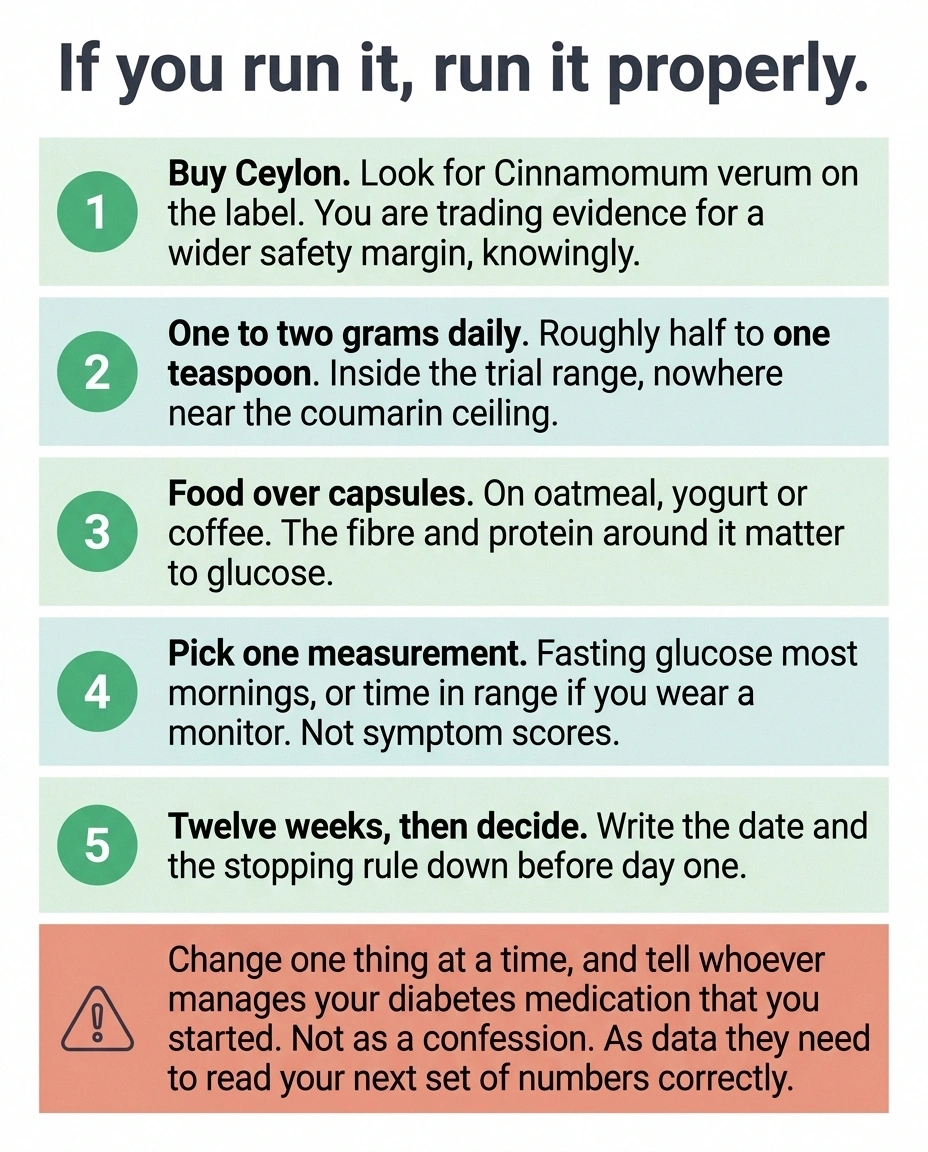
Buy Ceylon, labeled Cinnamomum verum. Accept that you are trading evidence for a wider safety margin and make that trade knowingly.
Keep the dose modest. One to two grams a day, roughly half to one teaspoon, is inside the range trials used and does not require you to think about coumarin at all with Ceylon.
Prefer food over capsules where you can. Cinnamon in oatmeal, yogurt, coffee, or on roasted vegetables gets you the compound alongside fibre and protein, which is a better context for glucose than a capsule swallowed on its own.
Write the stopping rule down before you start. Twelve weeks, one thing measured, and a decision at the end. Pick the measurement that cinnamon could plausibly move: fasting glucose most mornings, or time in range if you wear a monitor. Symptom scores are the wrong endpoint here, because nothing in the evidence base suggests cinnamon changes them and you will end up reading noise as signal.
Change one thing at a time. Starting cinnamon, magnesium, and a new eating pattern in the same week guarantees that whatever happens, you will not know what caused it.
And tell whoever manages your diabetes medication that you started, in the same sentence you would use for any other change. Not as a confession. As data they need to interpret your next set of numbers correctly.
Frequently Asked Questions
Does cinnamon help nerve pain?
There is no human trial testing cinnamon in people with nerve pain, so the honest answer is that nobody knows. The theory is indirect: cinnamon may modestly lower blood sugar, and better blood sugar control slows nerve damage over time. That is a reasonable mechanism for slowing progression, not a reason to expect burning or tingling to improve.
How much cinnamon per day is safe?
It depends entirely on the species. With Ceylon cinnamon, coumarin is negligible and a teaspoon or two daily raises no liver concern. With cassia, the common supermarket type, the European tolerable daily intake for coumarin works out to about seven milligrams for a 70 kilogram adult, which a single teaspoon can already exceed. Occasional cassia in cooking is fine. Daily gram-level cassia for months is where the concern starts.
Is Ceylon cinnamon better than regular cinnamon for diabetes?
Safer, yes. Better studied, no. Most trials showing glycemic effects used cassia. Ceylon has far less coumarin and is the sensible choice for daily long-term use, but choosing it means accepting that you are using a less-studied product for the safety margin.
Can cinnamon lower A1C?
Some trials say yes, including one reporting an average 0.83 percent reduction in people with poorly controlled type 2 diabetes. The Cochrane review pooling the evidence found no significant difference. Results are inconsistent enough that cinnamon should not be counted on as an A1C strategy.
Does cinnamon interact with metformin?
Not dangerously, but the effects are additive on blood sugar. The bigger caution applies to sulfonylureas and insulin, where an additional glucose-lowering agent can contribute to a genuine low. Check your levels more often for the first two weeks after starting.
Can too much cinnamon damage your liver?
High cumulative doses of cassia can, because of coumarin. Case reports of liver injury exist, and Germany’s risk assessment body notes that sensitive individuals may react at relatively small amounts. This is a supplement-dose issue, not a cooking issue, and it does not apply to Ceylon in any realistic quantity.
Should I take cinnamon instead of my diabetes medication?
No. Nothing in the evidence supports substituting a spice for a medication, and stopping a glucose-lowering drug is the fastest available route to worse nerve damage.
How do I tell whether the jar in my cupboard is cassia or Ceylon?
If the label says only cinnamon with no species named, it is almost certainly cassia. Ceylon costs more, so sellers label it. In stick form, cassia is thick and hard and rolls as one tight tube, while Ceylon is thin, brittle, and made of many fine layers. Ground, cassia is darker and redder with a hot sharp smell, Ceylon is tan with a sweeter, more floral one.
Does cinnamon tea count, or does it have to be the powder?
Tea made from sticks extracts far less of everything, including both the polyphenols and the coumarin. That makes it pleasant and essentially free of liver concern, and also makes it an unlikely route to any glycemic effect. If you enjoy it, drink it. Do not count it as the intervention.
What should I take instead if I want something with actual nerve evidence?
Alpha-lipoic acid has the most direct trial evidence in diabetic neuropathy, with studies that enrolled people with nerve symptoms and measured those symptoms. B12 matters if you are deficient, which is common on long-term metformin. Both are worth understanding before adding anything else to the shelf.
About the Author