
Half the medicine cabinets in America already contain a bottle of this. It was bought for memory, usually around the time somebody’s mother started repeating stories, and it has been sitting behind the vitamin C ever since.
Which is how ginkgo ends up in neuropathy conversations. Not because anyone read a study, but because the bottle is already there, the word “circulation” is on it somewhere, and cold, numb feet sound like a circulation problem.
That reasoning is not unreasonable. It is also worth checking, because ginkgo has one genuinely relevant human trial in diabetic neuropathy that almost nobody has read, and it has an interaction profile that decides the question for a lot of people before efficacy ever comes up.
The Code Number on the Label Is the Important Part
Nearly all serious ginkgo research uses one preparation, and it has a name that looks like a catalog number: EGb 761.
That is a standardized leaf extract, defined as roughly 24 percent flavone glycosides and 6 percent terpene lactones. Those two families do different jobs. The flavone glycosides are antioxidants. The terpene lactones include ginkgolide B, which blocks a signalling molecule called platelet-activating factor, and that single fact is responsible for both the circulation benefits and the bleeding concerns discussed later on this page.
Two things follow from this that affect what you buy.
First, leaves and seeds are completely different. Ginkgo seeds, sold in some Asian groceries and eaten roasted, contain a compound the leaf extract barely has, and it causes problems covered further down. Supplements should be leaf extract. If a label does not say leaf, put it back.
Second, a bottle that says only “Ginkgo Biloba 120 mg” without a standardization figure is telling you the weight of the powder, not the content of the active compounds. Look for the 24 percent and 6 percent figures on the panel. They appear on most reputable products and their absence is informative.
It is worth knowing where the rest of the ginkgo research sits, because it shapes what people expect. The largest body of work is on memory and cognition, where results have been genuinely disappointing in the big trials. There is a smaller and more respectable evidence base in intermittent claudication, the cramping leg pain on walking that comes from narrowed arteries, and a scattering of work on tinnitus. None of that is nerve research, and none of it transfers automatically to your feet.
The One Human Neuropathy Trial, Read Closely
Search this topic and you will find dozens of pages asserting that ginkgo helps nerve damage. Follow the citations and they lead to rat studies, or to cognitive research, or to nothing at all.
There is one directly relevant human trial, published in the Korean journal Diabetes & Metabolism Journal, and it deserves a careful read rather than a summary.
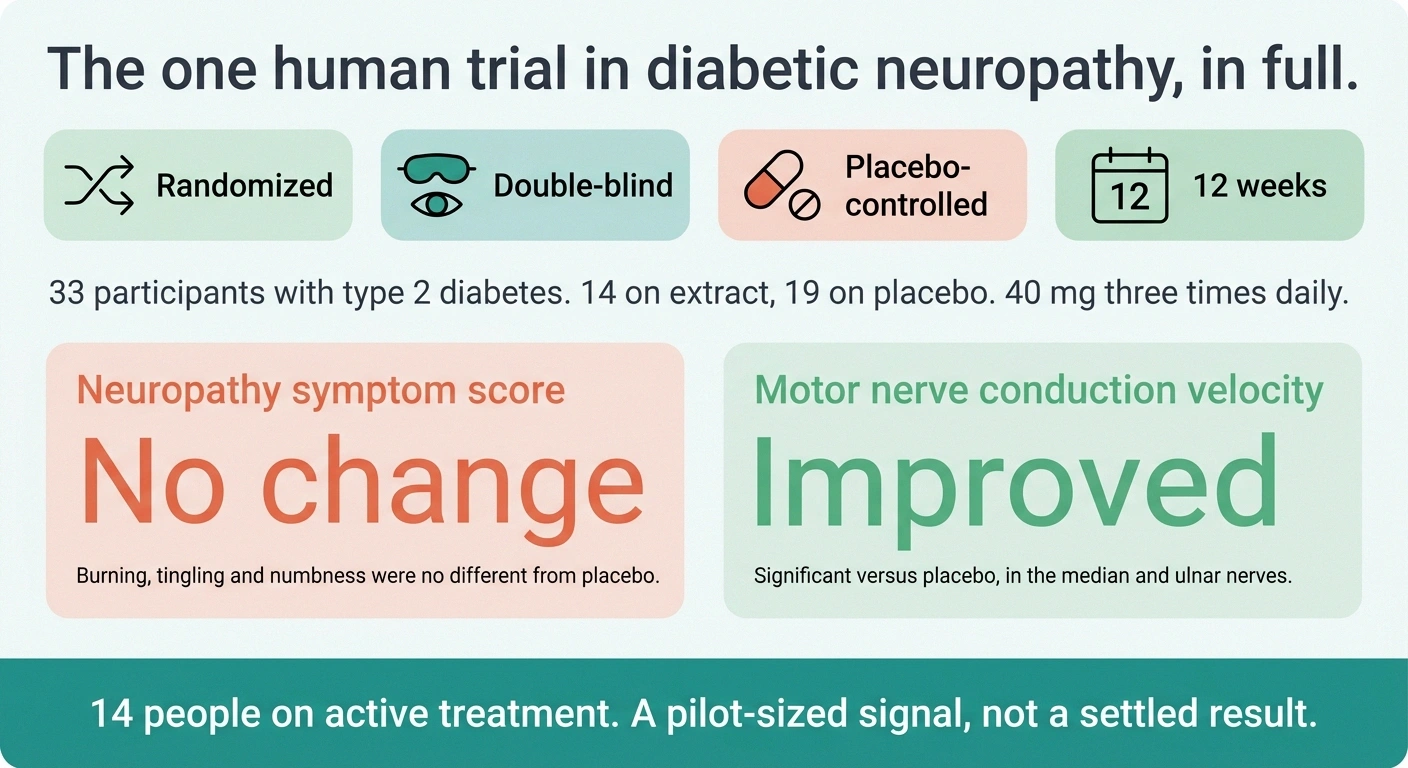
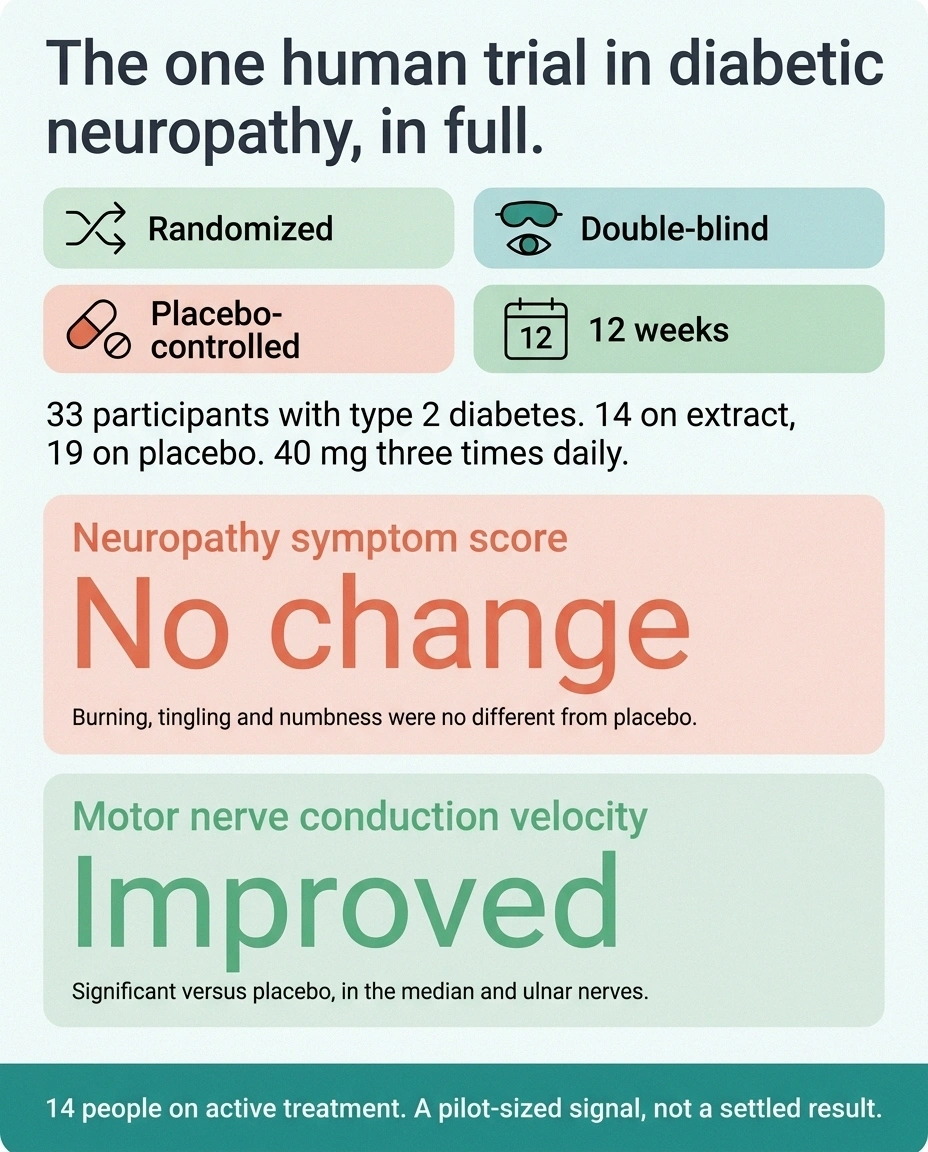
The design was sound in shape: randomized, double-blind, placebo-controlled, 12 weeks, 40 milligrams three times daily for a total of 120 milligrams a day. The group was small, 33 people with type 2 diabetes, split 14 on extract and 19 on placebo.
Two results came out, and they point in different directions.
Symptom scores did not change. The burning, the tingling, the numbness, measured on a neuropathy symptom score, were no different between the ginkgo group and the placebo group after 12 weeks.
Motor nerve conduction velocity improved. Specifically in the median and ulnar nerves, significantly compared with placebo. No serious adverse effects were reported.
A finding like that is genuinely interesting. An objective electrical measurement moved while the subjective experience did not, which is the opposite of the usual supplement pattern where people feel better and nothing measurable changes. It suggests something real happened at the nerve, just not something the person noticed.
It is also 14 people on active treatment. That is a pilot-sized group, and pilot-sized groups produce findings that vanish on replication about as often as they hold up.
The Detail in That Trial Nobody Mentions
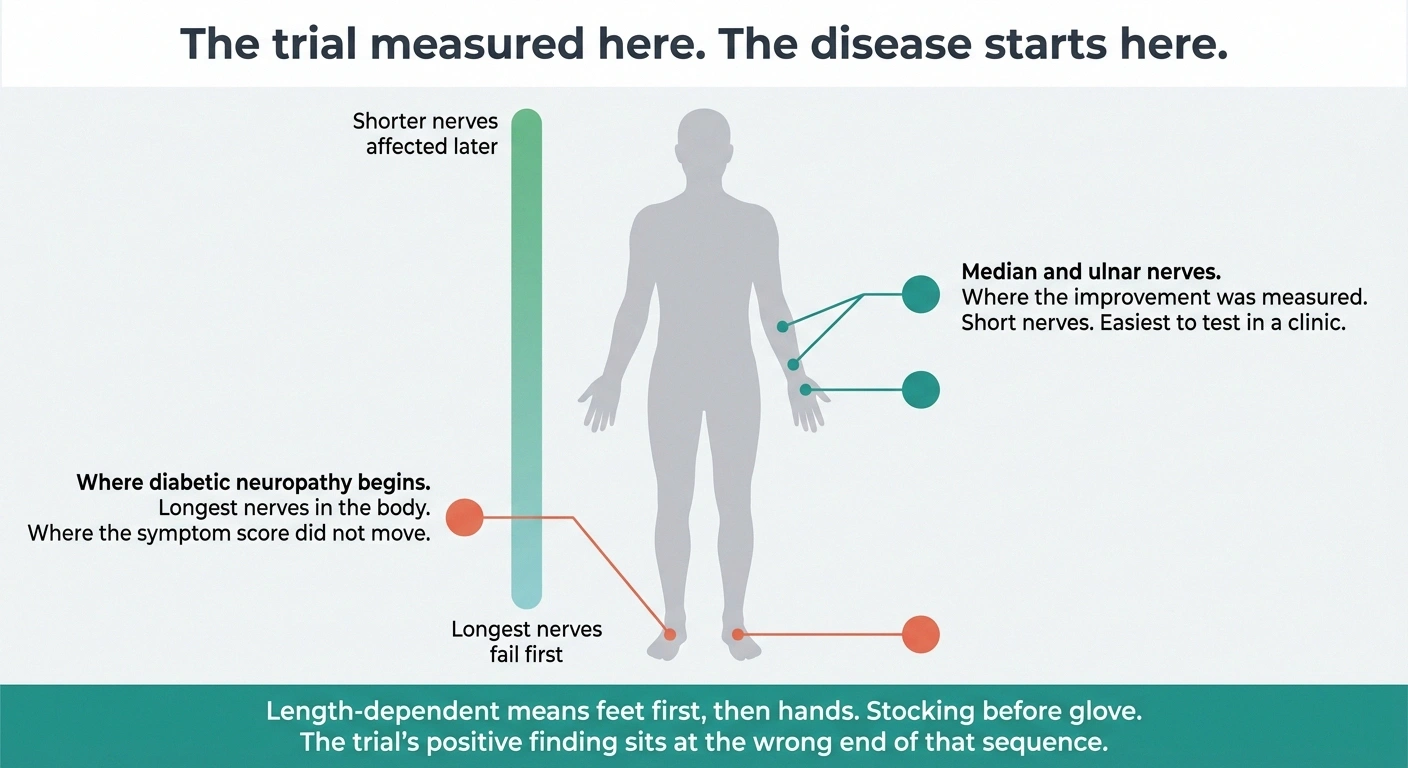
Look at which nerves improved. Median and ulnar.
Those are arm nerves. The median nerve runs to your thumb and first two fingers. The ulnar runs to your little finger.
Diabetic polyneuropathy is length-dependent, which means it damages the longest nerves first, which means it starts in the feet and works upward. That is why the classic pattern is stocking-then-glove rather than the reverse, and it is one of the most reliable features of the condition.
So a study of diabetic neuropathy reported improvement in two nerves that are not where the disease starts, are not where most participants’ worst symptoms live, and are the most technically convenient nerves to test in a clinic. Meanwhile the symptom scores, which reflect the feet, did not move.
This does not mean the finding is worthless. Arm nerves are affected in diabetes too, and there is a real possibility that a circulation-acting compound reaches shorter nerves more effectively than the longest ones. That would be a coherent explanation, and if true it is an argument that ginkgo is more plausible for hand symptoms than foot symptoms, which is not a claim anyone is currently making in either direction.
What it does mean is that a page telling you “a clinical trial showed ginkgo improves diabetic neuropathy” has skipped the part where the improvement happened somewhere other than where you hurt. That is the kind of detail that separates reading a study from reading a headline about a study, and it is worth knowing before you spend a year on something. It is also a reminder that nerve conduction studies only measure large fibers, so this trial says nothing at all about the small fibers that generate burning, a limitation covered in our guide to neuropathy testing.
What the Animal Work Adds
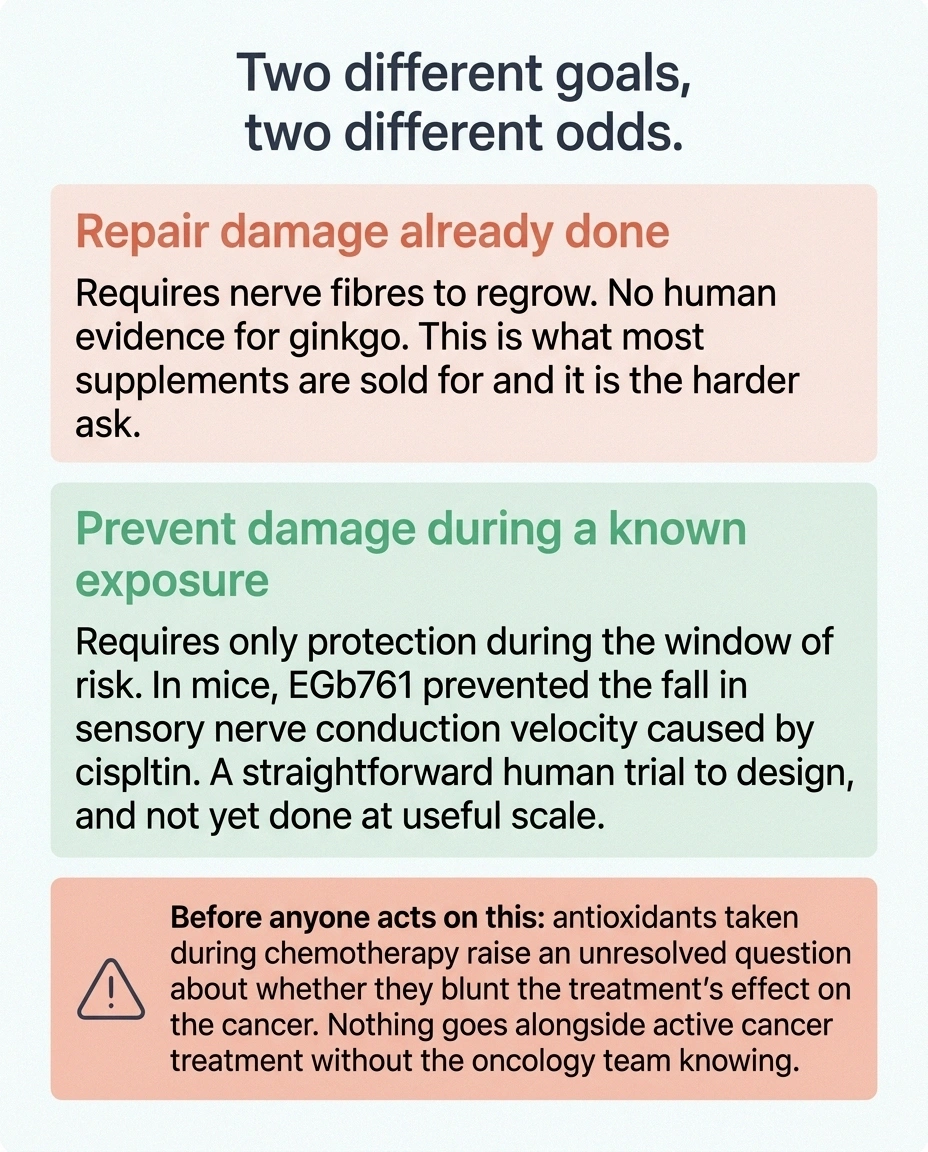
Two animal findings get cited constantly, and both are more interesting for what they suggest about direction than for what they prove.
Three questions to ask any time a supplement page cites a mouse
Animal results are not worthless, they are early. These three questions tell you how early, and you can run them on almost any citation in under a minute.
- Was the dose anywhere near a human dose? Rodent studies often use amounts that scale to many times what a person could take. If the paper does not say, assume it was high.
- Was the animal’s nerve damage the same kind as yours? A chemically induced nerve injury in a mouse over three weeks is not decades of diabetes in a person. Sometimes the model fits, often it does not.
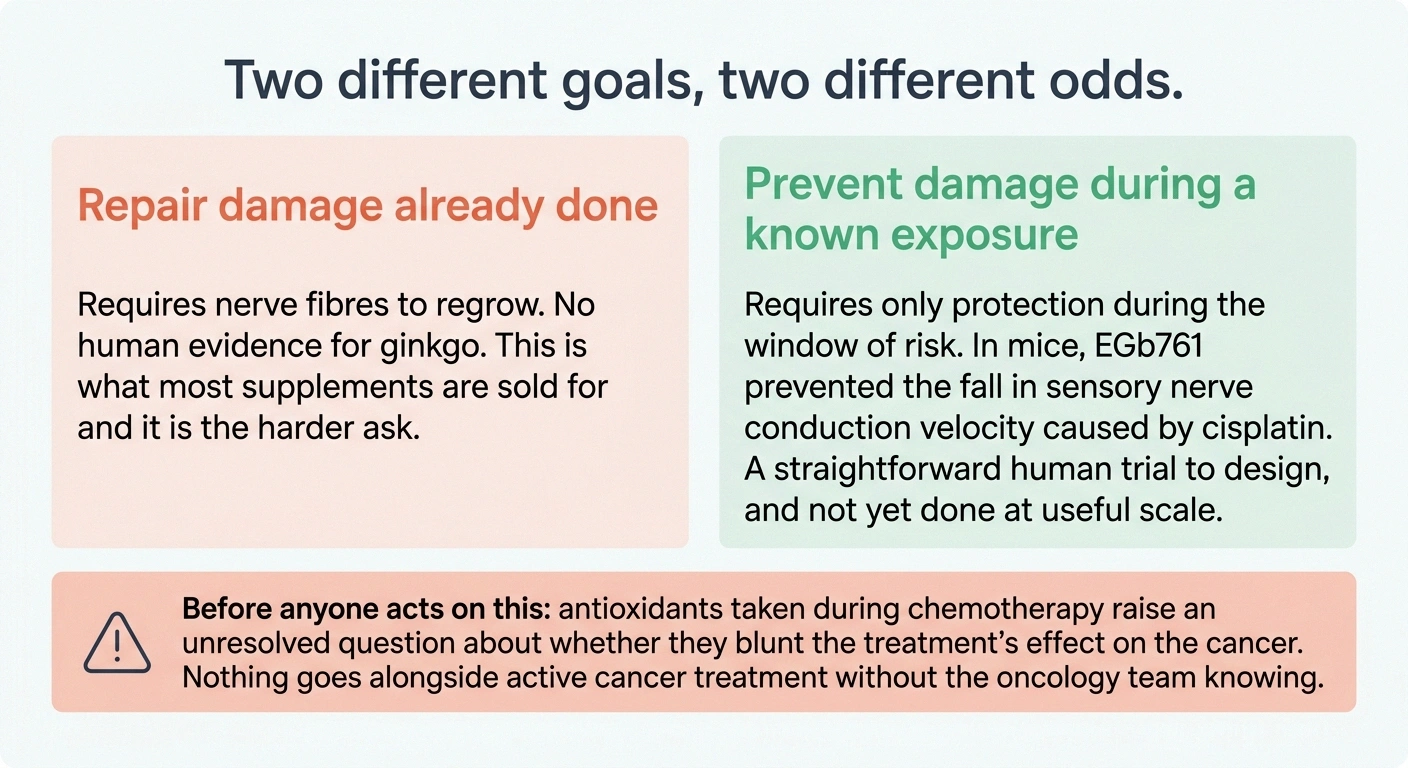
- Was it prevention or reversal? Nearly all positive animal nerve results are prevention studies, where the compound was given before or alongside the injury. Almost nobody tests whether it repairs damage that already exists, which is what you actually want.
Question three eliminates most supplement claims on its own. Try it on the last three things you read about.
In diabetic rats, EGb 761 reduced neuropathic pain behaviours, with the researchers attributing it to a combination of antioxidant and anti-inflammatory activity.
In mice given cisplatin, a chemotherapy drug notorious for nerve damage, EGb761 prevented the drop in sensory nerve conduction velocity that cisplatin normally causes.
That second one is the more provocative result, because prevention is a different and more achievable goal than repair. If a compound protects nerves during a known toxic exposure, the trial that follows is straightforward to design: give it alongside chemotherapy and see whether fewer people develop chemotherapy-induced neuropathy.
That human trial has not been done at any useful scale. And there is a hard reason for caution before anyone tries it independently: antioxidants taken during chemotherapy raise a theoretical question about whether they blunt the treatment’s effect on the cancer, since some chemotherapy works partly through oxidative damage. That question is unresolved. Nobody should add an antioxidant supplement during active cancer treatment without their oncology team knowing, and that is not a formality.
Animal nerve studies also have a translation record worth remembering. Compounds that protected rodent nerves have repeatedly failed in humans. It is a reason to run the trial, not a reason to skip it.
The Bleeding Question, With Both Sides

This is where most of the real decision-making happens, and most articles handle it badly in one of two ways: an alarming warning with no numbers, or a dismissive “generally safe” that ignores a real signal.
The mechanism is not in doubt. Ginkgolide B blocks platelet-activating factor, which is part of how platelets clump together to form a clot. Reduce that and blood is marginally slower to clot. That is the same property that makes the circulation claims plausible, which is worth sitting with: the benefit and the risk are the same effect measured from two sides.
Now the evidence, which genuinely conflicts.
Pointing toward real risk: a case-report literature going back decades describing spontaneous bleeding events in people taking ginkgo, serious enough to have been systematically reviewed. And a 2025 hospital-based analysis of 2,647 prescriptions found 342 involving a ginkgo interaction, a prevalence of about 13 percent, with antiplatelets, anticoagulants and NSAIDs the most frequent partners. Clopidogrel and aspirin each showed up in about 2.6 percent of prescriptions.
Pointing toward lower risk: pooled data from randomized controlled trials has generally not found a significant excess of bleeding events on ginkgo compared with placebo. In at least one analysis, interactions with direct oral anticoagulants and with acenocoumarol were not statistically significant.
How to hold both. Case reports capture rare events in real-world users, including people on four other drugs who never enrolled in anything. Trials capture average risk in screened populations who were healthier to begin with. When those two disagree, the honest read is that the average risk is low and the tail risk is not zero, and which one applies to you depends on what else you take.
Practically, that produces a clear rule rather than a vague caution. If you take warfarin, apixaban, rivaroxaban, clopidogrel, or daily aspirin, this is a conversation with your pharmacist before the first capsule, not after. And it comes off two weeks before any surgery or dental extraction, on the same schedule you would use for fish oil or vitamin E.
The Seizure Caution Specific to This Plant
This one belongs on a neuropathy site for a reason that has nothing to do with seizures.
The stop-two-weeks-before list, since most people have more than one thing on it
Ginkgo is rarely the only item in the cupboard that affects clotting. Surgeons and dentists ask about prescriptions and often get an incomplete answer, because people do not count supplements as medication. These are the common ones worth naming unprompted before a procedure.
Two weeks is the usual instruction, but your surgeon’s number is the one that counts and it varies by procedure. Ask for it rather than assuming, and photograph your supplement shelf on your phone so the pre-op conversation takes thirty seconds instead of relying on memory.
Ginkgo seeds contain a compound called ginkgotoxin, chemically 4-O-methylpyridoxine. It works as a vitamin B6 antagonist, meaning it interferes with the body’s use of B6, and in sufficient quantity it can provoke seizures. This is documented from cases of people eating large amounts of roasted ginkgo nuts.
Standardized leaf extract contains far less of it, and the extract is not the seed. But case reports of seizures in people taking ginkgo supplements exist, and anyone taking anti-seizure medication should treat this as an interaction question rather than a curiosity.
Here is the part that matters more broadly. Vitamin B6 status is directly a nerve issue, and unusually, in both directions. Too little causes neuropathy. Too much, from high-dose supplementation, causes a well-documented sensory neuropathy of its own. Anything that interferes with B6 handling deserves attention from a reader who may already be taking a B-complex, and our guide to vitamin deficiencies that cause neuropathy covers why B6 is the vitamin most worth being precise about.
The practical version is short. Buy leaf extract, never seed. If you take an anti-seizure medication, including one prescribed for nerve pain rather than epilepsy, raise this specifically. And do not assume a supplement that affects B6 handling is neutral in a person whose problem is nerves.
Dose, Form, and Reading the Label

Dosing across ginkgo research is unusually consistent, which makes this easier than it is for most botanicals.
Typical study doses run 120 to 240 milligrams a day of standardized extract, taken in two or three divided doses. The diabetic neuropathy trial used 120 milligrams a day as three 40-milligram doses. Higher intakes have not shown extra benefit and do increase the interaction concerns.
What to check on the panel:
- Leaf, not seed. Non-negotiable, for the reason above.
- Standardization stated: 24 percent flavone glycosides and 6 percent terpene lactones. Without those numbers you do not know what is in the capsule.
- Divided dosing. Twice or three times daily matches how it was studied.
- Third-party testing. Ginkgo has a documented adulteration history, with products found containing added cheaper flavonoids to hit the standardization number on paper. A USP or NSF mark is worth more here than on most supplements.
Onset is slow. Circulation and cognitive studies generally run 8 to 12 weeks before measuring anything, and the neuropathy trial ran 12. A four-week personal experiment tells you nothing.
Who This Is Reasonable For, and Who Should Not Bother
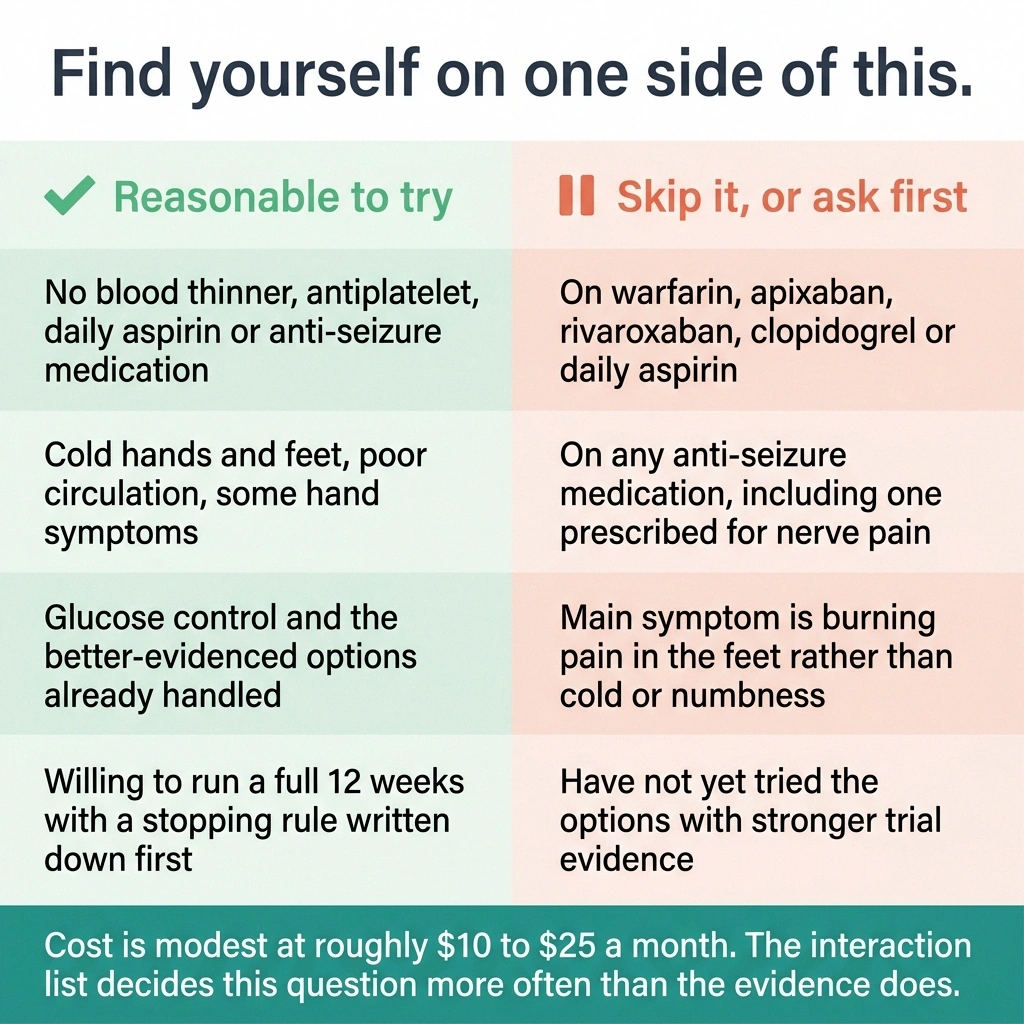
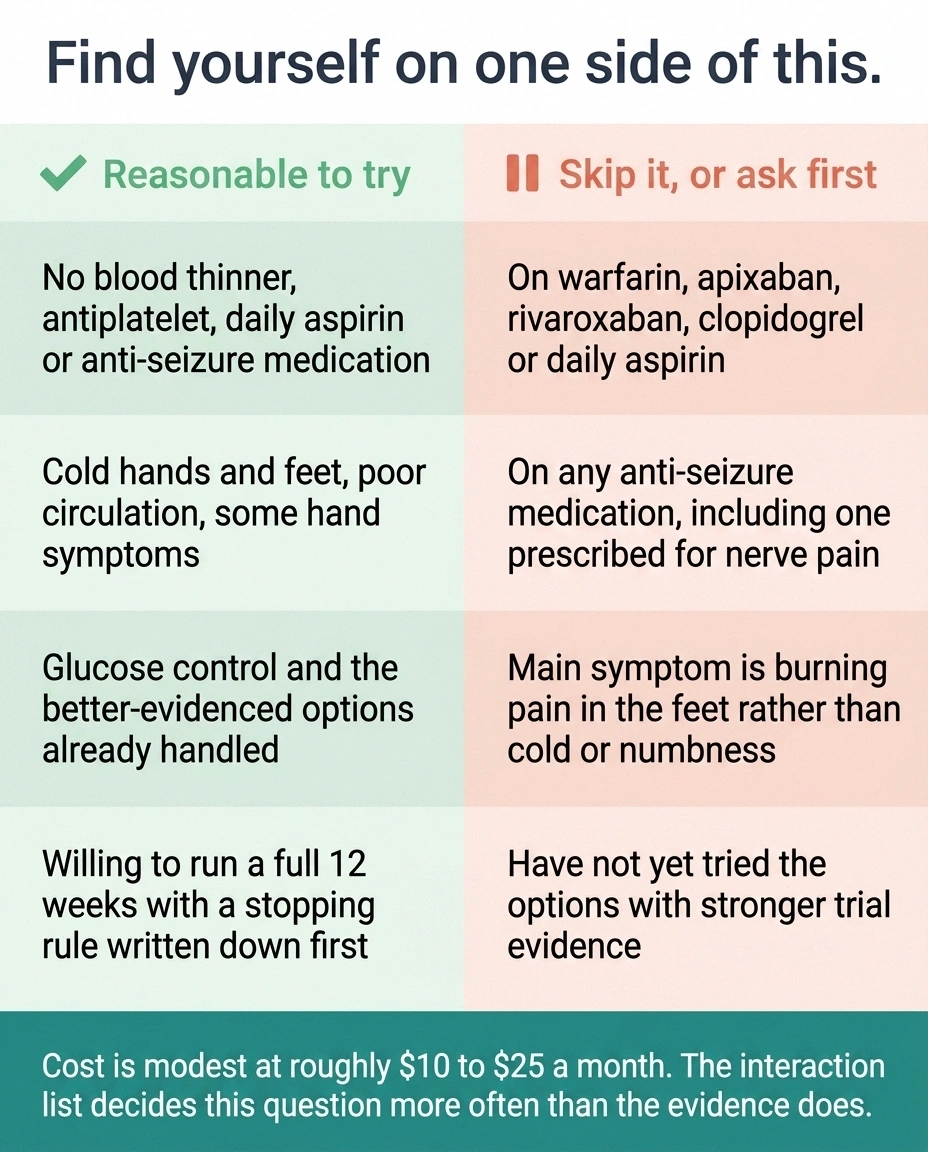
Putting it together honestly.
If you do run the 12 weeks, measure the things this could plausibly move
The trial that found anything found it on an electrical measurement you cannot take at home, and found nothing on symptoms. So set expectations at the low end and pick endpoints that at least match the proposed circulation mechanism.
- Rewarming time
- Minutes from getting into bed to your feet feeling warm. Same bedding, same room temperature. Record it three nights a week, not every night, so it stays a habit rather than a chore.
- Hand symptoms specifically
- This is the one place the trial data actually points, and nobody tracks it because everyone is watching their feet. Count dropped items per week, or note whether buttons and zips have got easier.
- Walking before heaviness
- Blocks or minutes to the point where your legs feel heavy. The claudication research is the strongest circulation evidence ginkgo has, so this is the fairest test available to you.
- Not: burning pain
- The one trial that looked at symptoms found nothing. Expecting burning to improve sets you up to credit or blame the wrong thing when something else in your month changes.
A reasonable candidate is someone not taking any blood thinner, antiplatelet, daily aspirin, or anti-seizure medication, whose symptom picture includes cold hands and feet, poor circulation, and possibly hand symptoms, who has already addressed glucose control and the better-evidenced options, and who is willing to run 12 weeks with a defined stopping rule. Costs are modest, roughly 10 to 25 dollars a month, which is a fraction of what most neuropathy supplements run.
A poor candidate is someone on any of the medications above, someone whose main symptom is burning pain in the feet, or someone who has not yet done the things with real evidence behind them. On that last point, alpha-lipoic acid has larger trials, longer durations, independent research groups, and endpoints that measured foot symptoms directly. If you are choosing one supplement, it is not a close call, and our supplement priority guide lays out the full ordering.
There is also a version of this question that is not about supplements at all. If your hands and feet are cold, discoloured, or painful specifically when walking, that pattern points toward arterial circulation rather than nerve damage, and it is checked with a five-minute blood pressure test at the ankle rather than treated with a capsule. Our guide to telling nerve pain from vascular pain covers how to tell which one you are dealing with, and that distinction is worth far more than any supplement decision downstream of it.
Frequently Asked Questions
Does ginkgo biloba actually help neuropathy?
The evidence is thin and mixed. One randomized placebo-controlled trial in 33 people with type 2 diabetes found no change in neuropathy symptom scores after 12 weeks, but a significant improvement in motor nerve conduction velocity in the median and ulnar nerves. Animal studies are more encouraging, particularly for preventing chemotherapy-related nerve damage, but that has not been tested in people at any useful scale.
Why does it matter that the improvement was in the median and ulnar nerves?
Those are arm nerves. Diabetic neuropathy is length-dependent, meaning it affects the longest nerves first and starts in the feet. An improvement measured in the arms, with no change in symptoms, is a weaker and more oddly located signal than the headline suggests. It may hint that ginkgo is more plausible for hand symptoms than foot symptoms, but that has not been studied directly.
Is ginkgo safe with blood thinners?
Treat it as a pharmacist conversation before starting. Ginkgolide B interferes with platelet clumping, and case reports of spontaneous bleeding exist, though pooled randomized trial data has generally not shown a significant excess of bleeding events. A 2025 hospital analysis found ginkgo interactions in about 13 percent of prescriptions reviewed, most often with antiplatelets, anticoagulants and NSAIDs. It should also be stopped roughly two weeks before surgery or dental extraction.
Can ginkgo cause seizures?
Ginkgo seeds contain ginkgotoxin, a vitamin B6 antagonist that can provoke seizures when eaten in quantity. Standardized leaf extract contains far less, but seizure case reports in supplement users exist. Buy leaf extract only, and if you take any anti-seizure medication, including one prescribed for nerve pain rather than epilepsy, raise it specifically before starting.
How much should I take, and for how long?
Studies typically use 120 to 240 milligrams daily of standardized extract in two or three divided doses. The diabetic neuropathy trial used 120 milligrams daily as three 40-milligram doses for 12 weeks. Effects are slow, so a fair personal trial runs at least 12 weeks, not four.
What should the label say?
Leaf extract, standardized to 24 percent flavone glycosides and 6 percent terpene lactones. A bottle listing only a milligram amount with no standardization tells you the weight of the powder rather than the content of the active compounds. Ginkgo has a documented adulteration history, so third-party testing marks such as USP or NSF carry more weight here than usual.
Is it worth taking if I already take alpha-lipoic acid?
Probably not as a first addition. Alpha-lipoic acid has larger and longer trials, multiple independent research groups, and endpoints that measured foot symptoms directly, which ginkgo does not. Adding ginkgo also means adding its interaction profile. If you want to test something new, change one thing at a time so you can tell what did what.
About the Author