Three different people type “vitamin C and neuropathy” into a search bar in the same afternoon, and they are not asking the same thing.
One has burning feet and wants to know whether a cheap vitamin will quiet them down. One has surgery scheduled in three weeks and read something about preventing a nerve pain syndrome. One has been eating badly for a long time and is quietly wondering whether the tingling is a deficiency.
Those three questions have three different answers, and the strength of the evidence is wildly different across them. Search results blend all three into a single vague impression that vitamin C is somehow good for nerves. Pulling them apart is most of the work, and once they are apart, the answers get much clearer than the reputation of this topic suggests.
Three Different Questions Wearing the Same Search Term
Here is the map before the detail, so you can jump to the section that is actually yours.
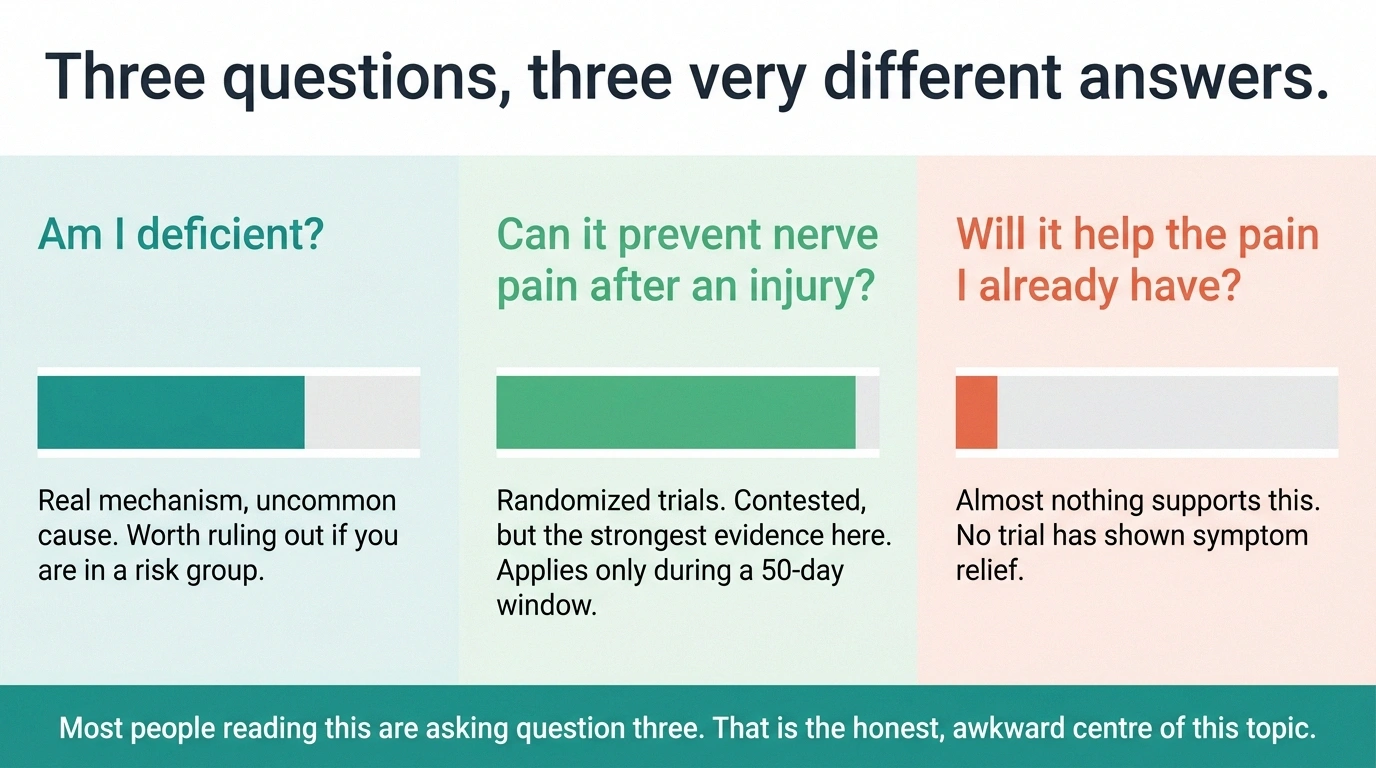
Am I deficient, and is that causing this? Genuine and worth ruling out in specific circumstances. Uncommon, but the failure mode of missing it is bad, and correcting it is trivially cheap.
Can vitamin C stop nerve pain from developing after an injury or surgery? This is where the real trial evidence lives, and it is better than most supplement questions ever get. It is also contested, and it only applies during a narrow window.
Will vitamin C help the nerve pain I already have? Weakest of the three by a wide margin. Almost nothing supports it as a standalone treatment.
Most readers arriving here are the third person. That is the awkward part of this topic, and it is worth naming early rather than burying under the parts that sound more impressive.
It also explains why searching this topic feels so unsatisfying. The pages that rank are either clinical reviews of fracture prophylaxis, written for surgeons, or general vitamin monographs that mention nerves once in passing. Neither was written for somebody with burning feet at eleven at night. The result reads as though a great deal is known, which is true, and as though it applies to you, which usually is not.
One more thing before the detail. Vitamin C is genuinely cheap, genuinely safe at ordinary doses, and genuinely important to nerve tissue. None of what follows is an argument that it does not matter. It is an argument about which question you are asking, because that determines whether the impressive evidence is yours to use.
The Deficiency Route, Which Is Real and Rarer Than It Sounds
Vitamin C is required for the synthesis of collagen, and it is also required by Schwann cells for the formation of myelin, the insulating sheath around peripheral nerves. That second role is not decoration. A nerve without adequate myelin conducts badly, and symptoms of peripheral neuropathy can genuinely result from vitamin C deficiency.
The risk groups, and roughly what covers a day
Deficiency is close to binary rather than gradual, so the useful question is whether you are in a group where it happens at all. If you are not on this list, this is not your explanation.
- Living alone and no longer cooking, or eating mostly packaged food for months
- Heavy alcohol use, which displaces food and impairs absorption at once
- Dental pain or ill-fitting dentures making fruit and raw vegetables hard to eat
- Malabsorption from bowel disease or bariatric surgery, or long-term dialysis
- Smoking, which raises daily requirement measurably even on a normal diet
What one day’s requirement actually looks like
One medium orange, half a raw red pepper, a cup of strawberries, or a serving of broccoli each cover an adult day several times over. This is a low bar, which is exactly why crossing it downward takes months of eating almost nothing fresh.
Severe deficiency is scurvy, and it is not a historical curiosity. Signs appear within roughly a month of intake below about ten milligrams a day. The classic picture is bleeding gums, petechiae, easy bruising, poor wound healing, and profound fatigue, sometimes with nerve symptoms alongside.
The honest caveat is that this is uncommon in countries with reliable food supply. You do not get scurvy by eating a mediocre diet. You get it by eating almost no fruit or vegetables at all for months.
Which means the useful question is not “could this be me” but “am I in one of the groups where it happens.” Those groups are reasonably well defined: people living alone who have stopped cooking, heavy alcohol use, restrictive eating driven by illness or dental problems, malabsorption from bowel disease or bariatric surgery, dialysis, and people with significant food insecurity. Smoking raises requirements measurably. If none of that describes you, deficiency is not the explanation for your symptoms and the answer is somewhere in the wider list of nutritional causes or, far more likely, somewhere else entirely.
There is a detail about vitamin C’s behaviour in the body that explains why the deficiency question is so binary. Absorption is saturable. At ordinary intakes the gut takes up most of what arrives, but as the dose climbs the fraction absorbed falls steeply, and the kidneys clear the excess. Plasma levels plateau regardless of how much you swallow. This is why a person eating any fruit at all is essentially never deficient, and why a person eating none for months can crash all the way to scurvy. There is no slow middle drift. You are either topped up or you are running out.
It also explains the appeal of very large oral doses, and why they do not deliver what people expect. Swallowing three grams does not produce three times the plasma concentration of one gram. Most of the difference ends up in the toilet, which is harmless and also not the outcome anybody was paying for.
If you are in one of those groups, this is a blood test and a cheap correction, and it belongs in the same conversation as B12 rather than in a separate supplement decision. The standard diagnostic workup does not always include vitamin C, so it is a reasonable thing to raise by name.
The CRPS Evidence, Which Is the Strongest Thing Here

Now the part with actual randomized trials behind it.
The evidence is contested, and here is the shape of the disagreement
Summaries of this topic tend to quote whichever analysis suits them. All four are below. A risk ratio under 1.0 favours vitamin C, and 1.0 means no difference.
| Analysis | Result | Verdict |
|---|---|---|
| 416-patient dose-comparison trial | 10.1% placebo vs 2.4% treated | Favours |
| Pooled 500 mg trials | Risk ratio 0.54 | Favours |
| Four high-dose prophylaxis studies | Risk ratio 0.22, all four favouring | Favours |
| 2015 meta-analysis, three larger studies | No difference | Against |
Three positive against one substantial negative, with the negative being the newer and larger pooled analysis. That is a reasonable basis for asking a surgeon, and not a basis for promising anybody anything.
Complex regional pain syndrome is a severe, disproportionate pain condition that sometimes develops after a limb injury, most classically a wrist fracture. The limb becomes intensely painful, often swollen, discoloured, and hypersensitive to touch, far out of proportion to the original injury. It is miserable, it can be persistent, and preventing it is worth a great deal more than treating it.
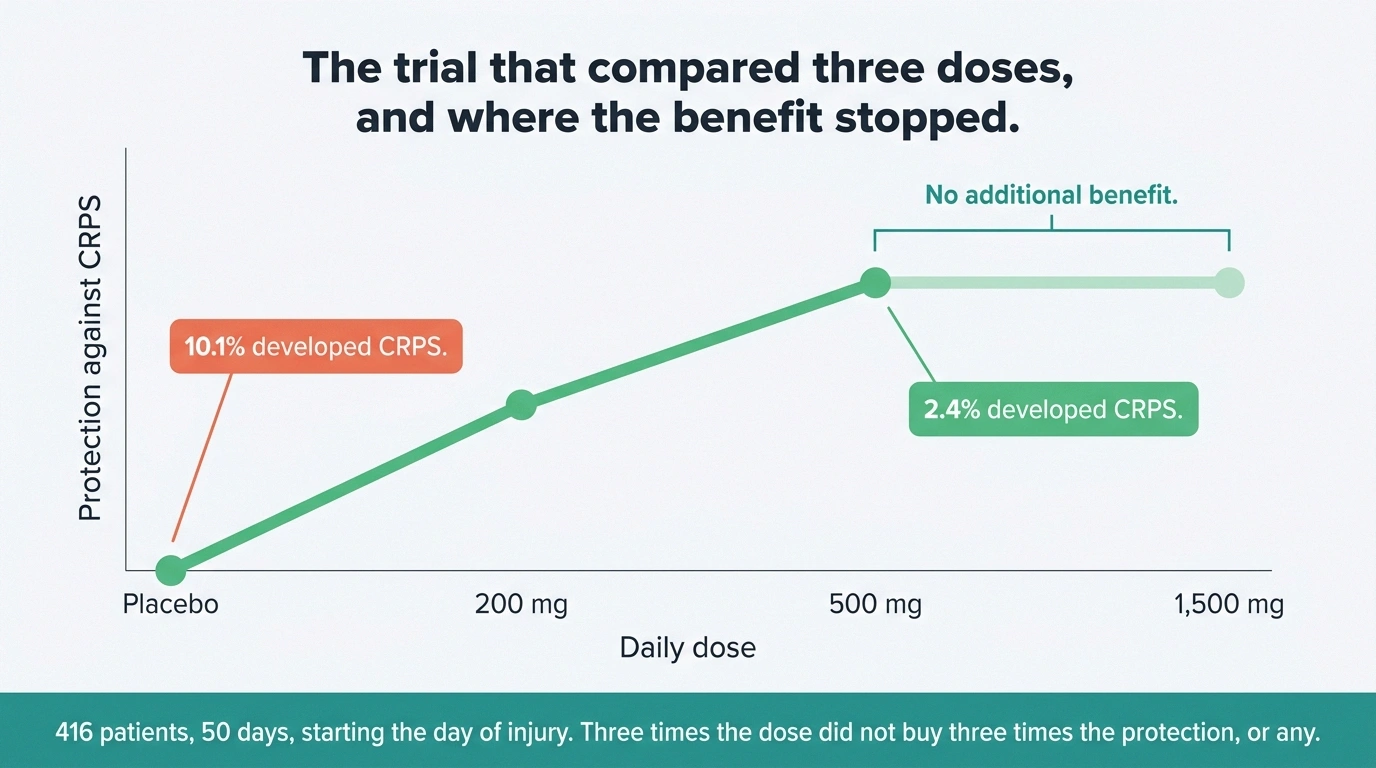
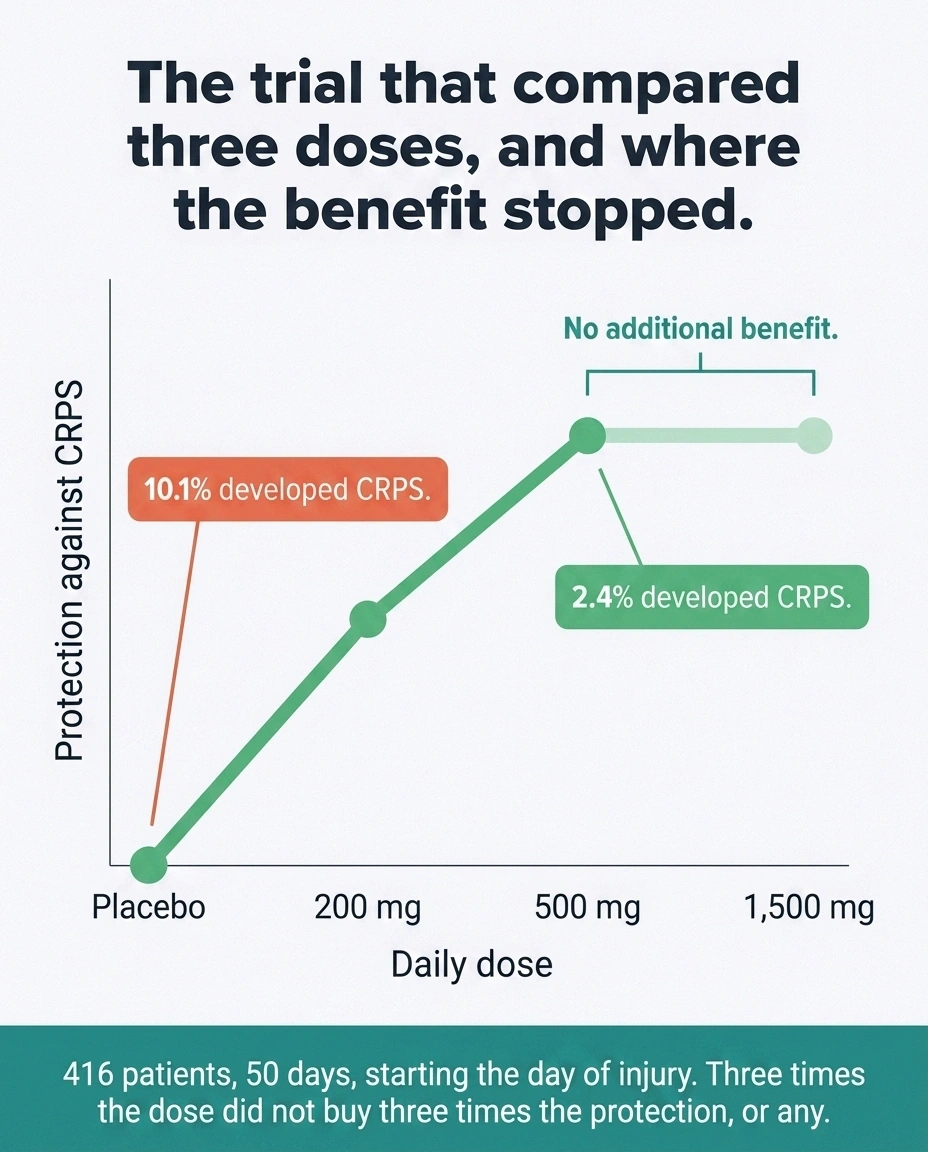
A trial of 416 patients randomised people after wrist fracture to placebo or to 200, 500, or 1,500 milligrams of vitamin C daily for 50 days. CRPS developed in 10.1 percent of the placebo group and 2.4 percent of those taking vitamin C.
Pooled analyses of the 500 milligram trials put the risk ratio around 0.54. A meta-analysis of four high-dose prophylaxis studies found an overall risk ratio of 0.22, with every included study favouring the intervention. A 2013 systematic review concluded that 500 milligrams daily for 45 to 50 days after trauma may reduce CRPS.
And then a 2015 meta-analysis restricted to three larger studies found no difference at all.
That last sentence belongs in every honest summary of this topic. The evidence is genuinely contested, the newer and larger analysis is the negative one, and anybody presenting vitamin C for CRPS as settled is not reading the whole file. What can be said fairly is that the intervention is cheap, low-risk at the studied dose, and supported by several positive trials against one substantial negative pooled analysis. That is a reasonable basis for a conversation with a surgeon, not a reason to promise anyone anything.
Why the Number Stops at 500 Milligrams
The most useful single finding in this literature gets almost no attention, and it is a dose-response curve that flattens.
In the 416-patient trial, the arms received 200, 500, and 1,500 milligrams. The benefit plateaued at 500. The group taking three times as much did not do better.
That is unusual and it is worth sitting with, because supplement culture runs on the opposite assumption. If a little helps, more must help more, and the bottles get bigger every year. Here the data says the opposite: past a certain point you are buying expensive urine and, at high enough doses, some genuine risks discussed below.
Five hundred milligrams a day is not an impressive-sounding dose. It costs a few dollars a month and comes in the most boring bottle on the shelf. It is also, on the available evidence, the entire effective range.
The Timing Problem That Decides Whether Any of This Applies
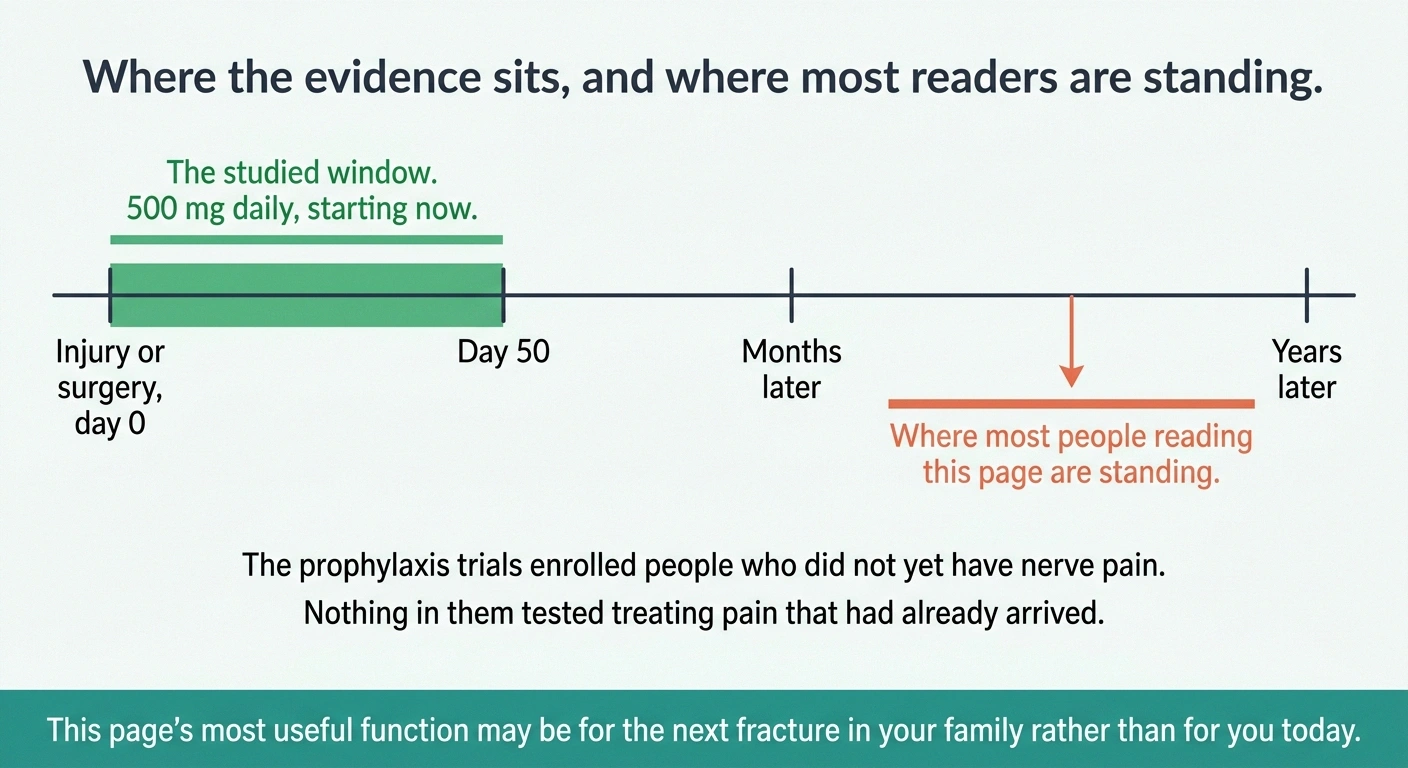
Here is the part that reorders the whole page.
The whole thing fits in one sentence at the pre-op appointment
People rehearse these conversations and then say nothing, usually because they cannot find a phrasing that does not sound like second-guessing. Here is one that does not.
“I read that vitamin C for about fifty days after the procedure may lower the chance of complex regional pain syndrome. Is 500 milligrams a day reasonable in my case?”
Three things make it work. It names the specific outcome rather than asking a vague question about supplements. It states the dose, so the answer can be yes or no rather than a discussion. And it asks whether it is reasonable for you, which invites the clinical judgement they are there to provide.
If the answer is no, you have lost nothing and learned something. If it is yes, buy the tablets before the surgery date, because day one is the day of the procedure and nobody feels like errands afterwards.
Every one of those CRPS trials started the vitamin C on the day of the injury or at the time of surgery, in people who did not yet have nerve pain. The intervention was prophylaxis. It was aimed at a window that opens the moment a bone breaks and closes about seven weeks later.
The person reading this page almost always already has nerve pain. Which means the strongest evidence on this page is for a moment most readers have already lived through.
That is not a reason to close the tab. It is a reason to reframe what this page is for. Vitamin C is not primarily a treatment you take now. It is a thing to remember the next time somebody in your life breaks a wrist, or you are scheduled for foot or hand surgery, or a family member is heading into an orthopaedic procedure. It is a note for the pre-op conversation, filed in advance.
People with existing neuropathy have foot surgery more often than the general population, so this is not a hypothetical. If you have a procedure on the calendar, the question worth asking your surgeon is short: given the CRPS data, is 500 milligrams daily for 50 days reasonable in my case. Most will say yes or shrug. Either way you asked at the only time asking was useful.
Diabetic Nerve Pain: the Thin Middle Ground

Between deficiency and CRPS prophylaxis sits the question most readers actually have, and the evidence there is thin rather than absent.
A registered trial has examined vitamin C as a preventive treatment for diabetic peripheral neuropathy. A separate study looked at 200 milligrams of oral vitamin C combined with duloxetine for diabetic nerve pain, notably as an add-on to an established medication rather than as a substitute for one, and at a dose lower than the CRPS work used.
The mechanistic argument is reasonable on its face. Oxidative stress is one of the recognised pathways by which high glucose injures nerves, vitamin C is an antioxidant, therefore reducing oxidative stress should help. That reasoning has been tested repeatedly across the antioxidant class and the results have been humbling. Antioxidant biology in a test tube and antioxidant benefit in a person have a long history of not matching.
Where the evidence is stronger is alpha-lipoic acid, which is also an antioxidant but has multiple trials that enrolled people with diabetic neuropathy and measured their symptoms directly. If you want an antioxidant with nerve-specific trial evidence, that is the one with a file behind it, and it belongs ahead of vitamin C in any sensible supplement order.
There is one adjacent use worth flagging because this audience is at high risk for it. Vitamin C is a required cofactor for collagen synthesis, and collagen is what wound healing runs on. Anyone dealing with a slow-healing foot wound has a legitimate reason to make sure intake is adequate, which is a nutrition question rather than a nerve question, and it sits alongside the rest of daily foot care rather than replacing any of it.
Where High Doses Stop Being Antioxidant
Vitamin C has a reputation for being harmless at any dose, which is mostly but not entirely true, and the exceptions are specific enough to be worth knowing.
Vitamin C is safe for most people, and specifically not for some
The blanket reassurance is mostly true and hides four situations where the dose genuinely matters. None of these apply at 500 milligrams in a healthy person.
- A kidney stone history
- Excess vitamin C is partly metabolised to oxalate. Gram-level daily dosing becomes a prescriber question rather than a default choice.
- Active chemotherapy or radiation
- Some of those treatments work partly through oxidative damage. Whether antioxidants blunt them is unresolved, so the oncology team hears about it first.
- G6PD deficiency
- Hemolysis has been reported with large pharmacologic intravenous doses. Rare, and consequential enough to know your status if it runs in the family.
- Managing diabetes by meter readings
- High-dose vitamin C can skew some glucose monitoring systems. If your numbers suddenly look strange after starting a supplement, that is worth checking before changing any medication.
At high doses, vitamin C flips and acts as a pro-oxidant rather than an antioxidant. This is not a fringe claim, it is the pharmacological basis for the intravenous high-dose vitamin C being studied in oncology, where the pro-oxidant effect is the point. For somebody taking a supplement hoping for antioxidant protection, it means the dose-response logic runs backwards past a certain threshold.
Kidney stones. Excess vitamin C is metabolised partly to oxalate, and high doses raise the risk of oxalate stones. Anyone with a stone history or reduced kidney function should treat gram-level daily dosing as a question for their prescriber rather than a default.
G6PD deficiency. Hemolysis has been reported with large pharmacologic intravenous doses in people with this inherited enzyme deficiency. Rare, but consequential.
Chemotherapy. This one matters here, because chemotherapy-induced neuropathy sends a steady stream of people to pages exactly like this one. It remains uncertain whether supplemental antioxidants interfere with chemotherapy or radiation, since some of those treatments work partly through oxidative damage to cancer cells. The oncology team needs to know before anything antioxidant goes in, particularly at high doses. This is not a supplement to start quietly during active treatment.
Interference with glucose meters. High-dose vitamin C can skew readings on some glucose monitoring systems, which is worth knowing if you are managing diabetes by those numbers.
Who Should Actually Act on This Page
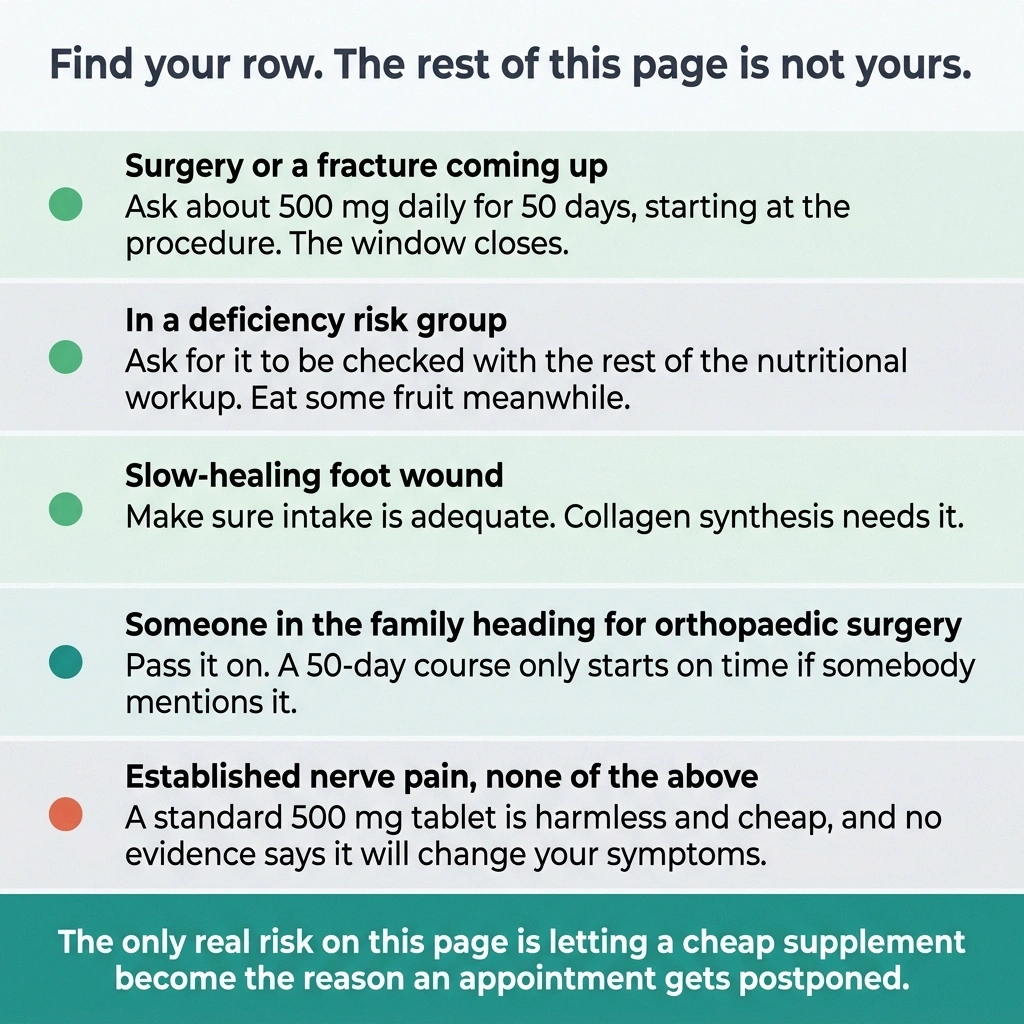
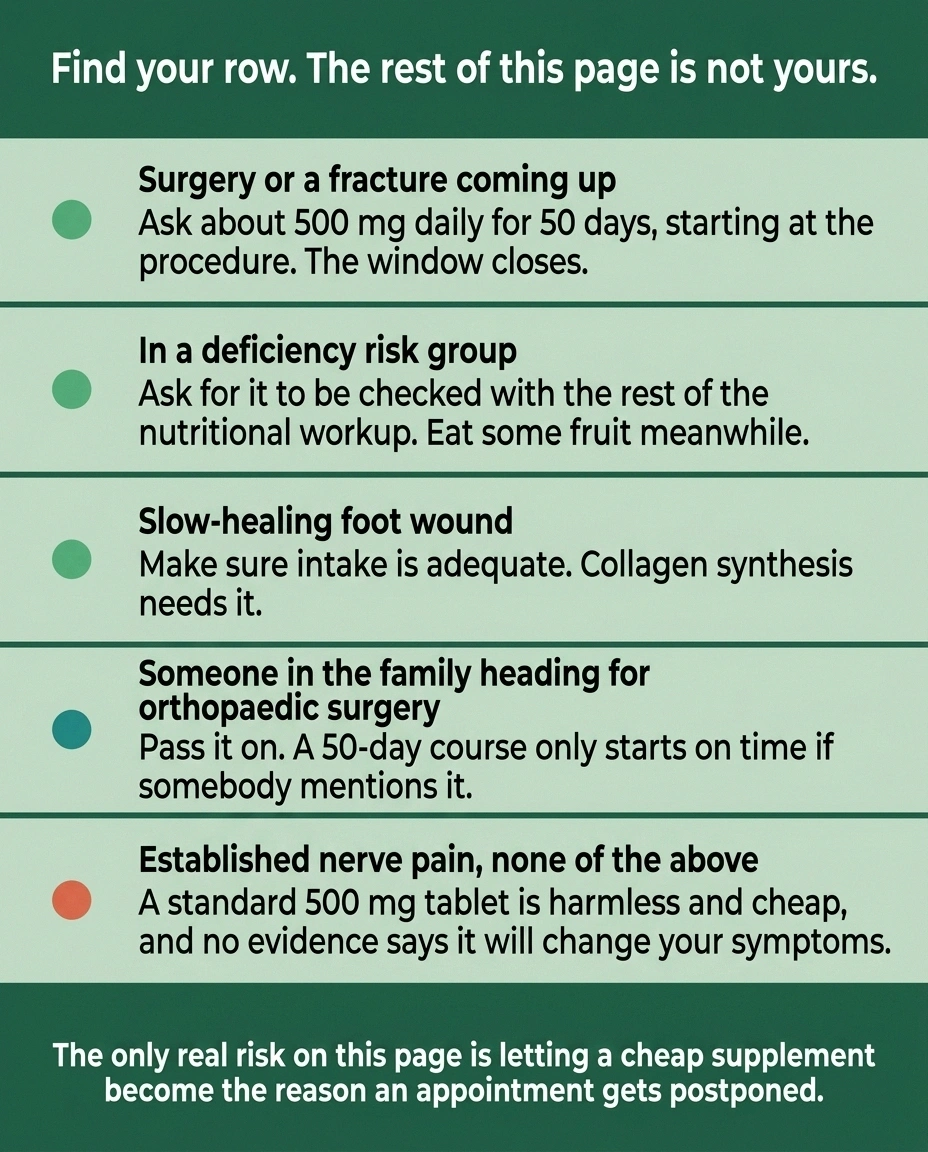
Stripping out everything that is merely interesting, four groups have something to do.
If you have surgery or a fracture coming. Ask about 500 milligrams daily for 50 days, starting at the time of the procedure. Cheap, low-risk, several positive trials, one negative pooled analysis, and a genuine window that closes.
If you are in a deficiency risk group. Ask for it to be checked alongside the rest of the nutritional workup, and eat some fruit while you wait. Correction is fast and cheap.
If you have a slow-healing foot wound. Make sure intake is adequate for collagen synthesis. This is a healing question with a real mechanism behind it.
If somebody in your family is heading for orthopaedic surgery. Pass it on. This page’s most useful function is probably not for the person reading it, and a fifty-day course started on the right day is the kind of thing that only happens because somebody mentioned it in time.
If you have established nerve pain and none of the above. A standard 500 milligram supplement is harmless and inexpensive, and there is no evidence it will change your symptoms. If it makes you feel you are doing something, that has some value, provided it does not become the reason you postpone the appointment where somebody would find the actual cause. That is the only real risk this page carries, and it is worth guarding against.
Frequently Asked Questions
Can vitamin C deficiency cause neuropathy?
Yes. Vitamin C is needed by Schwann cells for myelin formation, and peripheral neuropathy symptoms can result from deficiency. Severe deficiency is scurvy, with signs appearing within about a month of intake below roughly ten milligrams daily. It is uncommon where food supply is reliable, and concentrated in specific groups: heavy alcohol use, very restricted diets, malabsorption, dialysis, food insecurity, and isolated older adults who have stopped cooking.
How much vitamin C should I take for nerve pain?
For existing nerve pain, no dose has been shown to help, so there is no evidence-based number. For CRPS prevention after a fracture or surgery, the studied dose is 500 milligrams daily for about 50 days, and the benefit plateaued at that dose in the trial that compared 200, 500 and 1,500 milligrams.
Does vitamin C help CRPS?
For prevention, several randomized trials say yes, with one showing CRPS in 2.4 percent of people taking vitamin C against 10.1 percent on placebo, and pooled risk ratios ranging from 0.22 to 0.54. A 2015 meta-analysis of three larger studies found no difference, so the evidence is contested rather than settled. For treating CRPS that has already developed, there is no good evidence.
Is 1,000 mg of vitamin C daily too much?
For most people it is safe but pointless, since the CRPS benefit plateaued at 500 milligrams. It becomes a real question if you have a kidney stone history, since excess vitamin C is partly metabolised to oxalate, or if you have reduced kidney function. High doses also flip vitamin C from antioxidant to pro-oxidant behaviour.
Can vitamin C repair nerve damage?
No evidence supports that. It supports myelin formation and collagen synthesis, which matters if you are deficient or healing a wound, but correcting a deficiency and repairing established nerve damage are different things.
Should I take vitamin C during chemotherapy?
Not without telling your oncology team first. It remains uncertain whether antioxidant supplements interfere with chemotherapy or radiation, since some of those treatments work partly through oxidative damage. This is a conversation to have before starting, especially at higher doses.
Is vitamin C better than alpha-lipoic acid for neuropathy?
No. Alpha-lipoic acid has multiple randomized trials that enrolled people with diabetic neuropathy and measured their symptoms directly. Vitamin C has no comparable evidence for treating established nerve pain. If you are choosing one antioxidant, the trial evidence points clearly.
Does the type of vitamin C matter, buffered or liposomal or plain ascorbic acid?
For the doses discussed here, no. Absorption is saturable and plasma levels plateau, so plain ascorbic acid at 500 milligrams gets you to the same place as the expensive formulations. Buffered forms are gentler on a sensitive stomach, which is a comfort question rather than an effectiveness one.
Can I just eat more fruit instead of taking a supplement?
For preventing deficiency, easily. A single orange, half a red pepper, or a cup of strawberries each covers a day’s requirement several times over. For the CRPS prophylaxis dose of 500 milligrams daily, food alone gets awkward, which is one of the few situations where a tablet is genuinely the simpler answer.
About the Author