Roughly 20 million people in the United States have some form of peripheral neuropathy, according to the National Institute of Neurological Disorders and Stroke, and the agency itself notes that figure is almost certainly low, because many people are never formally tested and the standard tests miss entire categories of nerve damage.
A condition that common, that under-diagnosed, and that poorly explained in a ten-minute appointment generates a lot of folklore. Some of it comes from doctors in a hurry. Some comes from clinics selling packages. Some gets passed between patients in waiting rooms with the best of intentions.
Below are fifteen of the ones that cause real harm, sorted by what they cost the person who believes them. Each is followed by what is actually true and why the myth has staying power.
The Fifteen at a Glance
| Myth | What is actually true |
|---|---|
| 1. Neuropathy means diabetes | Diabetes is the largest single identified cause, but it does not account for most cases. Dozens of causes exist. |
| 2. A normal nerve test rules it out | Standard nerve conduction studies test large fibers only and are routinely normal in small fiber neuropathy. |
| 3. Nothing can be done | Cause-directed treatment, symptom treatment and progression control all exist. The reachable goal is usually control rather than cure. |
| 4. It is just part of aging | Age raises risk. It does not explain new numbness, and treating it as inevitable is how causes get missed. |
| 5. Burning means the damage is accelerating | Pain intensity does not track nerve loss. Some of the worst pain occurs early, and pain can fade as fibers die. |
| 6. It always starts in the feet | Usually, because the longest nerves fail first. Non-length-dependent forms start in the face, trunk or hands. |
| 7. Numbness is the mild version | Numbness is the more dangerous symptom. Painless feet are how ulcers and fractures go unnoticed. |
| 8. If you can still feel your feet, you are fine | Protective sensation can be lost while touch remains. That gap is what monofilament testing measures. |
| 9. Gabapentin works for everyone | Most people get partial relief at best, and a substantial minority get none. Several classes are worth trying. |
| 10. Supplements regrow nerves | Correcting a real deficiency helps. Beyond that, supplements have modest evidence and no regrowth claim holds up. |
| 11. It only affects hands and feet | Autonomic nerves control blood pressure, digestion, bladder and sweating, and they are frequently involved. |
| 12. Amputation is inevitable with diabetic neuropathy | The pathway to amputation is preventable at several steps, and daily foot checks interrupt it early. |
| 13. Exercise makes it worse | Appropriate exercise is one of the few interventions with evidence for slowing progression. |
| 14. Idiopathic means nobody looked properly | Sometimes true, sometimes not. A fifth to a third stays unexplained after a genuinely thorough workup. |
| 15. It is uncomfortable but not dangerous | Falls, foot wounds, cardiac autonomic involvement and untreated inflammatory causes all carry real risk. |
Myths About What Causes It
Myth 1: Neuropathy means you have diabetes.
What a first-pass search for a cause usually contains
Named here so you can tell a thorough workup from a brief one. This is a common first tier rather than a required list, and the second tier depends entirely on what the first tier and your examination suggest.
Metabolic. Fasting glucose and HbA1c, and in many cases a two-hour glucose tolerance test, since impaired tolerance is missed by HbA1c alone. Kidney and liver function. Thyroid function.
Nutritional. Vitamin B12 with methylmalonic acid when B12 is low-normal, because the B12 level alone misses functional deficiency. Folate. Copper and vitamin E where the history suggests it.
Paraprotein and inflammatory. Serum protein electrophoresis with immunofixation, which is the single most commonly omitted test on this list. Full blood count, inflammatory markers, and a basic autoimmune screen.
If a diagnosis of unknown cause was reached without the immunofixation and without a glucose tolerance test, the label describes how far the search went rather than what is wrong.
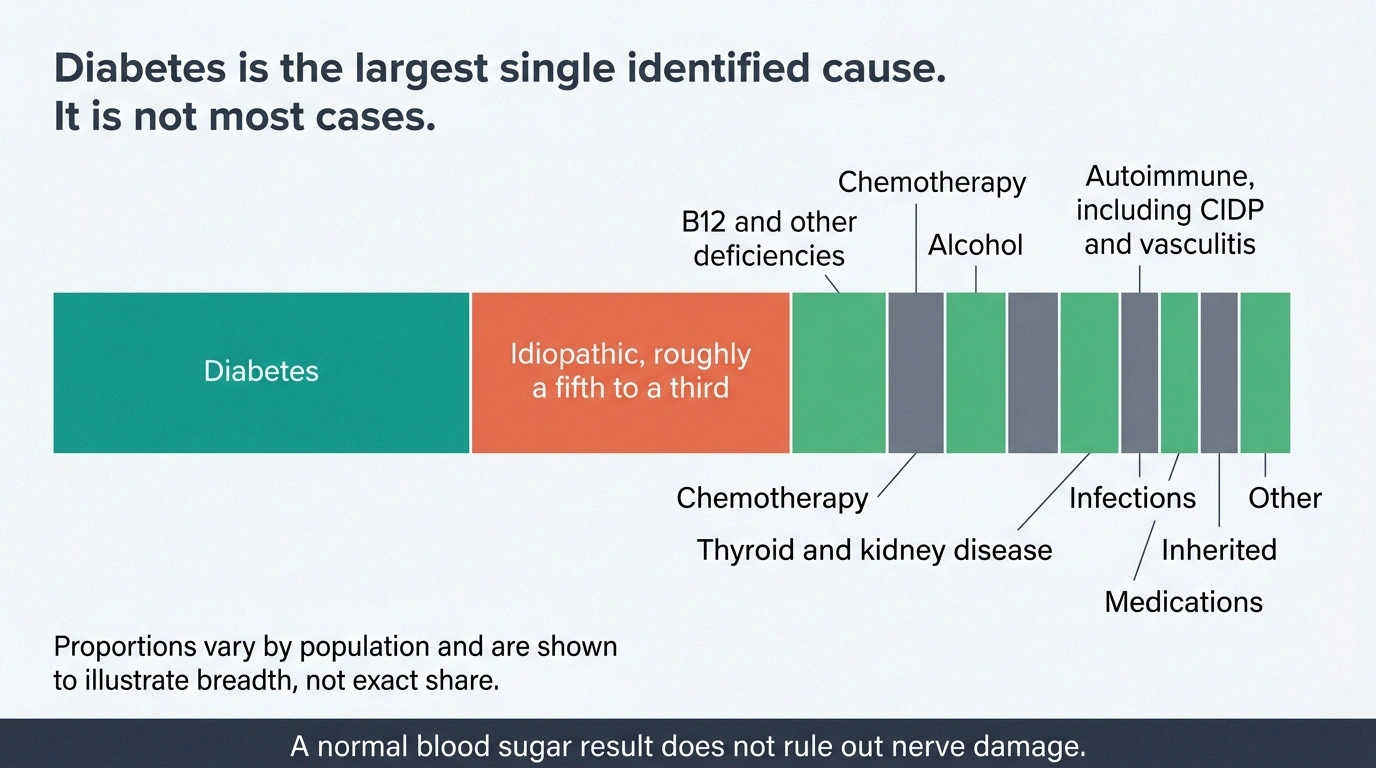
Diabetes is the largest single identified cause in high-income countries, and it dominates the conversation for that reason. It does not account for most cases. The list of other established causes is long: B12 and other vitamin deficiencies, chemotherapy, alcohol, thyroid disease, kidney failure, autoimmune conditions including CIDP and vasculitis, infections such as shingles and Lyme and HIV, inherited conditions, paraproteins, heavy metals, and a surprisingly long list of ordinary prescription medications.
Why it persists: diabetes is the cause most doctors screen for first and the one most public education covers. If your blood sugar is normal and you have neuropathy, the risk is being told you cannot have it, or being handed a diagnosis of unknown cause before anyone has looked at the rest of the list.
Myth 4: It is just part of getting older.
Nerve function does decline with age, and prevalence climbs steeply after 60. That is a statistical statement, not an explanation for an individual. New numbness, new burning or new balance loss in a 72-year-old deserves the same workup as in a 45-year-old, because the treatable causes do not become untreatable with age. The relationship between neuropathy and aging is real and frequently overstated in exactly the direction that stops investigation.
Why it persists: it is a comfortable thing to say in a short appointment, and it is not entirely false, which is what makes it effective at closing conversations.
Myth 14: Idiopathic means they did not look hard enough.
This one is half true, which is the worst kind of myth. Somewhere between a fifth and a third of neuropathy remains unexplained after a thorough evaluation. That is a genuine limit of current medicine and not a failure by your doctor.
The other half of the truth: a great deal of what gets labelled idiopathic neuropathy received a blood sugar test, a B12 level and nothing else. Those two situations look identical on the chart and are completely different in practice. The useful question is never whether the label is right. It is which tests were actually run before the label was applied.
Myths About Testing and Diagnosis
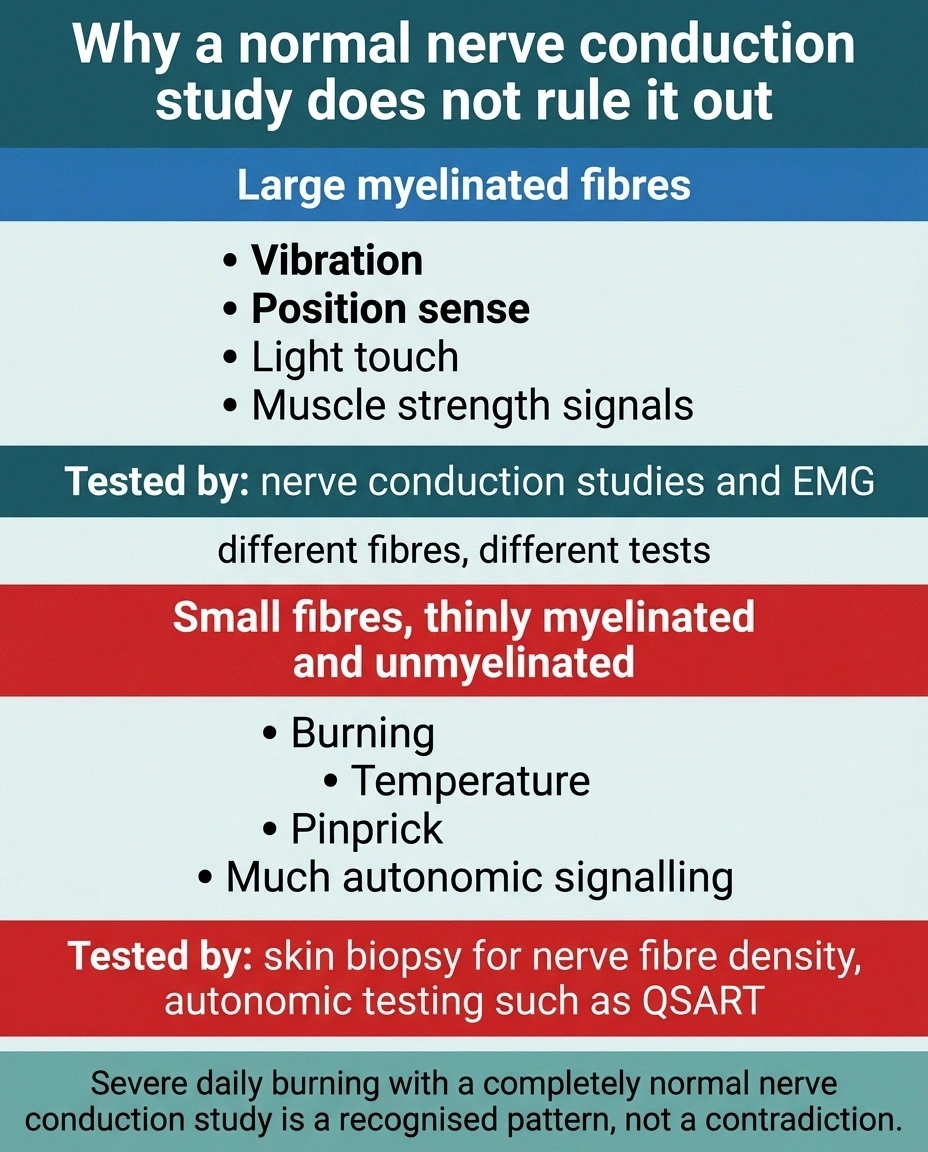
Myth 2: A normal nerve conduction study means you do not have neuropathy.
Four tests, and the blind spot in each
Every one of these is a good test. None of them sees everything, which is why a single normal result closes nothing.
- Nerve conduction study
- Measures speed and signal size in large myelinated fibres. Distinguishes demyelinating from axonal damage, which changes the whole differential. Blind to small fibres, so it is often entirely normal in burning-predominant neuropathy.
- Needle EMG
- Records electrical activity inside muscle, showing whether the nerve supply to that muscle has been lost and roughly how long ago. Says nothing about sensory symptoms at all.
- Skin punch biopsy
- A 3mm sample, usually from the lower leg, counted for nerve fibre density in the epidermis. The main way small fibre neuropathy is confirmed. It quantifies loss without identifying its cause.
- Autonomic testing, including QSART
- Measures sweat response, heart rate variability and blood pressure behaviour on tilting. Detects the involvement that causes dizziness on standing and digestive problems, which no other test on this list registers.
This is the most consequential myth in the entire list, and it sends people away with an anxiety diagnosis every day.
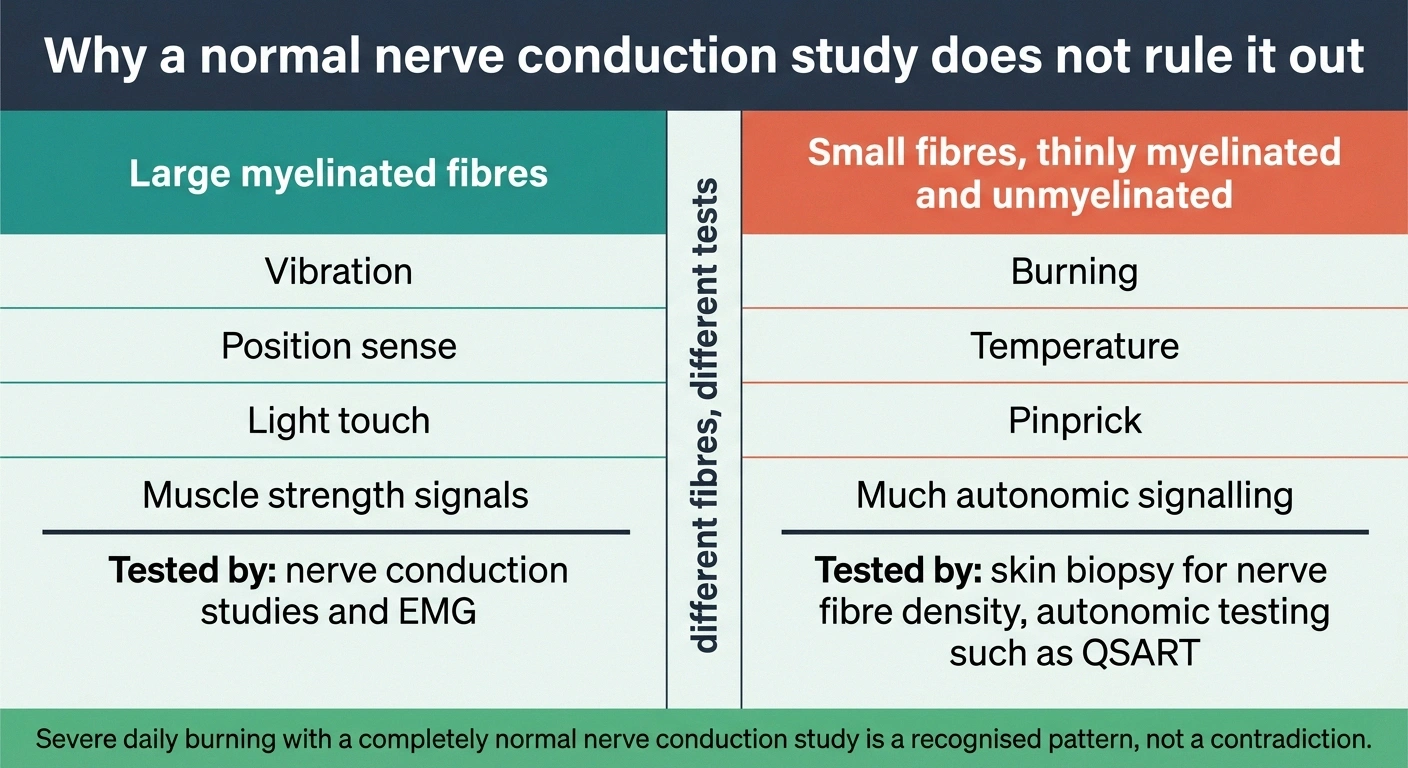
Nerve conduction studies and EMG measure large, myelinated nerve fibers. The fibers that carry burning, temperature, pinprick and much of the autonomic signalling are small and thinly myelinated or unmyelinated, and they are effectively invisible to that test. Someone with pure small fiber neuropathy can have severe daily burning and a completely normal study. Detecting it requires a skin biopsy to count nerve fiber density, or autonomic testing such as QSART.
Why it persists: the test is excellent at what it does, and its limitation is technical enough that it rarely gets explained. If your burning is real and your study was normal, the correct next question is whether small fiber testing has been done.
Myth 8: If you can still feel your feet, you are fine.
Sensation is not one thing. Light touch, vibration, position sense, temperature and protective sensation ride on different fibers and fail at different rates. You can feel a sock perfectly well and still be unable to feel a pebble, a blister or a nail through the sole. That specific loss, protective sensation, is what a nylon monofilament pressed against the foot is testing for, and it is the threshold that predicts ulcers.
Why it persists: people self-assess with the sensation that is most obvious to them, which is touch, and touch is often the last to go.
Myth 6: It always starts in the feet.
Usually, and for a good structural reason. The nerves running to the toes are the longest in the body, so a metabolic or toxic insult that damages nerves by length hits them first. That is why the classic pattern climbs from toes to shin before reaching the hands.
But non-length-dependent neuropathy exists and behaves differently, starting in the face, the trunk, the thighs or patchily across the body. It is more often immune-mediated. Patients with that presentation are frequently told their symptoms cannot be neuropathy because of where they started, which is exactly backwards: the unusual pattern is the reason to investigate harder, not to dismiss.
Myths About Symptoms and Severity
Myth 5: The worse the burning, the faster the nerves are dying.
Pain intensity and nerve loss are only loosely related. Damaged nerves that are still alive fire spontaneously and inappropriately, and that misfiring is what burning is. Nerves that have died fire nothing at all.
The practical consequence catches people out. Pain sometimes decreases as neuropathy advances, and the decrease is not improvement. If burning fades and is replaced by numbness and unsteadiness, that is progression rather than recovery, and it is worth reporting as such rather than celebrating.
Myth 7: Numbness is the mild symptom and pain is the serious one.
Backwards, in terms of what actually causes harm. Pain is what drives people to seek care, and it is miserable. Numbness is what causes hospital admissions.
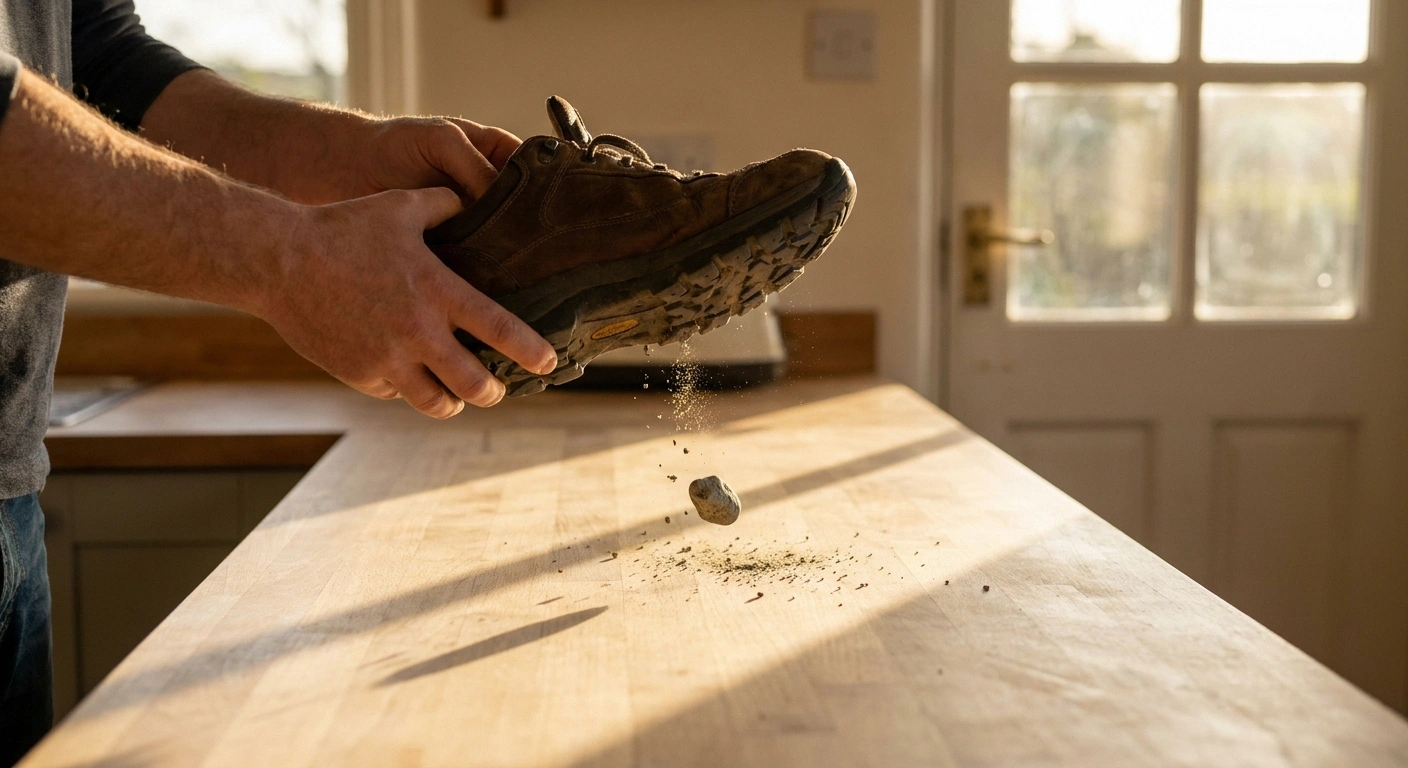
You cannot protect a foot you cannot feel. Blisters from new shoes go unnoticed for days. A stone stays in a shoe. A hot water bottle burns skin that never reported heat. Small wounds progress to foot ulcers before anyone sees them. Add loss of position sense and the fall risk climbs sharply, which is its own cascade of fractures and head injuries.
Why it persists: pain demands attention and numbness does not, which is the entire problem.
Myth 11: Neuropathy is a hands-and-feet condition.
Peripheral nerves also run the systems you do not think about. When autonomic fibers are affected, the results include blood pressure that drops on standing, a resting heart rate that no longer varies, delayed stomach emptying, constipation or diarrhoea, bladder problems, sweating that is absent in some places and excessive in others, and sexual dysfunction. Autonomic neuropathy is under-recognised partly because its symptoms get attributed to a dozen other things.
Why it persists: the name says peripheral, people hear extremities, and the autonomic nerves never come up.
Myth 15: It is uncomfortable but it will not hurt you.
Nerve pain itself does not shorten life. The condition around it can. Falls are the most common serious consequence. Foot wounds in insensate feet are the second. Cardiac autonomic involvement blunts the warning signs of a heart attack and is associated with worse outcomes. And a treatable inflammatory neuropathy left unrecognised can cause permanent weakness that timely treatment would have prevented. There is also a specific short list of symptoms that need urgent evaluation rather than a routine appointment, including rapidly progressive weakness and difficulty breathing or swallowing.
Myths About What Treatment Can Do

Myth 3: Nothing can be done.
How long before a treatment has actually been tried
A great many people were told something failed after two weeks at a starting dose that was never going to be therapeutic. These are general timeframes, and individual plans vary a great deal.
| Class | Roughly how it works | Fair trial length |
|---|---|---|
| Gabapentinoids | Calms calcium channel activity on overexcitable nerves | 4 to 8 weeks, most of it spent titrating upward |
| SNRIs | Strengthens the spinal cord’s own pain-damping pathways | 6 to 8 weeks at a maintained dose |
| Tricyclics | Similar pathway, different chemistry, usually taken at night | 6 to 8 weeks, starting very low |
| Topical agents | Acts on nerve endings in the skin, with little reaching the rest of the body | 2 to 4 weeks, or a single in-office application for high-dose capsaicin |
| Treating the cause | Removes what is damaging the nerve in the first place | Months to years, and the only route that can change the trajectory |
The most damaging sentence in neuropathy care, and it is usually a compression of something narrower and true: there is no reliable way to reverse established nerve damage in most cases.
What can be done falls in three categories. Treating the cause, where one is found, which sometimes stops progression outright and occasionally allows partial recovery. Treating symptoms, where multiple drug classes and non-drug approaches exist. And reducing the consequences, through foot care, balance work and fall prevention. Whether neuropathy can be reversed deserves a more careful answer than either yes or no, and depends heavily on cause, duration and fiber type.
Myth 9: Gabapentin works for nerve pain, so if it did not work for you, nothing will.
Trial data for gabapentin and its relatives show that a minority of people get substantial relief, more get partial relief, and a significant group get none. That is normal for neuropathic pain medication generally and is not a statement about you.
Failing one drug says almost nothing about the next, because the mechanisms differ. Gabapentinoids, tricyclics, SNRIs and topical agents act on different targets. Dose and duration matter too: a great many people were told a drug failed after two weeks at a starting dose that was never going to be therapeutic.
Myths About Cures, Amputation and Exercise
Myth 10: The right supplement stack will regrow your nerves.
Correcting a documented deficiency genuinely matters. B12 deficiency causes neuropathy, and replacing it can improve or halt it. The same logic applies to B1, B6 within safe limits, copper and vitamin E.
Beyond deficiency correction, the honest summary is that a few supplements have modest supporting evidence for symptoms and none has demonstrated reliable nerve regeneration in people. Peripheral nerves can regenerate under the right conditions, slowly and incompletely, which is what makes the marketing claim sound plausible. Slow partial axonal regrowth in favourable circumstances is a long way from a capsule that rebuilds nerves.
Why it persists: it is the most profitable claim in the space, and it is attached to a true premise.
Myth 12: Diabetic neuropathy leads to amputation eventually.
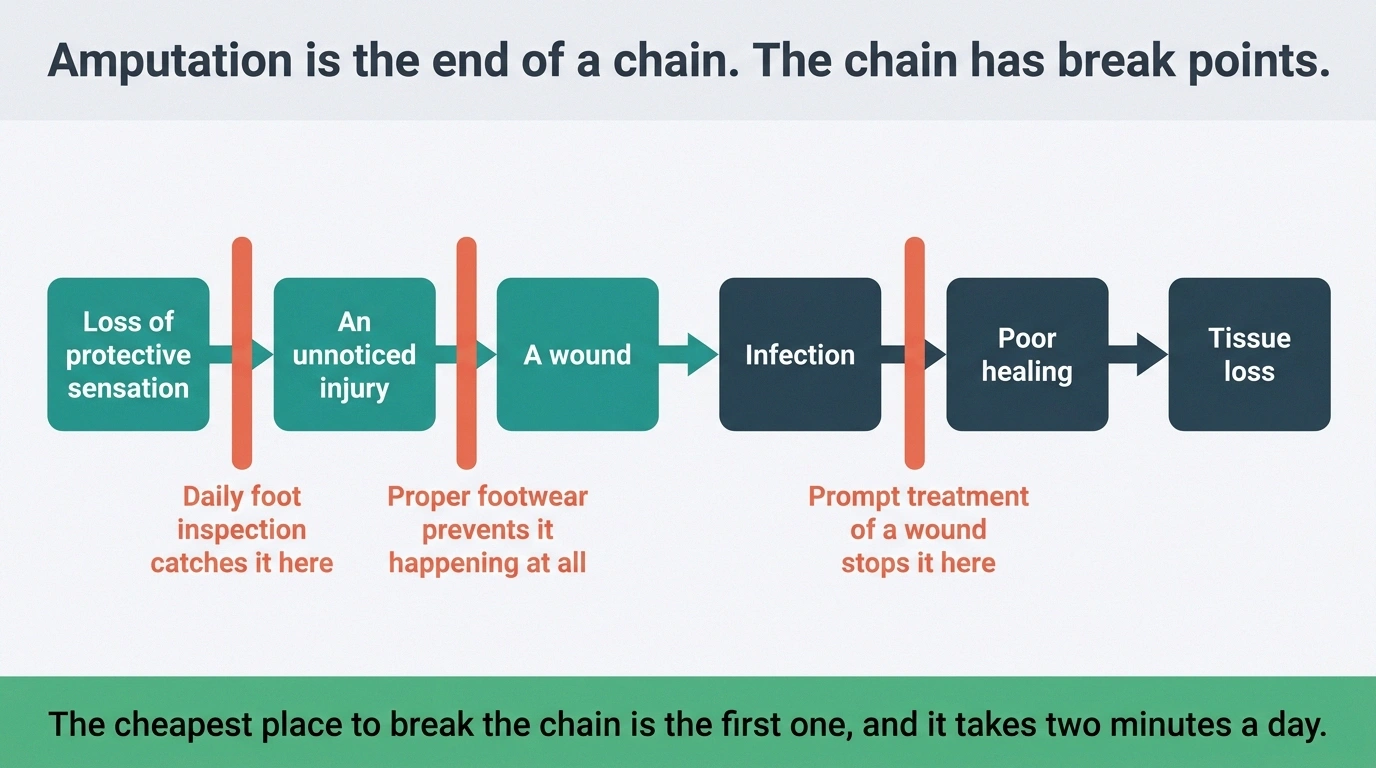
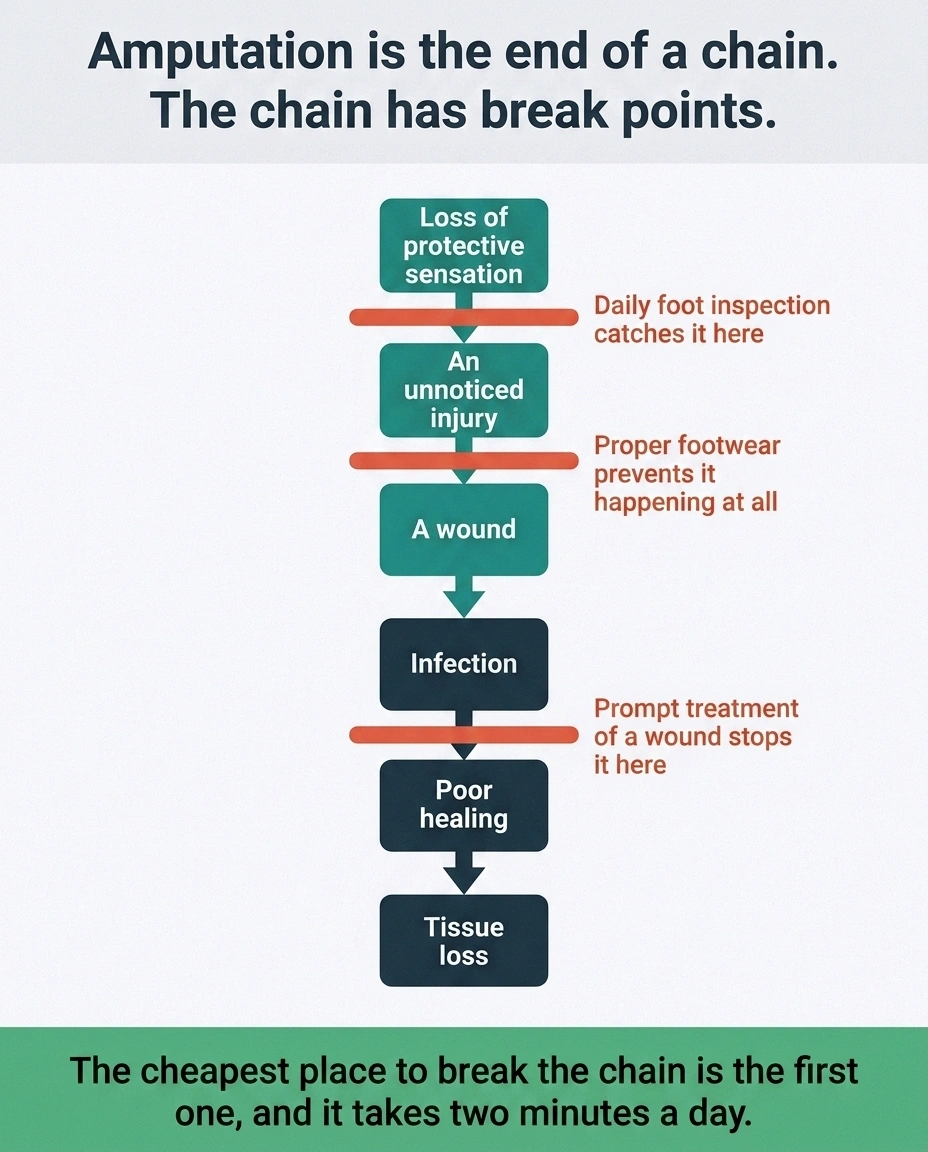
Amputation is the end of a chain, and the chain has several places it can be broken. Loss of protective sensation, then an unnoticed injury, then a wound, then infection, then poor healing from vascular disease, then tissue loss. Daily foot inspection interrupts the chain at step two, which is where it is cheapest to interrupt. Good footwear prevents step two from happening at all. Prompt treatment of a wound interrupts step four.
Fatalism is dangerous here specifically because it removes the motivation for the two-minute daily habit that does the most work.
Myth 13: Exercise makes neuropathy worse.
Exercise is one of the few interventions with reasonable evidence for slowing progression and improving symptoms, and it also directly addresses the balance loss that causes falls. Walking in particular is well studied.
The kernel of truth is real though: activity on an insensate foot needs precautions. Proper footwear, no barefoot exercise, and a foot check afterwards. The rule is not to avoid exercise. It is to inspect the feet after it.
How to Test a Neuropathy Claim You Read Somewhere
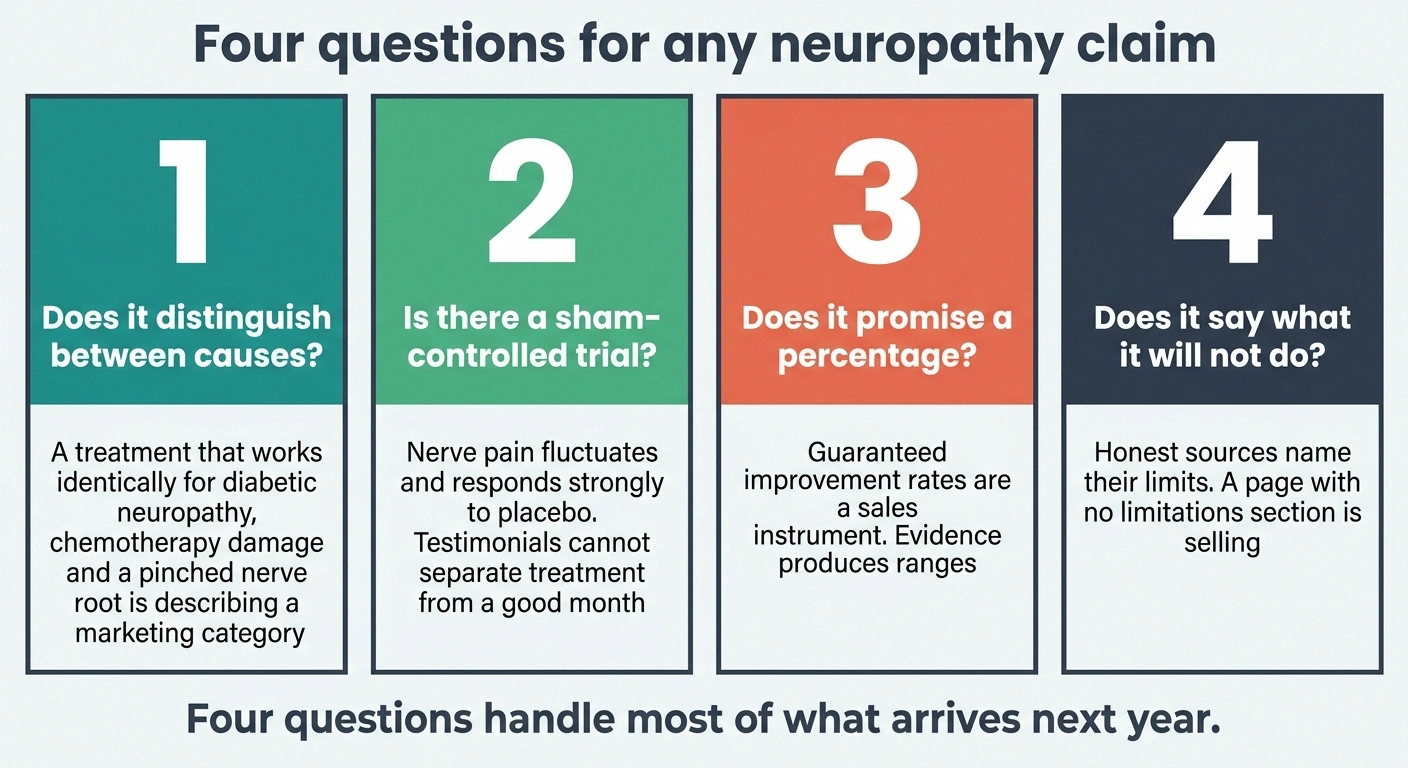
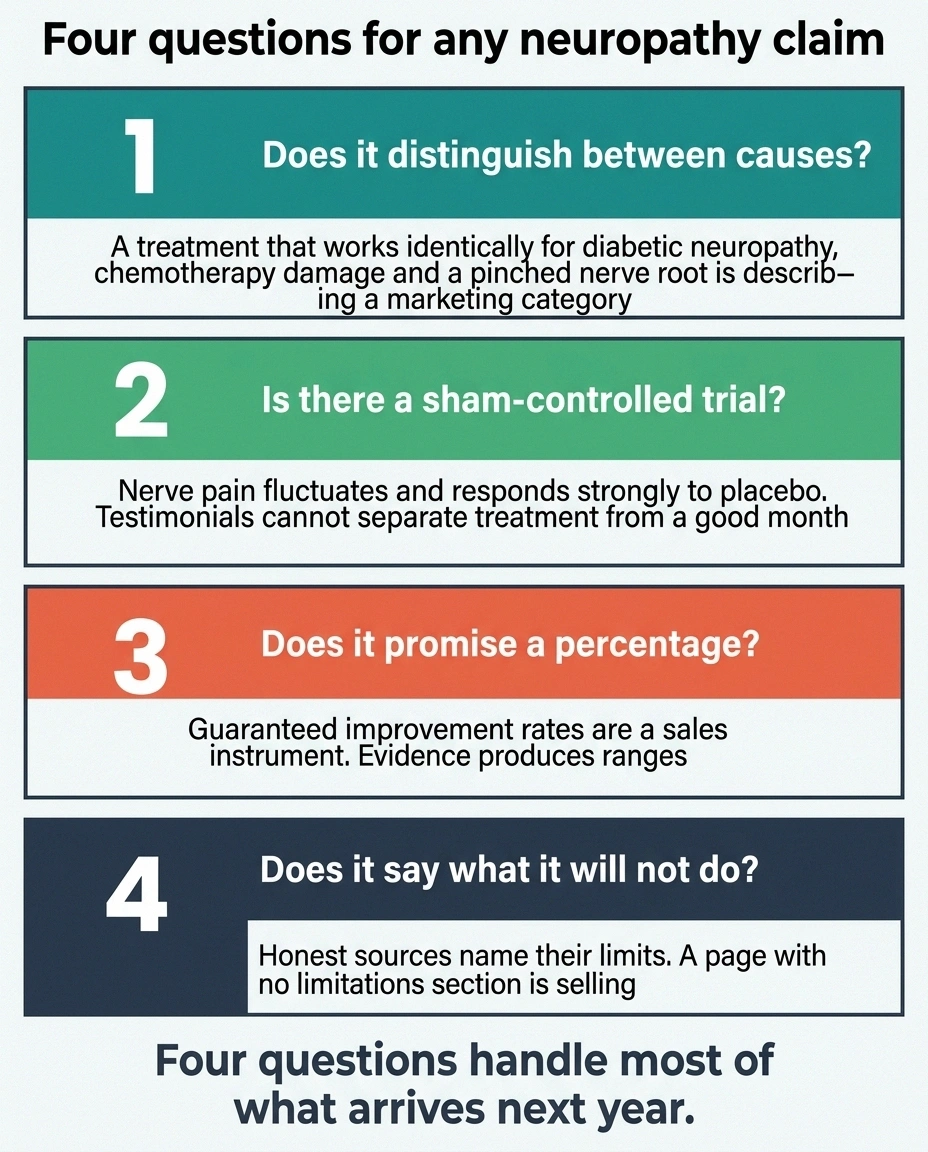
New claims arrive constantly. Four questions handle most of them.
Five phrases and what each one actually means
These appear on clinic pages and product listings constantly, and each one sounds like a credential while conveying almost nothing.
“FDA registered.” The manufacturer’s facility is on a list. It says nothing about the device or whether it works.
“Clinically proven.” An unregulated phrase. Ask which trial, how many people, and whether there was a sham group.
“Drug-free and non-invasive.” True of almost everything, including things that do nothing. It describes what a treatment avoids rather than what it achieves.
“Patients report up to 90 percent improvement.” The words “up to” carry the entire sentence. One person’s best week is enough to justify the claim.
“Addresses the root cause.” Ask which cause, in your case specifically. If the answer applies identically to diabetic neuropathy, chemotherapy damage and a pinched nerve root, it is not a cause.
None of these phrases is illegal or even unusual. They are simply not evidence, and reading them as evidence is what the page is counting on.
Does the claim distinguish between causes? A treatment that works identically for diabetic polyneuropathy, chemotherapy-induced neuropathy and a compressed nerve root is describing a marketing category rather than a mechanism.
Is there a sham-controlled trial? Nerve pain fluctuates and responds strongly to placebo. Before-and-after testimonials cannot separate a treatment from a good month.
Does it promise a percentage? Guaranteed improvement rates are a sales instrument. Clinical evidence produces ranges and confidence intervals.
Does it say what it will not do? Honest sources name their limits. A page with no limitations section is selling.
The broader numbers behind all of this, including prevalence by cause, age distribution and diagnostic rates, are collected in our neuropathy statistics reference. And if the symptom that brought you here is numb feet rather than a claim you read, working through what else causes foot numbness is a better starting point than any myth list.
Frequently Asked Questions
Does neuropathy always mean diabetes?
No. Diabetes is the largest single identified cause in high-income countries but does not account for the majority of cases. Vitamin deficiencies, chemotherapy, alcohol, thyroid and kidney disease, autoimmune conditions, infections, inherited conditions and a range of common medications all cause neuropathy. A normal blood sugar result does not rule out nerve damage.
Can neuropathy be diagnosed if my nerve conduction study was normal?
Yes. Nerve conduction studies and EMG assess large myelinated fibers and are frequently normal in small fiber neuropathy, which affects the thin fibers carrying burning, temperature and pinprick sensation. Diagnosing small fiber neuropathy usually requires a skin biopsy measuring intraepidermal nerve fiber density, or autonomic testing. A normal study narrows the possibilities rather than closing the question.
Is numbness or pain the more serious symptom?
Numbness carries more risk, even though pain causes more suffering. A foot that cannot feel injury does not report blisters, pressure sores, burns or foreign objects in a shoe, which is how small wounds become ulcers. Loss of position sense also drives falls. Pain is the symptom people report; numbness is the symptom that causes hospital admissions.
How much of neuropathy stays unexplained?
Roughly a fifth to a third remains idiopathic after known causes are excluded. The important distinction is between a case labelled idiopathic after a comprehensive evaluation and one labelled idiopathic after a blood sugar test alone. If the workup was limited, the label may be premature rather than accurate.
Can supplements repair nerve damage?
Correcting a genuine deficiency can improve or halt deficiency-related neuropathy, and B12 is the clearest example. Beyond that, no supplement has demonstrated reliable nerve regeneration in people. Peripheral nerves do regrow slowly and incompletely under favourable conditions, which is why the claim sounds credible, but that biology does not support the marketing.
Is exercise safe with neuropathy?
For most people yes, and it is among the better-supported interventions for slowing progression and improving balance. The precautions matter: proper footwear, nothing barefoot, and a foot inspection afterward to catch any injury you would not have felt.
Does neuropathy shorten life expectancy?
Nerve pain itself does not, but the associated risks are real. Falls, foot ulcers and their complications, cardiac autonomic involvement that masks the warning signs of a heart attack, and untreated inflammatory neuropathies causing permanent weakness all affect outcomes. Most of these risks respond to attention, which is the argument against treating the condition as merely uncomfortable.
About the Author