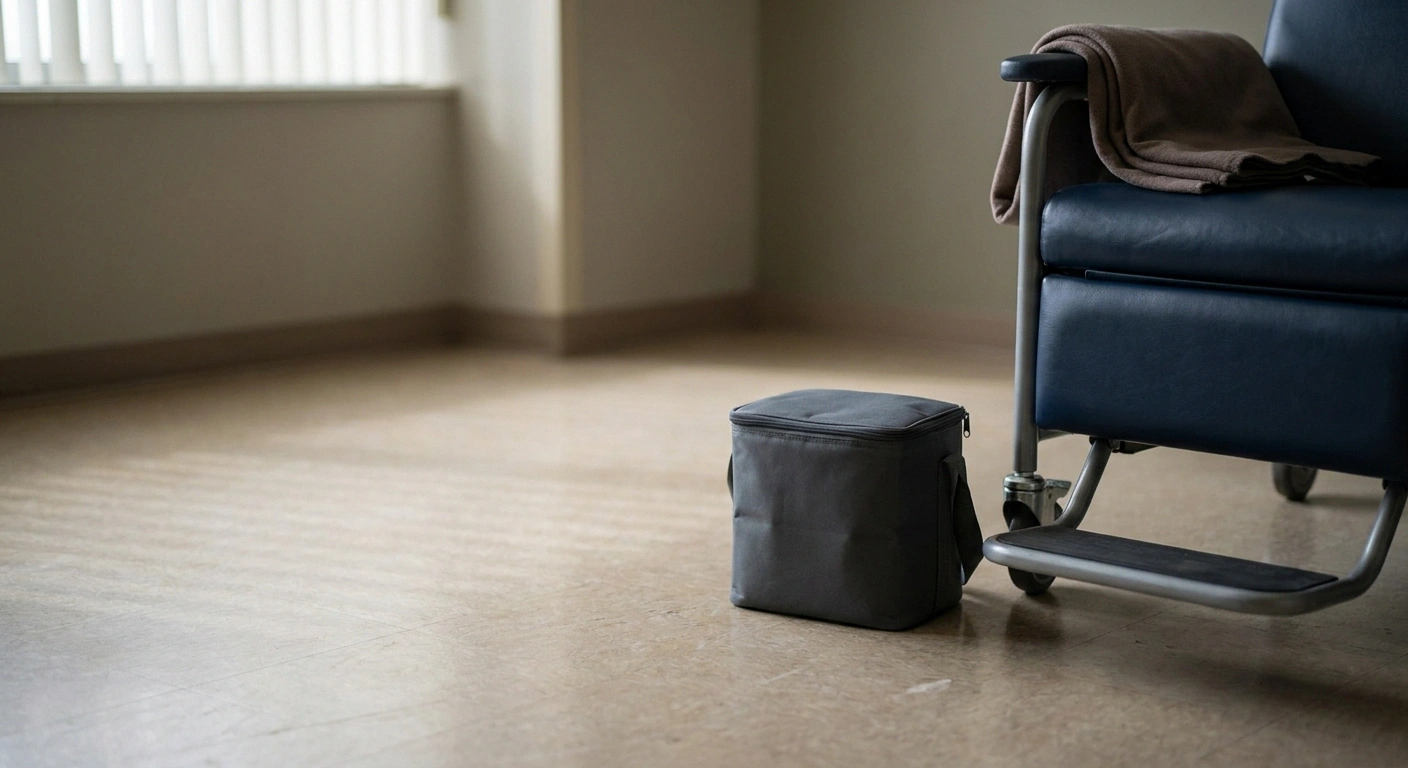
Somewhere in an infusion suite this morning, a woman is sitting with a small cooler bag at her feet and a nurse is deciding whether to let her open it.
Inside are frozen gel gloves and socks. She read about them in a forum, or a friend from her support group swore by them, and she wants to wear them during her taxane infusion in the hope of protecting the nerves in her hands and feet. Whether she is allowed to depends less on evidence than on which building she is sitting in.
That is a strange situation for something that has been studied in randomized trials. So this article does two things. It separates three different treatments that keep getting called by each other’s names, and it reports what the trials found without rounding the results in either direction. For the wider picture of what else is being tried, our guide to preventing chemotherapy-induced neuropathy covers the whole field. This page goes deep on the cold.
Three Treatments, Three Names, One Confusion
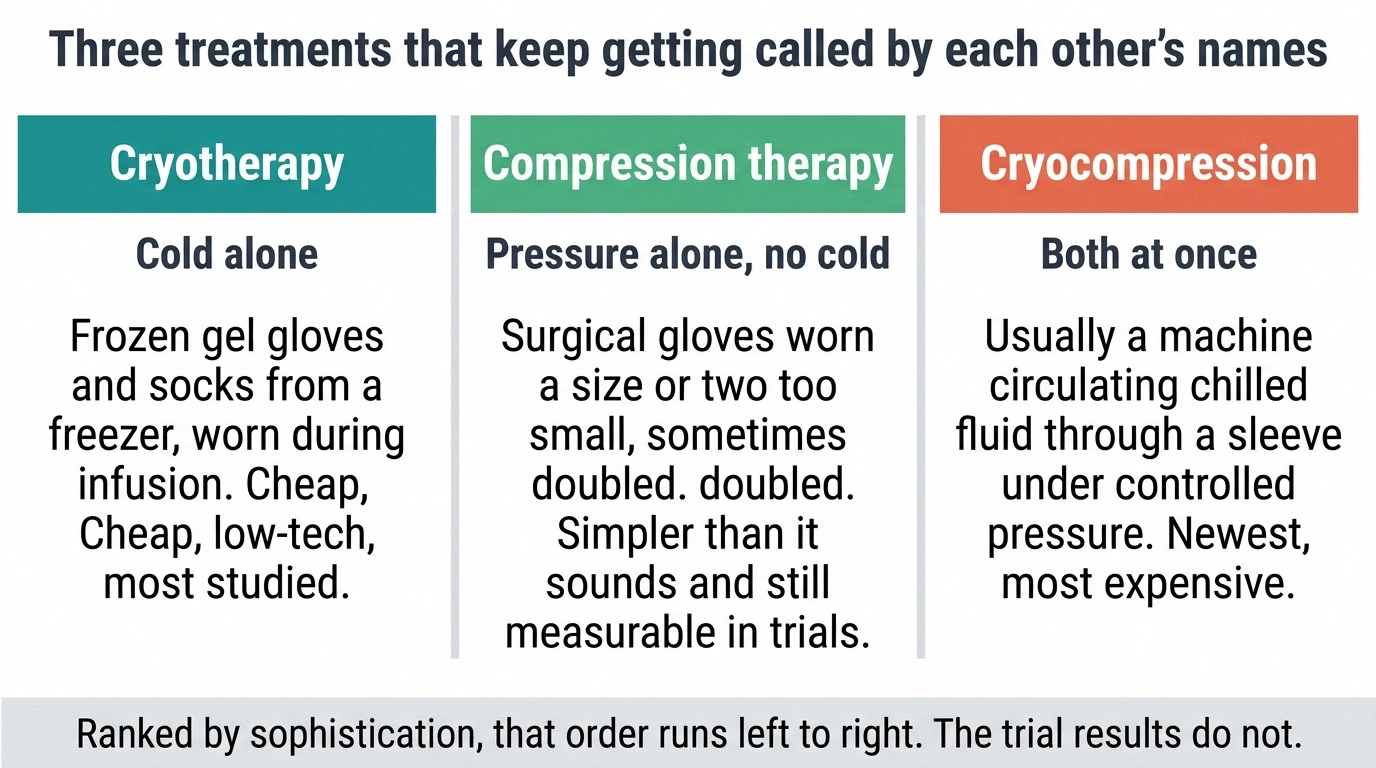
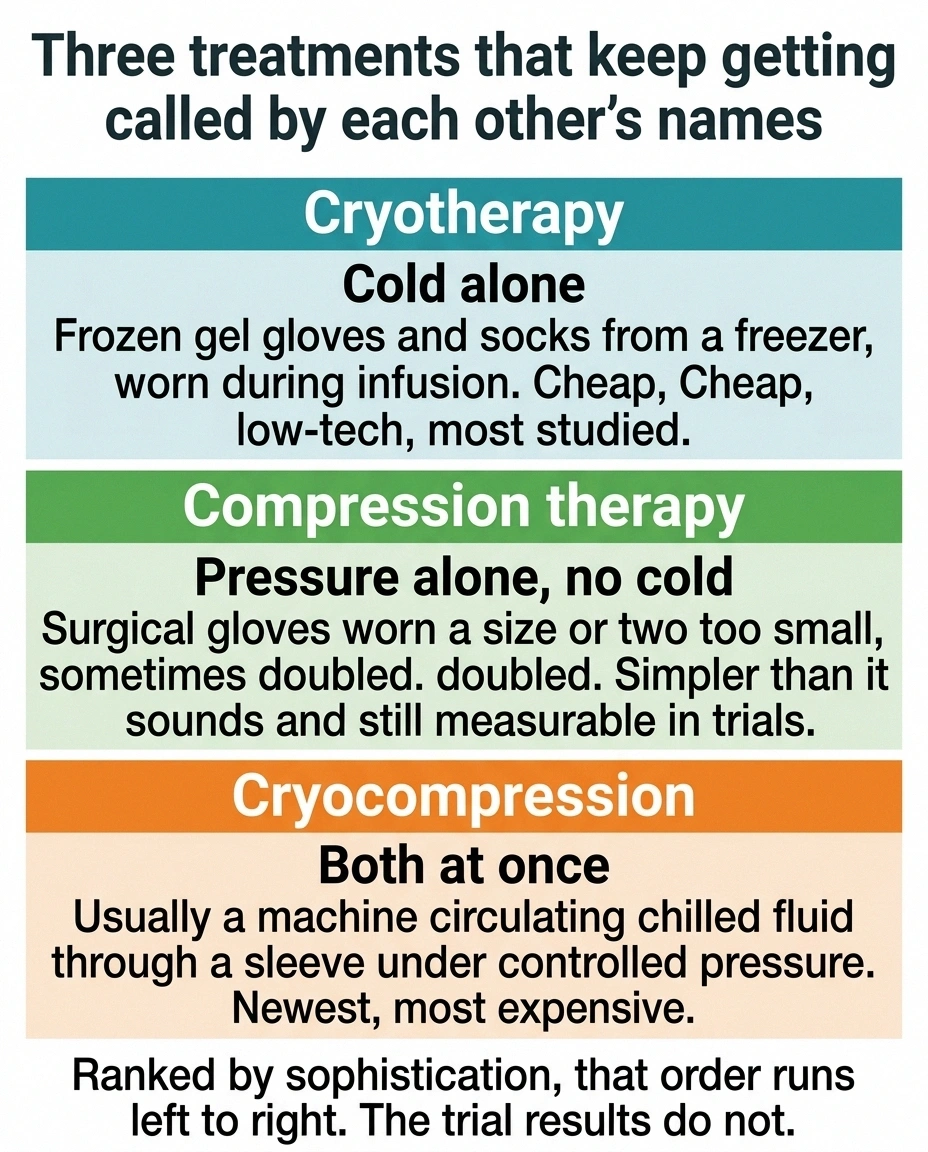
Almost every conversation about this goes sideways within a minute because people are using the same word for different things. There are three approaches, and they are genuinely distinct.
Cryotherapy is cold alone. In practice this means frozen gel gloves and socks, taken from a freezer and worn during the infusion. Cheap, low-tech, and the version most often studied.
Compression therapy is pressure alone, no cold. Usually surgical gloves worn a size or two too small, sometimes doubled. It sounds almost too simple to matter and it has still produced measurable results in trials.
Cryocompression is both at once, generally delivered by a machine that circulates chilled fluid through a sleeve while applying controlled pressure. It is the newest, the most expensive, and the one that sounds most impressive.
Hold on to that last point, because the trial results run in exactly the opposite direction from what the sophistication ranking would predict.
Why Cold Would Change Anything
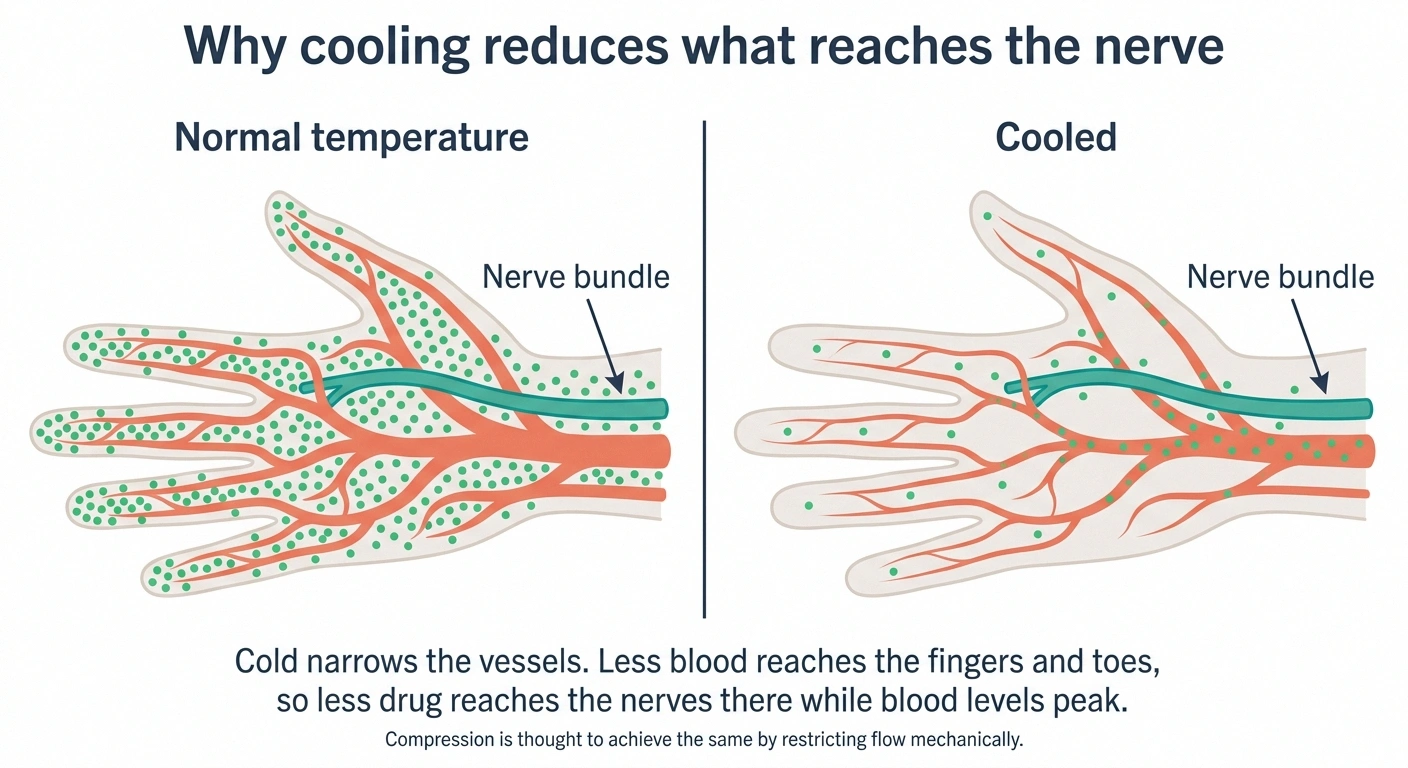
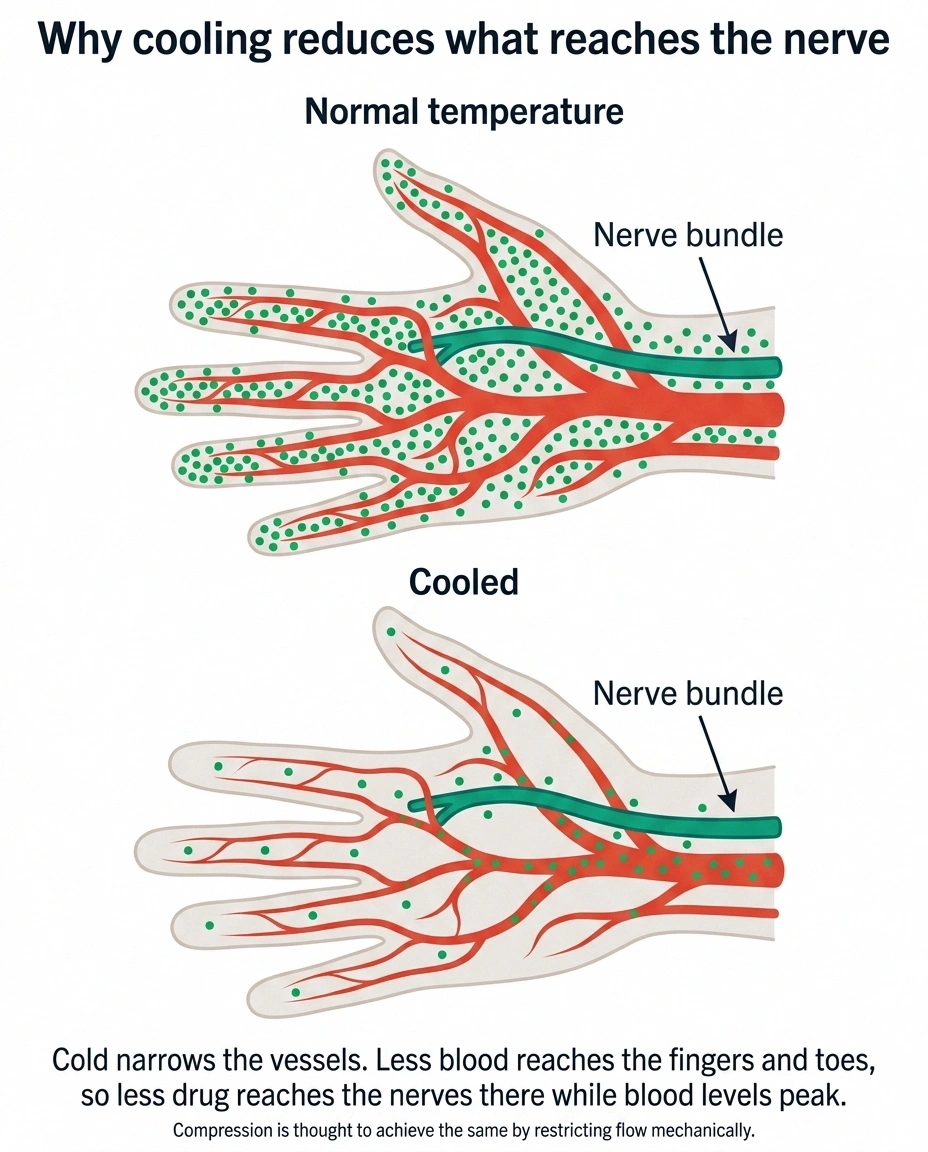
The reasoning is simple enough that it is worth stating in one sentence: taxane chemotherapy reaches your nerves through your bloodstream, so if you reduce blood flow to your hands and feet while the drug is circulating, less of it arrives there.
The evidence is drug-specific, and one drug runs the other way
| Chemotherapy | Where cold research stands |
|---|---|
| Paclitaxel, docetaxel and other taxanes | Where essentially all of the cryotherapy trials were run. If you read a study about frozen gloves, this is the setting it was in. |
| Oxaliplatin | Cold exposure can trigger acute reactions with this drug. Do not apply cold without specific direction from your oncology team. |
| Platinum agents other than oxaliplatin, vinca alkaloids, bortezomib | Little to no cryotherapy trial data. The mechanism might transfer; nobody has demonstrated that it does. |
Know which drug is in your bag before you read any study about cooling. It changes whether the finding applies to you at all.
Cold does that through vasoconstriction. Blood vessels narrow in response to cold, flow to the extremities drops, and the peripheral nerves in the fingers and toes see a lower concentration of the drug during the window when levels in the blood are highest. Compression is thought to achieve something similar by a different route, restricting flow mechanically rather than by triggering a reflex.
This is worth appreciating for what it is. Most attempts to prevent chemotherapy-induced peripheral neuropathy have gone after the biology, trying to protect nerve cells from damage with a drug or a supplement, and nearly all of them have failed. Cooling sidesteps the biology entirely. It is a plumbing solution, not a pharmacology one. That is why it remains interesting even though the results are uneven.
What the Trials Actually Found
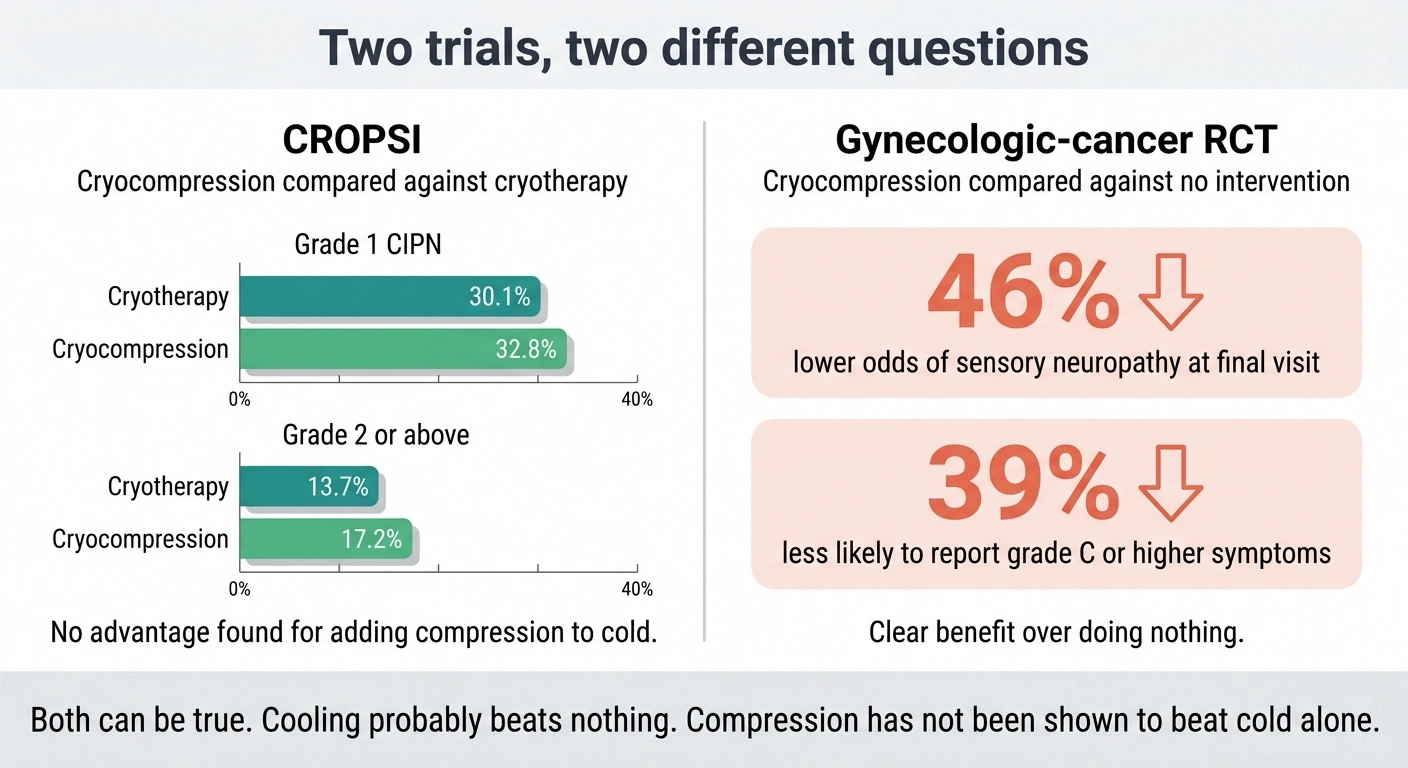
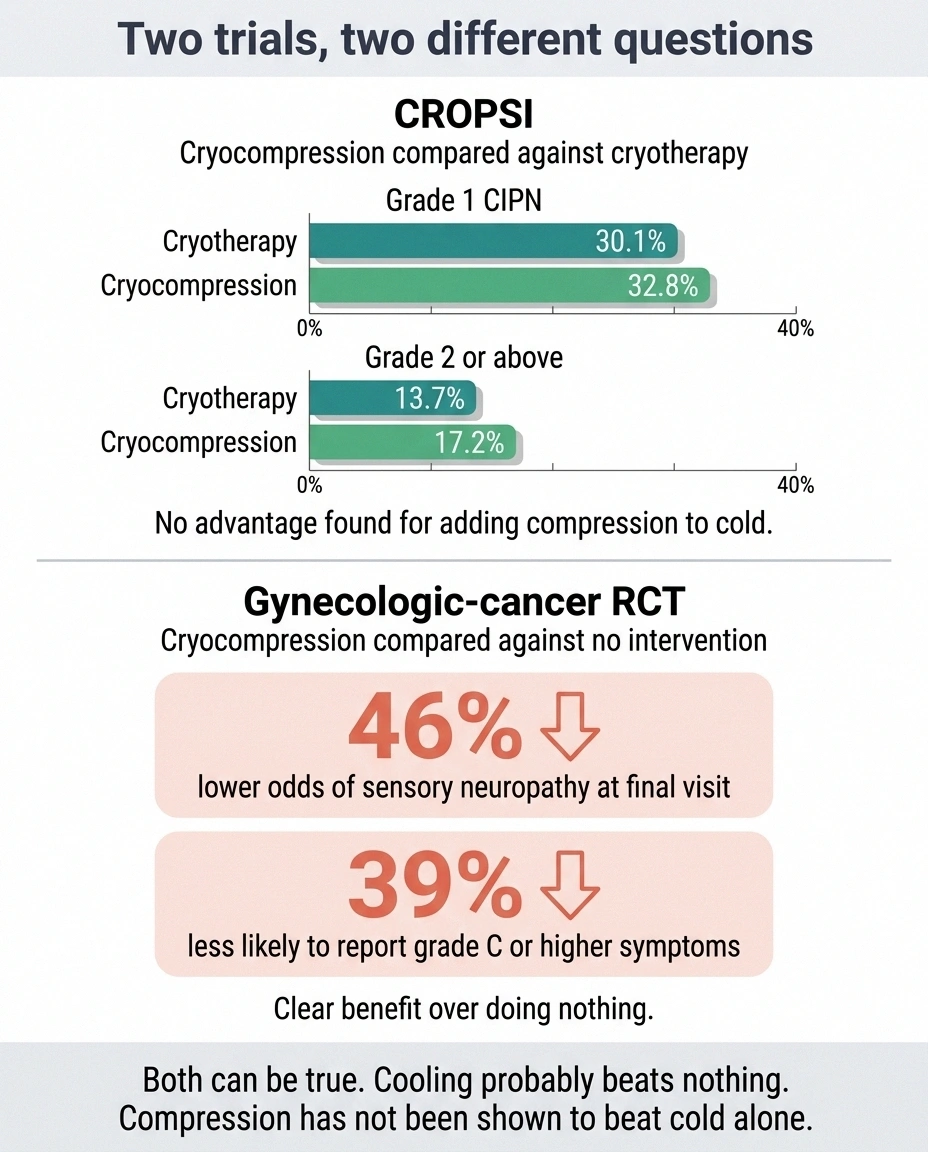
Two studies carry most of the weight, and they do not agree.
The CROPSI trial
Conducted in Innsbruck, enrolling patients between May 2020 and January 2023, CROPSI randomized people with breast and gynecological cancer receiving at least three cycles of taxane-based chemotherapy. It compared cryotherapy against cryocompression directly, which is what makes it valuable.
In the cryotherapy group, 30.1% developed grade 1 neuropathy and 13.7% reached grade 2 or above. In the cryocompression group, 32.8% developed grade 1 and 17.2% reached grade 2 or above.
Read those four numbers again. The more elaborate treatment did slightly worse on both measures. The differences are small enough that the honest interpretation is not that cryocompression is inferior, but that the trial found no advantage to adding compression to cold. That is a real finding, and it is the one most often left out of the enthusiastic write-ups.
The gynecologic-cancer randomized trial
A separate randomized controlled trial in gynecologic cancer produced a more encouraging picture for cryocompression specifically. It cut the odds of sensory neuropathy by 46% at the final visit compared with control. Patients were 39% less likely to report grade C or higher neuropathy symptoms. And more than 70% described the treatment as very tolerable at each cycle.
Note what the comparison was. This trial measured cryocompression against no intervention, which is a different question from CROPSI’s. Both results can be true at the same time: cryocompression may well beat doing nothing, while not beating a pair of frozen socks.
What the two results add up to
Cooling the hands and feet during a taxane infusion probably reduces neuropathy compared with doing nothing. Adding compression on top of cold has not been shown to improve on cold alone. A 2020 review of the whole field concluded the results were mixed, and nothing since has overturned that summary.
The trial designed to settle the question is running now. An NCORP study is comparing cooling and compression approaches head to head across multiple sites, which is the study size this question has always needed and never had.
Ninety Minutes, and What They Feel Like
The protocol used in trials is more demanding than most people picture.
The clock, for a one-hour infusion
Written as times rather than as rules, because the swap is the step people miss and it has to be scheduled, not remembered.
- Minute 0. Gloves and socks on. The infusion has not started.
- Minute 15. Infusion begins. Vasoconstriction is already established, which is the entire reason for the head start.
- Minute 40 to 55. First swap to the second frozen set. The first pair has warmed past useful by now.
- Minute 75. Infusion ends. Gloves and socks stay on.
- Minute 90. Off.
Ask for a skin check at each swap rather than judging by feel. If nerve damage has already started, your sense of how cold is too cold is the sense that is compromised.
Gloves and socks go on 15 minutes before the infusion starts and come off 15 minutes after it finishes. For a weekly one-hour paclitaxel infusion, that works out to about 90 minutes of continuous wear. And they do not stay on for the whole session, because they warm up. In the trials, they were swapped for fresh frozen pairs every 20 to 45 minutes, which means a second set in the freezer and someone to fetch them.
The temperatures used varied considerably across studies, from a relatively mild -4 to -10 C at one end up to -25 to -30 C at the other. Nobody has established the ideal temperature, and the studies that used the coldest settings were not obviously the most successful ones.
What it feels like: the first fifteen minutes are the hardest. Cold on skin that is already sensitized by chemotherapy is genuinely unpleasant, and there is a stretch where most people wonder whether they will manage it. It settles. Numbness sets in and the discomfort recedes. Then the swap comes and the first minutes repeat.
That over 70% of patients in the cryocompression trial called it very tolerable is a meaningful number precisely because tolerability is the main reason people abandon this. Somewhere between one in five and one in four will not complete it, and there is nothing wrong with being in that group.
One caution that applies specifically to this audience: if you already have nerve damage, your ability to judge how cold is too cold is compromised. That is the same principle behind our guidance on using ice packs safely with neuropathy, and it applies with more force here, not less. Ask for skin checks between changes rather than relying on what you feel.
There are also people for whom cold is the wrong tool regardless of tolerance. Raynaud’s phenomenon, cold urticaria, cryoglobulinaemia and significant peripheral vascular disease all make deliberate limb cooling a decision for your oncology team rather than a self-service one. Mention any of them before you ask about gloves, not after.
Whether Your Infusion Center Will Say Yes
This is the practical barrier, and it is a bigger one than the evidence.
Ask the oncologist, in these words, before cycle one
“I would like to use frozen gloves and socks during my taxane infusions to try to protect my hands and feet. Does this unit have a protocol for that, and if not, may I bring my own?”
Naming the drug and the specific method gets a specific answer; asking generally about cold therapy gets a general one. If the answer is no, the follow-up question is what kind of no it is. Freezer capacity is a logistics problem you can solve yourself with an insulated bag. A clinical objection is a different conversation and worth hearing out.
Cryotherapy during infusion is not standard practice, it is not in most treatment protocols, and it creates work: freezer space, staff time for changes, and a policy question about patient-supplied items. Centers therefore fall into three groups. Some have a protocol and offer it. Some have no protocol and will permit you to bring your own. Some decline outright.
How to ask, in the order that works:
- Ask your oncologist first, not the infusion nurse. It is a treatment question, and a nurse who wants to help still cannot authorize something outside policy.
- Ask specifically about cryotherapy with frozen gloves and socks during taxane infusion, naming the drug you are on. A general question about cold therapy will get a general answer.
- Ask before your first cycle if you possibly can. Prevention is the entire point, and by cycle four a good deal of the exposure has already happened.
- If the answer is no, ask what the objection is. Freezer capacity is a logistics problem you can often solve yourself with a cooler. A clinical objection is a different conversation.
There is one clinical objection worth taking seriously. Cold-induced symptoms are a known feature of oxaliplatin, where cold exposure can trigger acute and sometimes severe reactions. If oxaliplatin is part of your regimen, do not apply cold to anything without explicit direction. The cryotherapy research is almost entirely about taxanes, and the two drugs behave very differently with cold.
Doing It Yourself: What Changes and What Does Not
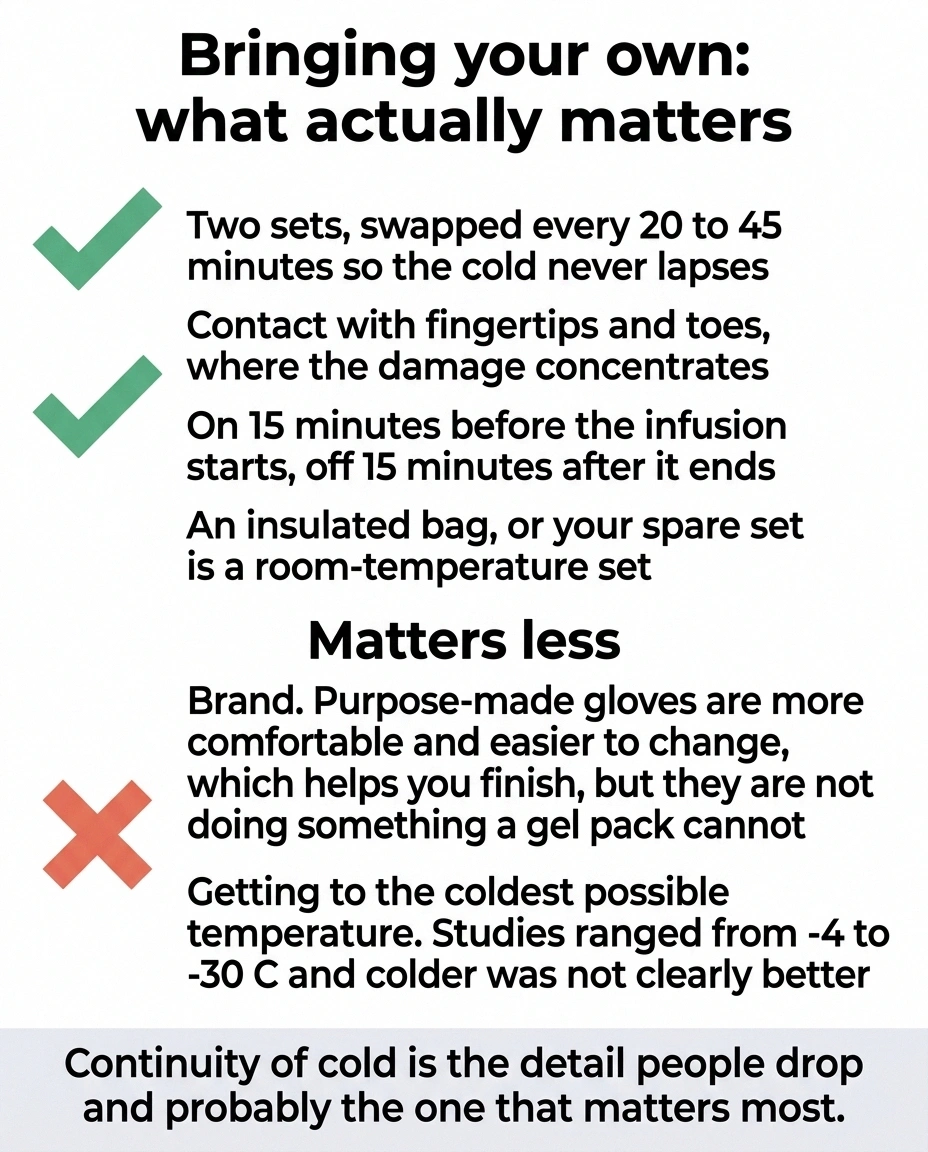
If you are supplying your own, the gap between what the trials did and what happens in a recliner with a cooler bag comes down to a few specifics.
What goes in the bag, and why each item is there
- Two full sets, not one
- A single pair worn for 90 minutes is not the intervention that was studied. The trials swapped every 20 to 45 minutes.
- A hard-sided or well-insulated cooler
- Without it, the second set is a room-temperature set by the time you need it, and you have effectively brought one pair.
- A thin liner sock or glove
- Not for warmth. It makes the first fifteen minutes survivable, which is when most people quit, and it keeps the gel making contact rather than being pulled away.
- Something to do with your hands off
- Ninety minutes with covered hands rules out a phone, a book and knitting. Audio, or company, or a screen someone else can operate.
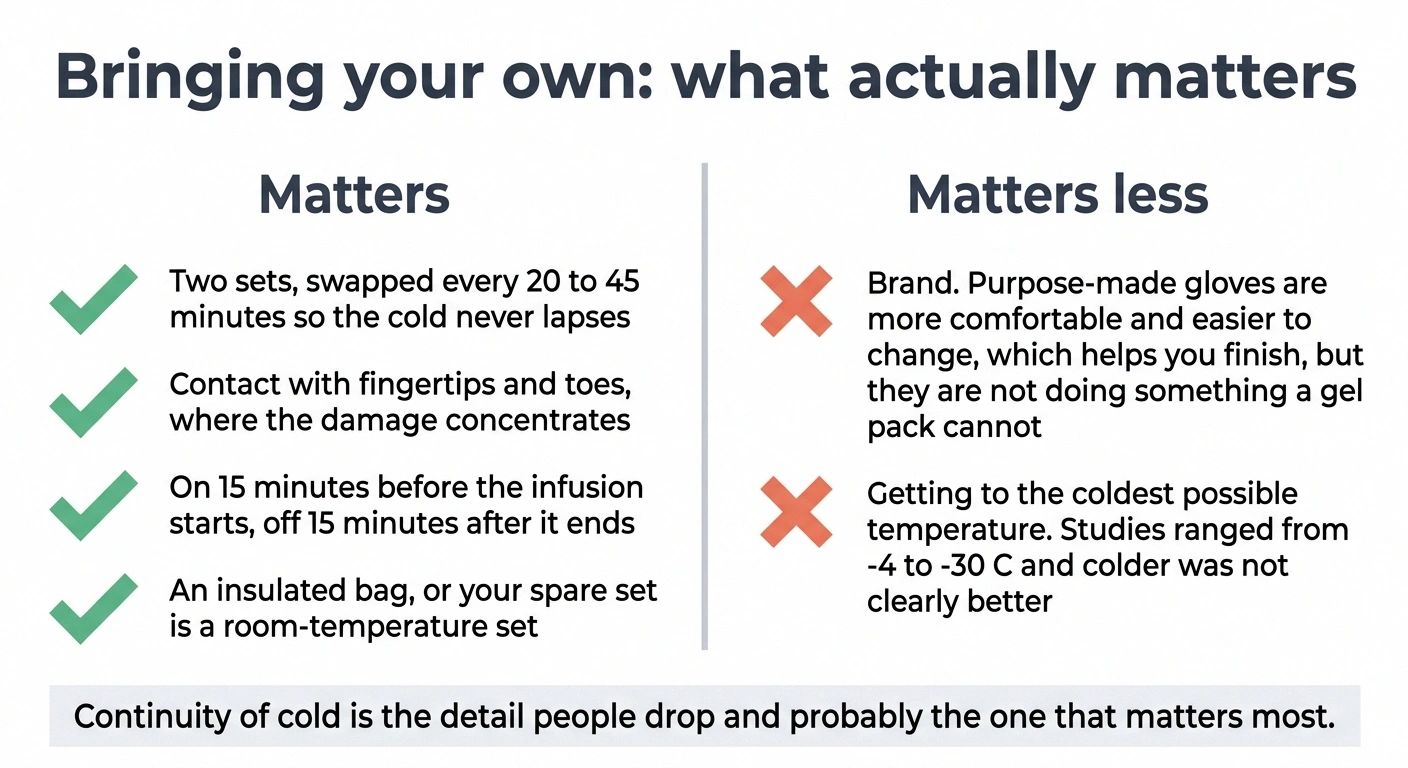
What matters most is continuity of cold. A single pair worn for 90 minutes is not the intervention that was studied. Bring two sets and swap them. This is the detail people most often drop and it is probably the one that matters most.
Coverage matters. The gel needs contact with fingers and toes, which is where the damage concentrates. Loose gloves that trap air, or ones that leave fingertips out, are doing less than they appear to.
The timing window is not decoration. Starting 15 minutes early is what ensures vasoconstriction is established before drug levels peak. Putting the gloves on as the infusion begins misses the point.
Insulation matters more than you would think. A cheap insulated bag with ice packs keeps a spare set usable for hours. Without it, your second set is a room-temperature set.
What does not matter much: brand. The studied variable is cold, delivered continuously, on the right anatomy. Purpose-made chemotherapy gloves are more comfortable and easier to change, which improves the odds you finish. They are not doing something a frozen gel pack cannot.
The Question People Are Reluctant to Ask
If cold reduces how much chemotherapy reaches your hands and feet, does it also reduce how much reaches the cancer?
It is a completely reasonable question and it deserves a direct answer rather than reassurance. The reasoning behind cryotherapy is that it works locally, restricting flow to the fingers and toes only, while leaving circulation to everything else unaffected. Tumors in the breast, the ovary, the abdomen are not in the cooled territory. The trials measured neuropathy outcomes rather than cancer outcomes, so this rests on the mechanism rather than on direct evidence, and nobody has reported reduced treatment efficacy from limb cooling.
But if this concern is what has been sitting at the back of your mind, say it out loud to your oncologist rather than deciding alone. It is the right person to ask, and it is a question they will have heard before.
Where the Cold Sits Against Everything Else
It helps to know what cryotherapy is competing with, because the field is thin.
For prevention, the honest summary is that very little has worked. A long list of supplements and protective agents has been tried in trials and mostly failed. That thin record is why a low-cost mechanical intervention with mixed but real results attracts as much attention as it does. Newer approaches are in development, including SP16, the first drug designed specifically to prevent chemotherapy nerve damage, but these are not yet available outside trials.
For treatment once neuropathy has developed, the picture is different and better. Duloxetine has the strongest evidence for established chemotherapy-related nerve pain, and mirogabalin has been compared against it in this specific setting.
Which is the argument for making the cryotherapy decision early. Prevention has one window and it is during treatment. Everything after that is management. If you are already several cycles in, the more useful move is turning attention to careful foot care and to how cold therapy is used for symptoms that have already arrived, which is a genuinely different application of the same idea.
Frequently Asked Questions
Do frozen gloves and socks actually prevent chemotherapy neuropathy?
The evidence points toward yes, with real uncertainty about how much. Randomized trials have found lower rates of neuropathy in cooled limbs than in uncooled ones, and a 2020 review of the field described the overall results as mixed rather than conclusive. The mechanism is sound and the risks are low rather than absent, which is why many people choose it despite the evidence being imperfect. Cold is not harmless for everyone: it should not be applied during oxaliplatin, and Raynaud’s, cold urticaria, cryoglobulinaemia, significant circulatory disease or nerve damage already affecting your hands and feet all need it cleared and supervised rather than self-applied.
Is cryocompression better than plain cryotherapy?
It has not been shown to be. The CROPSI trial compared them head to head and found no advantage for cryocompression, with grade 2 or above neuropathy occurring in 17.2% of the cryocompression group against 13.7% of the cryotherapy group. A separate trial found cryocompression clearly better than no treatment at all, which is a different comparison. Adding compression to cold has not yet earned its place.
How cold do the gloves need to be?
Nobody has established an optimal temperature. Trials have used ranges from -4 to -10 C at the mildest through -18 to -20 C and down to -25 to -30 C. Colder was not clearly better in the results. What did stay consistent across studies was continuity: gloves and socks were replaced every 20 to 45 minutes so the cold never lapsed.
How long do I have to wear them?
The standard protocol runs from 15 minutes before the infusion starts to 15 minutes after it ends. For a one-hour paclitaxel infusion that comes to roughly 90 minutes, with a change of gloves and socks partway through.
Does this work for oxaliplatin neuropathy?
The cryotherapy research is almost entirely in taxanes such as paclitaxel and docetaxel. Oxaliplatin behaves very differently with cold, and cold exposure can trigger acute reactions in people receiving it. Do not apply cold therapy during or after oxaliplatin without specific direction from your oncology team.
Can I bring my own frozen gloves to the infusion center?
Policies vary widely. Some centers offer cryotherapy as part of their protocol, some permit patient-supplied items, and some decline. Ask your oncologist rather than the infusion nurse, ask before your first cycle, and if the answer is no, ask whether the objection is clinical or logistical, because a freezer-space problem can often be solved with an insulated bag you bring yourself.
Will cooling my hands and feet make the chemotherapy less effective?
The intervention is designed to be local, reducing blood flow only to the fingers and toes while circulation elsewhere continues normally, so tumors outside the cooled area are not in the affected territory. No reduction in treatment effectiveness has been reported from limb cooling. The trials measured neuropathy rather than cancer outcomes, so this reasoning rests on the mechanism. If the concern is on your mind, raise it directly with your oncologist.
Is it too late to start if I am already several cycles in?
Starting late is still better than not starting, since it reduces exposure for the cycles that remain. But the benefit is proportional to how much of the treatment is still ahead of you, and prevention research is built around starting at the first cycle. If most of your regimen is behind you, it is worth shifting attention toward managing symptoms that have already developed.
About the Author