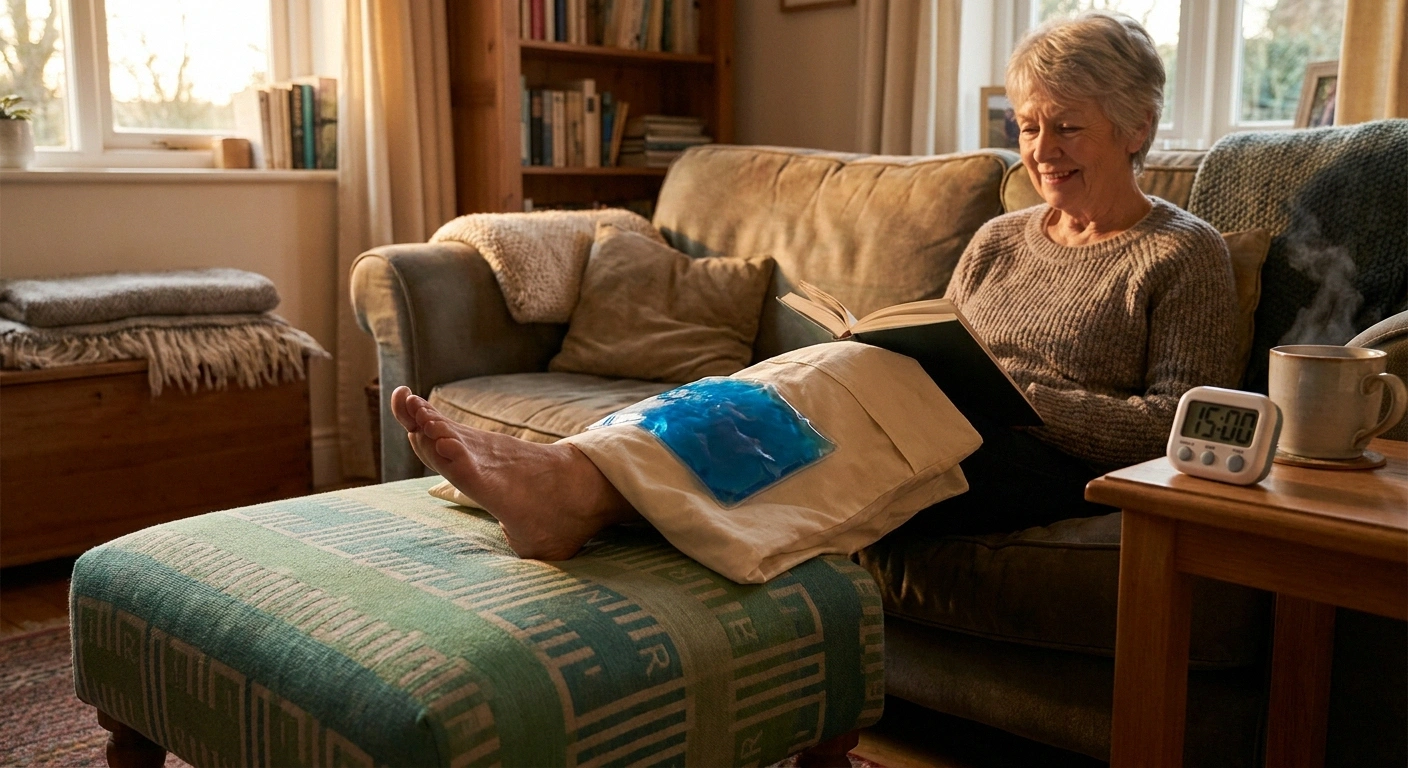
My first serious neuropathy scare with ice happened about a year into my journey. I had been on my feet all day at a family wedding — beautiful day, terrible shoes — and by evening my feet were burning. I threw a gel ice pack straight from the freezer into a thin dishtowel, wrapped it around one foot, curled up on the couch with a book, and promptly fell asleep. I woke up an hour later to a foot that was pale and dead-looking on top, with no sensation at all. It pinked up eventually, and no permanent damage was done, but it scared me straight. That night I made a rule for myself, and it is the rule I want to share with you here: cold therapy is a real tool for neuropathy, but only if you use it deliberately.
This guide is the practical safety playbook I wish someone had handed me before that couch nap. It walks through when ice can help, when it absolutely should not be used, how to apply it safely when it is the right choice, and what to do if something has gone wrong on your skin.
Why Ice Is Riskier for Neuropathic Feet
The whole reason ice can help pain — cold quiets nerve firing and reduces inflammation — is the same reason it can injure a neuropathic foot. Cold works by numbing tissue. If your feet are already numb, you have lost the early-warning system that tells a person with healthy nerves to move the ice pack before things get dangerous.
Numb feet cannot warn you when cold has crossed from helpful into damaging. An ice pack that would feel painfully cold to a person with healthy sensation can quietly cause a cold burn on a neuropathic foot. The most common home cold injury with neuropathy comes from falling asleep with an ice pack on. Set a timer. Every time. No exceptions.
A person with normal sensation feels ice go from pleasant, to uncomfortable, to painful, to intolerable — usually within 15 to 20 minutes — and takes the ice off. With peripheral neuropathy, that whole spectrum can shrink to “cool” and then straight to “damaged skin.” You bypass the warnings and land in tissue injury without any signal to stop.
The result can be anything from mild irritation to a real cold burn — the tissue equivalent of the frostbite skiers get from prolonged exposure — and in more serious cases, blistering and open wounds that are much harder to heal in a neuropathic foot than in a normal one.
The Six Golden Rules
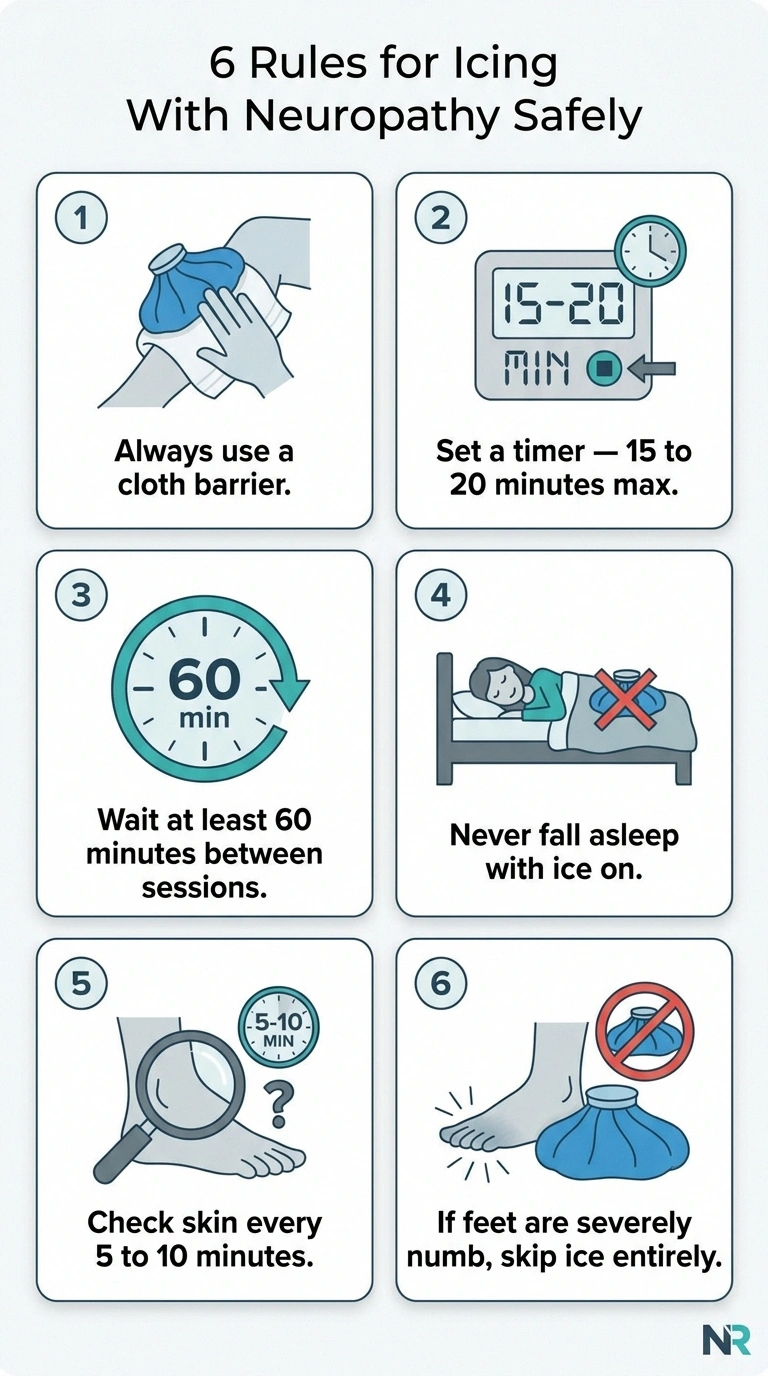
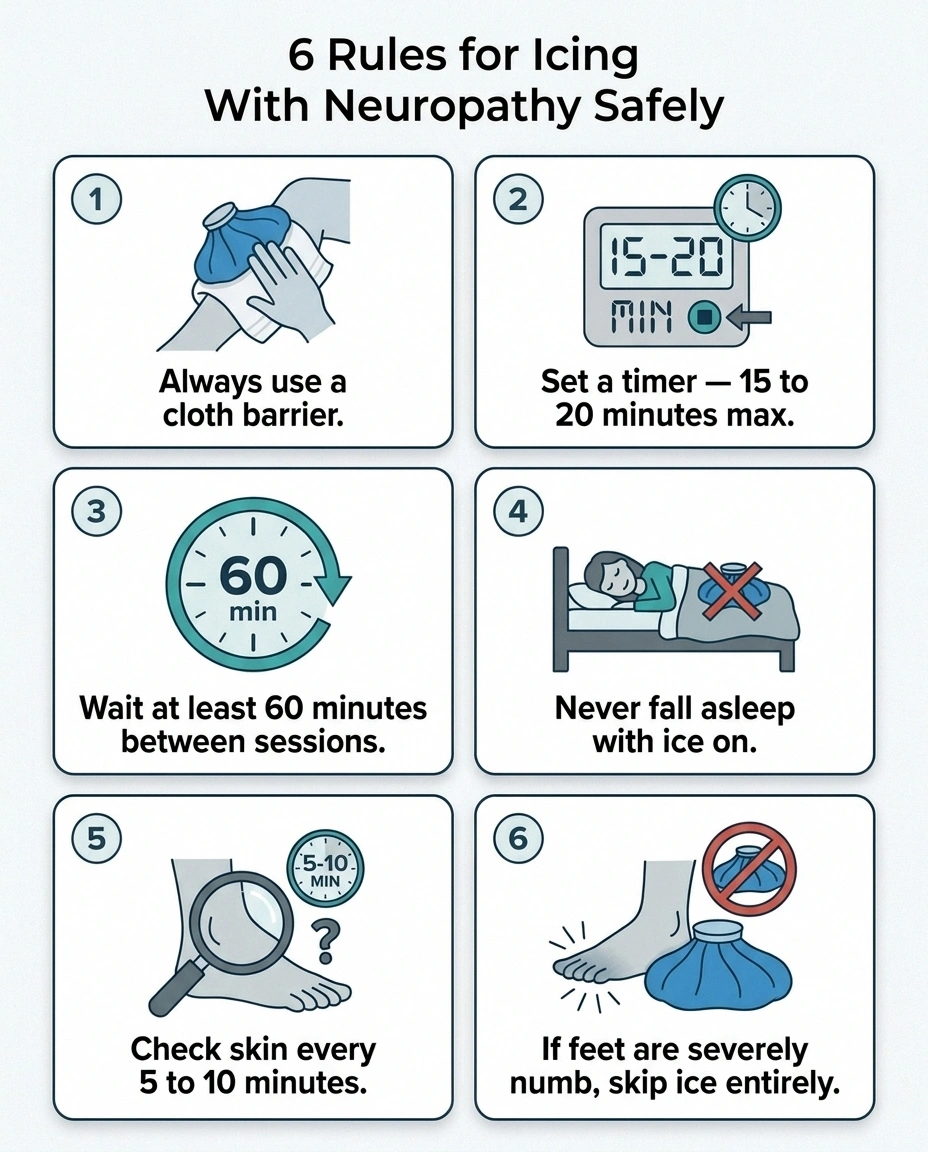
If you take nothing else from this article, take these six rules and put them on the fridge next to the ice packs.
The Six Golden Rules — Print for the Fridge
- Never put ice directly on skin. Always a cloth barrier — thin towel, pillowcase, or the padded fabric cover many gel packs come with. Direct contact is the fastest route to a cold burn.
- Set a timer. Fifteen to twenty minutes maximum per session. Do not rely on how it feels — you may not feel it accurately. A phone alarm or kitchen timer is non-negotiable.
- Wait at least an hour between sessions. Skin needs time to fully rewarm and recover before another round. Repeated back-to-back applications compound injury.
- Never fall asleep with ice on. This is the most common home injury I hear about. Set a timer. Take it off first, then rest.
- Check your skin every five to ten minutes. Look for color changes, wet-looking waxy patches, or hardness. Trust your eyes more than your sensation.
- If your feet are severely numb, do not ice them directly. Some feet are so numb that no safe amount of icing is really monitorable. In that case, use one of the safer alternatives below.
Choosing the Right Cold Pack
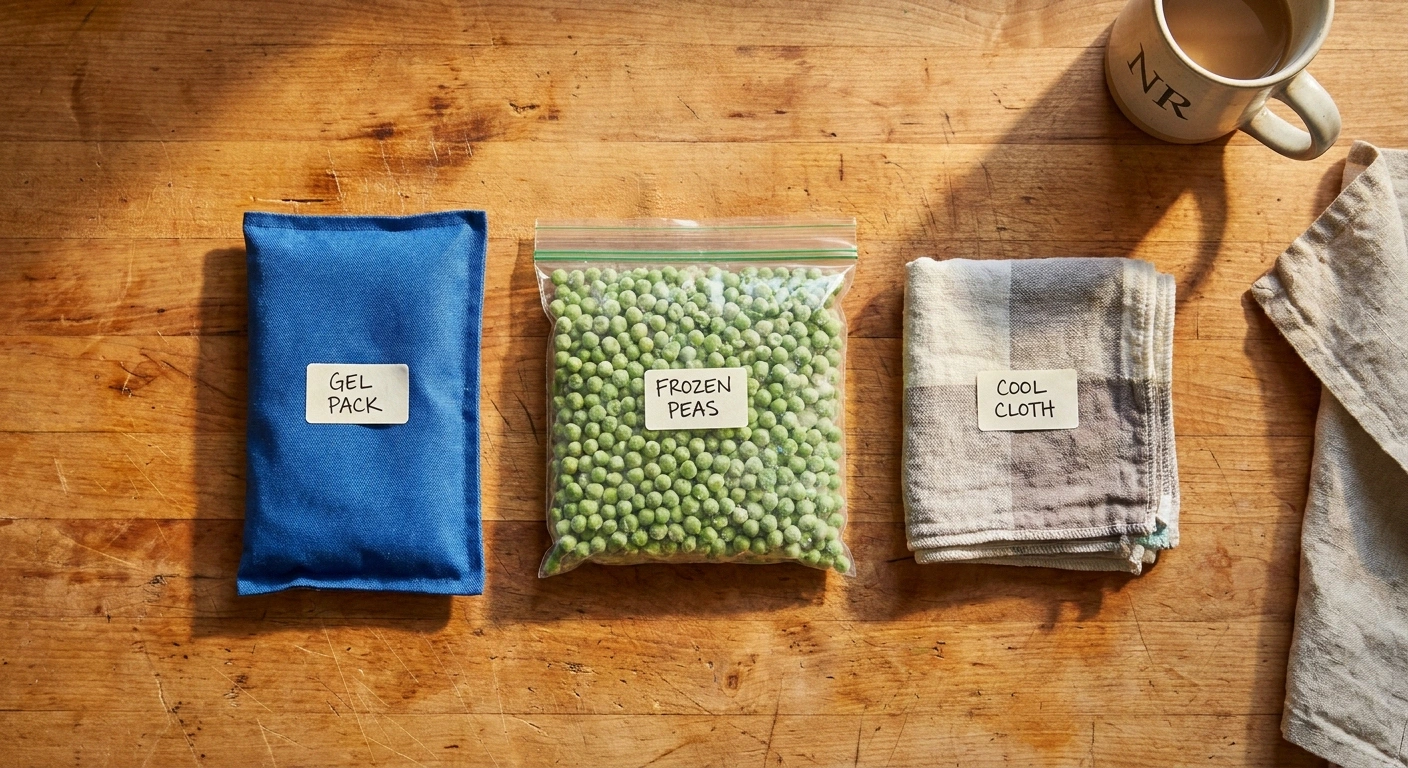
Not all “cold” is the same. Some options are gentler and more forgiving than others.
- Reusable gel packs with a fabric cover. These are usually the safest option for neuropathy. They stay flexible when frozen, conform to a joint or foot, and the fabric cover already provides a bit of buffer.
- Bag of frozen peas or corn. Old-school and surprisingly good — conforms nicely to the ankle or foot arch, warms more gradually than a hard freezer pack.
- Wet-cold compress. A damp cloth in the freezer for 10 to 15 minutes gives a cool, not brutally cold, application.
- Instant chemical cold packs (activated by squeezing). Use with extra caution — these can get colder than a fridge pack and are less predictable in temperature.
- Ice cubes in a plastic bag. Can work, but the direct-contact points where an ice cube pushes against the cloth get very cold very fast. Consider crushing the ice or using a slushy mix of ice and water in the bag instead.
Avoid entirely: ice baths, cold plunges, and prolonged submersion of neuropathic feet in cold water. Once your foot is in the water, there is no way to check the skin, and the cold surrounds every side of the tissue at once, which speeds up damage.
How Long, How Often, How Cold
Some concrete numbers to work from:
Safe Icing Numbers at a Glance
| What | Safe Range |
|---|---|
| Duration per session | 15 min default · 20 min absolute max |
| Rest between sessions | At least 60 minutes fully off |
| Max sessions per day | 3 to 4 for the same area |
| Barrier thickness | At least one folded pillowcase or dishtowel |
| Skin check frequency | Every 5 to 10 minutes during application |
- Duration per session: 15 minutes is a good default; 20 minutes is the absolute upper limit.
- Rest between sessions: at least 60 minutes fully off, longer if the skin still feels cold or looks pink.
- Maximum sessions per day: three to four applications for the same area is plenty.
- Ideal temperature: cool to cold, not freezing. A gel pack that has been in the freezer for a couple of hours and then out on the counter for two or three minutes is often the sweet spot.
- Barrier thickness: at least one folded pillowcase or dishtowel. If your feet are quite numb, add another layer.
If you find you need to ice more than four times a day for pain relief, that is a signal to revisit your overall pain plan with your doctor, not to ice more.
When Cold Therapy Is Absolutely Not Safe
A few specific medical situations make cold therapy dangerous — not just risky. If any of these apply to you, do not use ice packs at all without talking to your doctor first.
- You have Raynaud's phenomenon — cold triggers severe vessel spasm
- You have cryoglobulinemia or cold agglutinin disease
- You have cold urticaria (cold-triggered hives)
- You have peripheral vascular disease with poor circulation
- You have open wounds, ulcers, or fresh sores on the area
- You have a history of recent frostbite
- Your neuropathy is so advanced that you have essentially no sensation
Not sure if any of these apply? Ask your doctor before starting any cold therapy routine.
- Raynaud's phenomenon. Cold triggers severe blood vessel spasm and can cause tissue damage.
- Cryoglobulinemia or cold agglutinin disease. Cold-triggered blood proteins can cause circulation problems.
- Cold urticaria. A rare condition where cold triggers hives and, in serious cases, systemic reactions.
- Peripheral vascular disease with poor circulation. Reduced blood flow means the tissue cannot rewarm properly after cold, greatly increasing injury risk.
- Open wounds, ulcers, or fresh sores. Cold slows healing and worsens tissue damage.
- Recent frostbite injury. Previously injured tissue is far more vulnerable to repeat damage.
- Very advanced neuropathy with essentially no sensation. Without any temperature warning at all, safe monitoring becomes impossible.
If you are not sure whether you fall into any of these categories, ask your doctor at your next visit. It is a two-minute conversation that can save you a lot of grief.
Signs of a Cold Injury on Your Skin
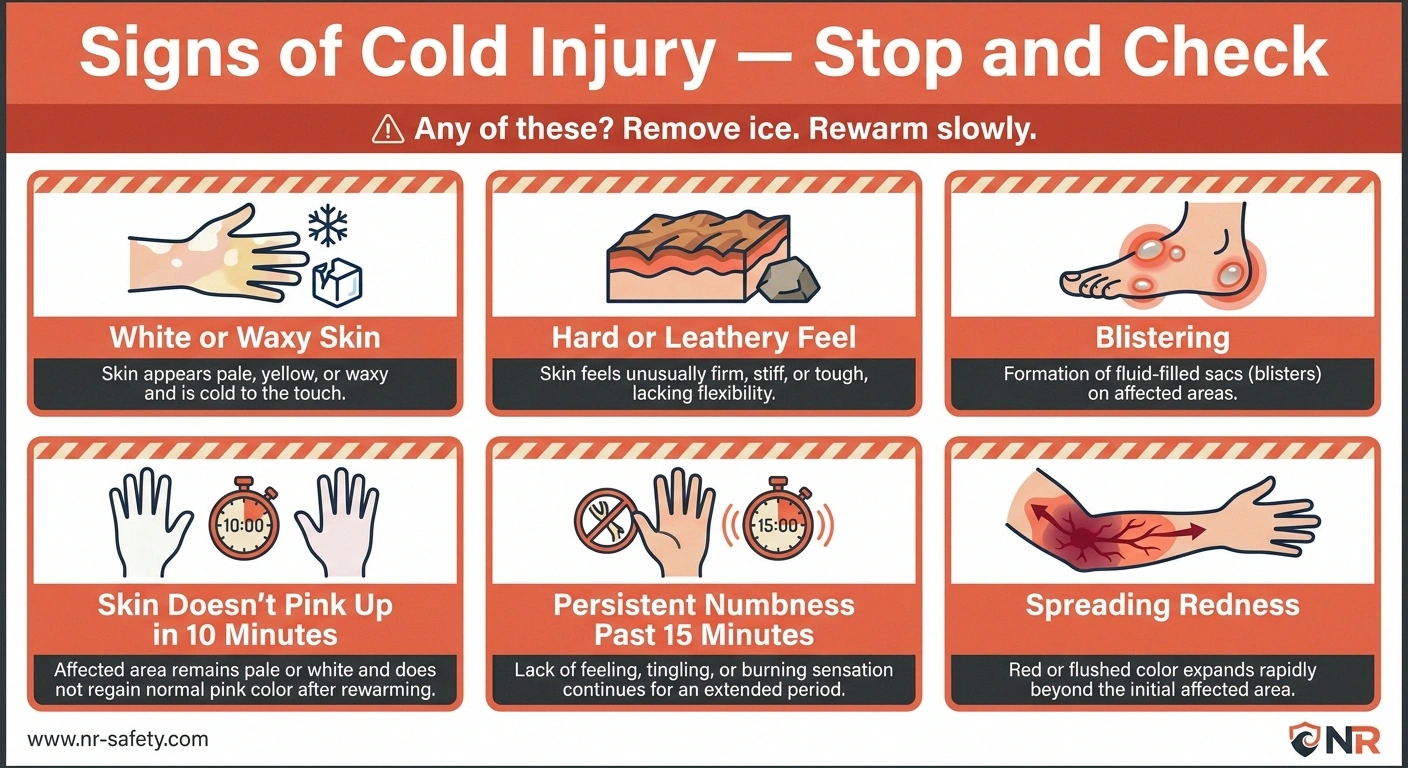
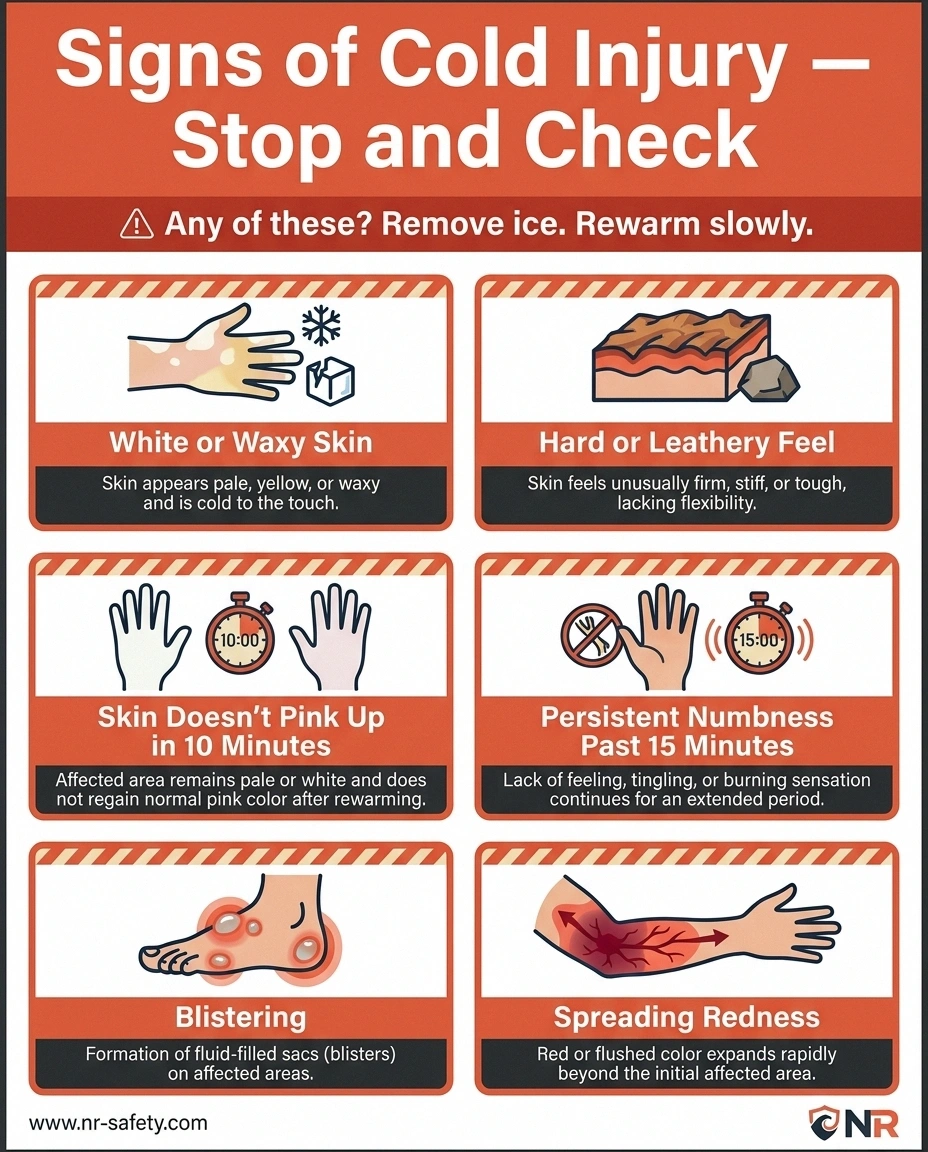
These are the things to look for during and after any cold application. If you see any of them, treat as a cold injury.
- Skin looks white, gray, or waxy after removing the ice.
- Skin feels hard, wooden, or like leather to the touch.
- Blisters — clear, cloudy, or blood-filled.
- Skin does not pink up within five to ten minutes of removing the ice.
- Numbness that persists more than fifteen to twenty minutes after removing the cold.
- Increasing pain after the ice comes off (some pain during rewarming can be normal, but progressive worsening is not).
- Streaks of red spreading out from the treated area (a sign of tissue reaction or, rarely, infection).
A helpful memory trick: healthy skin after ice comes off should be pink and pain-free within about ten minutes. Anything else is a signal.
What to Do If You Think You Have a Cold Injury
If you notice signs of injury, act calmly but promptly. Here is the sequence:
Cold Injury First Aid — Step by Step
For anyone with diabetes: any suspected foot cold injury deserves same-day medical attention.
- Remove the cold source immediately. Do not put it back on later “to keep the swelling down.”
- Rewarm slowly in tepid water. Water temperature between 98 and 102 degrees Fahrenheit — about body temperature, or a hair warmer. Test with your elbow, wrist, or a thermometer. Do NOT use hot water — hot water on cold-injured tissue can burn.
- Do not rub, massage, or scrub the area. Cold-injured tissue is fragile and rubbing can cause more damage.
- Do not use direct dry heat. No heating pads, no hair dryers, no fireplaces. Slow, gentle, moist rewarming only.
- Cover loosely with a clean cloth. Blisters should not be popped.
- Elevate the affected foot or hand slightly.
Call your doctor or go to urgent care if: skin is white, waxy, and painless (a deep cold burn); you see blisters forming; the numbness has not returned to normal after an hour; or you have any signs of infection in the following days (spreading redness, warmth, oozing, fever). For anyone with diabetes, any wound on a neuropathic foot deserves same-day medical attention. Slow-healing feet do not forgive mistakes the way healthy feet do.
Safer Alternatives When Ice Is Off the Table
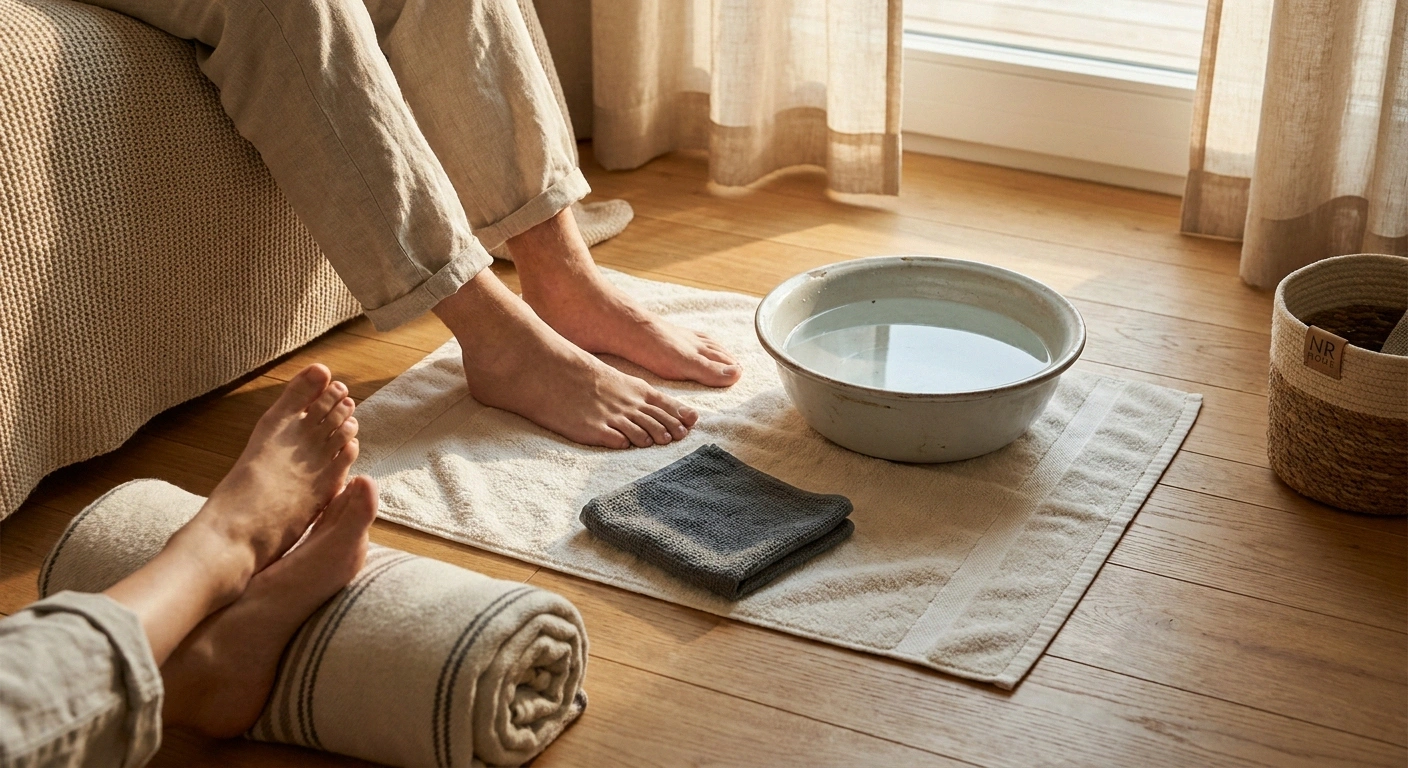
If you cannot use ice safely — or you have decided the risk-reward ratio is not right for you — there are other ways to bring the pain down.
- Cool foot soak (not cold). A basin of water around 60 to 70 degrees for 10 to 15 minutes. Comfortable, checkable, much lower injury risk. See our guide to neuropathy foot soaks for recipes.
- Compression. Well-fitted compression socks reduce the burning and swelling many people ice to fix, without any temperature at all.
- Elevation. Lie down with feet propped 6 to 12 inches above heart level for 15 to 20 minutes.
- Menthol or cooling gels. Products with menthol create a cooling sensation by activating skin receptors without actually dropping tissue temperature. The safest way to get “cool” without cold.
- Cool room, thin bedding. For nighttime burning feet, sleeping in a cooler room with a light cotton sheet is a passive form of cooling that is very hard to overdo.
- A cool damp washcloth. Take a clean washcloth, wet with cool tap water, wring out, drape briefly on the feet. Rewets easily. Very gentle.
- Distraction and relaxation. Not glamorous, but a calming activity — reading, a guided breathing app, a short walk in a cool part of the house — can drop pain perception meaningfully.
Cold Therapy Is Not the Same as Chronic Neuropathic Pain Treatment
One honest piece of context I want to add. Cold therapy is a symptom-management tool, not a treatment for the underlying neuropathy. A gel pack for an hour on a burning-foot evening can be a real comfort. It will not slow the progression of neuropathy, reverse nerve damage, or replace the actual medications and lifestyle changes that address the underlying cause.
If your feet are burning most nights and you are icing regularly to cope, that is worth a specific conversation with your doctor about your medication plan, blood sugar control, vitamin levels, and other pieces of your neuropathy management. Ice is a bandage, not a fix.
My Simple Nightly Rule
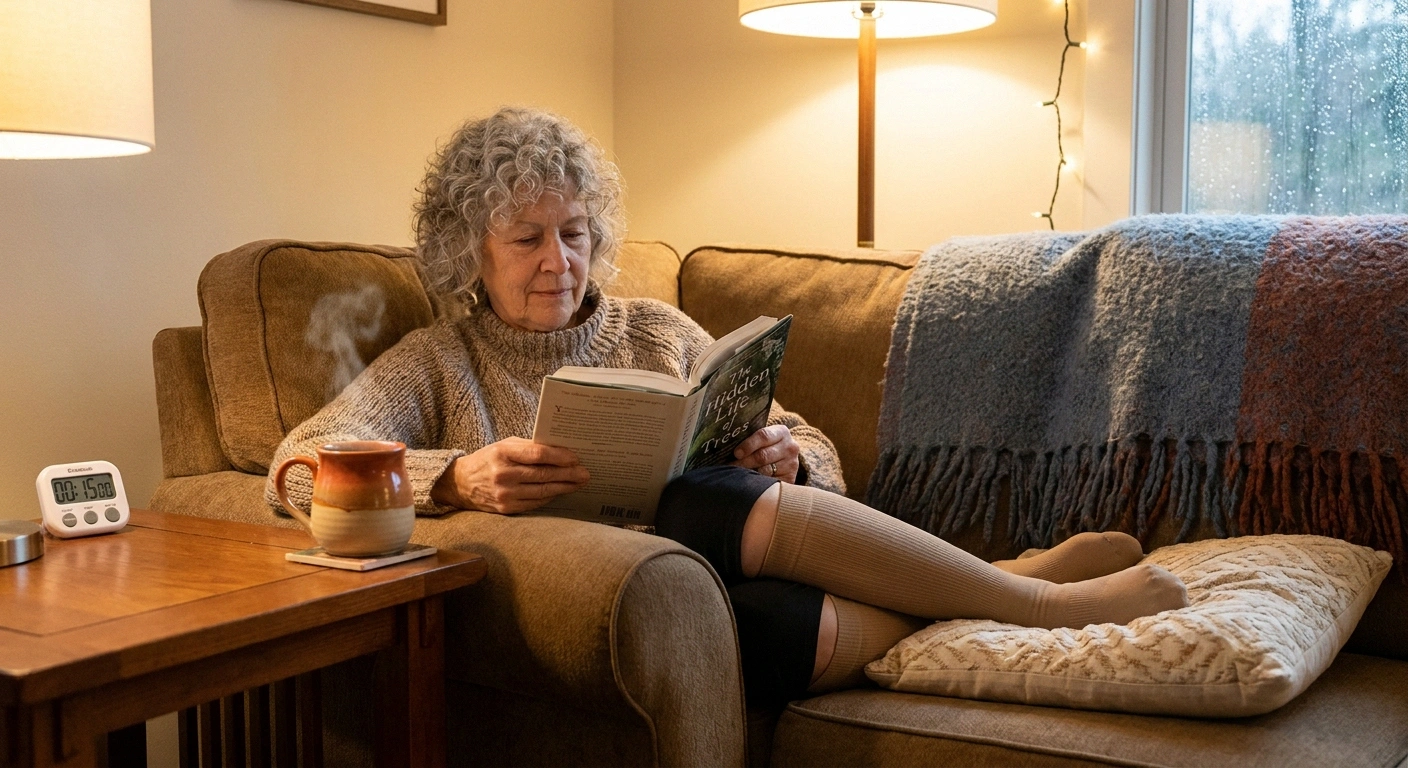
Here is the rule I have been using since that couch-nap wedding night, and it has kept me out of trouble for years:
Boring on purpose. Foot care with neuropathy needs to be repeatable, predictable, and safe.
If I need cold for my feet, I sit up on the couch (never in bed), I put the gel pack over a folded pillowcase, I set the timer for 15 minutes, I check my skin at the halfway point, and I am done with cold for the night once the pack comes off. If my feet are still burning after that, I use compression socks, a cool room, and a distraction — not another ice pack.
Boring? Absolutely. And that is the whole point. Nothing about foot care with neuropathy needs to be exciting. It needs to be repeatable, predictable, and safe.
Frequently Asked Questions
Can I put an ice pack directly on my numb feet?
No. Always use a cloth barrier — a folded pillowcase or thin dishtowel at minimum. Numb skin is exactly the skin that cannot signal you when the cold has crossed from “helpful” into “damaging.” Direct contact is the fastest way to develop a cold burn, and cold burns on neuropathic feet heal slowly. If you find yourself wanting more cold, add time to your session (up to 20 minutes) rather than reducing the barrier.
How long can I safely leave an ice pack on with neuropathy?
Fifteen minutes is a good default. Twenty minutes is the absolute maximum. Then a full 60-minute break before applying again. Set a timer every single time — do not rely on how it feels, because your feet may not be reporting temperature accurately. If you fall asleep, the ice keeps working while your normal alarm system is offline. This is the most common way home cold-injury happens.
What if my feet are so numb I cannot feel the ice at all?
That is a red flag. If your sensation is so reduced that you cannot tell the pack is even there, you have lost every layer of your safety system. In that situation, skip ice packs entirely and use safer alternatives: a cool foot soak at 60 to 70 degrees, elevation, compression socks, or menthol cooling gels. These give you cooling relief without the injury risk. Talk to your doctor if you are relying on ice regularly and are also this numb — it is a sign the overall plan needs adjustment.
Is a cold plunge or ice bath safe for neuropathy?
No, and this is an important point in the era when cold plunges have become fashionable. Immersion cold surrounds your feet on every side, cools much faster than a targeted pack, and gives you no way to inspect the skin during use. For neuropathic feet, the injury risk is meaningfully higher than for targeted ice pack use — which is already risk-managed. If you want the general wellness benefits of cold exposure, most experts recommend keeping neuropathic extremities out of the water and using cold on just the trunk or upper body instead.
Does cold therapy actually help nerve pain?
It can provide short-term symptom relief for some people, especially for burning feet from diabetic neuropathy. Small studies have shown modest short-term reductions in burning sensations with brief cold pack applications. That said, the benefit is symptomatic and temporary — cold does not treat the underlying nerve damage, and repeated use carries the risk we have covered. Use it as a comfort tool during flares, not as the mainstay of your pain plan.
Are cold gel packs safer than ice cubes?
Generally yes, especially the reusable fabric-covered kind. They conform to the foot shape, stay flexible, and warm more gradually. Ice cubes have sharp points that concentrate cold at contact points and can drop tissue temperature very quickly at those spots. If you use ice cubes, crush them first or make a slushy in a plastic bag by mixing ice and a little water — the slush conforms better and delivers cold more evenly.
What signs mean I have hurt my skin from ice?
Skin that looks white, gray, or waxy after removing the pack; skin that feels hard or leathery; blisters; skin that does not pink up within 10 minutes; numbness that persists more than 15 to 20 minutes past removal; or pain that gets worse after the ice comes off. Any of these means the tissue is injured. Rewarm slowly in tepid (not hot) water, cover loosely with a clean cloth, do not rub, and contact your doctor. For anyone with diabetes, any suspected foot cold injury deserves same-day medical attention.
Can I ice my feet at night to help me sleep?
Not while you are in bed and not while you might fall asleep. Never with a heating or cooling device active while you sleep. If cold helps you settle before bed, do it sitting up on the couch with a timer, take it off before you lie down, then use safer nighttime measures — a cool room, thin cotton bedding, elevated feet on a pillow, compression socks if you tolerate them — to keep the effect going through the night. Falling asleep with an ice pack on is how the majority of home cold injuries happen.
About the Author


