
There is a particular kind of frustration that arrives with a normal lab result.
Your feet burn. Your balance is off in the dark. You mentioned B12 because someone in a support group said to, and your doctor ordered it, and the number came back at 340, and 340 sits comfortably inside the reference range, so the conversation moved on to something else.
Except your feet still burn.
What almost nobody explains in that appointment is that the standard B12 test does not measure the thing you actually care about. It measures a pool of B12 in your blood, most of which your cells cannot use. There are other tests that ask better questions, and one of them, active B12, is the reason this article exists.
The Two Kinds of B12 in Your Blood
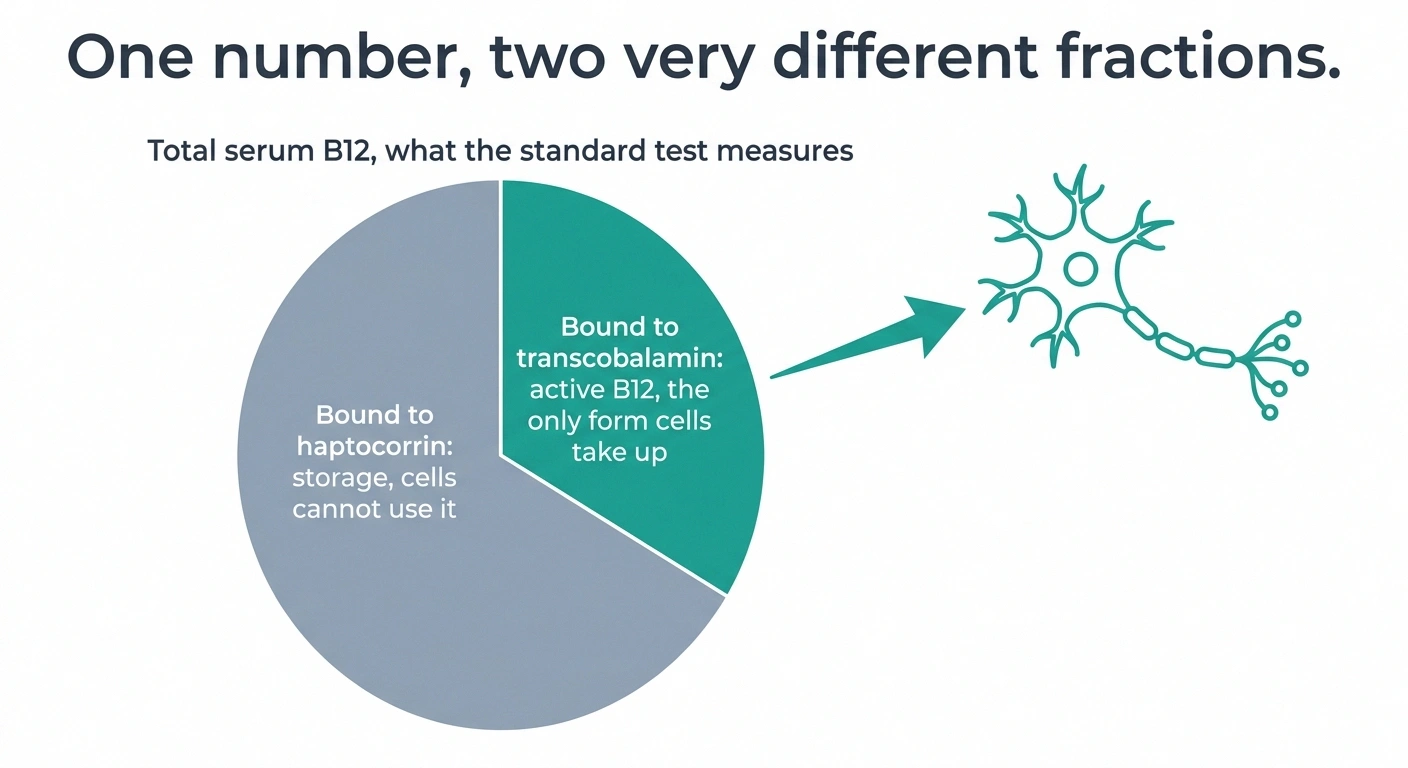
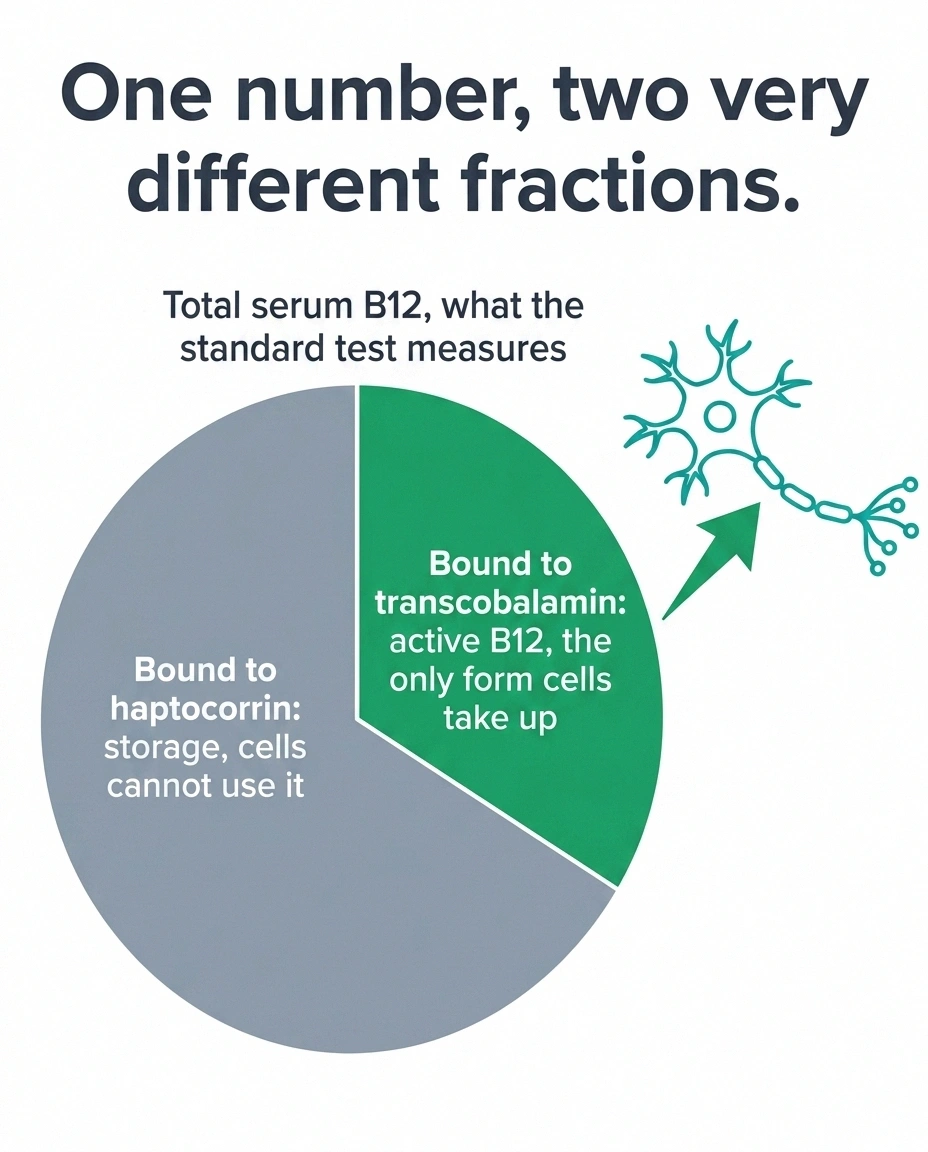
B12 does not float around loose. It travels bound to carrier proteins, and which carrier it is attached to determines whether your cells can do anything with it.
Most of the B12 in your bloodstream, commonly cited as roughly three quarters of it, is bound to a protein called haptocorrin. Haptocorrin-bound B12 is essentially in storage. Your nerve cells cannot pull it in and use it.
The rest is bound to transcobalamin, and that fraction is the working supply. Transcobalamin is the delivery protein. It is the only form your cells can take up. This bound complex has a name, holotranscobalamin, and the test that measures it goes by the friendlier label active B12.
Now hold those two facts against a standard B12 test. The standard test measures everything, storage and delivery together, in one number. Which means a total that looks reassuring can be carrying a small delivery fraction underneath it, and the test has no way to tell you that. This is not a rare quirk. It is the built-in limitation of measuring a pool when what matters is the flow.
Why Nerves Are the First Thing to Complain
B12 sits at the centre of two jobs that nerves depend on more than most tissues.
The first is maintaining myelin, the fatty insulation wrapped around nerve fibres that lets signals travel quickly and cleanly. When B12 runs short, myelin maintenance falters. Signals slow, misfire, or arrive garbled, which your brain interprets as tingling, burning, buzzing, or numbness.
The second is a metabolic step that clears a compound called methylmalonic acid. Without enough B12, that step stalls and methylmalonic acid accumulates. Remember that, because it turns into a test in a moment.
Here is the part that catches people out. B12 deficiency is filed in most minds under anemia, and the neurological damage is treated as a late complication of the blood problem. That is backwards often enough to matter. Nerve symptoms, tingling, burning feet, poor balance, memory change, can show up before any anemia appears. Waiting for a blood count to go abnormal before taking B12 seriously means waiting through the window where the damage is still most reversible.
Our overview of vitamin deficiencies that cause neuropathy covers the wider group, but B12 is the one where the testing question is genuinely thorny.
Four Tests, Four Different Questions

Guidance on diagnosing B12 deficiency recognises four biomarkers, and their accuracy varies between patient populations rather than one simply beating the others everywhere. It helps enormously to think of them as four different questions rather than four attempts at the same one.
Four markers, four separate questions
Accuracy varies between patient groups, so no single marker wins in every situation. Reading them as a sequence is more useful than ranking them.
| Test | The question it answers | Main limitation |
|---|---|---|
| Total serum B12 | How much B12 is in the blood altogether? | Includes a large fraction cells cannot use, so it can read normal during real deficiency |
| Active B12 (holotranscobalamin) | How much is in the form cells can take up? | Not a standalone marker; wide indeterminate band; availability varies by lab |
| Methylmalonic acid | Is the shortage already disrupting metabolism inside cells? | Can be raised by kidney impairment; confirms rather than predicts |
| Homocysteine | Is a B12-dependent pathway backing up? | Also rises with folate deficiency, B6 deficiency and kidney disease, so it is suggestive not specific |
Total serum B12 asks: how much B12 is in the blood, in total? Cheap, universally available, and the one your doctor will order by default. Its weakness is the storage fraction sitting inside the number.
Active B12, or holotranscobalamin asks: how much of it is in a form cells can actually take up? It is a more sensitive marker of B12 status than serum B12 and may be better than methylmalonic acid or homocysteine at flagging a developing shortfall. It is explicitly not meant to stand alone, though. Guidance is consistent that it should be read alongside the other markers rather than replacing them.
Methylmalonic acid, or MMA asks: is the shortage actually causing trouble inside cells? This is the compound that piles up when B12 cannot do its metabolic job. MMA is widely described as the gold standard for confirming deficiency precisely because it rises when B12 is functionally insufficient even while serum B12 reads normal. It is a downstream consequence measure, not a supply measure.
Homocysteine asks a similar functional question from another angle, and rises in B12 deficiency. Its drawback is that it also rises with folate deficiency, B6 deficiency, kidney impairment and several other things, so it is suggestive rather than specific.
Read as a sequence, the logic is clean. Total B12 measures the supply. Active B12 measures the usable supply. MMA and homocysteine measure whether the shortage has started to bite.
What the Numbers Mean, With a Caution
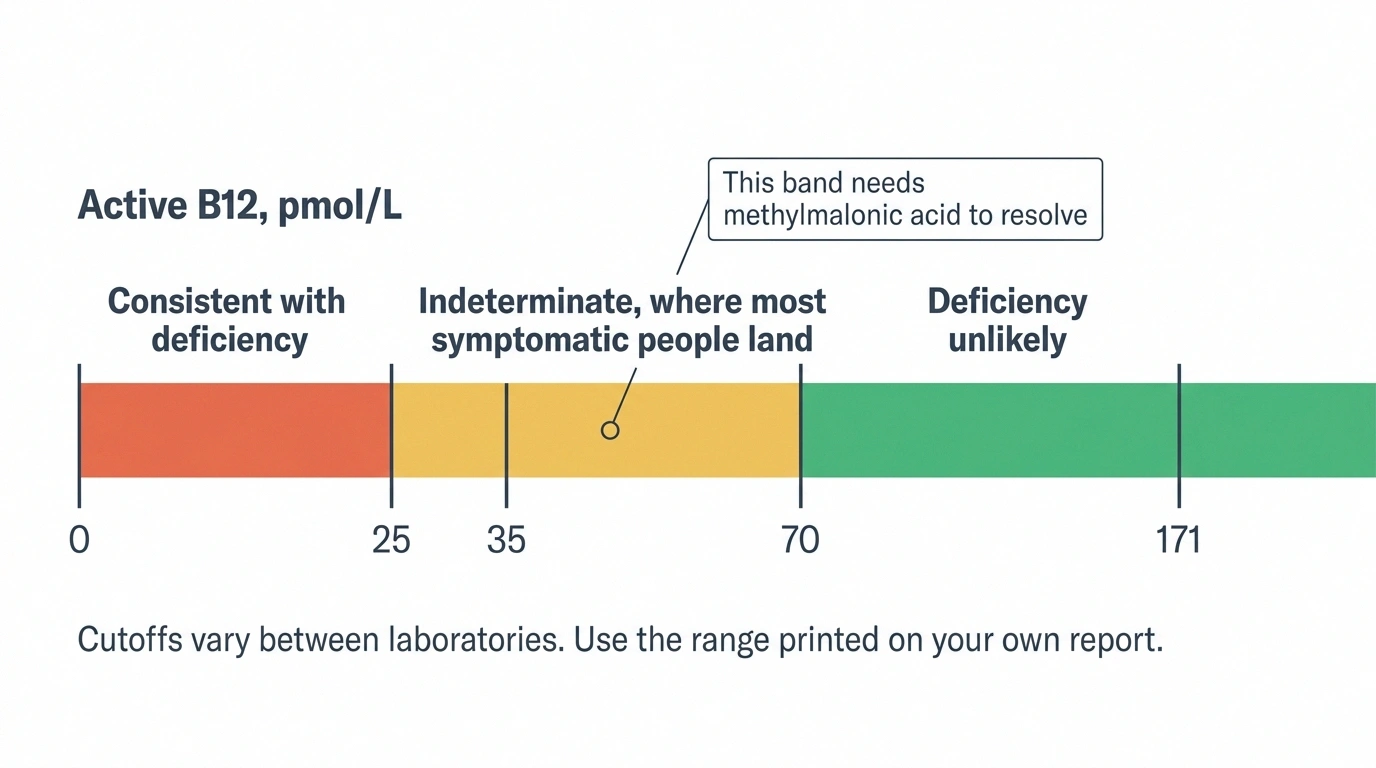
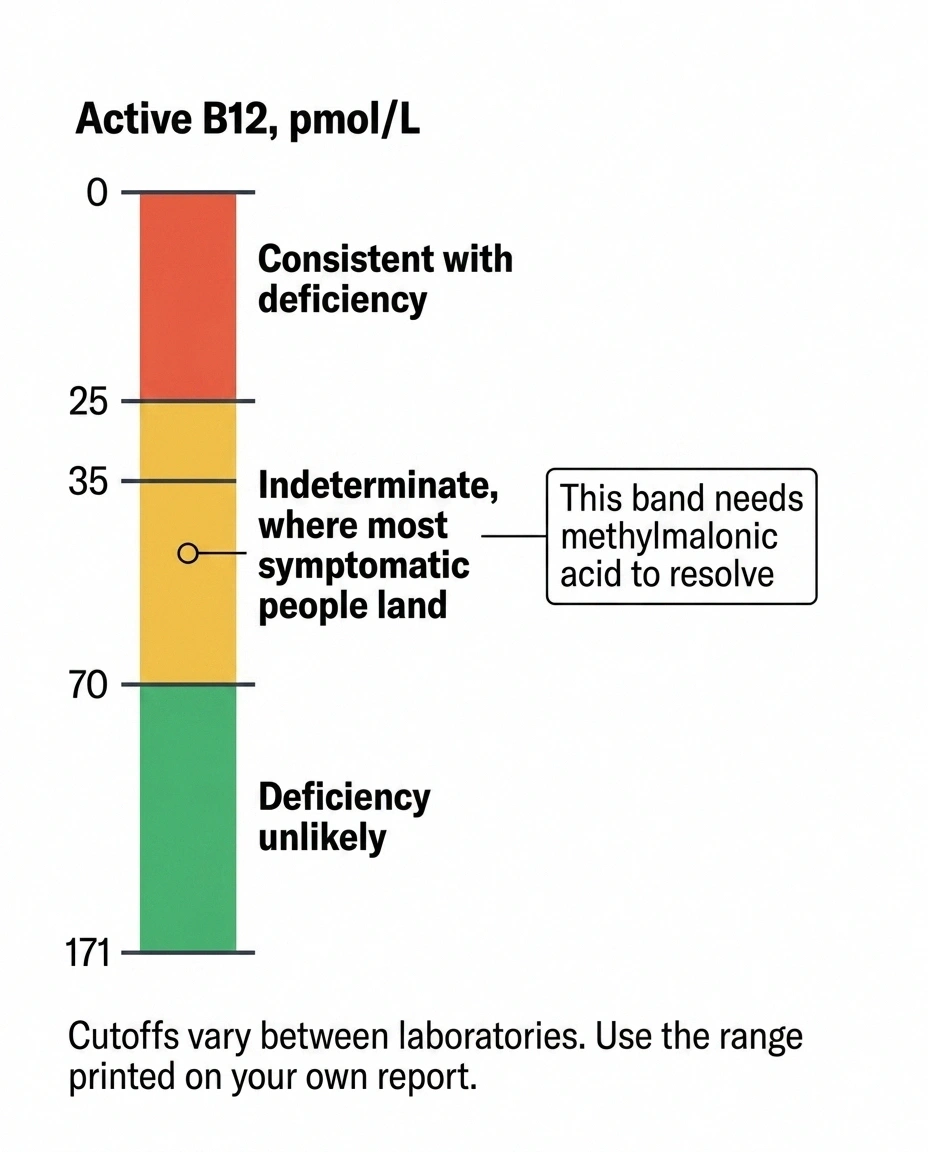
Active B12 results come back in picomoles per litre. In apparently healthy people, values commonly run somewhere around 35 to 171 pmol/L, and a result below roughly 70 pmol/L is often treated as worth investigating further rather than dismissing.
Reading an active B12 result
Commonly used bands in pmol/L. Assay cutoffs genuinely differ between laboratories, so the range on your own report overrides these.
Below 25
Consistent with deficiency. Usually acted on rather than repeated.
25 to 70
Indeterminate, and where most symptomatic people land. This is the band that needs MMA to resolve.
Above 70
Deficiency unlikely. Worth moving the search elsewhere rather than retesting.
A widely used banding puts values below 25 pmol/L as consistent with deficiency, 25 to 70 as indeterminate, and above 70 as making deficiency unlikely. Another commonly cited low cutoff sits around 35 pmol/L.
You may have noticed those cutoffs do not perfectly agree, and that is the honest state of things. Assay cutoffs genuinely differ between laboratories. The reference range printed on your own report beats any number in any article, including this one, and if your result sits near a boundary that variation is not a trivial detail.
The band worth staring at is the indeterminate one. Twenty-five to seventy is where a great many symptomatic people land, and it is precisely the zone the test cannot resolve on its own. That is not a flaw in the test. It is the point at which the question has to change from how much is there to whether the amount there is enough for you, and only a functional marker like MMA can answer that.
The Situations Where This Matters Most

Ordering an extra test on everybody is not a sensible policy, and this is not an argument for that. But there are specific situations where a normal total B12 is least trustworthy and the extra tests earn their cost.
Count your risk factors before you ask
Metformin for years. Long-term acid reducers. Little or no animal food. Gastric or intestinal surgery. Age over 65. Autoimmune disease in the family. Already taking B12 supplements.
Two or more of those plus nerve symptoms plus a mid-range total B12 is the combination that makes a specific request reasonable. One risk factor and a comfortably high B12 usually is not, and knowing which side of that line you sit on makes the conversation shorter.
You take metformin. Long-term metformin use reduces B12 absorption, which is well documented enough to have entered routine practice, and the resulting nerve symptoms are very easy to attribute to diabetic neuropathy instead. We covered this trap in detail in our piece on metformin and B12 depletion, and it is probably the single most common version of this story.
You take acid-reducing medication. Extracting B12 from food requires stomach acid. Proton pump inhibitors and H2 blockers taken for years reduce that acid, and reduce the extraction with it.
You eat little or no animal food. B12 comes almost entirely from animal sources. Long-term plant-based eating without reliable supplementation is a slow-motion deficiency, and our guide to B12 on a plant-based diet goes through what reliable actually means.
You have had gastric or intestinal surgery. Absorption of B12 depends on specific stretches of stomach and small intestine. Bypass, resection, or bariatric surgery can remove or bypass the very tissue that does the job.
You are over sixty-five. Stomach acid production falls with age, and food-bound B12 becomes progressively harder to liberate. Total B12 in older adults is particularly prone to looking better than the situation warrants.
You have autoimmune disease in the family. Pernicious anemia is an autoimmune attack on the intrinsic factor needed to absorb B12, and it clusters with other autoimmune conditions.
You are already taking B12 supplements. This one is counterintuitive. Supplementing lifts total serum B12 readily, which can mask a real absorption problem underneath. If you started supplements before testing, mention it, because it changes how the result should be read.
Getting the Test, Which Is Its Own Obstacle

Active B12 is not a fringe test, but it is not universally stocked either. Availability varies by region, by laboratory, and by what your practice is set up to order, and MMA is often easier to obtain than holotranscobalamin.
Three things make the conversation go better.
Ask for a specific test rather than for better testing in general. Naming methylmalonic acid works particularly well, because it has a clear clinical rationale that most clinicians will recognise instantly: it detects functional deficiency when serum B12 is normal.
Give the reason out loud. Not “I read about it,” but “I have symmetrical numbness and burning in both feet, I have been on metformin for nine years, and my B12 came back at 340.” That is a specific clinical case for a specific test, and it is much harder to wave away.
Ask what the plan is if the result lands in the middle. An indeterminate active B12 with no next step is a test that cost money and changed nothing. Agreeing in advance that a middling result leads to MMA saves you an appointment and a month.
Our guide to the lab tests worth running for neuropathy sets out the wider workup, and how to interpret neuropathy blood test results walks through reading a report you have already been handed.
What Happens If the Answer Is Yes

Confirmed deficiency is genuinely good news, in a strange way. It is one of the few causes of neuropathy with a direct, inexpensive, well-established treatment.
Blood corrects in weeks. Nerves take months.
This mismatch is the reason people abandon treatment that is working. Repeat labs come back beautiful while the feet feel unchanged, and the obvious conclusion is that B12 was never the problem.
Before you start replacement, write down one measurable thing: how many minutes you can stand at the counter, or how far you walk before balance goes. Re-read it at six months rather than six weeks.
Replacement is either injections or high-dose oral B12, and which one suits you depends mostly on why you are deficient. An absorption problem such as pernicious anemia or surgical bypass usually points toward injections. A dietary shortfall in someone who absorbs normally often does fine on oral dosing. Our guide to the B vitamins in neuropathy covers how the group interacts, and it is worth knowing that more is not automatically better across this family. B6, for instance, causes neuropathy at high doses rather than preventing it, which we covered in B6 toxicity.
Now the expectation-setting, because this is where people get discouraged.
Blood markers correct quickly. Nerves do not. Recovery of nerve symptoms lags well behind normalisation of the numbers, and the gap can be months. Some improvement is common, particularly in symptoms that arrived recently. Long-standing damage may not fully reverse, which is the whole reason the timing of the diagnosis matters so much. Our discussion of whether neuropathy can be reversed goes into what separates the cases that recover from the ones that stabilise.
A practical consequence of that lag: do not judge the treatment at six weeks. Judge it at six months, and write down where you started, because gradual improvement is remarkably hard to perceive from inside your own feet.
When the Answer Is No
Say you run the full panel and everything comes back genuinely, functionally fine. Active B12 comfortably above the indeterminate zone, MMA normal. What then?
You have bought something real, even though it does not feel like it. You have removed one of the most treatable causes from the list, which means the search moves on rather than circling. That matters most for people with small fiber neuropathy, where the workup runs long and vitamin deficiency is a standard early stop.
What it does not mean is that nothing is wrong. A normal B12 panel rules out one cause. Our overview of how neuropathy is diagnosed lays out the rest of the map, and a substantial fraction of people work through the whole of it without a definitive answer.
The Shortest Version
If your feet are telling you something and your B12 came back normal, the normal result may be answering a question you did not ask. Total B12 measures a pool. Active B12 measures the part your cells can reach. MMA measures whether the shortage has started to cause harm.
Ask for one of the better questions. Bring your specific circumstances rather than a general worry. And if the result lands in the murky middle, treat that as a reason to keep going rather than a reason to stop.
Frequently Asked Questions
What is active B12 and how is it different from a regular B12 test?
A regular test measures total B12 in your blood, which includes a large fraction bound to a carrier protein called haptocorrin that your cells cannot use. Active B12, also called holotranscobalamin, measures only the portion bound to transcobalamin, which is the form cells can actually take up. It is a more sensitive marker of B12 status than total serum B12, though guidance is clear that it should be interpreted alongside other markers rather than used alone.
Can I have B12 deficiency if my B12 test was normal?
Yes, and this is the main reason the additional tests exist. Because total serum B12 includes a large inactive fraction, the number can sit inside the reference range while the usable supply is low. Methylmalonic acid is widely considered the gold standard for this situation because it rises when B12 is functionally insufficient even when serum B12 appears normal.
What is a normal active B12 level?
Values in apparently healthy people commonly run in the region of 35 to 171 pmol/L, and a result below roughly 70 pmol/L is often considered worth investigating further. A frequently used banding treats below 25 pmol/L as consistent with deficiency, 25 to 70 as indeterminate, and above 70 as making deficiency unlikely. Cutoffs genuinely vary between laboratories, so the range printed on your own report is the one that applies to you.
Is methylmalonic acid better than active B12?
They answer different questions rather than competing. Active B12 tells you how much usable B12 is available, which can flag a shortfall early. MMA tells you whether the shortage is already interfering with metabolism inside cells, which is why it is described as the gold standard for confirming deficiency. In practice they work best together, particularly when active B12 lands in the indeterminate range.
Should I stop taking B12 supplements before testing?
This is worth asking your doctor rather than deciding alone, because stopping can complicate matters if you genuinely need the supplement. What matters most is that whoever interprets the result knows you have been supplementing, since supplementation raises total serum B12 readily and can mask an underlying absorption problem.
Can nerve damage happen before anemia shows up?
Yes. Neurological symptoms including tingling, burning feet, balance problems and memory changes can appear before any anemia develops. This is precisely why a normal blood count does not rule out B12 deficiency in someone with nerve symptoms, and why prompt diagnosis is emphasised so heavily in the guidance.
Will my doctor order an active B12 test if I ask?
Availability varies by region and by laboratory, and methylmalonic acid is often easier to obtain than holotranscobalamin. Asking for a specific named test and giving the specific clinical reason for it, such as symmetrical nerve symptoms plus long-term metformin use plus a mid-range B12 result, tends to work far better than asking for more thorough testing in general.
How long does it take for nerve symptoms to improve after treatment?
Blood markers typically correct much faster than nerves recover, and the gap can run to several months. Improvement is more likely and more complete when symptoms are recent, while long-standing damage may only partially reverse. Because the change is gradual, writing down a simple baseline measure at the start makes real progress far easier to recognise later.
About the Author