
Most people arrive at this question sideways. Years of neuropathy, no clear cause, and then somebody mentions that a cousin has bad feet too, or a neurologist asks whether your father had high arches, and suddenly there is a new thing to wonder about.
The wondering usually shapes itself as “is my neuropathy genetic.” That is the wrong question to spend money on. Genetics may well be involved in a great many neuropathies in ways no current test can show you, and knowing that would not change a single thing about Tuesday.
The question worth asking is narrower and harder: would a result change what happens to me?
For a specific and fairly small group of people, the answer is yes, decisively, and in two cases it comes attached to an actual prescription. For most people the answer is that a result would settle a question and change nothing else. Both of those are worth something. They are worth very different amounts of money and emotional energy, and the point of this page is to help you work out which one you are.
The Question Is Not Whether It Is Genetic
Start with what the test can and cannot see.
Two meanings of the word genetic
| A panel finds this | A panel cannot find this |
|---|---|
| A single identified change that causes the disease on its own | Why one person with diabetes develops nerve damage and another with the same control does not |
| Changes in a defined list of genes, typically 32 to several hundred | Why one person tolerates a chemotherapy regimen and another is left with permanent damage |
| Variants already documented in the medical literature | Inherited susceptibility spread thinly across many genes, which is how most heritability actually works |
A negative result rules out known single-gene causes in the genes examined. It does not rule out heredity as a contributor.
A hereditary neuropathy panel looks for known pathogenic variants in a defined list of genes. A 32-gene panel covers the common causes of Charcot-Marie-Tooth types 1, 2, 4, X and dominant intermediate. Larger panels run to fifty, eighty, a few hundred genes. Clinical exome sequencing reads the protein-coding portion of essentially everything.
All of those are looking for single-gene disorders where one identifiable change causes the disease. That is a real and important category. It is not the same as “genetics played a role.” Susceptibility to diabetic nerve damage, sensitivity to chemotherapy toxicity, the reason two people with identical B12 levels have different symptoms, all of that is influenced by genetics and none of it shows up on this test.
So a negative result does not mean genes are irrelevant to your neuropathy. It means no known single-gene cause was found in the genes examined. Those are very different statements, and conflating them is how people end up disappointed by an accurate test.
The Short List of People This Test Is Actually For
Insurers have thought about this harder than anyone, because they pay for it. Their medical policies converge on two situations where testing is considered medically necessary, and those policies are a reasonable proxy for where the yield actually is.
Before you conclude there is no family history
Nobody volunteers a hereditary neuropathy, because in most families it was never named. It gets remembered as a personality trait. Ask relatives these six questions specifically rather than asking whether anyone had nerve problems.
- Did anyone wear leg braces, special boots or built-up shoes as a child?
- Did anyone have unusually high arches, or hammertoes young?
- Was anyone described as clumsy, a tripper, or bad at sports in a way that stood out?
- Did anyone have thin calves or ankles relative to their thighs?
- Did anyone have carpal tunnel surgery on both hands, particularly before sixty?
- Did anyone die of heart failure with no clear cause identified?
The last two matter because bilateral carpal tunnel years ahead of neuropathy, and unexplained cardiac disease, are the pattern that transthyretin amyloidosis leaves across a family before anyone connects it.
One: you have clinical features of a hereditary neuropathy and a definitive diagnosis cannot be reached without it. The features that raise the question include symptoms starting in childhood or early adulthood, very high arches or hammertoes, an inverted-champagne-bottle look to the lower legs from long-standing muscle wasting, foot drop, a slowly progressive course over decades rather than years, and a family history that becomes obvious once you start asking about it rather than waiting for it to be volunteered.
That last part matters more than people expect. Family history in these conditions is frequently hidden rather than absent. A parent who “just had bad feet” or “was always clumsy” or wore braces as a child and never had it named. Ask the specific questions before concluding there is no history.
Two: a close blood relative has a known pathogenic variant. If someone in your family has a confirmed genetic diagnosis, testing you for that one specific variant is straightforward, cheap relative to a full panel, and gives a clean answer. This is the highest-value version of the test by a wide margin.
There is a third situation the policies handle less cleanly, and it is the one that has changed most in recent years. Progressive neuropathy with no identified cause, in an adult, particularly with autonomic symptoms or cardiac involvement. That combination is where hereditary transthyretin amyloidosis hides, and it hides specifically inside cohorts of people who have been labeled idiopathic. More on that below, because it is the strongest single argument for testing that exists.
The Two Answers That Come With a Prescription
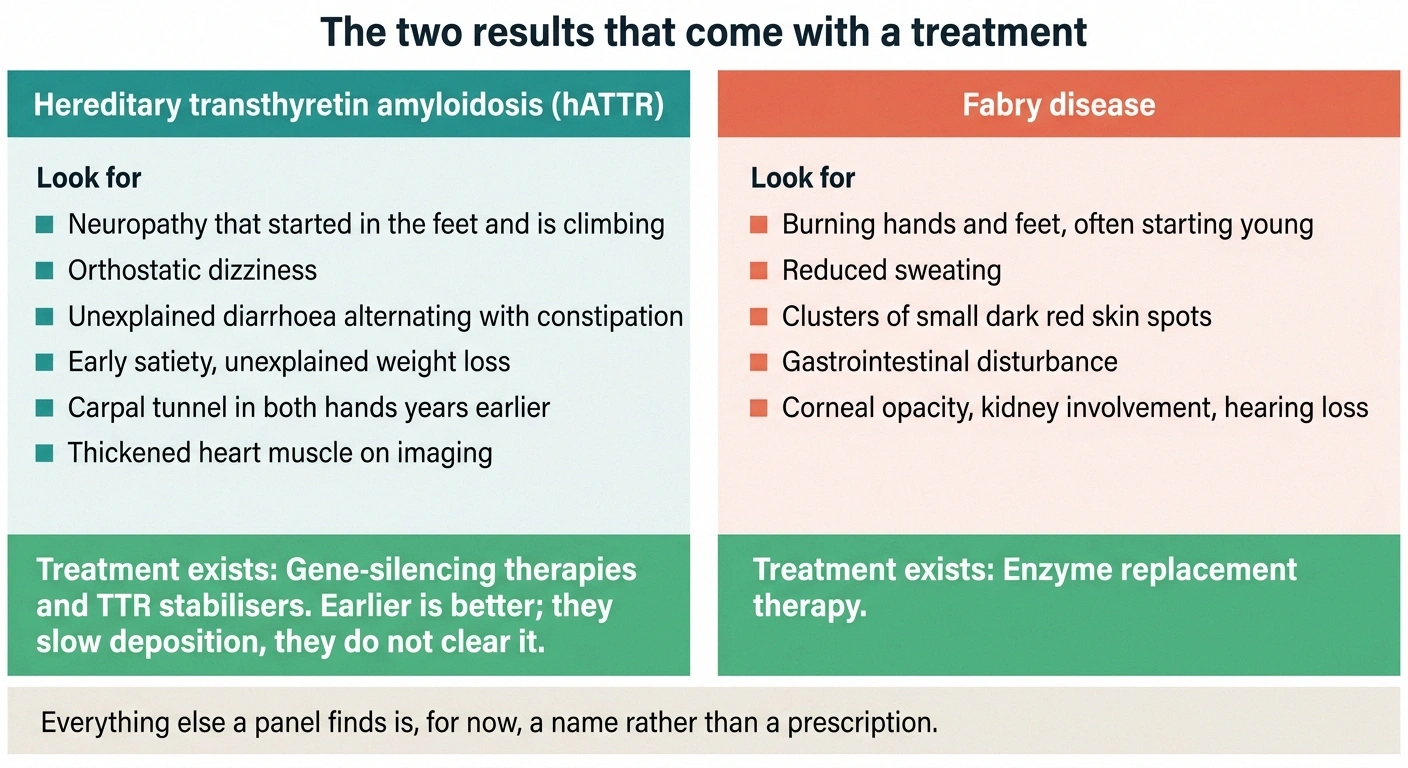
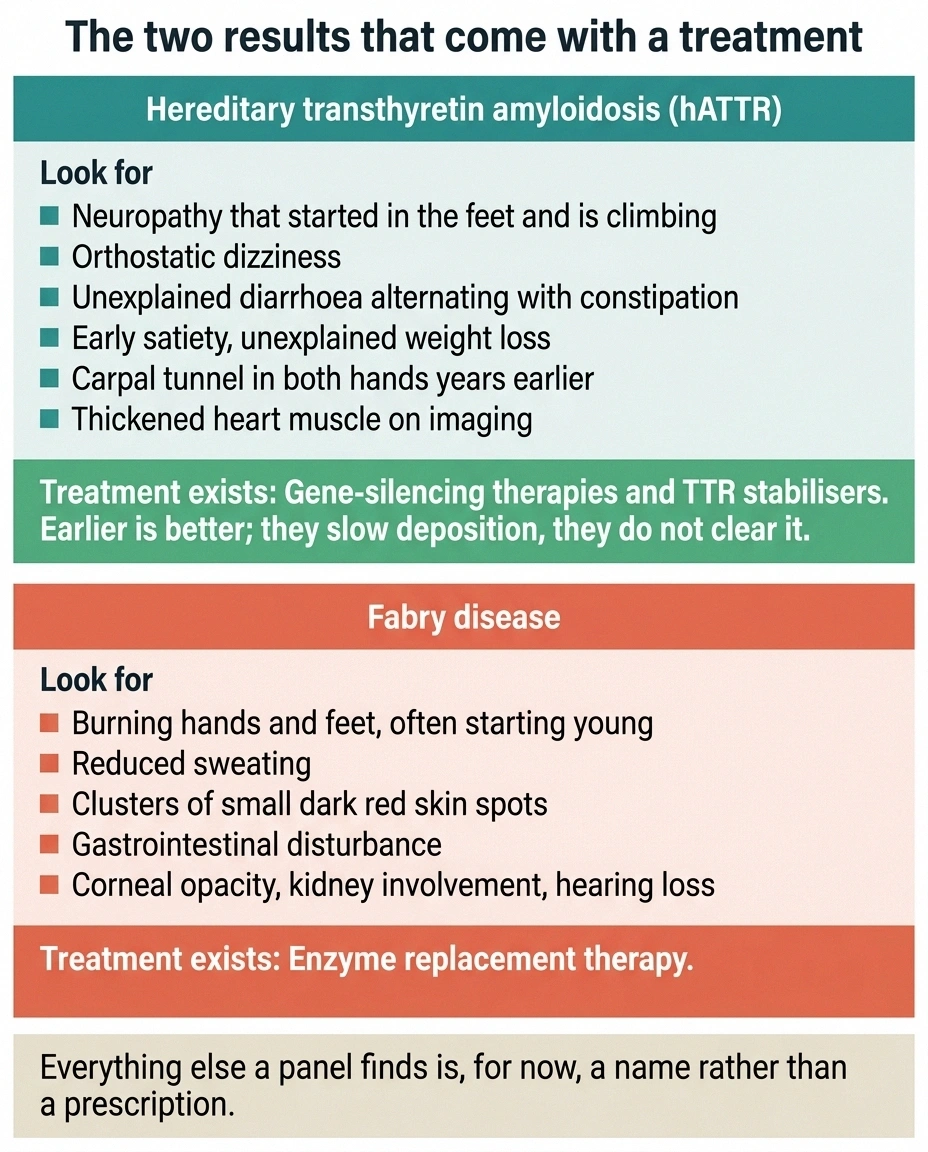
Here is the part that justifies the whole exercise. Two hereditary neuropathies have real disease-modifying treatment, and for both of them, earlier is better.
Hereditary transthyretin amyloidosis
hATTR is caused by variants in the TTR gene that make the transthyretin protein unstable. It misfolds, deposits in nerve and heart tissue, and produces a progressive neuropathy that is frequently mistaken for something else for years.
It is treatable. Gene-silencing therapies that reduce transthyretin production and stabilizers that hold the protein in its correct shape are first-line therapy, and there is gene-editing work moving through trials behind them. Treatment works better the earlier it starts, because these drugs slow deposition rather than clearing what has already been laid down. Nerve you have already lost does not come back.
The reason this matters for people with no family history is that studies screening idiopathic progressive neuropathy populations keep finding hATTR cases in them. Penetrance varies, late-onset variants exist, and family members who died of “heart failure” in their seventies were never sequenced. The absence of a family history is much weaker evidence against this diagnosis than it feels like.
Signs that should push this up the list: neuropathy that started in the feet and is climbing, prominent autonomic symptoms such as orthostatic dizziness, unexplained diarrhea alternating with constipation, early satiety, erectile dysfunction, unexplained weight loss, carpal tunnel syndrome in both hands preceding the neuropathy by several years, and any cardiac finding suggesting thickened heart muscle.
Fabry disease
Fabry is an X-linked deficiency of the lysosomal enzyme alpha-galactosidase A. Enzyme replacement therapy exists.
The neuropathy in Fabry is small-fiber and it typically starts young, with burning pain in the hands and feet that can be episodic and severe. The clue is that it never travels alone. Reduced sweating, clusters of small dark red skin lesions called angiokeratomas usually around the hips and trunk, gastrointestinal disturbance, a characteristic corneal opacity an ophthalmologist can see, kidney involvement, thickening of the left ventricle, and hearing loss.
If you have unexplained burning in the hands and feet that began before age forty and any two items from that list, this is worth naming out loud at your next appointment.
Everything else a panel might find is, at present, a name rather than a treatment. That is not nothing. It is just a different kind of value, and it should be priced differently in your decision.
How Often It Finds Anything
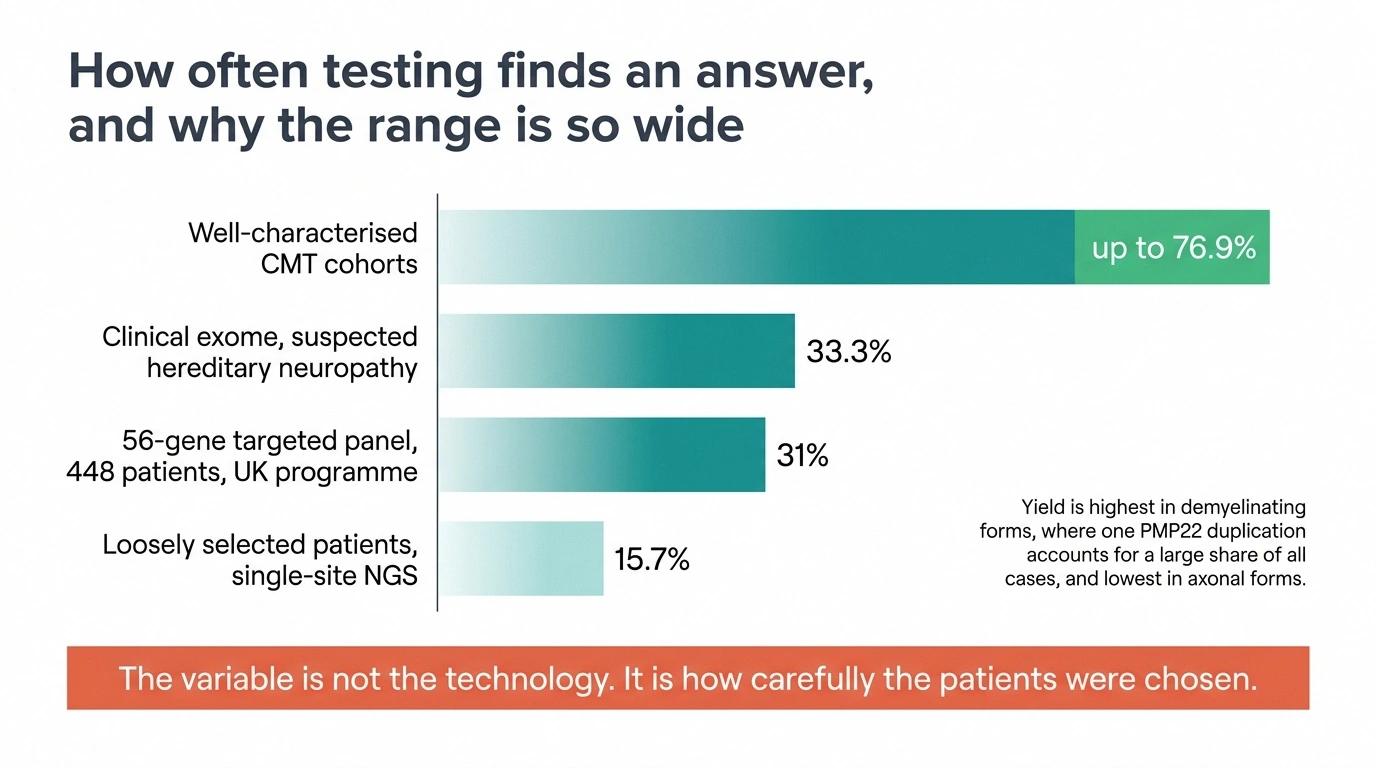
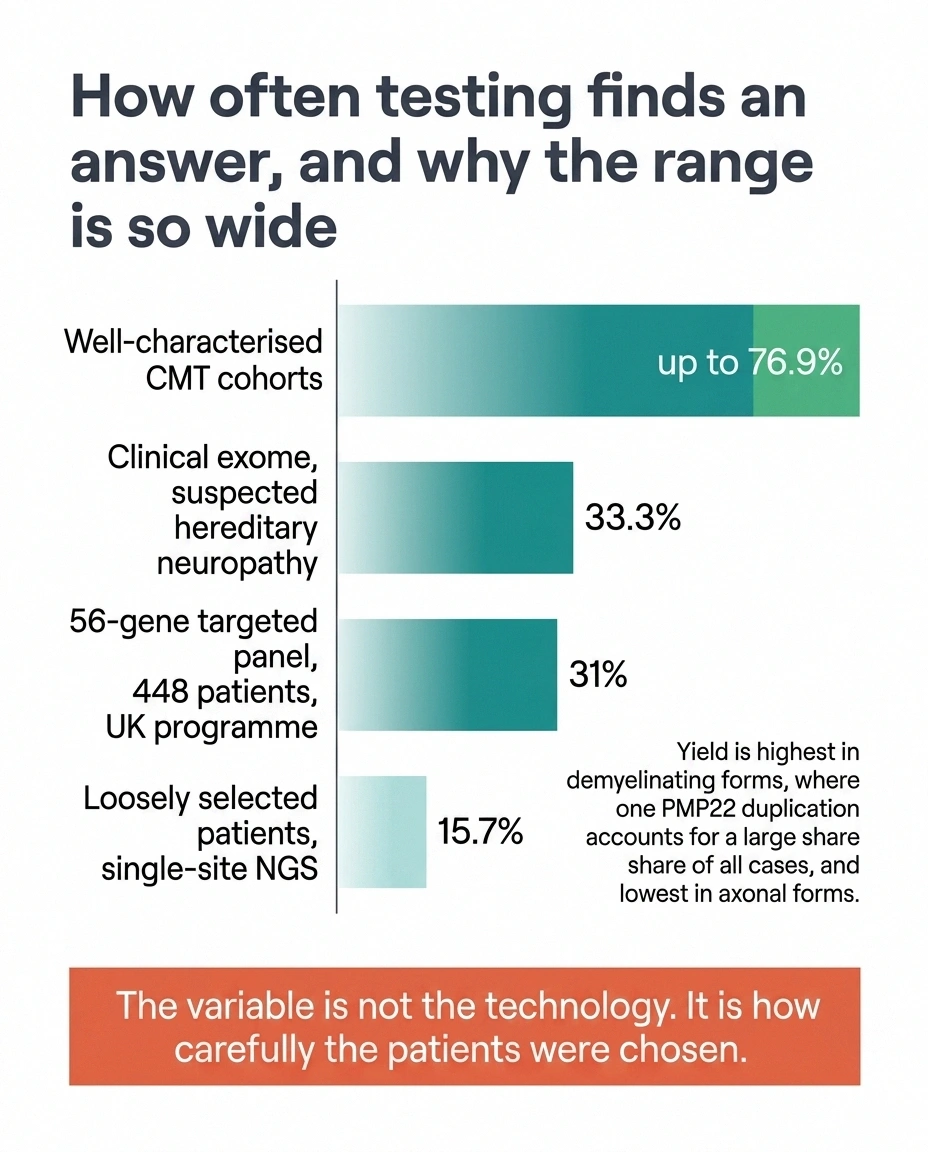
The published yield figures for hereditary neuropathy testing range from about 16% to about 77%, which sounds like the literature cannot make up its mind. It can. The range is telling you something useful.
- 15.7% in one single-site study of patients sent for advanced genetic testing without tight selection.
- 31% using a 56-gene targeted panel across 448 patients in a UK national testing programme.
- 33.3% with clinical exome sequencing in patients with suspected hereditary neuropathy.
- Up to 76.9% in well-characterised CMT cohorts, varying enormously by subtype.
The variable is not the technology. It is how carefully the patients were chosen. Test everyone with neuropathy and you find something one time in six. Test people with a demyelinating picture on nerve conduction studies, childhood onset and a family history, and you find something most of the time.
Yield is also much higher for CMT1 and other demyelinating forms, where a duplication in the PMP22 gene accounts for a large share of all cases, than for the axonal CMT2 forms, where the causes are scattered across many rarer genes.
The practical consequence: your personal odds of a useful result depend almost entirely on how well your clinical picture matches a hereditary pattern. If your nerve conduction study showed uniformly slowed conduction velocities across multiple nerves, your odds are good. If it showed a length-dependent axonal pattern typical of diabetes, they are poor. Our page on reading EMG and NCS results will help you find out which one you had.
What the Test Involves and What It Costs

Physically it is nothing. A blood draw, or in some cases a saliva kit mailed to your house. Results usually take two to six weeks depending on the lab and the panel size.
Money is where it gets interesting. Multi-gene panels at the more cost-effective labs run $250 to $1,000. Some labs offer a flat patient-pay rate in the region of $475 per clinical indication. That is dramatically cheaper than these tests were a decade ago and it is the main reason the decision is now worth making rather than automatically declining.
Insurance will often cover it when medical necessity criteria are met, and the criteria are the ones described earlier. Coverage is far from automatic. If the reviewer decides the test was not medically necessary, the lab may not be reimbursed at all.
One trap worth knowing before you choose: if you take the cash-pay route you generally cannot then file for insurance reimbursement. Labs offer the discounted self-pay price precisely on the understanding that no claim will be submitted. Decide which path you are on before the sample is drawn, not after the bill arrives.
Most labs also run financial assistance programmes with genuinely low or zero cost for people who qualify. Ask. The genetic counselor will know which labs have the best programmes, which is one of several reasons to see one.
The Third Result Nobody Prepares You For
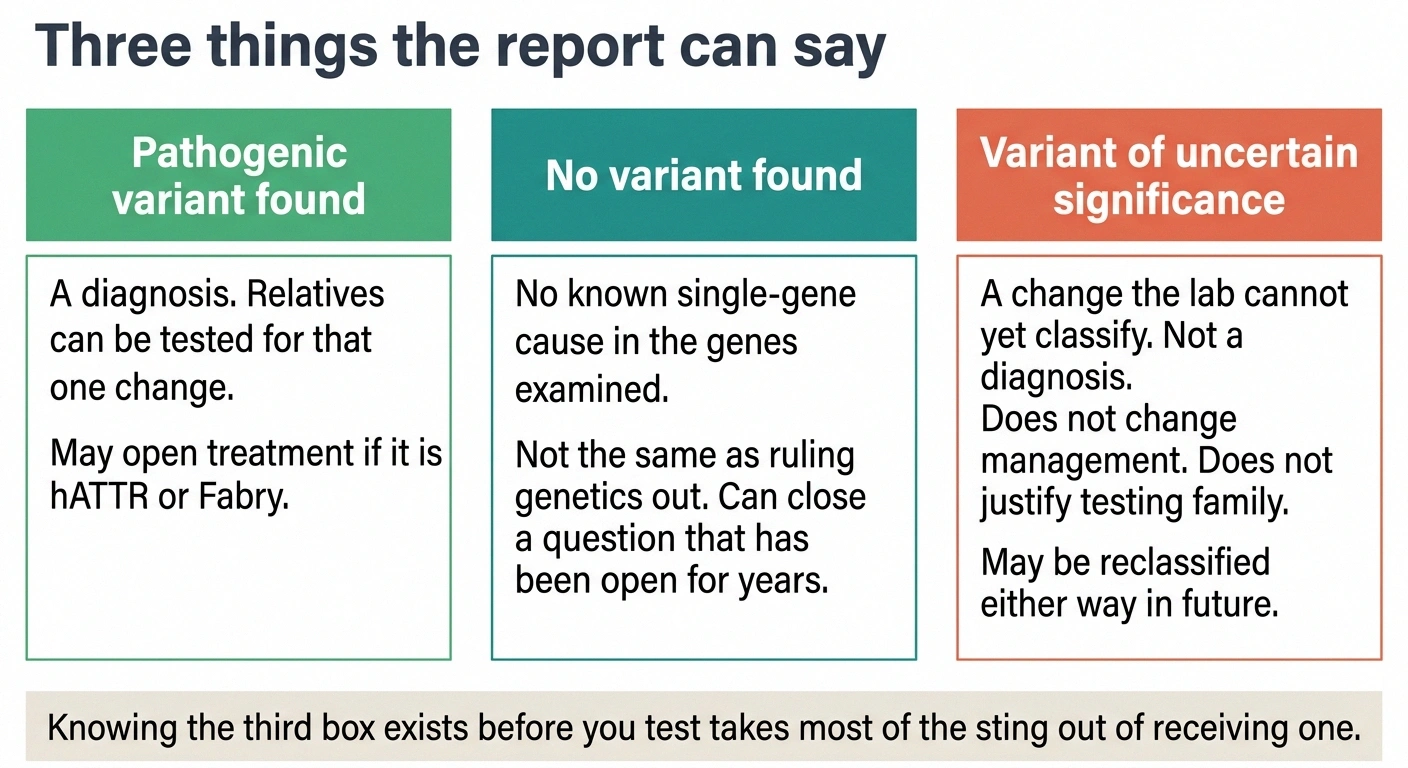
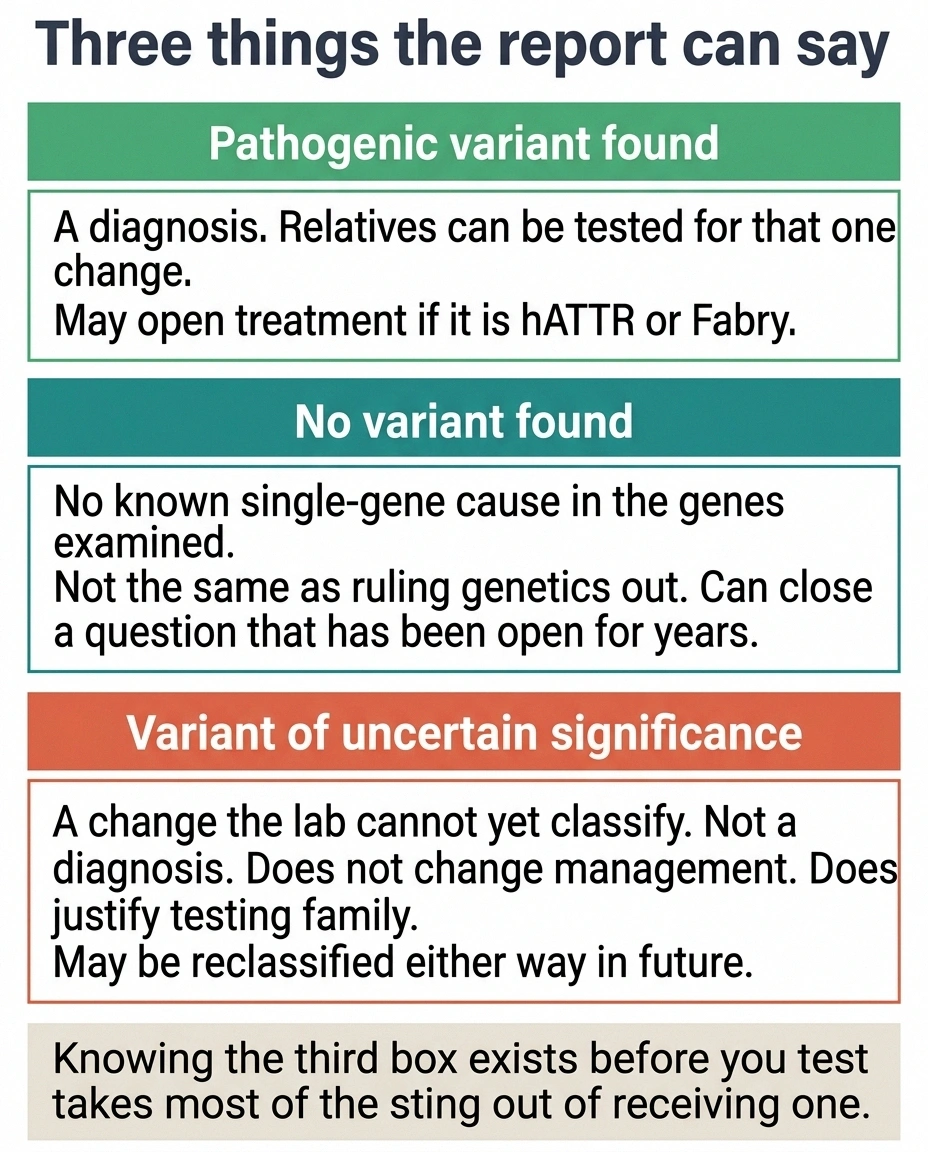
Everyone expects positive or negative. There is a third box, and it is the one that causes the most distress.
A variant of uncertain significance means the lab found a change in a gene that could plausibly matter and cannot currently say whether it does. Not pathogenic. Not benign. Unclassified, pending more data from more people.
A variant of uncertain significance is not a diagnosis and should not be treated as one. It does not justify family testing, it does not change management, and reputable labs will say so in the report. It sits there. It may be reclassified in a few years as evidence accumulates, in either direction.
Emotionally this is the worst of the three outcomes, because it looks like an answer and functions like a question. Knowing the category exists before you test takes a surprising amount of the sting out of receiving one, which is the main reason I am spending a section on it.
What It Means for Your Children and Siblings
A confirmed pathogenic variant is the only result that has real implications beyond you, and it is the reason many people test at all.
If a variant is confirmed, what the pattern means
| Pattern | Chance per child | Examples | Note |
|---|---|---|---|
| Autosomal dominant | 50% | Most CMT1, hATTR | Penetrance can be incomplete, so a carrier parent may never have shown symptoms |
| Autosomal recessive | 25% if both parents carry | CMT4 forms | Siblings are the relatives most at risk, not children |
| X-linked | Depends on parent and child sex | CMTX, Fabry | Severity often differs between sexes, and carriers can be symptomatic |
Once one variant is confirmed, relatives are tested for that single change rather than a full panel, which is cheaper, faster and usually covered.
The inheritance pattern determines the risk numbers. Autosomal dominant conditions, which include most CMT1 and hATTR, carry a 50% chance of passing the variant to each child. Autosomal recessive conditions require a variant from both parents. X-linked conditions such as Fabry and CMTX follow their own pattern, with different implications for sons and daughters.
Once a variant is confirmed in you, relatives can be tested for that specific change rather than needing a full panel. That is cheaper, faster and definitive, and insurers generally cover targeted familial testing readily.
Whether relatives should be tested is genuinely their decision, and it is not always yes. For a condition with no treatment, an adult sibling with no symptoms may reasonably prefer not to know. For hATTR, where treatment exists and early treatment works better, the case for telling family is much stronger. Predictive testing of children for adult-onset conditions with no childhood treatment is generally discouraged, on the grounds that the child can decide as an adult.
This is exactly the territory a genetic counselor is trained for, and it is worth more than the test itself.
GINA, and the Protections That Stop Short

The Genetic Information Nondiscrimination Act prevents health insurers and employers from using genetic information against you. Health insurers cannot use it to deny coverage or set premiums. Employers cannot use it in hiring, firing or promotion.
The gaps are the part to actually plan around.
GINA does not cover life insurance, disability insurance, or long-term care insurance. Those three can ask about genetic test results and can decline you or price you accordingly. If any of them are on your horizon, the sequencing of decisions matters, and the conventional advice is to sort out the policies first.
GINA’s protections do not extend to members of the United States military, or to veterans receiving health care through the VA. Those systems sit outside the statute and operate under their own rules, which is not the same as saying no protection exists there. It does mean the specific federal shield described above is not the one covering you, and it is a carve-out rarely mentioned on patient-facing pages despite an elevated rate of neuropathy in this population. If it applies to you, ask what the relevant policy actually is before testing rather than assuming either extreme.
None of this is a reason not to test. It is a reason to test in the right order.
When a Negative Is Worth the Money Anyway
There is a case for testing that has nothing to do with finding something, and I want to make it honestly rather than pretend the only good result is a positive.
The management that stays the same either way
Outside of transthyretin amyloidosis and Fabry disease, a genetic diagnosis does not upgrade the treatment plan. It is the same plan with a name attached. That plan is:
- Ankle-foot orthoses where there is foot drop, fitted properly rather than bought online
- Physical therapy aimed at maintaining range and preventing contracture, not at rebuilding nerve
- Footwear that accommodates the foot shape you have
- Balance work and home hazard removal, because falls do more damage than the neuropathy does
- Symptom control for pain where pain is present
Which is worth knowing before you test, because it sets a realistic expectation of what a positive result buys.
Some people have spent five or ten years cycling through possible explanations. Every appointment opens a new avenue. Every negative result gets filed as “well, it wasn’t that.” The uncertainty itself becomes a chronic condition sitting on top of the physical one.
For those people, a comprehensive negative panel can close a door that has been standing open for years, and closing it frees attention for the things that actually help: the reversible causes worth rechecking, symptom management that works, and the daily practices that hold function steady. That is a legitimate return on a few hundred dollars.
What it is not worth doing is testing on the theory that finding a name will make the neuropathy better. For most hereditary neuropathies there is no treatment aimed at the cause, and the management is the same management: bracing where there is foot drop, physical therapy, appropriate footwear, fall prevention, and pain control. A diagnosis does not upgrade the plan.
How to Raise It

If you have read this far and think you might be on the short list, the useful move is not to ask your neurologist for a genetic test. It is to ask a question that lets them use what they already know about your case.
Try this: “Looking at my nerve conduction pattern and my history, is there anything here that suggests a hereditary cause? And is there any reason to rule out transthyretin amyloidosis specifically?”
That second sentence does real work. It names the treatable one. If your clinical picture has any of the features described earlier, it is a legitimate question, and a neurologist will recognise it as an informed one rather than a request driven by internet reading.
If the answer points toward testing, ask for a referral to a genetic counselor before the sample is taken rather than after the result arrives. They handle lab selection, cost, insurance pre-authorisation, financial assistance, interpreting whatever comes back including a variant of uncertain significance, and the family conversation. In a field where the test is cheap and the interpretation is everything, that referral is the highest-value part of the process.
For the broader picture of what else belongs in a neuropathy workup before or alongside any of this, our guide to neuropathy diagnosis and the tests your doctor may order covers the standard sequence, and our page on hereditary neuropathy and Charcot-Marie-Tooth goes deeper on what the conditions themselves involve.
Frequently Asked Questions
How much does genetic testing for hereditary neuropathy cost?
Multi-gene panels run roughly $250 to $1,000 at the more cost-effective laboratories, and some labs offer a flat patient-pay rate around $475 per clinical indication. Insurance often covers it when medical necessity criteria are met. If you choose the discounted cash-pay route you generally forfeit the ability to submit an insurance claim afterward, so decide which path you are on before the sample is taken.
Will insurance cover it?
Frequently, when criteria are met. The two standard criteria are clinical features of a hereditary neuropathy where a definitive diagnosis cannot be reached without genetic testing, and being an asymptomatic person with a close blood relative who carries a known pathogenic variant. Coverage is decided case by case and is not automatic.
Can my neuropathy be hereditary if nobody in my family has it?
Yes. Family history in these conditions is often hidden rather than absent. Relatives described as clumsy or as having bad feet were frequently never diagnosed. Late-onset variants exist, penetrance is incomplete in some conditions, and hereditary transthyretin amyloidosis in particular turns up in people with no known family history. New variants also occur spontaneously.
What is a variant of uncertain significance?
A genetic change the laboratory found but cannot currently classify as either disease-causing or harmless. It is not a diagnosis, it should not be used to guide treatment, and it does not justify testing relatives. It may be reclassified in either direction as more data accumulates.
How likely is the test to find something?
It depends almost entirely on how well your clinical picture matches a hereditary pattern. Reported yields range from about 16% in loosely selected patients to over 70% in well-characterised Charcot-Marie-Tooth cohorts. Yield is highest in demyelinating forms and lower in axonal forms.
Do I need a genetic counselor?
It is strongly worth it. A counselor handles lab and panel selection, cost and financial assistance, insurance pre-authorisation, interpretation of ambiguous results, and the conversation about what a result means for relatives. Testing is cheap now and interpretation is where the value sits.
Will a genetic diagnosis change my treatment?
For two conditions, substantially. Hereditary transthyretin amyloidosis has gene-silencing and protein-stabilising therapies, and Fabry disease has enzyme replacement therapy. For most other hereditary neuropathies the management is unchanged: bracing, physical therapy, footwear, fall prevention and symptom control.
Should my children be tested?
If a pathogenic variant is confirmed in you, relatives can be tested for that specific change cheaply and definitively. Whether they should is their decision. Predictive testing of children for adult-onset conditions with no childhood treatment is generally discouraged so the child can decide as an adult. Where an effective treatment exists, as with transthyretin amyloidosis, the case for testing at-risk adult relatives is considerably stronger.
About the Author