A woman in my support group named Deb spent two years being told her burning feet were “just the diabetes.” She does have type 2 diabetes. She also has a fatty liver that three different doctors had mentioned in passing and nobody had connected to anything, and a set of liver enzymes that had been quietly drifting upward since 2021.
When she finally asked her gastroenterologist point-blank whether her liver could have anything to do with her feet, he said something I’ve thought about ever since. He said, “Possibly. That’s not really my end.”
Nobody’s end — and that’s the whole problem with this topic. Your hepatologist watches your liver, your neurologist watches your nerves, and the road between the two organs is a stretch of highway that neither one patrols.
So let’s patrol it. Because there isn’t one connection between liver disease and nerve damage. There are four, they work by completely different mechanisms, and the one you have determines whether anything can be done about it.
Four Different Roads From the Liver to Your Feet
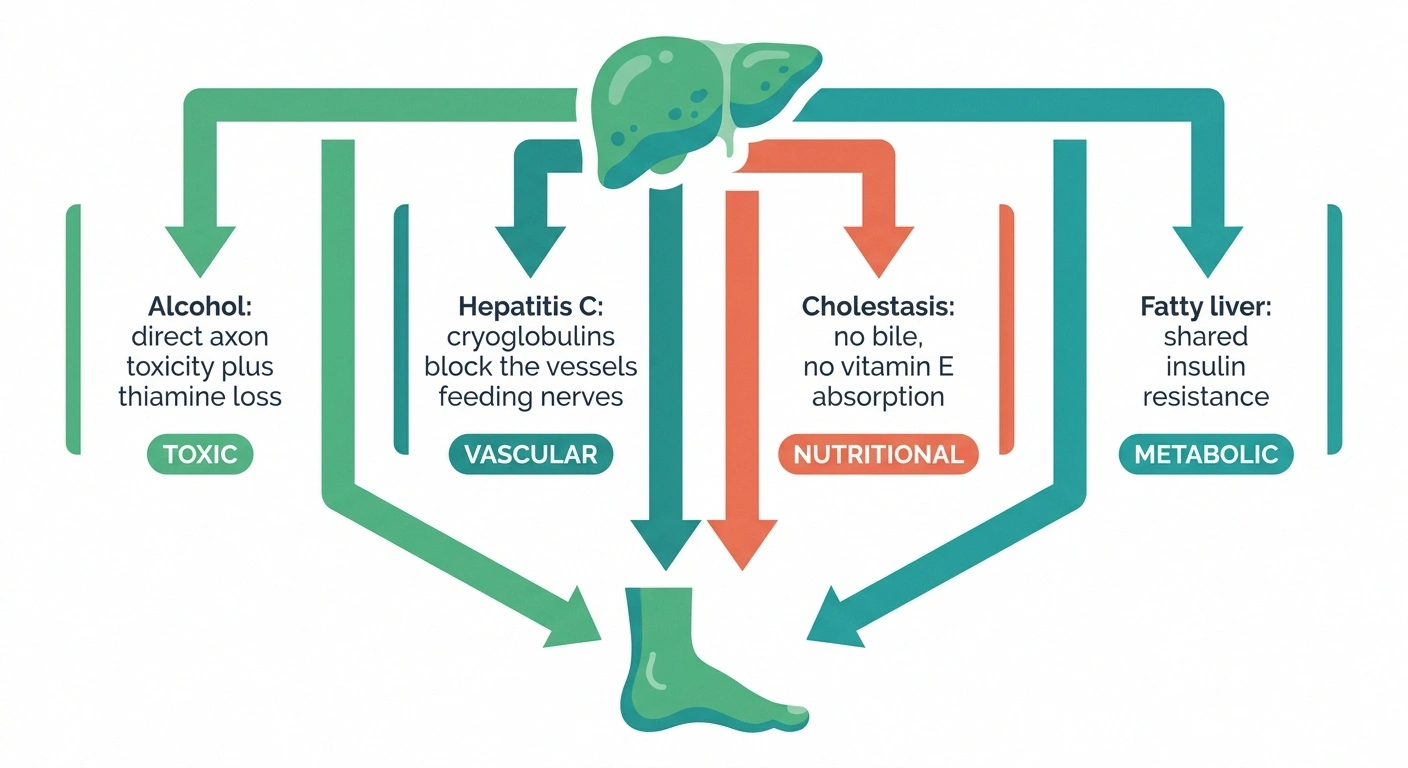
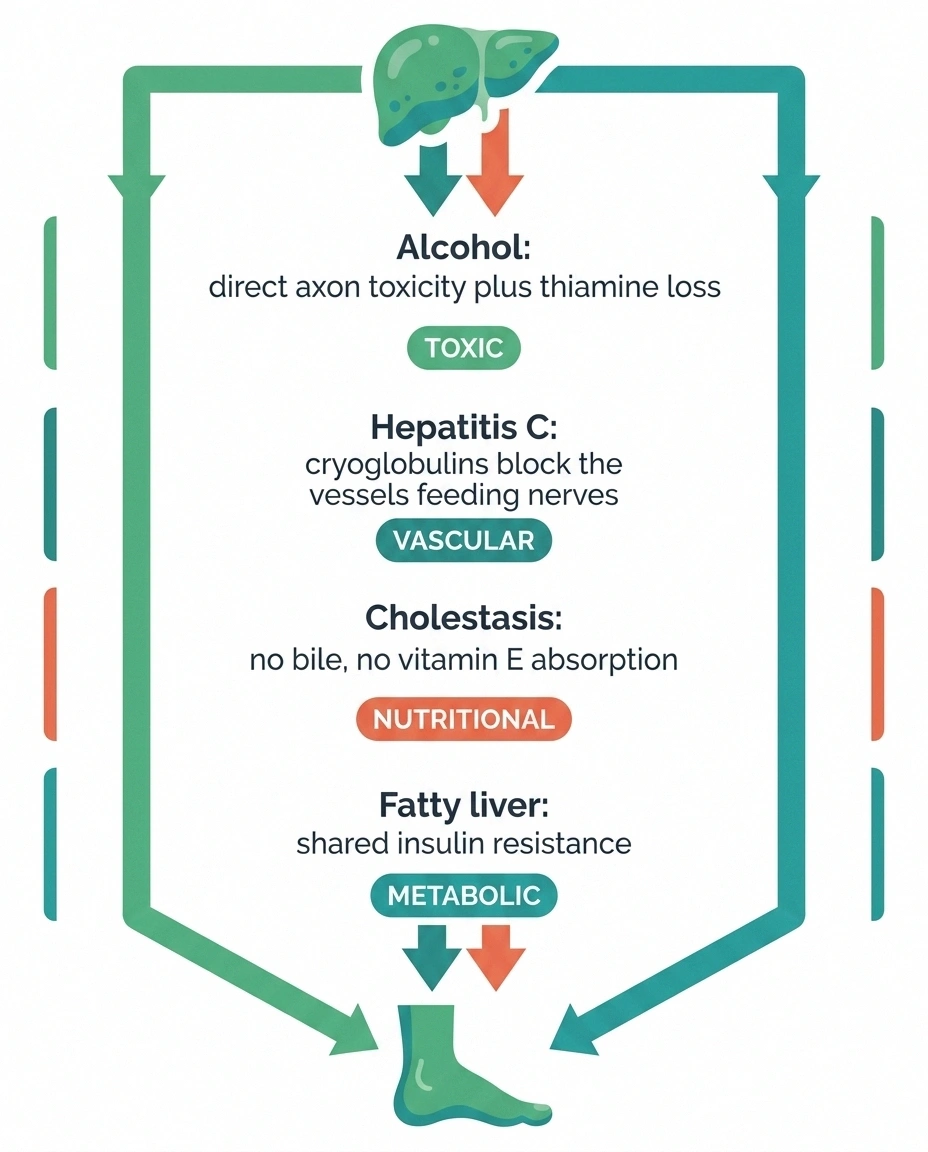
Most articles on this subject give you a single sentence: liver disease can cause neuropathy. True, and nearly useless, because it flattens four separate problems into one.
| Road | Test that settles it | Recovery odds |
|---|---|---|
| Alcohol | Thiamine level, B12, drinking history | Nutritional half good, toxic half slow |
| Hepatitis C | HCV antibody, HCV RNA, cryoglobulins | Improves in many after viral clearance |
| Cholestatic | Vitamin E level (rarely ordered) | Good if caught before long deficiency |
| Fatty liver | A1c, fasting insulin, lipids | Slower progression, partial improvement |
Here’s the honest map.
Road one is alcohol. The most assumed cause, and the one people jump to whether it fits or not.
Road two is viral and inflammatory, mostly hepatitis C, where the damage happens in the tiny blood vessels feeding your nerves rather than in the nerves themselves.
Road three is malabsorption. When bile can’t do its job, fat-soluble vitamins stop being absorbed, and one of them is essential to the long sensory tracts.
Road four is metabolic, and it’s the newest and by far the most common. Fatty liver, insulin resistance, and nerve damage travel together.
Four roads — one destination. Knowing which one you’re on changes the test you request, the treatment that helps, and how much sensation you can reasonably expect back.
The Number That Surprises Everyone
Before we walk the roads, sit with this for a second.
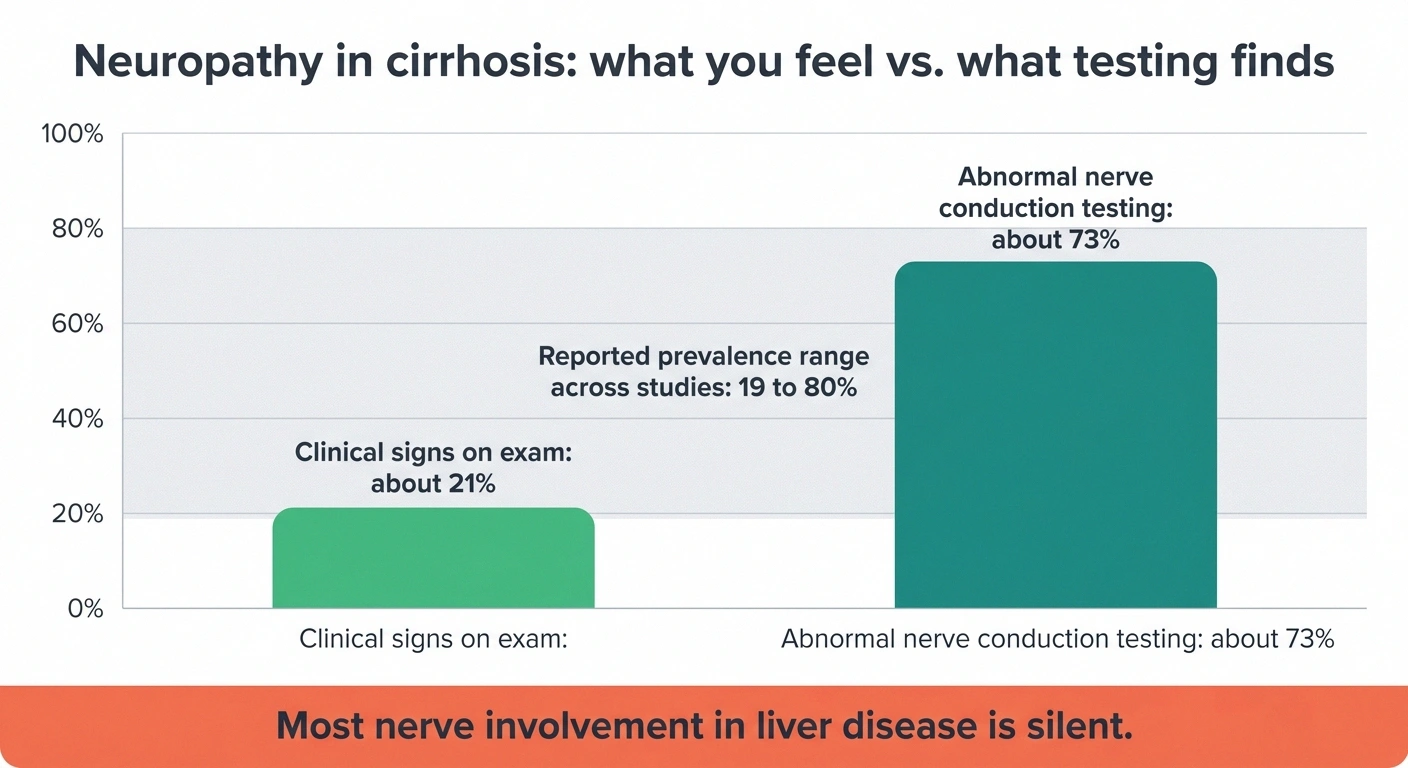
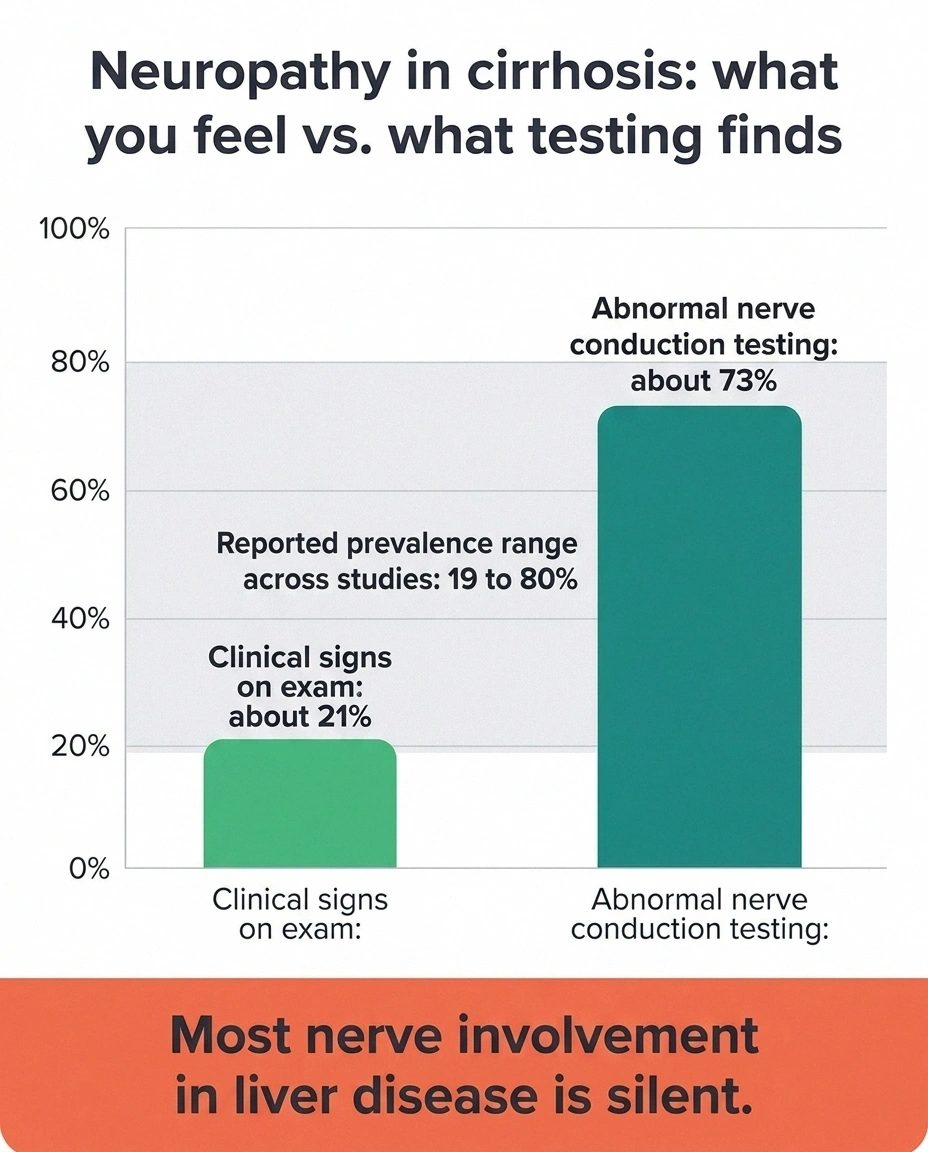
Studies that put cirrhosis patients through nerve conduction testing find abnormalities in a startling share of them. Across the literature, the prevalence of peripheral neuropathy in chronic liver disease runs somewhere between 19 and 80 percent depending on how it’s measured and who’s being measured. In one careful study, clinical signs of neuropathy showed up in about 21 percent of patients, while the nerve conduction studies came back abnormal in roughly 73 percent.
Read those two numbers next to each other. Most of this is silent — completely, unhelpfully silent. The nerves are already misbehaving in a measurable way long before anyone feels a thing, which means a fair number of people reading this have early nerve involvement they’d never guess at.
The other finding worth knowing: the neuropathy shows up regardless of what caused the cirrhosis. Not just alcohol-related cirrhosis — all of it. That points hard at the liver disease itself being part of the mechanism, not merely at whatever damaged the liver in the first place.
And the further along the liver disease is, the more likely the nerve involvement. It tracks with severity.
Road One: Alcohol, and Why It’s Only Half the Story
Let’s deal with alcohol first, because it’s the assumption that gets made about anyone with a liver problem and tingling feet, and it deserves a more precise treatment than it usually gets.
Alcohol damages nerves two ways at once, and they’re genuinely separate.
The first is direct. Alcohol and its metabolites are toxic to the axon itself, the long transmitting fiber of the nerve cell. The longest fibers, the ones running all the way to your toes, take the hit first. That’s why it starts in the feet and works upward, the same length-dependent pattern most neuropathies follow.
The second is nutritional, and thiamine sits at the center of it. Heavy drinking impairs thiamine absorption, depletes stores, and increases the requirement all at the same time. Thiamine deficiency produces its own neuropathy, independent of alcohol’s direct toxicity.
Why does the distinction matter to you? Because they respond differently. The nutritional half often improves meaningfully with repletion. The directly toxic half depends almost entirely on stopping the exposure, and improvement is slower and less complete. Two people with identical-looking symptoms can have very different prognoses depending on which half dominates.
We’ve covered this pathway in depth in our guide to alcohol-related neuropathy, including how it typically progresses over time.
But here’s the part I want to underline, because it’s where the assumption becomes a problem: if you have cirrhosis from any cause and you have neuropathy, alcohol is not automatically the explanation. The research is clear that nerve involvement occurs across every etiology of cirrhosis. Someone with primary biliary cholangitis and neuropathy has been told “have you considered cutting back?” more times than they can count, and it’s the wrong conversation.
Road Two: Hepatitis C and the Blood Vessels That Feed Your Nerves
This road is genuinely different, and it’s the one I find most interesting mechanically, because the nerve isn’t the primary target at all.
Ordinary length-dependent neuropathy is symmetrical, slow, and starts in both feet at once. Vasculitic neuropathy is not. It picks off individual named nerves one at a time, in no particular order, over days to weeks.
Concrete example: a wrist that stops lifting on Tuesday, then three weeks later a foot that drops on the opposite side. That sequence is not slow progression of the same problem. It warrants evaluation within days rather than at the next scheduled appointment, because ischemic nerve damage becomes permanent while it is being watched.
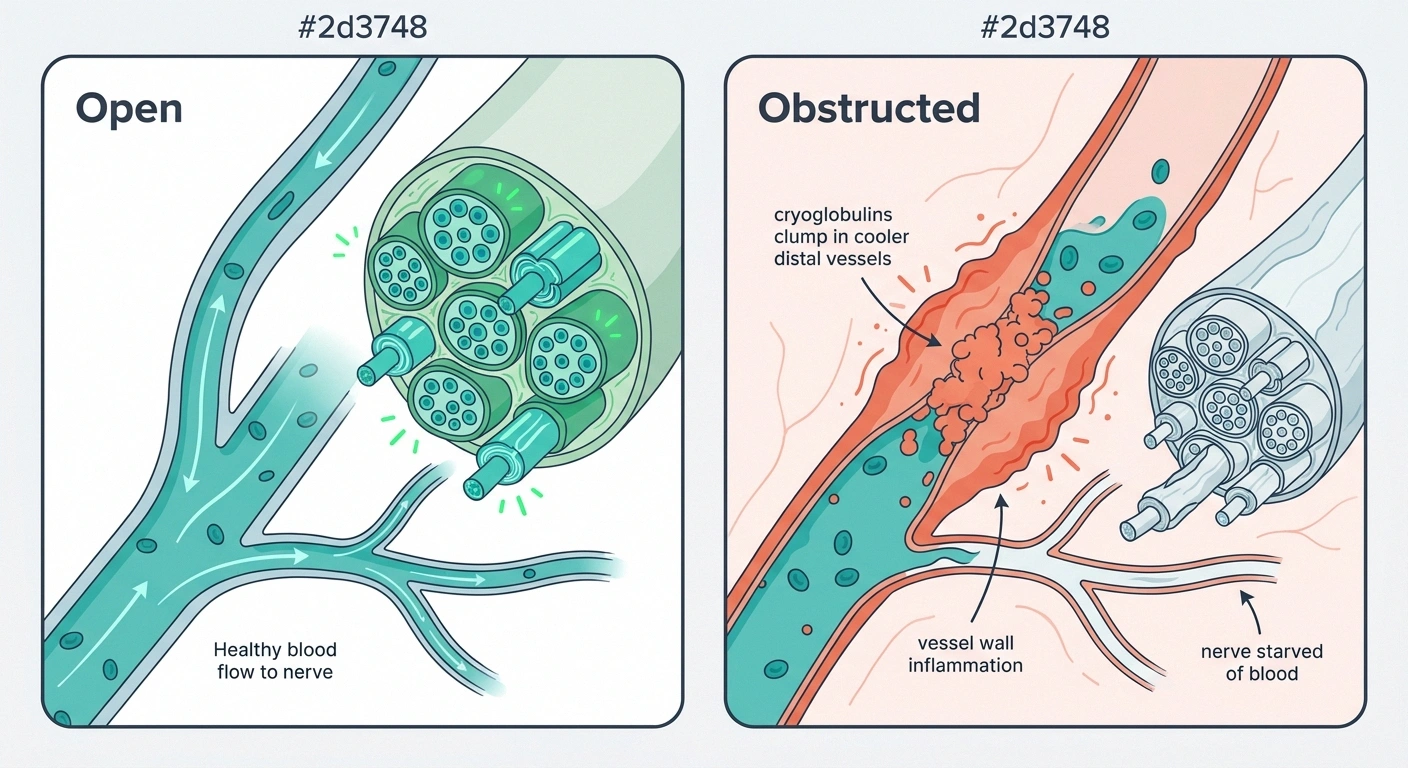
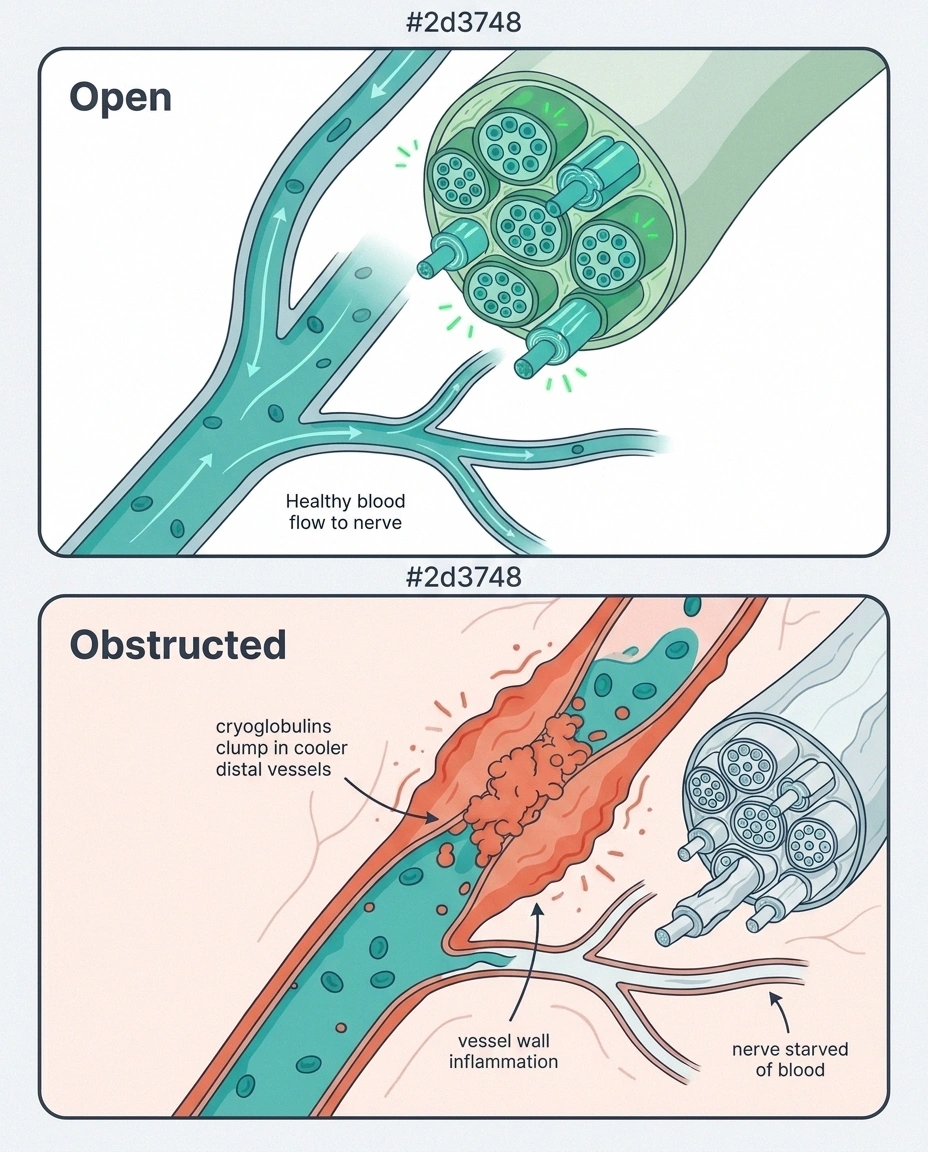
Chronic hepatitis C can trigger the production of abnormal proteins called cryoglobulins. They’re antibodies with an unusual property: they clump together at temperatures below normal body temperature. Then they travel to the smallest, coolest, most distant blood vessels in your body and precipitate out there.
Now think about where those vessels are. Your fingers. Your toes. And, critically, the microscopic vessels that supply the nerves themselves.
When those tiny vessels get obstructed, the nerve tissue downstream is starved of blood. On top of that, the immune complexes piling up in the vessel walls provoke an inflammatory vasculitis that damages the vessels directly. The nerve dies of ischemia — starved rather than poisoned. It’s a plumbing problem that presents as a wiring problem.
Neuropathy is common in hepatitis C, and when mixed cryoglobulinemia is present the reported prevalence climbs dramatically, into a range some studies put as high as 26 to 86 percent. The pattern differs too. With cryoglobulinemia, people tend toward a symmetrical polyneuropathy. Without it, you’re more likely to see mononeuritis multiplex, which is a patchy pattern where individual named nerves fail one at a time, in no symmetrical order at all.
That patchiness is a real clue. Standard length-dependent neuropathy is symmetrical and gradual. A wrist drop on Tuesday and a foot drop three weeks later on the opposite side is a different animal entirely, and it deserves urgent evaluation rather than a wait-and-see.
Our full write-up on hepatitis C and nerve damage goes deeper on the testing and treatment side. The headline worth carrying here: modern antiviral therapy clears the virus in the large majority of people, and studies looking at nerve outcomes after eradication have found improvement in a meaningful share of patients. That’s not nothing. In a field where “manage it” is the usual answer, an actual curable upstream cause is worth chasing hard.
Road Three: Cholestatic Liver Disease and the Vitamin Nobody Checks
This one is rarer, and it’s the reason I wanted to write this article at all, because it’s the pathway most likely to be missed for years.
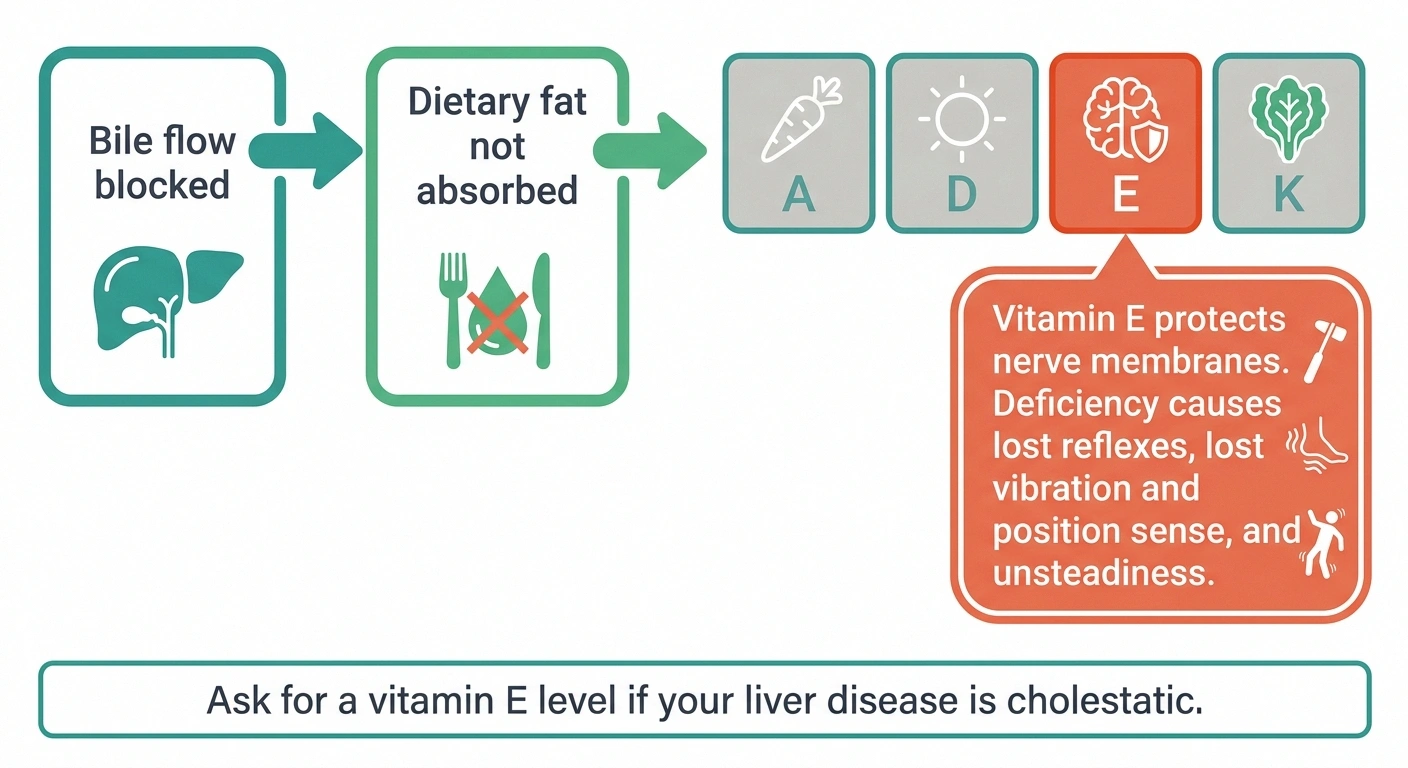
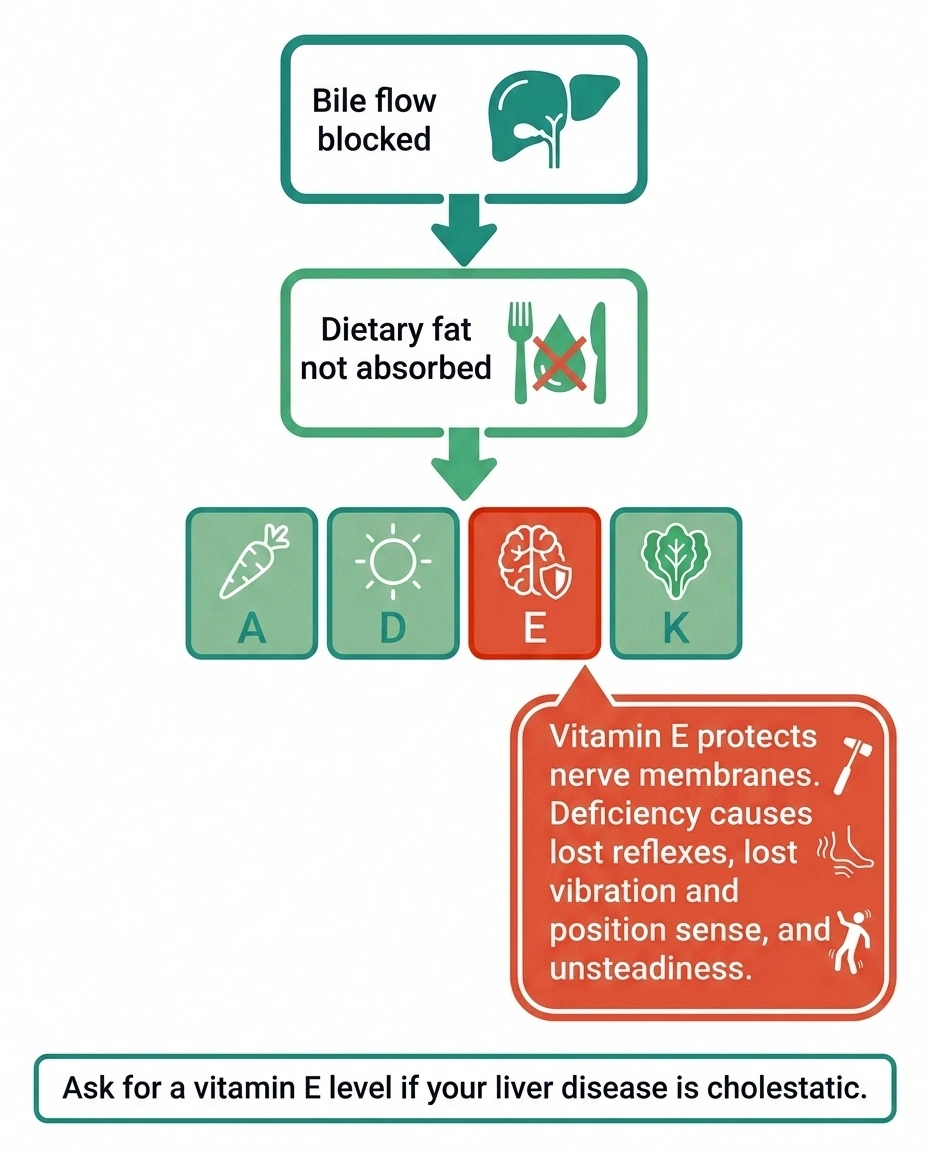
In cholestatic liver conditions such as primary biliary cholangitis and primary sclerosing cholangitis, bile flow is obstructed. Bile isn’t just waste disposal. It’s what emulsifies fat in your intestine so the fat can be absorbed. No bile, no fat absorption. And the vitamins that ride along with dietary fat are A, D, E and K.
Vitamin E is the one that matters for nerves. It’s a fat-soluble antioxidant that protects nerve membranes, and prolonged deficiency produces a distinctive neurological syndrome: loss of reflexes, loss of vibration sense, loss of position sense, ataxia, sometimes proximal muscle weakness. It was documented in adults with primary biliary disease decades ago and it remains under-recognized.
Notice what’s absent from that symptom list — burning. Vitamin E deficiency isn’t primarily a painful neuropathy. It’s a numb, unsteady, “I can’t tell where my feet are in the dark” neuropathy, hitting the large fibers that carry position sense rather than the small fibers that carry pain and temperature. If your complaint is unsteadiness rather than pain and you have a cholestatic liver condition, a vitamin E level is a cheap, specific test that almost nobody orders.
The same malabsorption also hits vitamin D, which matters for bone health in a population already prone to fractures, and vitamin K, which matters for clotting.
Road Four: Fatty Liver, Insulin, and the Metabolic Middle
Now the common one. Fatty liver disease, which the field has renamed metabolic dysfunction-associated steatotic liver disease, or MASLD, affects roughly a third of adults. It’s the reason most people reading this ended up here.
The evidence linking it to neuropathy is real but needs careful reading. A meta-analysis found that diabetic peripheral neuropathy was significantly more prevalent in people with fatty liver than in those without. A cross-sectional analysis using national survey data on more than 3,000 U.S. adults aged 40 to 85 found the same association.
Here’s the detail that tells you what’s actually going on — the association was confirmed in type 2 diabetes but not in type 1.
Sit with that. If fatty liver were poisoning nerves directly, it should show up in both. That it shows up only in the insulin-resistant group suggests the fatty liver isn’t the cause so much as the visible marker of the metabolic state that’s damaging the nerves. Insulin resistance produces fat in the liver and damages small nerve fibers, and it does both through overlapping machinery.
Which means the practical takeaway is genuinely different from roads one through three. There’s no vitamin to replace and no virus to clear. The lever is metabolic: glucose control, weight, activity, and the insulin resistance sitting underneath all of it. Improving the liver and improving the nerves are, to a real extent, the same project.
I find that framing helps people. Two problems that felt like two more items on an overwhelming list turn out to have one shared handle.
Encephalopathy Is Not Neuropathy, and the Confusion Costs People
This comes up constantly, so let’s separate three things that get tangled together.
- Hepatic encephalopathy
- Brain. Confusion, personality change, reversed sleep, asterixis. Treated by lowering ammonia with lactulose or rifaximin.
- Peripheral neuropathy
- Nerves outside brain and cord. Numbness, burning, tingling, weakness, usually feet first. Treated by addressing the cause plus symptom control.
- Restless legs syndrome
- Neither of the above. An urge to move that worsens at rest and eases with movement. Common in liver disease, checked with iron studies, treated differently again.
Describing the sensation precisely gets you further in an appointment than naming a condition.
Hepatic encephalopathy is a brain problem. When the liver can’t clear toxins, ammonia among them, they reach the brain and cause confusion, personality change, sleep-cycle reversal, and in advanced cases stupor. One of its classic signs is asterixis, the “liver flap,” where outstretched hands lose tone in brief jerks. That’s a brain sign, not a nerve sign — even in the hands, even though it happens in the hands.
Peripheral neuropathy is the nerves outside your brain and spinal cord: numbness, burning, tingling, weakness, usually starting in the feet.
Restless legs syndrome is common in liver disease, feels awful, and is neither of the above. It’s an urge to move that’s worse at rest and better with movement, and it responds to different treatments entirely.
Why does the distinction matter? Because they get mixed up in appointments and the wrong one gets treated. Someone describing “my legs won’t let me sleep” gets ammonia-lowering therapy for a problem that isn’t ammonia, or a neuropathy workup for a movement disorder. If you’re describing symptoms to a doctor, describing the sensation precisely does more work than naming a condition.
What to Actually Ask For

Here’s what I’d want on the list if I were sitting in that appointment with liver disease and symptomatic feet.
Ask for the deficiency panel, not just B12. A standard B12 is a start, but in liver disease it can read falsely high because the liver stores B12 and releases it when hepatocytes are damaged. Methylmalonic acid is more informative when there’s any doubt. The full picture of nutritional causes includes thiamine, B6, folate and copper, and our B-vitamin guide walks through what each one does.
Ask about vitamin E specifically if your liver disease is cholestatic. This is the single most skipped test on this list.
Ask whether hepatitis C has been ruled out and whether cryoglobulins have ever been checked. A hepatitis C antibody test plus an RNA test if positive. Cryoglobulin testing has real handling requirements, so it’s worth confirming the lab does it properly.
Ask for nerve conduction studies if the pattern is unusual. Asymmetry, rapid progression, weakness out of proportion to numbness, or hand involvement early all argue for testing rather than assumption.
Ask what else on your medication list touches nerves. People with advanced liver disease take a lot of medications, and metabolism of many of them is altered when the liver is compromised, which can push normal doses toward toxic exposure.
If burning feet are your main complaint and the cause is genuinely unclear, our guide to sorting through the differential for burning feet covers the wider set of possibilities beyond the liver.
Does Any of It Get Better?
Honest answer: it depends entirely on which road you’re on, and I’d rather give you the specifics than false comfort.
Across all four roads, the same factor separates the people who get sensation back from the people who do not: whether the nerve was starved or destroyed.
Demyelination and metabolic starvation are recoverable. Axon loss largely is not, and the neuropathy of advanced cirrhosis is predominantly axonal, which is why it is the hardest of the four.
Practical consequence: nerve conduction studies do more than confirm neuropathy exists. They tell you which kind you have, which is the closest thing available to a prognosis. Worth requesting even when the diagnosis already feels obvious.
Nutritional causes have the best odds. Replace what’s missing early enough and nerves recover, because the machinery was starved rather than destroyed. Timing is everything, and recovery runs on a nerve’s schedule — months, not weeks.
Hepatitis C-related neuropathy can improve after the virus is cleared, particularly when treatment happens before extensive vessel damage has accumulated.
Metabolic neuropathy responds to metabolic control, slowly and partially. Realistic expectation: slower progression and modest improvement rather than reversal.
The neuropathy of advanced cirrhosis itself is the hardest. It’s largely axonal, which is the type that regenerates poorly and slowly.
There’s one more thing worth knowing. Case reports and small series have described improvement in neuropathy after liver transplantation in some patients, which is at least a hint that some of this damage is driven by the ongoing liver failure rather than being permanently baked in. It’s a hint, not a promise — and nobody gets transplanted for neuropathy.
Living With Both at Once

The practical reality of carrying a liver diagnosis and a nerve diagnosis together is that the standard advice for each one occasionally collides.
Pain medication is the sharpest example. Acetaminophen has a hard ceiling in liver disease. NSAIDs carry bleeding and kidney concerns in cirrhosis. Duloxetine carries hepatic cautions. Gabapentin and pregabalin are cleared by the kidneys rather than the liver, which makes them relatively more usable here, though sedation raises fall risk. This is exactly the kind of tangle where a pharmacist earns their keep, and pharmacists are far easier to get five minutes with than specialists.
Alcohol is not a gray area on either side. Both the liver and the nerves are unambiguous about it. If cutting back has been hard, that’s a medical problem with medical treatments, not a character issue. Our piece on where the actual limits sit is worth reading if you’re trying to work out what “moderate” means with a compromised liver.
Foot care deserves extra attention here, because two things stack. Numb feet don’t report injuries, and advanced liver disease brings edema, fragile skin, and impaired clotting. A small wound on a swollen, insensate, poorly healing foot is a bigger event than it looks.
And be gentle with yourself about fatigue. Liver disease is exhausting on its own, neuropathy disrupts sleep on its own, and the two together produce a tiredness that isn’t laziness and isn’t in your head. It’s the arithmetic of two conditions that both tax the same reserves.
The Thing I Wish Someone Had Told Deb
Deb eventually got her vitamin panel, her hepatitis serology, and a straight conversation about insulin resistance. Her neuropathy turned out to be, most likely, metabolic. No hidden vitamin, no virus.
You might think that was a disappointing answer. She didn’t take it that way at all — not even slightly. Two years of not knowing had been worse than knowing, and the answer came with something to actually do about it.
That’s the whole reason to map these roads. Not every road leads somewhere fixable. But you can’t tell which one you’re on without asking, and nobody’s going to ask on your behalf, because it isn’t anybody’s end of the hallway.
Make it yours.
Frequently Asked Questions
Can liver problems cause neuropathy?
Yes, and through several distinct mechanisms rather than one. Studies of people with cirrhosis find peripheral neuropathy on nerve conduction testing in a large share of patients, with reported prevalence ranging from about 19 to 80 percent across the literature. Importantly, the neuropathy appears regardless of what caused the cirrhosis, which suggests the liver disease itself contributes rather than only the underlying cause such as alcohol. Most of it is subclinical, meaning nerve testing detects it before the person notices symptoms.
Does fatty liver cause nerve damage?
The association is real but the causal picture is more subtle. Research has found that peripheral neuropathy is more prevalent in people with fatty liver disease than in those without, including a meta-analysis and a large cross-sectional study of U.S. adults. However, the association held in type 2 diabetes and not in type 1, which points toward shared insulin resistance driving both conditions rather than the fatty liver damaging nerves directly. Practically, this means addressing the underlying metabolic state benefits both the liver and the nerves.
What is the difference between hepatic encephalopathy and neuropathy?
Hepatic encephalopathy affects the brain and causes confusion, personality changes, sleep-cycle disruption and, in advanced cases, reduced consciousness. It results from toxins the failing liver cannot clear. Peripheral neuropathy affects the nerves outside the brain and spinal cord, causing numbness, burning, tingling and weakness that usually begins in the feet. They are separate problems with separate treatments, and confusing them can lead to the wrong one being addressed.
Which vitamin deficiency from liver disease damages nerves?
Several, depending on the type of liver disease. In cholestatic conditions such as primary biliary cholangitis, obstructed bile flow prevents absorption of fat-soluble vitamins, and vitamin E deficiency produces a characteristic syndrome of lost reflexes, lost vibration and position sense, and unsteadiness. In alcohol-related liver disease, thiamine deficiency is central. B12, folate and copper deficiencies also occur. A vitamin E level is the test most often overlooked in cholestatic disease.
Can hepatitis C neuropathy be reversed?
Improvement is possible, particularly when the virus is cleared before extensive damage accumulates. Modern direct-acting antiviral therapy eliminates hepatitis C in the large majority of people treated, and studies examining nerve outcomes after eradication have documented improvement in a meaningful proportion of patients. Recovery is more limited where cryoglobulinemic vasculitis has already caused significant damage to the small blood vessels supplying the nerves. Earlier treatment produces better nerve outcomes.
Is tingling in the feet a sign of liver disease?
By itself, no. Tingling has many causes, with diabetes and vitamin deficiencies far more common than liver disease. That said, if tingling occurs alongside other signs such as abnormal liver enzymes, unexplained fatigue, easy bruising, swelling in the abdomen or legs, or yellowing of the skin or eyes, the combination is worth investigating together rather than separately. Liver-related neuropathy rarely presents as tingling alone with no other indication of liver trouble.
Does neuropathy improve after a liver transplant?
Some case reports and small series have described improvement in autonomic and peripheral nerve function following transplantation, suggesting a portion of the nerve dysfunction is driven by ongoing liver failure rather than being permanently established. The evidence base is limited and outcomes vary considerably. Neuropathy is not an indication for transplantation, and anyone being evaluated for transplant is being assessed on liver criteria. Where nerve improvement occurs, it is a welcome side effect rather than a goal of the procedure.
Should I stop drinking if my neuropathy is not from alcohol?
With existing liver disease, yes, regardless of what caused the neuropathy. Alcohol contributes independently to both liver injury and nerve injury, so continuing adds a second insult to two systems already under strain. This holds even when the primary diagnosis is viral, autoimmune or metabolic. If reducing intake has proven difficult, that is a treatable medical problem with effective options available, and raising it directly gets you further than managing it alone.
About the Author