Every supplement sold for nerve pain rests on an argument, and most of the time the argument has three steps. Step one is usually true. Step two is usually reasonable. Step three is where the money is made — and step three is almost never examined.
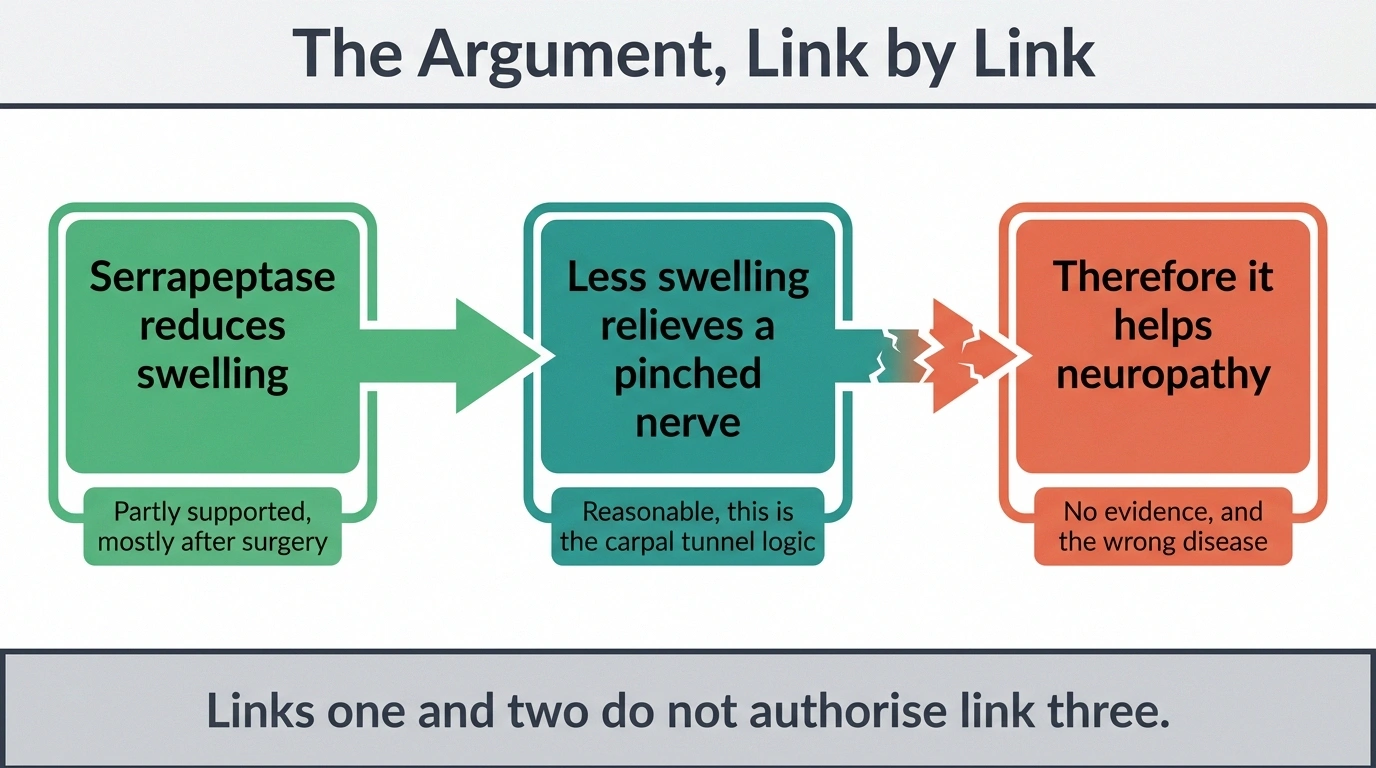
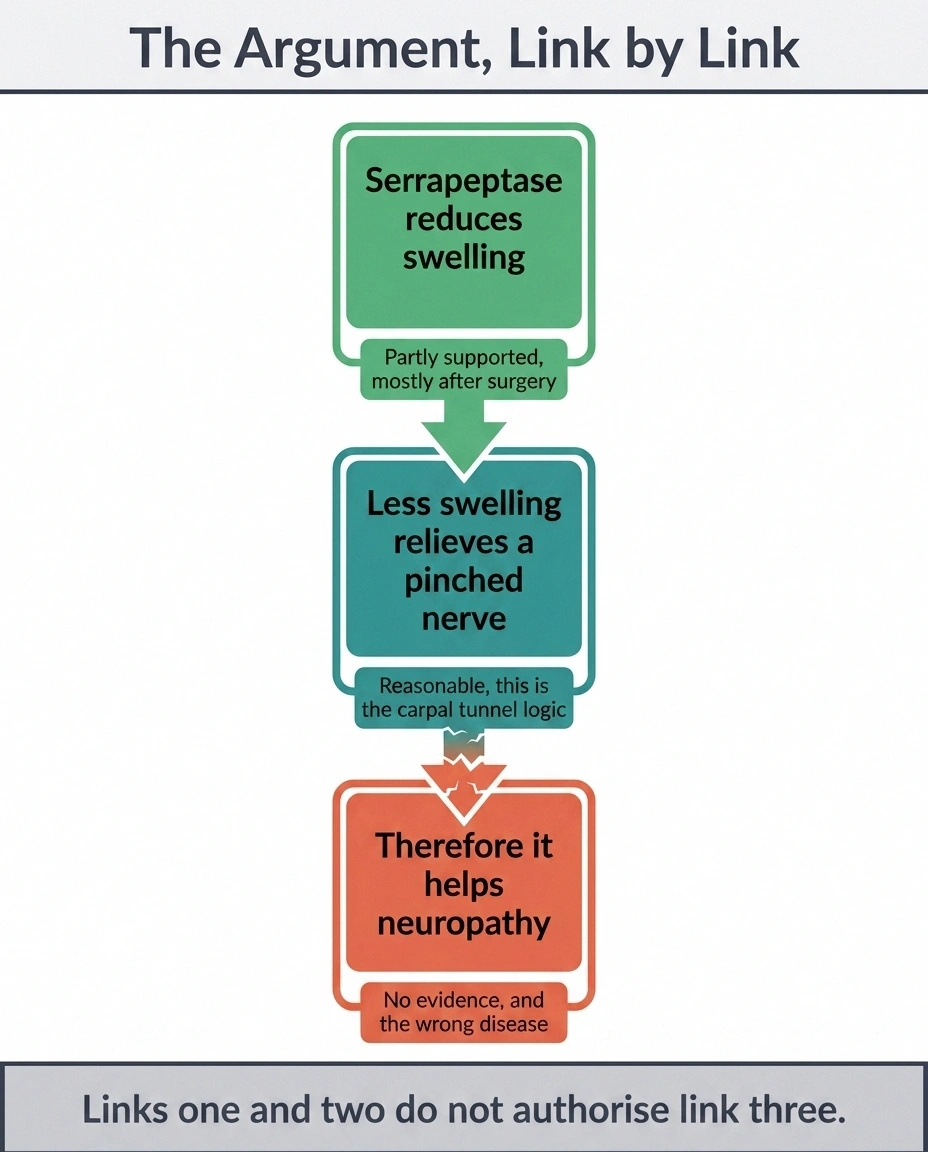
Serrapeptase is the cleanest example I’ve come across. The argument runs like this: serrapeptase reduces inflammation, inflammation compresses nerves, therefore serrapeptase helps neuropathy. Read quickly, that’s persuasive. Read slowly, and the third step is doing something the first two never authorized.
So let’s take the argument apart one step at a time, because the answer to whether this is worth your money depends entirely on which kind of nerve problem you have. For some readers there’s a genuine conversation to be had. For most, there isn’t, and knowing which group you’re in takes about four minutes.
What Serrapeptase Actually Is
Serrapeptase, or serratiopeptidase on a scientific label, is an enzyme. Specifically it’s a proteolytic enzyme, meaning its job is cutting proteins apart.
It was isolated from a bacterium called Serratia, found living in the gut of the silkworm. The silkworm uses it to dissolve its cocoon from the inside and get out. That’s the origin story, it’s on nearly every bottle, and it does an enormous amount of persuasive work while proving nothing at all. An enzyme that dissolves silk in a silkworm’s cocoon tells you nothing about what it does after passing through a human stomach.
It has a real history in medicine, though, and that’s worth being fair about. Serratiopeptidase has been used for roughly forty years in Japan and parts of Europe for pain and swelling: after surgery, after trauma, in arthritis, sinusitis, bronchitis, carpal tunnel syndrome, and breast engorgement.
Look closely at that list. Nearly every item is a condition involving swollen tissue. Not one of them is a condition involving damaged nerve fibers. That distinction is the whole article, and it arrives this early because everything after it follows from it.
Step One: Does It Reduce Inflammation?
Partly, and in some settings genuinely.
The systematic review in the International Journal of Surgery gets quoted by both sides of this argument, usually by people who have read the abstract’s first half. Its conclusion was that the existing evidence is insufficient to support serratiopeptidase as an analgesic or health supplement.
The four faults it identified are worth memorising, because they apply to most supplement literature you will ever read: trials that were not randomised, trials with no placebo group, small numbers of participants, and treatment periods too short to mean much.
A study can be real, published, peer-reviewed, and still unable to answer the question you are asking of it.
The strongest single result is in dentistry. After wisdom tooth extraction, people often develop trismus — a stiff, limited jaw opening caused by swelling in the surrounding muscle and tissue. A review of five studies reported that serrapeptase outperformed both ibuprofen and corticosteroids for that specific problem. That finding comes from the clinical literature rather than from a supplement company, which is worth something. It also carries the same limitations as the rest of this evidence base, which is where the next paragraph goes.
But the overall picture is far weaker than the marketing suggests. The most rigorous look at this, a systematic review published in the International Journal of Surgery, concluded that the existing scientific evidence is insufficient to support serratiopeptidase’s use as an analgesic or health supplement. The problems it identified are the usual ones: many trials weren’t randomized, many had no placebo group, sample sizes were small, and treatment periods were short.
So step one earns a qualified yes. There is something here, it’s most visible in acute post-surgical swelling, and the broader evidence base is thin enough that serious reviewers won’t endorse it.
Step Two: Can Less Swelling Free a Trapped Nerve?
Yes, and this is the step where the argument is at its strongest, so I want to give it full credit.
Carpal tunnel syndrome is the model case. The median nerve runs through a narrow bony passage at the wrist, roofed by a tough ligament. When the tissue inside that tunnel swells, there’s nowhere for the pressure to go, and the nerve gets squeezed. Squeeze a nerve and you get exactly what you’d expect: numbness, tingling, night pain, weakness in the thumb side of the hand.
In that situation, reducing swelling could plausibly relieve nerve pressure. The logic is sound. It’s the same logic behind a wrist splint and behind a corticosteroid injection, both of which are standard care. Carpal tunnel is on serrapeptase’s traditional use list for precisely this reason, and if that’s your problem, this is a fair thing to raise at your next appointment.
Note carefully what kind of problem that is. It’s a mechanical problem — a healthy nerve being pressed on by something swollen. Remove the pressure and the nerve, which was never damaged in the first place, resumes working.
Step Three: Where the Argument Breaks
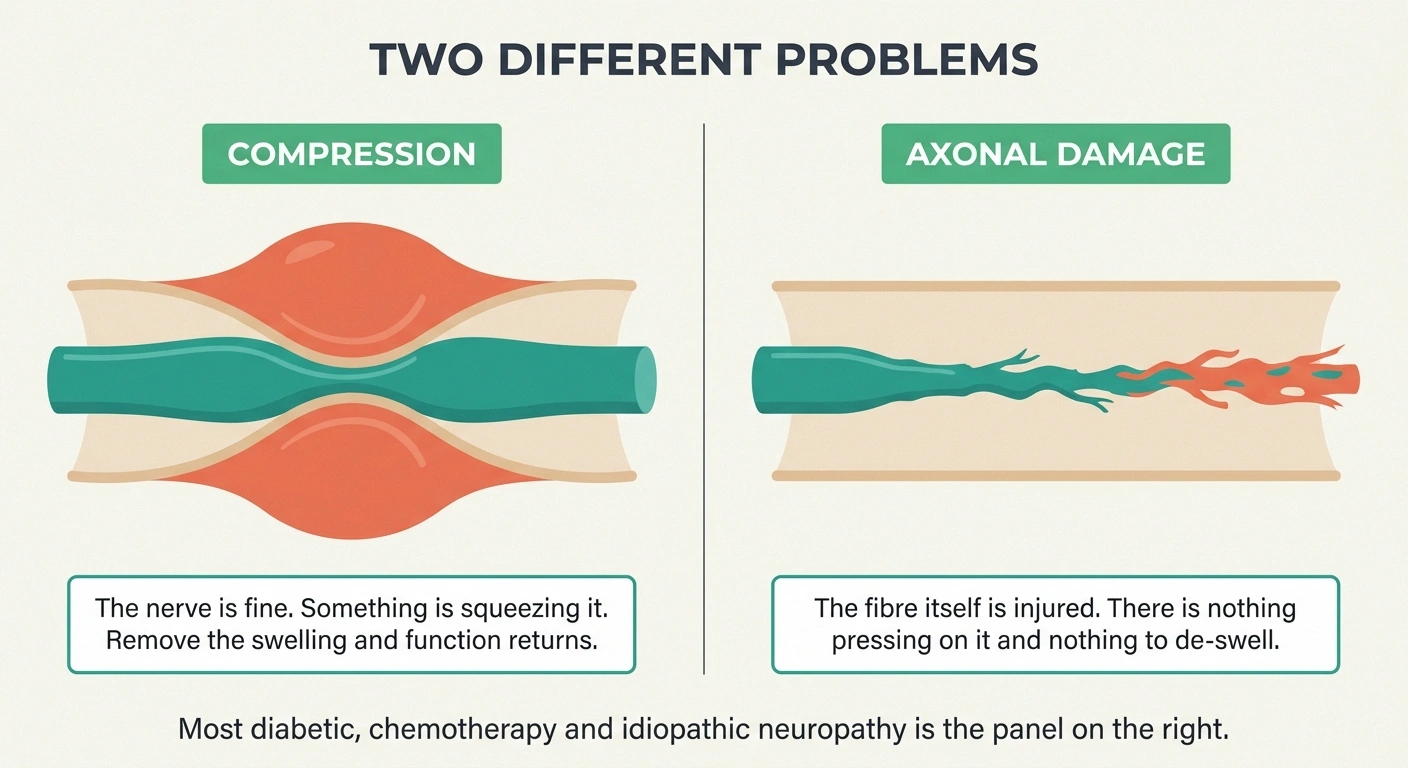
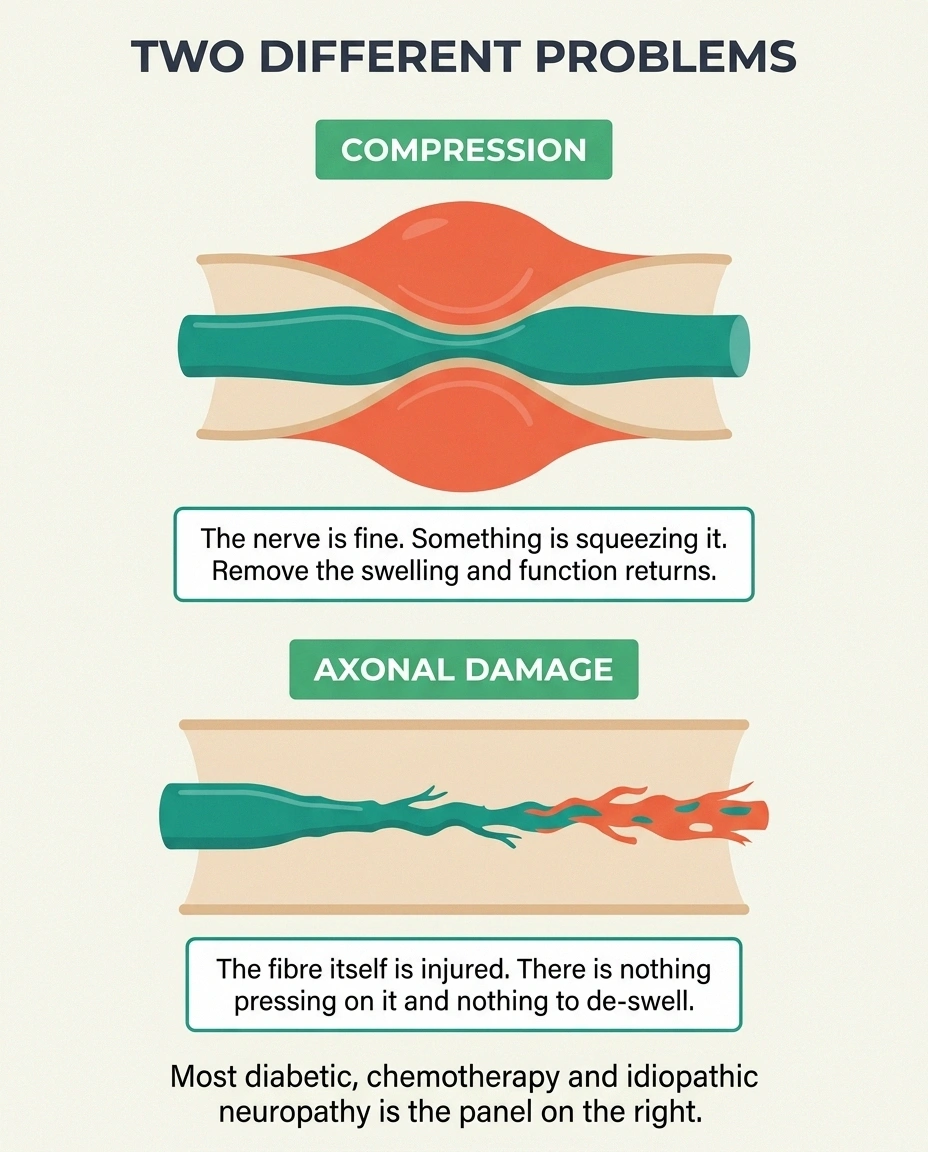
Here’s the leap. Serrapeptase relieves nerve compression, so serrapeptase helps neuropathy.
- An entrapment
- Symptoms in the territory of one nerve rather than both feet. Often worse at night or after a specific position. Frequently one-sided. Carpal tunnel, cubital tunnel, tarsal tunnel. The nerve itself is healthy and something swollen is pressing on it, so the swelling argument at least applies to you.
- A polyneuropathy
- Symmetric, both feet, starting at the toes and moving upward over months or years. Diabetic, chemotherapy-related, alcohol-related, or idiopathic. The nerve fibre itself is injured and nothing is compressing it, so there is no swelling for an enzyme to act on.
- If you genuinely do not know
- Nerve conduction testing usually sorts this out, and it is the same test that would already be on the table for any unexplained numbness. One caveat worth carrying in: it can read normal in small fiber neuropathy, so a normal result does not always close the question. This distinction decides far more than one supplement purchase.
That works only if your neuropathy is a compression problem. For the large majority of people reading this page, it isn’t.
Diabetic neuropathy, chemotherapy-induced neuropathy, alcohol-related neuropathy, most idiopathic neuropathy — these are not nerves being squeezed. They’re nerves being damaged. High blood sugar, a chemotherapy agent, or a toxin injures the nerve fiber itself and the machinery that maintains it. The longest fibers fail first, which is why symptoms start in the toes and work upward, a pattern with its own name and its own specific explanation. Nothing is pressing on those nerves. There’s no swelling to remove.
An enzyme that breaks down swollen tissue has nothing to act on in that scenario. It isn’t that the enzyme is too weak, or that the dose is wrong, or that you haven’t taken it long enough. It’s that there’s no target. You could dissolve every bit of inflammatory debris in the foot and the axon would remain exactly as damaged as it was.
This is also why the disease models matter so much when you’re evaluating anything sold for nerve pain. Small fiber neuropathy involves the loss of tiny nerve endings in the skin. Chemotherapy-induced neuropathy involves direct toxicity to the nerve cell and its transport system. Neither one is a plumbing problem, and neither responds to a treatment aimed at swelling.
If you’re genuinely unsure which category you’re in, the distinction between an entrapment and a widespread neuropathy is one nerve conduction testing can usually sort out, with the caveat that it can read normal in small fiber neuropathy, and it’s covered in more detail in our page on what tingling hands actually mean.
The Absorption Problem
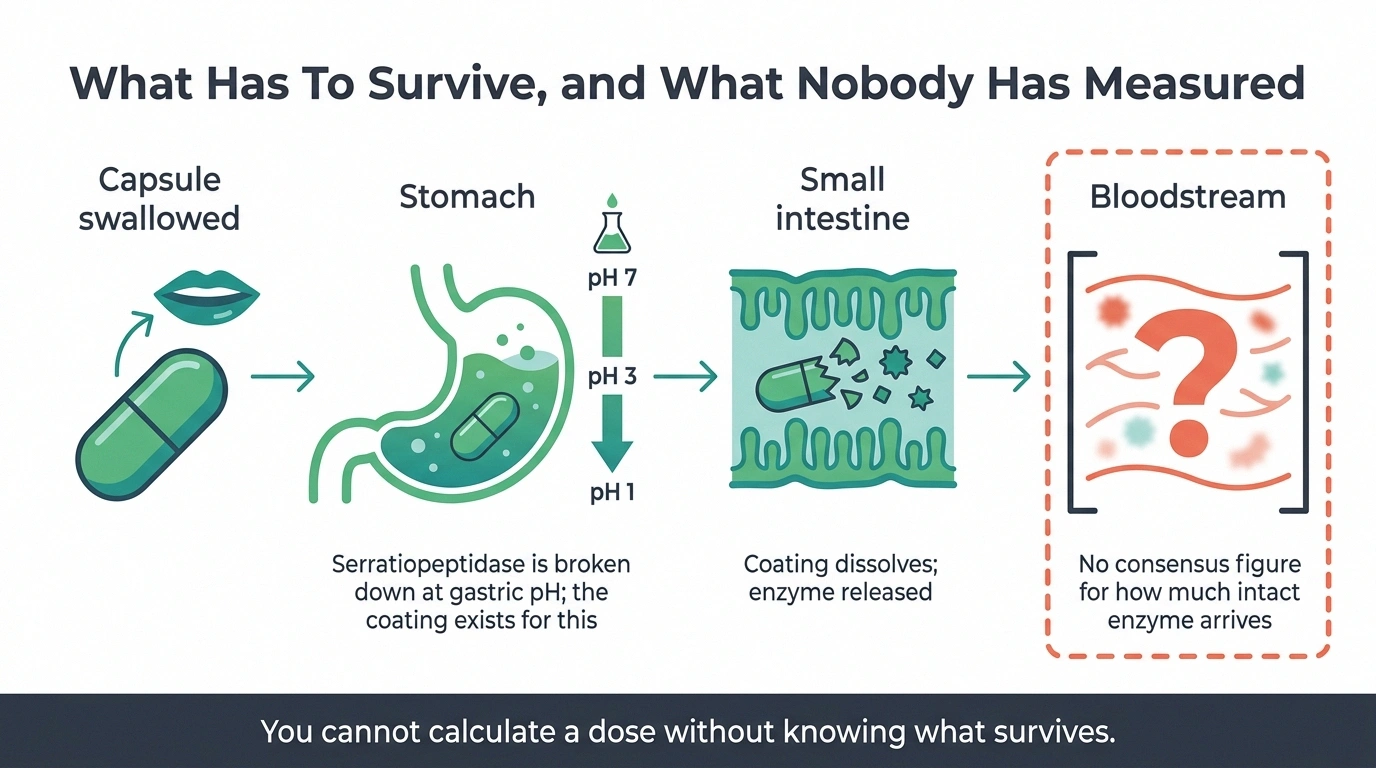
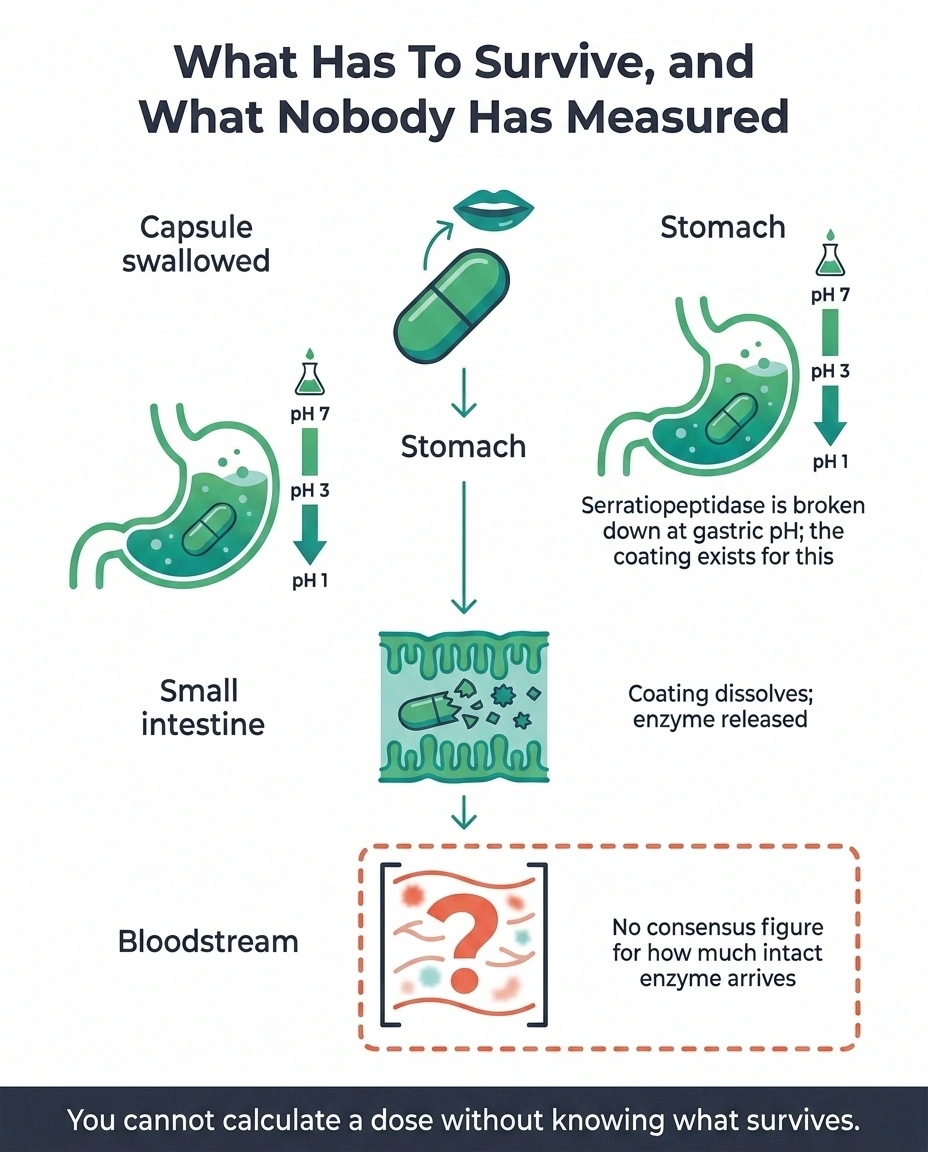
Set aside everything above for a moment and grant the whole argument. There’s still a mechanical obstacle sitting between the capsule and your bloodstream.
Serrapeptase is a protein. Your stomach exists, in large part, to destroy proteins. Serratiopeptidase undergoes acid hydrolysis at gastric pH, which is a formal way of saying that stomach acid takes it apart. Its stability in the digestive tract is poor.
The supplement industry’s answer is enteric coating: a shell designed to survive the stomach and dissolve further down, in the small intestine. That’s a real solution to a real problem, and it’s why the better products are enteric-coated and why the instructions tell you to take it on an empty stomach.
Here’s the part that troubles me. Despite decades of use, there is no consensus figure for how much intact enzyme actually reaches the human bloodstream. Not a disputed number with a range. No agreed number at all.
For a supplement that has to arrive intact and systemically to do anything at all — an enzyme, not a small molecule that shrugs off digestion — that gap sits underneath every claim on the label. You cannot calculate a meaningful dose without knowing what fraction survives, which means the dosing recommendations in circulation are inherited convention rather than derived from measurement.
Reading the Label Without Getting Confused

If you do buy this, the label itself is a small maze, and the confusion is worth clearing up because it costs people money.
There is no universal conversion between the two units, which means two products cannot be compared on price per milligram unless both report activity.
| On the label | What it measures | Useful? |
|---|---|---|
| SPU | Enzyme activity, the work it can actually do | The meaningful one |
| Milligrams | Weight of material in the capsule | Sounds like information |
| Enteric coated | Designed to survive stomach acid and dissolve lower down | Required, not optional |
| “Maximum strength” | Nothing. It is not a defined term. | Ignore |
Doses in circulation run about 10 to 60 mg daily in divided doses, with enteric-coated products commonly at 20 to 40 mg. Higher has not been shown to be better.
Serrapeptase strength appears two different ways. Some products list milligrams. Others list SPU, meaning serrapeptase units, a measure of enzyme activity rather than weight. They aren’t interchangeable, and there’s no universal conversion you can do in your head at the shelf. A 20 mg capsule and a 40,000 SPU capsule are not obviously comparable, and a bottle listing only milligrams is telling you how much powder is present rather than how active that powder is.
Practical guidance:
Prefer a product that lists SPU. Activity is the thing that matters. Weight without activity is a number that sounds like information.
Confirm it’s enteric-coated. Uncoated serrapeptase is fighting your stomach acid with no protection, and the whole absorption argument depends on the coating.
Take it on an empty stomach. Standard advice is roughly thirty minutes before eating or two hours after. Food triggers acid and slows transit, both of which work against you.
Know the typical range. Doses in use run about 10 to 60 mg per day, usually split into two or three, with enteric-coated products commonly at 20 to 40 mg. Higher is not established as better, and there’s no evidence base behind the very high SPU products.
The Bleeding Conversation
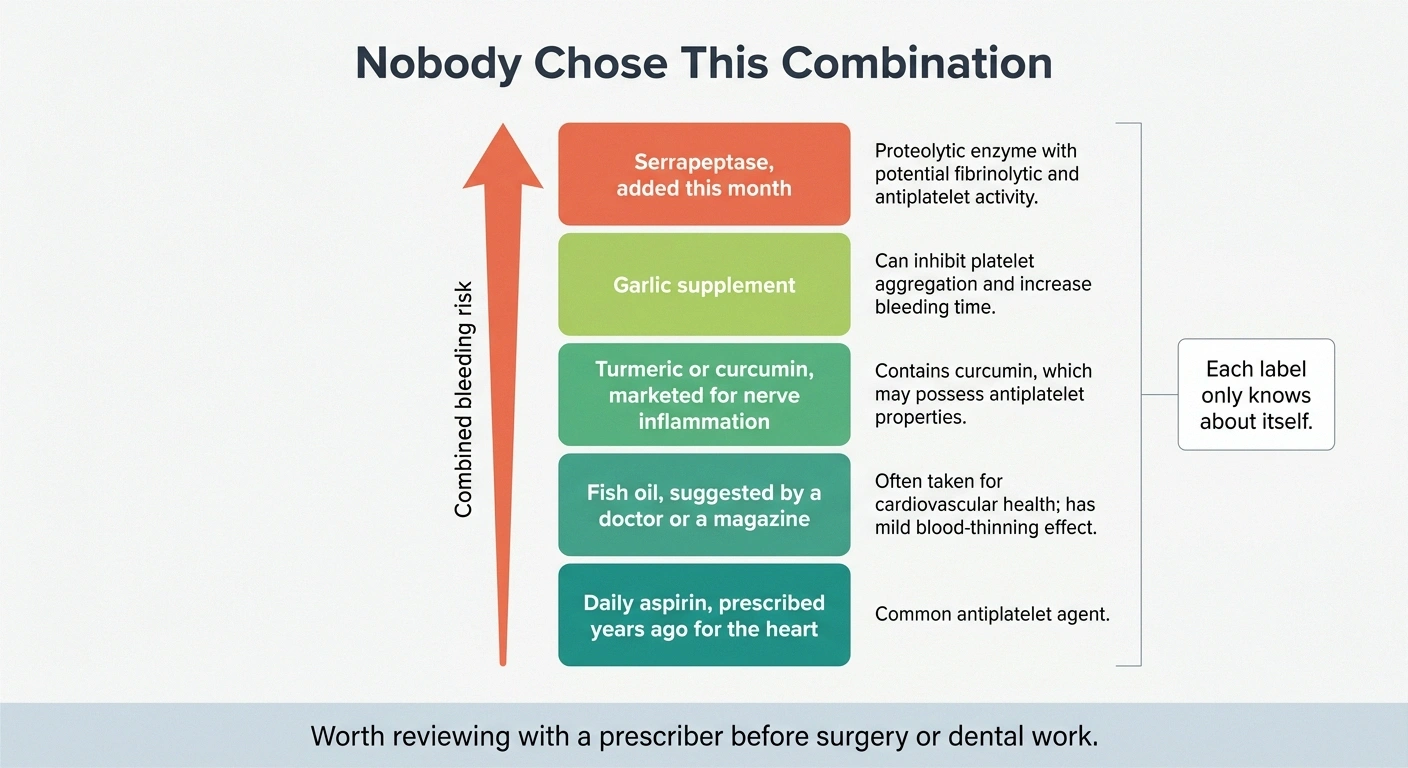
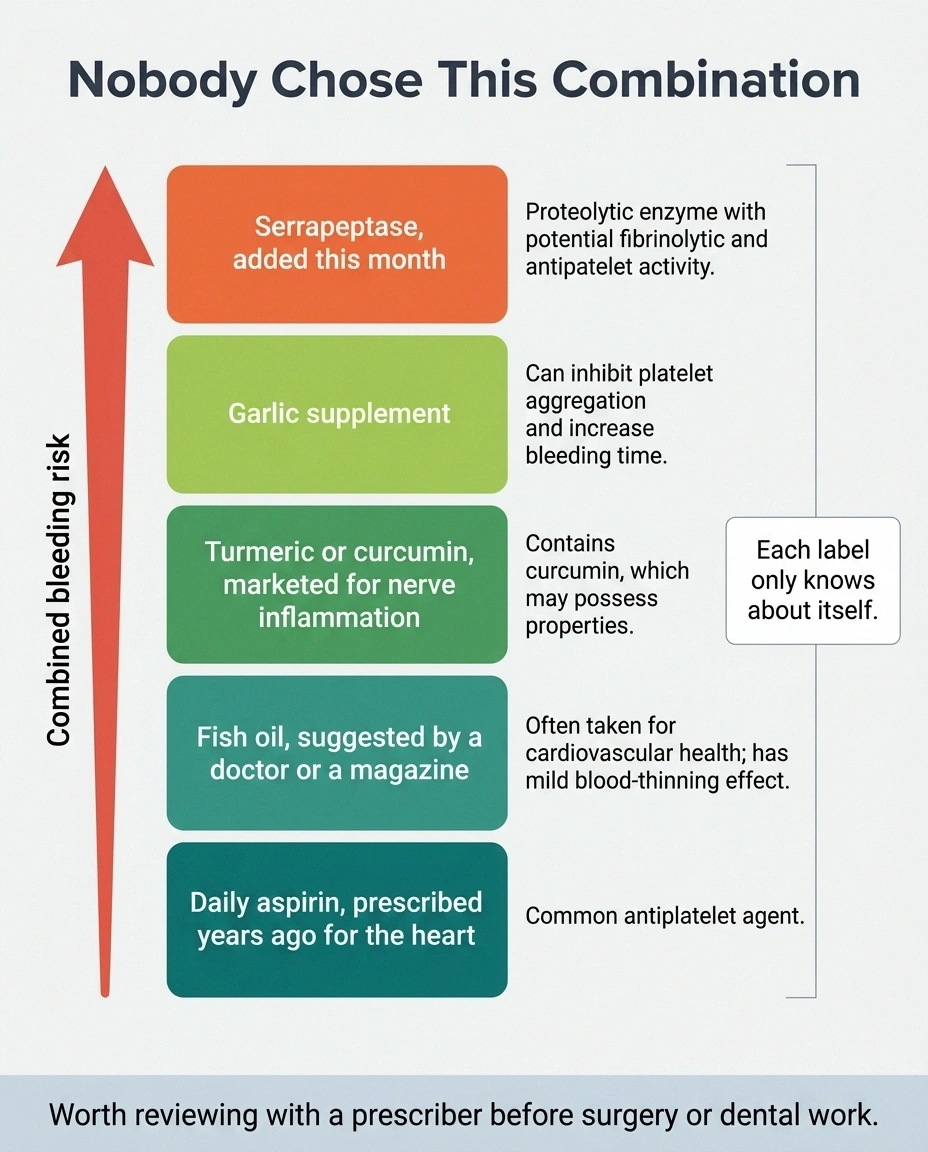
This is the section that matters most for our readers, and it’s the one supplement pages handle with a single vague line.
Bring the actual bottles or a photograph of the labels, not a remembered list. The interaction here is additive across several items that each look harmless alone.
- Warfarin, or any newer anticoagulant
- Daily aspirin, clopidogrel, or another antiplatelet
- Fish oil or omega-3 at supplement doses
- Turmeric or curcumin, including in a combined nerve formula
- Garlic supplements, ginkgo, or vitamin E at high doses
- Any surgery or dental procedure scheduled in the next few weeks
Two or more items on this list is the point at which the combination deserves a review rather than an assumption. Nobody assembled that stack on purpose; it accumulated.
Serrapeptase may increase bleeding risk. It can potentiate the effect of warfarin and antiplatelet medications, and the concern compounds when it’s stacked with other supplements that do the same thing.
Now think about what’s actually in a typical neuropathy medicine cabinet. Turmeric or curcumin, because it’s marketed relentlessly for nerve inflammation. Fish oil, because a doctor or a magazine suggested it. Garlic supplements. A daily aspirin, prescribed years ago for cardiac reasons. Possibly warfarin or a newer anticoagulant, because diabetes and vascular disease travel together, and because many of the people with neuropathy have the exact medical history that lands you on a blood thinner.
Add serrapeptase to three or four of those and you’ve assembled a stack with additive bleeding risk that no single label warns you about, because each label only knows about itself. Nobody chose that combination — it accumulated one reasonable decision at a time.
Beyond bleeding, the reported adverse effects are worth knowing. Common ones are digestive: nausea, stomach discomfort, diarrhea. Rare but documented ones include eosinophilic pneumonitis, an inflammatory lung reaction reported in several Japanese case reports, along with bullous pemphigoid, a hemorrhage in a patient with Behçet disease, and possible Stevens-Johnson syndrome. These are genuinely uncommon. They’re also more than the “no known side effects” that appears on a lot of sales pages.
If you take any blood thinner, an antiplatelet drug, or have surgery or a dental procedure scheduled, this belongs on the list you review with your prescriber before you start rather than after.
Where the Same Money Buys Actual Evidence
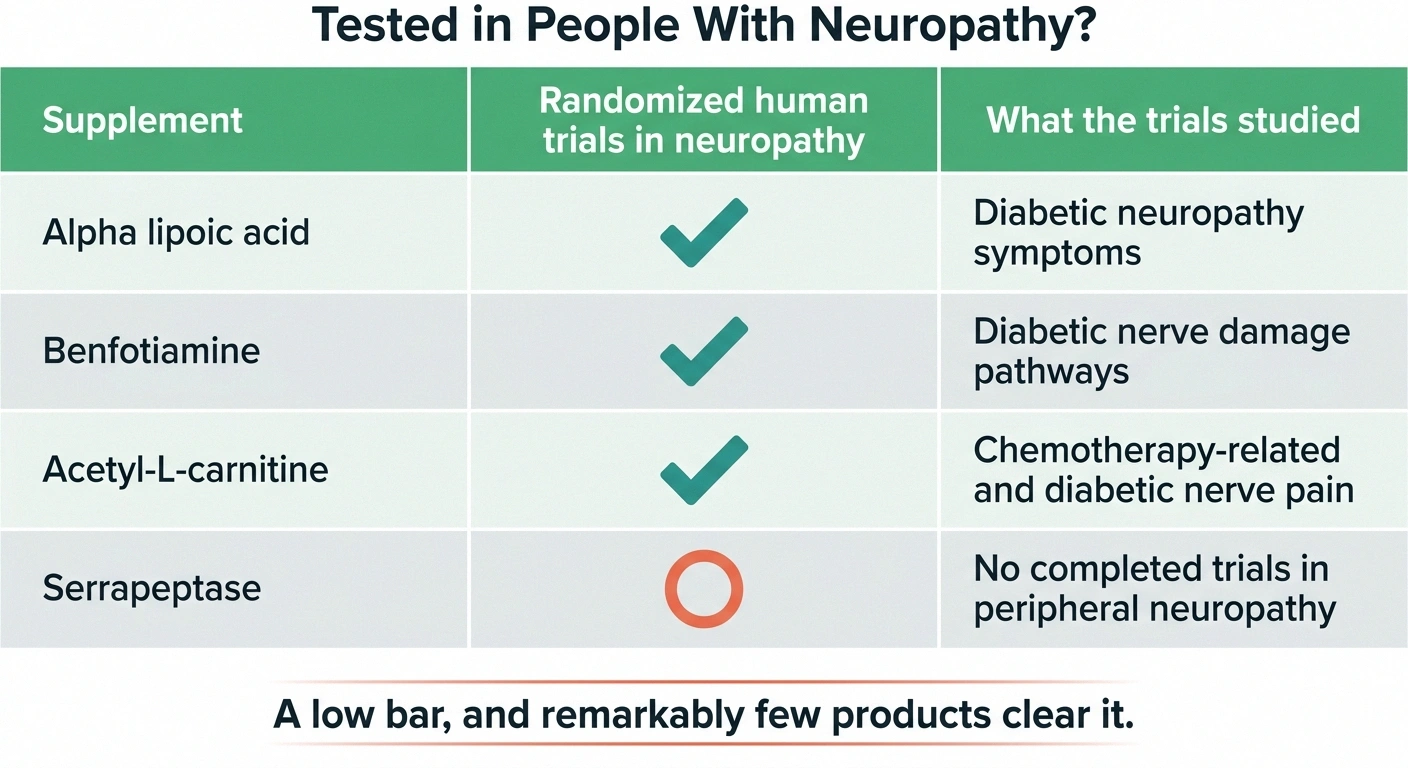
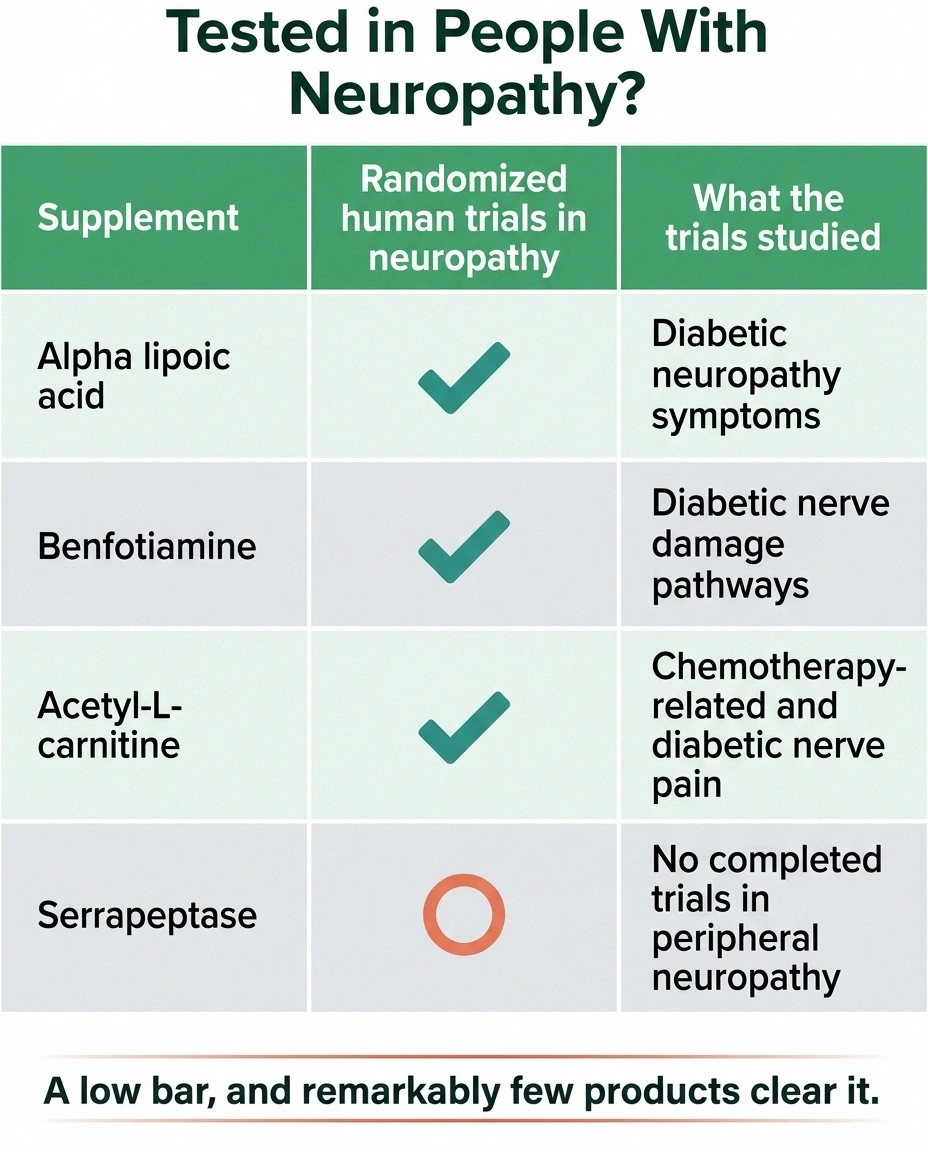
Here’s what frustrates me about supplements like this one. The underlying instinct is right. People with damaged nerves are looking for something that acts on the biology rather than just muting the pain signal, and that instinct is correct. It’s just pointed at the wrong shelf.
If the appeal of serrapeptase is that it targets a process rather than a symptom, these have the same appeal and considerably more human data behind them:
Alpha lipoic acid is the most-studied supplement in diabetic neuropathy, with randomized controlled trials in actual patients rather than case series. It’s the honest benchmark against which everything else on the shelf should be measured.
Benfotiamine is a fat-soluble form of thiamine that reaches nerve tissue better than standard B1, aimed directly at the metabolic damage pathway in diabetic neuropathy.
Acetyl-L-carnitine has been studied specifically in chemotherapy-related and diabetic nerve pain, with a mechanism tied to nerve cell energy rather than swelling.
None of these are cures, and I’d distrust anyone who told you otherwise. What they have that serrapeptase lacks is a body of trials done in people with the condition you actually have. That’s a low bar and it’s remarkable how few products clear it. Our supplement roundup ranks them by evidence rather than by marketing spend, and it’s the page I’d read before buying anything.
So Should You Take It?
Two clear answers, depending on which group you’re in.
If your problem is a compressed nerve — carpal tunnel, cubital tunnel, a nerve entrapment confirmed by testing — then the argument at least applies to your situation. The evidence is still thin and the safety points still stand, but you’d be using it for something like the reason it’s been used in Japan and Europe for decades. Raise it with whoever is managing that entrapment, especially before considering injection or surgery.
If your problem is peripheral neuropathy from diabetes, chemotherapy, alcohol, or an unidentified cause, the argument doesn’t reach you. There’s no compression to relieve, no completed research showing benefit in your condition, a real absorption question, and a bleeding interaction that matters given what else you’re likely taking. I’d put the money elsewhere and I’d feel comfortable saying so.
The reason worth remembering isn’t that serrapeptase is a scam. It’s that a treatment aimed at swelling was quietly redirected at a disease that isn’t made of swelling, and nobody in the chain had a reason to point that out.
Frequently Asked Questions
Does serrapeptase help nerve pain?
There is no completed research showing that serrapeptase helps peripheral neuropathy. It has been used traditionally for conditions involving swelling, including carpal tunnel syndrome, where the theory is that reducing swelling relieves pressure on a compressed nerve. That reasoning may apply to an entrapped nerve. It does not apply to diabetic, chemotherapy-induced, or idiopathic neuropathy, where the nerve fiber itself is damaged and there is no swelling to remove.
How long does serrapeptase take to work?
Product labels commonly suggest two to four weeks, but that timeline comes from convention rather than from trials measuring onset in nerve conditions. Because there is no established figure for how much intact enzyme is absorbed in humans, there is no reliable basis for predicting a response time. If you try it, set a fixed trial period and a written symptom score at the start so you have something objective to compare against.
Should serrapeptase be taken on an empty stomach?
If you have decided to take it, yes. Serrapeptase is broken down by stomach acid, which is why quality products are enteric-coated to survive the stomach and dissolve in the small intestine. Taking it with food increases acid production and slows stomach emptying, both of which are thought to work against absorption. The usual instruction is about thirty minutes before eating or two hours after a meal.
Can I take serrapeptase with blood thinners?
This needs a conversation with your prescriber before you start. Serrapeptase may increase the effect of warfarin and antiplatelet medications, raising bleeding risk. The risk compounds if you also take fish oil, garlic, turmeric, or daily aspirin, which is a common combination among people with neuropathy. Also mention it before any surgery or dental procedure.
Is serrapeptase FDA approved?
No. In the United States it is sold as a dietary supplement, which means it is not reviewed for effectiveness before sale and cannot legally be marketed as treating a disease. Dietary supplement regulation does not require proof that a product works, only that the manufacturer does not make illegal disease claims. It has a longer regulatory and prescribing history in Japan and parts of Europe.
What is the difference between serrapeptase and nattokinase?
Both are enzymes sold as supplements and they are often confused or sold together. Serrapeptase comes from a bacterium associated with silkworms and is marketed for inflammation and swelling. Nattokinase comes from fermented soybeans and is marketed for breaking down fibrin, a blood-clotting protein. Both carry bleeding-risk considerations, and stacking them compounds that risk rather than doubling the benefit.
What does SPU mean on a serrapeptase label?
SPU stands for serrapeptase units and measures enzyme activity rather than weight. Milligrams tell you how much material is in the capsule; SPU tells you how much of it is actually doing enzymatic work. There is no universal conversion between the two, so comparing a milligram product against an SPU product is not straightforward. Where you have the option, an SPU figure is the more meaningful number.
Are there side effects from serrapeptase?
The common ones are digestive: nausea, stomach discomfort, and diarrhea. Rare but documented adverse events include eosinophilic pneumonitis, an inflammatory lung reaction described in several case reports from Japan, along with bullous pemphigoid, a bleeding event in a patient with Behçet disease, and possible Stevens-Johnson syndrome. Serious reactions appear to be uncommon, but the widely repeated claim that serrapeptase has no side effects is not accurate.
About the Author