
If there is one supplement category that genuinely matters for neuropathy, it is B vitamins. Not because they are a miracle cure — they are not — but because B vitamin deficiencies are one of the most common, most treatable, and most overlooked causes of nerve damage. I have seen people in my support group suffer for months or even years with worsening neuropathy symptoms, only to discover that a simple blood test could have identified the problem.
The tricky part is that “B vitamins” is not a single thing. There are eight different B vitamins, and they affect your nerves in very different ways. Some protect nerves, some help repair them, and one can actually cause neuropathy if you take too much. This guide breaks down what the research says about each relevant B vitamin, how to know if you are deficient, and how to supplement safely.
Why B Vitamins Are Essential for Nerve Health
Your nerves are among the most metabolically active tissues in your body. They require a constant supply of energy, building materials, and protective molecules to function properly. B vitamins are involved in nearly every aspect of this process.
The three “neurotropic” B vitamins — classified for their direct affinity for and effect on nerve tissue
At the most fundamental level, B vitamins serve three critical functions for nerves: energy production (your nerves need fuel to transmit signals), myelin maintenance (the protective coating that insulates nerve fibers), and neurotransmitter synthesis (the chemical messengers nerves use to communicate). When any of these processes is disrupted due to a B vitamin deficiency, nerve function suffers — and that is when symptoms like tingling, numbness, burning, and pain develop.
A 2021 review in the journal Nutrients highlighted that vitamins B1, B6, and B12 are specifically classified as “neurotropic” — meaning they have a direct affinity for and effect on nerve tissue. These are the heavy hitters for neuropathy, but they are not the whole story.
Vitamin B12 (Cobalamin): The Most Critical B Vitamin for Nerves
If you take away nothing else from this article, take this: if you have neuropathy and have not had your B12 levels checked, ask your doctor for a blood test. B12 deficiency is one of the most common reversible causes of peripheral neuropathy, and catching it early can prevent permanent damage.
What B12 Does for Your Nerves
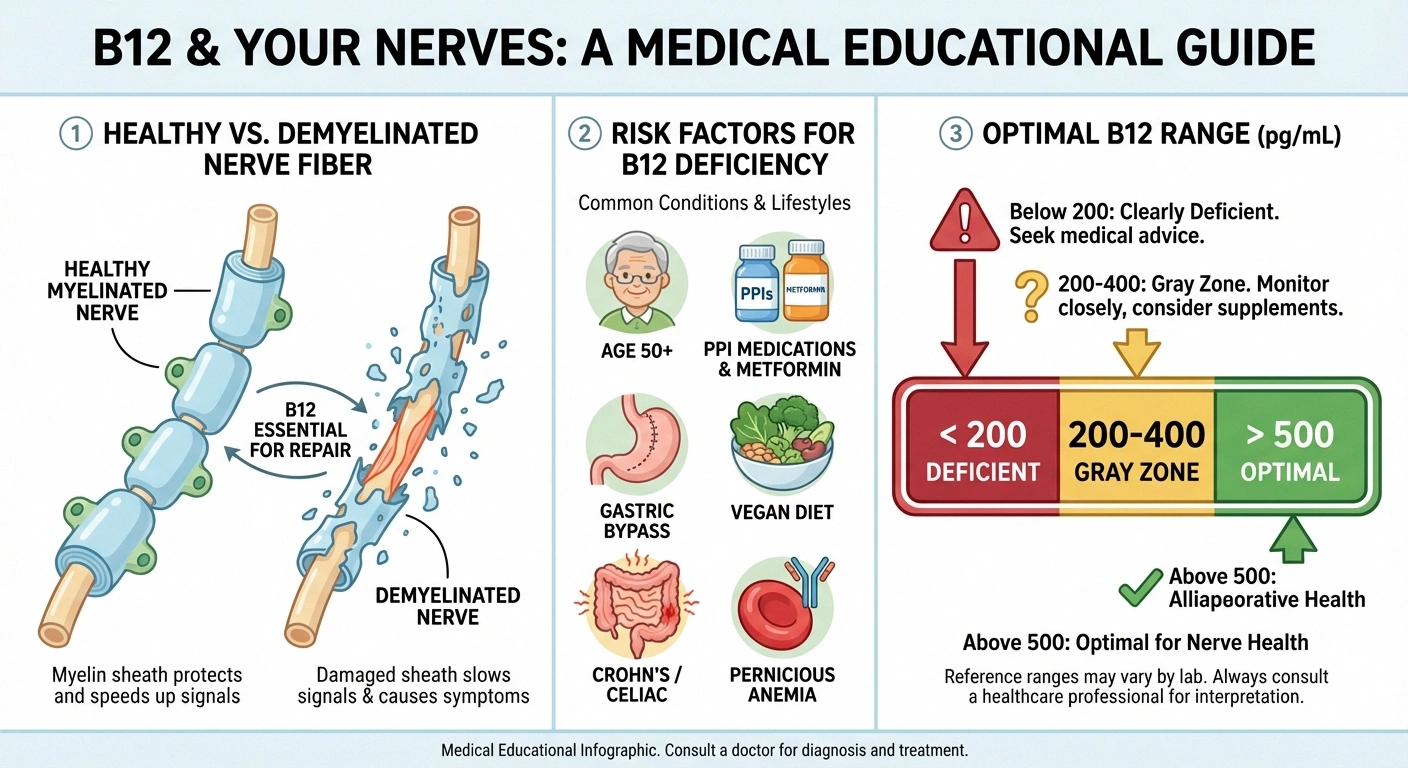
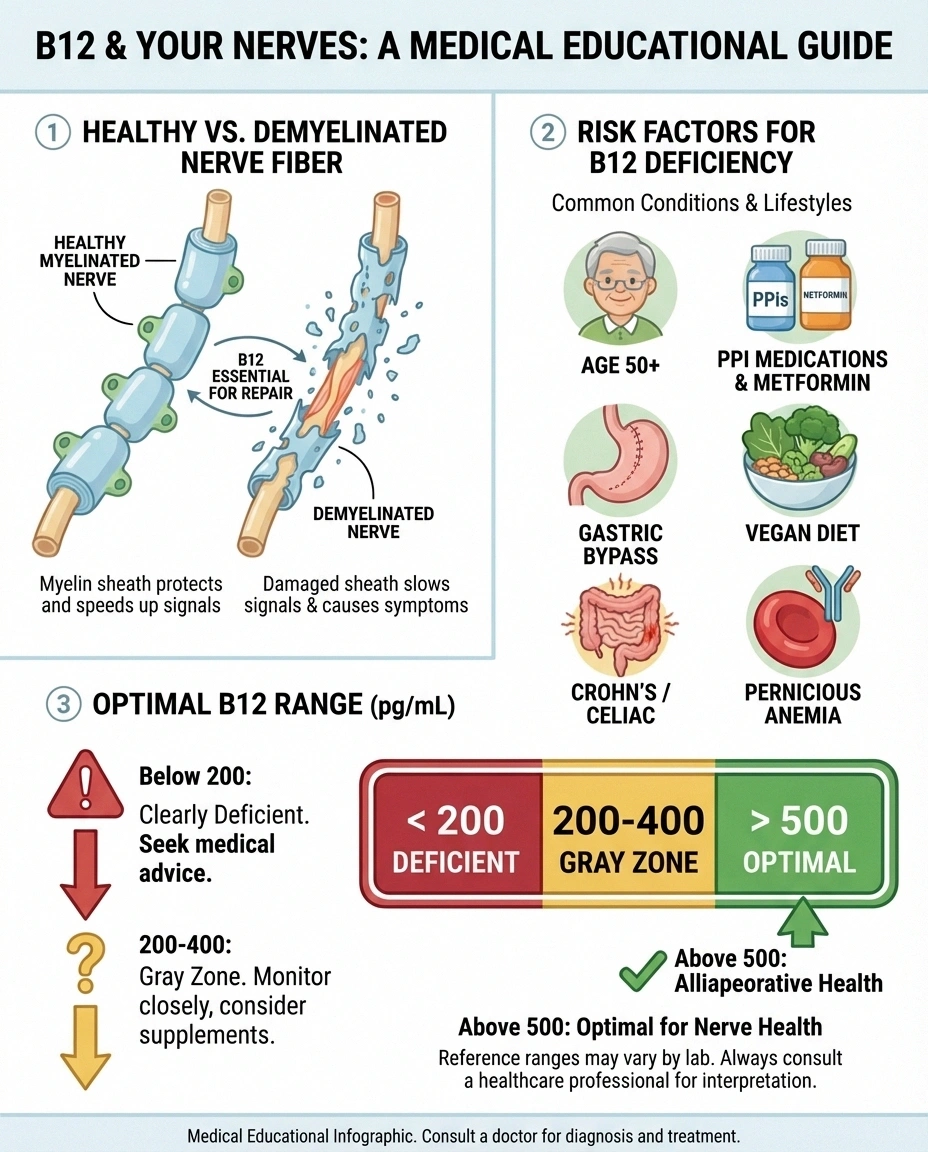
Vitamin B12 is essential for synthesizing and maintaining myelin — the fatty sheath that surrounds nerve fibers and enables rapid signal transmission. Without adequate B12, myelin breaks down and nerve signals slow or stop entirely. B12 also plays a critical role in DNA synthesis for nerve cell repair and in maintaining the overall health of the nervous system.
How B12 Deficiency Causes Neuropathy
When B12 levels drop too low, the myelin sheath degrades in a process called demyelination. This typically starts with the longest nerves first — which is why tingling and numbness in the feet are often the earliest symptoms. Left untreated, B12 deficiency neuropathy can progress to affect the hands, cause balance problems, and even impair cognitive function.
Don't Wait to Test
B12 deficiency neuropathy is reversible if caught early, but prolonged deficiency can cause permanent nerve damage. If you have neuropathy and haven't had your B12 checked, ask your doctor for a blood test — including methylmalonic acid (MMA) for a more accurate picture.
The damage is reversible if caught early — but after prolonged deficiency, some nerve damage may become permanent. This is why testing is so important.
Who Is Most at Risk for B12 Deficiency?
You might assume B12 deficiency only affects vegans, but that is far from the truth. The most common cause in older adults is malabsorption — your gut simply cannot extract B12 from food efficiently. People at highest risk include:
Adults over 50 (stomach acid production declines with age, reducing B12 absorption). People taking long-term proton pump inhibitors like omeprazole or pantoprazole. Metformin users — diabetics taking metformin have significantly higher rates of B12 deficiency due to the drug interfering with absorption. People with Crohn's disease, celiac disease, or who have had gastric bypass surgery. Strict vegetarians and vegans, since B12 occurs naturally only in animal products. People with pernicious anemia, an autoimmune condition that destroys the cells needed to absorb B12.
Testing and Optimal Levels
A standard serum B12 test is a reasonable starting point, but it can miss early or functional deficiency. Many neurologists now recommend also checking methylmalonic acid (MMA) and homocysteine levels, which rise when B12 is functionally low even if the serum level looks normal. Serum B12 below 200 pg/mL is clearly deficient. Between 200 and 400 pg/mL is a gray zone where symptoms may already be present. Many experts now suggest optimal levels should be above 500 pg/mL for neurological health.
Supplementation: Oral vs. Injections
For people with absorption problems, B12 injections bypass the gut entirely and deliver the vitamin directly into your bloodstream. This is often the first-line treatment for deficiency-related neuropathy. High-dose oral B12 (1,000 to 2,000 mcg daily) can also work for many people, even those with some absorption issues, because roughly 1% of oral B12 is absorbed through passive diffusion regardless of gut function.
The two most common supplemental forms are methylcobalamin and cyanocobalamin. Methylcobalamin is the bioactive form and may be better for neurological applications, though both forms effectively raise B12 levels.
Vitamin B1 (Thiamine): The Energy Vitamin Your Nerves Depend On
Vitamin B1, or thiamine, does not get the attention that B12 does, but it is equally important for nerve health. Thiamine is essential for energy production in nerve cells — and nerves are energy hogs. When thiamine is deficient, nerve cells literally run out of fuel.
Thiamine Deficiency and Nerve Damage
Severe thiamine deficiency causes a condition called beriberi, which includes peripheral neuropathy as a hallmark symptom. But you do not need to be severely deficient to experience nerve effects. Even marginal thiamine insufficiency — more common than most people realize — can contribute to nerve dysfunction over time.
The biggest risk factor for thiamine deficiency is alcohol use. Alcohol directly impairs thiamine absorption and increases its excretion. But other factors can contribute: certain diuretics, a diet heavy in refined carbohydrates (which require thiamine to metabolize), and bariatric surgery.
Benfotiamine: The Better-Absorbed Form
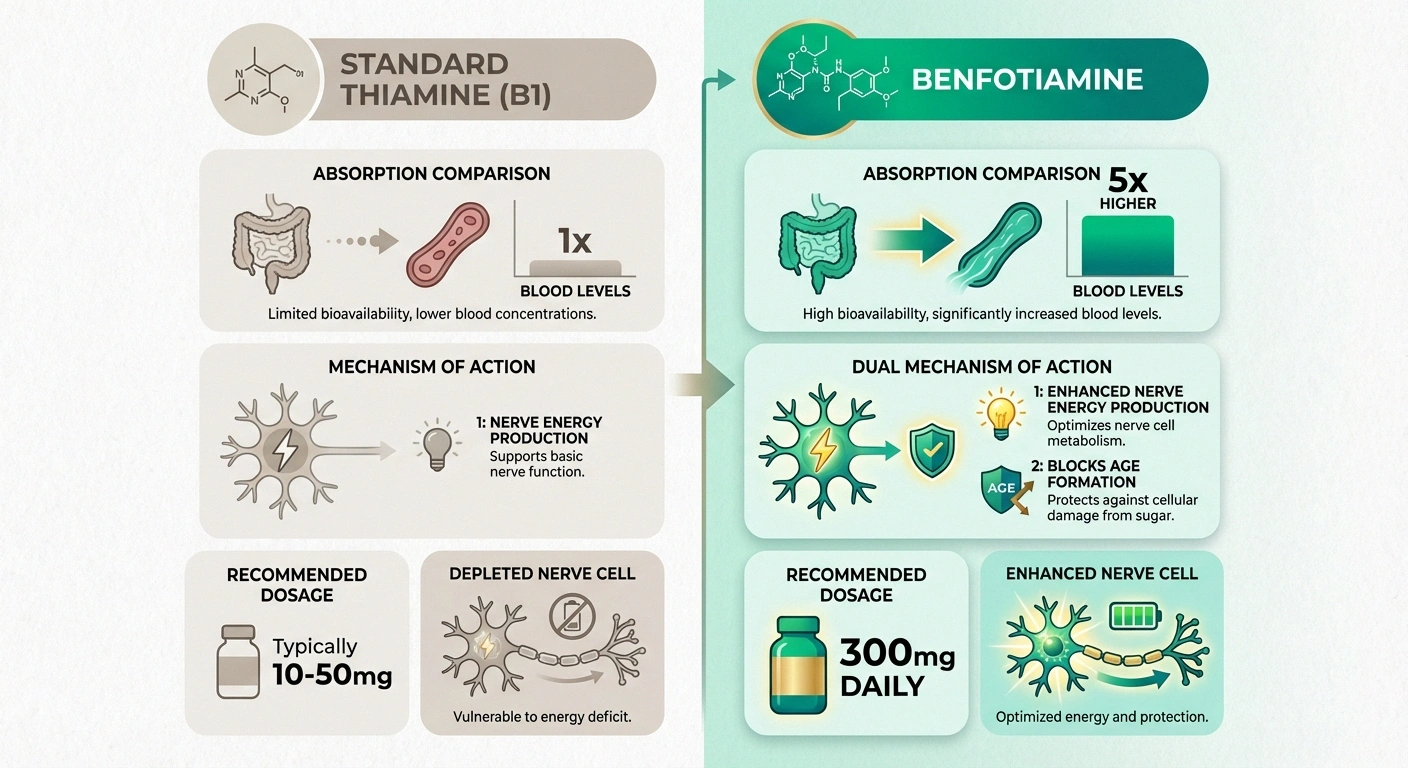
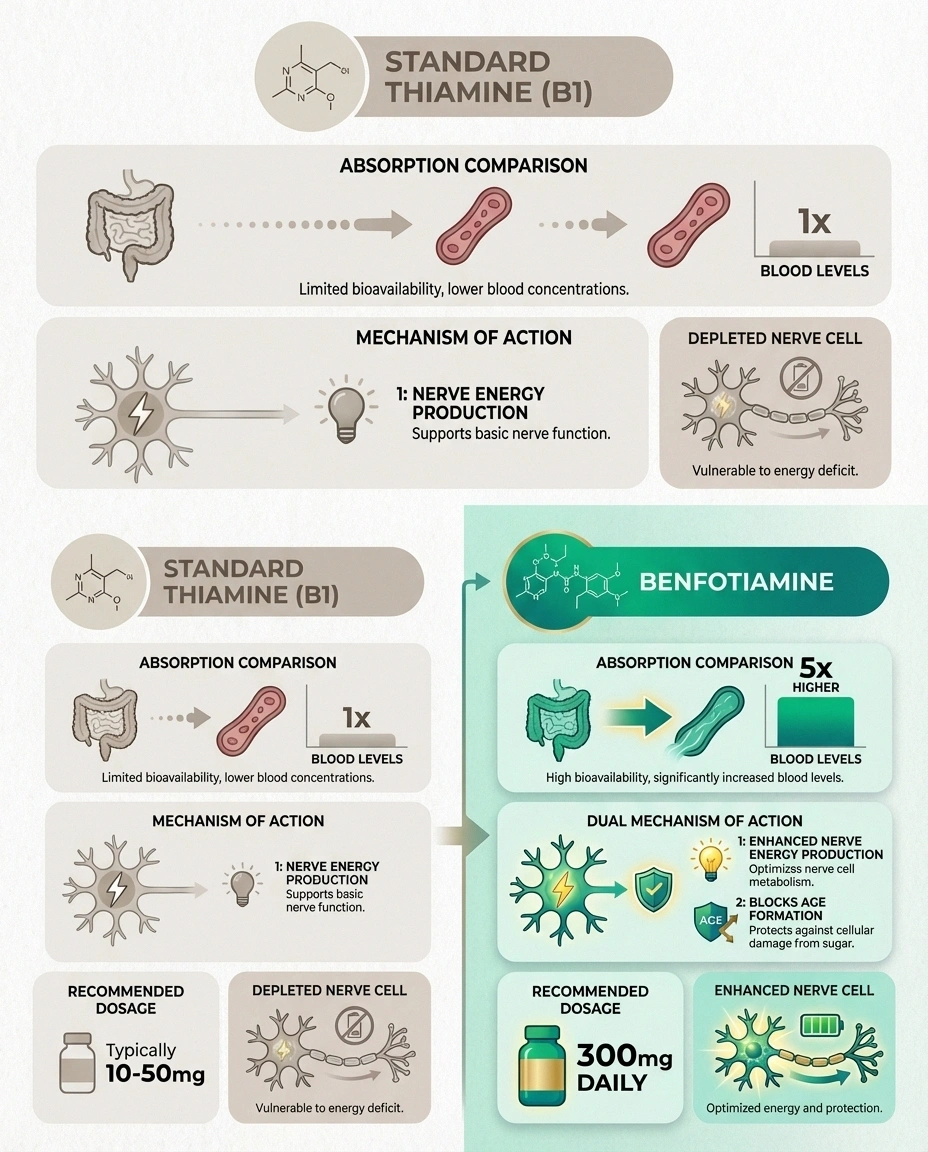
Standard thiamine is water-soluble and poorly absorbed at higher doses. Benfotiamine is a fat-soluble derivative of thiamine that achieves blood levels up to five times higher than regular thiamine at the same dose. This is particularly relevant for neuropathy.
Key Takeaway
Benfotiamine achieves blood levels up to 5x higher than regular thiamine and blocks AGE formation — which puts it ahead of most alternatives for diabetic neuropathy, though the trials behind it are small. Available without a prescription at 300mg daily.
A clinical study found that benfotiamine at 300 mg daily improved neuropathy symptoms in diabetic patients. Some studies have tested doses up to 900 mg daily with good safety profiles. Benfotiamine also helps block the formation of advanced glycation end-products (AGEs) — toxic compounds that form when blood sugar is elevated and directly damage nerve tissue.
For people with diabetic neuropathy specifically, benfotiamine has the most research behind it of any B vitamin. It addresses both the energy production and the glycation damage pathways simultaneously.
Vitamin B6 (Pyridoxine): The Double-Edged Sword
Vitamin B6 is where things get complicated — and potentially dangerous if you are not careful. B6 is essential for nerve function and helps maintain the covering on nerve endings. Deficiency can cause neuropathy. But here is the critical warning: excessive B6 can also cause neuropathy.
The Toxicity Risk
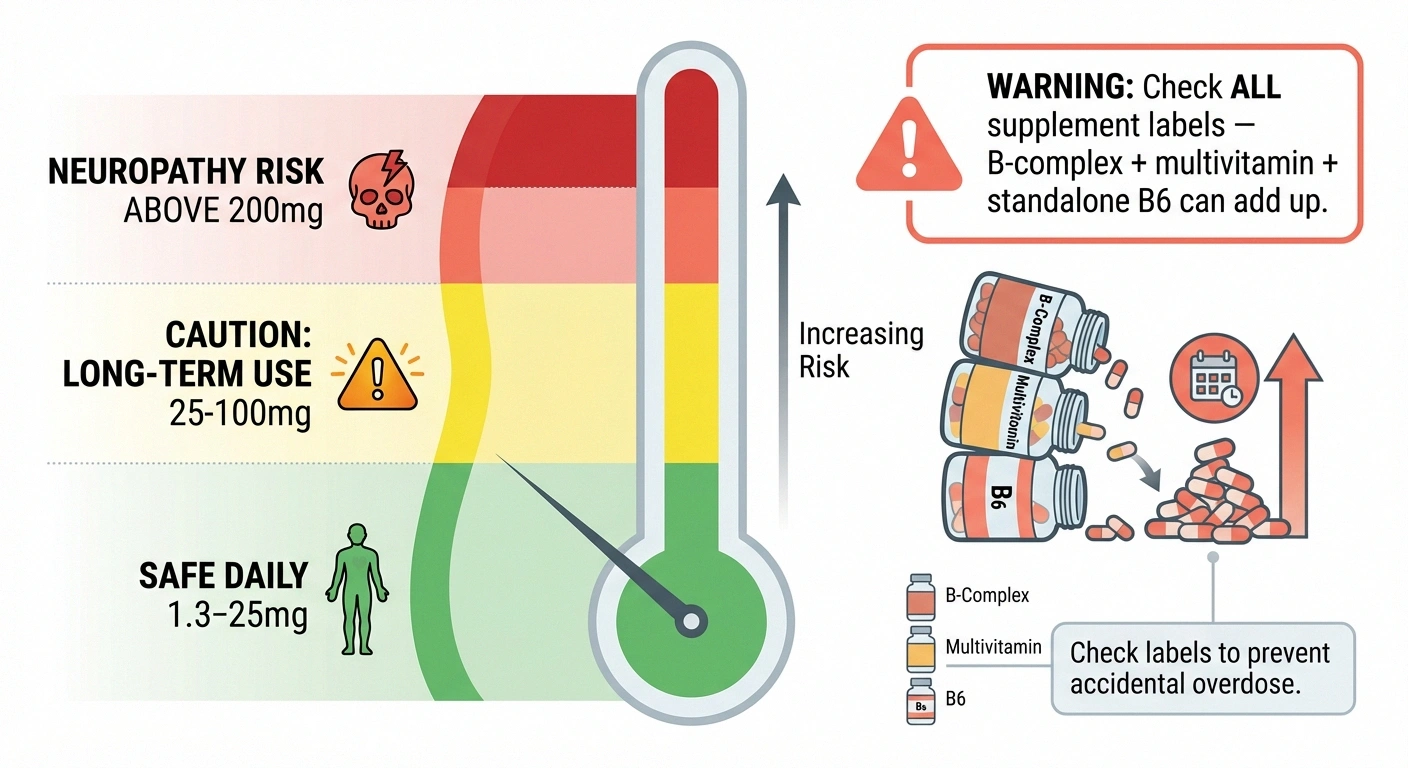
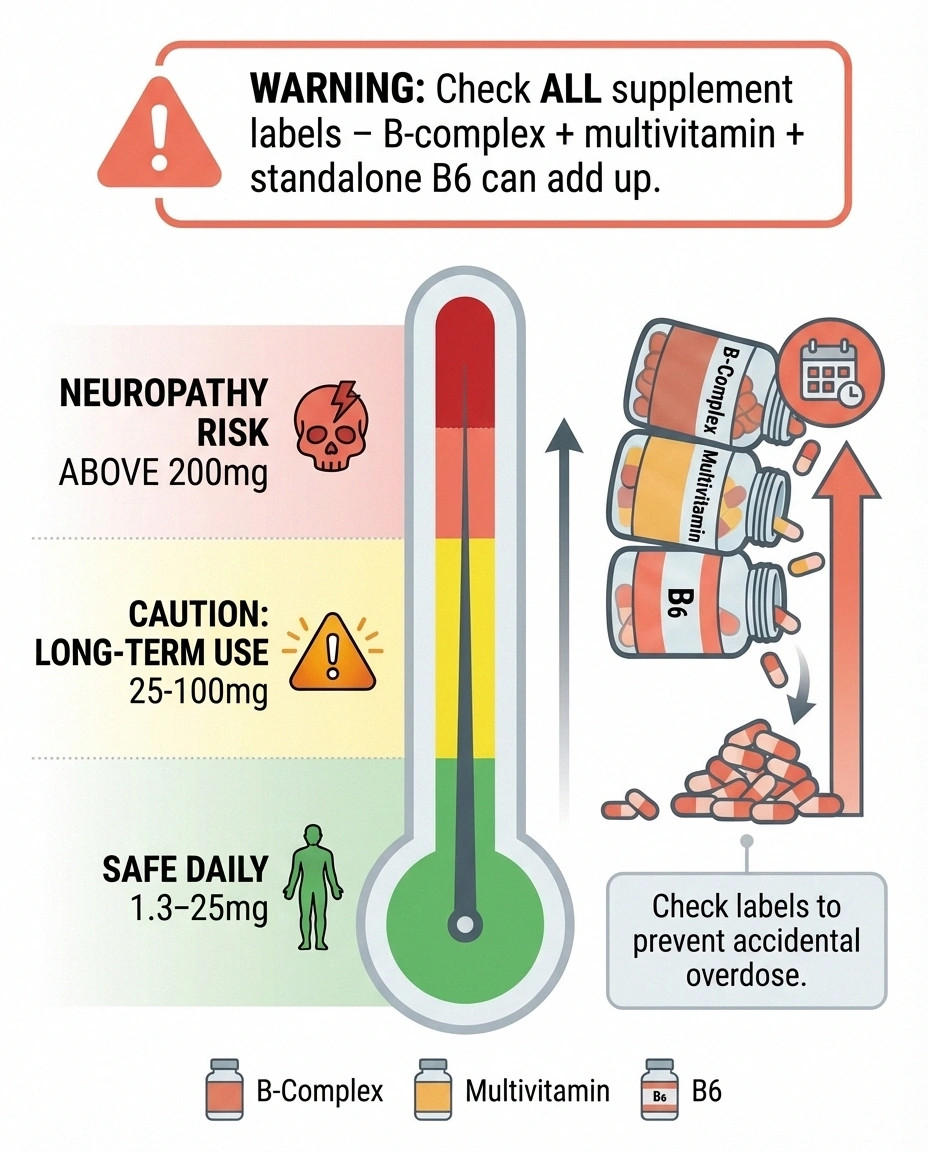
B6-induced neuropathy (pyridoxine toxicity) is more common than many people realize. Research shows that chronic intake of more than 200 mg per day can cause sensory neuropathy. Some individuals develop symptoms at even lower doses — as low as 50 mg per day with long-term use. The symptoms mimic other neuropathies: numbness, tingling, and burning in the hands and feet.
B6 Toxicity Warning
Too much vitamin B6 can CAUSE neuropathy. Chronic intake above 200mg/day causes sensory nerve damage. The trap: a B-complex + multivitamin + standalone B6 can quietly push you over the limit. Add up B6 from ALL your supplements.
The insidious part: many people with neuropathy take multiple supplements, each containing B6. A B-complex plus a multivitamin plus a standalone B6 supplement can easily push your total daily intake above safe levels. Check all your supplement labels and add up the total B6 from all sources.
Safe Dosage Range
The recommended daily allowance is just 1.3 to 1.7 mg for adults. The tolerable upper limit is 100 mg per day, but many experts recommend staying below 50 mg daily for long-term use. If you are taking a B-complex supplement, check that the B6 content is within this range. The active form, pyridoxal-5-phosphate (P5P), may be gentler and less likely to cause toxicity at moderate doses.
Other B Vitamins That Support Nerve Health
Folate (B9)
Folate works closely with B12 in nerve function and DNA synthesis. A high folic acid intake — from supplements or fortified foods — can correct the anemia a B12 deficiency would otherwise cause, so a standard blood count can look normal while nerve damage continues. That's why a normal blood count on its own isn't enough to rule B12 out. Adequate folate supports the methylation processes that B12 depends on. The active form, methylfolate (5-MTHF), is preferred for supplementation since up to 40% of people have genetic variations that impair their ability to convert standard folic acid.
Niacin (B3)
Niacin is involved in energy metabolism and nerve cell repair. Severe deficiency causes pellagra, which includes neurological symptoms. For most people eating a reasonable diet, niacin deficiency is rare. However, chronic alcohol use and certain medications can deplete it.
Pantothenic Acid (B5)
Vitamin B5 is crucial for producing coenzyme A, which is involved in nerve signal transmission and myelin synthesis. Deficiency is uncommon because B5 is found in almost all foods (its name literally comes from the Greek word “pantos,” meaning everywhere), but it deserves mention as part of the full B vitamin picture for nerve health.
The Case for B-Complex Supplements
B vitamins work synergistically — they depend on each other for proper function. A 2025 study found that the combination of B1, B6, and B12 enhanced nerve cell maturation and connectivity more than any single B vitamin alone. This is why many neurologists recommend a B-complex rather than individual B vitamins for general nerve support.
Research Says
A 2025 study found that the combination of vitamins B1, B6, and B12 enhanced nerve cell maturation and connectivity more than any single B vitamin alone. B vitamins work synergistically — they depend on each other for optimal nerve support.
However, the “one-size-fits-all” B-complex approach has limitations. If you have a specific identified deficiency — say B12 — you may need higher doses than a standard B-complex provides. And you need to watch the B6 content, as discussed above. The ideal approach for many people with neuropathy is a B-complex for baseline coverage plus individual supplementation based on blood test results.
Testing: What to Ask Your Doctor For
If you have neuropathy, here is the minimum B vitamin testing I recommend discussing with your healthcare provider:
📋 B Vitamin Tests to Request
Serum B12 — screens for deficiency (optimal: above 500 pg/mL)
Methylmalonic acid (MMA) — catches early/functional B12 deficiency
Homocysteine — rises when B12 or folate is functionally low
CBC (Complete Blood Count) — identifies B12/folate-related anemia, though it can read normal
Serum folate — high intake can hide low B12 on a blood count
Thiamine level — especially important if diabetic or using alcohol
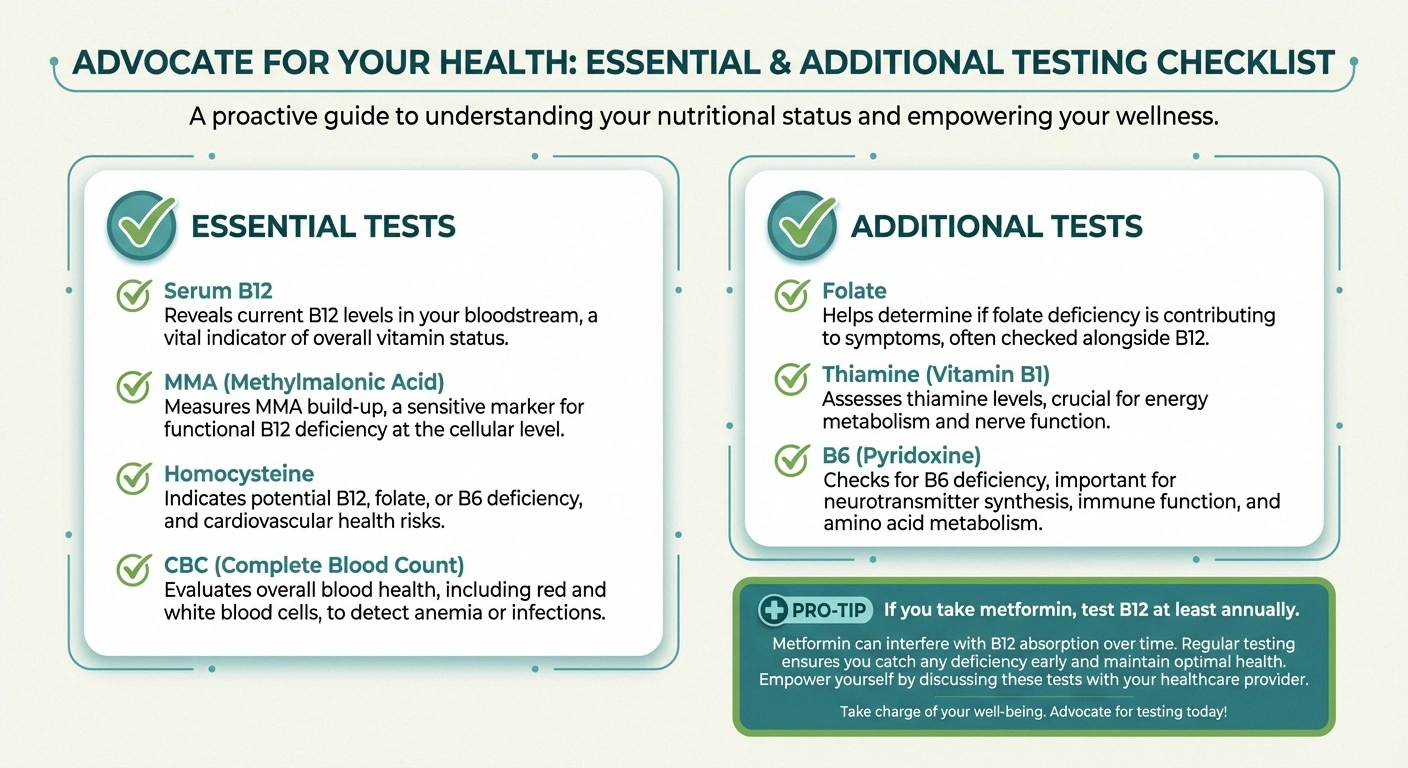
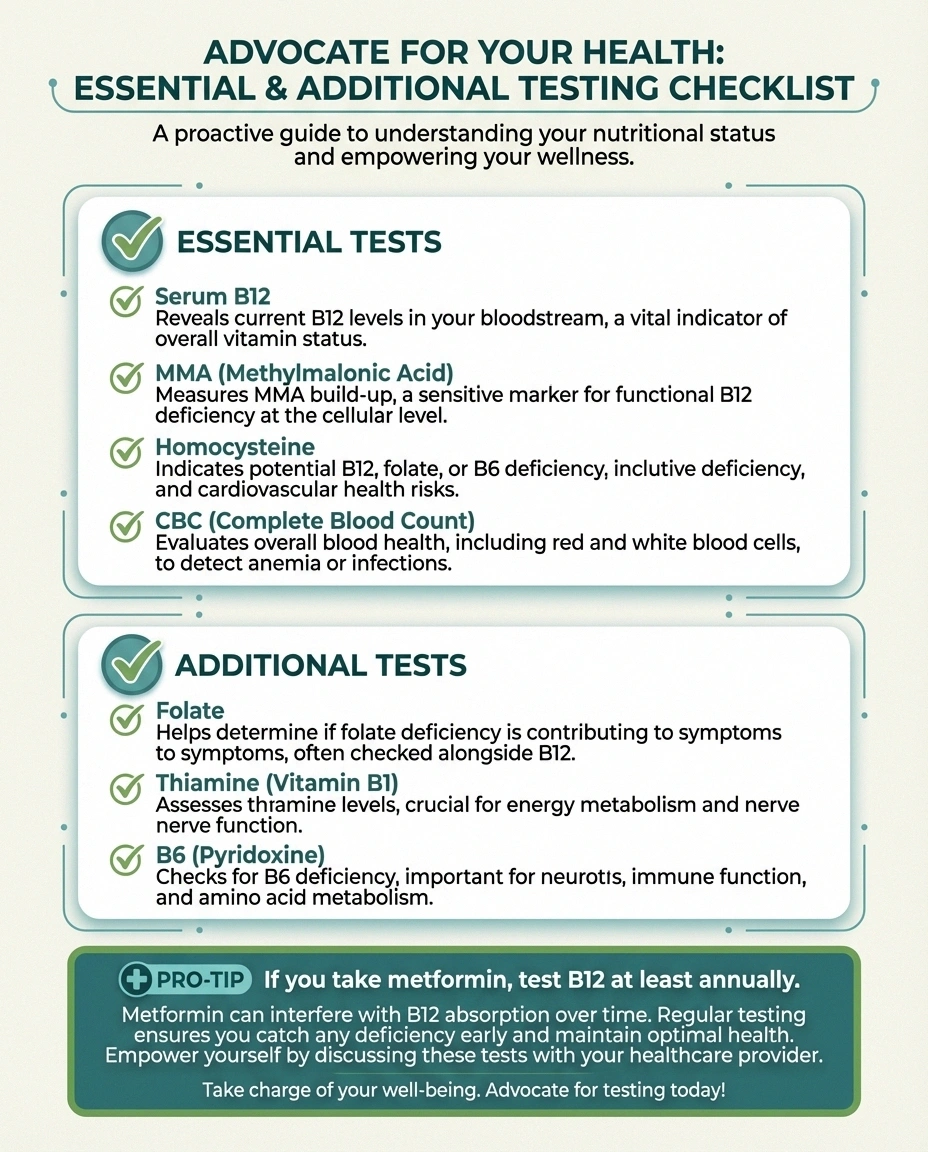
Essential tests: Serum B12, methylmalonic acid (MMA), homocysteine, and complete blood count (CBC). These cover the deficiency that matters most, but a normal blood count on its own doesn't rule a B12 problem out; the functional markers catch what the others can miss.
Additional tests to consider: Serum folate, thiamine (especially if you have diabetes or use alcohol regularly), and vitamin B6 (to check both for deficiency AND excess). If you take metformin, B12 testing should be done at least annually.
A full discussion of neuropathy testing is available in our diagnosis guide. The key takeaway: do not supplement blindly. Test first, supplement based on results, and retest to confirm levels have improved. Your doctor can help you interpret results and determine appropriate doses based on your specific situation.
Practical Supplementation Guidelines
Based on the research and clinical experience, here are practical guidelines for B vitamin supplementation for nerve health:

If your blood tests show B12 deficiency: Work with your doctor on a repletion protocol. This typically starts with B12 injections (often weekly for a month, then monthly) or high-dose oral B12 (1,000 to 2,000 mcg daily of methylcobalamin). Retest in 3 months.
If you have diabetic neuropathy: Consider benfotiamine (300 mg daily) in addition to a B-complex. What we know comes mostly from short trials, and the results vary, so treat it as promising rather than proven. It is available without a prescription.
For general nerve support: A high-quality B-complex providing methylcobalamin (at least 1,000 mcg), benfotiamine or thiamine (50 to 100 mg), methylfolate (400 to 800 mcg), and no more than 25 to 50 mg B6 (preferably as P5P). Take with food for better absorption.
What to avoid: Mega-dose B6 supplements (anything over 100 mg), cheap B-complexes using cyanocobalamin and folic acid instead of the active forms, and any supplement regimen that has not been discussed with your healthcare provider — especially if you take medications.
For more on how other supplements complement B vitamins for neuropathy management, see our comprehensive supplements guide. And remember — supplements are meant to supplement, not replace, a nutrient-rich diet and proper medical care.
Frequently Asked Questions
Can B vitamins cure neuropathy?
B vitamins can reverse neuropathy symptoms when the neuropathy is caused by a B vitamin deficiency — if caught early enough. However, they cannot cure neuropathy caused by other factors like diabetes, chemotherapy, or autoimmune conditions. In those cases, B vitamins may support nerve health as part of a comprehensive management plan but are not a standalone cure.

How long does it take for B12 to improve neuropathy symptoms?
Many people notice some improvement in neuropathy symptoms within a few weeks of starting B12 repletion, particularly with injections. Full recovery can take three to twelve months depending on how long the deficiency lasted and the extent of nerve damage. If the deficiency was prolonged, some degree of nerve damage may be permanent even after levels are restored.
Can too much vitamin B6 cause neuropathy?
Yes. Chronic intake of vitamin B6 above 200 mg per day can cause sensory neuropathy, and some people develop symptoms at doses as low as 50 mg per day with long-term use. This is called pyridoxine toxicity. The symptoms can mimic other types of neuropathy, making it difficult to diagnose. Always check the total B6 from all your supplement sources combined.
Should I take a B-complex or individual B vitamins?
Research shows that B vitamins work better together than individually for nerve health. A B-complex provides broad coverage, but if you have a specific identified deficiency you may need additional supplementation beyond what a B-complex provides. The ideal approach for most people with neuropathy is a B-complex for baseline support plus targeted individual supplementation based on blood test results.
Which form of B12 is best for neuropathy?
Methylcobalamin is generally preferred for neurological applications because it is the bioactive form that the nervous system uses directly. Cyanocobalamin is the more common and less expensive form, and it does effectively raise B12 levels, but it requires conversion in the body. Both forms work, but many neurologists recommend methylcobalamin specifically for neuropathy patients.
Does metformin cause B12 deficiency?
Yes. Long-term metformin use is associated with reduced B12 absorption and can lead to deficiency over time. Studies suggest that up to 30% of long-term metformin users develop low B12 levels. If you take metformin for diabetes, ask your doctor about annual B12 testing and consider supplementation, especially if you are also experiencing neuropathy symptoms.
About the Author