You don’t realize how much you write by hand until the day you can’t. Signing the back of a check. Filling out a clipboard at the doctor’s office. Writing a card for a grandchild’s birthday. Initialing a stack of paperwork at the bank. Then one day your fingers stop cooperating, or the pen slips, or your signature comes out as a wobbly scrawl that doesn’t look like your signature at all — and suddenly the small everyday thing has turned into a daily struggle.
If neuropathy in your hands has started making writing harder, this guide is for you. We’ll walk through what’s actually breaking down, the simple tools and techniques that make pens cooperate again, how to handle signature situations (banks, legal documents, contracts) when your hand simply won’t do what it used to, and the small daily exercises that can help maintain what function you still have.
Why Writing Gets Harder With Neuropathy
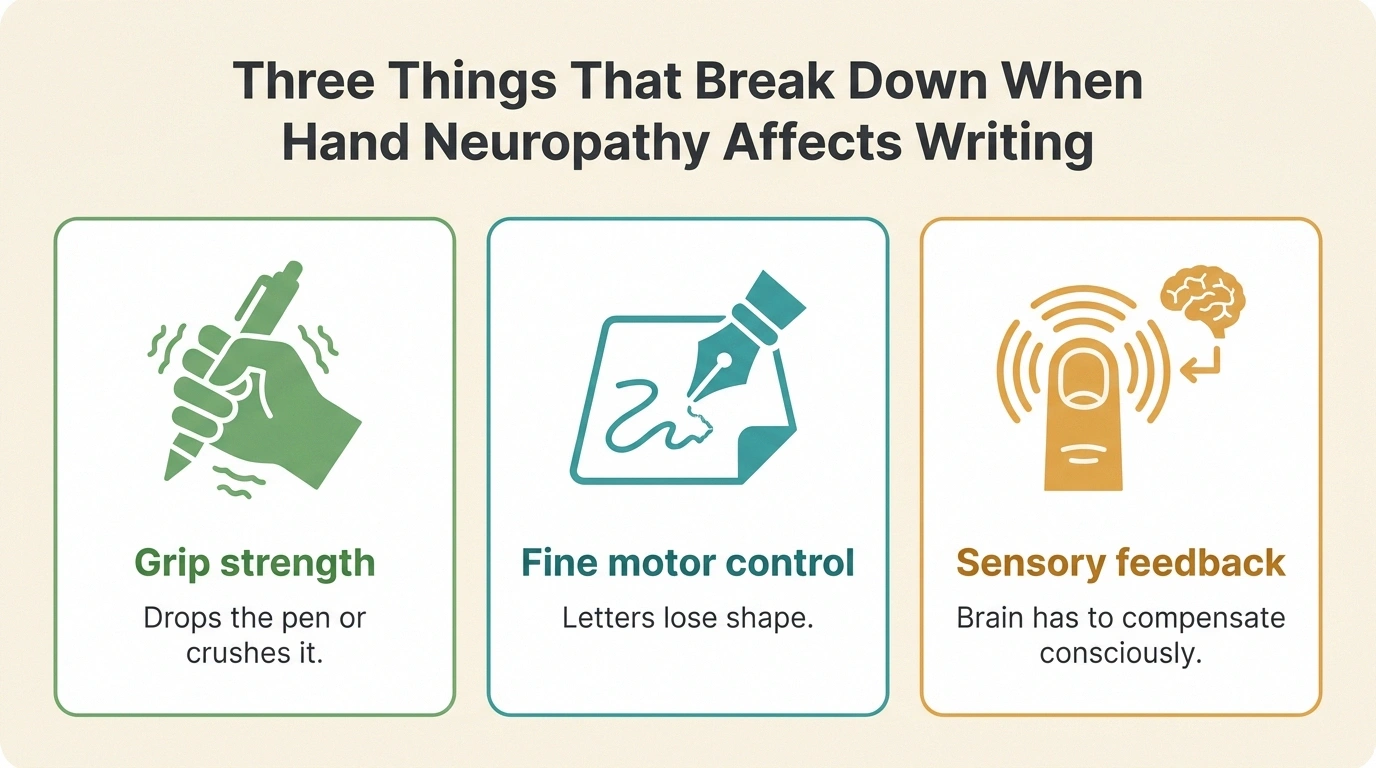
Three things have to work together for handwriting to flow:
You don’t have to fix all three breakdowns to get writing back. Even improving one — grip strength, fine motor control, or sensory feedback — makes a real difference. Most people see the biggest improvement from switching to a smoother-flowing pen (gel or rollerball instead of ballpoint) and adding a wider grip — total cost under $15.
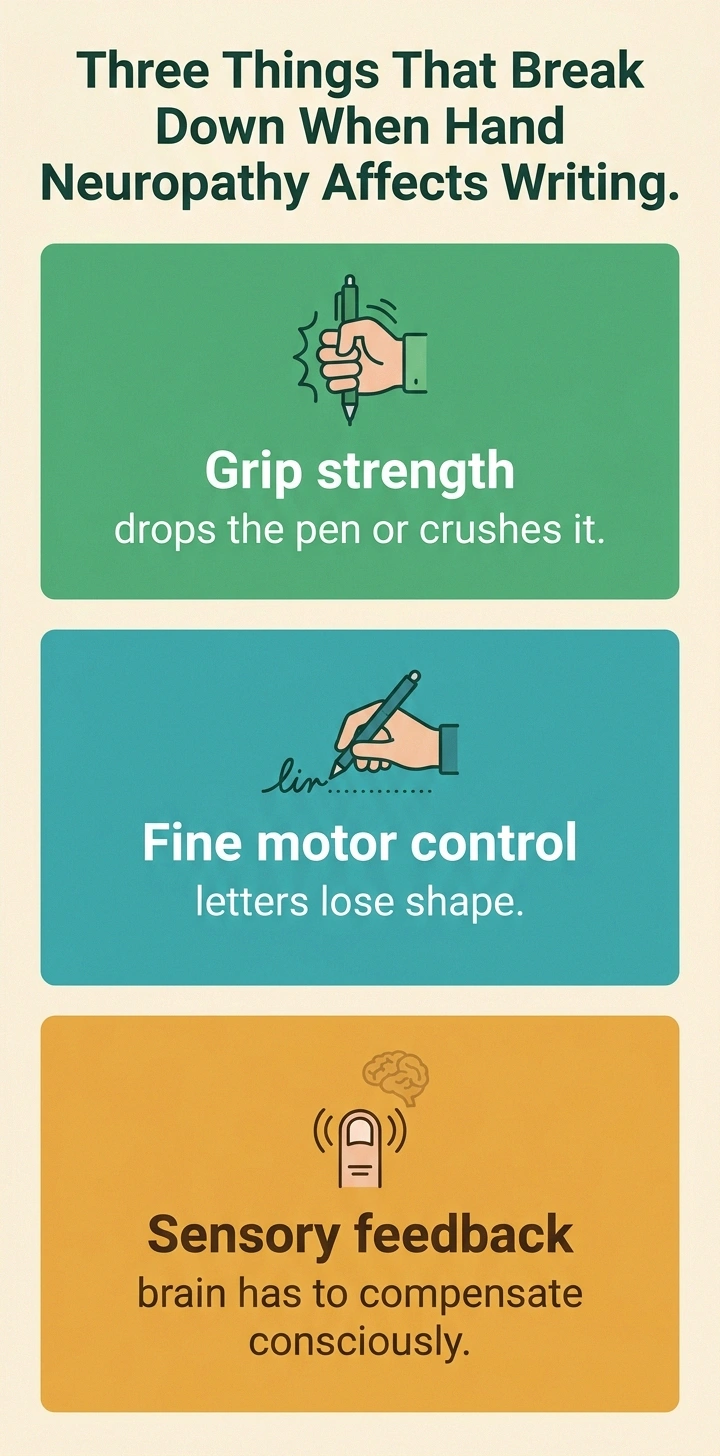
Grip strength. You have to hold a pen with enough force that it doesn’t slip out of your fingers, but not so much that you cramp. Hand neuropathy disrupts both ends of that range. Numb fingers don’t know how hard they’re squeezing. So either the pen drops or you crush it.
Fine motor control. Writing legible letters requires tiny, precise muscle movements coordinated dozens of times per second. Neuropathy interferes with the small motor units that produce these movements. Letters come out misshapen. Words drift off the line. The whole thing gets exhausting fast.
Sensory feedback. Your fingertips constantly report back to your brain: how hard you’re pressing, where the pen tip is touching the paper, whether your grip is slipping. When sensation is reduced or replaced by tingling and burning, your brain has to compensate with vision and conscious attention — which is mentally exhausting and slower.
You don’t have to fix all three to get back to functional handwriting. Even improving one of them makes a real difference. The pen, paper, and positioning choices below address each of these breakdowns.
The Right Pen Changes Everything
This is the single biggest lever you have, and it costs almost nothing. The pen you grab off the counter is probably making things harder than they need to be.
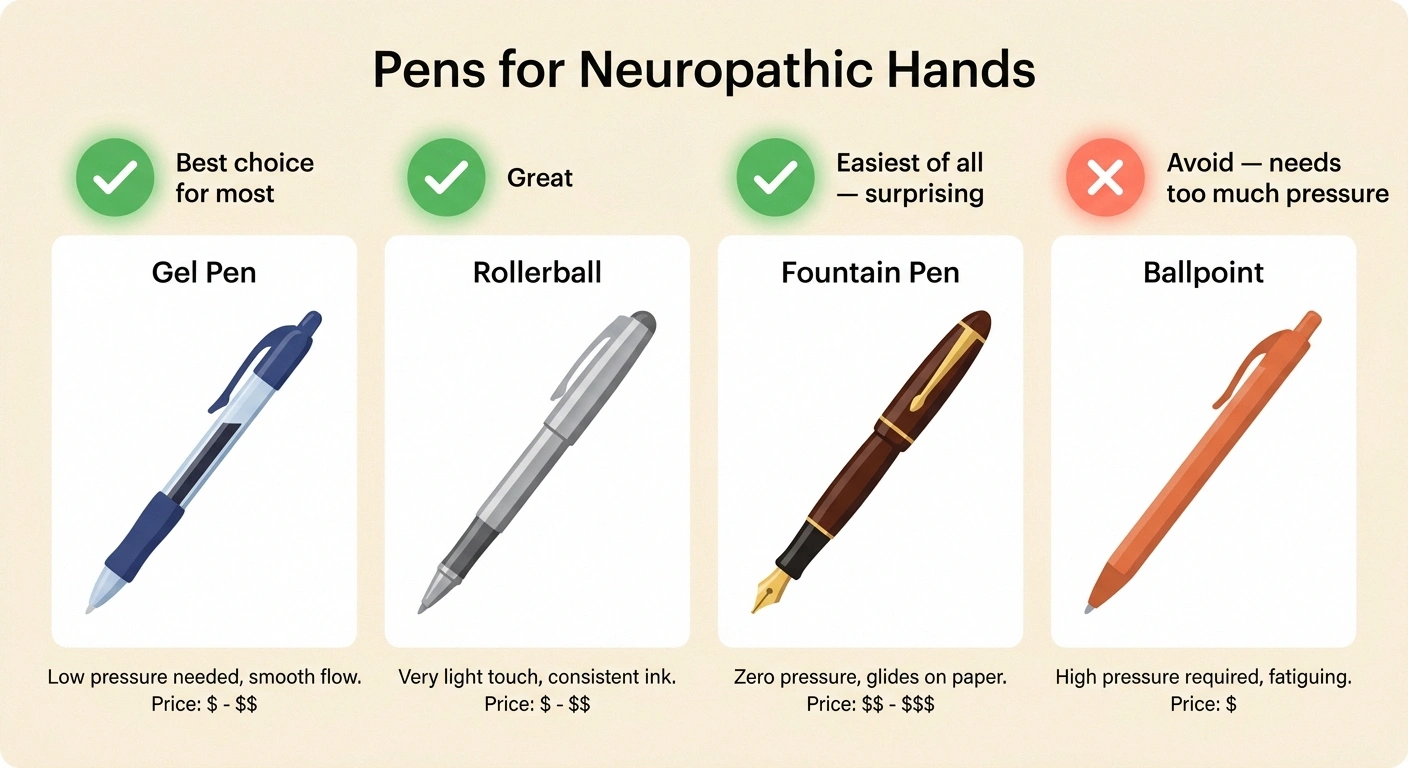
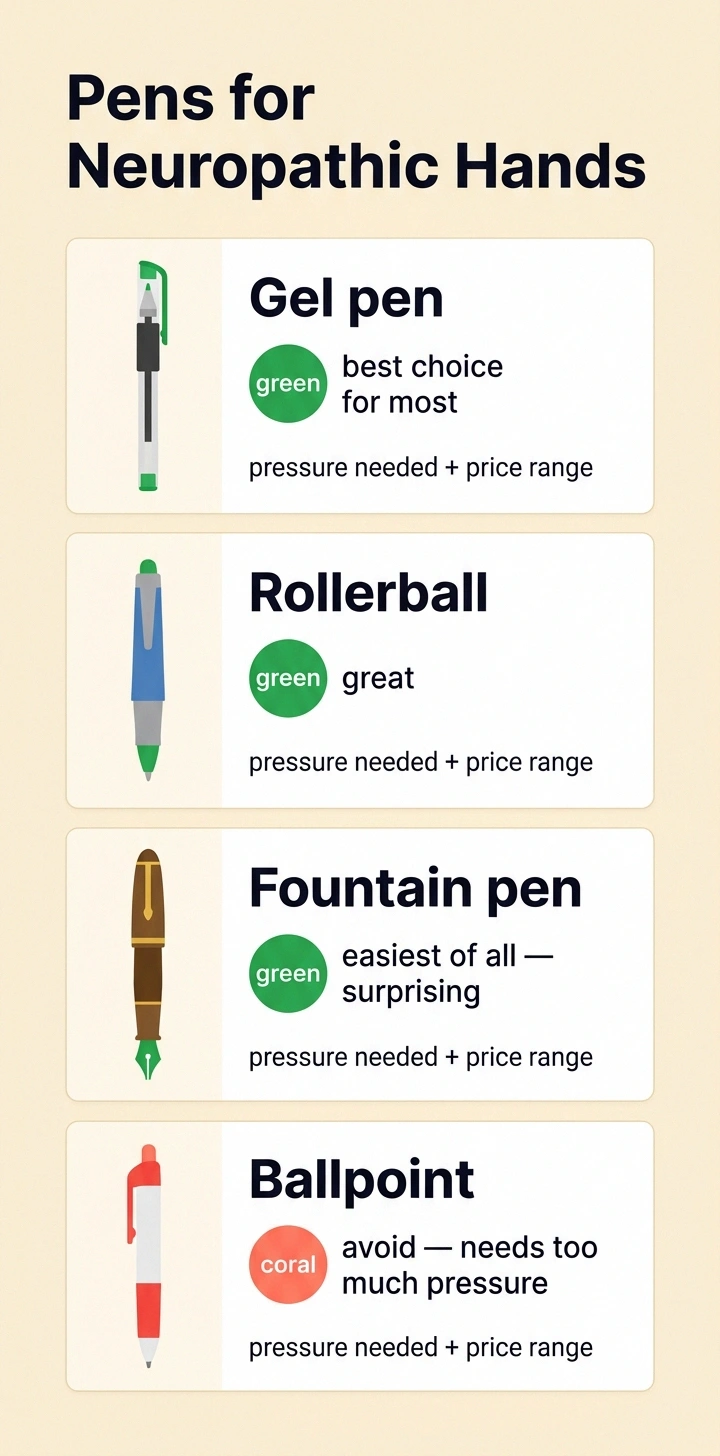
Use a pen that needs less pressure. Standard ballpoint pens require firm pressure to write. The dry, sticky ink doesn’t flow until you push hard. For neuropathic hands, this is the worst possible choice. Switch to:
- Gel pens — Pilot G2, Uni-ball Signo, Pentel EnerGel. Smooth ink, almost no pressure needed.
- Rollerball pens — Uni-ball Vision Elite, Pilot Precise. Even thinner ink, glides across the page.
- Fountain pens (yes, really) — they write with the lightest possible touch and many people with neuropathy find them dramatically easier than any modern pen. The Pilot Metropolitan is around $20 and very forgiving.
Use a pen that fills your hand. Thin pen barrels force your fingers into a tight pinch grip. Wider barrels distribute the work across more of your hand. Look for:
- Pens with barrel diameter 12–18 millimeters (standard pens are around 8 mm).
- Triangular or contoured grip sections — naturally rotate the pen to a comfortable angle.
- Pens designed for arthritis — PenAgain, Yoropen, Ring-Pen are widely sold for around $15 to $25.
Add a pen weight. Slightly heavier pens (1.5 to 2 ounces) reduce tremor and feel more “anchored” in the hand. Some pens come weighted. You can also add small silicone weights ($5 to $10 on Amazon) to a pen you already like.
One simple test: try writing your name with three different pens and see which one feels easiest. Most people are surprised at how much the answer matters.
Cheap Grip Aids That Work
If you’ve found a pen you like but the grip is still hard, a silicone or foam grip add-on can be transformative.
Total under $15. Try for one week before deciding what else to upgrade.
- Silicone triangle grips — about $5 for a 10-pack on Amazon. Slide onto any standard pen or pencil. The triangle shape positions your fingers naturally and the soft silicone reduces the force required to hold on.
- Stetro grips — designed for handwriting therapy, these position each finger in the optimal spot. Around $4 each. Worth trying if your fingers don’t naturally find the right position.
- Foam pencil grips — even softer, slightly larger diameter. $3 to $5 each.
- Hand-strap pen holders — for severe grip weakness, a velcro strap holds the pen in your hand without requiring you to squeeze. The Wanchik Writer ($15 to $20) and similar products from Maddak and North Coast Medical are sold through medical supply catalogs.
Try one at a time. Cycle through them until you find a combination that lets you write for several minutes without your hand cramping.
Paper Matters Too
Paper choice is the cheapest improvement you’ll make.
- Wide-ruled paper — bigger lines mean each letter has more room. Less precision required.
- Raised-line paper — paper with slightly embossed lines you can feel with the pen tip. Excellent for hands with reduced sensation. Mr. Pen sells a 100-sheet pad for around $8.
- Bold-line paper — for combined neuropathy and low vision, paper with thick dark lines is easier to see.
- Avoid glossy paper — the pen slips and you compensate by gripping harder. Standard matte notebook paper works best.
The same logic applies to greeting cards, journals, and notebooks. Pick ones with wide-ruled lines or no lines at all (free-form writing avoids the frustration of writing off the line).
Set Up Your Writing Space

Where and how you write changes how long you can write before your hand gives out.
Sit at a table, not in a chair or in bed. Lap-writing forces your shoulder and elbow to support all the work. Your forearm should rest fully on a flat surface.
Slight desk tilt helps. A 15 to 20 degree angled writing surface (think of an old draftsman’s desk) reduces wrist extension and lets ink flow more naturally with rollerball and gel pens. An inexpensive angled writing slope is around $25 to $40 on Amazon, or a thick three-ring binder propped up by a smaller binder works fine for free.
Bright direct light. A good desk lamp with daylight-temperature LED reduces visual compensation strain. If you find yourself leaning closer to the paper to see, your light is too dim.
Posture matters. Feet flat on the floor, hips at 90 degrees, shoulders relaxed. Neuropathy makes you tense up unconsciously, which makes your hand worse. A few deep breaths before writing helps.
Pace yourself. Two to three minutes of writing at a time is plenty when your hand is fatigued. Take a 30-second break to stretch your fingers between bursts. Trying to push through long writing sessions usually backfires — you end with worse handwriting, more pain, and a sore hand that lasts the next day.
The Signature Problem
Of all the writing tasks neuropathy disrupts, signatures are the one most people care about most. Your signature is part of your identity and a tool of everyday legal and financial life. When it stops looking like your signature, the world gets confusing fast.
You have more options than you may realize.
Update Your Signature on File
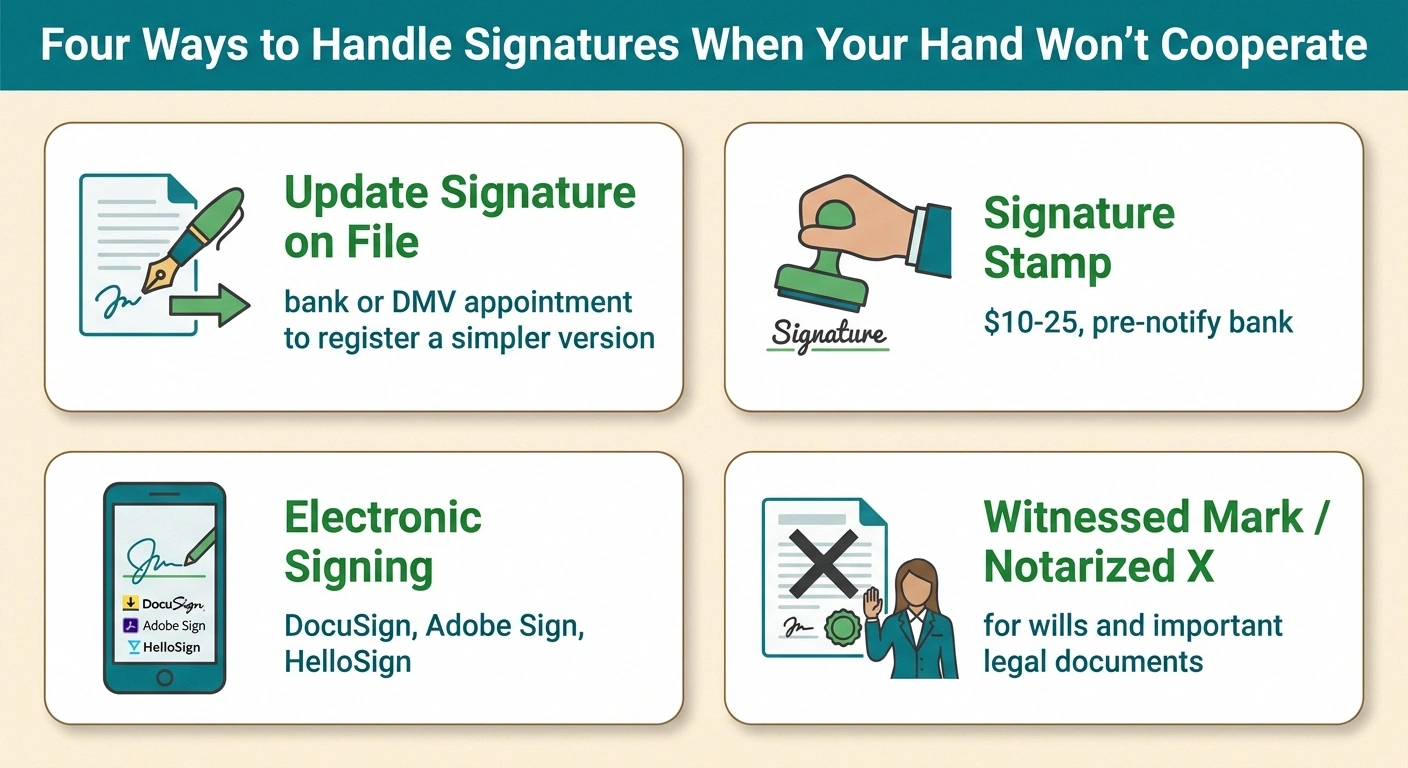
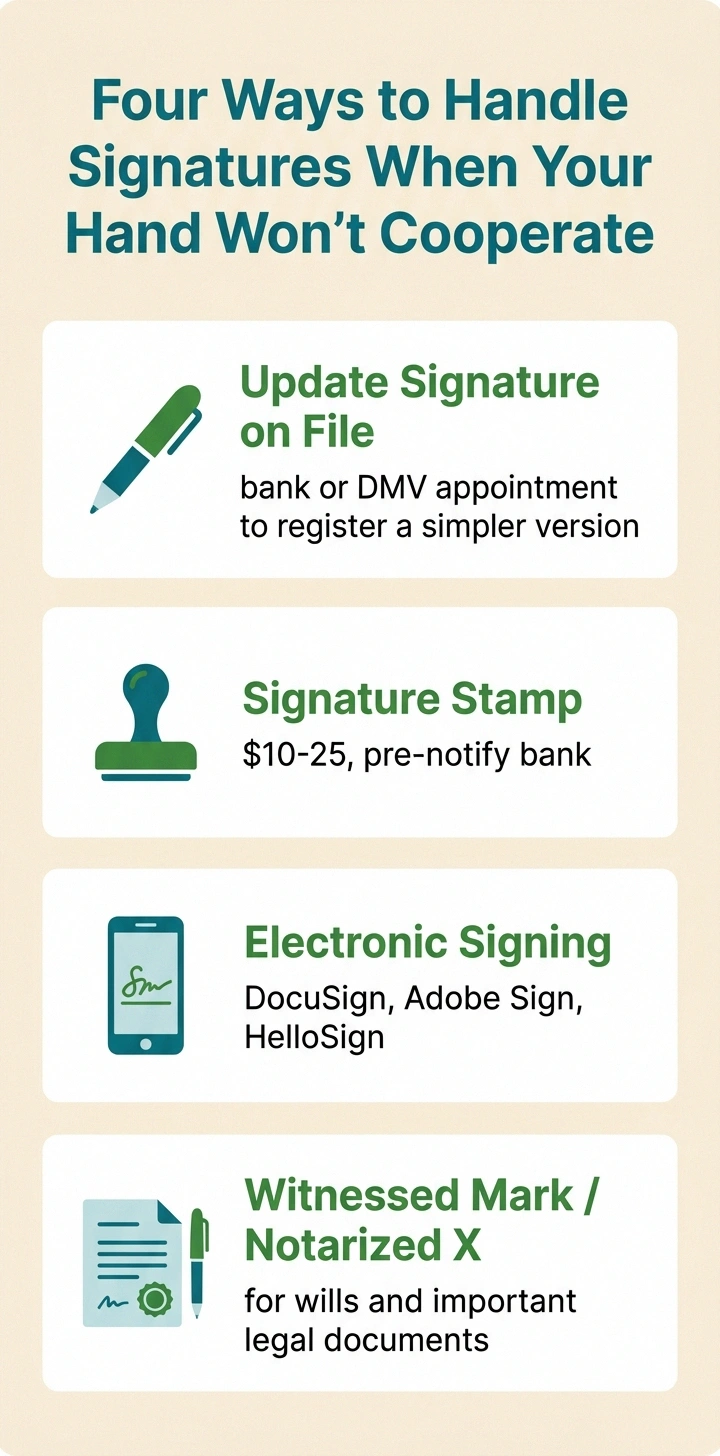
Many adults are signing documents using a version of their signature they developed when they were thirty. If your hand changed, it’s perfectly reasonable to develop a new, simpler signature that you can produce reliably now. Banks, the DMV, your employer, and most institutions allow you to update your signature on file.
What actually counts as a signature?
In most U.S. jurisdictions, a signature is “any mark made with the intent to sign.” A wobbly scrawl, a single initial, or even an X are legally valid as long as you intended them as your signature. The practical issue is institutional consistency — that’s why updating your signature on file at your bank and other institutions matters more than producing a perfect copy of your old version.
What works as a new signature:
- A shorter version (first initial plus last name).
- A simpler version (printed letters instead of cursive).
- Any consistent, repeatable mark that you can reproduce.
The legal standard for a signature in most U.S. jurisdictions is “any mark made with the intent to sign.” A wobbly scrawl is legally valid as long as you intended it to be your signature. The practical problem is that institutions want consistency. The fix is to update the version they have on file to match what you can actually produce.
To do this at your bank: call your branch and ask to schedule an appointment to update your signature card. Bring photo ID. The bank manager will have you sign a new signature card several times until they have a clear sample. Going forward, that’s the signature your checks and signed documents will be compared against.
The same process works for many other institutions — the DMV, your employer’s payroll office, your medical record signature on file. Each may want a separate appointment, but each is happy to accommodate.
Signature Stamps
A rubber signature stamp produces an exact copy of your signature every time. For many people with progressive neuropathy, this is the cleanest solution.
- Cost: $10 to $25 from RubberStamps.net, VistaPrint, or Office Depot.
- How it works: You provide a clear sample of your signature; they make a rubber stamp that produces an exact replica.
- Where it’s accepted: Personal correspondence, greeting cards, low-stakes paperwork, and routine business signatures.
- Where to ask first: Banks vary in policy. Some accept signature stamps if you’ve pre-notified the branch and signed a waiver acknowledging the stamp; others don’t. Medical and legal documents often require a witnessed mark or wet signature.
A practical tip: keep your signature stamp in a secured drawer like you would a checkbook. Treat it as a controlled item.
Electronic Signatures
For documents that don’t require a wet signature, electronic signing through DocuSign, Adobe Sign, HelloSign, or similar services is often easier than handwriting. You sign once on a touchscreen — using a stylus, your finger, or even a saved image — and the system reuses that signature for future documents.
Electronic signatures are legally binding in the United States under the E-SIGN Act for almost all routine transactions. Your bank, your insurance company, real estate transactions, employment paperwork, vendor contracts — almost all of it can now be done electronically. Ask any institution sending you paperwork whether they can use an electronic signing platform instead of a paper mail-in form. Most can.
The Witnessed Mark for Legal Documents
For documents that genuinely require a wet signature — wills, certain real estate documents, some court filings — and your hand can no longer produce a recognizable signature, the legal system has a long-standing accommodation.
Under most state laws and the Uniform Commercial Code, a person who cannot sign their name may make a mark (often an “X”) in the presence of a witness or notary public. The witness writes a brief statement: “I, [witness name], confirm that [your name] made this mark in my presence with the intent to sign this document.” Both the mark and the witness statement are accepted as a valid signature.
For important documents (wills, powers of attorney, real estate closings), use a notary public rather than just a friend. Most banks have a notary on staff, and the service is usually free for account holders. The notary documents that you understood what you were signing and intended the mark as your signature.
This is not a workaround for emergencies — it’s a fully accepted, centuries-old legal accommodation. If your hand can no longer reliably sign, this is the route your attorney will likely recommend for important documents.
Power of Attorney for Progressive Cases
If your neuropathy is progressive and you anticipate that signature problems will get worse, a durable power of attorney lets you designate a trusted person (usually a spouse, adult child, or sibling) to sign certain documents on your behalf. This is not something to set up casually — it gives the designated person significant legal authority — but it can simplify life enormously for ongoing financial and medical paperwork.
- Routine signatures (greeting cards, low-stakes paperwork): updated signature on file, or signature stamp
- Most business contracts + bank documents: electronic signing (DocuSign, Adobe Sign, HelloSign) — legally binding under E-SIGN Act
- Important legal documents (wills, real estate closings, court filings): witnessed mark or X with notary public — long-standing legal accommodation
- Ongoing financial/medical paperwork (progressive cases): durable power of attorney with appropriate scope
Consult an estate or elder-law attorney about which type of POA fits your situation: a general durable POA for finances, a healthcare POA for medical decisions, or a limited POA scoped to specific tasks like banking. Your attorney can also build in safeguards: requiring the agent to keep records, limiting their authority to specific accounts, or requiring two co-agents to sign together for major decisions.
Daily Hand Exercises
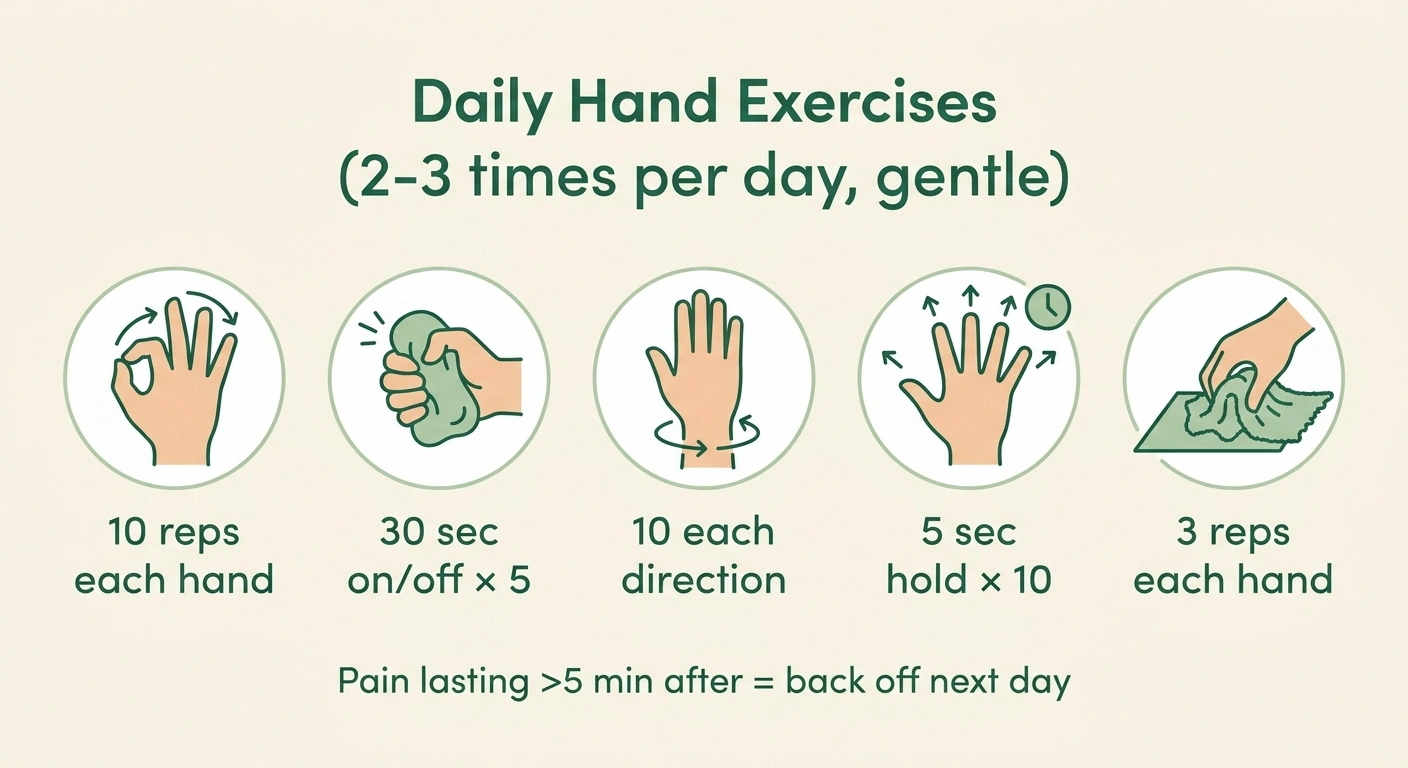
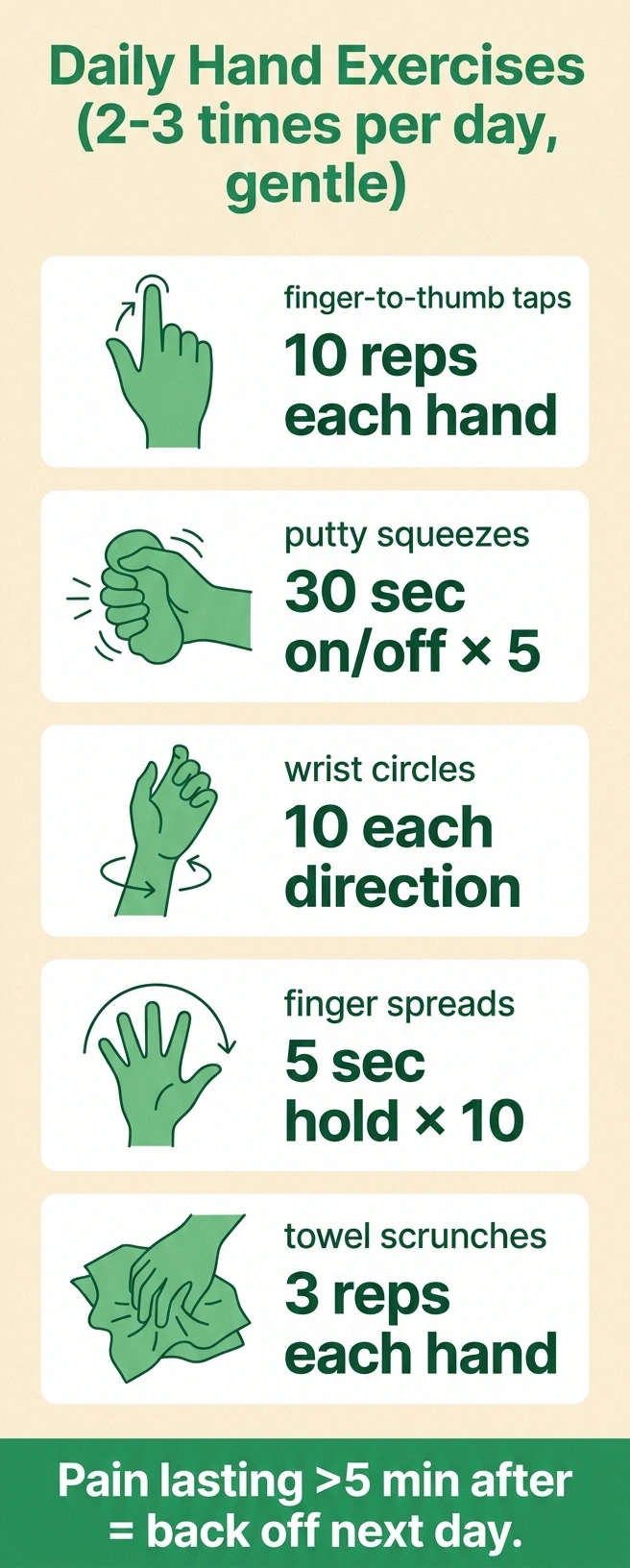
Hand neuropathy doesn’t reverse with exercise, but maintaining the strength and dexterity you have makes everyday tasks — including writing — easier. A few minutes of low-burden exercises 2 to 3 times per day adds up.
⚠ If pain lasts more than 5 minutes after exercise, back off the next day. Gentle and consistent beats intense and sporadic.
- Finger taps to thumb: Touch each fingertip to your thumb in sequence (index, middle, ring, pinky). 10 reps per hand, 3 times per day. Builds fine motor coordination.
- Therapy putty squeezes: Light-resistance therapy putty (around $10 for a tub) — squeeze and release for 30 seconds, rest 30 seconds, repeat 5 times. Builds grip endurance.
- Wrist circles: 10 rotations each direction, both hands. Improves wrist mobility and reduces stiffness.
- Finger spreads: Open your hand wide, hold for 5 seconds, then close into a soft fist. 10 reps per hand. Maintains range of motion.
- Towel scrunches: Place a small hand towel on a table. Use your fingers (not your wrist) to gather the towel up into a ball. 3 reps per hand. Builds intrinsic hand muscles.
Do these gently. Hand pain that lasts more than a few minutes after exercise means you pushed too hard — back off the next day.
When to Ask for Occupational Therapy
Occupational therapists (OTs) specialize in adaptive tools and techniques for daily life. For hand neuropathy, an OT consultation can be transformative — they can:
- Evaluate your specific deficits and recommend the right adaptive equipment for your situation.
- Fit custom splints to support a weakened thumb or wrist.
- Teach you specific compensatory techniques for tasks beyond writing.
- Connect you with funding for higher-cost adaptive equipment (some can be billed through insurance with the right documentation).
To get an OT consultation, ask your primary care doctor or neurologist for a referral. Medicare and most private insurance cover OT for neuropathy-related functional limitations. The typical evaluation is one or two visits, with follow-up sessions as needed.
When Sudden Writing Changes Need a Doctor
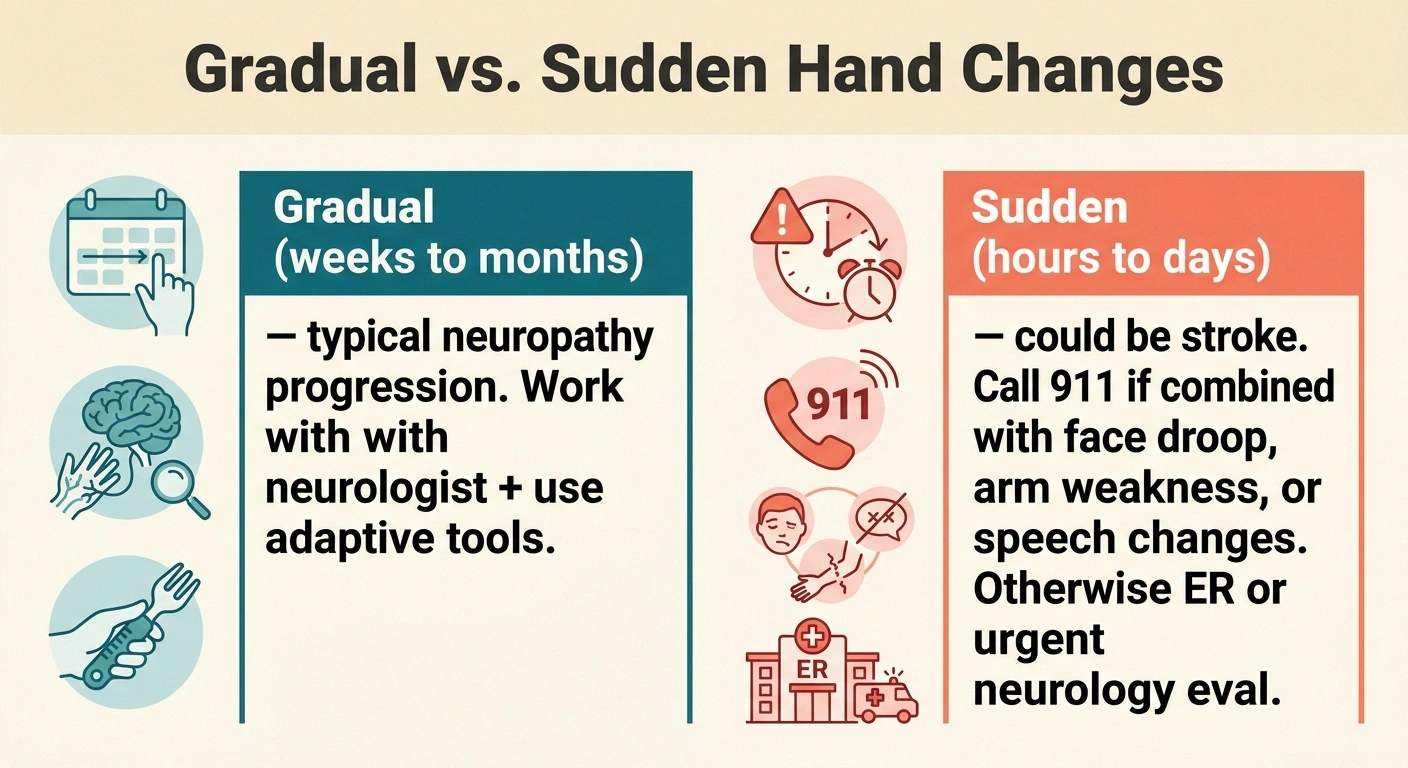
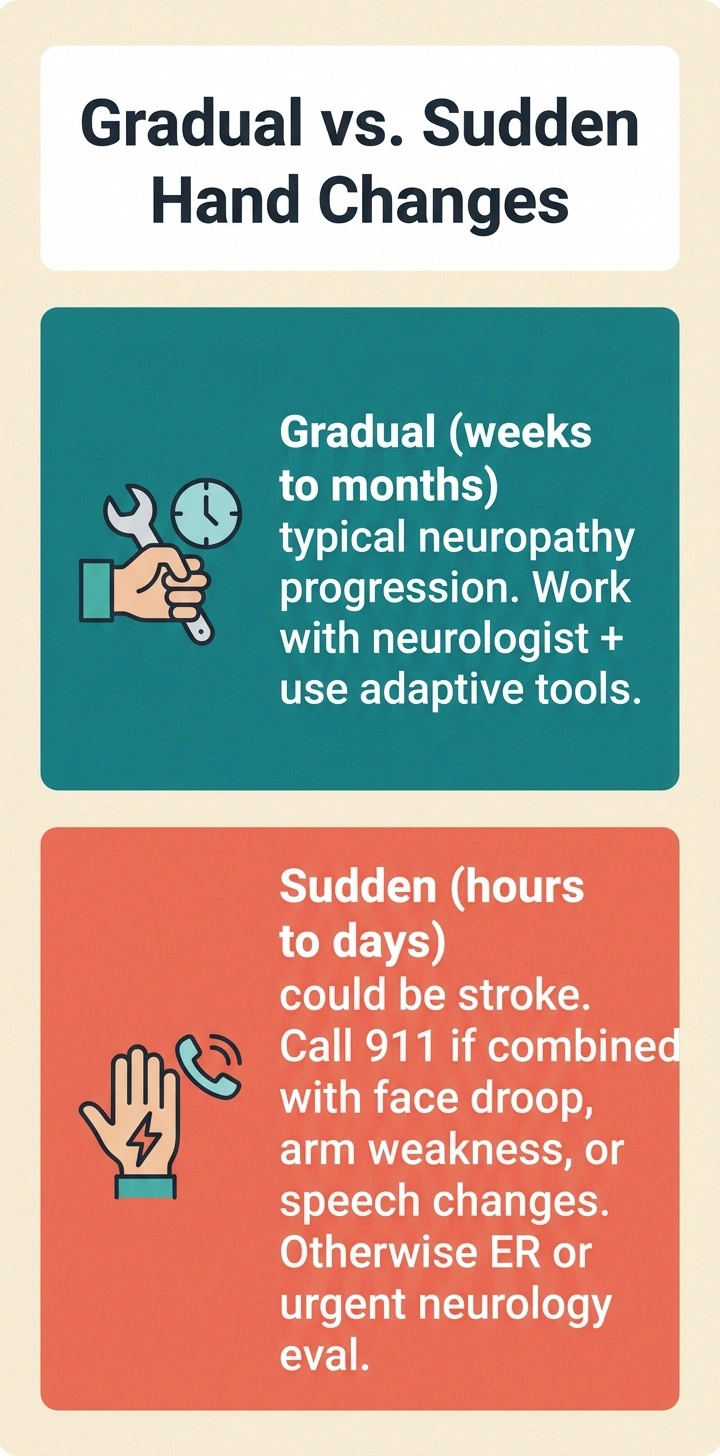
Most handwriting changes from neuropathy come on gradually over weeks or months. If your handwriting changes suddenly — within hours or a day or two — that’s not garden-variety neuropathy. Sudden hand weakness or coordination loss can be a sign of:
Sudden hand weakness or coordination loss with ANY of these — could be a stroke:
- Face droop (one side of mouth or eye drooping)
- Arm weakness (one arm hard to lift)
- Speech changes (slurring, can’t find words, can’t understand)
- Sudden severe headache “worst of your life”
- Sudden vision loss in one eye
- Sudden balance loss or vertigo
Time is brain. Don’t drive yourself. Don’t wait. Call 911.
- Stroke — especially if combined with face droop, arm weakness, or speech changes. Call 911. Time is brain.
- Acute nerve compression — a sudden pinched nerve from sleeping on your arm or carrying a heavy bag can cause rapid hand weakness. Usually resolves but should be evaluated.
- Carpal tunnel syndrome flare — sometimes the first sign of a flare is sudden hand weakness or “drop” of objects. Worth telling your doctor.
- Other neurological conditions — multiple sclerosis, ALS, and certain autoimmune conditions can present with hand weakness. Sudden changes warrant a neurology evaluation.
Gradual changes over weeks or months — typical of diabetic neuropathy, chemo neuropathy, or idiopathic small fiber neuropathy — are best addressed by working with your neurologist on overall treatment and using the adaptive tools in this article.
The Practical Bottom Line
You don’t have to accept that handwriting is “over” because you have neuropathy in your hands. A few small changes — a better pen, a grip aid, wide-ruled paper, the right setup — usually restore enough function for daily writing. A signature stamp or updated signature on file solves the most common signature problem. A witnessed mark or electronic signature handles the rest. And an OT consultation can fine-tune everything for your particular hand.
Start with the cheapest changes first: a gel pen, a $5 grip pack, a wide-ruled notepad. If those help, build from there. If they don’t, ask for the OT referral.
Your signature is still your signature. It just has to be something your hand can do today.
Frequently Asked Questions
Is a signature stamp legally valid?
Signature stamps are legally valid in most jurisdictions for most purposes, but acceptance varies by institution. Banks may require you to pre-notify the branch and sign a waiver. Some legal documents (wills, certain real estate documents) require a wet signature or witnessed mark and don’t accept stamps. Ask the receiving institution about their policy before relying on a stamp for important documents.
Can I change my signature?
Yes. There is no legal requirement that your signature stay the same throughout your life. People change their signatures when they marry, when their hand changes from injury or illness, or simply when they want to. The practical step is to update your signature on file at your bank, the DMV, and other institutions so future signed documents can be matched to the version you can actually produce.
What if my bank refuses to accept my new signature?
Banks have an ADA obligation to provide reasonable accommodations for customers with disabilities. If your branch is reluctant, ask to schedule a meeting with the branch manager. Bring documentation from your doctor confirming that you have a neuropathy or hand condition affecting fine motor control. Most banks will accept a witnessed signature card, a signature stamp, or an updated simpler signature once they have proper documentation.
Are weighted pens really better for neuropathy?
For some people, yes. Slightly heavier pens (around 1.5 to 2 ounces) reduce fine tremor and feel more controlled in a numb hand. They don’t help everyone — for some, the added weight is fatiguing. Try one before committing. Pen weights ($5 to $10) can be added to a pen you already like rather than buying a whole new weighted pen.
What’s the best pen for neuropathy?
There’s no single best pen. The best pen is the one that combines a smooth ink (gel or rollerball), a wider barrel, and a grip that suits your hand. Common starting points: the Pilot G2 gel pen (around $2), the Pilot Metropolitan fountain pen (around $20), or a PenAgain ergonomic pen (around $10). Try a few and see which feels easiest to write with for several minutes.
Will hand exercises reverse my neuropathy?
No. Hand exercises don’t regenerate damaged nerves. They do maintain the muscle strength and joint mobility that’s still working, which makes everyday tasks easier. Combined with the medical treatment of your underlying neuropathy, exercises help preserve hand function over time. Treat them as maintenance, not as a cure.
How do I sign credit card receipts when I can’t sign anymore?
Most credit card transactions in the U.S. no longer require a signature for any amount under $10,000. If you do need to sign at the register, any mark you intend as your signature is accepted. Some people simply write their initials or print their last name. Card networks have largely moved on from signatures as a fraud-prevention tool.
Can I get insurance to cover adaptive writing equipment?
Some adaptive equipment is covered when prescribed by an occupational therapist after a formal evaluation. Custom splints, larger-grip writing tools, and angled writing surfaces may be billable through Medicare or private insurance under “durable medical equipment” or “OT services.” Most low-cost adaptive pens and grips ($5 to $30) are easier to buy out of pocket than to navigate through insurance.
Should I learn to write left-handed if my dominant hand has neuropathy?
Most people find it more practical to use adaptive tools with their dominant hand than to retrain a non-dominant hand from scratch. That said, if neuropathy is severely worse on one side, occupational therapists do sometimes teach hand-switching as one of several strategies. The decision is individual — discuss it with an OT during evaluation.
About the Author