
Last spring at a diabetes check-in, I asked my doctor a question I had been carrying for weeks. “If we know exactly how high blood sugar damages the nerves, why isn't there a drug that stops the damage instead of just numbing the pain?” She smiled the way doctors smile when a patient stumbles into a question the whole field has been wrestling with for forty years.
That conversation sent me down a rabbit hole. What I found was one of the longest and quietly hopeful stories in diabetic neuropathy research. A class of medicines called aldose reductase inhibitors, or ARIs, that targets the exact biochemistry believed to drive nerve damage in diabetes. Drugs available in Japan since I was in my twenties. Drugs that have failed in the United States over and over. And drugs that companies are still trying to move across the finish line here in 2026.
I want to walk you through what these medicines are, why the American approval story has been so bumpy, and what all of it means for someone living with diabetic neuropathy today. I will keep it plain and honest, and I will not promise anything about a cure — because that is not a promise anyone can honestly make.
The Doctor's Appointment That Sent Me Down This Rabbit Hole
I have written before about how diabetic neuropathy creeps in on quiet feet. Numbness, a burning at the arch, that pins-and-needles feeling that arrives without permission. My doctor and I had been talking about better glucose control and whether I should try a nerve-pain medication — she mentioned duloxetine and gabapentin as options that could take the edge off the burning.
What I noticed was that everything she offered was aimed at the experience of neuropathy — the pain, the sleep disruption — and nothing was aimed at the process. Nothing that would say to my nerves, “please stop breaking down.”
When I asked why, she paused and said, “There have been drugs designed to do that. They haven't worked out very well in the United States.” That night I started reading. Aldose reductase inhibitors kept coming up over and over.
What the Polyol Pathway Actually Is (In Plain English)
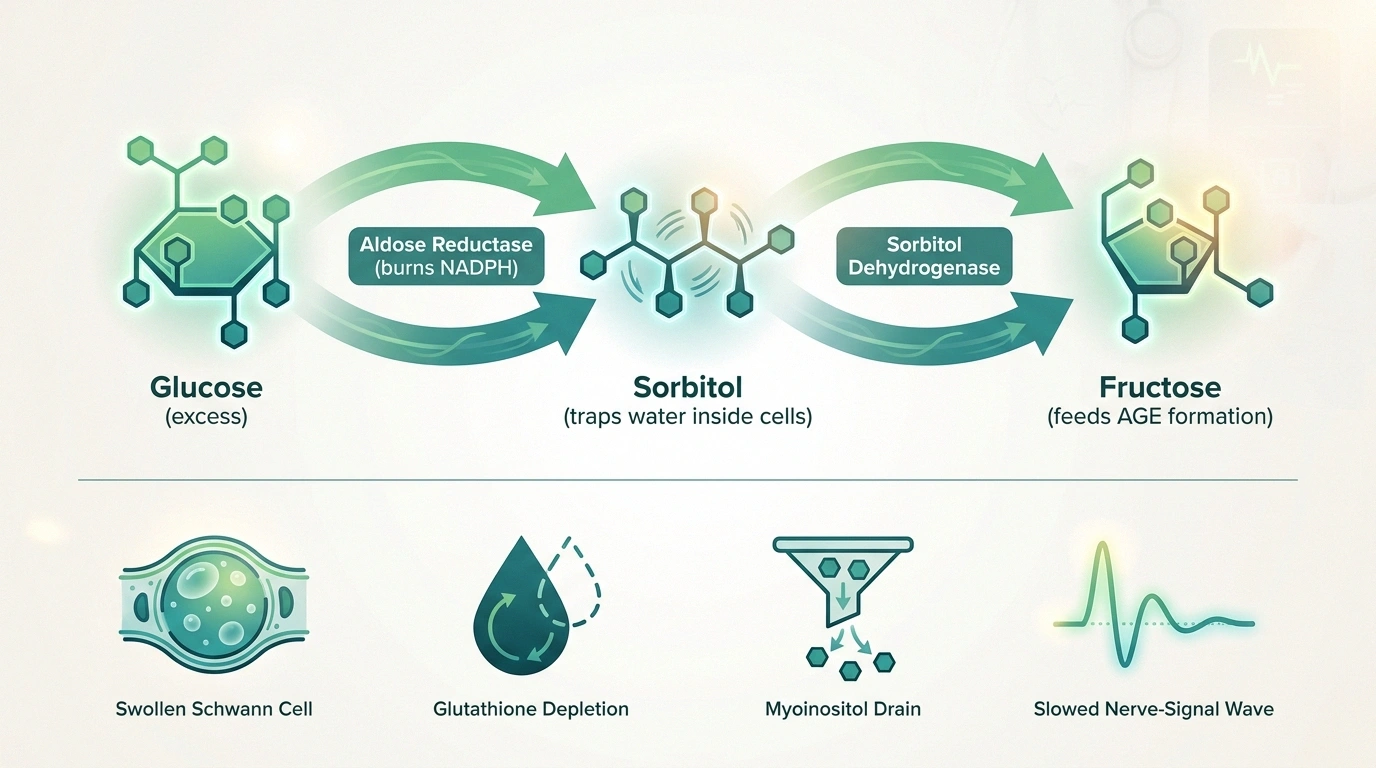
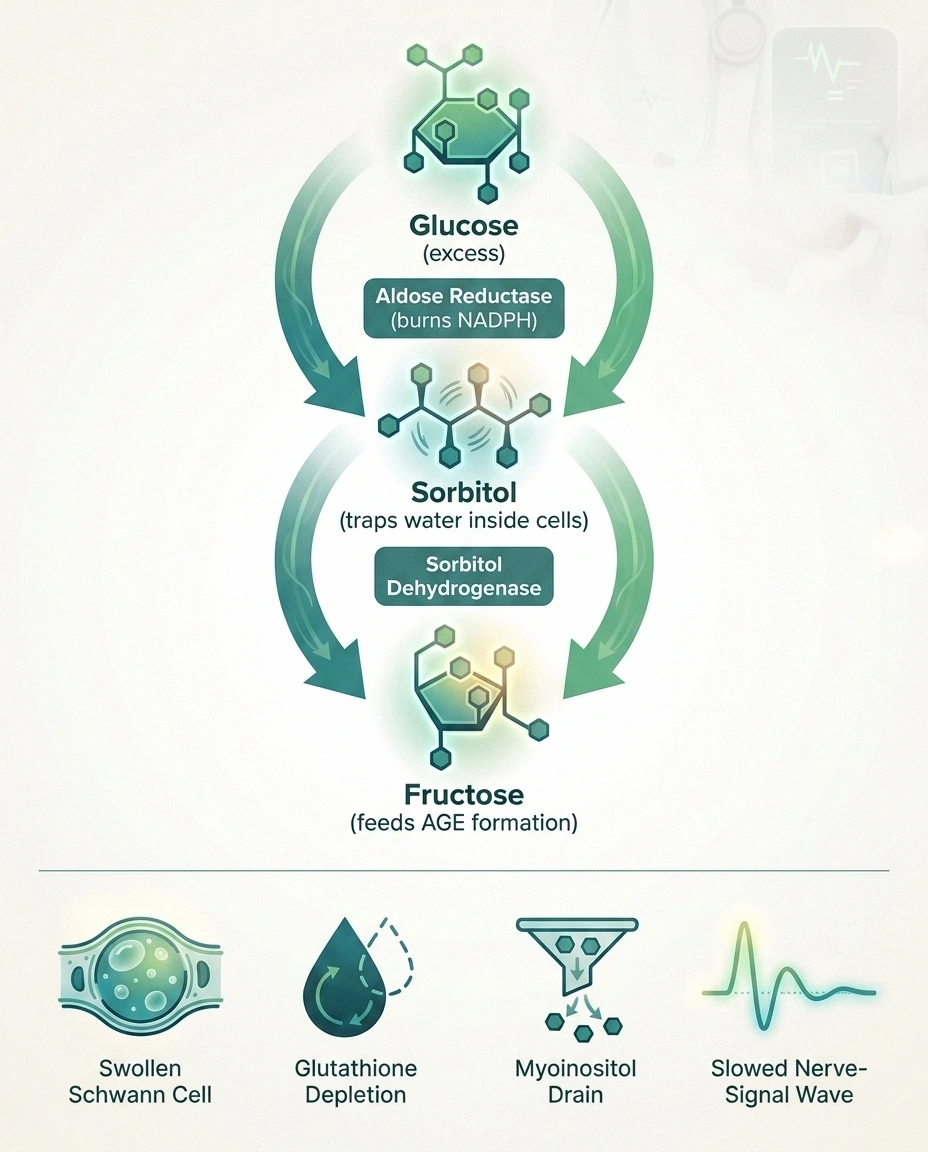
Before I tell you about the drugs, I have to tell you about the plumbing they target. Once you see it, a lot of what your body is doing under high blood sugar suddenly makes sense.
The polyol pathway is a backup route your cells open under high blood sugar. Aldose reductase converts extra glucose to sorbitol, sorbitol dehydrogenase converts sorbitol to fructose, and the whole cascade drains NADPH, swells cells, and depletes myoinositol. This is the leading candidate mechanism for how diabetes damages peripheral nerves.
Normally your cells burn glucose through a familiar pathway called glycolysis. When blood sugar runs high for a long time, that main pathway gets overwhelmed. A backup route called the polyol pathway (sometimes called the sorbitol pathway) opens up and starts processing the excess glucose instead.
The polyol pathway has two steps. In step one, an enzyme called aldose reductase converts glucose into a sugar alcohol called sorbitol. In step two, an enzyme called sorbitol dehydrogenase converts that sorbitol into fructose. Simple enough. The problem is what those two steps cost your nerves.
- Sorbitol gets stuck inside cells. Unlike glucose, it does not slip easily across cell membranes. It piles up inside Schwann cells and nerve endings, drawing water in behind it and causing the cells to swell.
- NADPH gets burned up. Aldose reductase uses NADPH to do its work. NADPH is also what your cells rely on to make glutathione, the master antioxidant. Drain the NADPH, drain the glutathione, and oxidative stress climbs.
- Fructose feeds glycation. The fructose from step two joins with proteins to form advanced glycation end-products (AGEs), which stiffen and damage nerve fibers over time.
- Myoinositol drains out. As sorbitol crowds in, myoinositol — needed for the nerve's sodium-potassium pump — flows out. Weaken the pump, slow the signal.
Put those together and you have swollen nerves, oxidative stress, sticky proteins, and slowed signaling. This is the leading explanation for why diabetes damages peripheral nerves the way it does.
Why Aldose Reductase Became a Drug Target in the First Place
If aldose reductase starts this whole cascade, the reasoning goes, then blocking it should stop the cascade before it does damage. Turn off step one and everything downstream never happens. That is the elegant logic behind aldose reductase inhibitors.
The first ARIs were designed in the late 1970s, and by the 1980s several were in clinical trials. Researchers dreamed of a drug that could actually slow diabetic neuropathy rather than just mask the symptoms.
What followed was a painful reality check. Some drugs worked in animals but not people. Others worked in people but caused liver damage. Others improved nerve conduction on tests but did not make patients feel better. A handful looked promising, hit late-stage trials, and either failed narrowly or ran into safety trouble. The FDA never approved any of them for diabetic peripheral neuropathy, and that is still true in 2026.
But the mechanism has never been debunked. The polyol pathway is real. The damage is real. The drug story has been about getting the right molecule with the right safety profile in the right patients — not about the underlying science being wrong.
Meet Epalrestat, the Drug Available in Japan Since 1992

The one aldose reductase inhibitor that did successfully cross a regulatory finish line is called epalrestat. It has been approved in Japan since 1992, and it is also available in India and China. Its brand name in Japan is Kinedak, and it is prescribed at a dose of 50 milligrams three times a day, taken before meals.
Epalrestat: 30+ years of Japanese use
Approved in Japan in 1992 for diabetic peripheral neuropathy. Standard dose 50 mg three times daily, taken before meals. Also approved in India and China. Not FDA-approved in the United States as of 2026.
The Japanese approval was based on studies showing modest but consistent improvements in subjective neuropathy symptoms — spontaneous pain, numbness, cold sensation — along with measurable improvements in nerve conduction velocity and vibration perception. A large long-term study published in 2012 followed patients on epalrestat for three years and found slower progression of nerve conduction decline compared with control patients not on the drug.
The benefits are described as modest. Not dramatic, not curative. Somewhere in the range of “helpful for a subset of patients with milder disease,” particularly people with good glucose control who still have measurable but not severe neuropathy. Side effects are generally mild and include liver enzyme elevations that need to be monitored, along with occasional nausea or stomach upset.
Epalrestat has been on the Japanese market for more than thirty years. Millions of patient-years of use have accumulated. Its safety profile is well understood. And yet, if you live in the United States, your doctor cannot prescribe it and your pharmacy cannot fill it. So what happened?
So Why Isn't Epalrestat in American Pharmacies?
The honest short answer is a mix of business, regulatory standards, and history. Epalrestat was never developed and submitted for FDA approval by its Japanese manufacturer. The American regulatory bar has historically demanded larger and more decisive clinical trials than the ones that supported the Japanese approval. And the modest benefit epalrestat shows — real, but modest — may not have looked like a commercial winner in a US market crowded with pain-focused options like Lyrica, gabapentin, and duloxetine.
Please do not order epalrestat from overseas pharmacies without talking to your doctor first.
Imported medications raise real safety, quality, and legal questions in the US — product purity, dosing accuracy, and drug interactions are genuine concerns. A decision about a medication approved elsewhere but not here is a conversation for a physician who knows your history, not something to act on from a website.
There have also been complications around generic availability. Since epalrestat's patent has long since expired, no company has a strong financial reason to invest in the years of trials and regulatory work needed to bring it to the US. It sits in a strange no-man's-land — a real, generic, well-understood medicine that most Americans have never heard of.
I want to be careful here. If you are reading this and thinking “I should just order it online” — please talk to your doctor first. Purchasing medications from overseas pharmacies raises serious safety, quality, and legal questions in the US. Product purity, dosing accuracy, and drug interactions are real considerations. This is a conversation to have with a physician who knows your medical history, not a decision to make from a website.
The Long Graveyard of American Aldose Reductase Inhibitor Trials

Epalrestat's story in Japan is unusual. The more typical story for ARIs in the United States is a graveyard of promising drugs that either failed to prove they worked or caused enough safety problems to be pulled from development.
Here are the names you may run across if you dig through old research:
- Tolrestat — Made it to market briefly in the mid-1990s. Withdrawn in 1997 after reports of severe and sometimes fatal liver damage.
- Sorbinil — Discontinued in trials after unexpectedly high rates of hypersensitivity reactions.
- Zenarestat — Trials halted over changes in kidney function markers.
- Alrestatin — One of the earliest candidates. Insufficient efficacy in trials, discontinued.
- Fidarestat — Late-stage Japanese trials showed modest benefit; development did not continue to major markets.
Some of these were killed by pure bad luck — a rare side effect that showed up in Phase 3 after looking clean in earlier studies. Others simply could not show enough benefit over placebo to justify approval. The FDA holds diabetes complication drugs to a high standard because the treatments are meant to be taken for years and the population is large.
What this history tells me is not that the polyol pathway is a bad target. It tells me that finding a drug that hits aldose reductase hard enough to help, without also causing damage somewhere else in the body, is genuinely difficult.
The Ranirestat Puzzle of Better Nerves and Same Symptoms
One drug still worth knowing about is ranirestat, developed by Sumitomo Pharma. It is a more potent aldose reductase inhibitor than epalrestat, and it made it through Phase 3 trials in both the United States and Japan over the last decade or so.
A 2023 meta-analysis of the ranirestat trials found the drug improved electrophysiologic measures like nerve conduction velocity, but did not clearly improve patient-reported symptoms.
One likely reason: once nerves have been damaged for years, restoring some measurable function does not automatically translate into feeling better. This is why the early-window question keeps coming up in ARI research.
The results were, honestly, a puzzle. On the objective measurements — nerve conduction velocity, vibration perception, quantitative sensory testing — ranirestat showed a real, measurable improvement over placebo. On the subjective measurements — how much pain patients felt, how much their day-to-day quality of life improved — the drug did not clearly outperform placebo. A 2023 meta-analysis of the ranirestat trials summed it up neatly: the drug improved electrophysiologic measures but did not clearly improve clinical symptoms.
Why the mismatch? Nobody knows for sure. One theory is that once nerves have been damaged for years, restoring some function on a test does not automatically translate into feeling better, because the nervous system has already rewired around the damage. Another theory is that the trials did not run long enough, or did not enroll patients early enough in the disease, to catch the drug at its most useful window.
Ranirestat has not been approved by the FDA. In Japan, further development for diabetic neuropathy has been limited. It remains an interesting compound with an unresolved story.
What Applied Therapeutics Is Trying With AT-001 and Govorestat

The most active company pushing aldose reductase inhibitors in the US as of 2026 is Applied Therapeutics.
Their lead compound, AT-001 (caficrestat), was tested in a Phase 3 trial called ARISE-HF for a related complication — diabetic cardiomyopathy, or heart damage from long-term high blood sugar. The trial enrolled 675 patients over 15 months. Topline results in January 2024 were mixed: the drug narrowly missed the overall primary endpoint but showed a clear benefit in patients not already on newer diabetes medications (SGLT2 inhibitors and GLP-1 receptor agonists), and it reduced progression to overt heart failure. The same biochemistry the drug targets in the heart is at work in the nerves, so researchers with an interest in the polyol pathway have been watching the program closely.
Applied Therapeutics also has govorestat (AT-007), a CNS-penetrant ARI submitted to the FDA for a rare condition called classic galactosemia. In late 2024 the FDA issued a Complete Response Letter, saying the application could not be approved because of deficiencies in the clinical data. The company has been working on a resubmission. Another example of how hard it is to get an ARI across the FDA finish line even in a small indication.
All of this is investigational. None of these compounds is currently available in a US pharmacy for diabetic neuropathy, and any change is likely years away, if it happens at all.
How Aldose Reductase Inhibitors Compare to What Your Doctor Can Prescribe Today
For someone with diabetic neuropathy in 2026, what your doctor can prescribe falls into two buckets.
Symptom-focused medications treat the pain without slowing the underlying damage — duloxetine, pregabalin, gabapentin, tricyclic antidepressants like amitriptyline, and topical treatments like lidocaine or capsaicin. They can meaningfully improve quality of life, but none of them changes the trajectory of the disease.
Disease-modifying approaches address the process causing the damage. In the US as of 2026, that means tight glucose control, blood pressure and cholesterol management, and lifestyle changes. There is no FDA-approved medication that specifically targets the polyol pathway or aldose reductase for diabetic neuropathy.
An aldose reductase inhibitor, if one were available and worked well, would sit in the second category. It would slow the damage rather than just numb the pain — complementing, not replacing, the symptom drugs many people already rely on. Until then, the disease-modifying strategy is largely lifestyle plus glucose management. Not glamorous, but it is what we have that actually addresses the process.
The Alpha-Lipoic Acid Connection (and Why It's Not the Same Thing)
Whenever the polyol pathway comes up, someone asks about alpha-lipoic acid. Fair question — the two topics are related but not the same.
Aldose reductase inhibitors block the enzyme at the top of the cascade. Alpha-lipoic acid is an antioxidant. It does not block aldose reductase. What it does is help neutralize the oxidative stress that the polyol pathway generates downstream. Mopping up the mess rather than turning off the faucet.
Some evidence suggests alpha-lipoic acid can improve neuropathy symptoms, particularly burning and prickling pain, at higher doses. The strongest data came from European trials using intravenous infusions of 600 mg per day; oral evidence at similar doses is more mixed. It is one of the more legitimate supplements in the neuropathy space. Please talk to your doctor before starting it, especially if you have diabetes, because it can affect blood sugar.
ALA addresses a consequence of the polyol pathway (oxidative stress). An aldose reductase inhibitor would address the cause (the enzymatic step that starts the whole cascade). Different levels of intervention, and in principle complementary.
What You Can Do Today to Support the Polyol Pathway Story
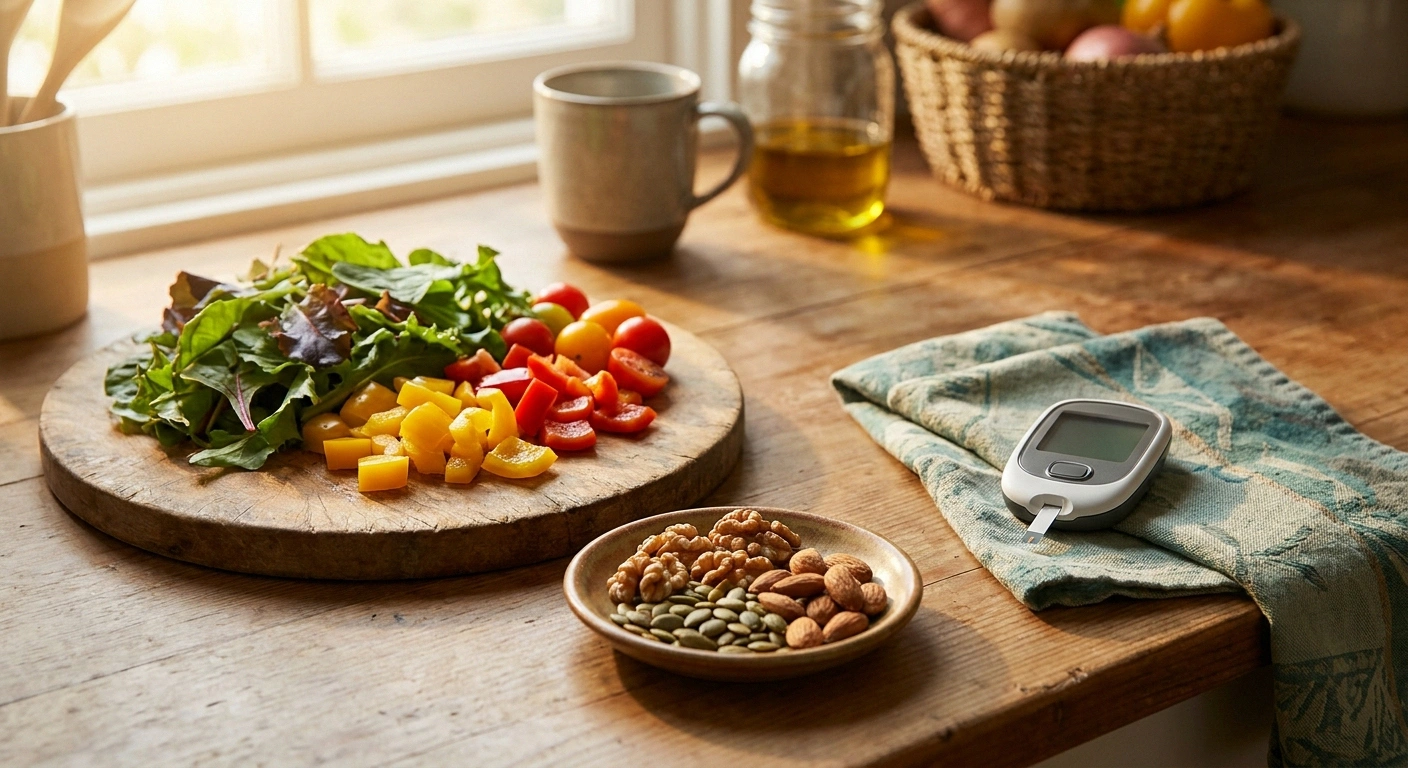
Since there is no FDA-approved ARI available right now, what does the polyol pathway research actually change about your day-to-day life? More than you might think. Here is what I have taken from it.
Tight glucose control matters more than the daily inconvenience suggests. The polyol pathway only kicks into high gear when blood sugar runs high. Every hour above target range is an hour aldose reductase is working overtime in your nerves. That is what endocrinology guidelines are really protecting against with their A1C targets.
Antioxidant support has a rational basis. NADPH depletion leading to glutathione depletion leading to oxidative stress is exactly what alpha-lipoic acid and certain vitamins are trying to offset. I do not want to oversell any supplement, but the biology supports paying attention to antioxidant status. Our guide to the best neuropathy supplements covers what the evidence actually says.
Diet is part of the picture. A diet that keeps blood sugar stable — lower in refined carbohydrates, higher in fiber, rich in vegetables and healthy fats — reduces polyol pathway activity. Our neuropathy diet guide lays out a practical framework. Not perfection. Fewer hours of high-glucose exposure over the years.
Early is better than late. Nerve damage present for years is harder to reverse than damage that is just beginning. If you are catching signs of neuropathy early, that is the highest-leverage moment to act. See the stages of neuropathy for what early damage looks like.
What I'd Watch For in the Coming Years

If ARIs are ever going to have their American moment, here is what I will be watching for.
The most interesting near-term possibility is a combination approach — an ARI paired with alpha-lipoic acid, benfotiamine, or an SGLT2 inhibitor — plus smarter patient selection that enrolls only people with early neuropathy and biomarker evidence of active polyol-pathway damage. A well-designed US trial in that population could quietly change what “disease-modifying” means for diabetic neuropathy.
- A US-relevant trial of epalrestat. The drug is generic, cheap, and has decades of safety data. A US academic or non-profit trial in early-stage diabetic neuropathy patients could revive the conversation.
- Applied Therapeutics' next moves with AT-001 and govorestat. If the company can address the FDA's feedback and get an ARI approved for any indication, it opens the door to nerve-focused studies.
- Combination approaches. An ARI paired with alpha-lipoic acid, benfotiamine, or an SGLT2 inhibitor might do together what neither can alone.
- Better patient selection. A smarter trial might enroll only people with early neuropathy, good glucose control, and biomarker evidence of active polyol-pathway damage.
- Real-world data from Japan and India. Thirty-plus years of epalrestat use gives an enormous observational data set. Better analysis could clarify who benefits most.
None of these breakthroughs are around the corner. But the direction of travel is not hopeless. The polyol pathway remains one of the best-understood mechanisms of diabetic nerve damage, and the drug class that targets it is still very much in play — just quietly, and mostly outside the United States.
The Honest Emotional Weight of a Forty-Year “Almost”
When I first started reading about aldose reductase inhibitors, I felt a wave of what I can only describe as gentle bitterness. The pathway has been understood since the 1970s. A working drug has been sitting on Japanese pharmacy shelves for three decades. In that same window, my nerves — and the nerves of millions of Americans with diabetes — kept quietly deteriorating without a treatment aimed at the process.
I sat with that feeling for a while. Then I made a cup of tea and thought about it more carefully.
Epalrestat is a modest drug. It helps some people, mildly. It is not a cure. Its absence in the American market is not the same thing as an absence of hope. What we do have — tight glucose control, symptom-managing medications, a richer understanding of the biology, a next generation of drugs in trials — is more than my grandmother's generation of diabetics had.
Living well with diabetic neuropathy today, using the tools that are actually available, is what makes me ready for whatever the next generation of treatments turns out to be. The best position I can be in when a real disease-modifying drug does arrive is with my glucose controlled, my nerves as protected as I can make them, and my body in a place where a good treatment has something to work with. That is what the aldose reductase inhibitor story has taught me more than anything about drugs specifically — the biology matters, the mechanisms are being unraveled, and the work being done in labs around the world is genuinely, quietly, on our side.
Frequently Asked Questions
Are aldose reductase inhibitors available in the United States for diabetic neuropathy?
No. As of 2026, no aldose reductase inhibitor has been approved by the FDA for diabetic peripheral neuropathy in the United States. Several have been studied in clinical trials over the past forty years, and several are still in development, but none is currently available at an American pharmacy for this use.
What is epalrestat and why can't I get it?
Epalrestat is an aldose reductase inhibitor that has been approved in Japan since 1992 for diabetic neuropathy. It is also available in India and China. It was never submitted for FDA approval in the United States, in part because its patent has long since expired and there is no clear commercial pathway. Please do not order it from overseas pharmacies without talking to your doctor first — there are real safety, quality, and legal considerations with imported medications.
Does alpha-lipoic acid do the same thing as an aldose reductase inhibitor?
No. Alpha-lipoic acid is an antioxidant that helps neutralize oxidative stress downstream of the polyol pathway. An aldose reductase inhibitor would block the enzyme at the top of the pathway, stopping the cascade before it starts. They address different levels of the same problem and could potentially be complementary, but they are not interchangeable.
What is the polyol pathway?
The polyol pathway is a backup route your cells use to process excess glucose when blood sugar runs high. Aldose reductase converts glucose to sorbitol, and sorbitol dehydrogenase converts sorbitol to fructose. In the process, cells lose NADPH (weakening antioxidant defenses), accumulate sorbitol (causing swelling), and lose myoinositol (slowing nerve signal conduction). Researchers believe this pathway is a leading cause of diabetic peripheral nerve damage.
Why did so many aldose reductase inhibitors fail in trials?
Different reasons for different drugs. Tolrestat was pulled from the market for liver toxicity. Sorbinil caused hypersensitivity reactions. Zenarestat had issues with kidney function markers. Ranirestat improved nerve conduction on tests but did not clearly improve patient-reported symptoms. The polyol pathway target itself is not disproven. The challenge has been finding a compound that hits it hard enough to help while staying safe enough for years of daily use.
Is there any US clinical trial I could join for an aldose reductase inhibitor?
ClinicalTrials.gov is the best place to search. Look for ongoing trials of AT-001 (caficrestat), govorestat, and any new ARI candidates in development. Not every trial recruits diabetic neuropathy patients specifically, so you may need to look at related conditions like diabetic cardiomyopathy or galactosemia. Talk to your doctor about whether any trial is a reasonable fit for your situation.
Should I take extra myoinositol or B vitamins because of the polyol pathway story?
Some evidence suggests myoinositol supplementation may modestly help nerve function, though trials are small and not conclusive. B vitamin deficiencies (especially B12) are genuinely important to correct if you have them, and blood testing is the way to check. I would not pile on supplements without a rationale specific to your situation. Please talk with your doctor before adding any new supplement.
If aldose reductase inhibitors get approved, will they reverse the neuropathy I already have?
Probably not fully. Most researchers expect any drug slowing the polyol pathway will be most useful at preventing further damage and giving mildly damaged nerves a chance to recover. Nerves damaged for many years, especially with significant loss of axon fibers, are harder to bring back. This is why the early window in neuropathy is so important — the same window in which a future ARI would likely be most useful.
The story of aldose reductase inhibitors is not finished. It may yet have another chapter or two. Whatever comes next, the best thing any of us can do is take care of what we can take care of today — our glucose, our nutrition, our movement, our follow-up with our doctors. And when the next chapter arrives, I would like all of us to be as ready as we can possibly be.
About the Author


