
Most FMLA denials for nerve pain are not decisions about your condition. They are decisions about one line on one form.
The line asks the provider to estimate how often episodes will occur and how long each will last. A neurologist who writes “as needed” or leaves it blank has, without meaning to, told the employer’s leave administrator that nothing about this is predictable enough to plan around. The file comes back marked incomplete, and by the time it is sorted out the fifteen day clock has run.
The condition qualified the whole time. The paperwork did not say so.
That is the part of this process worth understanding before you request anything, because the rest of it is mostly arithmetic.
Three Gates Before Anyone Looks at Your Diagnosis
Eligibility comes first and has nothing to do with how bad your symptoms are. You have to clear all three of these:
Run your own numbers before you ask anyone
All three have to be true on the day leave starts. The hours test is the one that quietly fails for people who already reduced their schedule.
| Gate | The threshold | What trips people up |
|---|---|---|
| Length of service | 12 months with the employer | Does not need to be consecutive. An earlier stint within the last seven years usually still counts. |
| Hours worked | 1,250 in the prior 12 months, about 24 hours a week | Hours worked, not paid. Vacation, holidays and sick days do not count toward it. |
| Employer size | 50 employees within 75 miles of your worksite | Measured from your site, not company-wide. Public agencies and school employers are covered at any size. |
Fail any one and the answer is not “no options.” It is the ADA at 15 employees, plus whatever your state program covers.
Twelve months of employment. Time with the same employer, and it does not have to be twelve months in a row. Seasonal work and a prior stint that ended within the last seven years usually still counts.
1,250 hours in the twelve months right before the leave starts. That works out to about twenty four hours a week. This is hours actually worked, not hours paid. Vacation, sick days and holidays do not count toward it, which catches people who have already been reducing their schedule because of symptoms. If you cut back to part time last spring, run the number before you assume.
Fifty employees within seventy five miles of your worksite. Not fifty in the company. Fifty within that radius of where you report. A regional office of eleven people belonging to a company of four thousand does not clear this gate.
One clarification that matters here, because it is easy to misread. Public agencies and public school employers are covered employers regardless of headcount, while private employers need fifty or more employees for twenty or more workweeks in the current or previous year. Employer coverage and your own eligibility are separate questions, and the fifty within seventy five miles test still applies to you personally either way. Working for a government or school employer does not remove that gate.
If you fail any of the three, stop reading this as an FMLA question and start reading it as an accommodation question. The Americans with Disabilities Act applies at fifteen employees rather than fifty, and it can require a modified schedule, a seated workstation or unpaid time off as a reasonable accommodation. It is a different statute with different mechanics, and the accommodations route is worth understanding on its own terms. Many people who cannot use FMLA can use that.
What the Law Actually Gives You

Twelve workweeks of unpaid leave in a twelve month period, and your group health coverage continues on the same terms while you are out.
Two words in that sentence carry most of the weight.
Unpaid. FMLA is job protection, not income. Your employer may require, and you may elect, that accrued paid leave run concurrently so you are drawing sick or vacation time while the FMLA clock runs. Income during leave otherwise comes from somewhere else entirely: a state paid family and medical leave program if your state runs one, short term disability if you carry it, or savings. Nobody tells you this up front and it is the single most common surprise.
Workweeks. Not days. If you work three days a week, a workweek of leave is three days, not five. This matters enormously for intermittent leave, because it means your twelve weeks convert into a bank of hours proportional to your schedule.
You also get your job back, or an equivalent one at the same pay, benefits and terms. Equivalent is a real legal standard, not a courtesy. And your employer cannot count FMLA absences against you in an attendance policy, which is the protection that matters most for a condition that produces scattered bad days.
Why Neuropathy Fits the Definition, and Which Definition It Fits
There are several routes to a serious health condition under the statute. Most people picture the inpatient one: a surgery, a hospital stay, a stretch of recovery. Neuropathy almost never arrives that way, which is why people assume it will not qualify.
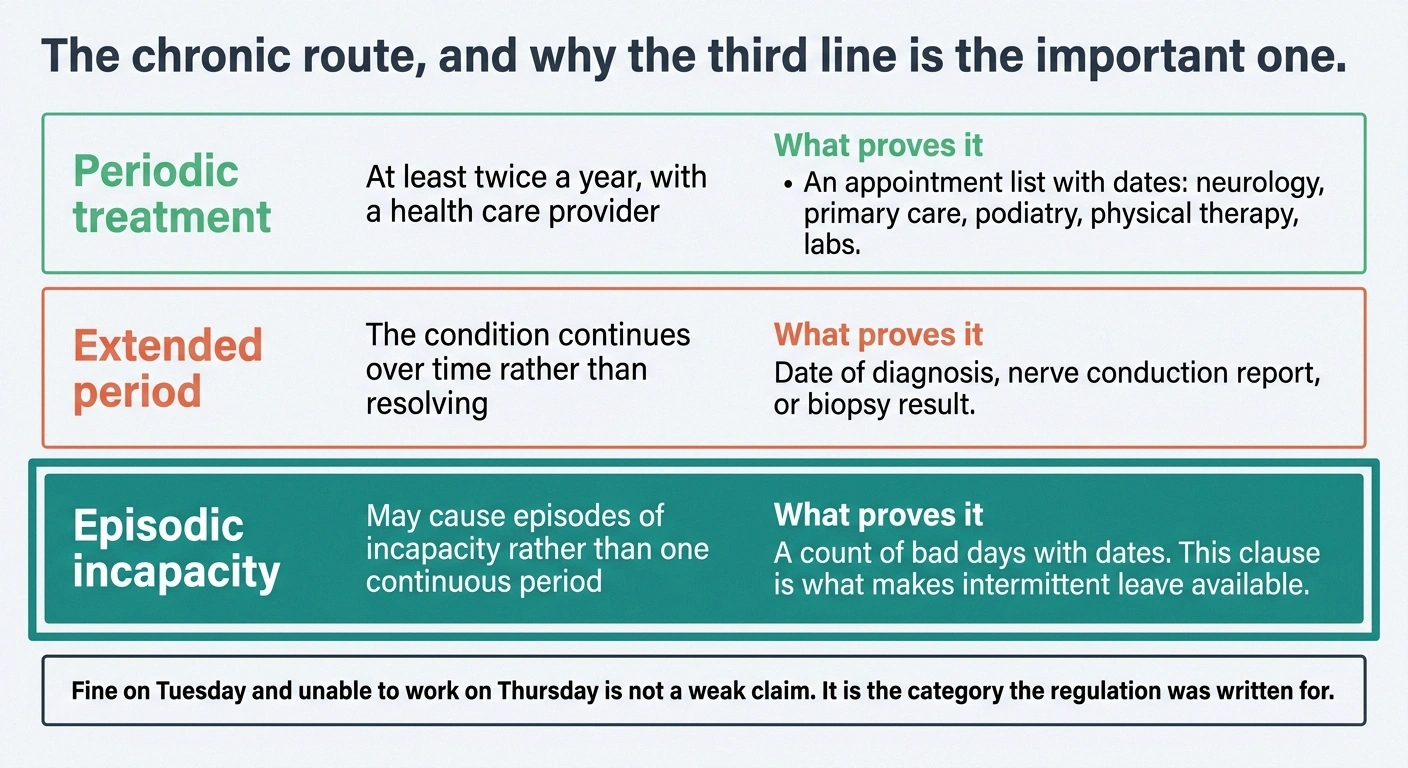
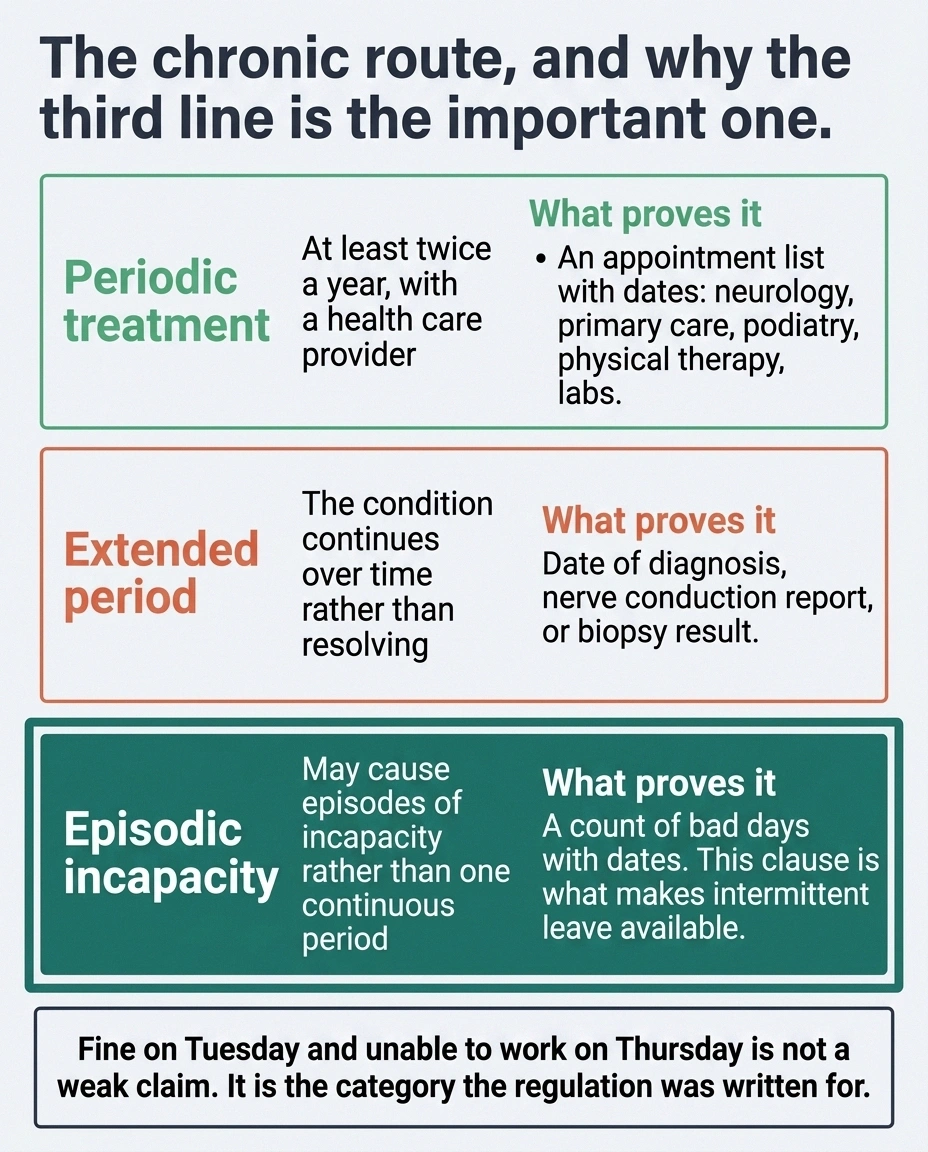
Three tests, and the paper that satisfies each one
The certification asks a provider to assert these. You can make that easy by bringing the underlying record with you.
- Periodic treatment, at least twice a year
- Proved by an appointment list with dates and providers. Count neurology, primary care visits about this condition, podiatry, physical therapy, infusions and lab monitoring. Most people undercount by half.
- Continues over an extended period
- Proved by the date of diagnosis or of the first documented symptoms. A nerve conduction report or skin biopsy result carries a date and settles this line without discussion.
- May cause episodic rather than continuing incapacity
- Proved by a count of bad days. This is the clause that makes intermittent leave available, and it is the one a symptom log answers better than any clinical record can.
It qualifies under the chronic condition route, which has three requirements:
- It requires periodic visits for treatment by a health care provider, defined as at least twice a year
- It continues over an extended period
- It may cause episodic rather than a continuing period of incapacity
Read that third item again. The regulation specifically contemplates a condition that is fine on Tuesday and disabling on Thursday. Episodic incapacity is not a weakness in your claim. It is the category your claim belongs in.
Peripheral neuropathy of essentially any origin fits this comfortably. Diabetic neuropathy comes with the twice yearly visit requirement built into ordinary diabetes management. Chemotherapy induced neuropathy arrives already attached to an oncology schedule. Idiopathic and autoimmune neuropathies involve ongoing neurology follow up by definition.
Two things do not have to be true, and people talk themselves out of applying because they think they do:
You do not need a rare or dramatic diagnosis. You do not need to be incapacitated most of the time. You need a chronic condition, periodic treatment, and episodes that stop you working.
Incapacity Is a Narrower Word Than It Sounds
Incapacity in this context means inability to work, attend school or perform other regular daily activities because of the condition, its treatment, or recovery from treatment.
The trap here is a specific and very common one. People with nerve pain are unusually good at working through it. You take the shift, you sit down more, you get through the day at forty percent and you go home and cannot move. Then the certification asks whether you are unable to work during episodes and you hesitate, because technically you have been going in.
Two things worth separating. Whether you *can* drag yourself through a shift is a different question from whether you are able to perform the essential functions of your job. A warehouse role that requires standing eight hours, a job with a driving component, or anything requiring fine hand control is genuinely not being performed if your hands cannot reliably grip or feel. Treatment time counts as incapacity too. An infusion appointment, a nerve conduction study, a same day visit during a flare, and the recovery time after any of them are all leave-qualifying, and those are the easiest hours to certify because they appear in a calendar.
Medication side effects belong in this conversation as well. If gabapentin or a similar drug leaves you sedated for the first hours after a dose, or a dose increase costs you a week of fog, that is treatment-related incapacity and it belongs on the form rather than in the category of things you quietly absorb.
Intermittent Leave Is the Version You Probably Want
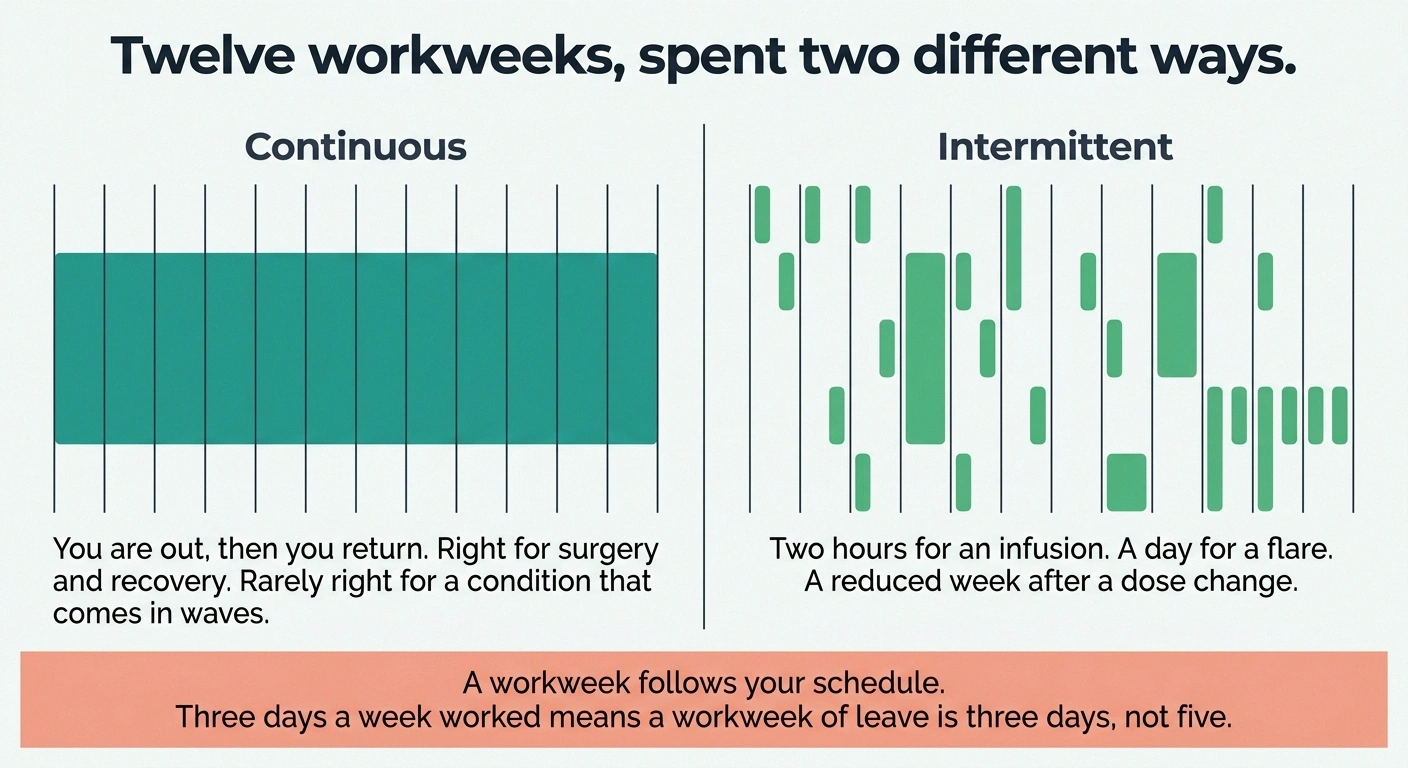
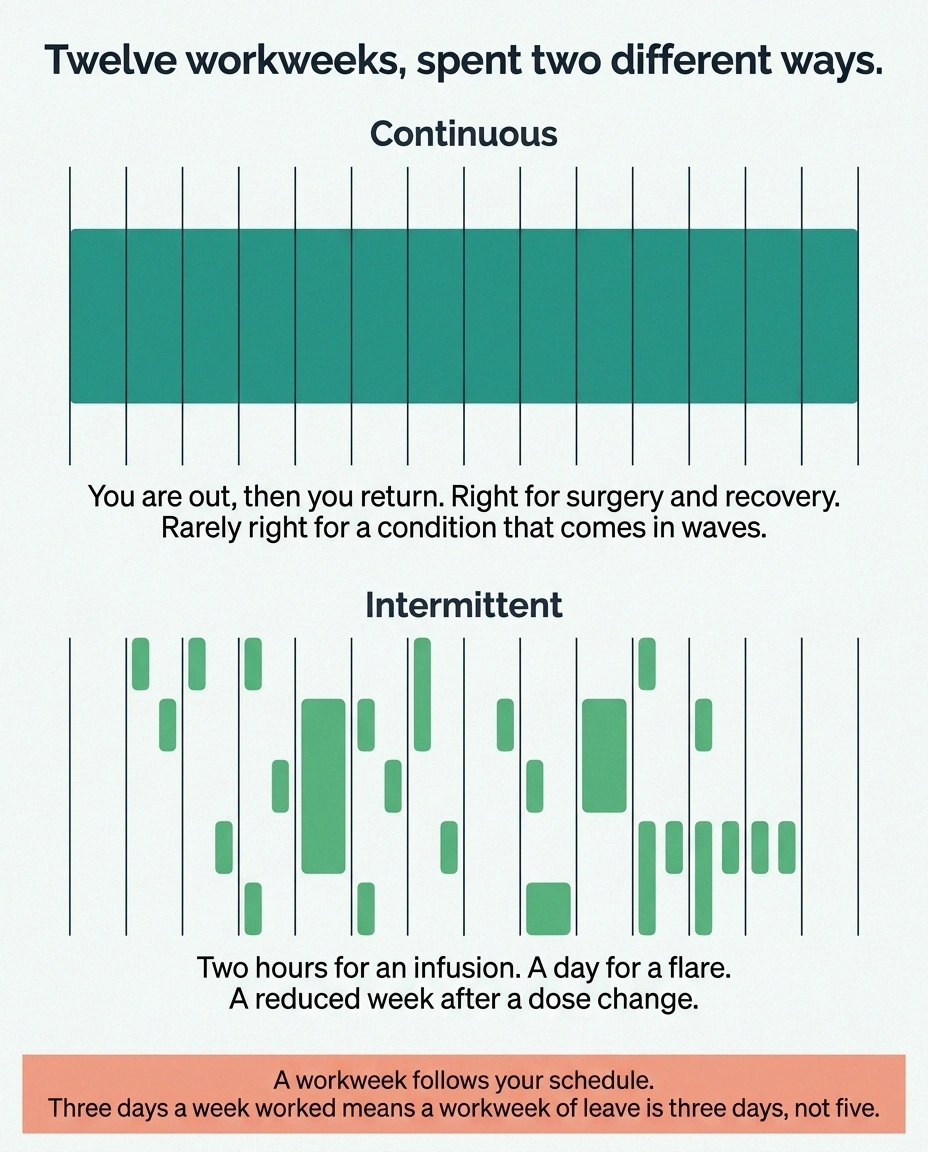
Continuous leave is the default picture: you go out, you are gone for weeks, you come back. For most people with neuropathy that is the wrong instrument.
Intermittent leave lets you take the twelve weeks in pieces. Hours for an appointment. A day for a flare. A reduced schedule for a stretch after a medication change. The employer may account for it in the smallest increment they use for other forms of leave, so an hour off for an infusion is generally an hour of FMLA, not a day.
This is where the certification stops being a formality. Intermittent leave must be medically necessary, and the provider has to say so in a way a leave administrator can process. Two ingredients:
Frequency. How many episodes over what period. “Approximately two to four episodes per month” is usable. “Variable” is not.
Duration. How long an episode lasts. “One to two days per episode” is usable. “Depends” is not.
These are estimates. Everyone in the process knows they are estimates. The point is not accuracy to the hour, it is that an estimate lets the employer plan coverage, and a blank does not. If you exceed the estimate the employer can seek recertification, which is a normal event and not an accusation.
Handing Over the Form Without Losing Two Weeks
Your employer will most likely give you form WH-380-E, the certification of health care provider for an employee’s own serious health condition. Some use their own version, which is allowed as long as it does not ask for more than the federal form does.
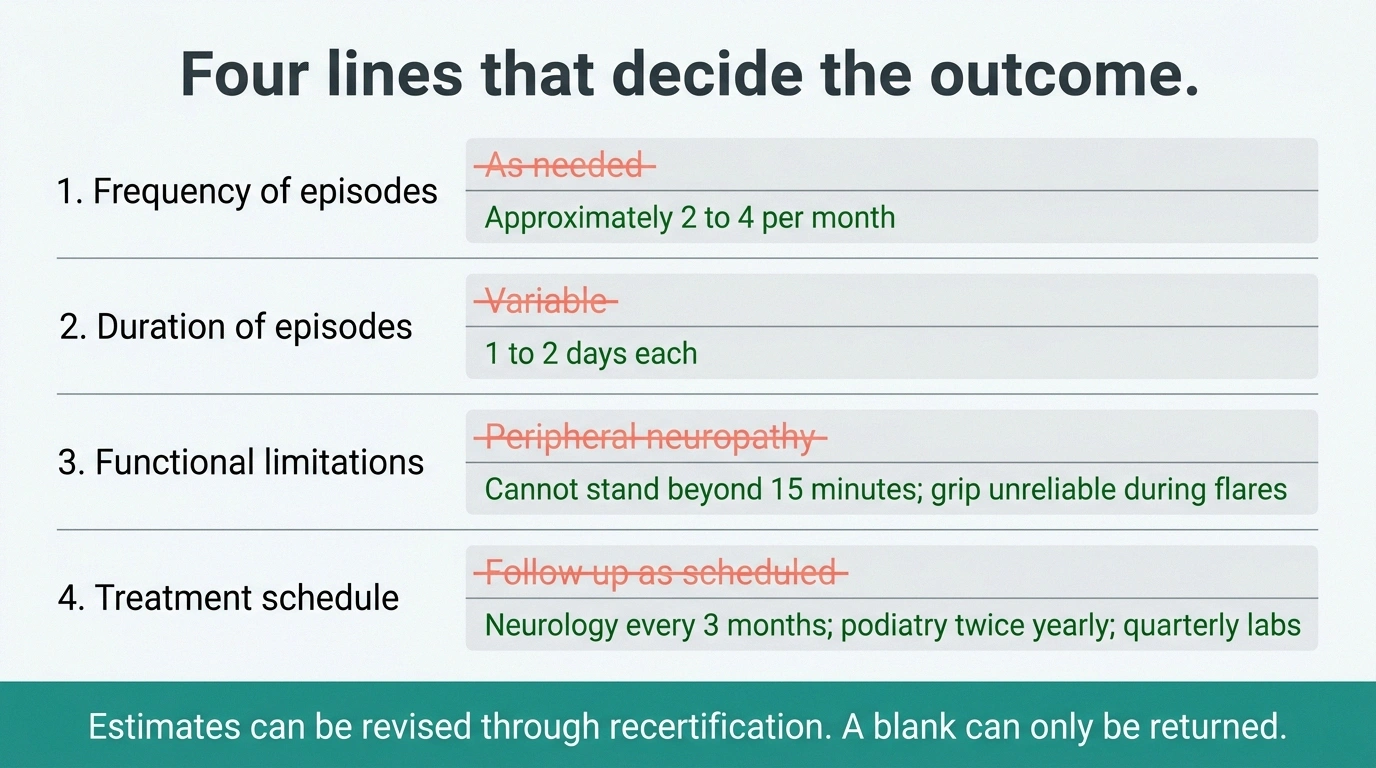
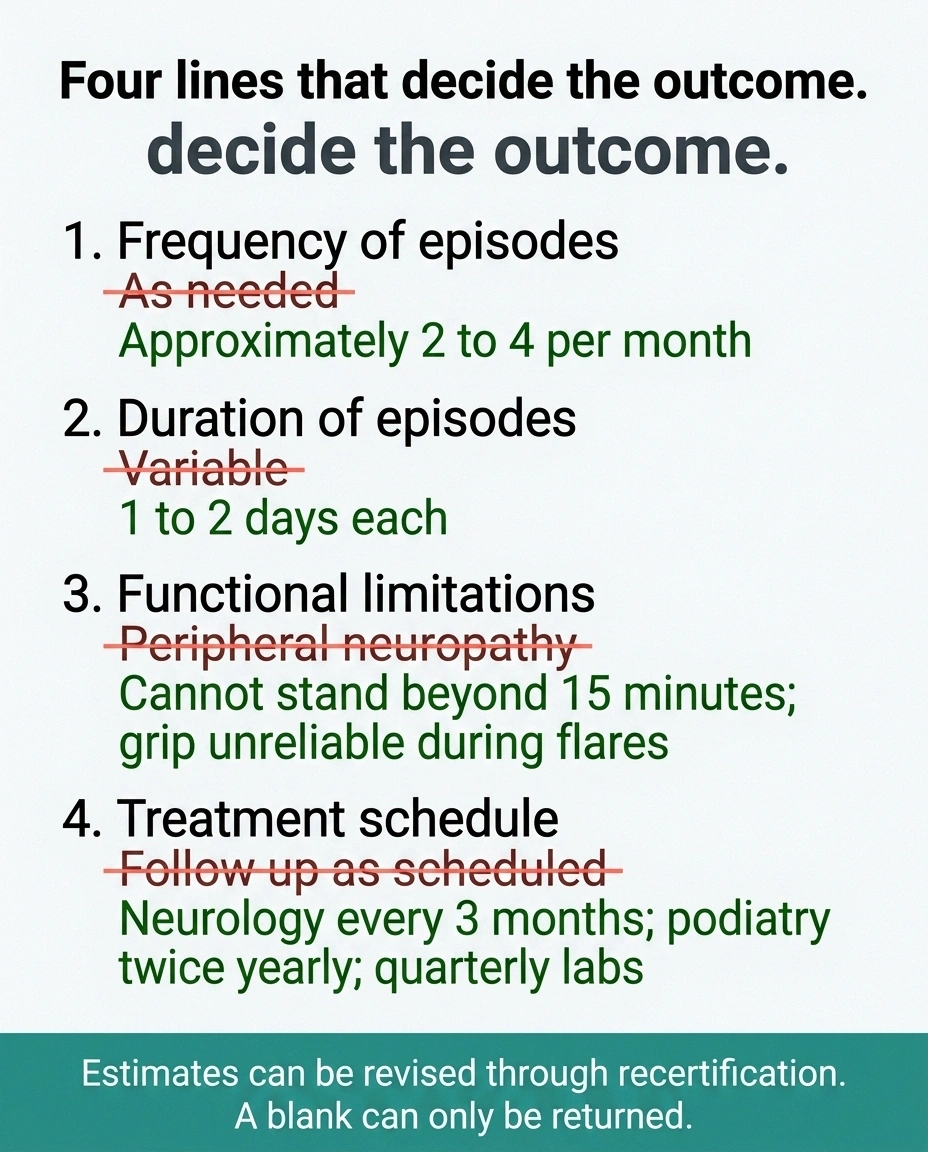
The same clinical reality, written two ways
Nothing on the right is a stronger claim than the left. It is the same facts, stated so a leave administrator can act on them without calling anybody.
Comes back as incomplete
Frequency: “As needed”
Duration: “Variable”
Limitation: “Peripheral neuropathy”
Treatment: “Follow up as scheduled”
Processes on the first pass
Frequency: “Approximately 2 to 4 episodes per month”
Duration: “1 to 2 days per episode”
Limitation: “Cannot stand beyond 15 minutes; grip unreliable during flares; must not drive within 4 hours of dose”
Treatment: “Neurology every 3 months, podiatry twice yearly, quarterly labs”
Estimates are expected and can be revised later through recertification. A blank cannot be revised, it can only be returned.
You have fifteen calendar days from the request to get it back. Not fifteen business days. That window includes however long it takes your neurologist’s office to schedule the paperwork, which in practice is the whole problem. Start the day you receive it.
Four places these forms go wrong, in rough order of how often:
The frequency and duration boxes are blank or vague. Covered above. This is the big one.
The provider describes the diagnosis instead of the functional limits. “Peripheral neuropathy” is a diagnosis. “Unable to stand more than fifteen minutes, unable to grip tools during flares, unable to drive within four hours of medication” is a functional limitation, and functional limitations are what the form is asking for.
The chronic condition boxes are not checked. If the form is completed as though this were an acute episode, the whole episodic structure disappears and the request reads as a one-off.
Treatment frequency is understated. The twice-a-year threshold matters. Count everything: neurology, primary care visits about this condition, podiatry, physical therapy, infusions, lab monitoring.
Practical move that costs nothing: type up a one page summary before the appointment. Your job’s actual physical demands in plain language, how many bad days you had in each of the last three months, what happens on a bad day, and the dates of every condition-related appointment in the past year. Hand it over with the form. You are not telling the provider what to write. You are supplying the facts they cannot know from a chart, and it takes a fifteen minute paperwork task down to five.
If you have been keeping any kind of symptom diary, this is the moment it pays for itself. A count of bad days with dates attached is a completely different document from a recollection.
What the Employer Can and Cannot Do Next

They can ask for the certification. They can come back once for clarification or authentication, though the person doing that must not be your direct supervisor.
They can require recertification, generally no more often than every six months for a chronic condition, or sooner if circumstances change substantially or they receive information casting doubt on the stated reason.
They can require a second opinion at their expense if they doubt the certification, and a third, binding one if the first two disagree. This is uncommon and is not, in itself, a sign of bad faith.
They cannot contact your provider to ask about anything beyond the four corners of the form. They cannot require a diagnosis be disclosed to your coworkers. They cannot count FMLA-protected absences in a no-fault attendance system. They cannot use the leave against you in a promotion decision. And they cannot ask you to work while on leave beyond brief, minor questions.
Retaliation for using FMLA is separately illegal. If a performance problem materializes for the first time shortly after you file, the timing is worth documenting in writing as it happens, not reconstructing later.
The Two Statutes Overlap and People Only Ever Use One
FMLA gives you time away. The ADA changes the job itself. The same neuropathy can trigger both, and they run in parallel rather than in sequence.
They solve different problems and you can use both
| FMLA | ADA | |
|---|---|---|
| Employer size | 50+ within 75 miles | 15+ |
| What it gives | Time away from the job, protected | Changes to the job so you can keep doing it |
| Typical use here | Flare days, infusions, recovery after a dose change | A stool, anti-fatigue matting, seated breaks, schedule shift |
| Time limit | 12 workweeks per leave year | None; accommodation lasts as long as it is reasonable |
| How it starts | A leave request plus a certification form | A request, which triggers an interactive process |
Order of operations that works for most people: ask for accommodations first so fewer bad days happen, then certify FMLA to cover the ones that still do.
A worked example. A quality inspector with small fiber neuropathy stands most of the shift and reports that after ninety minutes the burning makes accurate work impossible.
The FMLA answer is intermittent leave for the days when it is unmanageable, which protects roughly two days a month from the attendance policy.
The ADA answer is a stool at the inspection station, a rotation off the concrete floor, and a scheduled ten minute seated break every two hours. If those work, the two days a month may never be needed.
The second answer is better for almost everyone involved and it is the one people forget to ask for. Fifteen employees is the threshold, and the request opens an interactive process the employer is legally required to engage in. There are also cases where the honest answer is that the job cannot be modified enough, and at that point the conversation moves toward disability benefits and what qualifies, which is a slower road worth starting early rather than late.
Paperwork Worth Assembling Before You Need It
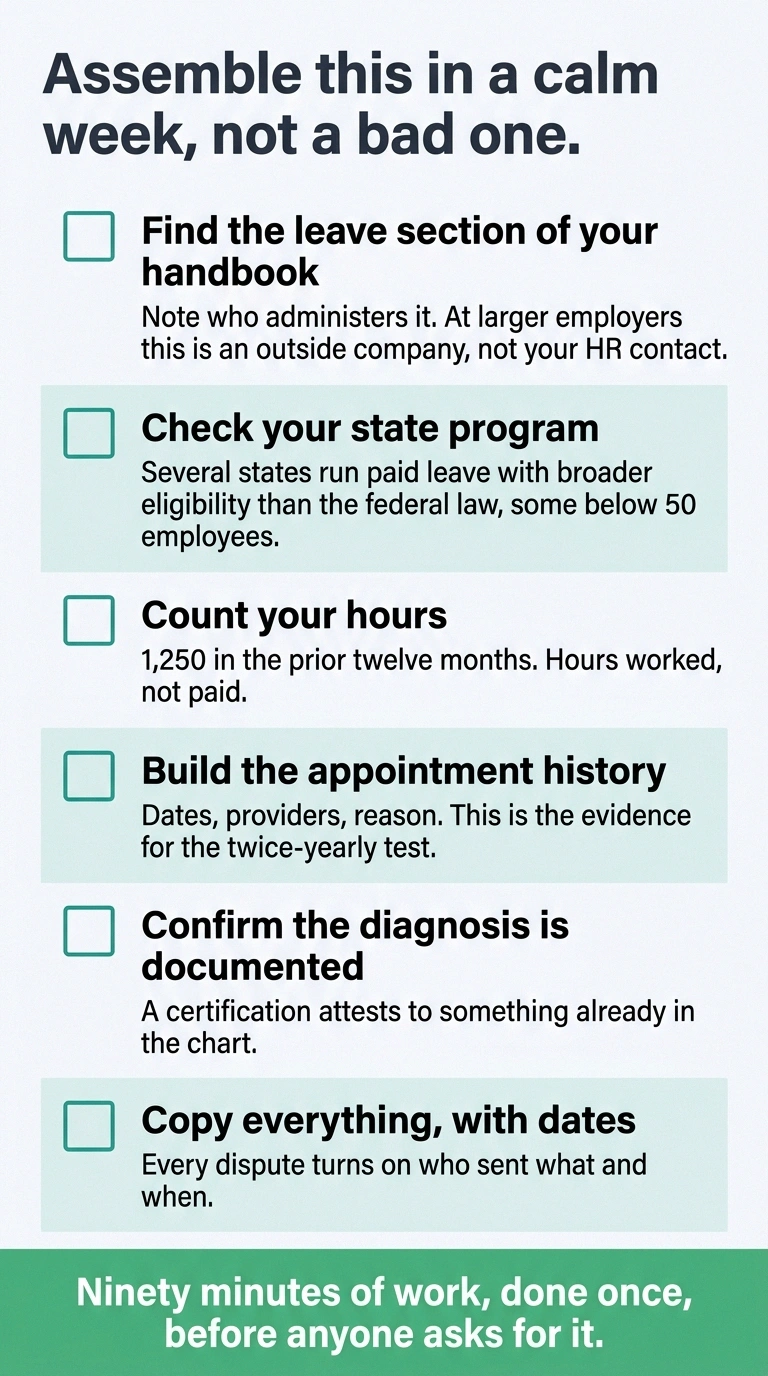
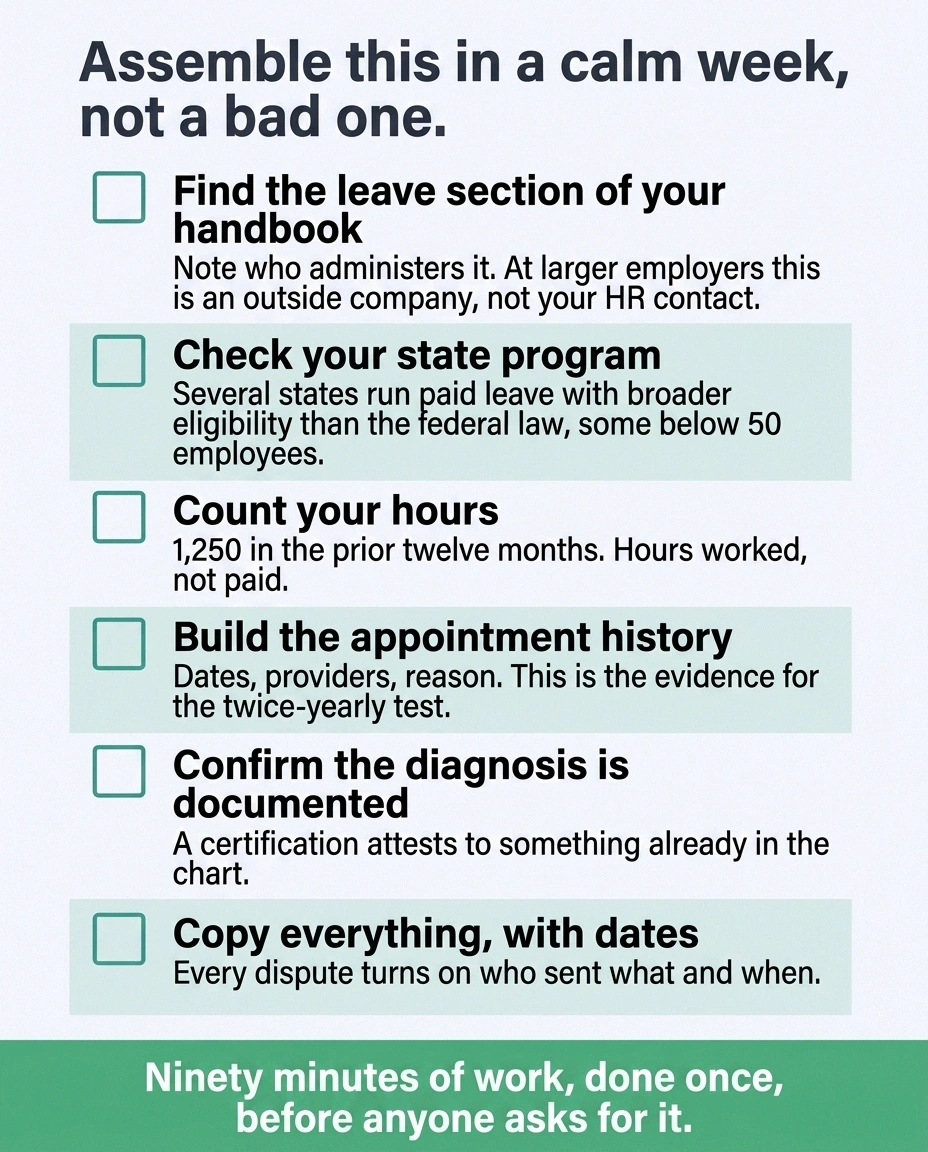
Nothing here requires a lawyer, and doing it in a calm week rather than a bad one changes the outcome.
Before any of this: the diagnosis has to exist on paper
A certification is a provider attesting to a documented condition. If your symptoms have never been formally worked up, or the chart still says “numbness, cause unclear,” the paperwork stalls at the first line and no amount of preparation fixes it. Get the workup finished first. It is also the step that changes treatment, so it is not time spent purely on administration.
Pull your employee handbook and find the leave section. Note who administers FMLA, because at larger employers it is an outside company and not your HR contact.
Check your state. Several states run paid family and medical leave programs with broader eligibility than the federal law, and some cover employers below the fifty employee line. A union contract may add more. These stack; they do not replace each other.
Count your hours if you are anywhere near the 1,250 threshold, especially if you have already reduced your schedule.
Get the appointment history together. Dates, providers, reason. This is the evidence for the chronic condition test and it is tedious to reconstruct under time pressure.
Make sure your diagnostic workup is actually documented. A certification is much easier to complete when nerve conduction results, a skin biopsy report or a clear clinical diagnosis is sitting in the chart. If your neuropathy has never been formally worked up, that is the first task, before any of this.
And keep copies of everything you submit, with dates. Every dispute in this area turns on who sent what and when.
The Part Nobody Puts in the Guides
Filing feels like an admission. That is the real barrier for most people, well ahead of the paperwork.
Worth being clear about what you are actually doing. You are converting scattered, unpredictable absences that look like an attendance problem into documented, protected time that cannot be held against you. The absences were happening either way. The only variable is whether they are protected.
People who wait usually wait until there is already a performance conversation on the calendar, and filing after that point is legally fine but strategically far worse, because it looks reactive even when it is not.
The other cost is the one people minimize. Managing a chronic condition alongside a job is exhausting in a way that has nothing to do with pain levels, and the administrative load is part of why the mental health side of neuropathy runs so heavy. Getting the leave sorted removes one recurring source of dread. That is worth something on its own.
Frequently Asked Questions
Does peripheral neuropathy qualify for FMLA?
It can, and it usually qualifies as a chronic serious health condition rather than as an acute one. The requirements are periodic treatment visits at least twice a year, a condition continuing over an extended period, and episodes of incapacity. Chronic neuropathy under ongoing care meets all three. Qualifying is separate from eligibility, which depends on your length of service, hours worked, and employer size.
Can I take FMLA a day at a time instead of all at once?
Yes, that is intermittent leave, and it is the form most people with nerve pain need. It can be used for flare days, appointments and treatment recovery, and employers generally track it in the smallest increment they use for other leave. It has to be certified as medically necessary, with an estimate of how often episodes happen and how long they last.
Is FMLA leave paid?
No. Federal FMLA provides unpaid, job-protected leave with continued group health coverage. Paid leave may run concurrently if you have accrued time, either by your election or your employer’s requirement. Income replacement otherwise comes from a state paid leave program, short term disability insurance, or savings.
What if my employer has fewer than 50 employees?
Then federal FMLA does not apply to you, but the ADA does at fifteen employees, and it can require reasonable accommodations including schedule changes and unpaid time off. Some states also run leave programs that cover smaller employers. Check state law before concluding you have no options.
How long do I have to return the certification form?
Fifteen calendar days from when your employer requests it, unless it is not practicable despite your diligent good faith effort. That window has to absorb your provider’s scheduling, so start immediately and ask the office how long paperwork usually takes.
Can my employer make me tell them my diagnosis?
The certification asks for medical facts sufficient to establish a serious health condition, which in practice usually includes the condition. What they cannot do is share it with coworkers, ask your provider questions beyond the form, or have your direct supervisor make the clarification contact.
Can I be fired while I am on FMLA leave?
Not for taking the leave. You can still be affected by things that would have happened anyway, such as a plant closing or a documented performance issue that predates the request. Discipline that appears for the first time shortly after you file is worth documenting in writing at the time.
What if my symptoms get worse than my certification says?
Tell your employer and expect a recertification request, which is routine. A certification is an estimate, not a promise. If your pattern has genuinely changed, an updated form with a revised frequency and duration protects you better than exceeding the old numbers and hoping nobody counts.
Should I apply for FMLA or ask for accommodations first?
Consider both at once, since they solve different problems. Accommodations change the job so fewer bad days occur. Leave protects the bad days that happen anyway. Employers with fifty or more employees are subject to both laws, and using one does not use up the other.
About the Author