
For years, “hepatitis C” was almost always discussed in terms of liver damage. That's where the virus does most of its visible work — chronic inflammation, fibrosis, cirrhosis, and in some cases liver cancer. But there's another conversation that doesn't get nearly enough airtime, and it matters for a lot of people: hepatitis C can also damage your nerves.
If you've ever been diagnosed with hepatitis C — whether you cleared it with treatment, are still living with it, or only learned about it years after the fact — and you're now noticing burning feet, numb fingers, or strange shooting pains, the connection is real. It is not in your head. It is, in fact, well documented.
I'm Janet Ellis. I'm a community advocate who lives with peripheral neuropathy myself, and I've spent years walking alongside people whose neuropathy turned out to be tied to something they hadn't expected — including hepatitis C. This is what I've learned, in plain English, about the connection.
The Short Answer
Yes, hepatitis C can cause peripheral neuropathy. The connection is most clearly established when the virus has triggered a related condition called mixed cryoglobulinemia — and we'll talk about exactly what that means below — but neuropathy can also occur in people with hepatitis C who don't have cryoglobulinemia.
Hepatitis C can damage your nerves — and treating the virus often helps them recover. The strongest link is through mixed cryoglobulinemia, but neuropathy can occur in HCV patients without cryoglobulins too. Modern direct-acting antivirals cure 95%+ of cases in 8-12 weeks, and nerve fiber density measurably improves within a year of viral clearance.
The good news is that the modern hepatitis C treatments — the direct-acting antivirals that started showing up around 2013 and have transformed how this disease is managed — don't just treat your liver. In many people, successfully clearing the virus from your system also leads to measurable nerve improvement over the following year. Not a guarantee. Not always complete. But real.
How Hepatitis C Damages Your Nerves
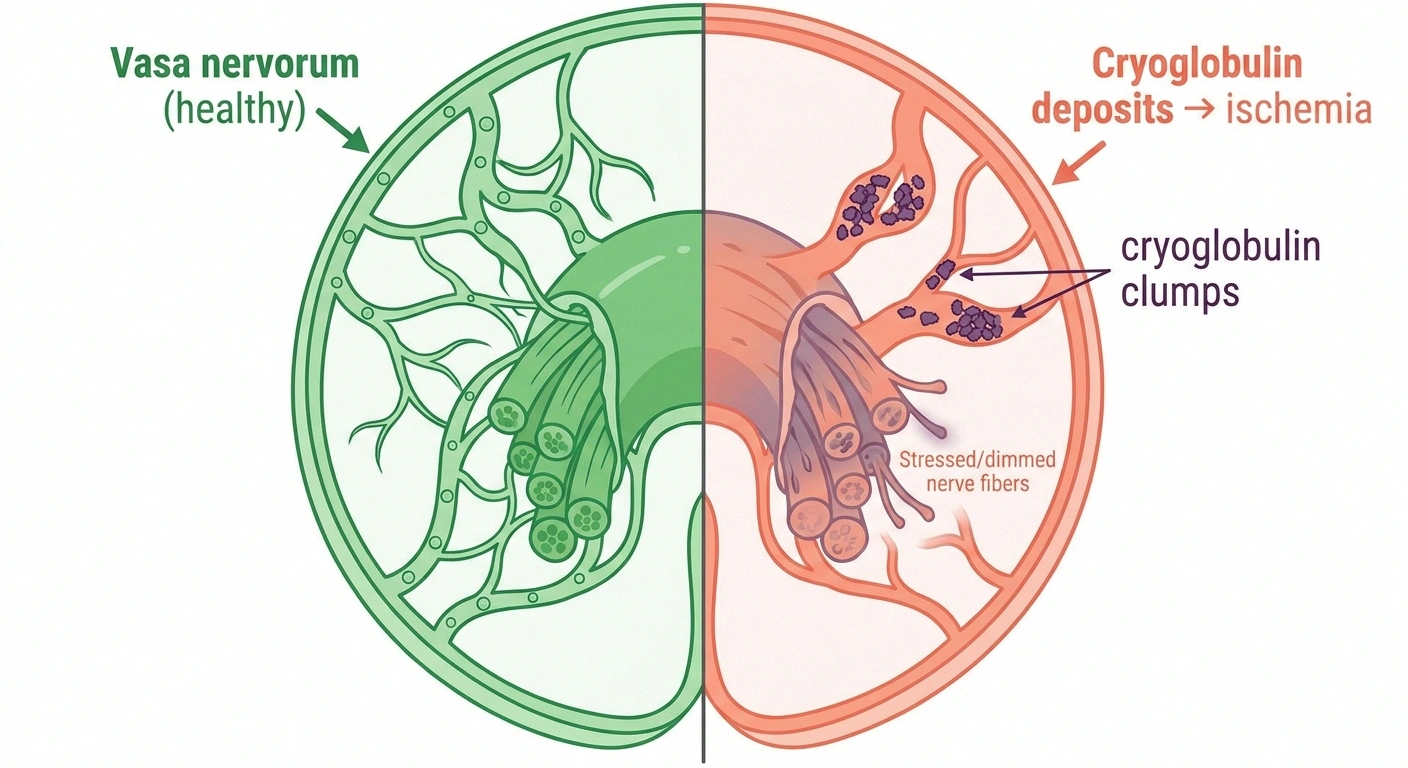
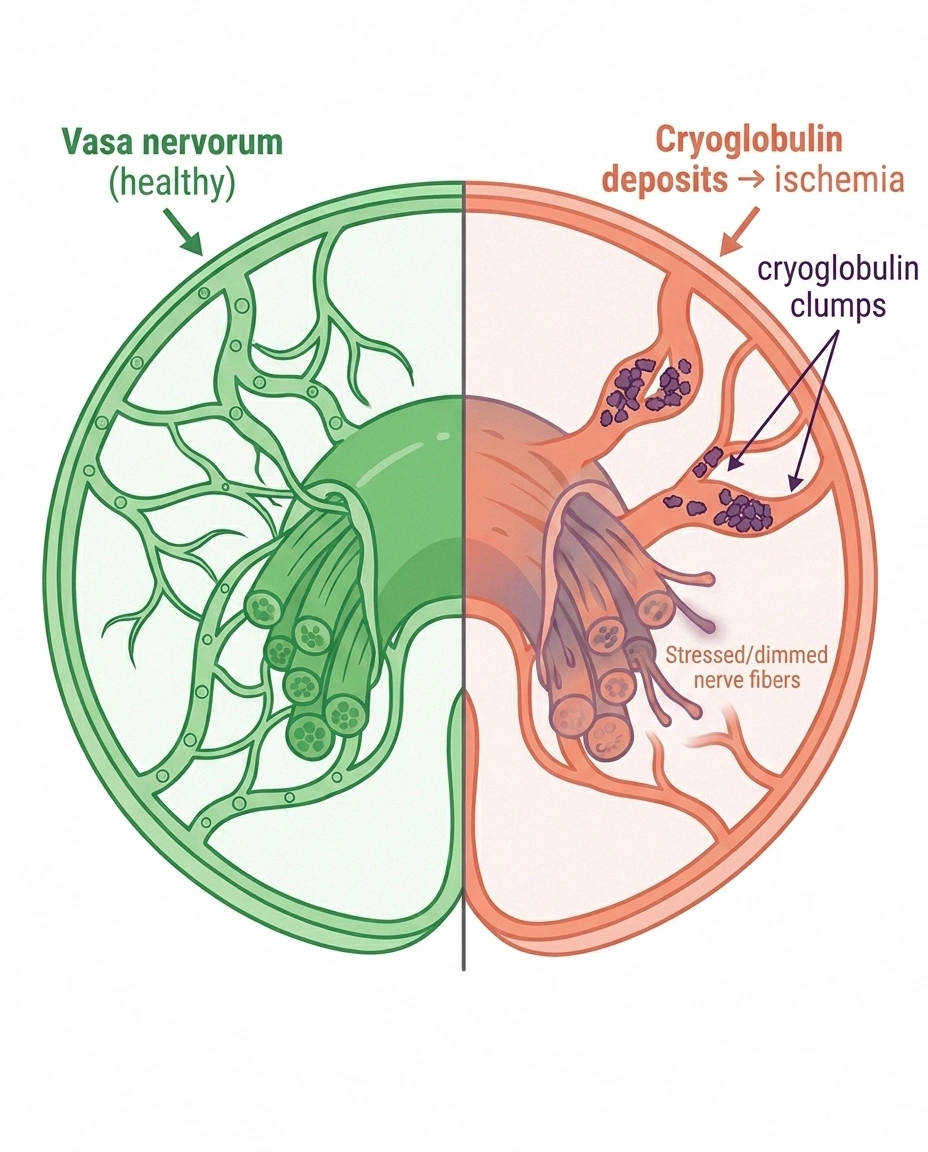
The hepatitis C virus is not directly attacking your nerve cells the way some viruses (like shingles or HIV) can. Instead, the damage usually happens by way of the immune system's response to chronic infection. Two specific mechanisms are best understood.
Two Mechanisms of HCV Nerve Damage
In HCV patients with mixed cryoglobulinemia, peripheral neuropathy occurs in 26%–86% of cases.
Cryoglobulinemia. In some people with chronic hepatitis C, the body produces unusual proteins called cryoglobulins. These are antibodies that have a strange property: they precipitate (clump together) when cold and dissolve when warm. In the bloodstream, these clumps can get stuck in small blood vessels — including the tiny vessels that supply oxygen and nutrients to your nerves. That's called the vasa nervorum, the “vessels of the nerves.” When cryoglobulin clumps obstruct those vessels, the nerve doesn't get enough blood. Without blood, nerve fibers start to die.
The prevalence is striking. In hepatitis C patients with mixed cryoglobulinemia, peripheral neuropathy occurs in anywhere from 26% to 86% depending on the study. That's a wide range, but the message is clear: if you have HCV with cryoglobulinemia, neuropathy is common.
Vasculitis. The second mechanism is necrotizing vasculitis — actual inflammation of the blood vessel walls, sometimes severe enough to damage them. The chronic precipitation of immune complexes (antibody-antigen clumps) in those small vessels triggers an inflammatory attack on the vessel itself. As the vessels become inflamed, they narrow or rupture, and once again the nerves they were supposed to feed start to fail.
There's also some evidence that hepatitis C may have direct effects on small nerve fibers in some people, even without significant cryoglobulinemia. Studies measuring intraepidermal nerve fiber density (the small unmyelinated fibers in your skin) have found those fibers are reduced in HCV patients and improve after the virus is cleared. We don't yet fully understand whether this is a direct viral effect, a low-grade inflammatory effect, or something else — but the pattern is consistent enough that researchers take it seriously.
What This Neuropathy Feels Like

The two presentations differ depending on the underlying mechanism, but they overlap a lot.
Two Patterns of HCV-Related Neuropathy
Distal sensory polyneuropathy. The most common pattern. Slow-onset numbness, tingling, burning, or aching, starting in the toes and gradually working up the legs. Often symmetric — both feet, then both calves. Many people describe the feeling as “walking on sand” or “wearing thick socks all the time.” This is the same general pattern you'd see with diabetic or idiopathic neuropathy, and frankly, in someone with HCV who also has diabetes or another risk factor, it can be hard to know which condition is the bigger driver.
Mononeuritis multiplex. A more dramatic and less common pattern. Sudden, asymmetric weakness or numbness — say, one hand goes weak, or one foot drops, then a few weeks later it's a different limb. This pattern is more strongly associated with cryoglobulinemic vasculitis. Because it's rapid and patchy, it tends to bring people to their doctor faster than the slow distal pattern does.
In addition to these motor and sensory symptoms, hepatitis C can affect the autonomic nervous system in some patients — the nerves that control things like blood pressure regulation, sweating, and digestion. These symptoms tend to be quieter and harder to attribute, and they're often missed in routine evaluation.
If your symptoms include sharp burning pain, cold-triggered worsening (cryoglobulins love cold), purple skin patches on the legs (a rash called purpura), joint pain, fatigue, and proteinuria (foam in your urine), that combination strongly suggests the cryoglobulinemic version. If it's just slow-onset distal numbness, it could be either pattern.
Getting the Diagnosis
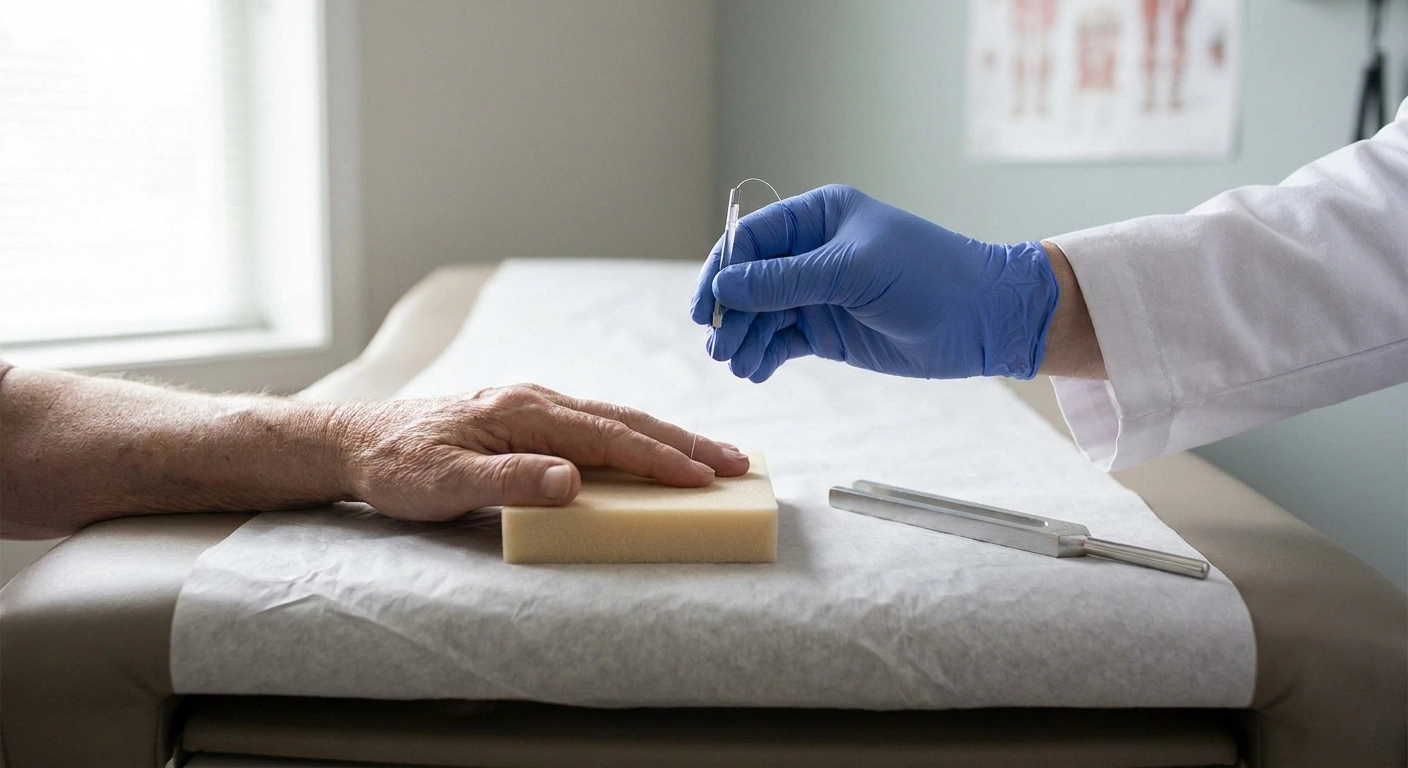
If you have known hepatitis C and new neuropathy symptoms, the workup should look like this in a thorough evaluation. A neurologist familiar with peripheral nerve disease is the right person to lead it, often coordinated with your hepatologist (liver doctor).
HCV Neuropathy Diagnostic Checklist
- Nerve conduction study + EMG — measures conduction speed and motor response
- Cryoglobulin testing — sample MUST be kept warm in transport (false negatives common)
- Complement levels (C3, C4) — often low in cryoglobulinemic vasculitis
- HCV viral load + genotype — guides antiviral selection
- Skin biopsy + IENFD — picks up small-fiber damage missed by NCS
- Routine labs — diabetes, B12, thyroid, kidney function
A neurologist working alongside your hepatologist gives the most thorough workup.
Nerve conduction study and EMG. The standard objective test for peripheral neuropathy. It measures how well your nerves carry electrical signals and how your muscles respond. In HCV-related neuropathy, you'll often see slowed conduction in sensory and sometimes motor nerves. If you've never had one, here's what to expect from an EMG and nerve conduction study.
Cryoglobulin testing. A specific blood test, but it's tricky — the sample has to be kept warm during transport because cryoglobulins, by definition, precipitate when cold. If your lab handles it incorrectly, you'll get a false negative. If your doctor is checking for cryoglobulins, ask specifically how the sample is being handled.
Complement levels (C3, C4). Often low in cryoglobulinemic vasculitis.
Hepatitis C viral load and genotype. Even if you've been treated, current viral status matters for treatment planning.
Skin biopsy with intraepidermal nerve fiber density. A small punch biopsy that measures the density of tiny sensory fibers in your skin. Useful for diagnosing small fiber neuropathy, which can be an early sign of nerve damage even when standard nerve conduction studies look normal.
Routine bloodwork. Your doctor will also want to rule out (or factor in) the usual suspects — diabetes, B12 deficiency, thyroid function, kidney function. A workup that says “this is HCV neuropathy” is really a workup that has thoughtfully addressed all of them. For a list of what to ask about, see the neuropathy lab tests guide.
Treatment: Treating the Virus First

Here is the critical thing to understand about hepatitis C-related neuropathy: treating the underlying virus is the first and most important step.
Treatment Priorities, In Order
The current generation of direct-acting antivirals — sofosbuvir/velpatasvir (Epclusa), glecaprevir/pibrentasvir (Mavyret), and others — clear the virus from over 95% of patients in 8 to 12 weeks of oral treatment. These medications have transformed hepatitis C from a chronic, often-progressive disease into something most people can be cured of in a season.
And here's what matters for your nerves: research consistently shows that successful viral eradication is associated with neuropathy improvement. One single-center study published in 2024 found that intraepidermal nerve fiber density — a sensitive measure of small-fiber damage — improved one year after sustained viral response. Other studies in cryoglobulinemic patients have shown similar trajectories: cryoglobulin levels drop, vasculitis quiets, and nerves slowly recover.
This recovery is partial in many people, not complete. Nerves regenerate slowly — typically less than a millimeter a day at best, and damaged proximal fibers may never fully reconnect. But “slower progression” and “some improvement” are both genuinely meaningful outcomes for someone living with neuropathy. The earlier you treat the virus, the more nerve you save.
One historical note worth knowing: the older interferon-alpha treatments (used before direct-acting antivirals became widespread) could actually worsen peripheral neuropathy in some patients. If you were treated with interferon and your neuropathy got worse during or after treatment, that's a known phenomenon. The modern DAAs do not have this problem.
Treating the Neuropathy Symptoms
Even when the underlying virus is cleared, you may still have nerve pain to manage — either as a residual from the damage already done, or while you wait for slow nerve recovery to do its work. The standard neuropathic pain medications are all options.
Gabapentin and pregabalin. Both are well-studied for nerve pain. Gabapentin (Neurontin) is the most common first-line choice; pregabalin (Lyrica) is similar but better-absorbed at higher doses. Both require careful dosing in patients with kidney involvement (which can occur in cryoglobulinemia).
Duloxetine. Duloxetine (Cymbalta) is an SNRI that's well-supported for neuropathic pain. Worth discussing with your hepatologist if you have liver involvement, since duloxetine has a liver warning, but it's commonly used safely after careful evaluation.
Tricyclic antidepressants. Amitriptyline or nortriptyline at low doses can help significantly with nerve pain, particularly the burning kind.
Oxcarbazepine. One specific note from the cryoglobulinemic neuropathy literature: oxcarbazepine has been studied as a pain control option in this population and was found to provide rapid, persistent relief with limited side effects and limited interaction with concomitant drugs. If you're on a complicated medication regimen, ask whether this is worth considering.
Topical options. Lidocaine patches and capsaicin cream can help localized burning pain, especially when systemic medications are limited by other conditions.
If you have significant cryoglobulinemic vasculitis, your team may also discuss immune-modulating therapies — rituximab is increasingly used in cryoglobulinemic vasculitis, sometimes alongside antiviral treatment. This is hepatology and rheumatology territory, not something to manage on your own.
Lifestyle Adjustments That Help

While medical treatment does the heavy lifting, several practical adjustments can ease symptoms in HCV-related neuropathy.
Cryoglobulins precipitate (clump) in the cold. Many patients with cryoglobulinemic neuropathy notice their burning, tingling, and pain get markedly worse in winter, in air-conditioned rooms, or when their hands and feet are cold. Layered clothing, heated socks, indoor gloves on bad days, and warm-water hand-washing are not luxuries — they reduce the trigger.
Stay warm — really warm. Cryoglobulins precipitate in the cold. Many cryoglobulinemic patients notice their symptoms get markedly worse in winter or when their hands and feet get cold. Layered clothing, heated socks, gloves indoors if you need them, and a thoughtful approach to neuropathy in cold weather can make a real difference.
Avoid alcohol. Alcohol is independently neurotoxic. In someone whose nerves are already under stress from a viral cause, adding the burden of alcoholic neuropathy compounds the damage. The American Association for the Study of Liver Diseases recommends people with HCV — even after successful treatment — avoid alcohol or drink only minimally.
Address the fatigue and the joint pain. Cryoglobulinemia is often a “syndrome” — neuropathy comes alongside fatigue, joint pain, and sometimes kidney involvement. A team approach (rheumatology, hepatology, neurology) tends to handle the whole picture better than treating each symptom in isolation.
Follow your liver labs. Even after a successful “cure” of HCV (sustained viral response), your liver health and any residual fibrosis still need monitoring. Cirrhosis can independently contribute to neuropathy, and your liver matters for processing many neuropathy medications.
Foot care matters more than usual. If you have sensory loss in your feet, you're at risk for unrecognized injuries — same as a diabetic patient. Daily foot inspection, well-fitted shoes, and prompt treatment of any cuts are non-negotiable. The neuropathy foot care protocol applies fully.
What About People Who Were Treated Long Ago?
A common scenario: someone was diagnosed with hepatitis C years or decades ago, took the older interferon-based treatments, was either cured or cleared the virus, and is now noticing neuropathy. Is the current neuropathy from the old infection?
The honest answer is: maybe. Several possibilities exist. The original infection may have caused nerve damage that didn't fully recover. Cryoglobulinemia can persist or recur even after viral clearance in some patients. Other unrelated causes of neuropathy may have developed in the meantime — diabetes, B12 deficiency, medications, age-related changes.
The right approach is the same: a thorough neuropathy workup that doesn't assume any single cause. Even if HCV was the original culprit, the current neuropathy may have additional contributors, and treating those matters too.
The Reversibility Question
People reasonably want to know: can neuropathy be reversed when hepatitis C is the cause?
How Reversible Is HCV Neuropathy?
The earlier you treat the virus, the more nerve you save.
The honest answer, based on current evidence:
- Mild and recent neuropathy often improves significantly after viral clearance, sometimes substantially.
- Long-standing or severe neuropathy may stabilize or improve modestly, but full reversal is uncommon.
- Cryoglobulinemic vasculitic neuropathy often improves with combined antiviral and immune-modulating treatment, sometimes dramatically.
- Small fiber damage appears especially responsive — intraepidermal nerve fiber density measurably improves in many treated patients within a year.
What this means in practice: the earlier you treat the underlying disease, the more nerve you save. Even if you're years into your symptoms, treatment is still worth pursuing — both for your nerves and for your liver, kidneys, and quality of life.
What I Want You to Take Away

If you have hepatitis C and you're experiencing neuropathy symptoms, please don't let anyone tell you they aren't connected. The mechanism is well-understood, the prevalence is significant, and the treatment pathway is increasingly clear.
The conversation to have with your medical team has three parts. First: am I actively infected, and if so, am I a candidate for direct-acting antiviral treatment? Second: do I have cryoglobulinemia, and if so, do I need additional immune-modulating treatment? Third: while we treat the underlying disease, what can we do for my nerve symptoms today? Each of those questions has answers in 2026 that didn't exist twenty years ago.
And one more thing: hepatitis C is no longer a life sentence. The current treatments cure most people in two to three months. If you're putting off the conversation because you're afraid of what's coming, please don't. The nerve damage is more reversible the earlier you act.
Frequently Asked Questions
Can hepatitis C cause neuropathy without cryoglobulinemia?
Yes. While the strongest connection is through mixed cryoglobulinemia, some hepatitis C patients develop neuropathy without measurable cryoglobulins. The mechanism is less well-defined and may involve direct viral effects, low-grade inflammation, or other factors. Studies measuring small fiber nerve density have shown reduced density in HCV patients regardless of cryoglobulinemia status.
Will my neuropathy go away if I clear the hepatitis C virus?
Often it improves, but rarely does it fully disappear, particularly if the neuropathy has been present for a long time. Studies tracking patients after sustained viral response show measurable improvement in nerve fiber density within a year for many people. Mild cases respond best. Long-standing or severe cases tend to stabilize or improve modestly rather than fully reverse.
What is mixed cryoglobulinemia?
It's a condition where your immune system produces unusual antibodies that clump together in the cold. These clumps can deposit in small blood vessels and trigger inflammation, damaging the tissues those vessels supply, including nerves, skin, kidneys, and joints. About 70% to 90% of mixed cryoglobulinemia cases worldwide are linked to chronic hepatitis C infection. The diagnosis is confirmed with a special blood test that has to be kept warm during transport.
Is hepatitis C neuropathy the same as diabetic neuropathy?
The symptoms can look very similar — burning, numbness, tingling, usually starting in the feet. The underlying mechanisms are different, though. Diabetic neuropathy is driven by long-term high blood sugar and metabolic stress. Hepatitis C neuropathy is most often driven by immune-mediated damage to the small blood vessels feeding the nerves. Many patients have both conditions, which complicates treatment but doesn't change the importance of addressing each driver.
Are there medications I should avoid if I have hepatitis C and neuropathy?
The biggest watch-out is liver function. Some neuropathy medications, including duloxetine, carry liver warnings, and dosing or selection should be discussed with your hepatologist. If you have kidney involvement from cryoglobulinemia, gabapentin and pregabalin doses also need adjustment, since both are renally cleared. Always make sure your hepatologist, neurologist, and pharmacist all know your full medication list.
Should I be worried about my joints and kidneys too?
If you have hepatitis C-related cryoglobulinemia, yes — these are common targets of the same inflammatory process. Joint pain, skin rashes (purpura), kidney involvement (sometimes presenting as foam in the urine or elevated blood pressure), and fatigue are part of the syndrome. A care team that includes rheumatology and nephrology in addition to hepatology and neurology is appropriate for moderate to severe cases.
I had hepatitis C in the 1990s and was treated with interferon. Could my current neuropathy be from that?
It's possible. Interferon-alpha was associated with both onset and worsening of neuropathy in some patients. If your nerves were damaged then and never fully recovered, you may have residual symptoms. It's also possible that other contributors (age, diabetes, medications, B12 deficiency) have since added to the picture. A current evaluation can sort out what's contributing now and what can still be improved.
Is there a cure for the nerve damage itself?
There's no medication that directly reverses established nerve damage. The treatment approach is twofold: treat the underlying cause to prevent further damage, and manage symptoms while the body slowly repairs what it can. Nerves do regenerate, but slowly — often less than a millimeter per day at best. Patience and consistency matter. The medications that help with symptoms in the meantime are well-established and reasonably effective for most patients.
About the Author