Last summer at a baby shower, my friend Linda rolled up her pant leg and showed me a small red spot on the side of her ankle. “I think it was the pedicure last week,” she said. The spot had been growing slowly, didn't hurt — and didn't hurt was the problem. Linda's diabetic neuropathy means she can't reliably feel injuries on her feet. By the time she noticed it, she'd been walking around on a small infection for six days.
I'm Janet, a patient advocate (not a medical professional), and the salon pedicure is one of those small, ordinary pleasures that turns into an outsized risk when neuropathy enters the picture. The good news: you don't have to give up pedicures. You just have to do them differently. This is the practical guide.
Why a Pedicure Is Higher Risk With Neuropathy
Three things stack up. First, the feet of someone with neuropathy may not feel small cuts, scrapes, burns, or pressure injuries the way healthy feet do. The body's normal early-warning system — pain — is muted or missing. Second, the same circulation issues that often accompany neuropathy mean any small wound can heal more slowly than it would for someone without nerve damage. Third, the salon itself introduces three specific risks: water that can be too hot for sensitive skin (and burn before you feel it), tools that may not be properly sterilized between clients, and technicians who may be aggressive with cuticles, callus removal, or nail-edge digging — well-intended cosmetic work that becomes a wound when your foot can't speak up.
Key Takeaway
Pedicures with neuropathy are completely doable — they just stop being a casual drop-in. The four habits that change everything: bring your own tools, ask for lukewarm (not hot) water, decline cuticle cutting and callus shaving, and inspect your feet the night of and again 48 hours later. With those four, salon foot-care stays a small monthly pleasure instead of an infection risk.
For an overview of the broader daily routine that builds awareness of your feet, our piece on neuropathy foot care covers the daily checks that make any salon visit much safer.
The Foot Bath — Where the Hidden Risk Lives
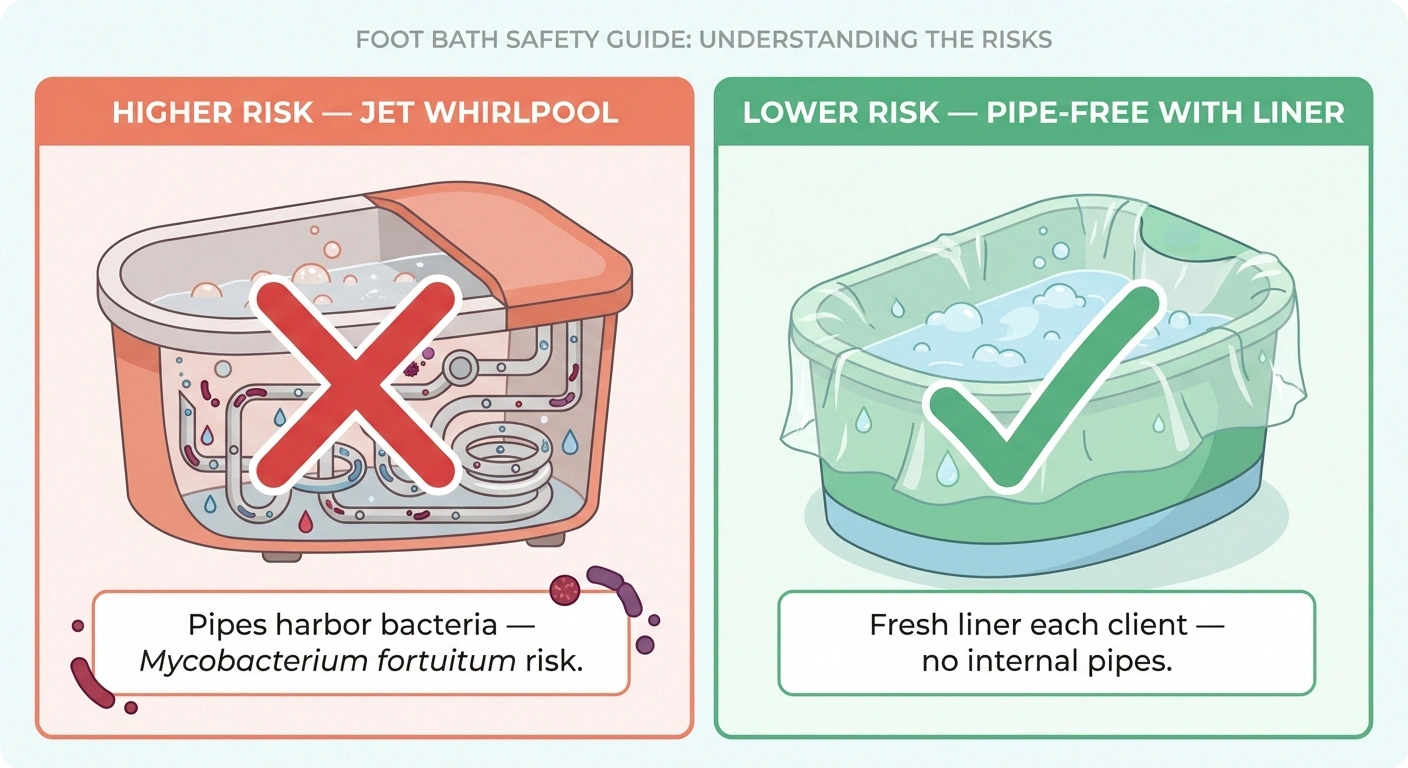
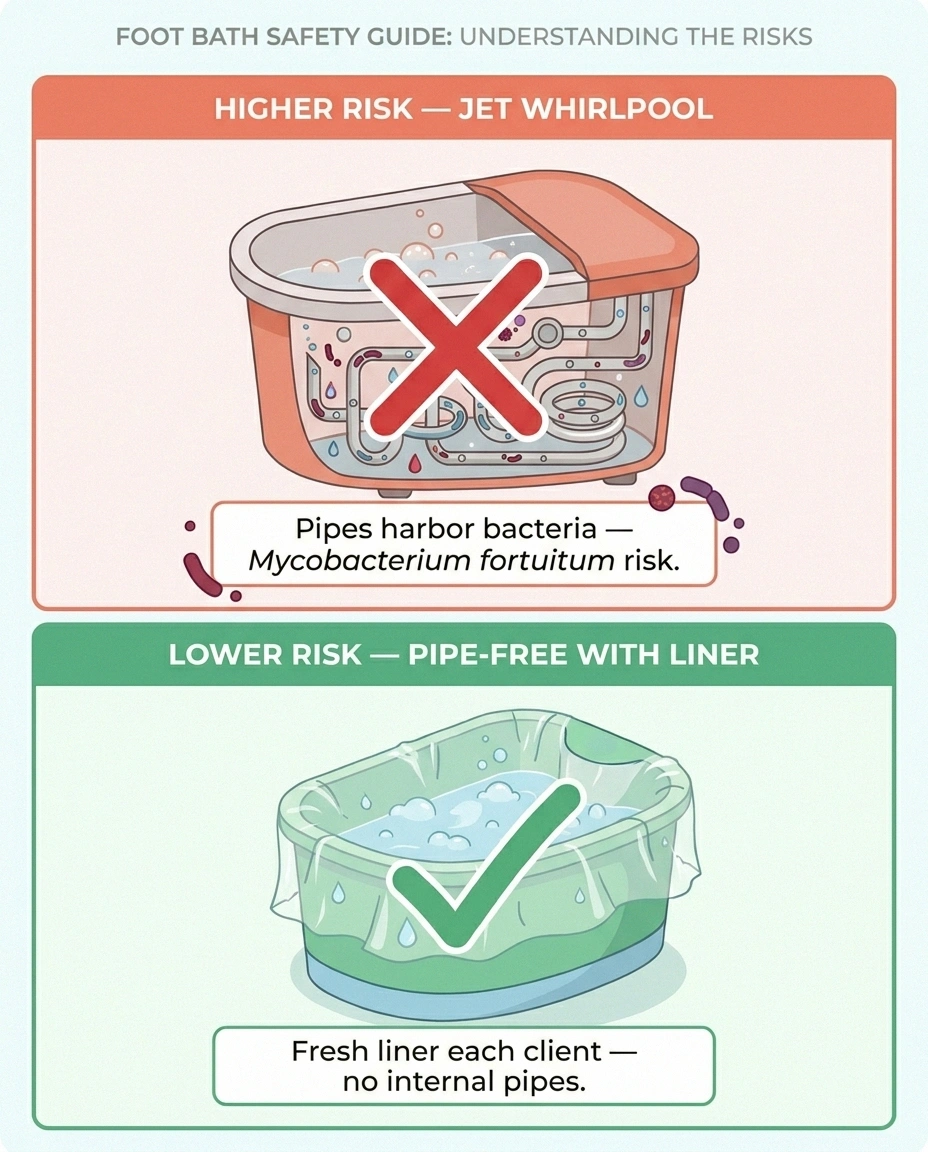
The whirlpool foot bath looks luxurious. It's also where the biggest hidden risk sits. The pipes and jets in a typical pedicure tub are hard to sterilize, and warm water creates an ideal environment for bacteria — most notably a slow-growing organism called Mycobacterium fortuitum that has caused outbreaks of foot infections traced to salon foot baths. Pseudomonas aeruginosa, which produces stubborn nail-bed infections, also lives well in warm standing water.
Two practical rules cut most of this risk:
- Avoid foot baths if you have any open cut, scrape, blister, or freshly shaved leg. Shaving the day before a pedicure is one of the documented risk factors for salon-related skin infection — the small razor nicks become entry points.
- Choose a salon that uses pipe-free foot baths with disposable liners or stainless-steel basins. Pipe-free designs eliminate the jet hardware where bacteria hide. Disposable liners (a fresh plastic sleeve for each client) are the most reliable cleanliness signal you'll see in a salon.
A safer alternative for sensitive feet: ask for a dry pedicure, where the technician uses lotion and steam towels instead of a soak. Many salons will accommodate this without fuss, especially if you mention you have a medical condition.
Tools That Should Make You Nervous
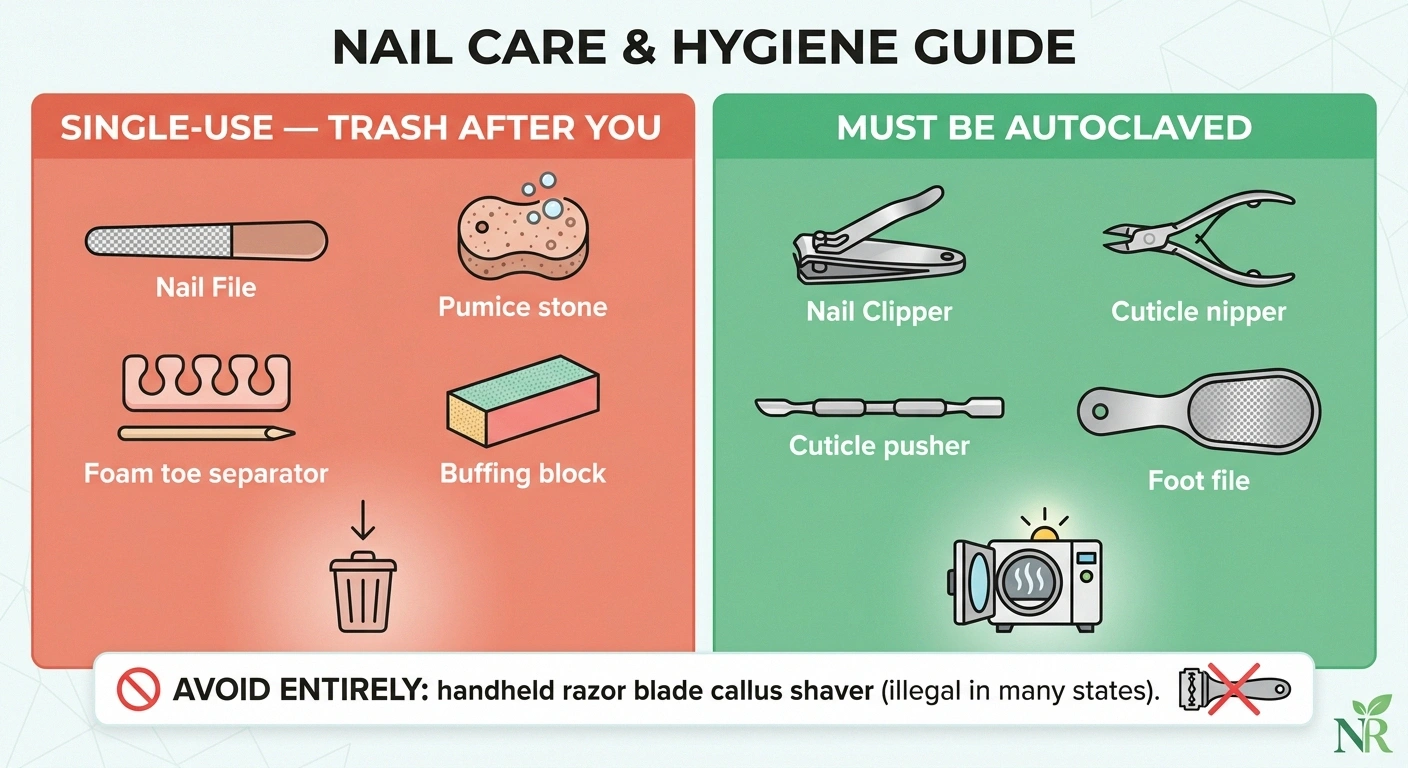
Some salon tools belong in a sterilizer. Others belong in the trash after one use. Knowing which is which is the second piece of the pedicure-safety puzzle.
The Five-Minute Salon Walk-Through
Single-use only: Nail files, emery boards, foam toe separators, pumice stones, cuticle pushers made of wood, and buffing blocks. These cannot be properly sterilized. They should go in the trash after your visit, not back into a drawer. Many salons get this wrong.
Must be autoclaved (steam-sterilized) between clients: Metal nail clippers, metal cuticle nippers, metal cuticle pushers, metal foot files. Look for an autoclave in the salon — it's a small countertop machine, often visible behind the reception desk or in a back area. If you don't see one, ask. “Do you autoclave your metal tools between clients?” is a fair question, and a good salon will be happy to show you.
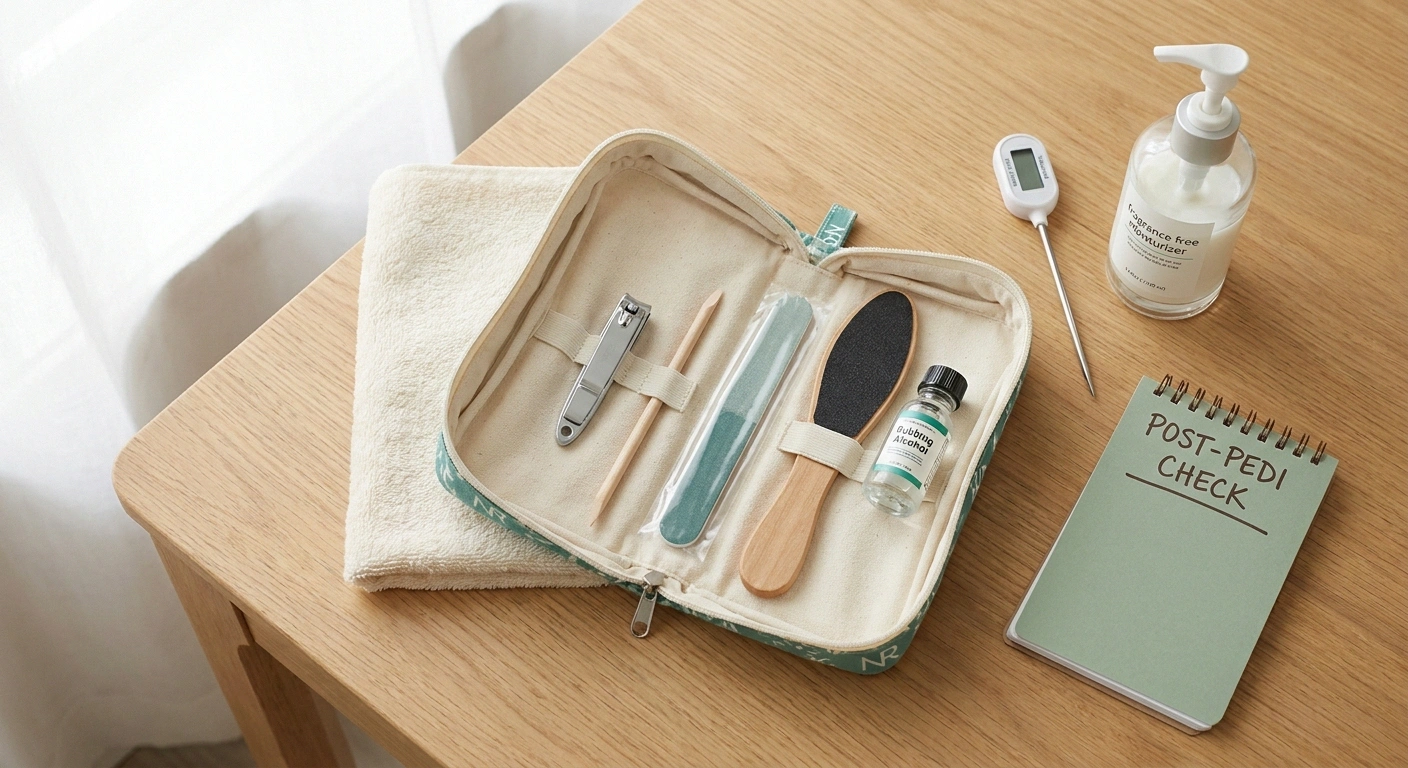
The bring-your-own-tools strategy. Many people with neuropathy or diabetes buy a small zippered kit of personal pedicure tools — clippers, cuticle pusher, foot file, fresh emery boards — and bring them to the salon. The technician uses your tools on you only, and you take them home and wash with rubbing alcohol after. Quality kits run $15-30 and last for years. This is probably the single most reliable safety upgrade you can make.
Choosing a Salon — The Five-Minute Walk-Through
Before you book, walk in and spend five minutes looking around. You're checking for things a casual customer wouldn't notice, but a careful one would:
- State license posted visibly. Every U.S. state licenses nail salons. The license should be on the wall, current, and matched to the technicians' individual licenses.
- Clean autoclave or sealed sterilization pouches. Reusable tools should arrive at your chair in a sealed paper pouch. If tools come out of a drawer that anyone can dip into, that's a red flag.
- Fresh disposables for each chair. The pumice stone, foam toe separator, and emery board at your chair should be unwrapped in front of you or visibly new.
- Visibly clean foot baths between clients. Pipe-free or with a fresh disposable liner.
- Technicians wash their hands between clients. Watch for this. The cleanest salons make it visible.
- No callus shaving. A handheld razor blade for shaving calluses is illegal in many states and is dangerous for anyone with reduced sensation or circulation. If you see a credo blade (the metal razor in a holder), pick a different salon.
The five-minute walk-through is not paranoia. It's the same level of attention you'd give to evaluating a restaurant kitchen if you had a food allergy. Diabetic neuropathy and circulation issues are your version of that allergy when it comes to foot care.
What to Say When You Sit Down
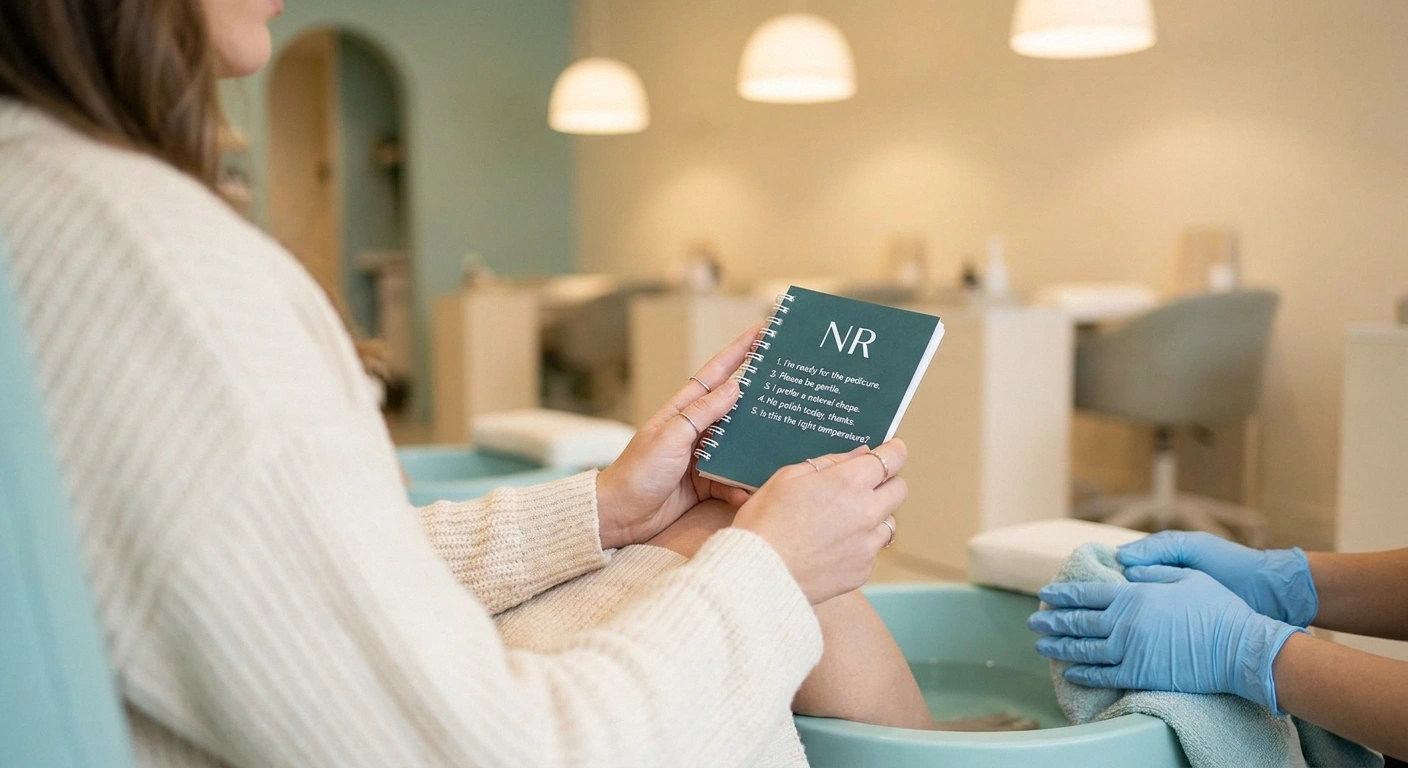
The conversation at the start of the appointment is more important than the manicure itself. A few sentences that protect your feet:
What to Say at the Start of the Appointment
“I have neuropathy and I can't feel my feet very well. I need lukewarm water — not hot. Please don't cut my cuticles, dig under my nails, or shave my calluses. Use light pressure on the massage. And if you see any small cut or red area, please show me before continuing.”
A good technician will appreciate the clear instructions. You'll get a safer, better appointment because of them.
“I have neuropathy and I can't feel my feet very well. I need you to keep the water lukewarm — not hot — and please be gentle with my cuticles.”
That single sentence sets all the right expectations. Add:
- “Please don't cut my cuticles — just push them back gently.” Cut cuticles are wounds, and wounds on neuropathic feet can take weeks to heal.
- “Please don't dig under my toenails.” Aggressive nail-edge work can create small lacerations that you won't feel and the technician won't notice.
- “Please don't shave or grate my calluses.” A pumice stone or fine foot file used gently is fine. Razor shaving and aggressive grating are not.
- “Please don't massage my feet hard — light pressure only.” Aggressive massage can bruise neuropathic feet.
- “If you see any small cut, scrape, or red area, please show me before continuing.” The technician's eyes are now part of your foot inspection.
You're not being difficult. You're being precise. A good technician will appreciate the clear instructions; you'll get a safer, better appointment because of them.
Water Temperature — Trust the Thermometer, Not Your Feet
One of the trickier risks is that hot water doesn't feel hot to neuropathic feet. A small kitchen thermometer in your handbag can solve this in a way your skin can't.
Water Temperature Rules
- Safe range: 92-95°F (33-35°C) — comfortably warm, not steaming
- Burn risk: anything above 100°F (38°C) on neuropathic skin
- Trust: a small kitchen thermometer ($5 in your bag)
- Don't trust: your toes — they can't reliably warn you
- Backup test: dip your wrist or inner forearm first, since those have normal sensation
Safe pedicure water temperature is 92 to 95°F (33-35°C) — comfortably warm, not steaming. Anything above 100°F (38°C) can cause a burn on neuropathic skin you won't feel until the next day.
If you don't carry a thermometer, dip your wrist or your inner forearm into the water before your feet — those areas have normal sensation in most people and will tell you immediately if the water is too hot. Don't trust your toes.
Our piece on daily neuropathy foot care covers the broader temperature-safety habit, including bath water at home — the same rules apply.
The Color Question — Polish, Acrylics, and Gel
For most people with neuropathy, regular polish is perfectly fine. Two specific cautions worth knowing:
Gel polish removal. The acetone soak and the mechanical scraping that some salons use to remove gel can be aggressive enough to damage the nail bed. If you wear gel, ask for gentle removal — long acetone-soaked cotton balls under foil, no scraping.
Acrylic and dip-powder nails on toes. The thicker enhancement layers can hide nail-bed infections until they're advanced. If you have any history of fungal nail issues, plain polish over the natural nail lets you (and your podiatrist) see what's happening underneath.
Dark polish is harder to monitor. A subtle bruise under the nail (a sign of pressure injury or minor trauma) is easier to spot through clear or pale polish than through dark burgundy. If you have advanced neuropathy and shoe-pressure issues, the lighter colors are quietly safer.
The Medical Pedicure — A Real Alternative
For anyone with significant diabetes, severe neuropathy, or a history of foot ulcers, the safest option isn't a regular salon at all. It's a medical pedicure — a foot-care appointment done by a podiatrist or by a certified medical nail technician who works in a podiatry office or specialty foot-care clinic.
Medical Pedicure vs. Salon Pedicure
Ask your podiatrist whether you qualify for Medicare-covered routine foot care.
What you get for a higher price tag (typically $50-90 vs. $35-50 at a regular salon):
- Sterile instruments — usually individually packaged and opened in front of you, hospital-grade
- No water foot baths (most medical pedicures are dry)
- Technicians trained in diabetic foot anatomy and high-risk feet
- Direct communication with your podiatrist if anything looks concerning
- Usually 45-60 minutes of careful work rather than 25-30 of cosmetic finishing
Medicare and many private insurance plans cover routine foot care for diabetic patients with neuropathy when it's done by a podiatrist (the technical billing term is “routine foot care for the high-risk patient”). The criteria are specific and your podiatrist's office can tell you whether you qualify. For people with significant diabetes-related nerve damage, this benefit is dramatically underused.
If you're not sure whether you're a candidate for medical pedicures rather than salon ones, our broader piece on diabetic neuropathy covers when the routine pedicure transition makes the most sense.
The Home Pedicure Setup
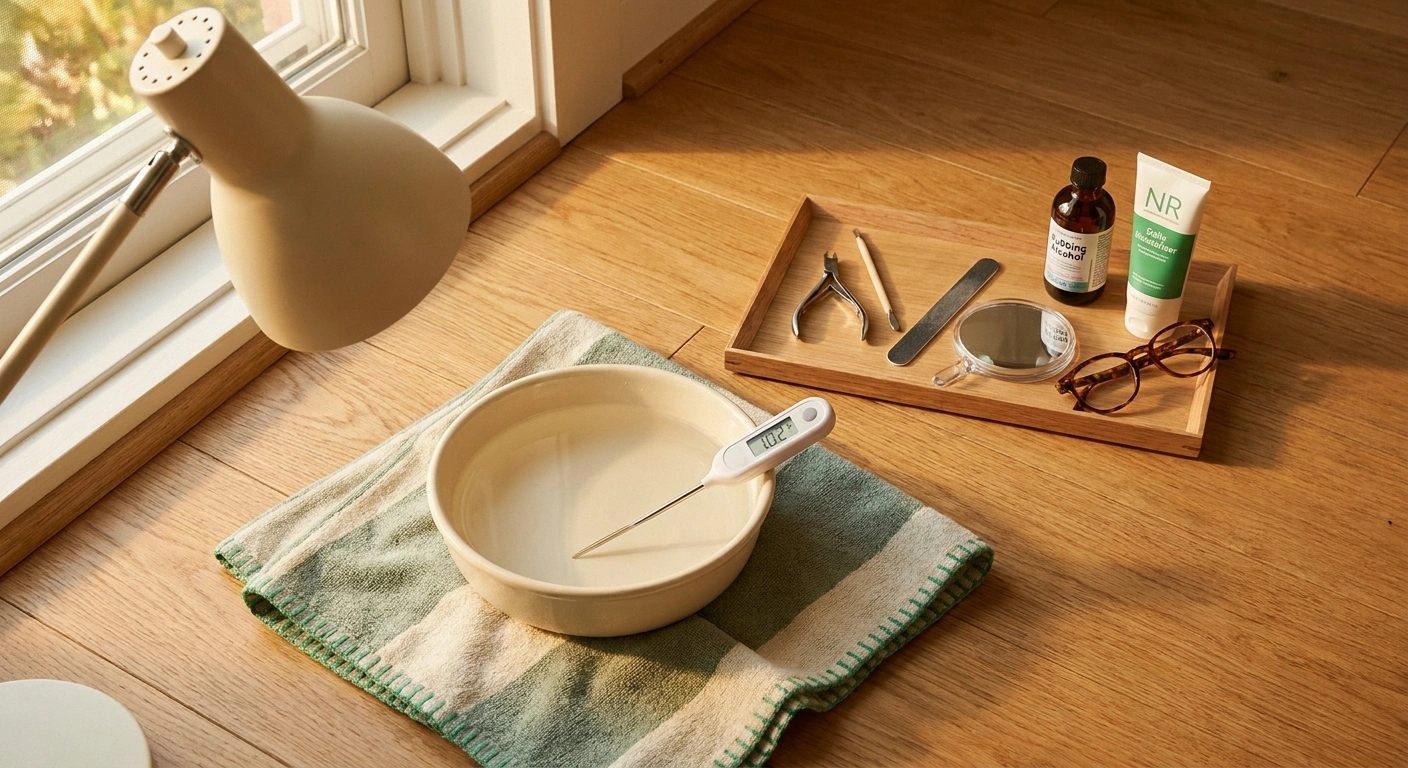
Many people with neuropathy gradually transition to doing their own pedicures at home. It costs less, the tools are yours alone, and you control the temperature, pressure, and timing. A reasonable home setup:
- A shallow basin or large bowl for warm-water soaking (no jets — the same bacterial concern applies at home, just at lower volume)
- A kitchen thermometer to check water temperature before your feet go in
- Quality clippers with a straight cut (curved cuts encourage ingrown nails)
- A wood orange stick or rubber cuticle pusher for gentle cuticle work
- A medium-grit fine foot file or pumice stone for callus smoothing — gentle pressure only
- A small handheld magnifying mirror for inspecting between toes and around the nail edges
- Good lighting at the spot you do it — a desk lamp or overhead light, not just bedside
- A pair of reading glasses if you wear them — depth perception and detail matter
- A small bottle of rubbing alcohol to wipe tools after each use
- A moisturizer formulated for diabetic skin — fragrance-free, urea or lactic-acid based for thick skin, applied to top and sides of the foot but NOT between the toes (where excess moisture invites fungal infection)
The whole setup costs $30-60 once. The recurring cost is moisturizer and the occasional new emery board.
The Post-Pedicure Foot Check
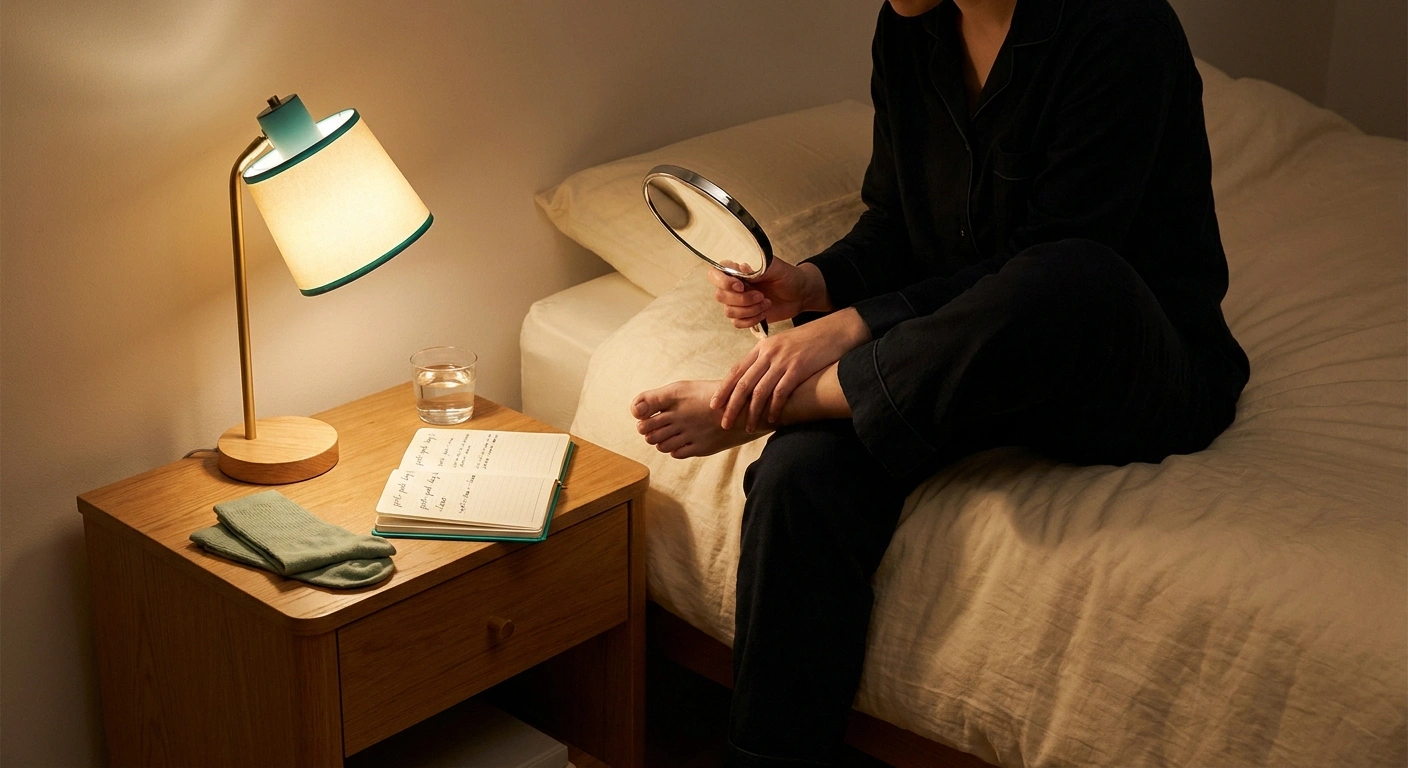
Whether you've been to a salon or done your own at home, a quick foot check that night and again 48 hours later is the most important habit in the entire pedicure routine. You're looking for:
- Any redness around a cuticle or under the nail edge
- Small cuts, scratches, or abraded skin you weren't aware of
- Warm spots that feel hotter than the surrounding skin (a sign of infection)
- Swelling around a toe or the nail
- Drainage or pus (a clear sign to call your doctor that day)
If any of these show up, don't wait. A small infection caught at day two of a pedicure is a fifteen-minute office visit and an antibiotic. The same infection caught at day ten is sometimes a hospitalization. Diabetic foot infections progress faster than non-diabetic ones, and they are the leading cause of non-traumatic amputation in the United States. This is not a place to wait and see.
The daily foot inspection — even on non-pedicure days — is the single highest-leverage habit you can build with neuropathy. Building it into a fixed routine (right after the morning shower, or last thing at night) makes the difference. Our daily routine guidance is part of the broader neuropathy foot care piece.
When to Skip the Pedicure Entirely
A few situations where rescheduling is wiser than going ahead:
The 48-Hour Rule
A small infection caught at day two of a pedicure is a fifteen-minute office visit and an antibiotic. The same infection caught at day ten is sometimes a hospitalization. Diabetic foot infections progress faster than non-diabetic ones. If you see redness, warmth, swelling, or drainage in the 48 hours after a pedicure, call your doctor or podiatrist that same day. Do not wait.
- Any current open cut, blister, or ingrown nail — water exposure and tools are too risky until the skin is healed
- Just-shaved legs — wait 24-48 hours before any foot bath
- Active fungal infection on the foot or toenail — treat first, salon later
- Recent change in blood-sugar control with elevated A1C — the immune system is working harder, infection risk is higher
- Active foot ulcer of any kind — this is a podiatrist visit, not a salon visit
None of these are forever. They're “not today” rules. Get the skin healed, the infection treated, the sugars steady — and a safer salon visit is fully available.
The Bottom Line
Pedicures with neuropathy are completely doable. They just stop being a casual drop-in and become an intentional, prepared appointment. Bring your own tools, ask the questions, set the water temperature, check the salon for the things that matter, and do your post-pedicure inspection that night. With those few habits, the small monthly pleasure of having attractive, well-cared-for feet stays available — without becoming the start of an infection that takes weeks to clear.
For anyone whose neuropathy is more advanced, the transition from a regular salon to a podiatry-based medical pedicure is a small investment that often pays for itself within a year by preventing one infection or ulcer. Talk to your podiatrist about whether you qualify, and whether Medicare or your insurance will cover it.
Frequently Asked Questions
Can I get a pedicure if I have diabetic neuropathy?
Yes, with precautions. Many people with diabetic neuropathy get safe, enjoyable pedicures for years by choosing a clean salon, bringing their own tools, asking for lukewarm (not hot) water, declining cuticle cutting and callus shaving, and doing a careful foot check that night and again at 48 hours. If your neuropathy is advanced or you have any history of foot ulcers, a medical pedicure with a podiatrist is the safer choice.
What is the safest type of foot bath at a salon?
A pipe-free basin or stainless-steel bowl with a disposable plastic liner used for one client and discarded. The traditional whirlpool tubs with jets are the highest-risk design because the internal pipes are difficult to sterilize and harbor bacteria that have caused outbreaks of stubborn foot infections. If a salon only offers whirlpool tubs and won't change for you, ask for a dry pedicure instead.
How hot is too hot for a pedicure foot bath?
Anything above 100°F (38°C) is potentially unsafe for neuropathic skin because you may not feel a burn before it has already happened. Safe pedicure water temperature is 92 to 95°F (33 to 35°C). A small kitchen or candy thermometer in your bag solves the temperature question reliably. If you don't have one, dip your wrist or inner forearm into the water first, since those areas have normal sensation in most people.
Should I bring my own pedicure tools?
Yes, especially if you have diabetes or any history of foot infection. A small zippered kit with clippers, cuticle pusher, foot file, and emery boards runs $15-30 and is the single most reliable safety upgrade you can make. The technician uses your tools only on you, and you wipe them with rubbing alcohol and take them home. Many salons welcome this and appreciate the conversation about it.
Are gel polish and acrylic safe for neuropathic feet?
Regular polish and well-applied gel are generally fine. The cautions are around removal (gentle acetone soak under foil, no scraping) and around thicker enhancements like acrylics or dip powders, which can hide developing nail-bed infections from view. If you have a history of fungal nail issues, plain polish over the natural nail is the safer cosmetic choice because it lets you and your podiatrist monitor what's happening underneath.
What is a medical pedicure and is it covered by Medicare?
A medical pedicure is a careful, sterile foot-care visit performed by a podiatrist or by a certified medical nail technician in a podiatry office. It uses individually-sterilized instruments, usually no water bath, and takes 45 to 60 minutes. Medicare and many private insurance plans cover routine foot care by a podiatrist for diabetic patients with documented neuropathy or circulation issues — the technical term is “routine foot care for the high-risk patient.” Your podiatrist's office can tell you whether you qualify and how often the visits are covered.
What should I do if I see something concerning on my foot after a pedicure?
If you notice any new redness, warmth, swelling, drainage, or pain in the 48 hours after a pedicure, call your primary care doctor or podiatrist that same day. Diabetic foot infections progress faster than non-diabetic ones, and an antibiotic started early prevents the small problem from becoming a serious one. Do not wait to see if it gets better on its own — this is not the right symptom to wait on with neuropathy.
How often is it safe to get a pedicure with neuropathy?
Every 4 to 6 weeks is reasonable for most people with mild to moderate neuropathy, the same cadence as anyone else. The interval matters less than the safety habits. A single careful pedicure every 4 weeks at a clean salon with your own tools is much safer than monthly visits to a salon that cuts corners. If your neuropathy is advanced or you have any history of ulcers, a medical pedicure with your podiatrist every 8 to 10 weeks is the typical recommendation.
About the Author