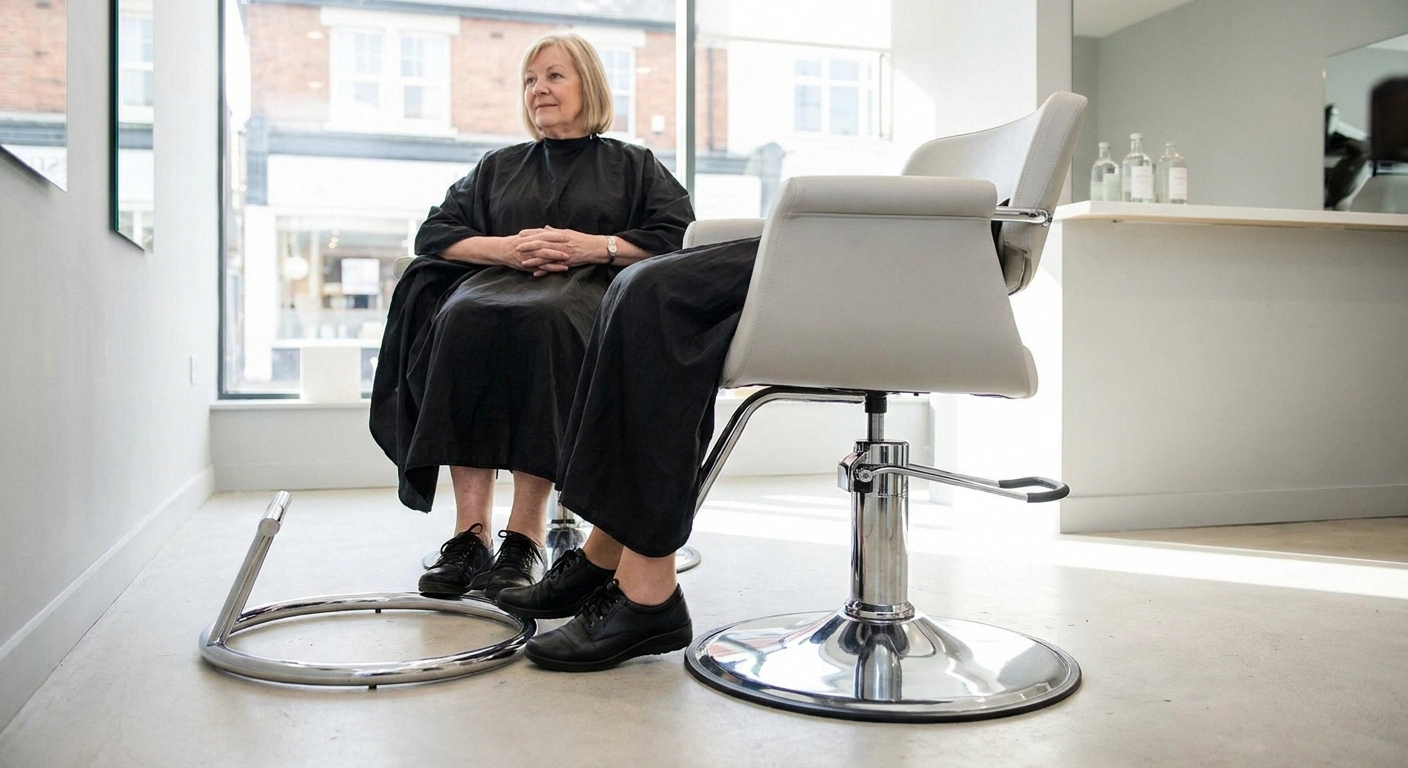
Look at a salon styling chair sometime and notice what it gives your feet. Not a footrest. A metal ring, about an inch across, set at whatever height the chair was built for. Your heels hang. Your weight lands on one narrow bar pressing a line across the middle of both feet, and you sit like that for forty minutes.
For most people that is a mild annoyance they never consciously register. If you have neuropathy in your feet, it is the difference between leaving with a decent haircut and leaving with your feet lit up for the rest of the day.
The salon is full of small design decisions like that. None of them were made with numb feet, unsteady balance, or hands that fumble in mind. The good news is that almost every one of them has a workaround, most workarounds cost nothing, and the staff are generally happy to help once they know what to help with.
Here is the whole visit, from booking to getting home.
The Chair Is Not Built for Your Feet
Start with the footring, because it is the problem you will be sitting with the longest.
Five things worth putting in the bag
None of these are things a salon can be expected to have ready, and all of them are small enough to forget.
- A small cushion or folded scarf. For the seat, not the back. Salon chairs are flat and firm and the appointment is longer than it sounds.
- A thin cardigan or wrap. Salons run cool, capes are not warm, and cold hands and feet report sensation even less reliably than usual.
- Water, and something to eat if the slot is long. Low blood sugar makes balance worse in a way that has nothing to do with your nerves.
- Payment sorted before you arrive. Card or phone on file, tip added digitally, or a note folded in an outside pocket. Counting coins at a counter with tired hands is the worst moment of the visit.
- The shoes you actually trust. Not the nicer pair. You are going to walk on a slick floor in them.
If your feet reach the floor comfortably when the chair is at working height, use the floor. Say so at the start: “I'd rather keep my feet flat on the floor than up on the ring, so please set the chair for that if you can.” Most stylists can work at that height without any trouble, and flat contact spreads pressure across the whole sole rather than concentrating it on one bar.
If the chair has to be higher for the stylist to work, ask whether there is a footstool. Many salons have one somewhere for children. A stool lets your whole foot rest flat and takes the bar out of the equation entirely.
Bring a cushion. A folded scarf, a small travel pillow, a seat pad from the car. Salon chairs are firm and flat, and forty minutes on a hard surface is uncomfortable for anyone and considerably worse when circulation and sensation are already compromised. Nobody will mind, and if you feel odd about it, remember that the same principles you would apply to choosing a comfortable chair at home apply just as much to a chair you only sit in once a month.
Then move. Every ten minutes or so, pump your ankles up and down a few times, roll them in a circle, press your toes down and release. It is invisible under a cape and it keeps blood moving through feet that have been holding one position. If you want more ideas in that vein, our seated exercises for neuropathy are built for exactly this kind of stuck-in-a-chair stretch of time.
The Shampoo Bowl Deserves Its Own Plan
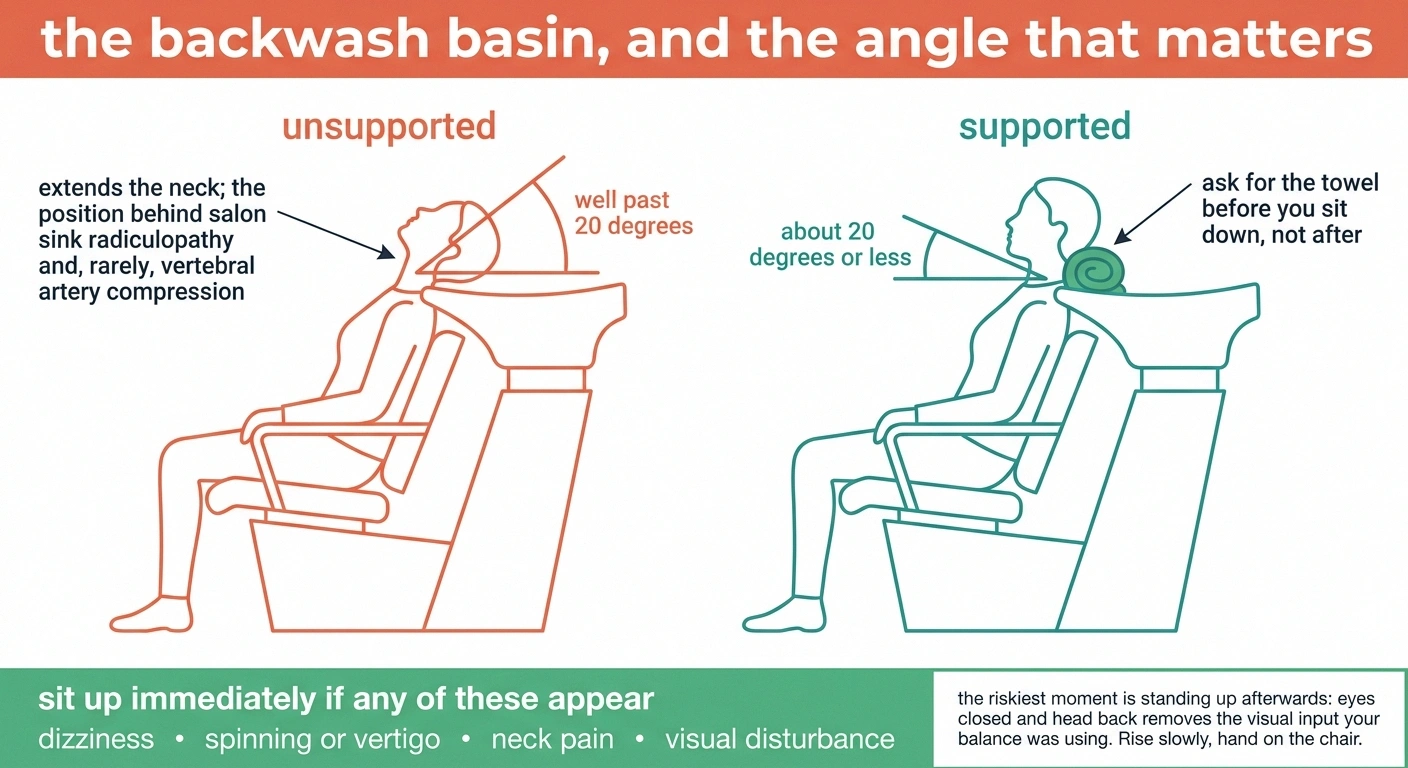
This is the part of the visit that carries genuine risk, and it is worth understanding why rather than just being told to be careful.
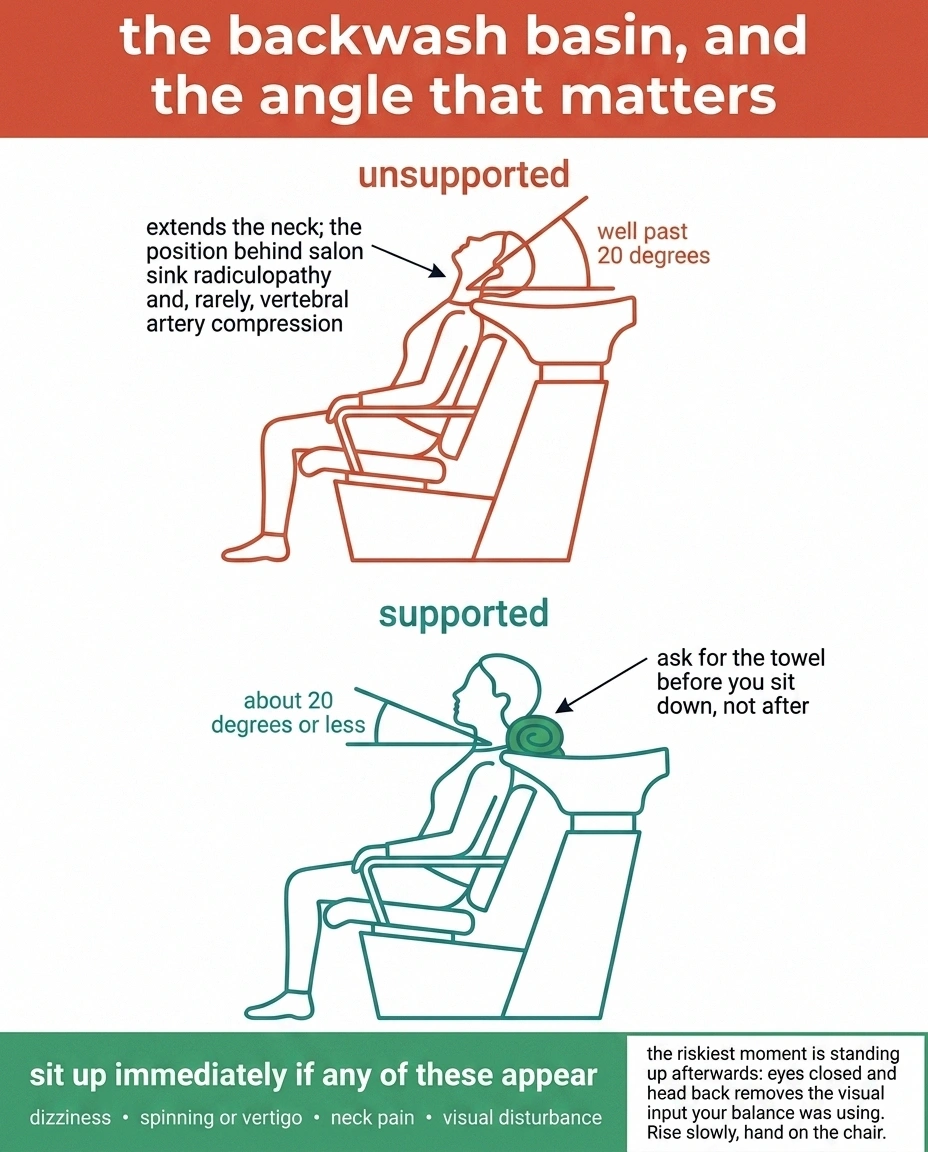
A backwash basin works by tipping your head backward into a notch. That position extends the neck, sometimes considerably. There is a published case series describing nerve root irritation from exactly this posture, given the name salon sink radiculopathy. There is also a rarer and more serious problem, sometimes called beauty parlor stroke syndrome, in which prolonged neck extension compresses the arteries running up through the vertebrae. It is uncommon. It is also well documented enough that the professional beauty trade publishes guidance to stylists about preventing it.
The guidance is specific and useful: your head should not tilt back more than about twenty degrees.
Three things make the bowl much safer.
Ask for a rolled towel behind your neck. Every salon has towels. Placed in the notch, one fills the gap between your neck and the hard porcelain, supports the curve, and reduces how far your head drops back. Ask for it before you sit down, not after.
Ask about a shampoo funnel or an upright wash. Shampoo funnels strap around the hairline and let the client sit upright while their hair is rinsed. Not every salon owns one, but plenty do, and asking costs nothing.
Speak up the moment anything feels wrong. Dizziness, spinning, neck pain, or visual disturbance during a wash are the warning signs, and they mean sit up now rather than wait politely for the rinse to finish.
There is a neuropathy-specific layer on top of all this that nobody else will mention. If your balance depends partly on vision, which it does for most people with significant sensory loss in the feet, then lying with your head back and your eyes closed removes almost every input you use to stay oriented at once. The wash itself is fine because you are supported. The dangerous moment is standing up afterward. Come up slowly, keep a hand on the chair arm, and wait a beat before you start walking. This is the same mechanism behind balance that fails in the dark, and it catches people out in exactly the same way.
And if the bowl simply is not worth it, wash your hair at home and arrive with it clean and damp. Stylists cut wet hair every day. Many will cut damp hair from home without a second thought if you ask when you book.
Heat You Cannot Feel
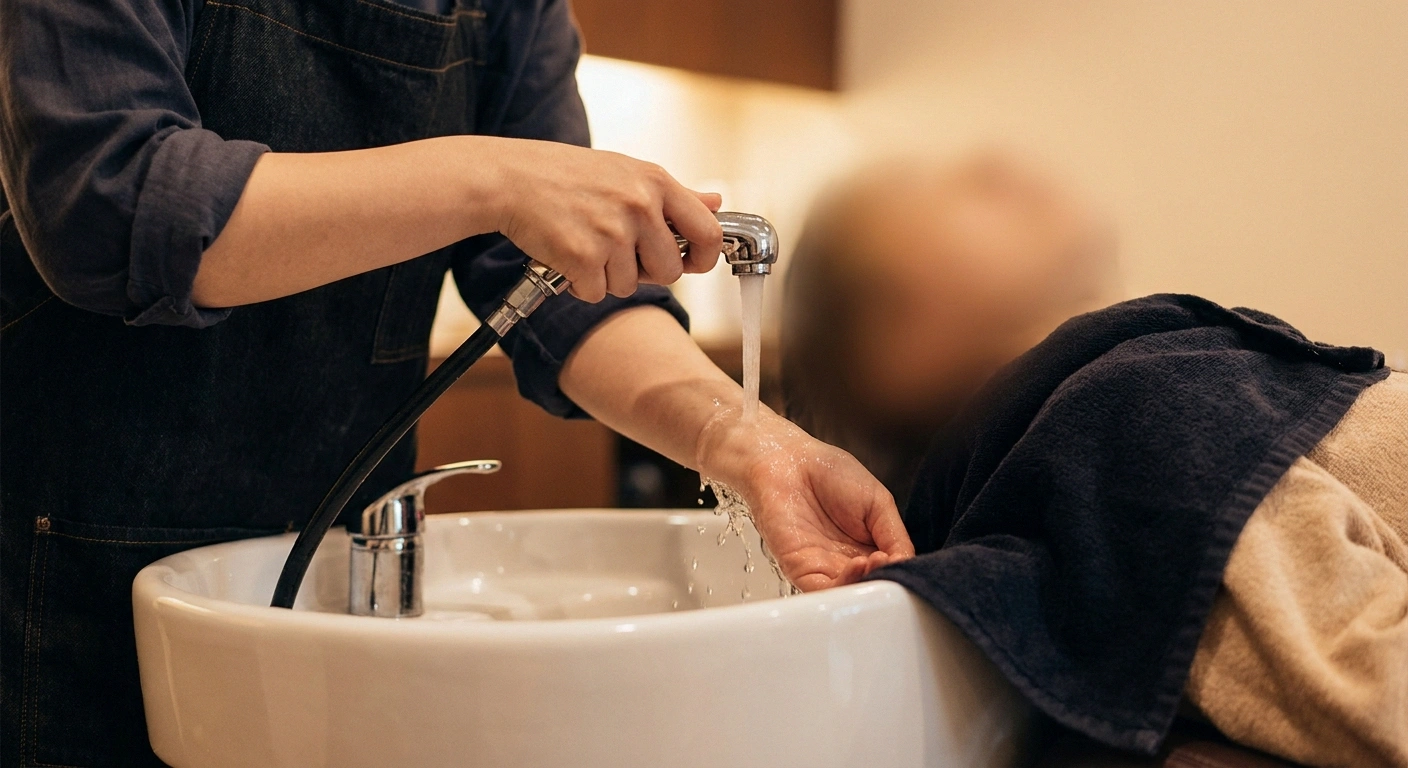
Numb skin is a poor smoke alarm. It reports temperature late, or inaccurately, or not at all, and burns from things that were only slightly too hot are one of the more common injuries in neuropathy precisely because nothing warned you in time.
Where the heat is, and what to ask for
| Rinse water at the bowl | Ask for it cooler than standard and tested on their own wrist. Keep your hands in your lap rather than under the spray. |
| Blow dryer | Held inches from the scalp, ears and neck. Ask for a medium heat setting and say if it is being held in one spot too long. |
| Flat irons and tongs | These run well above boiling point. The contact risk is the ear rim and the nape, both of which are easy for you not to feel. |
| Hot towel, barbershop | Calibrated to feel good on skin that reports accurately. Ask for it cooler; it is a routine request for sensitive skin. |
| Colour processing heat | Hooded dryers and heat lamps run for long stretches. Ask for a lower setting and a longer processing time instead. |
Check your ears, nape and hands in the mirror before you leave. A mark you have not felt is worth catching in the shop rather than discovering that evening.
A salon visit is full of heat sources: rinse water, hot towels, a blow dryer held a few inches from your scalp and ears, flat irons and curling tongs that run well above boiling point, and processing heat from color.
The most useful thing you can do takes one sentence. When you sit down at the bowl, say: “I can't judge water temperature reliably, so please run it cooler than you normally would and check it on your own wrist first.”
That request is easy to honour and it removes the guesswork. Stylists test water temperature as a matter of habit anyway; the difference is that they will now aim for cooler than average rather than for what most people find pleasant.
Two further points. Your hands are often under the running water during a rinse without anybody thinking about it, and hands with neuropathy are just as vulnerable as feet. Keep them in your lap. And if a pedicure or foot soak is bundled into your appointment, that is a separate set of considerations, covered properly in our guide to pedicure and salon foot safety with neuropathy, including what to ask about water temperature and tools.
If you have found that your sense of hot and cold has become unreliable rather than simply reduced, temperature sensitivity in neuropathy explains what is happening to those particular nerve fibers and why cold sometimes registers as burning.
The Floor Is Slicker Than It Looks
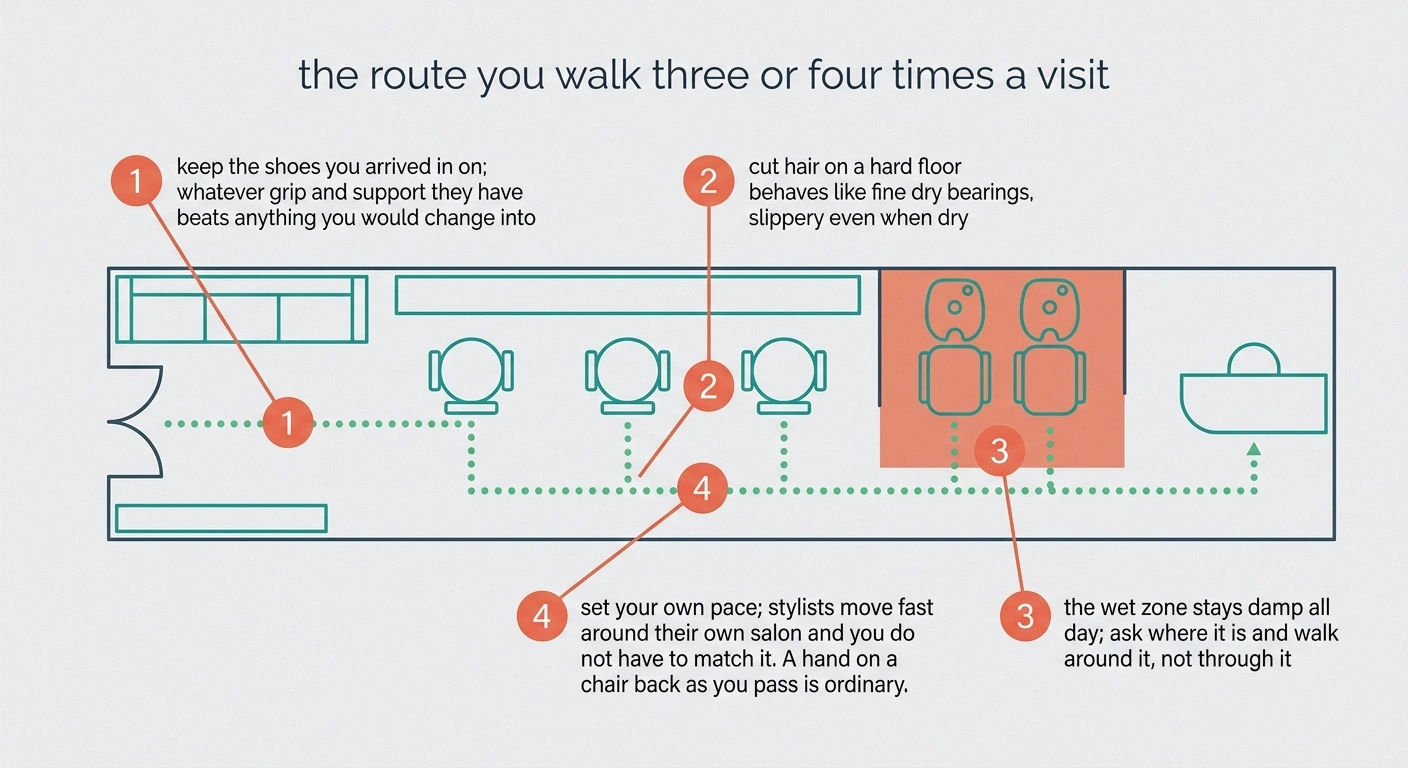
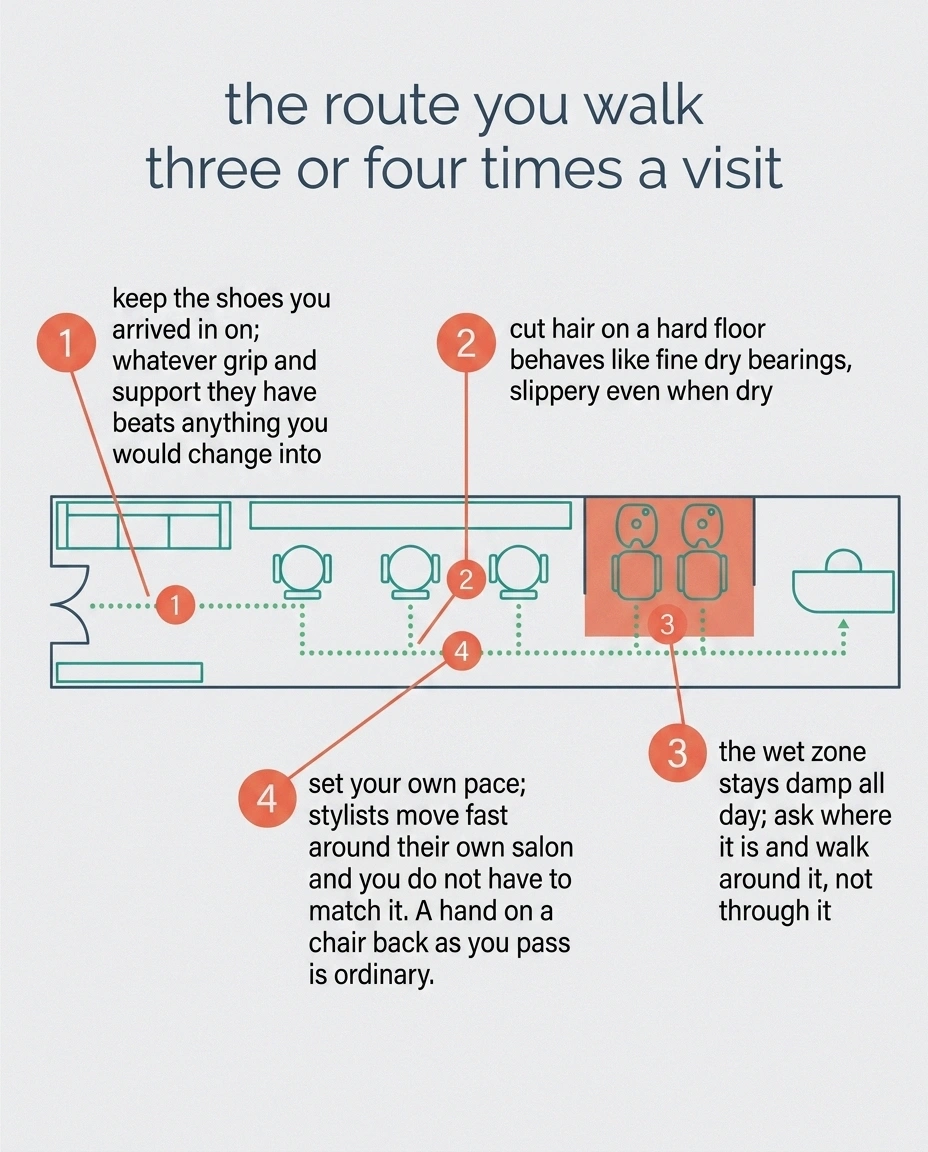
Cut hair on a hard floor behaves like a layer of fine dry bearings. Add water splashed from the bowl and you have a genuinely slippery surface, in a room where you will be walking between three or four stations.
Keep your own shoes on. Whatever you wore in, with whatever grip and support they have, is better than anything you would change into. This is not a place to be in socks or backless slippers, and it is worth wearing the pair you trust rather than the pair that looks nicer, which is much the same logic as our guidance on choosing shoes when you have neuropathy.
Ask where the wet area is and walk around it. There is usually a defined zone near the basins where the floor stays damp all day.
Take the walk between stations at your own pace. Stylists move quickly around their own salon and will unconsciously set the tempo. You do not have to match it, and a hand on the back of a chair as you pass is a perfectly ordinary thing to do. If falls are a live concern for you generally, our fall prevention guidance on neuropathy and balance covers the wider strategy.
Chairs That Move Under You
Styling chairs rotate freely and rise on a hydraulic pump. Barber chairs do the same and sit considerably higher. A chair that spins as you put weight on it is a real hazard when your feet cannot give you reliable feedback about where the ground is.
Two requests solve it. Ask for the chair to be lowered before you sit and before you stand. And ask them to hold it steady while you transfer, which stops the rotation and is a two-second job for whoever is nearest.
Neither request is unusual. Salons seat people of every age and ability all day long.
Long Appointments Are a Different Event
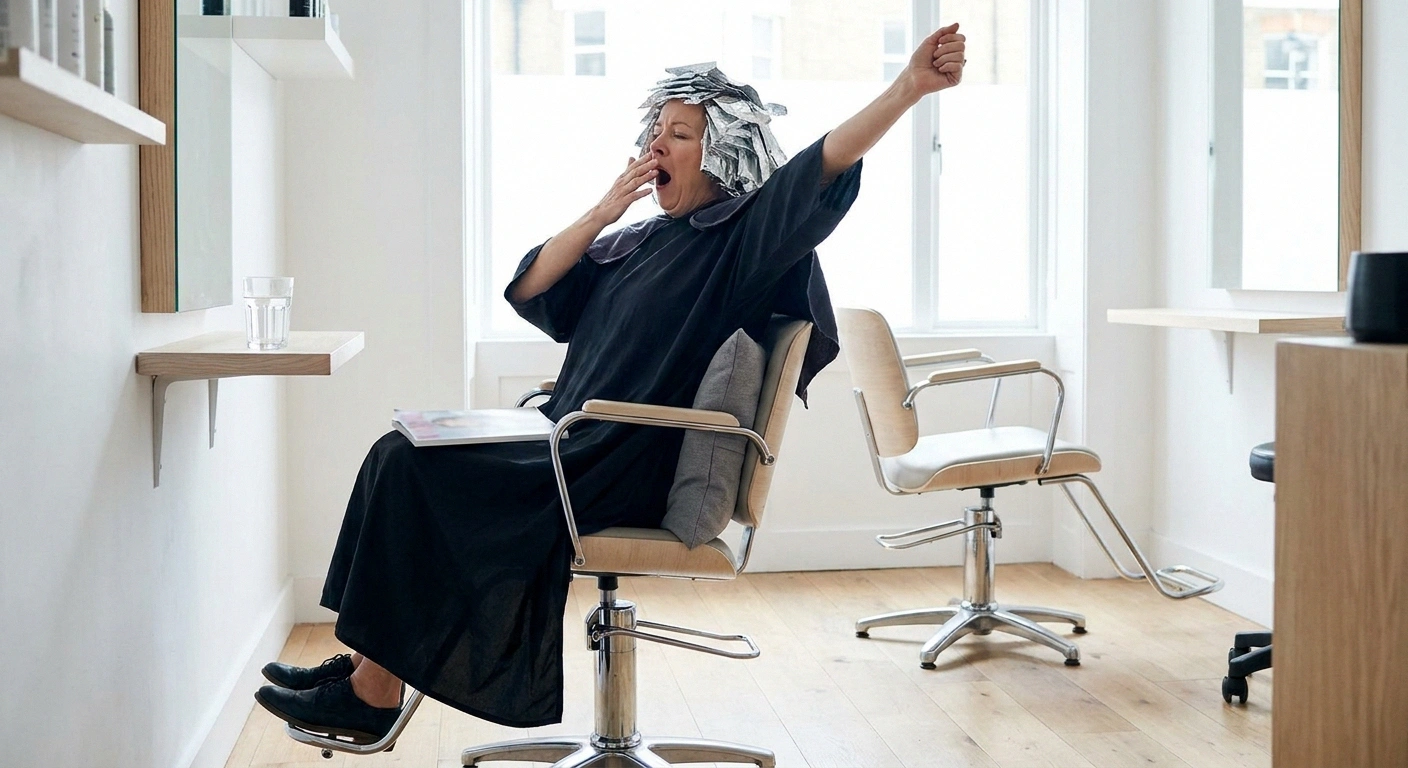
A trim is forty minutes. Color, highlights, or a perm is two to three hours, much of it sitting still while something processes.
Treat those as a different category of outing. A few things make them survivable.
Ask for a break during processing time. Most of that stretch involves waiting rather than working, and standing up, walking to the window and back, and sitting down again costs the stylist nothing.
Consider splitting the service across two visits where that is possible. Color one week, cut the next. It costs an extra trip and removes the three-hour block entirely.
Eat beforehand and bring water. Long appointments run through mealtimes and low blood sugar makes balance worse in a way that has nothing to do with your nerves.
And be honest with yourself about what the day holds afterward. A three-hour appointment is the day's outing, not a stop on the way to somewhere else. The pacing approach that works for other demanding activities applies here without modification.
What to Say, and When
The single most useful move is telling them when you book rather than when you arrive. At booking they can allocate a longer slot, choose a chair, or plan around the bowl. On arrival they are already running to a schedule.
Same information, very different results
Gets a sympathetic nod
“I have peripheral neuropathy.”
“My feet aren't great.”
“Is the water alright for you?”
“Sorry, I'm a bit slow today.”
Gets something to happen
“Could you set the chair so my feet reach the floor?”
“Would you mind putting a rolled towel behind my neck before I lie back?”
“Please run it cooler than usual and check it on your wrist first.”
“Could you hold the chair steady while I get up?”
The column on the right works because each line names a physical action someone can take in the next five seconds. Nobody has to interpret anything or decide how much help you want.
One sentence covers it: “I have nerve damage in my feet and hands, so I can't judge water temperature accurately and I'm a bit unsteady standing up. Nothing complicated, I'll just need the water cooler and a hand with the chair.”
That works because it says what you need rather than what you have. “I have peripheral neuropathy” invites a sympathetic nod and no change in behaviour. “Please run the water cooler and steady the chair” produces both.
It is also worth requesting the same stylist each time. After two or three visits they will remember, and you stop having the conversation.
Barbershops Have Their Own Set
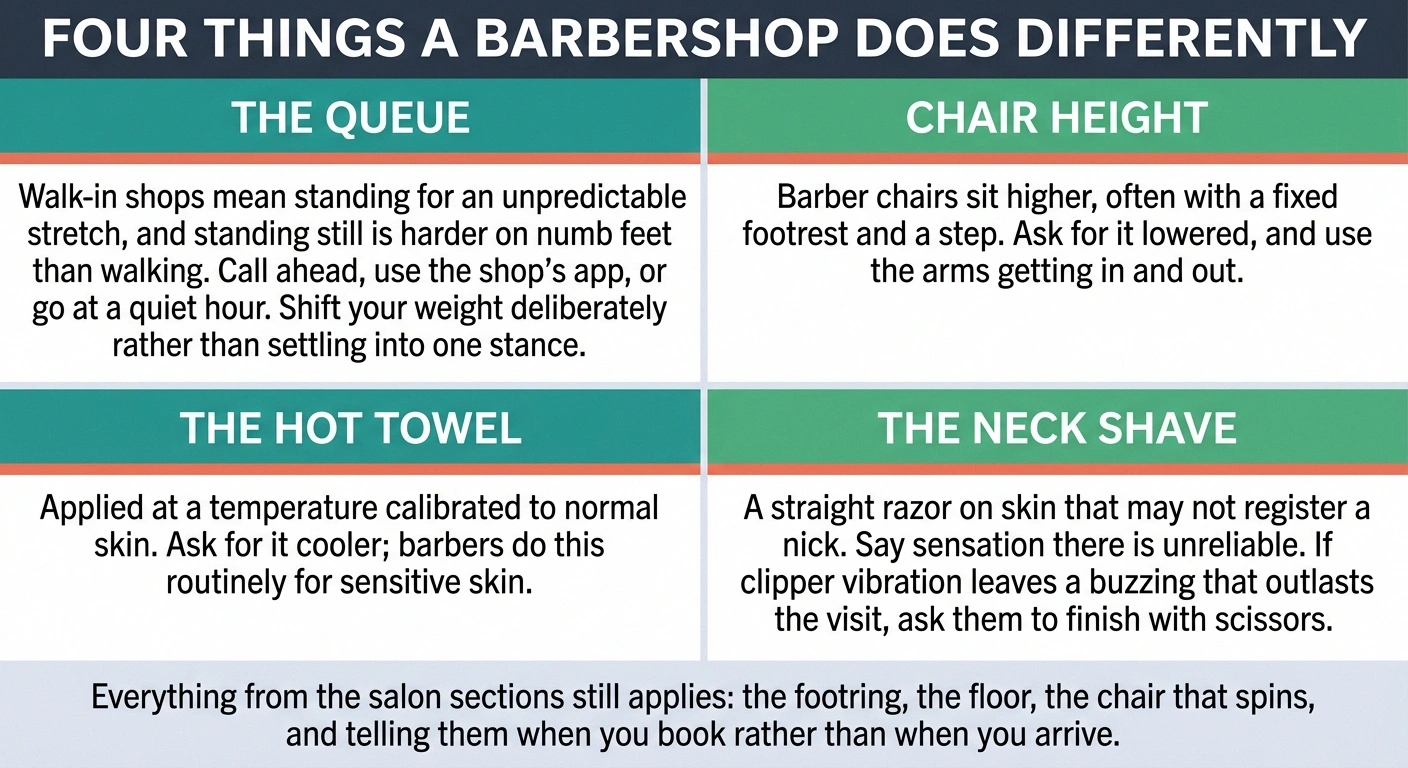
Most of the above transfers, with four differences worth planning around.
The queue. Traditional walk-in shops mean standing in line for an unpredictable stretch. Call ahead, use whatever booking app the shop has, or go at a quiet hour. Standing still is harder on neuropathic feet than walking, and standing on an unknown timer is worse again. If you are stuck in a queue, shift your weight between feet deliberately rather than settling into one stance.
Chair height. Barber chairs are tall, often with a fixed footrest and a step. Ask for it to be lowered, and use the arms getting in and out.
The hot towel. A hot towel wrapped around the face and neck before a shave is applied at a temperature calibrated to what feels good on normal skin. Ask for it cooler. Barbers do this routinely for people with sensitive skin and will not find the request strange.
The neck shave. A straight razor at the hairline, on skin that may not register a nick, is worth a mention. Say that sensation in that area is unreliable so they know to be deliberate about it. If clipper vibration on the neck sets off tingling or an unpleasant buzzing that outlasts the appointment, ask them to finish with scissors instead.
When Your Hands Are the Problem
Neuropathy in the hands changes a different set of small moments, and they cluster at the end of the appointment when you are already tired.
The cape clasp is fiddly and it is not your job. The hand mirror at the reveal is heavier than it looks and gets held at arm's length; two hands is fine, and so is asking them to hold it. Payment terminals want a firm tap on a small screen, and coins for a tip are genuinely difficult with reduced grip and sensation.
Solve the last one in advance. Pay by card or phone and add the tip digitally, or bring a note folded and ready in an outside pocket rather than fishing in a wallet at the counter. Our guide to neuropathy in the hands covers the broader set of grip and dexterity adaptations.
Booking Well Is Half the Job

When you go matters more than most people expect.
Not all slots are the same slot
If the only slot you can get is a bad one, take it and adjust: eat beforehand, arrive a few minutes early so you are not rushing in, and keep the rest of that day genuinely clear.
The first appointment of the day is the best slot available. The floor is clean and dry, nobody is running late, the shop is quiet, and the stylist has the most time and patience they will have all day.
Avoid Saturday afternoon, which is the busiest, most crowded, most rushed window in any salon.
Book for your own best hours. Most people with neuropathy have a reliable window when symptoms are quietest, often late morning, and using it for something that requires sitting still is a good trade.
Then leave the rest of the day light. Not empty, just light. An outing that involves an unfamiliar chair, a slippery floor, temperature exposure and an hour of sitting still has a cost that shows up later, and planning nothing demanding afterward is the difference between a good decision and a day you regret.
Frequently Asked Questions
Is the shampoo bowl safe if I have neuropathy?
It is safe for most people with a few adjustments. Ask for a rolled towel behind your neck to support the curve and limit how far your head tips back, since guidance for salons suggests keeping the tilt under about twenty degrees. Sit up immediately if you feel dizzy, notice neck pain, or have any visual disturbance. The riskiest moment is standing up afterward, because lying back with your eyes closed removes the visual input your balance has been relying on, so rise slowly with a hand on something solid.
How do I sit through a long appointment with numb feet?
Ask for the chair to be set so your feet rest flat on the floor rather than on the metal footring, which concentrates pressure along one narrow line. Bring a cushion for the seat. Pump and circle your ankles every ten minutes under the cape. For services lasting two hours or more, ask for a short walking break during processing time, or split the service across two appointments.
What should I tell my stylist?
Tell them at booking rather than on arrival, and describe what you need rather than the diagnosis. Something like: “I have nerve damage in my feet and hands, so I can't judge water temperature accurately and I'm unsteady standing up. I'll just need the water cooler and a hand with the chair.” Requests produce action in a way that a condition name does not.
Can hot tools burn me if I cannot feel them?
Yes, and this is one of the more common injuries in neuropathy because nothing warns you in time. Rinse water, hot towels, blow dryers and flat irons all run hotter than damaged nerves reliably report. Ask for the water cooler than standard and for the stylist to test it on their own wrist. Keep your hands out of the running water during rinses, since hands are as vulnerable as feet.
Is a hot towel shave safe with neuropathy?
Ask for the towel cooler than the barber would normally apply it, which is a routine request they honour for sensitive skin. Mention that sensation at the neck and hairline is unreliable so they know to be deliberate with a straight razor. If clipper vibration leaves an unpleasant buzzing that outlasts the appointment, ask them to finish the neckline with scissors.
What is the best time to book?
The first appointment of the day. The floor is clean and dry rather than covered in cut hair and splashed water, the shop is quiet, and nobody is running behind. Avoid Saturday afternoons. Beyond that, book within whatever window your symptoms are usually quietest, and keep the rest of that day light.
How do I avoid slipping on the salon floor?
Keep the shoes you arrived in on, whatever their grip and support, rather than changing into anything lighter. Ask where the wet zone near the basins is and walk around it rather than through it. Move at your own pace between stations instead of matching the stylist's, and rest a hand on a chair back as you pass. Cut hair on a hard floor is genuinely slippery even when dry.
Can I skip the salon wash entirely?
Yes. Wash at home and arrive with clean, damp hair. Stylists cut wet hair routinely and most will work with hair washed at home if you mention it when booking. This removes the neck extension, the temperature exposure and the standing-up transition in one decision, and it is a reasonable choice if the bowl has caused you trouble before.
About the Author