
About six months into my deep-dive on neuropathy supplements, a friend forwarded me a brand-new bottle from her son. The label said it would “rebuild her mitochondria” and “support nerve energy from the inside out.” She wanted to know if I’d ever heard of PQQ.
I’m Janet. I’m a patient advocate, not a doctor, and I’ve spent the better part of the last few years separating supplement marketing from the actual evidence for people like us. PQQ — pyrroloquinoline quinone, if you want the mouthful — is one of the more interesting newcomers on the neuropathy supplement shelf. The mechanism is genuinely fascinating. The hype is well ahead of the human data. And the price tag is steeper than most of the supplements with stronger evidence behind them. This is the honest tour.
What PQQ Actually Is (And Why You’re Hearing About It)
PQQ is a small molecule first discovered in the 1960s in bacteria, where it acts as a cofactor — a helper molecule that lets certain enzymes do their jobs. For a while in the early 2000s, researchers thought it might be a new vitamin for mammals. That claim was later retracted, but the chemistry that got everyone excited is real: PQQ is a powerful redox-cycling molecule, which means it can hand off electrons over and over again without breaking down the way most antioxidants do.
Key Takeaway
PQQ supports mitochondrial function in lab studies, but there are no randomized clinical trials in people with neuropathy. The mechanism is promising; the human evidence is thin. Build the foundation with B12, ALA, and ALCAR first — PQQ is a later addition, not a starter supplement.
It shows up in trace amounts in food. Fermented soy (especially natto), parsley, green tea, kiwi, and papaya are commonly cited sources. Your body produces almost none on its own, and the amounts in food are tiny compared with what’s in a supplement capsule — usually 10 to 20 milligrams.
The reason it’s now in nearly every “mitochondrial support” formula on the market is a series of laboratory and animal studies suggesting PQQ does two things that sound very relevant to nerve health. First, it appears to stimulate the growth of new mitochondria — the tiny power plants inside every cell. Researchers call this “mitochondrial biogenesis.” Second, it acts as a sustained antioxidant inside those mitochondria, reducing the kind of damage that comes from normal energy production.
If you’ve ever read about why nerves are so vulnerable to damage, you already know why this matters. Long peripheral nerves are some of the most energy-hungry cells in the body, and they’re also some of the longest — which means a tiny amount of damage at the cell body has to be paid for all the way down to your toes. Anything that supports mitochondrial health in those cells is at least theoretically interesting for neuropathy.
The Mechanism — Why It Sounds Promising
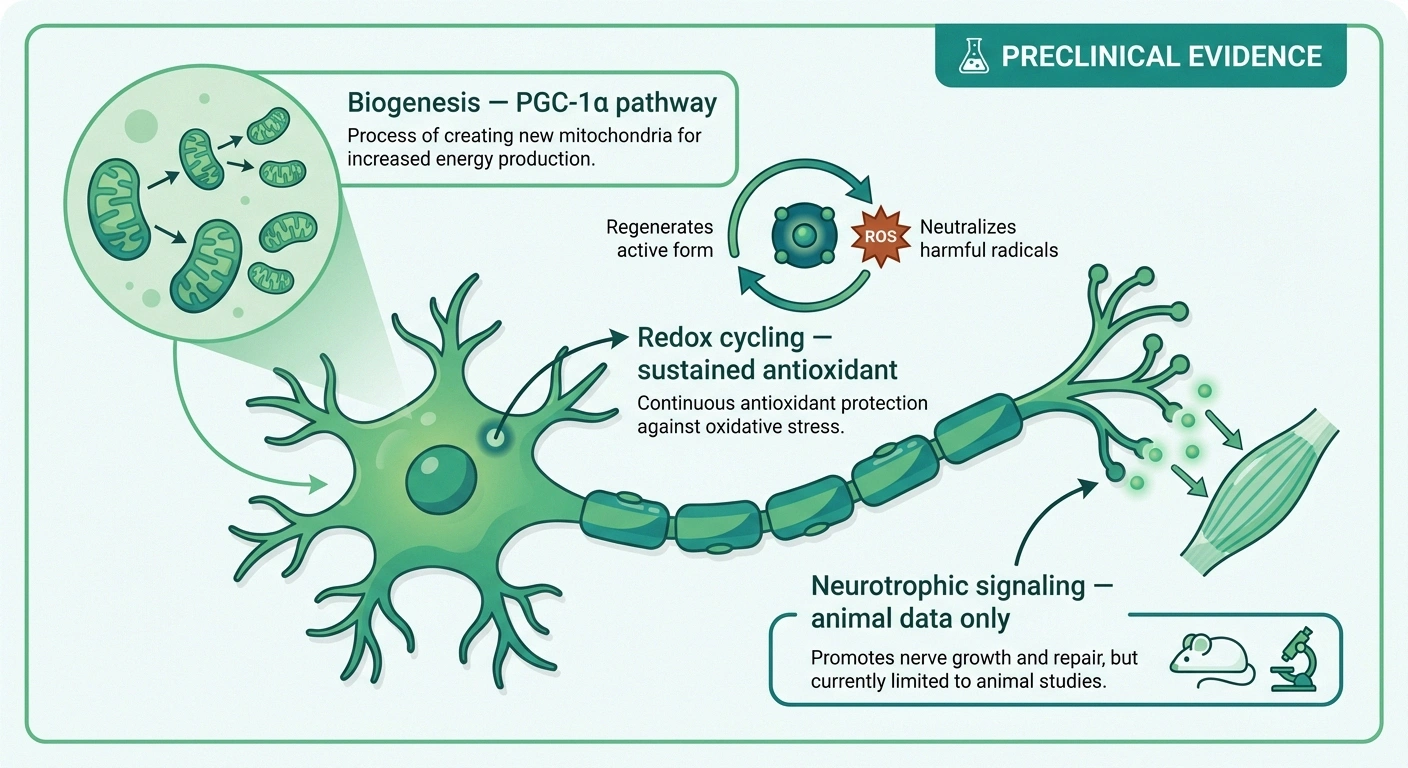
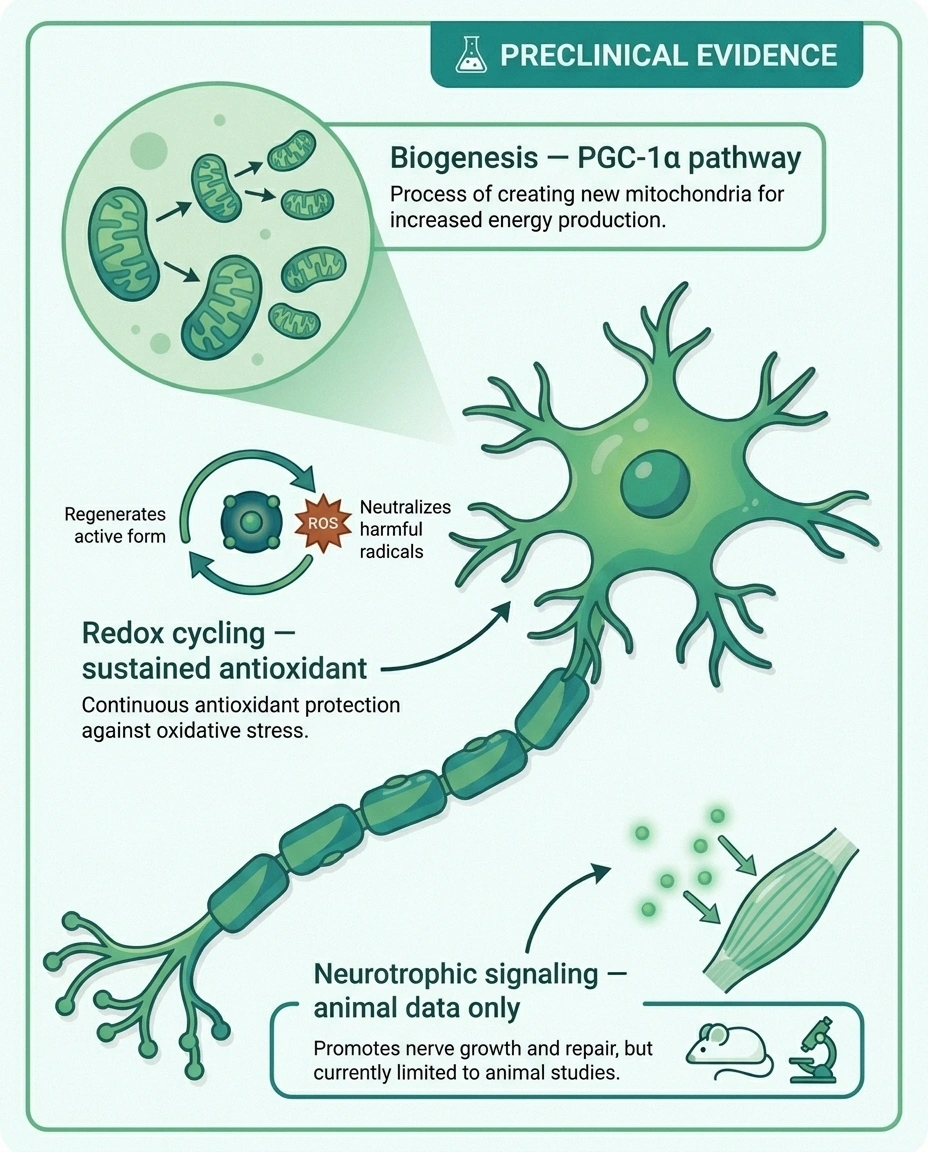
Three pieces of biology underlie the case for PQQ in nerve health:
Mitochondrial biogenesis. In rodent cells, PQQ activates a pathway called PGC-1α, which signals the cell to build more mitochondria. More mitochondria, in theory, means more capacity to handle the energy demands of a long peripheral nerve. This is the headline mechanism in nearly every PQQ marketing piece.
Sustained antioxidant action. PQQ can cycle through its oxidized and reduced forms thousands of times before being used up. Most antioxidants — vitamin C, glutathione — get “spent” after a single reaction. The continuous-cycling property means PQQ can quietly mop up oxidative damage inside cells for longer than a single dose of a one-shot antioxidant would.
Neurotrophic effects in animal models. A handful of rodent studies have shown PQQ promotes the survival of nerve cells in culture, supports nerve growth factor activity, and protects nerves from crush injury or chemical damage. These are early-stage findings — interesting, but a long way from a human with diabetic or chemotherapy-induced neuropathy.
Each of these mechanisms is real in a petri dish or a rodent. Translating any of them to a meaningful benefit for a person sitting at home with burning feet is a much bigger leap. Mechanisms are seductive. They’re also where most supplement hype lives.
What the Human Research Actually Shows
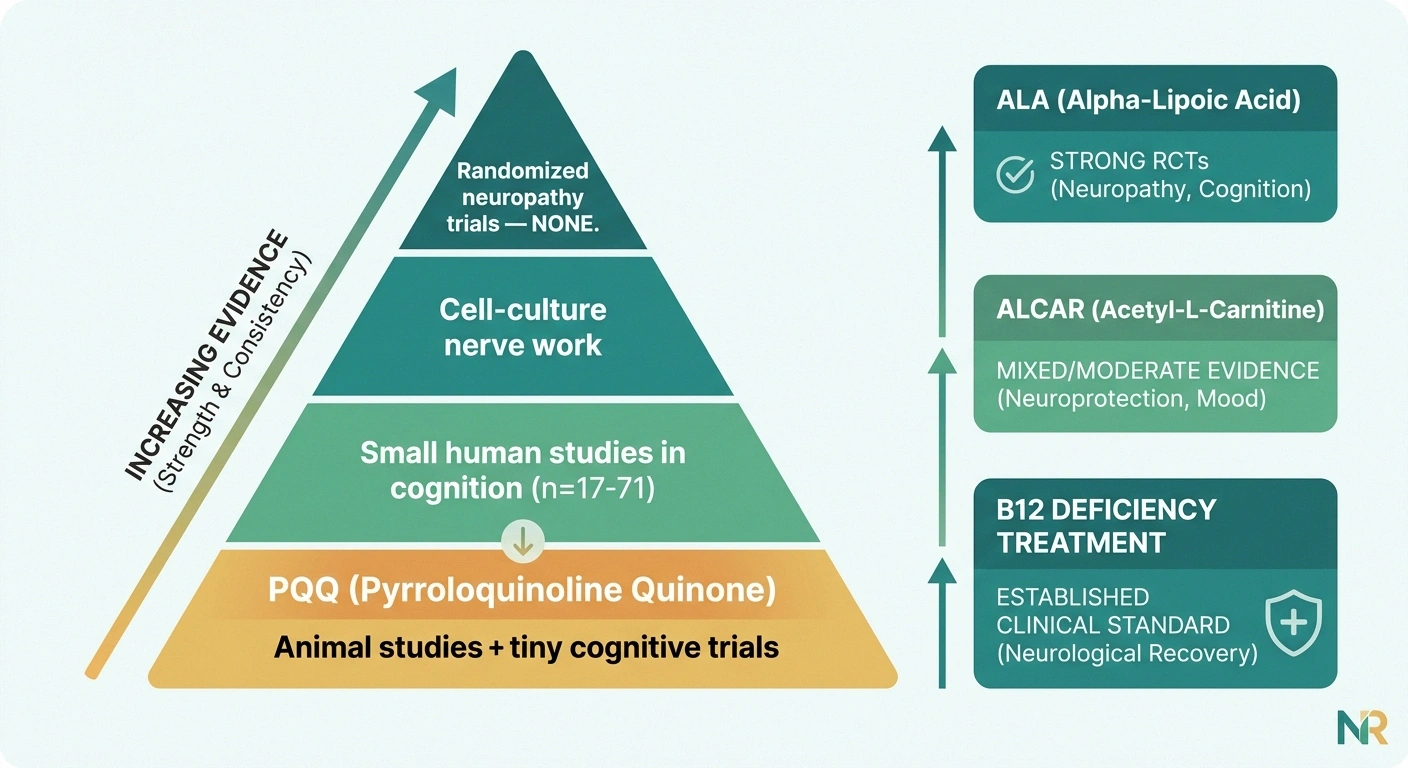
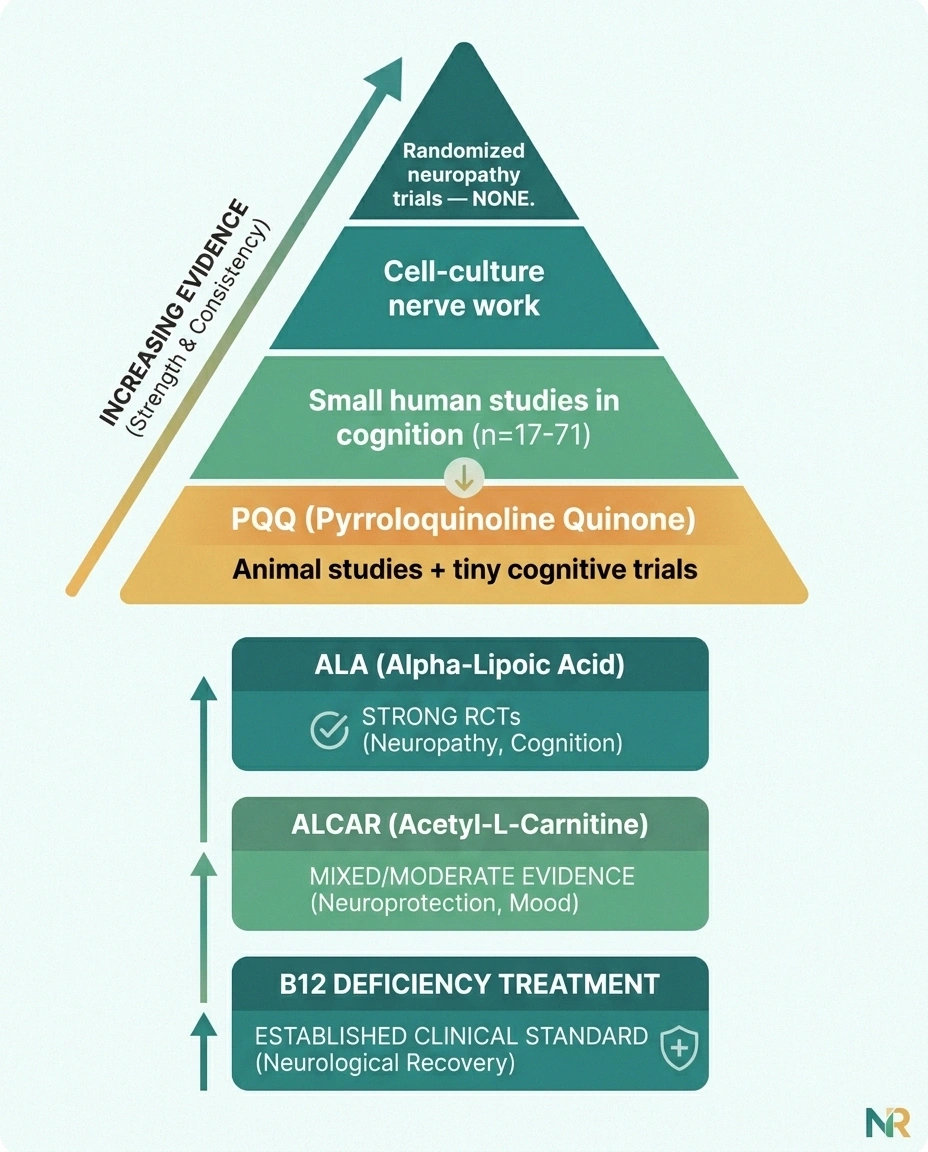
Here’s the honest part. As of this writing, there are no published randomized clinical trials of PQQ in patients with peripheral neuropathy. That’s not a minor footnote — that’s the whole story. Every claim you’ll read about PQQ and nerve health is extrapolation from animal studies, cell-culture work, or related-but-different conditions.
Evidence Strength: PQQ vs. Other Nerve Supplements
What does exist in humans is a small body of research, mostly funded by Japanese manufacturers, looking at PQQ for cognitive function, sleep, and fatigue in middle-aged or older adults. Sample sizes tend to be small — typically 17 to 71 participants — and most last 8 to 12 weeks. The studies suggest modest improvements in memory tests, sleep quality, and self-reported energy at doses of 10 to 20 milligrams per day. The trials are not large enough or independent enough for a strong conclusion, and the participants weren’t being studied for neuropathy at all.
A few preclinical signals are at least related. Diabetic rats given PQQ have shown some protection against the nerve damage that normally develops over weeks of high blood sugar. PQQ has also been studied alongside CoQ10 in heart-failure models with positive findings. None of this is a substitute for an actual trial in people with neuropathy, and there’s a reason no major medical society includes PQQ in their treatment guidelines.
Compare that to alpha-lipoic acid (ALA) for neuropathy, which has been studied in thousands of diabetic patients across multiple decade-long trials. Or acetyl-L-carnitine for neuropathy, where the human evidence base — while imperfect — actually exists. PQQ isn’t in that league yet. It might get there. Today, it isn’t.
Dosing — What You’ll Find on the Shelf
If you decide to try PQQ despite the thin evidence, the dosing is fairly standardized:
- Typical adult dose: 10 to 20 milligrams once daily, usually with breakfast or lunch.
- Higher doses (40 mg per day) are sometimes used in the cognitive-function studies. There’s no good reason to start above 20 mg.
- Form to look for: The most-studied branded form is MGCPQQ (sometimes labeled BioPQQ), made by a Japanese manufacturer. Other generic PQQ disodium salt is widely available and is chemically the same molecule.
- With or without food: Either works. Some people report mild stomach upset on an empty stomach, so taking it with food is a sensible default.
- Pairing: PQQ is often sold alongside CoQ10, because mechanism-minded formulators argue the two complement each other in mitochondrial pathways. There’s no strong human data that the combination outperforms either one alone for neuropathy.
Don’t expect a dramatic short-term result. Even the cognitive-function studies that show benefit usually need 8 to 12 weeks of daily use before differences appear. If you’re going to test PQQ at all, give it three months and keep a simple symptom and foot-care log so you have something to look back on. Memory and supplement memory are not the same thing.
The Cost Problem
Here’s the unromantic part. PQQ is one of the more expensive supplements aimed at neuropathy. A 30-day supply of 20 mg PQQ runs roughly $25 to $50 depending on the brand and whether it’s combined with CoQ10. Stacked with CoQ10, the combined cost can climb to $60 or more per month.
Monthly Cost: PQQ vs. Better-Evidenced Options
| Supplement | Typical Dose | Monthly Cost | Evidence in Neuropathy |
|---|---|---|---|
| Methyl-B12 | 1,000-5,000 mcg/day | $5-15 | Strong (B12 deficiency) |
| Magnesium glycinate | 200-400 mg/day | $10-15 | Good for cramps |
| Alpha-lipoic acid | 600 mg/day | $15-25 | Strong (diabetic) |
| Acetyl-L-carnitine | 1,000-2,000 mg/day | $20-35 | Moderate |
| PQQ alone | 20 mg/day | $25-50 | Weak in neuropathy |
| PQQ + CoQ10 combo | 20 mg + 100-200 mg/day | $45-70 | Weak in neuropathy |
Prices reflect typical reputable third-party-tested brands as of 2026. Choosing PQQ over a foundational supplement is a real opportunity cost.
For context, here is what the same monthly budget buys you in supplements with much stronger human evidence for neuropathy:
- Alpha-lipoic acid at 600 mg per day — roughly $15 to $25 per month, with decades of randomized-trial evidence in diabetic neuropathy.
- Methylcobalamin (B12) at 1,000-5,000 mcg per day — roughly $5 to $15 per month, foundational for anyone with B12 deficiency-related vitamin-deficiency neuropathy.
- Acetyl-L-carnitine at 1,000-2,000 mg per day — roughly $20 to $35 per month, with reasonable evidence in chemo-induced and diabetic neuropathy.
- Magnesium glycinate at 200-400 mg per day — roughly $10 to $15 per month, useful for nighttime cramps that often accompany neuropathy-related muscle issues.
If your supplement budget is unlimited, none of this matters. For most of us, choosing PQQ over one of the better-evidenced options is a real opportunity cost. My honest take: PQQ is a “later addition” supplement, not a foundation. Build the foundation first.
Safety — What We Know and What We Don’t
Across the small human studies, PQQ at 10 to 20 mg per day has been generally well-tolerated. The side effects most commonly reported are mild and short-lived:
Check With Your Pharmacist Before Adding PQQ If…
- You take a blood thinner (warfarin, apixaban, rivaroxaban, dabigatran, clopidogrel).
- You are on chemotherapy, immunosuppressants, or biologics.
- You have moderate-to-severe kidney or liver disease.
- You take more than five prescription medications.
- You are pregnant, breastfeeding, or trying to conceive (no safety data).
Two-minute pharmacist call costs nothing. “It’s a supplement, not a drug” is not a free pass for interaction risk.
- Headache, especially in the first week (often resolves on its own)
- Mild stomach upset if taken on an empty stomach
- Vivid dreams or changes in sleep patterns at higher doses
- Skin rash (rare)
The honest gaps in the safety picture:
We don’t have long-term human data. The studies that exist run weeks to a few months. Daily use over years is essentially unstudied. For a healthy adult, that’s probably fine. For someone with kidney disease, liver disease, or a complex medical history, it’s worth a conversation with your doctor before adding any new supplement that hasn’t been studied long-term.
Pregnancy and breastfeeding: No safety data exists. Avoid.
Interactions: Theoretical interactions with blood thinners and immunosuppressants have been raised but not well-studied. If you take warfarin, eliquis, methotrexate, or any cancer therapy, ask your pharmacist before adding PQQ. The same goes for anyone on the more aggressive medications associated with neuropathy — interactions are more theoretical than proven, but worth a quick pharmacist check.
Quality control: Like all supplements in the United States, PQQ isn’t regulated to pharmaceutical standards. Look for third-party-tested brands (NSF, USP, or Informed Choice certifications). The branded MGCPQQ/BioPQQ ingredient does come with chain-of-custody manufacturing documentation, which is unusual in this category.
Who Might Reasonably Consider PQQ (and Who Shouldn’t Bother)
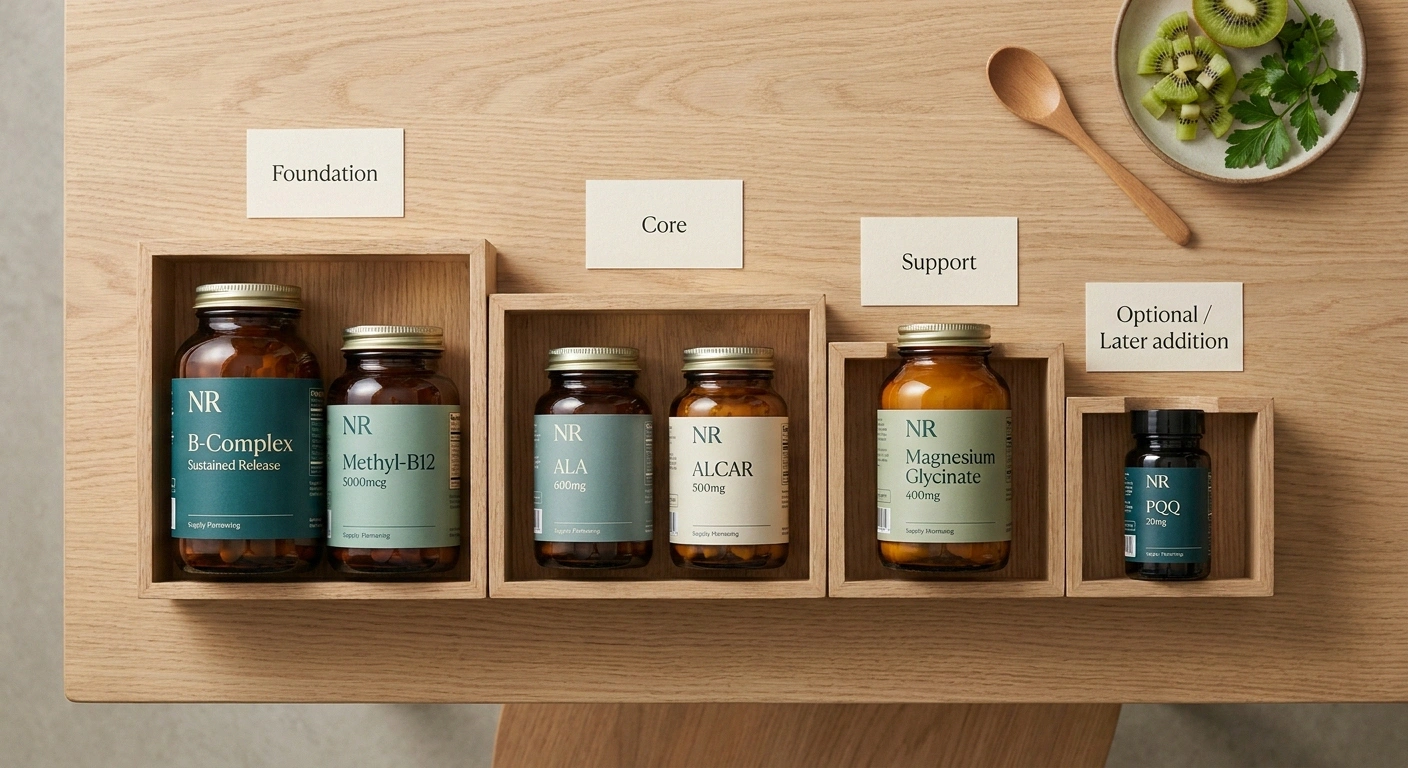
If I’m being practical with people who ask me about this supplement, here’s how I split it:
Could reasonably consider PQQ:
- Someone who has already optimized the basics — B12, ALA, ALCAR, dietary anti-inflammatory pattern, magnesium for cramps, sleep, exercise — and wants to add one more theoretically mitochondrial-supportive option.
- Someone whose neuropathy is paired with low energy, brain fog, or fatigue — symptoms where the modest human data on PQQ at least overlaps. (See neuropathy and mental health for why these often travel together.)
- Someone with a generous supplement budget who’s already paying for high-quality CoQ10 and wants to layer PQQ on top.
Should probably skip PQQ for now:
- Anyone whose B12 status hasn’t been checked. B12 deficiency causes neuropathy directly. Fix that before adding anything novel.
- Anyone not yet on a trial of alpha-lipoic acid. ALA has decades of evidence; PQQ has weeks.
- Anyone on a tight budget. The opportunity cost of choosing PQQ over better-evidenced options is real.
- Anyone hoping for a dramatic short-term effect on burning, tingling, or pain. Even in the best human studies, the effects were modest and slow.
- Anyone on multiple medications without a pharmacist consult.
None of this is a no-forever. Research moves. If a well-designed PQQ trial in diabetic or chemo-induced neuropathy reports clear benefit two or three years from now, I’ll update my view. But “promising mechanism” is not the same as “proven to help your feet,” and the supplement industry has a long history of selling the former as if it were the latter.
PQQ vs. the Other “Mitochondrial Support” Players

If your goal is specifically to support mitochondrial function for nerve health, PQQ is one of several options. Quick comparison:
Alpha-lipoic acid: Antioxidant inside and outside mitochondria, decades of human evidence in diabetic neuropathy, well-studied dosing (600 mg/day), affordable. The default choice if you only pick one.
Acetyl-L-carnitine (ALCAR): Transports fatty acids into mitochondria for energy production. Good evidence in chemo-induced and diabetic neuropathy. Affordable. Worth trying after or alongside ALA.
CoQ10 (ubiquinone or ubiquinol): Direct mitochondrial respiratory-chain support. Strong evidence for statin-related muscle pain, modest evidence in diabetic neuropathy. Often paired with PQQ in formulas. Worth considering, especially if you’re on a statin.
PQQ: Theoretical mitochondrial-biogenesis support, very limited human evidence in neuropathy specifically, expensive. The least-evidenced of the four.
Nicotinamide riboside / NMN: Boost NAD+ levels, which supports mitochondrial function. Even less neuropathy-specific evidence than PQQ. Very expensive.
If I were drawing up a “mitochondrial-support for neuropathy” stack today, it would start with ALA, layer in ALCAR, add CoQ10 if statin-related symptoms are present, and consider PQQ only after all three are in place and a couple of months have gone by. The best neuropathy supplements guide walks through the full hierarchy with budgets in mind.
How to Test It Honestly If You Decide to Try

If you’re going to spend money on PQQ, give it a real test. Here’s how I’d structure that:
How to Run a Real 90-Day PQQ Test
Before you start. Spend a week writing down a simple daily rating of your three most consistent symptoms — for example, “burning at night,” “balance walking to the bathroom,” and “energy level mid-afternoon.” A 0-to-10 scale is plenty. No need to be fancy.
Don’t change anything else. If you start PQQ the same week you also start a new shoe, a new neuropathy-friendly diet change, or a new medication, you’ll have no way to attribute any improvement. Hold everything else steady.
What the Research Actually Says
- No randomized clinical trials of PQQ in patients with peripheral neuropathy have been published as of 2026.
- Small human studies (17-71 subjects, 8-12 weeks) suggest modest improvements in cognitive function, sleep, and fatigue at 10-20 mg/day.
- Animal studies show nerve-protective effects in diabetic rats and crush-injury models — promising preclinical signals, not human proof.
- Mechanism is real: PQQ stimulates mitochondrial biogenesis through the PGC-1α pathway and acts as a sustained antioxidant.
- The translation gap between rodent mitochondria and your toes is exactly where most supplement hype lives.
Take it consistently for 90 days. No “I’ll try it for a week and see.” If even the favorable studies needed 8 to 12 weeks to show effects, a one-month trial proves nothing.
Re-rate at 90 days. Compare your same three numbers. If two of three are meaningfully better (a couple of points each), it’s reasonable to continue. If they’re unchanged, it’s reasonable to stop and put the money toward something with stronger evidence. If they’re worse, stop sooner.
This same test design works for any supplement you’re considering. It’s the difference between “I felt like maybe it helped” and “here’s actual evidence in my own body that something changed.”
The Bigger Picture: Supplements vs. Foundations
Every time someone in my support group asks me about a new supplement, my first question is the same: “How’s the foundation?” Sleep, walking, blood-sugar control if diabetic, blood pressure, B12, weight, alcohol, careful medication review with your pharmacist. These are the things that change neuropathy outcomes at scale. Supplements — even the well-evidenced ones like ALA — are accelerants on a fire that’s already burning in the right direction. They aren’t the fire itself.
PQQ is a fascinating molecule with an attractive mechanism story. It’s not where I’d spend my supplement dollars first, and I wouldn’t push it on anyone whose B12 hasn’t been checked or whose diabetic neuropathy management hasn’t been thoroughly reviewed by their care team. If you’ve done all of that and you want one more thing to layer on, PQQ is a reasonable later addition. If you’re hoping it’s the one thing that will fix what years of nerve damage have built, the human evidence isn’t there. Yet.
When to Talk to Your Doctor First
Even though PQQ is over the counter, please talk to your doctor or pharmacist before starting if any of these apply to you:
- You take a blood thinner (warfarin, apixaban, rivaroxaban, dabigatran, clopidogrel).
- You’re on chemotherapy or immunosuppressants.
- You have moderate-to-severe kidney or liver disease.
- You’re pregnant, breastfeeding, or trying to conceive.
- You take more than five prescription medications (the more medications, the higher the chance of an unstudied interaction).
- You have a complicated neuropathy diagnosis that isn’t yet stable.
“It’s a supplement, not a drug” is a phrase I’ve stopped accepting at face value. Some of the most impactful interactions I’ve seen in our support group came from over-the-counter products no one thought twice about. A two-minute call to your pharmacist costs you nothing and can save you from a problem you’d never have predicted.
Frequently Asked Questions
Does PQQ help peripheral neuropathy?
There is no published randomized clinical trial of PQQ in people with peripheral neuropathy. Animal and cell-culture studies suggest it supports mitochondrial function and may protect nerve cells, but those preclinical findings have not yet been confirmed in humans with neuropathy. PQQ may help indirectly through mitochondrial support, but it should not be considered a proven treatment.
What is the best dose of PQQ for nerve support?
Standard adult doses in available studies range from 10 to 20 milligrams per day, taken with breakfast or lunch. Doses up to 40 milligrams per day have been used in cognitive-function studies. There is no human dosing data specific to neuropathy. Start at 10 to 20 milligrams and do not exceed 20 milligrams without speaking to your doctor.
How long does PQQ take to work?
In the small human studies of cognitive function and fatigue, benefits typically appeared after 8 to 12 weeks of daily use. A short trial of a few weeks is unlikely to be informative. Plan a minimum of 90 days before judging whether PQQ is helping.
Is PQQ safe to take with gabapentin or pregabalin?
There is no documented direct interaction between PQQ and gabapentin or pregabalin in the literature. However, the studies are limited, and combining multiple agents that affect the nervous system always warrants a pharmacist consultation. Bring all your supplements to your next pharmacy visit and ask for an interaction check.
Should I take PQQ with CoQ10?
Many supplement formulators pair them because the two molecules act on related mitochondrial pathways. There is no strong human evidence that the combination outperforms CoQ10 alone for neuropathy. If budget is a concern, prioritize one well-studied product at a time.
Is BioPQQ or MGCPQQ better than generic PQQ?
MGCPQQ (also sold as BioPQQ) is the branded form produced by Mitsubishi Gas Chemical and is the form used in most published human studies. Chemically it is the same molecule as generic PQQ disodium salt. The argument for the branded form is supply-chain transparency and third-party testing, not a different effect in the body.
Can I get enough PQQ from food?
No. The amounts in food (fermented soy, parsley, green tea, kiwi, papaya) are measured in micrograms — typically 100 to 400 micrograms in a varied diet — while supplements provide 10,000 to 20,000 micrograms (10 to 20 milligrams). You can have a healthy diet without supplementing PQQ, but if you specifically want the supplement-level dose, food alone will not get you there.
What side effects should I watch for?
The most commonly reported side effects in small studies are mild headache (often in the first week), stomach upset on an empty stomach, vivid dreams or changes in sleep at higher doses, and rarely a skin rash. If any side effect is more than mild, stop the supplement and discuss with your doctor.
How does PQQ compare to alpha-lipoic acid for neuropathy?
Alpha-lipoic acid has decades of randomized human evidence in diabetic neuropathy and is much less expensive. PQQ has theoretical mechanisms and preclinical data but no human neuropathy trials. If you can only afford one mitochondrial-support supplement and you have neuropathy, ALA is the better-supported choice.
About the Author