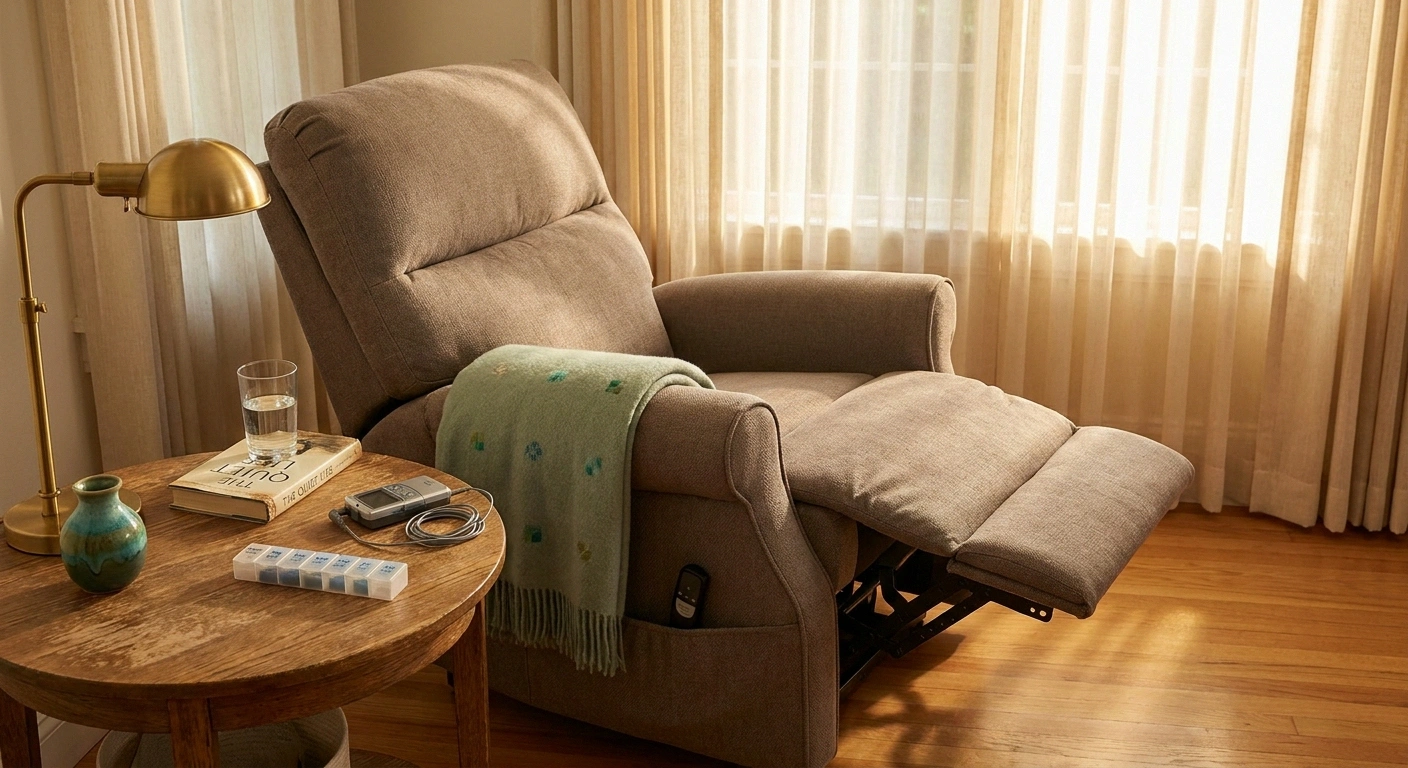
The chair in my living room is the most expensive piece of furniture I've ever bought, and I'd buy it again twice. For people with neuropathy, “where you sit” is not a small decoration question — it's the place where you spend most of your worst hours and most of your best ones. The right chair quiets your symptoms and makes the simple act of standing up easier; the wrong one feeds the burning, swells the ankles, and turns “getting up to use the bathroom” into a thirty-second project of bracing and rocking.
I'm Janet. I'm a patient advocate, not an interior designer, and I've helped a lot of friends in our support group think through this decision over the last few years. This is the practical version: what actually matters in a chair when you have neuropathy, what's marketing fluff, what the price tiers really get you, and how to test a chair before you bring it home.
Why the Chair Choice Matters More Than People Think
Most of us with neuropathy spend a significant chunk of our day sitting — reading, watching TV, eating, recovering from a walk, waiting out a flare. A few specific things go wrong when the chair is wrong:
Key Takeaway
The five features that actually matter for neuropathy: correct seat height for YOUR body, firm armrests you can push from, independent leg elevation, a power lift mechanism if standing is hard, and a seat width that fits. Skip the massage upgrade; pay for the lift. The right chair quietly pays itself back in fewer falls, less swelling, and more independence.
- Ankle and foot swelling from prolonged dependent sitting. Feet dangling down, no elevation, hours adding up.
- Numbness and pins-and-needles in the thighs or calves when the seat presses against the back of the legs in the wrong place.
- Burning intensifies as the day goes on because circulation slows in a low or hard chair.
- Stiffness in the hips and knees from too-low seats that fold the body deeply.
- Falls during standing when the chair sits too low or doesn't give you anything firm to push from.
- Sleep migration — a chair becomes the only place you can rest, but it's not designed for true sleep, and your spine pays for it overnight.
The right chair quietly solves most of those problems without anyone in the household having to think about them. The wrong chair quietly creates them. Most people don't notice until they sit in a friend's well-designed chair and realize how much pain has been compounding at home.
The Five Features That Actually Matter
You'll see a lot of marketing language when you shop for a recliner — “memory foam,” “infinite-position,” “zero-gravity,” “heat-and-massage.” Most of that is genuinely nice to have but not essential. The features that actually change life with neuropathy are these five.
The 5 Features Worth Paying For
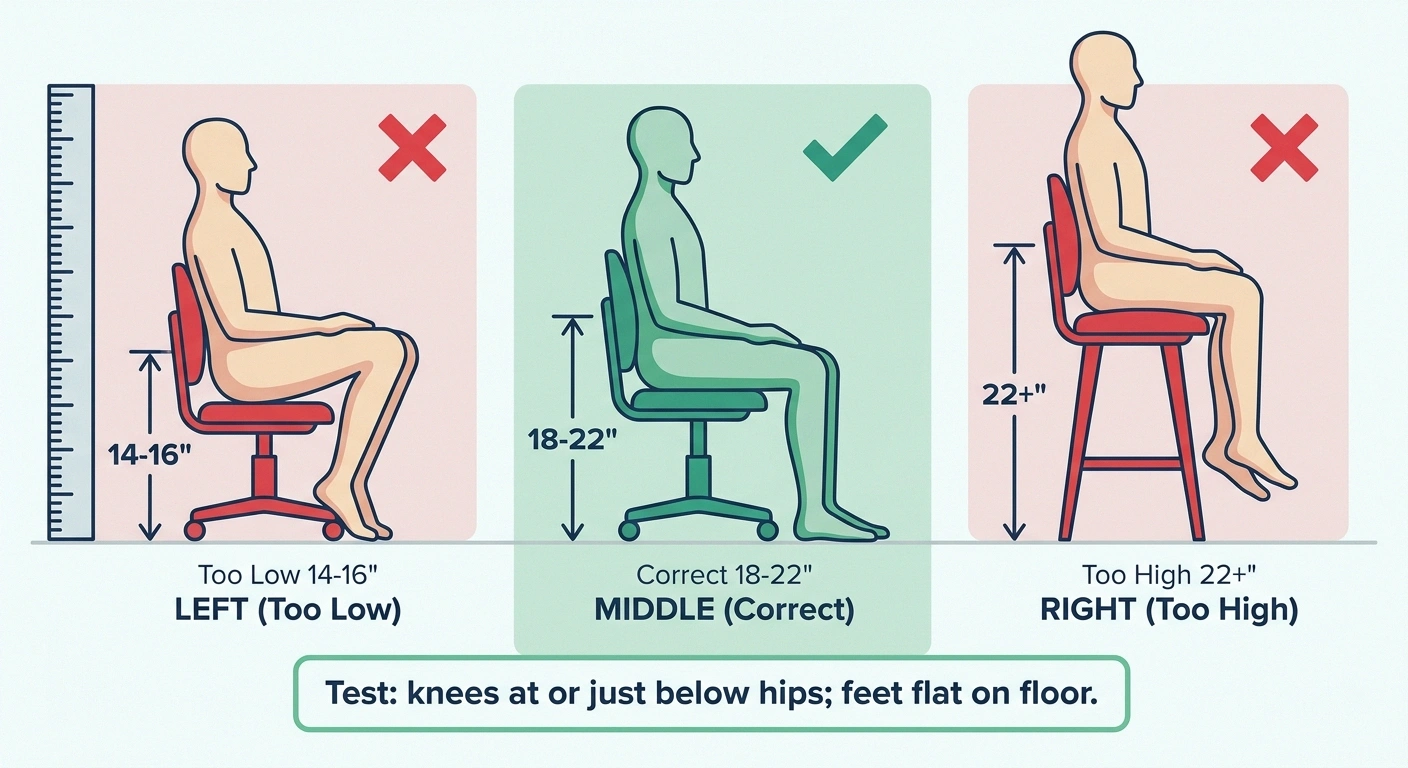
1. Seat height that fits YOUR legs. Sit in the chair. Feet flat on the floor. If your knees are higher than your hips, the chair is too low and you'll struggle to stand. If your feet dangle without floor contact, the chair is too high and the seat edge will compress the back of your knees. For most adults between 5'2″ and 5'10”, a seat height of 18 to 20 inches works. Taller people need 20 to 22 inches. Shorter people often need 16 to 18. Measure before you buy. Bring a measuring tape to the showroom.
2. Power lift if standing up is hard. A power lift recliner has a motor that tilts the entire chair forward, pushing you gently toward standing. This is not the same as a manual recliner with a footrest; the lift function gets you from sitting to almost-standing without using your legs. For anyone with significant balance issues, weakness, or who has fallen during stand-ups, a power lift chair is one of the most life-changing purchases you can make. The motors are quiet, the controls are simple (two buttons, up and down, sometimes a third for the footrest), and almost all of them have battery backup so they still work in a power outage.
3. Independent leg elevation. A chair that elevates your legs above heart level helps reduce peripheral swelling and feels noticeably better for most people with peripheral neuropathy. Look for a chair with a separate footrest control — not one that's coupled to the backrest. You want to be able to elevate your legs without having to fully recline your back. This single feature distinguishes the chairs designed for medical comfort from the chairs designed for nap-time.
4. Firm, supportive armrests that you can push from. Cushy armrests look inviting and feel terrible in practice. When you stand up from a chair, you push down on the armrests with your hands. If the armrests squish, your wrists hyperextend and you lose the leverage you need. Firm flat or slightly-padded armrests with a real wooden or steel frame underneath are what you want. Test this by pushing both palms down hard on the armrests while seated. They should not flex.
5. A seat width and back support that match your body. A chair that's too narrow makes you feel trapped and worsens hip stiffness. A chair that's too wide leaves you slumping sideways. The lumbar support should match the natural curve of your lower back; if it doesn't, ask whether the chair accepts a separate lumbar pillow without compromising the recline. Most quality chairs come in two or three sizes — sometimes labeled “small/medium/large” or by inseam measurements. Don't assume one size fits everyone.
If a chair has those five features, the rest is preference. If it's missing one or more, no amount of memory foam or massage settings will compensate.
The Chair Types — A Plain-English Map
Here's how the categories actually break down once you strip the marketing away:
Chair Types at a Glance
| Type | Price | Best for |
|---|---|---|
| Manual recliner | $300-$800 | Good hand strength, simple needs. |
| Power recliner | $600-$1,500 | Easier on hands; no lift needed yet. |
| Power LIFT recliner | $800-$3,000 | Hard to stand up; fall risk; medical use. |
| Wing chair + ottoman | $400-$700 | Budget-friendly alternative; no lift needed. |
| Glider recliner | $500-$1,200 | Soothing motion. NOT for high fall risk. |
| Wallhugger | $600-$1,800 | Small living rooms; reclines without rear clearance. |
Manual recliner. A handle or lever on the side moves the footrest up and the back down. Cheap ($300-$800), no batteries needed, simple. Downside: takes meaningful arm strength and core leverage to operate. If your hand strength or balance is significantly affected by neuropathy in the hands, the lever can be hard to use.
Push-button (power) recliner. Same chair concept but motorized. You press a button on the side or a small remote, and the chair reclines smoothly. Mid-range ($600-$1,500). Easier on hands and shoulders. Good middle option for people without lift needs.
Power lift recliner. The chair tilts forward to help you stand. Most also fully recline. Premium tier ($800-$3,000 depending on size and features). The standard recommendation for anyone whose neuropathy meaningfully limits standing from a chair. Medical Equipment Suppliers often sell these, and a few are partially covered by Medicare under specific medical necessity criteria (more on that below).
Zero-gravity recliner. A specific position where the legs are slightly higher than the heart and the spine is in a neutral S-curve. Some lift chairs include this as a preset. Useful for swelling and lower-back relief during long sits. Not a separate chair type, but a position worth asking about.
Glider recliner. A chair that gently rocks while reclined. Soothing for some people, motion-sickness-inducing for others. Test before buying. The rocking mechanism is harder to keep stable if you stand up unsteadily, so glider rockers are not the first pick for high fall-risk situations.
Wallhugger / space-saving recliner. Designed to recline without needing space behind it. Good for small living rooms. Same features otherwise as standard recliners.
The non-recliner option: a high-back wing chair with a separate ottoman. Don't dismiss this. A well-made wing chair with firm arms and a separate ottoman that elevates your legs is sometimes the best choice — particularly if you don't need a full lift function and you already have a fall-prevention plan. Easier to keep upright posture, simpler to clean, and often cheaper. Look for a wing chair with a 19-20″ seat height and firm padding throughout.
Power Lift Chairs — When They're Worth the Money
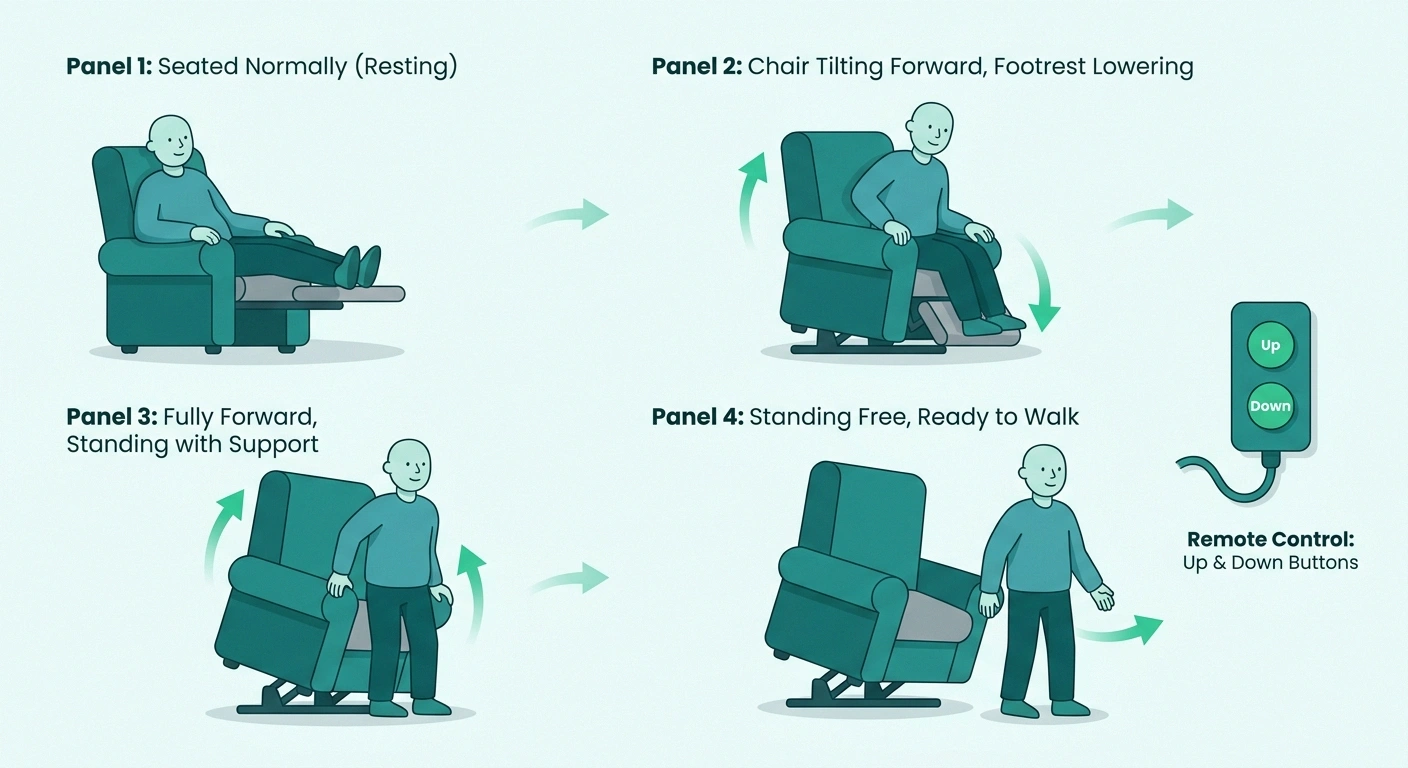
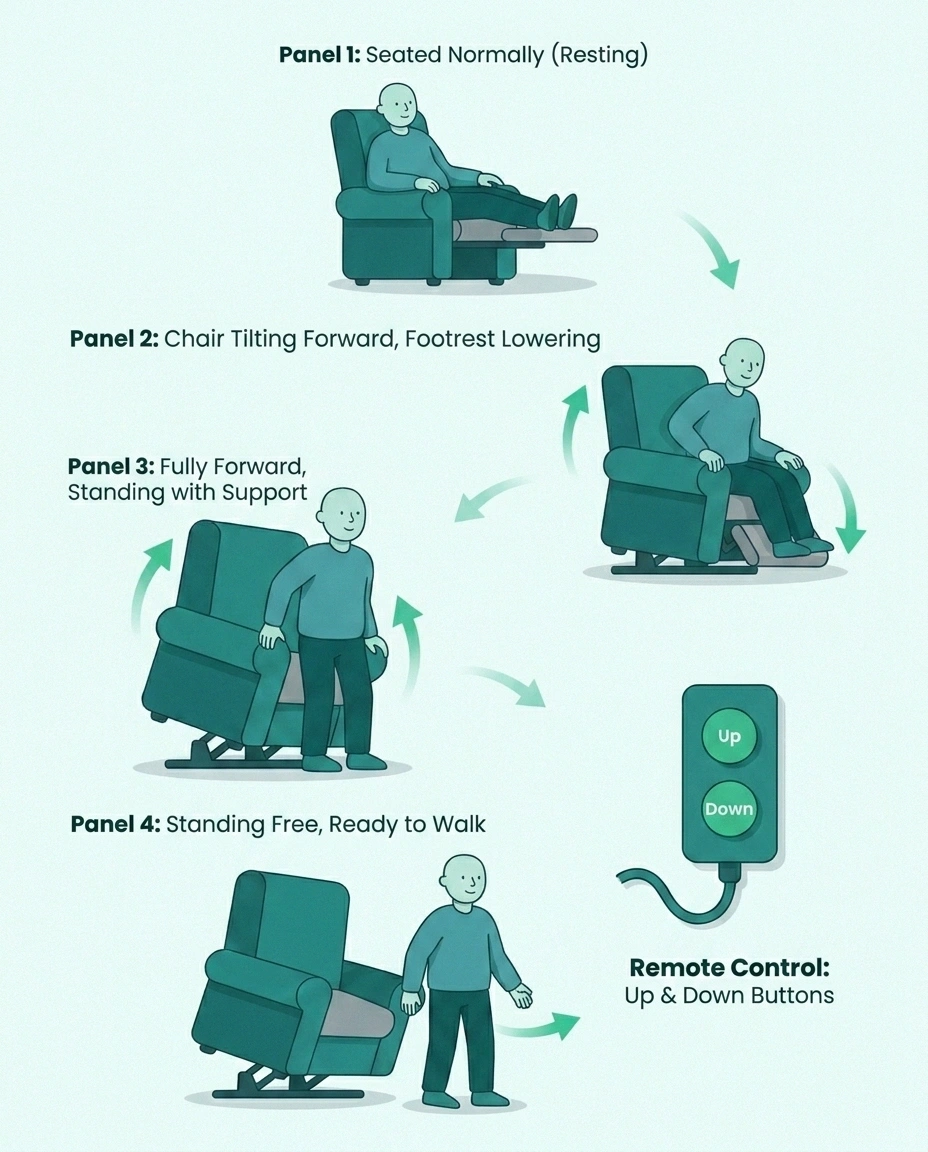
I want to spend a little time on power lift chairs specifically because they're the most expensive option in this category and the one people are most uncertain about.
A power lift chair is worth the money if:
- You've fallen or come close to falling while standing up from a regular chair in the last year.
- You sometimes avoid sitting in low chairs because you're not confident you can get up.
- Standing up takes you more than a few seconds and leaves you breathless or shaky.
- Your spouse or caregiver has had to help you up from a chair more than occasionally.
- You take longer than usual to start walking after standing up (often a sign of orthostatic autonomic neuropathy compounding the chair issue).
A power lift chair is probably overkill if:
- You can stand up from a regular dining chair without using the armrests.
- You only sit in your living room chair for an hour or two at a time.
- You're young and your neuropathy is currently mild — a good supportive recliner with a regular footrest is fine.
The power lift chair is one of those purchases that feels excessive until you have it and then feels essential. If standing up from your couch is genuinely hard right now, don't wait until after a fall to decide.
The Medicare Coverage Conversation
Here's a question that comes up nearly every time: does Medicare cover lift chairs? The short answer: partially, under specific conditions, and the part they cover is smaller than people assume.
Medicare and Lift Chairs — The Honest Numbers
Medicare Part B covers the lift mechanism only, NOT the whole chair. Typical reimbursement is roughly $300 of a $1,200-$2,500 chair price.
To qualify, your doctor certifies that you:
- Have severe arthritis of hip/knee OR a severe neuromuscular condition (peripheral neuropathy can qualify).
- Cannot stand from a regular chair even with arms.
- Will use the chair to transfer from sitting to walking — not to sleep.
Buy from a Medicare-approved DME supplier who will help file the claim. Check Medicare Advantage and supplemental plans — many cover more. Veterans should ask about VA prosthetic services, which often cover the full chair.
Medicare Part B will reimburse for the lift mechanism only — not the chair itself — if a doctor certifies that:
- You have severe arthritis of the hip or knee, OR a severe neuromuscular condition (peripheral neuropathy can qualify here).
- The lift mechanism is medically necessary for you to stand up.
- You cannot stand from a regular chair, even one with arms.
- You will use the chair to transfer from sitting to walking — not to nap or sleep.
The lift mechanism itself reimburses at roughly $300 of the typical $1,200-$2,500 chair price. You pay the rest. Some Medicare Advantage plans, and some private insurance, cover more — check your specific plan.
To get the partial reimbursement: your doctor writes a prescription specifying “seat lift mechanism, medically necessary for peripheral neuropathy” (or whatever your relevant diagnosis is), you buy the chair from a Medicare-approved Durable Medical Equipment (DME) supplier, you submit the paperwork. Most reputable lift-chair retailers know this process and will help you file the claim.
A separate path worth knowing: if you have a Veterans Affairs benefits package, the VA sometimes covers lift chairs more fully than Medicare. If you're a veteran, ask your VA primary care provider whether a Home Health evaluation could result in a lift chair through VA prosthetic services.
How to Test a Chair Before You Buy

This is where I see the biggest mistakes happen. People order chairs online based on photos and reviews, the chair arrives, it doesn't fit their body, and returning a 200-pound lift chair is a nightmare. Test in person if at all possible.
Test-Drive Checklist (Bring This to the Store)
Test protocol:
Wear what you'd actually wear at home. Don't test a chair in dress shoes if you mostly sit in soft house shoes. Don't test in jeans if you mostly wear loose pants. Bring whatever you'll actually sit in.
Sit for at least 15 minutes. A chair that feels wonderful for 30 seconds can become painful at 10 minutes. Most showrooms expect a real test sit. Bring a book or a cup of coffee. If a salesperson rushes you, find a different store.
Recline fully and check the leg position. Are your heels supported or hanging off the end? Does the footrest feel firm or floppy?
Stand up. Then stand up again. Then a third time. The first stand-up always feels easier than the third. If you're noticeably slower or shakier by the third try, the chair is too low for you.
Test the controls with one hand. If your hand neuropathy affects fine motor control, can you operate the buttons without dropping the remote? Are the buttons large enough to feel?
Push on the armrests. Both hands, hard, simulating a real stand-up. Any flex is a problem.
Ask about delivery and setup. A good retailer delivers the chair fully assembled, sets it up in your home, and shows you the controls. Avoid white-glove-extra services if the price quoted should already include this — many retailers bundle setup into the price for chairs over $800.
Check the return policy. Even with careful testing, a chair sometimes doesn't work in your home. Look for retailers offering a 30-day in-home return. Avoid stores that charge restocking fees over 15%.
The Setup at Home
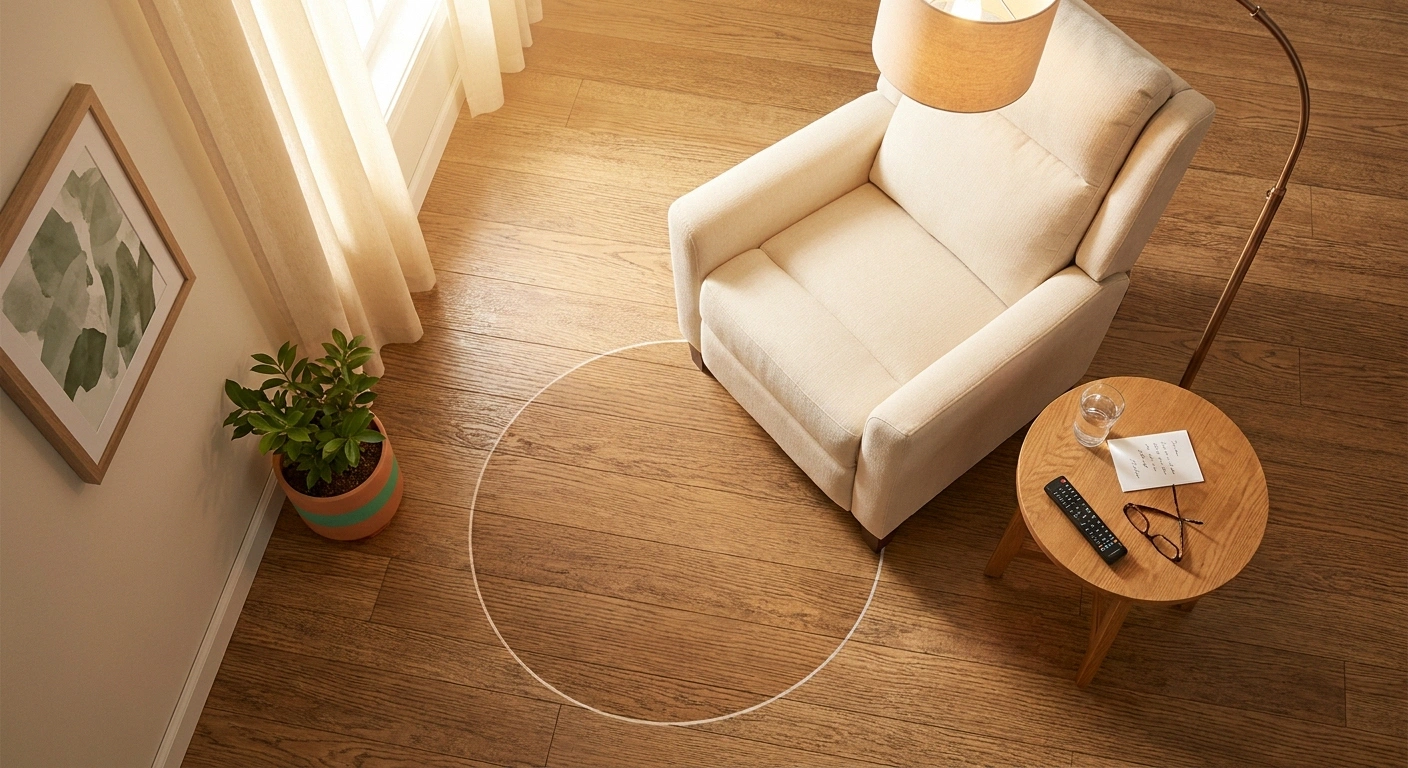
Once the chair is yours, a few practical setup notes:
Place it where you can stand up safely. Allow enough open floor in front for the footrest to fully extend without hitting a coffee table, plus enough room to swing your feet to the floor and stand without immediately bumping into anything. A clear 3-foot radius in front of the chair is the safe minimum.
Keep the floor around it clear. No throw rugs (a fall hazard for anyone with balance issues from neuropathy). No power cords across the standing path. No piles of magazines or laundry baskets that can be tripped over in low light.
Mind the side table. Place it where you can reach it without leaning far. A glass of water, your medication for the evening, a notebook, your phone, the TV remote — all within easy reach of your dominant hand. Reaching across your body for things you use constantly is a small repeated strain that adds up.
Lighting matters. A floor lamp behind the chair on the dominant-hand side gives you reading light without glare. Overhead lighting alone often isn't enough as eyes age. Lamp switches should be either touch-activated (easy with numb fingers) or accessible without leaning out of the chair.
Battery backup. If your chair is power lift, find out where the 9-volt battery backup compartment is (usually under the chair near the controls) and check it once a year. The battery only matters during a power outage, but during one is exactly when you most need to be able to stand up.
Don't sleep in it overnight. A recliner is wonderful for naps and rest periods. For full sleep, your spine, hips, and back need the support of a real mattress. People who end up sleeping in chairs long-term often develop pressure injuries, worsening swelling, and back pain. If the bed is no longer working, the problem is the bed (or a sleep condition like sleep apnea), and a chair isn't the right answer. Our supportive footwear and sleep-position resources walk through alternatives.
If the Budget Is Tight
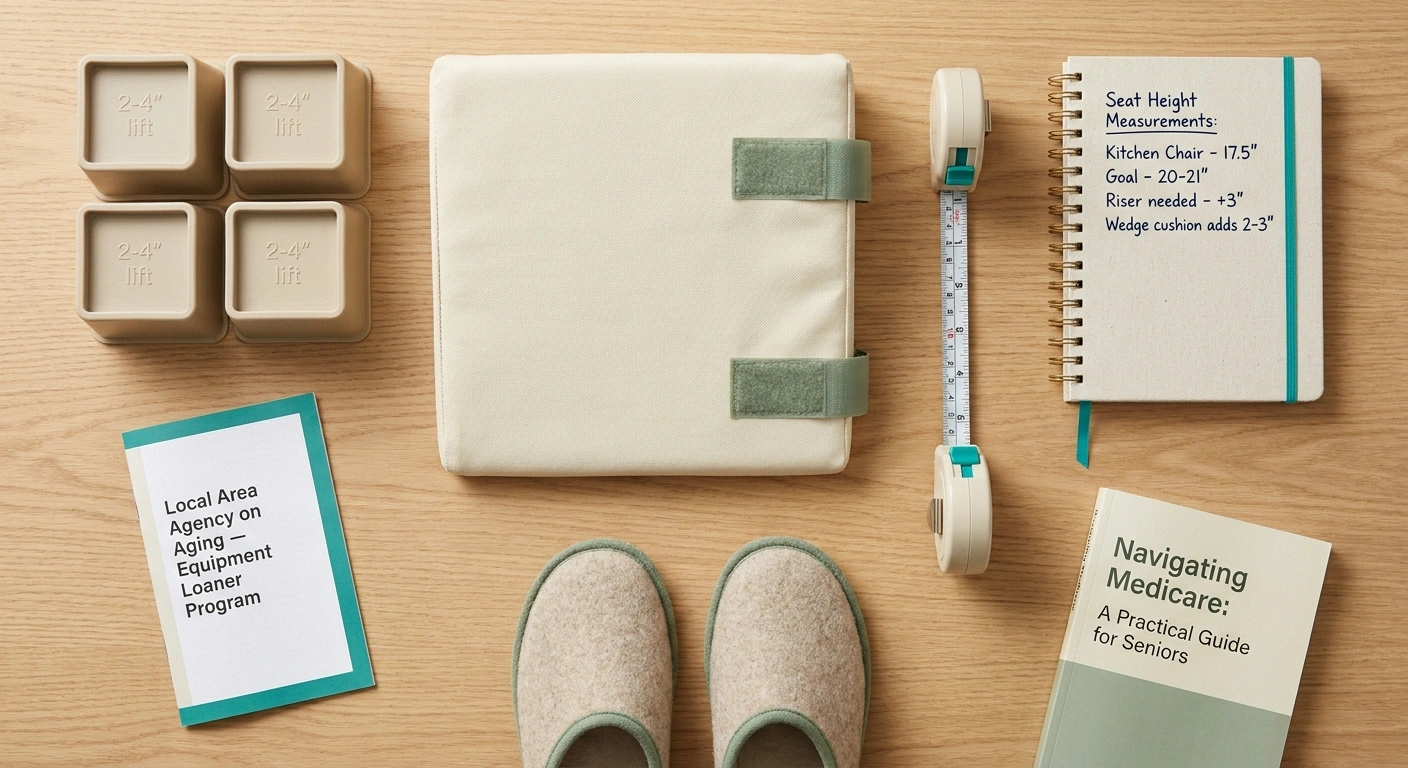
Not everyone has $1,500 for a power lift chair. Here are alternatives that get most of the benefit:
If Budget Is Tight — Smart Alternatives
Riser blocks for an existing chair. If your current recliner is comfortable but too low, $30-$60 plastic risers under the legs add 2-4 inches of seat height and dramatically improve standability. Available at hardware stores.
A wedge cushion. A firm foam wedge cushion ($40-$80) raises the seat by a couple of inches and angles you slightly forward — closer to the lift-chair position. Use Velcro straps to keep it from sliding.
A high-back wing chair plus separate ottoman. A good wing chair with a 19-20″ seat height and a separate ottoman that you can position for leg elevation can be assembled for $400-$700 total — about half a power lift chair. Less convenient (you have to move the ottoman to stand), but functionally similar.
Used or floor-model lift chairs. Furniture stores often have last-year's-model lift chairs at 40-60% off. Medical supply stores sometimes sell gently used returns. These are not glamorous to shop for, but the chairs themselves last many years.
State and area-agency programs. Some states have aging-and-disability resource centers that can connect you with grants or loaner programs for adaptive equipment. The local Area Agency on Aging is the place to start — these programs are real and underused.
A Brief Note on Massage and Heat
A lot of recliners advertise built-in heat and vibration massage. People ask whether these are worth paying for.
Heat: yes, generally useful, especially in cold weather. A warm seat reduces the cold-triggered burning and stiffness some people get. Caution: if you have significant numbness, you may not feel a heater set too high. Use the lowest setting and limit to 15-20 minutes at a time, just as you would with any heating pad.
Massage: pleasant, rarely transformative. The vibration in a recliner-based massage is mild and won't substitute for a real foot massage or a TENS unit. Nice to have, not worth paying $500 more for. If it comes with the chair you already want, enjoy it.
The Bottom Line
Spend the most you can sensibly afford on the place you'll sit for most of every day. Get the chair height right for your body. Get firm armrests. Get separately-elevating legs. If you can't reliably stand up from a regular chair, get a power lift. Test in the store before you buy. Set the chair up in a clear, well-lit area with what you need within reach.
A good chair will outlast every other piece of furniture in your house and quietly do the work of half a dozen smaller adaptations. The wrong one is a daily tax on your nerves you don't notice you're paying. This is one of those purchases where the right one repays its cost in the first six months — in fewer falls, less swelling, less stiffness, more independence — and then keeps repaying it for the next decade.
Frequently Asked Questions
What is the best recliner for neuropathy?
The best recliner for neuropathy depends on your specific needs, but the features that matter most are correct seat height for your body (knees at or just below hip level), firm armrests you can push from, independent leg elevation, and a power lift mechanism if standing up is difficult. Spending $1,000 to $2,000 on a power lift recliner from a Medicare-approved durable medical equipment supplier is the typical sweet spot for chronic neuropathy with mobility limitations.
Does Medicare cover a lift chair for neuropathy?
Medicare Part B partially covers the lift mechanism (about $300 of the typical chair price), not the chair itself, when a doctor certifies medical necessity for severe arthritis, severe neuromuscular disease, or another qualifying condition. Peripheral neuropathy with significant standing limitation can qualify. You buy from a Medicare-approved DME supplier and submit the claim. Many Medicare Advantage and supplemental plans cover more.
What seat height should a recliner be for neuropathy?
The right seat height depends on your inseam length. For most adults between 5'2″ and 5'10”, a seat height of 18 to 20 inches works. Taller adults need 20 to 22 inches. Shorter adults often need 16 to 18 inches. The test: when seated with feet flat on the floor, your knees should be at or just below the level of your hips. If your knees are higher than your hips, the chair is too low.
Should I get a power lift recliner or a regular recliner?
Get a power lift recliner if you have fallen or come close to falling while standing up from a regular chair, if you sometimes avoid sitting in low chairs because you cannot get up, if a spouse has had to help you stand more than occasionally, or if standing leaves you shaky for several seconds. A regular power recliner with firm armrests is enough if you can stand from a dining chair without using the armrests.
Can I sleep in my recliner if I cannot sleep in my bed?
Occasional naps in a recliner are fine. Sleeping in a recliner every night long-term is not advised — your spine, hips, and back need the full support of a real mattress, and people who sleep in chairs often develop pressure issues, increased swelling, and back pain. If your bed has stopped working for you, the right step is to address the bed or the underlying sleep problem rather than make a chair your bed.
What is a zero-gravity recliner position?
Zero-gravity position is a recliner setting where your legs are slightly higher than your heart and your spine is in a neutral S-curve, distributing your body weight evenly. It helps reduce peripheral swelling, eases lower-back pressure, and is often a preset on higher-end lift chairs. It is a position, not a separate chair type.
How can I make my current chair work better for neuropathy?
If your current chair is comfortable but too low, plastic riser blocks under the legs add 2 to 4 inches of seat height for $30 to $60. A firm foam wedge cushion ($40 to $80) raises the seat and angles you forward toward standing. A separate ottoman provides leg elevation. Adequate lighting and a clear floor zone in front make standing safer. These changes can buy you years before a new chair becomes necessary.
Are massage recliners helpful for neuropathy?
Recliner-built-in massage is pleasant but rarely transformative. The vibration is mild and will not substitute for a TENS unit or a real foot massage. Built-in heat is more useful, especially in cold weather, but be careful with significant numbness — use the lowest setting and limit duration as you would with a heating pad. Pay for the chair features that matter (height, lift, leg elevation), not for the massage upgrade.
How long should a quality recliner last?
A well-made recliner from a reputable manufacturer should last 10 to 15 years with regular use. The lift mechanism in a power lift chair is typically warranted for 1 to 7 years depending on brand. Frame warranties of 25 years or lifetime are common in the better tier. Choose a brand with a service network in your area in case a motor needs replacement.
About the Author