
If you’ve been prescribed isoniazid — usually because you tested positive for latent tuberculosis or are being treated for active TB — there’s one small, cheap, over-the-counter pill that can prevent one of its most common side effects. That pill is vitamin B6.
Isoniazid, often written as INH, has been the backbone of tuberculosis treatment since the 1950s. It’s remarkably effective and has saved millions of lives. But it has an inconvenient chemistry problem: its structure looks a lot like vitamin B6, and when the two go into the same body, isoniazid competes with B6 for the enzymes and pathways your nerves depend on. Left alone, the nerves in your feet start to complain.
The good news is that this is one of the few drug-induced neuropathies where prevention is genuinely straightforward. In this guide, I’ll walk you through why isoniazid causes nerve problems, who’s at highest risk, why B6 fixes it, how much to take (and how much is too much), and what to do if symptoms have already appeared.
What Isoniazid Is and Why It’s Being Prescribed to You
Isoniazid is one of the oldest and most important antibiotics in tuberculosis care. In the United States, you’re most likely to encounter it in one of two ways:
Key Takeaway
Isoniazid-induced peripheral neuropathy is one of the few drug-induced neuropathies where prevention is genuinely simple: 25 to 50 milligrams of vitamin B6 (pyridoxine) daily alongside your isoniazid keeps nerves protected while the TB drug does its job.
- Active TB treatment: As part of a multi-drug regimen (typically alongside rifampin, pyrazinamide, and ethambutol) taken for several months. Active TB is the version of the disease that causes cough, fever, weight loss, and can spread to others.
- Latent TB infection (LTBI) prophylaxis: A single-drug or short-course regimen taken to prevent latent TB — a “dormant” infection with no symptoms — from progressing to active disease later. This is common after a positive skin test or IGRA blood test, particularly for healthcare workers, immigrants, people with HIV, and those on immunosuppressive therapy.
Both patterns work. Both also carry the same B6-related nerve-side-effect risk if you don’t take a small supplement along with them.
How Isoniazid Damages Peripheral Nerves
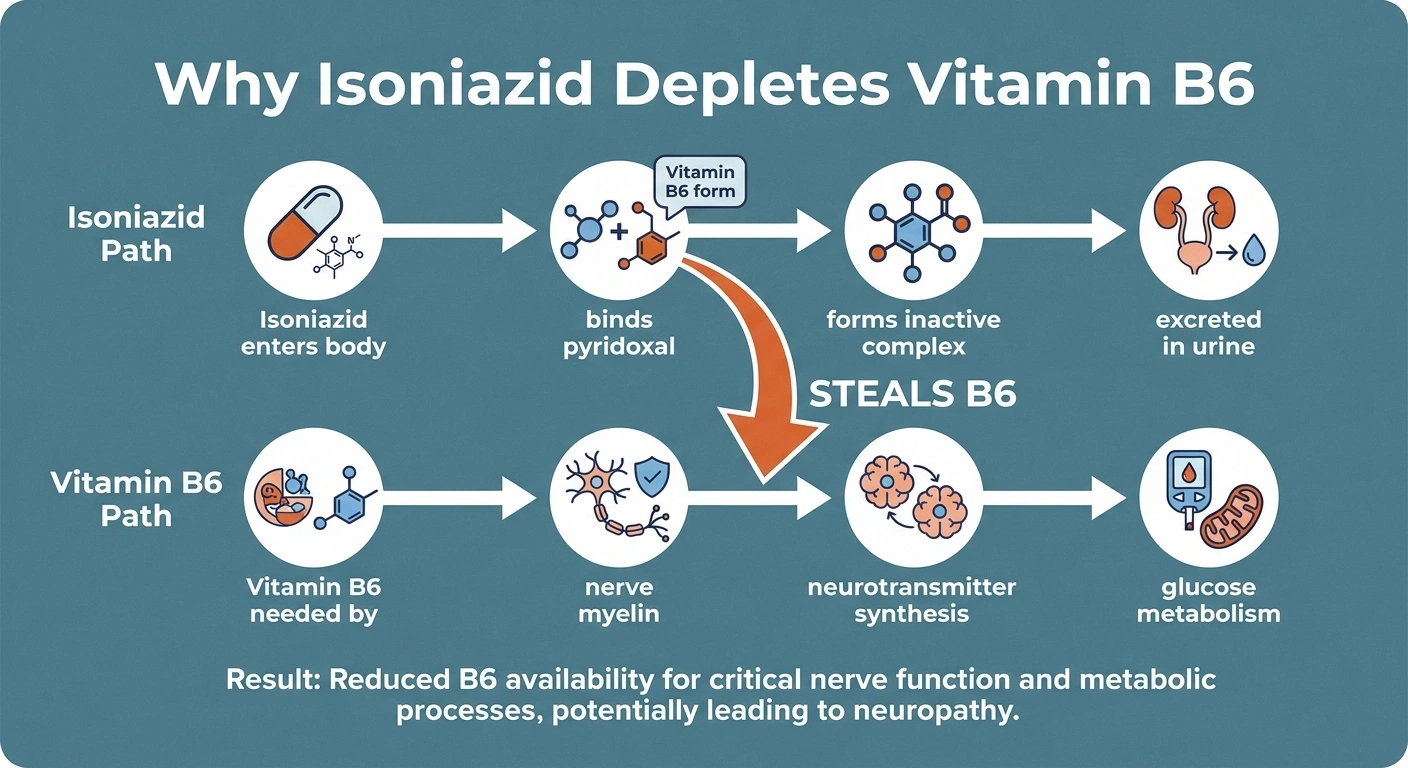
Here’s the chemistry, in plain language. Vitamin B6 (called pyridoxine in its supplement form and pyridoxal 5-phosphate in its active biological form) is a required cofactor for dozens of enzymes throughout your nervous system. Your nerves use B6 to build the neurotransmitters that carry signals, to keep the myelin sheath (the insulating coating around nerve fibers) healthy, and to help nerve cells manage energy metabolism.
🔬 The Mechanism in Plain Language
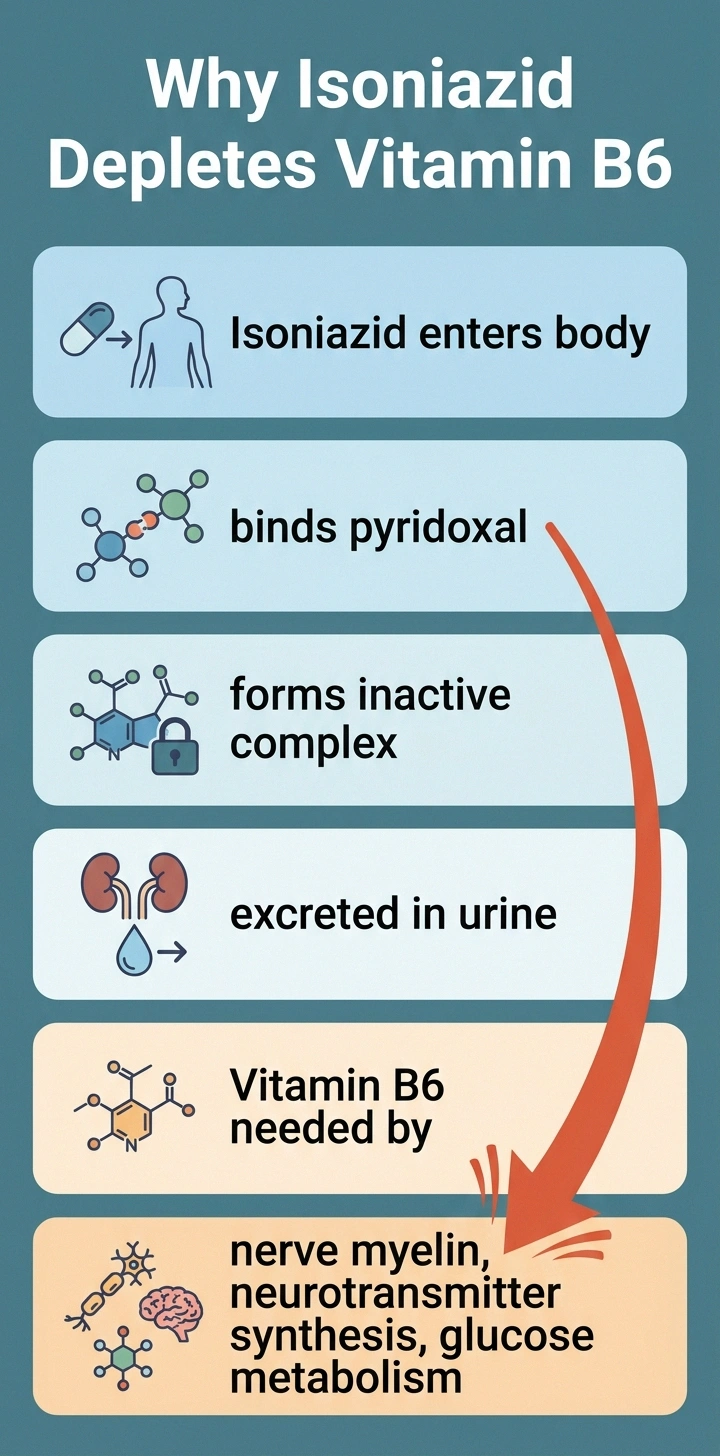
Isoniazid is chemically similar to vitamin B6. It binds to B6 in the body and forms an inactive complex that gets flushed out in the urine — draining the B6 stores your nerves need to function. Without B6, the long peripheral nerves feel it first. Add B6 back at the right dose, and the damage doesn’t happen.
Isoniazid is structurally similar enough to B6 that it hijacks the enzyme that normally activates it. Two things happen:
- Isoniazid binds to pyridoxal, forming an inactive compound that your kidneys excrete in the urine. That’s B6 leaving your body faster than it should.
- Isoniazid also competes with pyridoxine at the enzyme (pyridoxal kinase) that converts dietary B6 into the active form. So even the B6 you take in isn’t fully usable.
The result: over weeks to months, functional B6 stores get depleted. And when B6 runs low, the long peripheral nerves — the ones running down to your feet — are the first to feel it. Signals slow. Membranes destabilize. What you experience is tingling, then burning, then numbness in your feet, and it slowly climbs upward if the process isn’t halted.
This is a classic vitamin-deficiency neuropathy, just triggered by a medication rather than a diet gap.
Why Vitamin B6 Prevents Isoniazid Neuropathy

Once you understand the mechanism, the fix is obvious. If isoniazid is depleting B6 faster than your diet replaces it, then supplementing with B6 keeps the balance sheet in the black. The nerves keep functioning normally, and the isoniazid does its TB-killing job without side effects on the nervous system.
Prophylactic B6 Dose
25-50 mg
of pyridoxine (vitamin B6) daily, taken alongside isoniazid. This is the recommended standard for adults on TB therapy. One small tablet — that’s the whole intervention.
Every major TB treatment guideline — from the CDC in the United States to the World Health Organization globally — recommends pyridoxine coadministration with isoniazid for anyone at elevated risk of neuropathy. In practice, many providers give it to virtually everyone on isoniazid, because the cost is negligible, the safety profile is excellent at recommended doses, and the tradeoff is entirely in the patient’s favor.
The typical prescribing pattern is 25 to 50 milligrams of pyridoxine (vitamin B6) daily, taken alongside your isoniazid. That’s it. One small tablet. That’s the whole intervention.
Who Is Highest Risk and Who Absolutely Needs B6
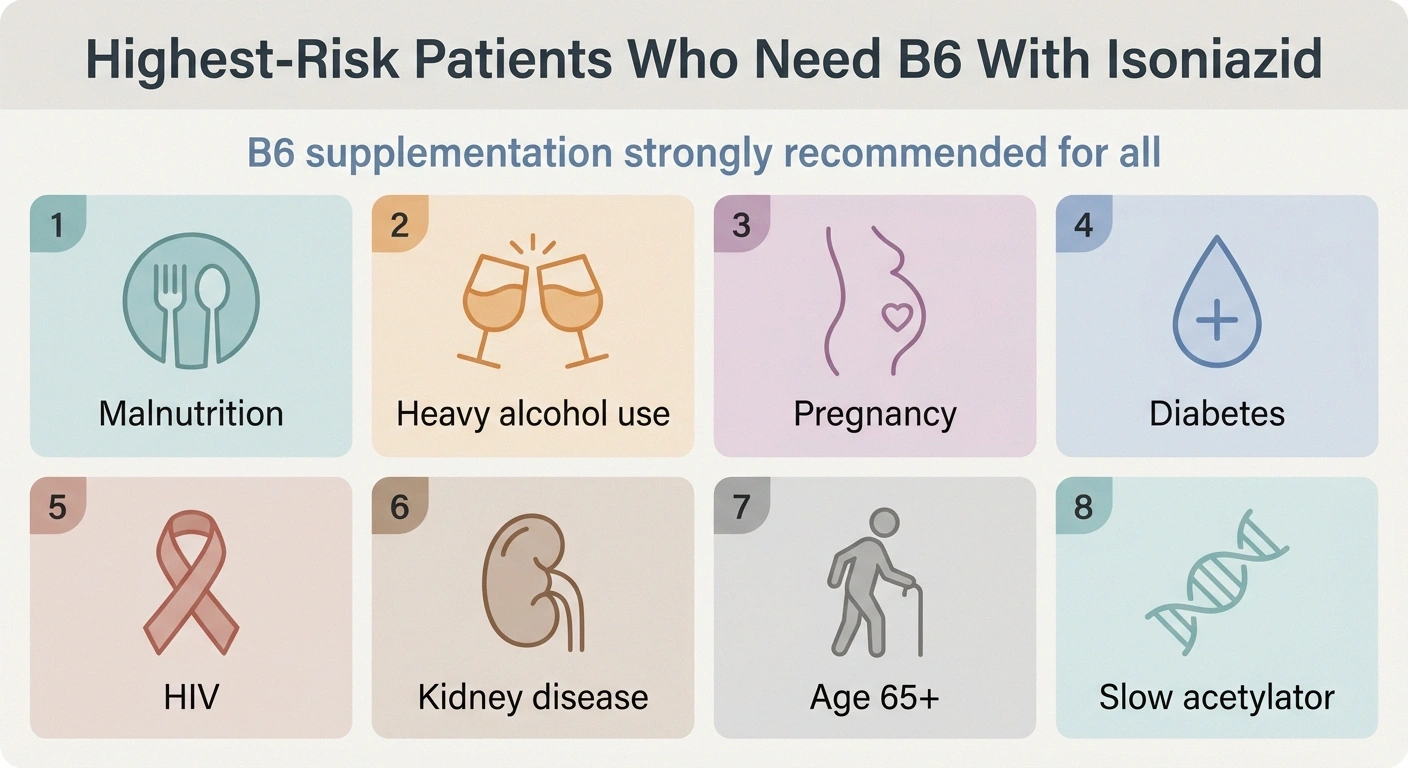
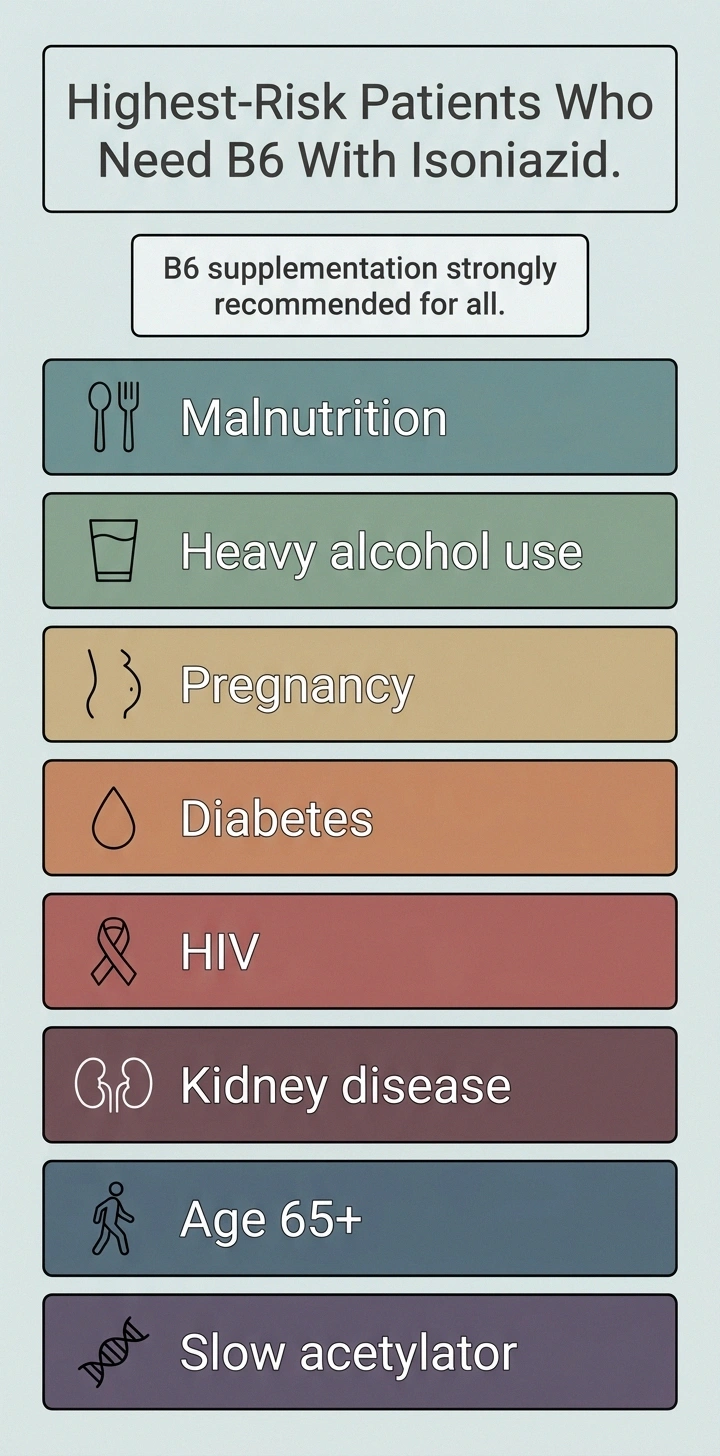
Some patients need B6 prophylaxis more than others. If any of the following apply to you and you’re on isoniazid, B6 coadministration should not be optional — it should already be part of your regimen. If it isn’t, that’s a conversation to have with your prescriber today:
⚠️ If You’re on Isoniazid Without B6
If you have any of the high-risk conditions listed above and pyridoxine was not prescribed alongside your isoniazid, contact your prescriber. This is a routine, easy fix — but it’s the fix that keeps small nerve issues from becoming permanent ones.
- Malnutrition or generally poor nutrition, including recent significant weight loss, restrictive eating, or food insecurity.
- Alcohol use disorder or heavy drinking. Alcohol independently depletes B vitamins and damages nerves — see our companion guide on alcoholic neuropathy — so adding isoniazid on top of chronic alcohol exposure stacks two neurotoxic influences.
- Pregnancy or breastfeeding. B6 requirements are elevated, and the nervous system is a priority for both the mother and the developing infant.
- Diabetes. Diabetic patients already run higher risk of peripheral neuropathy, and adding a nerve-toxic exposure compounds the vulnerability.
- HIV infection. HIV itself can cause peripheral neuropathy, and many antiretroviral regimens further contribute.
- Chronic kidney disease or advanced age (65+), which affect the clearance of isoniazid and its byproducts.
- Slow acetylators — a common genetic pattern in which the liver clears isoniazid more slowly than average. About half of people of European, Middle Eastern, and North African descent are slow acetylators. Genetic testing is available but rarely used in practice. If you have a family history of drug reactions or nerve issues on isoniazid, this may be part of the picture.
- Young children. Any child on isoniazid should also be on B6.
Even if none of these apply to you, most current U.S. prescribers still recommend B6 alongside isoniazid as a matter of routine. It’s a low-cost, low-risk safety net.
The Timeline: When Symptoms Typically Appear
Isoniazid-induced peripheral neuropathy is not a first-week reaction. It builds slowly as B6 stores get depleted.
Isoniazid Neuropathy Timeline (Without B6)
First few weeks
Symptoms unlikely — B6 stores still adequate.
1-3 months
Tingling in the toes — the earliest window in high-risk patients.
3-6 months
Burning feet syndrome develops — symmetric, stocking-distribution.
Beyond 6 months
Muscle weakness possible — reversibility still usually good with B6.
First few weeks
Symptoms are very unlikely in this window, whether or not you’re taking B6. Isoniazid needs time to gradually deplete B6 stores.
One to three months
This is the most common window for early symptoms to appear if B6 supplementation isn’t in place. High-risk patients (see the risk-factor list above) may notice symptoms earlier. Tingling in the toes and soles is typically the first sign, often noticed at rest or in bed at night.
Three to six months
Untreated, symptoms progress. Tingling gives way to burning — often described in the medical literature as “burning feet syndrome.” The pattern is symmetric and length-dependent, meaning both feet are affected and the sensation stops somewhere below the knee, in a stocking-like distribution. Our article on burning feet syndrome covers this presentation in detail — it applies to isoniazid neuropathy almost exactly.
Beyond six months
With prolonged exposure and no B6 correction, muscle weakness can develop. Fine coordination in the feet declines, balance becomes noticeably worse, and in severe cases foot drop can appear. The good news, even at this stage, is that isoniazid neuropathy is usually largely reversible once B6 is added and the drug is either stopped or continued with adequate supplementation.
Warning Signs to Report to Your Doctor
If you’re on isoniazid and notice any of the following, contact your prescriber promptly:
⚠️ Do Not Stop Isoniazid on Your Own
Stopping isoniazid partway through TB treatment can cause drug-resistant infection and puts you and those around you at risk. In most cases of early nerve symptoms, adding or increasing B6 handles the problem while your TB regimen continues.
- New tingling, pins-and-needles, or numbness in your toes or soles.
- A burning sensation in your feet, particularly at night.
- A feeling that your feet are cold, cottony, or that there’s something wrapped around them.
- Any new weakness — catching your toe on the carpet, difficulty climbing stairs, foot slap when you walk.
- New tingling or clumsiness in your hands (this indicates the process has progressed).
- Any change in balance or a new tendency toward stumbling.
Do not stop taking isoniazid on your own. This is critical. Untreated or partially treated TB can become resistant, requiring longer and more difficult drug regimens, and active TB can spread to others. Your prescriber may need to adjust your B6 dose, evaluate your symptoms, or in rare cases modify your TB regimen — but that decision is theirs, not yours to make alone.
How Much B6 Is Enough — and How Much Is Too Much
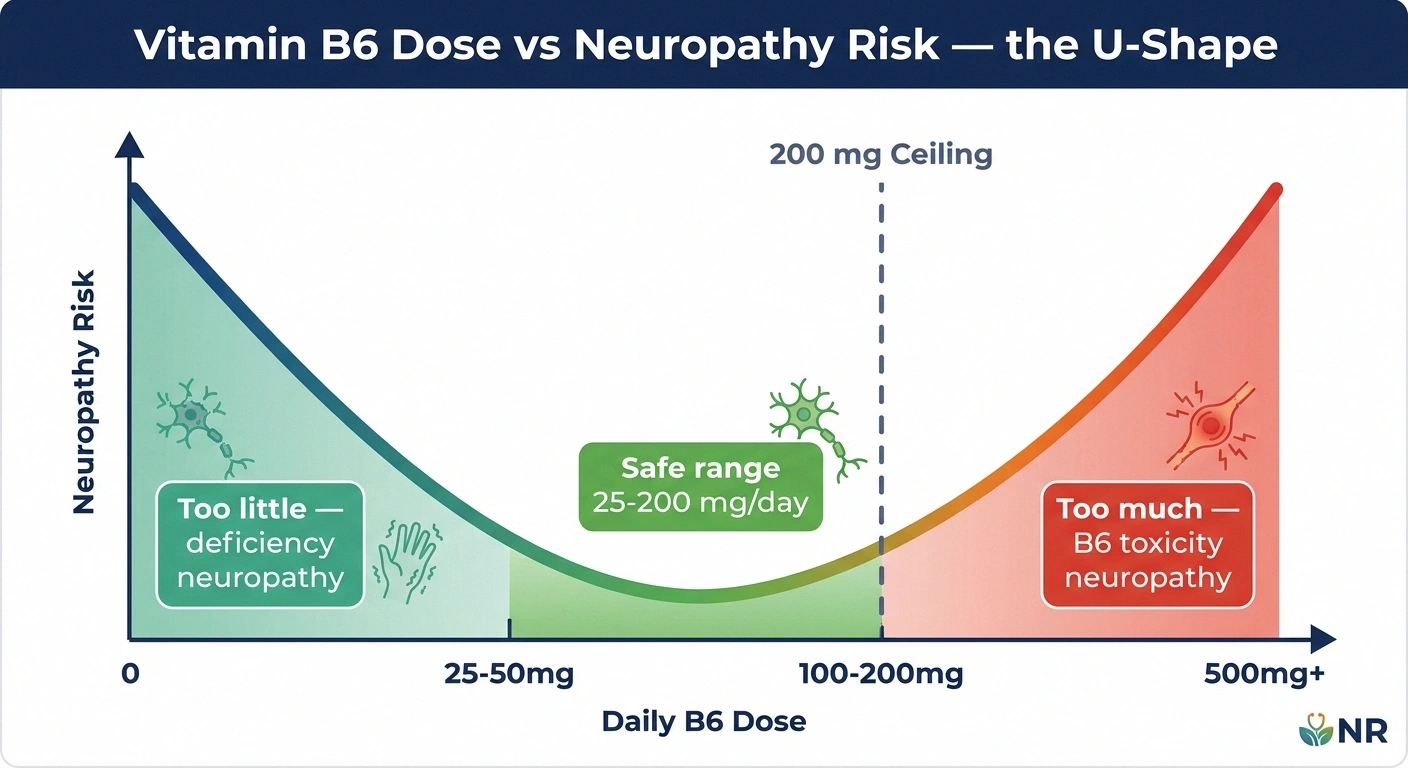
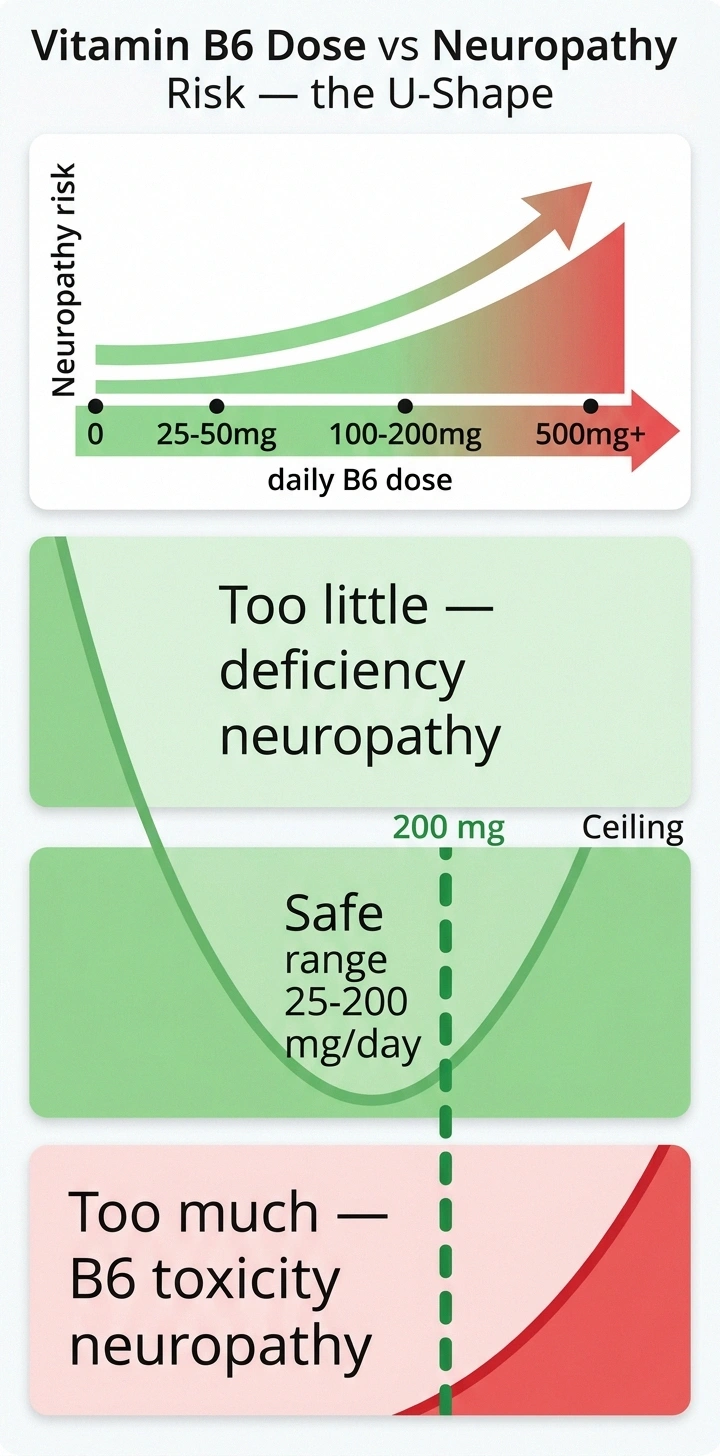
Here’s where things get nuanced, because vitamin B6 has an unusual dose-response pattern. Too little B6 causes neuropathy. And, strange as it sounds, too much B6 also causes neuropathy. It’s a U-shaped curve.
🔬 The B6 U-Curve
25-50 mg
Prophylactic — prevents neuropathy
100-200 mg
Treatment (with doctor)
> 200 mg
B6 toxicity — CAN cause neuropathy
Too much B6 is not “safer than too little.” Chronic doses above ~200 mg/day are linked to a paradoxical sensory neuropathy that mimics the deficiency it’s meant to prevent.
Prophylactic dose (preventing neuropathy while on isoniazid)
25 to 50 milligrams of pyridoxine per day is the standard prophylactic dose. This is what’s recommended alongside isoniazid for essentially all adult patients.
Treatment dose (for established isoniazid neuropathy)
Under a doctor’s guidance, higher doses of 100 to 200 milligrams per day may be used short-term to reverse established symptoms. This is a medical decision that should be made by your prescriber, not self-administered.
The ceiling — do not go higher
Doses above 200 milligrams per day of B6 taken chronically can themselves cause a peripheral neuropathy — a paradoxical B6 toxicity that produces symptoms nearly identical to the deficiency it’s supposed to prevent. This is not a theoretical concern; there are clear case series in the medical literature of patients developing sensory neuropathy from megadosed B6, sometimes reaching into the grams-per-day range.
The takeaway: stay within the range your doctor prescribes. Don’t grab the highest-dose B6 bottle on the shelf thinking more is safer. It isn’t.
What to Do If Symptoms Have Already Started
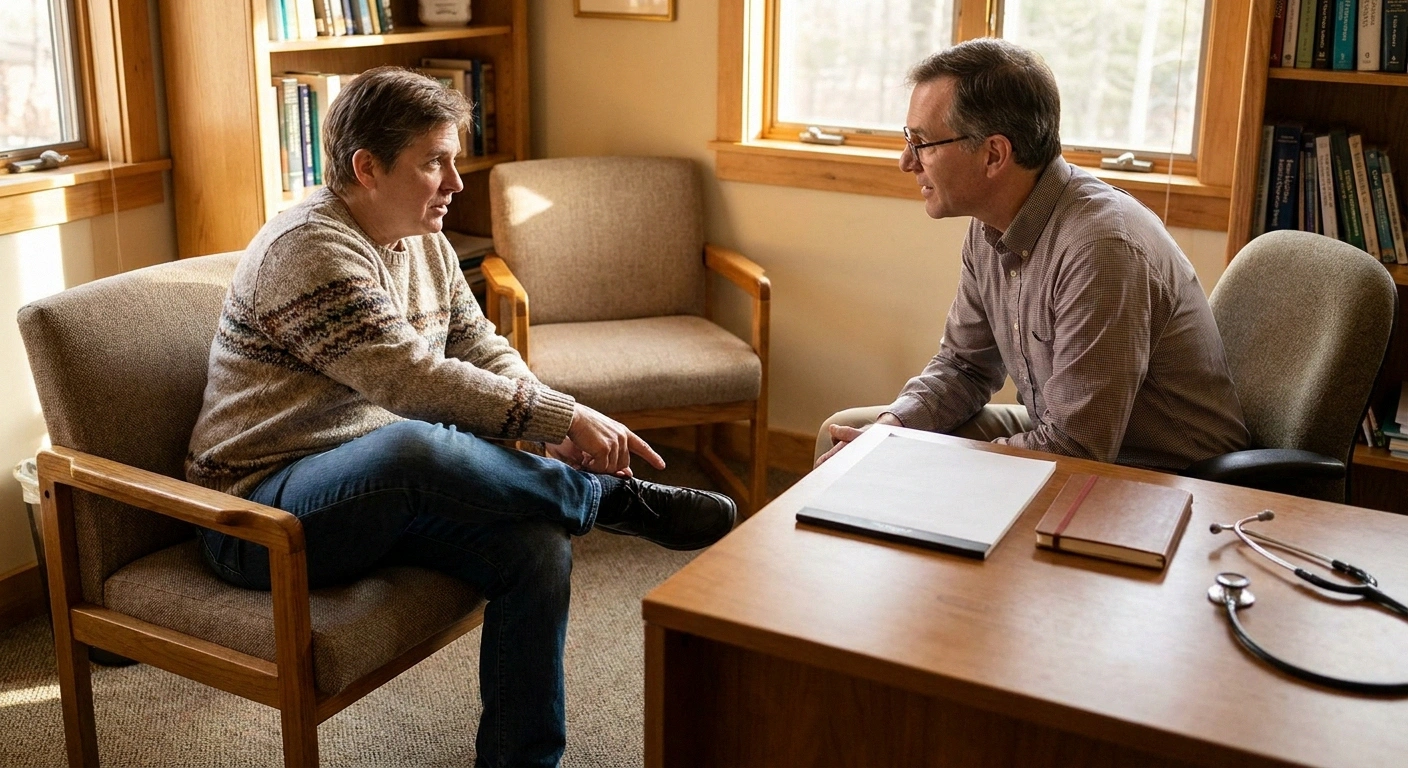
If neuropathy symptoms have appeared while you’ve been on isoniazid, the workup is usually straightforward and the outcome is often good. Here’s what a typical evaluation looks like:
- Call your prescriber. Describe the symptoms clearly, including when they started and how they’ve evolved.
- Blood work to check B6 levels (if available), B12, folate, glucose, thyroid, and basic metabolic panel — ruling out other contributors.
- Physical exam to characterize the pattern (distal, symmetric, length-dependent = classic isoniazid picture).
- Adjustment of B6 dosing — either starting supplementation if it wasn’t already prescribed, or increasing the dose short-term to treatment levels.
- Decision on isoniazid — most patients continue their TB regimen with added or increased B6 and see symptom improvement. In severe cases with weakness, temporary discontinuation may be considered, but this is a specialist call.
- Referral if needed. If symptoms are advanced or don’t respond to B6, a neurologist may perform nerve conduction studies and EMG. Our article on neuropathy diagnosis walks through what to expect from those tests.
Recovery: What to Expect

Isoniazid neuropathy has one of the better recovery outlooks among drug-induced neuropathies. Because the root problem is a nutrient depletion — not direct axonal destruction — most patients see meaningful improvement once B6 stores are restored, provided the process hadn’t progressed to advanced muscle weakness.
Recovery is typically measured in weeks to months, not days. The tingling usually eases first, then the burning, then any weakness that had developed. Some patients report lingering mild sensations that improve slowly over the year following completion of TB therapy.
Supportive strategies during recovery mirror general nerve-health care: consistent B6 within the safe range, good general nutrition (including other B vitamins — see our supplement guide), attention to blood sugar if diabetes is in the picture, careful foot care, and reasonable physical activity to keep circulation and nerve health supported.
Other TB Medications and Nerve Concerns

A quick note for anyone on a multi-drug TB regimen: isoniazid is the main peripheral-neuropathy concern among the standard first-line TB drugs. Ethambutol, a different first-line drug, can affect the optic nerves (vision) rather than the peripheral nerves and requires periodic eye checks — a distinct issue that your TB team will be monitoring separately. Rifampin and pyrazinamide have other concerns (liver function, drug interactions) but aren’t major peripheral-nerve threats. Linezolid, sometimes used for multidrug-resistant TB, is another peripheral neuropathy risk drug worth discussing with your specialist if it’s part of your regimen.
For the broader landscape of drugs that can cause nerve problems, our medications that cause neuropathy guide covers the terrain.
Frequently Asked Questions
Do I really need to take vitamin B6 with isoniazid?
In most cases, yes. Every major TB treatment guideline recommends pyridoxine coadministration for patients at elevated neuropathy risk, and many U.S. prescribers give it to essentially everyone on isoniazid because it prevents a common, avoidable side effect at very low cost and risk. If you weren’t given a B6 prescription and think you may have missed it, ask your prescriber directly.
What dose of B6 should I take with isoniazid?
The standard prophylactic dose is 25 to 50 milligrams of pyridoxine (vitamin B6) daily, taken alongside isoniazid. If symptoms have already developed, your doctor may temporarily increase this to a treatment range of 100 to 200 milligrams per day. Do not exceed 200 milligrams per day of B6 chronically, as high doses can themselves cause nerve damage.
Can isoniazid neuropathy be reversed?
Usually, yes — especially when B6 is added early and the drug is either continued with adequate supplementation or, in severe cases, adjusted by your prescriber. Because the underlying problem is a functional B6 deficiency rather than direct nerve destruction, restoring B6 typically produces meaningful improvement. Recovery takes weeks to months rather than days.
How long does it take for isoniazid neuropathy to develop?
Typically one to six months of isoniazid therapy without adequate B6 supplementation. High-risk patients (malnourished, diabetic, HIV-positive, heavy alcohol use, elderly) may develop symptoms sooner. Patients taking prophylactic B6 alongside isoniazid rarely develop neuropathy at all.
Should I stop isoniazid if I notice tingling in my feet?
No — do not stop on your own. Call your prescriber promptly, describe the symptoms, and let them decide the next step. TB requires complete treatment; stopping partway through can lead to drug-resistant infection, which is far more difficult to treat. In most cases, adding or increasing B6 handles the problem while you continue your TB regimen.
Can I get enough B6 from food instead of a supplement?
Under normal circumstances, dietary B6 (from foods like chicken, fish, potatoes, bananas, chickpeas, and fortified cereals) is adequate for most adults. But isoniazid actively depletes B6 through a chemical mechanism that diet alone can’t fully overcome. When you’re on isoniazid, a targeted B6 supplement at the doses your prescriber recommends is the reliable approach.
Is high-dose B6 dangerous?
Yes, at chronic doses above about 200 milligrams per day. Paradoxically, too much B6 can itself cause a peripheral sensory neuropathy with symptoms very similar to a B6 deficiency — a well-documented U-shaped dose-response. Stick to the range your prescriber recommends and don’t reach for megadose B6 supplements thinking more is better.
What if I’ve already finished my TB treatment and still have symptoms?
Continue with the B6 dose your doctor recommends and give recovery time. Follow up with your prescriber if symptoms don’t improve over the following months, or ask for a neurology referral. Persistent symptoms after adequate B6 replacement may warrant further evaluation to rule out other contributing causes.
About the Author