
If you’ve been taking nitrofurantoin — you might know it as Macrobid, Macrodantin, or Furadantin — for a urinary tract infection, or if you’ve been on a low nightly dose for months to prevent them from coming back, this article is worth reading carefully.
Nitrofurantoin has been a workhorse antibiotic for UTIs since the 1950s. For most people who take a five-day course, it does its job and moves on quietly. But there’s one side effect that doesn’t get talked about enough at the pharmacy counter: peripheral neuropathy. It’s uncommon, but when it happens, the damage can be permanent — and the people most at risk are the ones most likely to be on the drug the longest.
I want to walk you through what actually happens, who’s most vulnerable, and — most importantly — the warning signs that mean “call your doctor today, not next week.” This isn’t about scaring anyone away from a medication that’s helped countless women (and it is mostly women) stay out of the ER for UTIs. It’s about making sure you know what to watch for so a small tingle doesn’t become something you can’t undo.
What Nitrofurantoin Is (and Why Doctors Reach For It)
Nitrofurantoin is an antibiotic that concentrates in your bladder. That’s actually its superpower — it goes exactly where the UTI is and doesn’t spread throughout your whole system the way many antibiotics do. Because it stays local, it disrupts your gut bacteria less, and bacteria are slower to become resistant to it than they are to some newer antibiotics. All good things.
Key Takeaway
A five-day course of nitrofurantoin for an active UTI carries a very low risk of neuropathy in most healthy adults. The nerve-damage concern grows sharply with long-term suppression — nightly low-dose therapy taken for months, especially in patients over 65 or with reduced kidney function.
You’ll typically see it prescribed in one of two patterns:
- Short course for an active UTI: Usually 100 mg twice a day for five days. This is the standard treatment for uncomplicated bladder infections and is what most guidelines recommend.
- Long-term nightly suppression: A lower dose — often 50 or 100 mg once at bedtime — taken for months or even years to prevent recurring UTIs. This is where the neuropathy risk climbs.
Both patterns are legitimate. The short course is generally very safe. The long-term suppression is where I want you to pay close attention, especially if you’re over 65 or have kidney issues.
How Nitrofurantoin Can Damage Peripheral Nerves
Here’s the piece that helps everything else make sense. Nitrofurantoin, once absorbed, gets broken down into reactive chemical byproducts. Normally, healthy kidneys filter these out quickly and they’re gone. But when the kidneys are working slower — from age, from diabetes, from kidney disease, from dehydration — those byproducts hang around in the bloodstream longer than they should.
The Big Risk Number
CrCl < 60
A creatinine clearance below 60 mL/min is the strongest single risk factor for nitrofurantoin-induced peripheral neuropathy. A simple blood test tells you where you stand.
Nerve tissue is remarkably sensitive to that kind of chemical stress. The long nerves running down to your feet are the most vulnerable because they have the farthest to send signals and the least room for error. Over time, if the toxic exposure continues, the axons — the wire-like part of the nerve that carries the electrical signal — start to degenerate. That’s when the tingling, burning, and numbness begin.
This is a classic medication-induced neuropathy pattern. It’s length-dependent, meaning it hits the feet first and, if allowed to progress, moves up the legs and can eventually involve the hands.
Who Is Most at Risk for Nitrofurantoin Neuropathy?

The medical literature is consistent on this — nitrofurantoin neuropathy is not a random event. It clusters around specific risk factors. If none of these apply to you and you’re taking a five-day course for a UTI, your risk is very low. But the more of these boxes you check, the more carefully you and your prescriber should be watching.
⚠️ Warning — Higher-Risk Profile
If three or more of these apply to you, extra vigilance is warranted:
- Age 65 or older
- Kidney function below normal (CrCl < 60 mL/min)
- Diagnosed diabetes
- Long-term (> 3 months) nitrofurantoin use
- Known low B12 or other B vitamin levels
- Anemia
Kidney function is the big one
Reduced kidney function — technically, a creatinine clearance below 60 milliliters per minute — is by far the strongest risk factor. If your kidneys can’t clear the drug efficiently, the toxic byproducts accumulate. For years, the FDA label said absolutely no nitrofurantoin below CrCl 60. Newer guidance (including the 2015 Beers Criteria and later updates) softened that slightly for short-course use in patients with CrCl of 30 to 60, because the drug still works well for acute UTI and the short duration limits harm. But even the updated guidance still says avoid long-term suppression in anyone with reduced kidney function.
Your kidney function is easy for your doctor to check with a simple blood test (basic metabolic panel or renal panel). If you’re on long-term nitrofurantoin and no one has checked your kidney function in the last year, that’s a reasonable thing to ask about.
Other conditions that stack the risk
Beyond kidneys, several conditions compound the risk of nitrofurantoin-induced neuropathy:
- Diabetes. Diabetic patients are already at higher risk for diabetic peripheral neuropathy. Adding a nerve-toxic drug on top of already-vulnerable nerves compounds the problem, and it can be hard to tell whether new symptoms are from the diabetes or from the drug — which is exactly why any new tingling deserves attention.
- Anemia. Reduced oxygen delivery to nerve tissue makes it more vulnerable to any additional insult.
- B vitamin deficiency. If you’re already low on B12, B6, or thiamine, your nerves have less reserve. See our guide to vitamin deficiency and neuropathy for a fuller picture.
- Electrolyte imbalances. Chronic dehydration, diuretic use, or other electrolyte disturbances add stress on the nervous system.
- Being frail or having multiple chronic conditions. Sometimes described in the literature as “debilitating disease,” this just means the body has less overall reserve to buffer against a drug side effect.
Age matters — but not in the way you’d think
Older adults aren’t at higher risk simply because they’re older. They’re at higher risk because kidney function naturally declines with age, and because they’re the ones most likely to be prescribed long-term suppressive nitrofurantoin for recurring UTIs. If you’re a 78-year-old woman who’s been on a nightly dose for two years and no one has checked your kidneys in a while — that’s the exact profile that gets in trouble.
The Timeline: When Symptoms Typically Appear
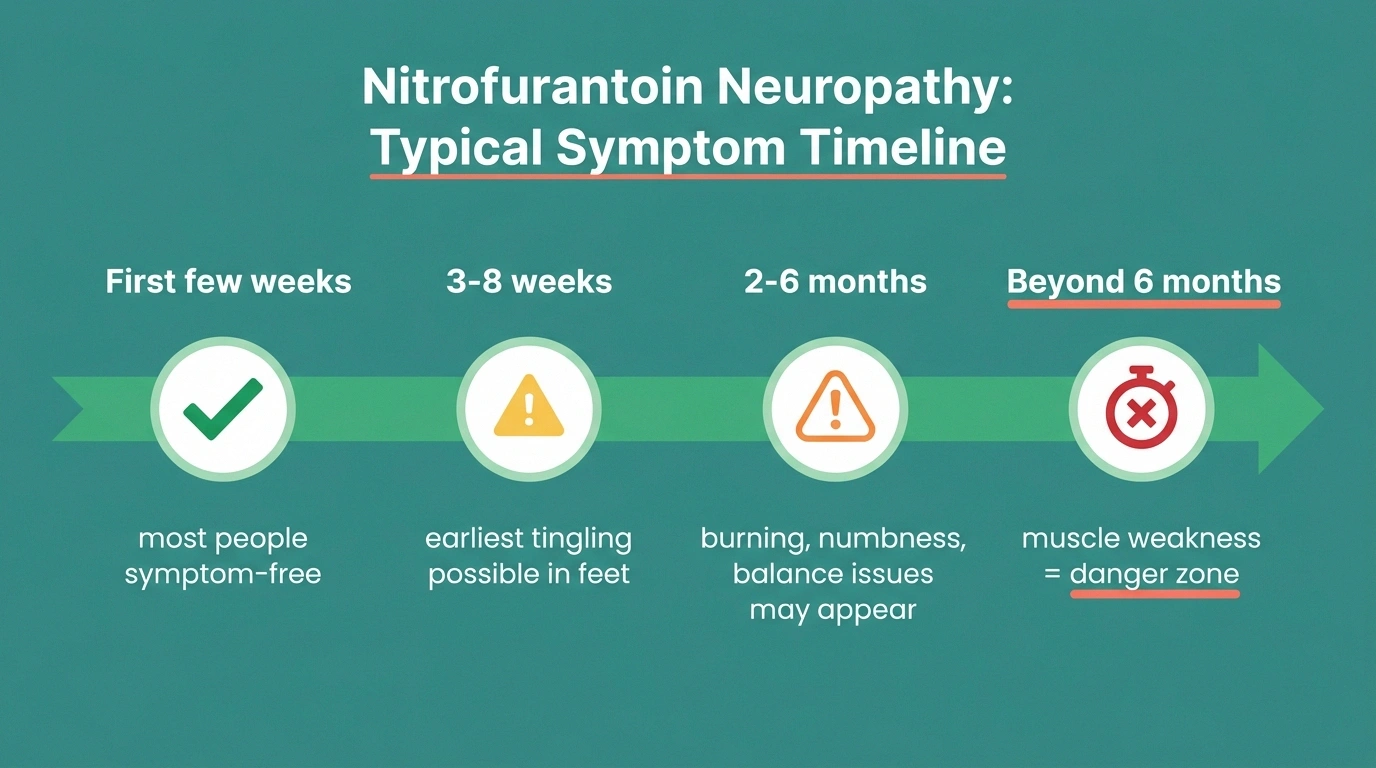
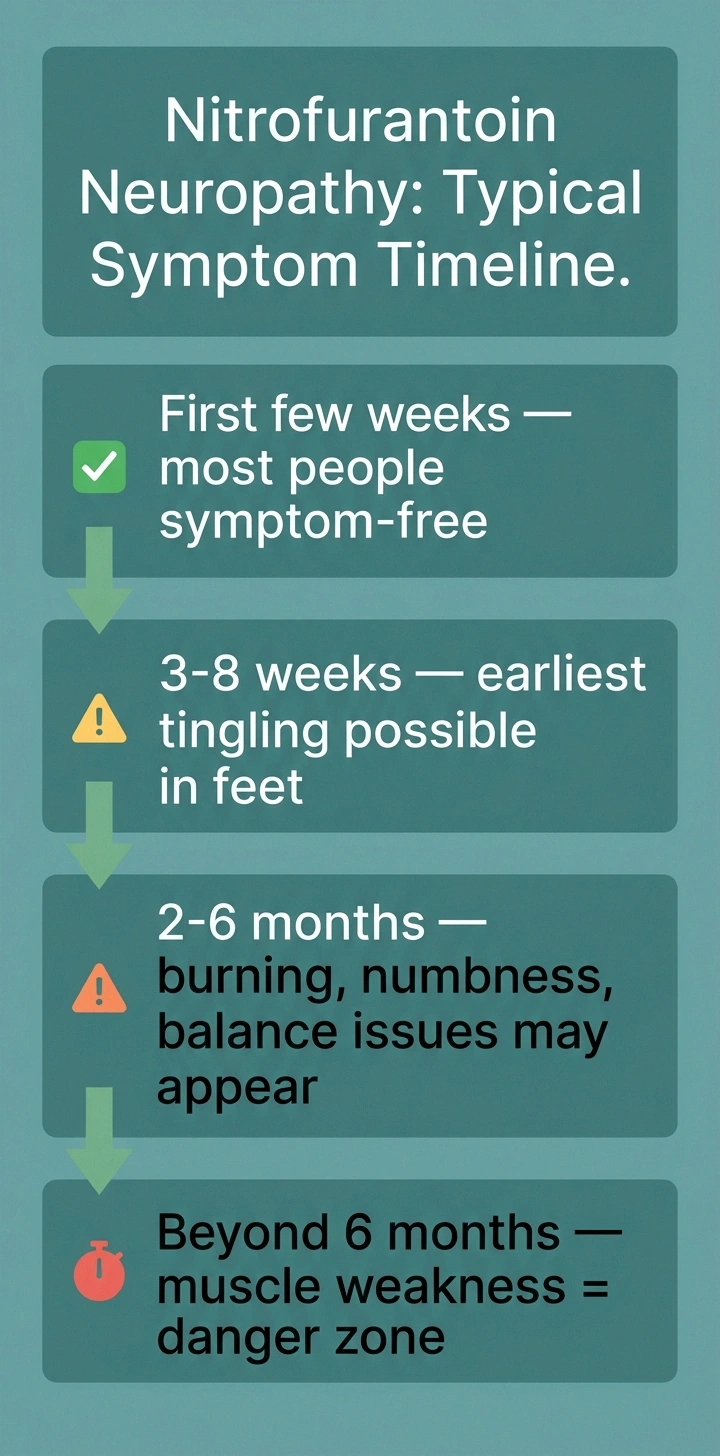
This part is important because it dispels a common misunderstanding — that a side effect from a drug shows up on day one or not at all. Nitrofurantoin neuropathy has a delayed onset, and the timeline looks roughly like this:
Typical Symptom Timeline
First few weeks
Most people symptom-free. Short courses (5 days) almost never trigger nerve issues.
3-8 weeks
Earliest window for subtle tingling in the toes — often first noticed sitting still or lying in bed.
2-6 months
Burning, numbness, balance issues can emerge. This is when many patients seek help.
Beyond 6 months
Danger zone — muscle weakness may develop and full recovery becomes less likely.
The first few weeks
Most people finish a five-day course with no neurological symptoms whatsoever. Nitrofurantoin neuropathy is not a same-day reaction. If you’re doing a short course for an acute UTI and you feel fine, you’re almost certainly going to remain fine.
Three to eight weeks in
This is the earliest window where problems can begin to appear in someone on continuous therapy — either a longer treatment course or the start of suppressive therapy. Early symptoms are subtle: a faint pins-and-needles feeling in the toes, perhaps only when sitting still or lying in bed at night. Many people mistake this for how their feet fell asleep, or for restless legs, or for a “long day.” It’s easy to shrug off.
Two to six months
If symptoms went unrecognized, they typically progress during this window. The tingling becomes more persistent, may become uncomfortable, and often includes burning. You might notice numbness that makes your feet feel slightly foreign — like there’s a thin sock between your soles and the floor. This is also when balance can start to feel a little off, particularly in the dark or in the shower.
These are the same sensations we describe in our article on why neuropathy gets worse at night — nighttime is often when patients first notice something is wrong.
Beyond six months
This is the danger zone. If nitrofurantoin has been driving nerve damage for six months or more without being stopped, muscle weakness may emerge — trouble pushing off with your toes, difficulty picking up your foot, or a slight foot-drop feel. At this stage, the axons may be damaged badly enough that stopping the drug will only give partial recovery, not full.
Warning Signs That Mean Call Your Doctor Today
Nothing on this list requires a 911 call, but every single one of them is a reason to phone your prescriber the same day — not next month at your annual visit. If you are taking nitrofurantoin and you notice any of these:
⚠️ Do Not Self-Discontinue
If you notice symptoms, call your prescriber the same day — don’t just stop the antibiotic on your own. An untreated UTI can spread to the kidneys, which is a bigger problem than the potential nerve issue. Your prescriber can switch you to an alternative safely.
- New tingling, pins-and-needles, or numbness in your toes or soles.
- A burning sensation in your feet, especially at night.
- A feeling like something is between your foot and the floor (like a wrinkled sock, cotton pad, or thin cushion).
- Any new weakness in your legs or feet — feeling clumsy on stairs, catching your toe on the carpet, having trouble climbing curbs.
- Loss of coordination or a new sense that your balance is worse than it was.
- Symptoms that started or worsened after several weeks on the drug.
The reason for the urgency is not that the drug is dangerous to keep taking one more day — it’s that the earlier nitrofurantoin is stopped once symptoms appear, the better your chances of full recovery. This is one of those drug reactions where waiting has real cost. Speed matters.
What not to do: Please don’t just stop taking the antibiotic on your own without talking to your prescriber. If you’re actively being treated for a UTI, an untreated infection can worsen or spread to the kidneys, which creates a much bigger problem. What you should do is call, describe the symptoms clearly, and let your prescriber decide whether to switch antibiotics.
How Reversible Is Nitrofurantoin Neuropathy?
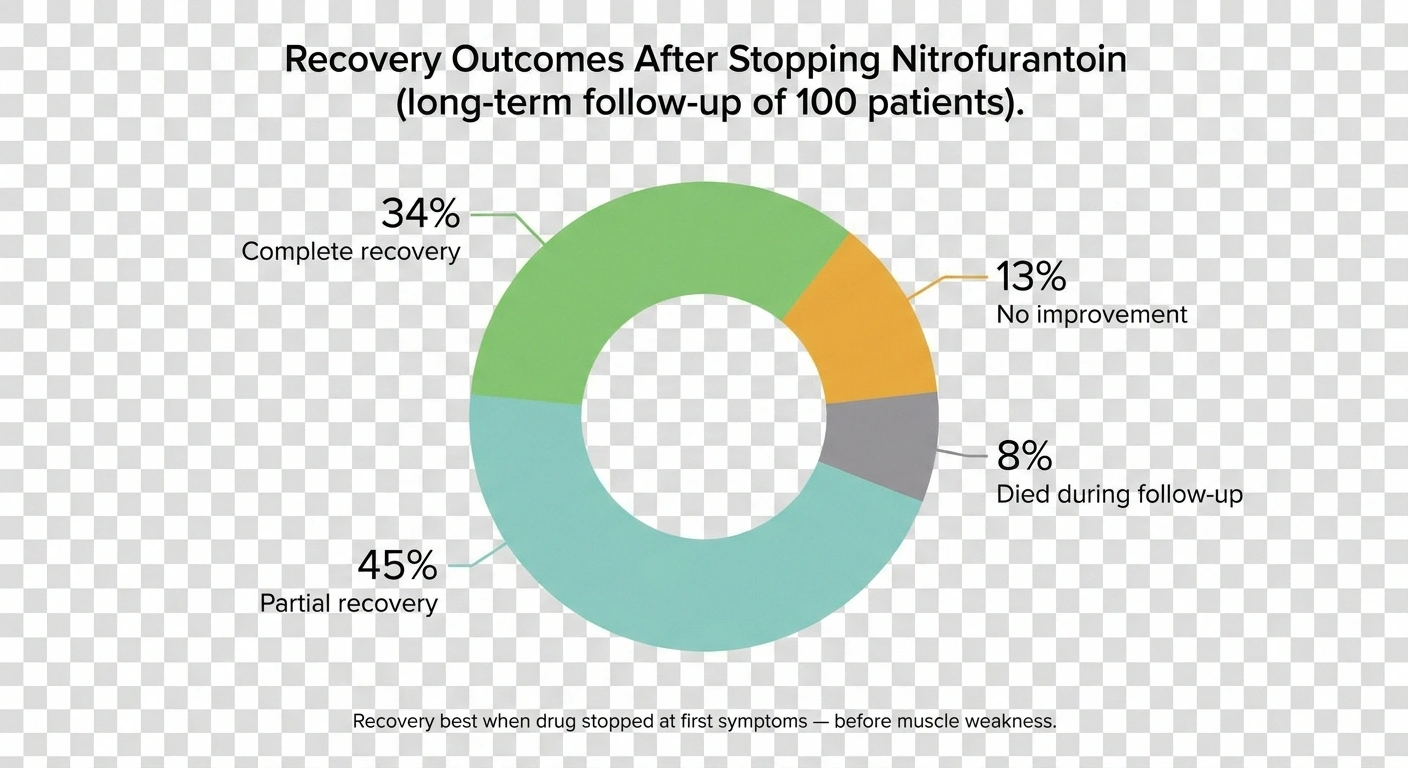
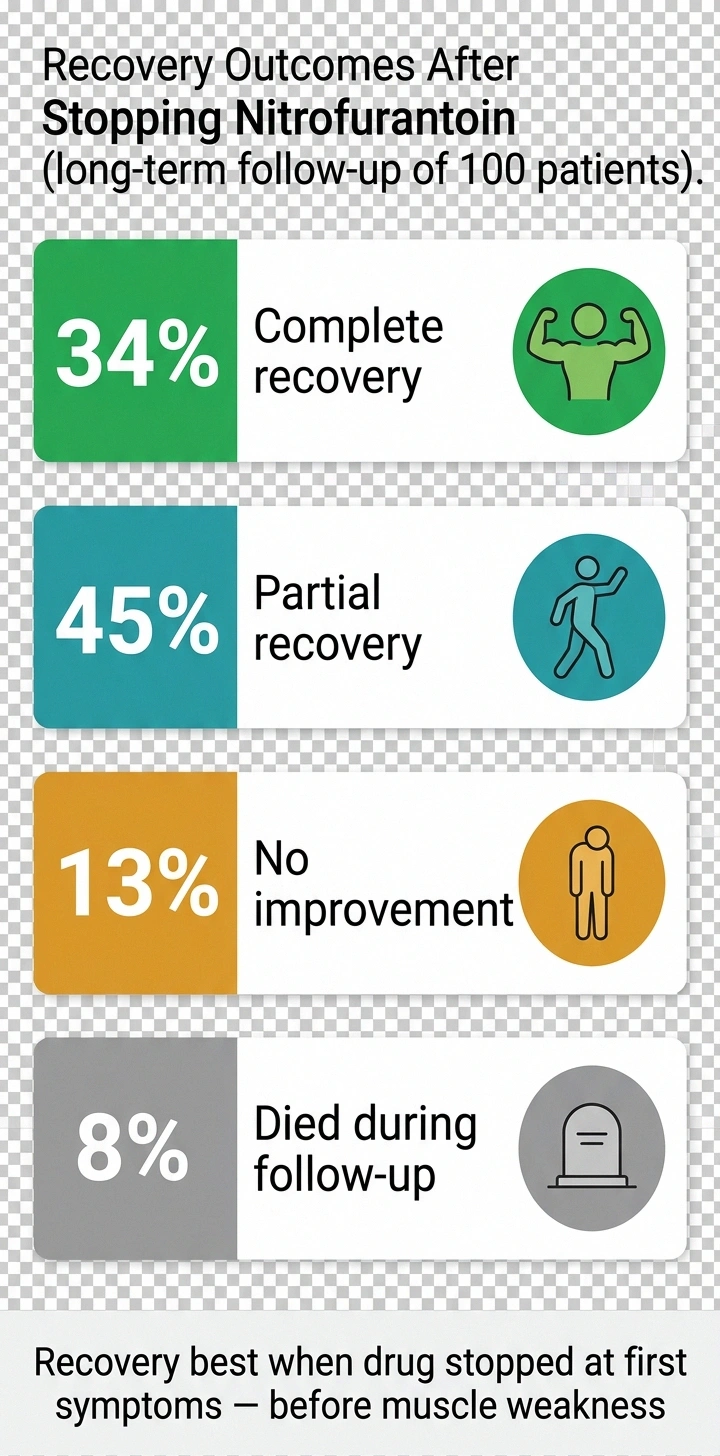
This is the question I know is on your mind, so let me answer it honestly. The best data we have comes from a landmark long-term follow-up of 100 patients with nitrofurantoin-induced peripheral neuropathy. Here’s what happened after the drug was stopped:
🔬 Research Says
In a long-term follow-up of 100 patients with nitrofurantoin-induced neuropathy:
34%
Complete recovery
45%
Partial recovery
13%
No improvement
Complete recovery clustered heavily in patients whose drug was stopped before muscle weakness developed.
- 34% made a complete recovery.
- 45% made a partial recovery — improvement, but with lingering symptoms.
- 13% showed no meaningful improvement.
- 8% died during long-term follow-up (mostly from other causes in an already-frail population, not directly from the neuropathy).
Recovery timelines ranged from a few days to several months. Here’s the critical pattern: complete recovery clustered heavily in the group where the drug was stopped early — before muscle weakness set in. Patients who had already developed motor symptoms had a much rougher recovery.
That single fact — early stop equals better outcome — is why the “call your doctor today” list above matters so much. The window for full reversibility is real, but it closes as damage accumulates.
If You’ve Been on Long-Term Nitrofurantoin: Questions to Ask Your Prescriber

Long-term nitrofurantoin suppression is not always the wrong choice. Some women have UTIs so recurrent and disruptive that suppressive antibiotics are genuinely the best available option. But if you’ve been on it for months without a check-in, it’s worth having an honest conversation. Consider bringing these questions to your next appointment (or calling to schedule one, if it’s been a while):
Key Takeaway
Long-term nightly suppression isn’t automatically wrong — but it deserves a periodic reassessment. If it’s been a year without your prescriber checking kidney function or asking about symptoms, it’s fair to bring it up. You are your own best safety net.
- When was my kidney function last checked, and what was my creatinine clearance?
- Given how long I’ve been on this drug, is it still the right choice for me?
- Are there alternatives to nightly nitrofurantoin I could try — such as post-coital dosing, methenamine, vaginal estrogen (for postmenopausal women), or intermittent self-start therapy?
- What are the earliest signs of nerve damage I should watch for, and what should I do if I notice any?
- Should we plan a periodic reassessment — every 6 or 12 months — to see if I still need this?
Your prescriber wants you well — but they may not have the whole timeline of your suppressive therapy in front of them at every visit. Bringing it up gives them a chance to reassess.
Other Antibiotics and Nerve Damage

Nitrofurantoin is not the only antibiotic linked to peripheral neuropathy. Fluoroquinolones (ciprofloxacin, levofloxacin) carry a well-documented risk. Metronidazole, isoniazid, and certain older drugs are also implicated. If you’re already prone to nerve issues — from diabetes, alcohol use, chemotherapy history, or another cause — the whole antibiotic-and-nerves conversation is worth having with your doctor before any long course of any of these drugs is started.
For the bigger picture, our guide to medications that can cause neuropathy covers the full landscape.
Getting Evaluated If Symptoms Appear
If your prescriber agrees the symptoms could be nitrofurantoin-related, the next step is usually stopping the drug and observing. If symptoms persist or worsen after the drug is stopped, or if there’s any diagnostic uncertainty, a formal evaluation is warranted.
A typical workup for suspected drug-induced peripheral neuropathy includes a neurological exam, blood work to rule out other causes (B12 deficiency, thyroid disease, blood sugar, kidney function), and — if the picture is unclear — nerve conduction studies and EMG performed by a neurologist. Our guide to neuropathy diagnosis walks through what to expect from each of those tests.
The diagnosis of drug-induced neuropathy is usually made by matching the clinical picture (length-dependent, distal sensorimotor pattern) with the exposure history and by ruling out other common causes. There’s no single blood test that says “yes, it’s from the drug.” It’s a clinical decision based on the whole story.
Supporting Your Nerves During Recovery

If you and your doctor agree to stop nitrofurantoin, the nerves need time and support to heal. There’s no magic pill for this — recovery happens slowly and depends heavily on how much damage occurred before stopping. That said, several supportive steps make sense:
- Follow up on any underlying B vitamin deficiencies. If bloodwork shows low B12, B6, or folate, address those under your doctor’s guidance.
- Manage blood sugar tightly if you’re diabetic — high glucose adds ongoing nerve stress independent of the drug.
- Practice good foot care — daily inspection, well-fitting shoes, avoiding walking barefoot on hard surfaces where you could miss an injury.
- If you’ve lost sensation, take extra care with balance — especially in the shower, at night, and on stairs. See our guide on neuropathy and fall prevention.
- Give it time. Nerve recovery is measured in weeks and months, not days.
For readers wanting a broader look at what may help, our roundup of the best natural remedies for peripheral neuropathy pain covers the evidence-based options many people find useful during recovery.
Frequently Asked Questions
Is a five-day course of nitrofurantoin for a UTI safe?
For most people with normal kidney function and no significant risk factors, yes. Nitrofurantoin has been used safely for uncomplicated UTIs for decades. The neuropathy risk is strongly associated with long-term prophylactic use, impaired kidney function, and the risk-factor stack described above — not with short treatment courses in otherwise healthy patients.
How long does it take for nitrofurantoin neuropathy to develop?
It’s typically weeks to months into continuous therapy. The earliest symptoms may appear after three to eight weeks on the drug in vulnerable patients, though the pattern varies. Symptoms rarely develop from a short five-day treatment course. The longer the exposure, the higher the risk.
Can nitrofurantoin neuropathy be reversed?
Sometimes fully, sometimes partially, sometimes not at all. Data from long-term follow-up of patients with this condition suggests roughly one-third recover completely, nearly half improve partially, and the rest see limited or no improvement. Complete recovery is much more likely when the drug is stopped at the first sign of symptoms, before any muscle weakness appears.
Should I stop taking nitrofurantoin if I notice tingling in my feet?
Do not stop on your own. Call your prescriber today, describe your symptoms, and let them decide the next step. If you’re mid-course for an active infection, an untreated UTI can turn into a kidney infection, which is a bigger problem than the potential nerve issue. The right move is prompt communication, not silent discontinuation.
Does everyone on long-term nitrofurantoin get neuropathy?
No. Many patients take nightly suppressive nitrofurantoin for years without any nerve problems. The risk clusters around specific factors — most notably reduced kidney function, diabetes, anemia, and older age. If you have none of those, your absolute risk is low. If you have several, your risk is significantly higher, and periodic monitoring makes sense.
What tests can confirm nitrofurantoin-induced neuropathy?
There’s no single blood test that identifies the drug as the cause. The diagnosis is clinical — matching the pattern of symptoms (distal, symmetric, starting in the feet) with the medication history and ruling out other common causes like B12 deficiency, diabetes, thyroid dysfunction, and other neurotoxic exposures. Nerve conduction studies and EMG can help characterize the extent of nerve damage.
Are there safer alternative antibiotics for recurring UTIs?
Several. Options include intermittent self-start therapy (treating each UTI as it arises rather than nightly prevention), methenamine hippurate, post-coital dosing when infections are triggered by intercourse, and — for postmenopausal women — vaginal estrogen, which can dramatically reduce recurrence without any systemic antibiotic. Your prescriber can help you weigh which alternatives fit your situation.
Does nitrofurantoin cause other serious side effects besides neuropathy?
Yes, though also uncommonly. Two important ones to know about are pulmonary reactions (lung inflammation that can occur early or after long-term use) and liver injury. Both are much less common than the drug being tolerated well, but they’re worth being aware of if you’re on long-term therapy. Persistent cough, shortness of breath, unusual fatigue, or yellowing of the skin or eyes should also prompt a call to your doctor.
About the Author