“Idiopathic” is a strange word to be handed at the end of a long workup. It sounds like a diagnosis. It’s shaped like one, it’s spelled like one, and it goes in the same box on the chart where a diagnosis would go.
What it means is: we don’t know.
Somewhere between a quarter and a third of people with peripheral neuropathy end up with that word after every test comes back unremarkable. Blood work, fine. B12, fine. Thyroid, fine. Blood sugar, fine. Nerve conduction study confirms there’s damage but doesn’t say why. And you go home with numb feet and a word that describes the state of medical knowledge rather than the state of your nerves.
Since 2019, that word has been getting smaller. A gene called RFC1 turned out to explain a substantial share of these cases, and the studies that followed produced a number I think everyone in this situation should know. It doesn’t come with a treatment. It does come with an answer, and for some people it comes with an explanation for a symptom they’d stopped mentioning to doctors years ago because nobody ever connected it to anything.
A Gene Nobody Was Looking At
In 2019, researchers identified the genetic cause of a condition called CANVAS, which stands for Cerebellar Ataxia, Neuropathy, and Vestibular Areflexia Syndrome. Three systems, all involved in knowing where your body is and keeping it upright.
- Repeat expansion
- A short DNA sequence that should appear a modest number of times instead appearing hundreds or thousands of times over. A stutter, not a spelling mistake.
- Biallelic
- Present on both copies of the gene, one inherited from each parent. One copy alone makes you a carrier, not a patient.
- Intron
- A stretch inside a gene that does not directly code for protein. Part of why this expansion sat unnoticed for so long.
- Sensory neuronopathy
- Damage to sensory nerve cell bodies rather than to the long fibres running out from them. The distinction is why the symptom pattern looks wrong.
- Vestibular areflexia
- Loss of the inner ear’s balance reflexes. Tested for directly, and often the piece a general workup never checks.
- Oscillopsia
- The visual world appearing to bounce or jitter while you walk. Distinctive enough that mentioning it changes an appointment.
The cause turned out to be a repeat expansion in a gene called RFC1, short for replication factor C subunit 1. A repeat expansion is a stutter in the DNA: a short sequence of letters that’s supposed to appear a modest number of times instead appears hundreds or thousands of times over. In this case the sequence is usually AAGGG, and it sits in an intron — a stretch of the gene that doesn’t code for protein directly, which is part of why it went unnoticed for so long.
You need the expansion on both copies of the gene, one from each parent, for it to cause disease.
Then something interesting happened. Once researchers could test for it, they went looking beyond the people with the full CANVAS triad, and found the expansion in people who had only some of it. Many had the neuropathy without much ataxia. Some had balance problems without a classic cerebellar picture. The presentation varied so much that the field has largely stopped calling it CANVAS and started calling it RFC1 disease or RFC1 spectrum disorder — a rename that matters here, because the person most likely to be reading this page has the neuropathy piece and none of the rest.
The Number That Should Change the Conversation
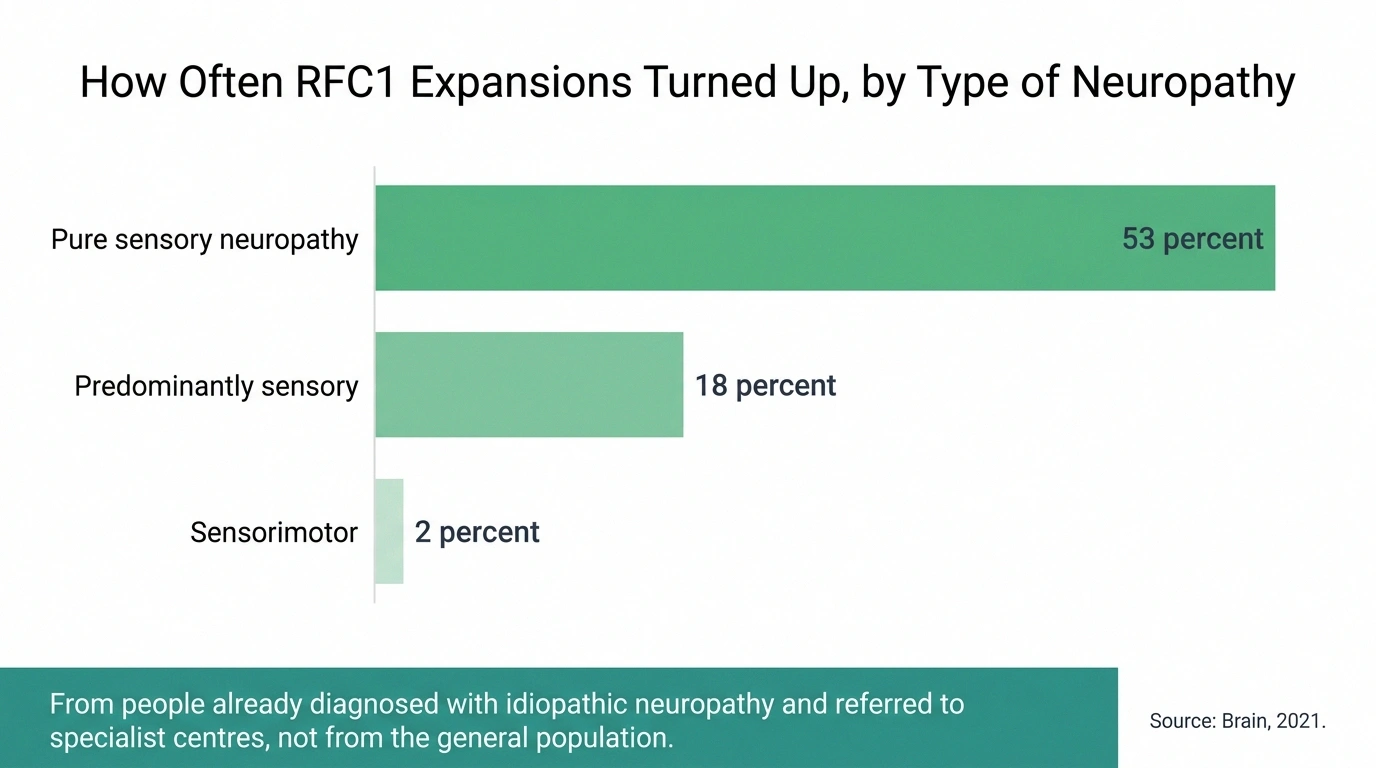
In 2021 a study in the journal Brain tested people who had been diagnosed with chronic idiopathic axonal polyneuropathy — the formal name for nerve damage of unknown cause — and looked for RFC1 expansions.
They found biallelic expansions in 34% of the sensory cases.
That figure alone is striking, but the breakdown is what makes it usable, because it splits sharply by what kind of neuropathy people had:
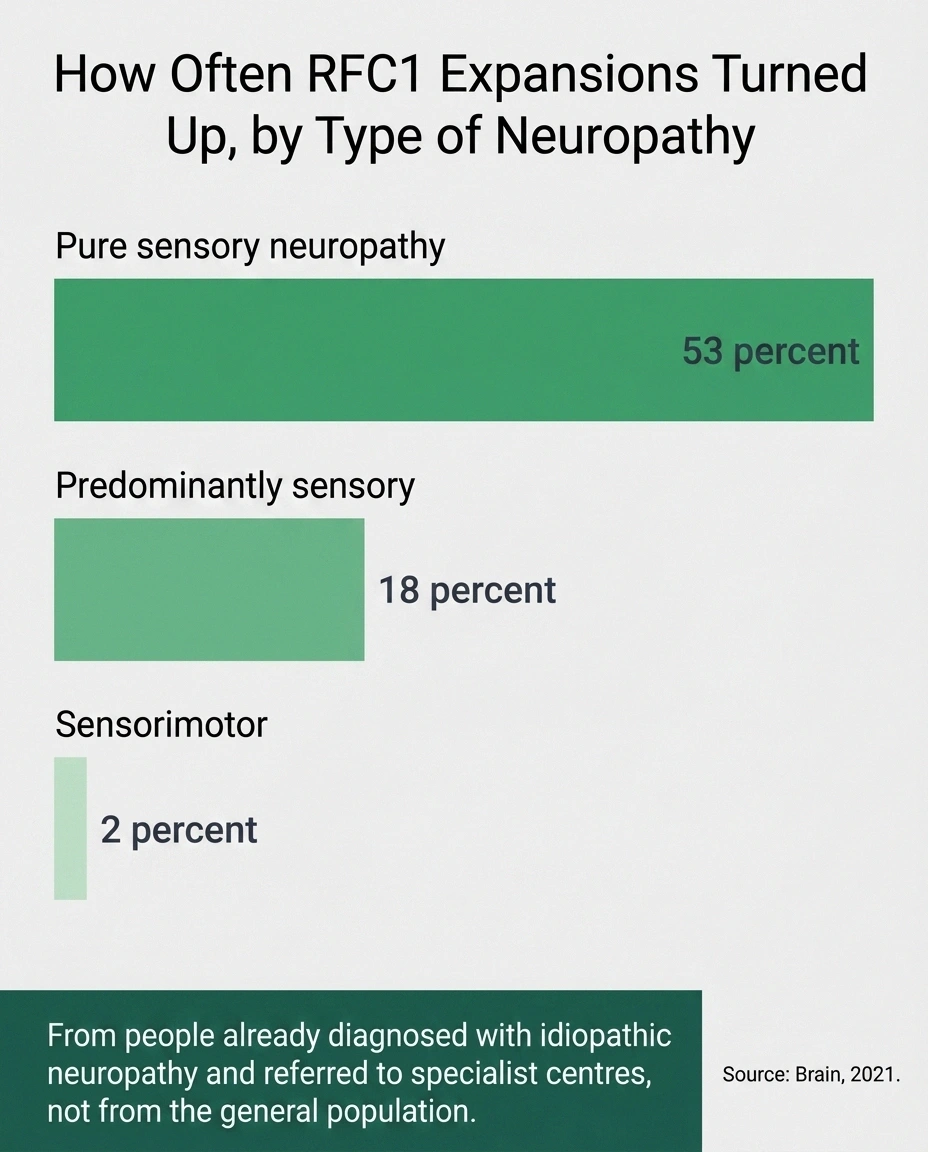
Pure sensory neuropathy: 53%. Roughly half.
Predominantly sensory: 18%.
Sensorimotor: 2%. Essentially background.
That gradient is the single most practical thing on this page. If your neuropathy is purely sensory — numbness, tingling, imbalance, unreliable position sense, with normal strength — this is not an exotic possibility to raise apologetically. In the studied groups it was close to a coin flip.
If you have significant weakness alongside the sensory symptoms, the picture points elsewhere, and something else deserves the attention.
Two honest cautions about those percentages, because they get repeated carelessly. First, they come from people already diagnosed with idiopathic neuropathy and referred to specialist centers, so they describe a filtered group rather than everyone with numb feet. Second, more recent cohorts in North America and elsewhere have reported somewhat different rates and additional repeat patterns beyond AAGGG. The field is still mapping this. The direction of the finding is solid; the exact number depends on who you test.
For scale at the population level: the AAGGG allele shows up in roughly 0.7% to 6.8% of people depending on the population studied, which puts the estimated number of people born carrying two copies somewhere between about 1 in 20,000 and 1 in 200. The wide range reflects real variation between populations. Even at the conservative end, that is not a rarity in the way “rare genetic disease” usually implies.
The Cough That Arrives Thirty Years Early
This is the part I’d want someone to tell me.
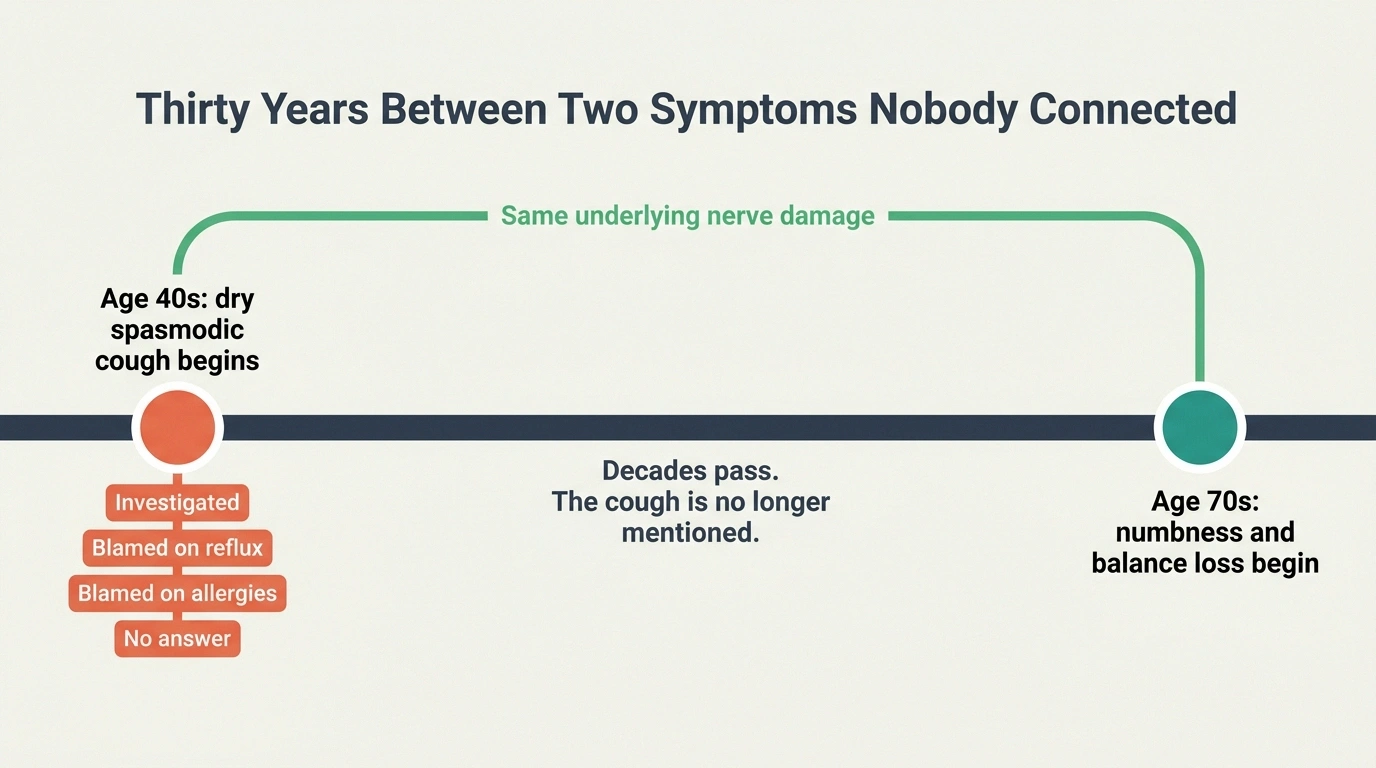
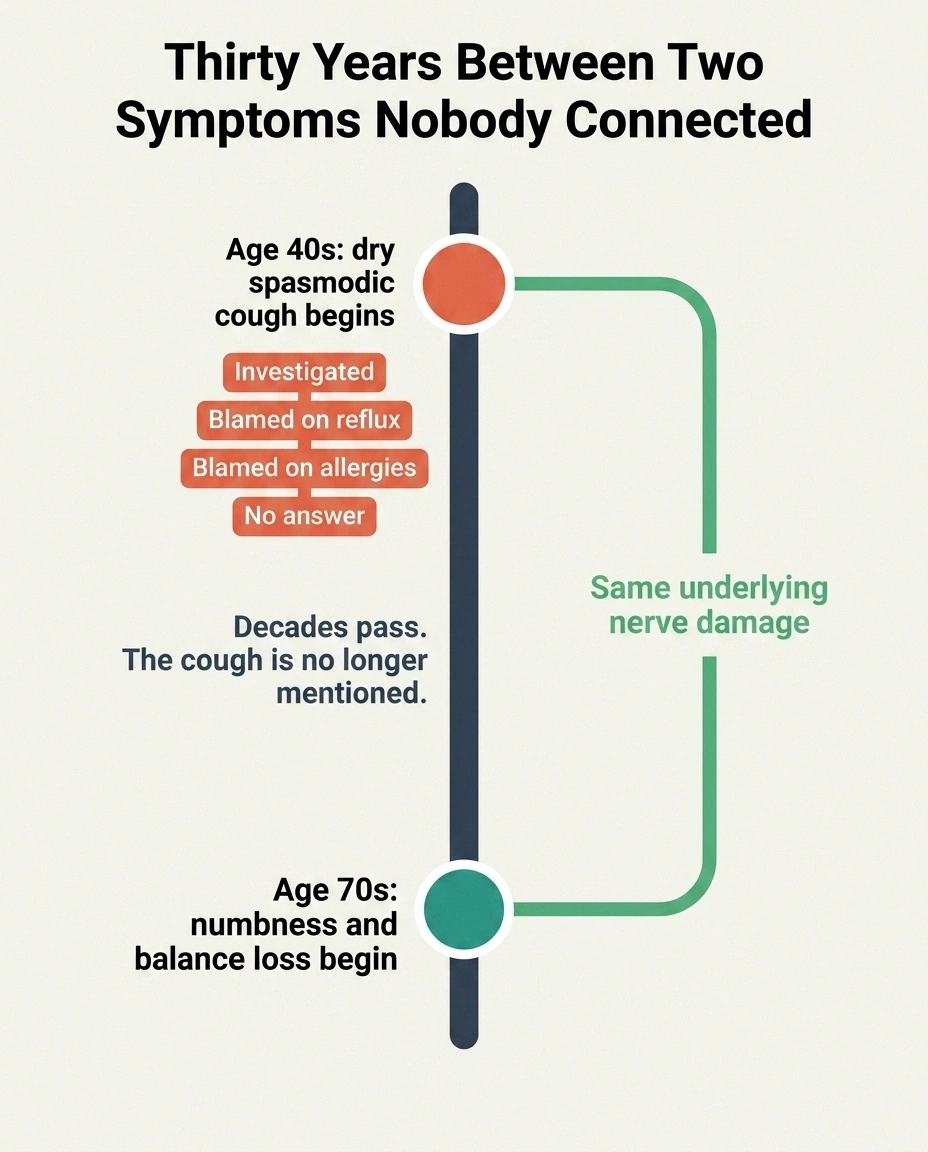
A dry, spasmodic, hard-to-suppress cough is one of the most consistent features of RFC1 disease. Reported prevalence across studies ranges from 30% to 97%, and at least 60% of patients have it. It’s not a productive cough. It comes in fits, it can be set off by talking or laughing or a change in air temperature, and it tends to have been investigated at some point and blamed on reflux, or allergies, or asthma, or a medication, or nothing.
Here’s the remarkable part: the cough can precede the neurological symptoms by more than thirty years.
Sit with that. Someone develops an unexplained chronic cough in their forties. They see a pulmonologist, try an inhaler, try an acid reducer, get told it’s one of those things. Three decades later, in their seventies, their feet go numb and their balance falls apart, and nobody connects the two because nothing in ordinary medical training links a persistent cough to a sensory neuropathy.
The connection appears to run through the same nerve damage. The nerve fibers involved in the cough reflex come from the same population of sensory cells that later fail in the feet, and there’s evidence of early peripheral nerve involvement present at the time the cough starts.
If you have a long-standing dry cough that nobody has ever explained, and you now have a sensory neuropathy nobody can explain either, those two unexplained things may be the same explanation. That’s worth saying out loud at your next neurology appointment, and most people never think to mention the cough because it doesn’t feel like a nerve problem.
Why This Neuropathy Feels Wrong
Most peripheral neuropathy follows a predictable geography. The longest nerve fibers fail first, so symptoms begin in the toes, creep up the feet, then the ankles, and only reach the fingertips much later. That’s the length-dependent pattern, and it’s what makes the classic stocking-and-glove description useful.
Any one of these on its own means very little. It is the combination that carries the signal, and most people who fit this pattern have never had the pieces looked at together.
- Sensory symptoms with strength that has stayed normal
- Imbalance worse than the numbness alone would explain
- Markedly worse in the dark, in dim rooms, or with eyes closed
- A distribution that is patchy or asymmetric rather than a neat stocking pattern
- A long-standing dry cough nobody has explained
- A workup that found nothing, sometimes twice
Weakness alongside the sensory loss points away from this, and toward something else worth chasing instead.
RFC1 disease doesn’t do that, and the reason is anatomical.
The damage isn’t happening along the nerve fiber. It’s happening at the dorsal root ganglion — clusters of sensory nerve cell bodies sitting just outside the spinal cord, where every sensory nerve in the body has its headquarters. When the cell body is affected rather than the far end of its axon, length stops mattering. A short nerve to the face and a long nerve to the toe are equally vulnerable, because both start in the same place.
The technical name for this is a sensory neuronopathy, as opposed to a neuropathy, and the distinction shows up as a pattern that doesn’t fit expectations. Numbness that appears in patches. Involvement of the hands, arms, trunk, or face without the feet being dramatically worse. Symptoms that are asymmetric when they ought to be even.
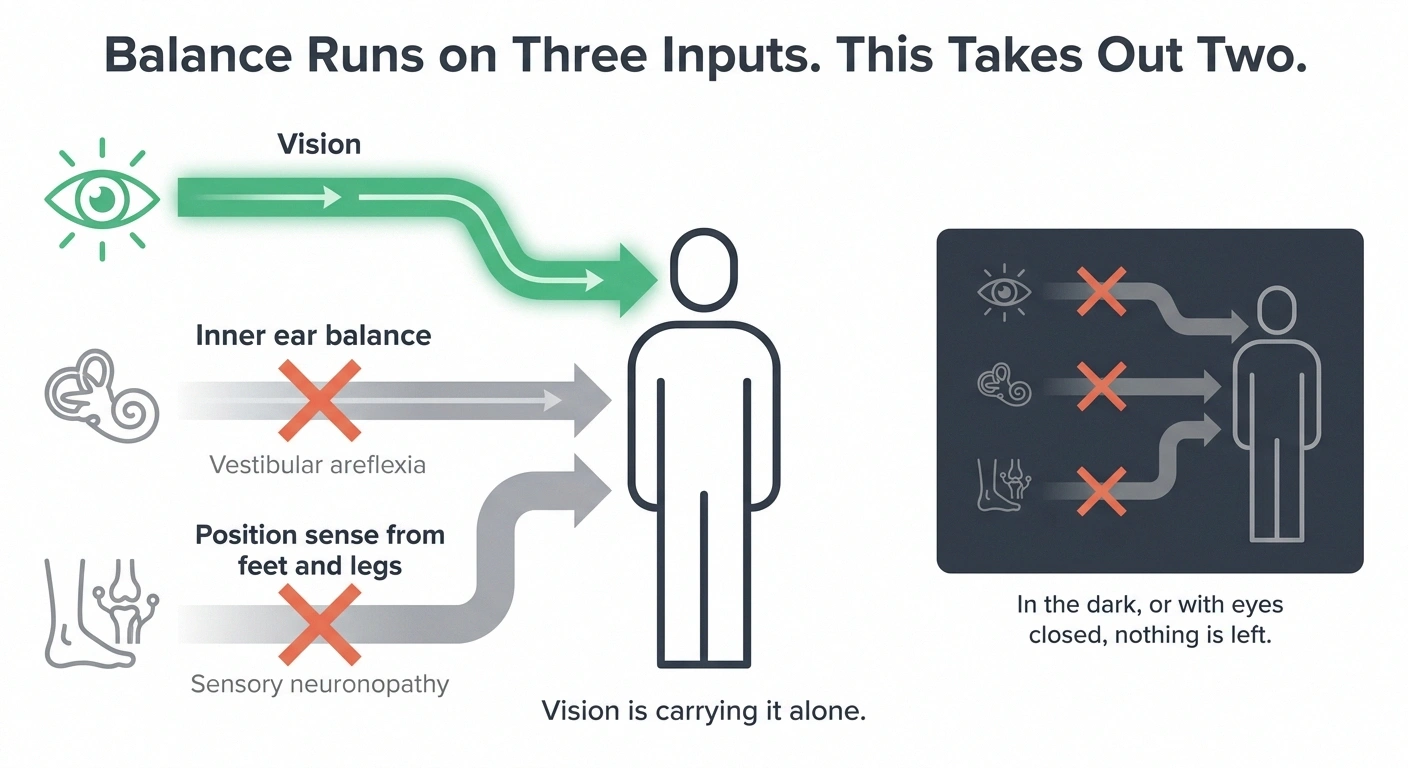
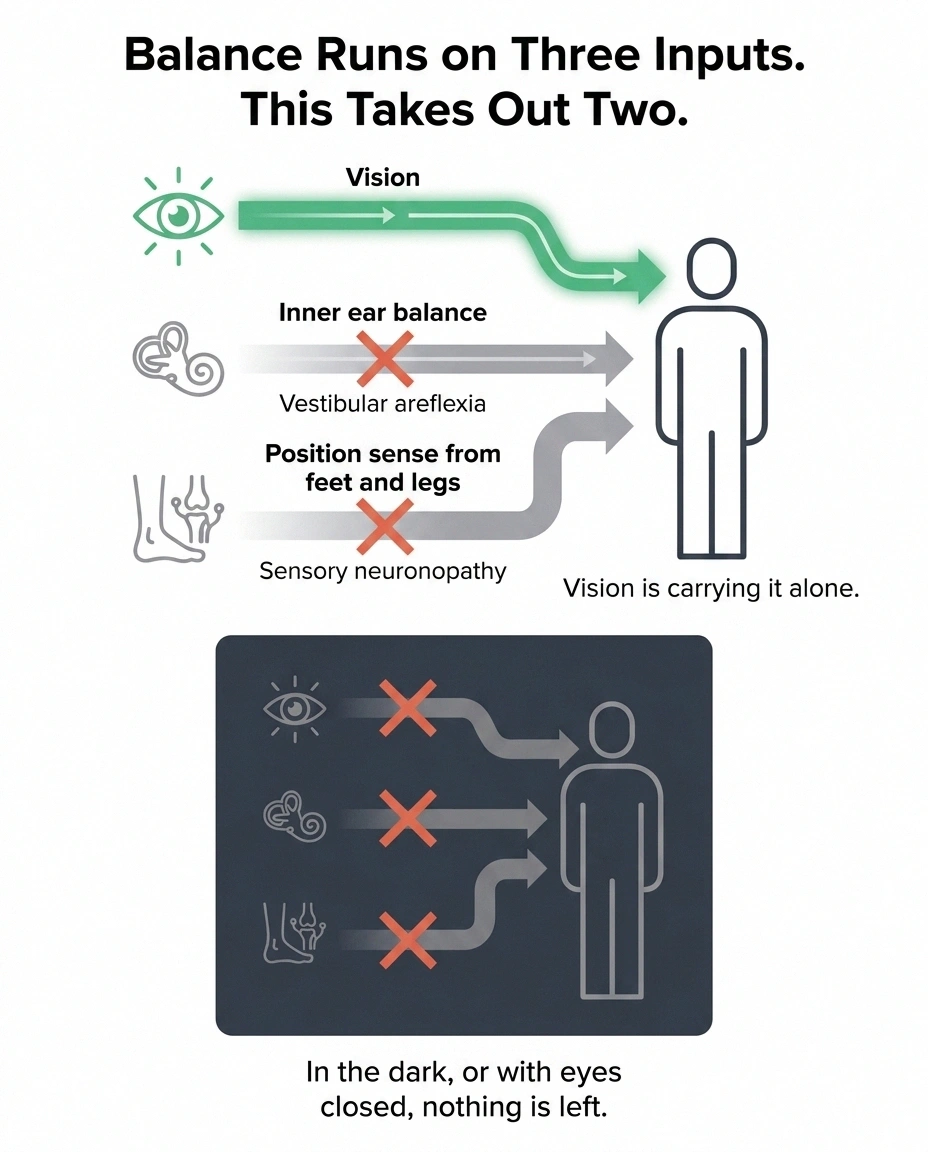
It also explains the balance problem, which tends to be the disabling part. You keep your balance using three inputs: vision, the vestibular system in your inner ear, and position sense from your feet and legs. Lose one and the other two compensate. RFC1 disease attacks two of the three simultaneously, taking out position sense and vestibular function together, and leaves you standing on vision alone.
Which is exactly why people describe getting noticeably worse in the dark. A dim hallway, a restaurant at night, closing your eyes in the shower: remove the only remaining input and there’s nothing left holding you up. If that description lands, our pages on position sense loss and sensory ataxia cover the mechanics in more depth, and the fall prevention strategies there apply regardless of what’s causing it.
On testing, nerve conduction studies typically show absent or dramatically reduced sensory nerve action potentials — sometimes with motor conduction that looks surprisingly intact. Brain MRI often shows cerebellar atrophy, and there can be changes in the spinal cord.
Why Your Genetic Testing Came Back Normal
This is the practical failure point, and it catches almost everyone.
The useful question at your next appointment is not whether genetic testing was done. It is whether repeat expansion sizing was part of it.
| Test | Finds single-letter changes | Sizes a repeat expansion |
|---|---|---|
| Inherited neuropathy gene panel | Yes | Generally no |
| Exome sequencing | Yes | Generally no |
| Whole genome sequencing | Yes | Not unless analysed for it |
| Repeat-primed or long-range PCR | Not its job | Yes, this is the one |
Plenty of people with unexplained neuropathy have already had genetic testing. An inherited neuropathy panel, or exome sequencing, sometimes whole genome sequencing. It came back negative and the file closed.
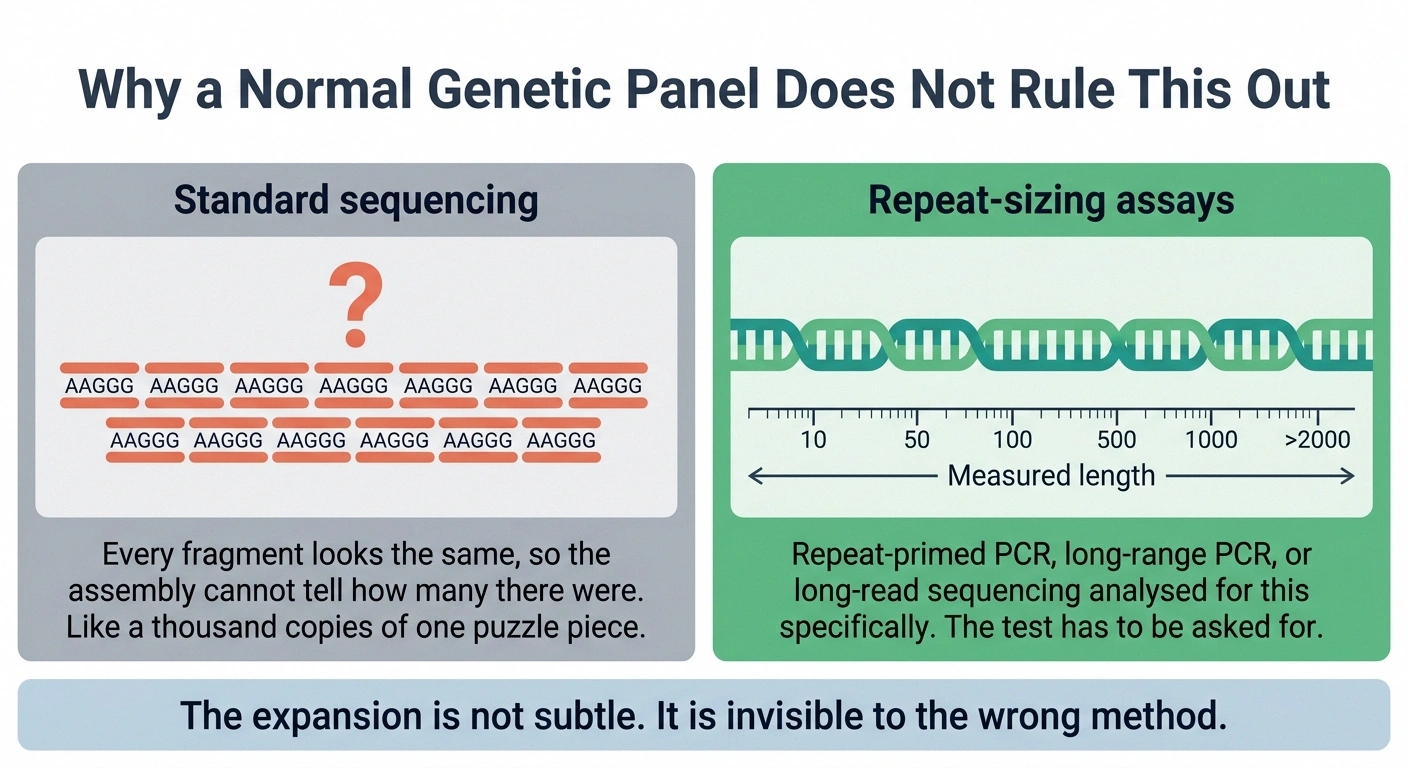
Standard sequencing generally cannot detect a repeat expansion.
The reason is technical but easy enough to picture. Most sequencing reads DNA in short fragments and reassembles them by matching overlaps. When a sequence repeats hundreds or thousands of times, all those fragments look identical, and the assembly software has no way to tell how many there were. It’s like being handed a thousand copies of the same puzzle piece and asked how long the row was. The expansion is invisible not because it’s subtle, but because of how the reading works.
Detecting it takes a purpose-built assay: repeat-primed PCR, long-range PCR, or long-read sequencing analyzed specifically for this. The test has to be asked for.
So a normal genetic panel does not rule this out, and that single sentence is the most actionable thing in this article. If you were told your genetic testing was normal, the relevant question is whether RFC1 repeat expansion testing was specifically included — not whether genetic testing was done.
Recessive, Which Is Why There’s No Family History
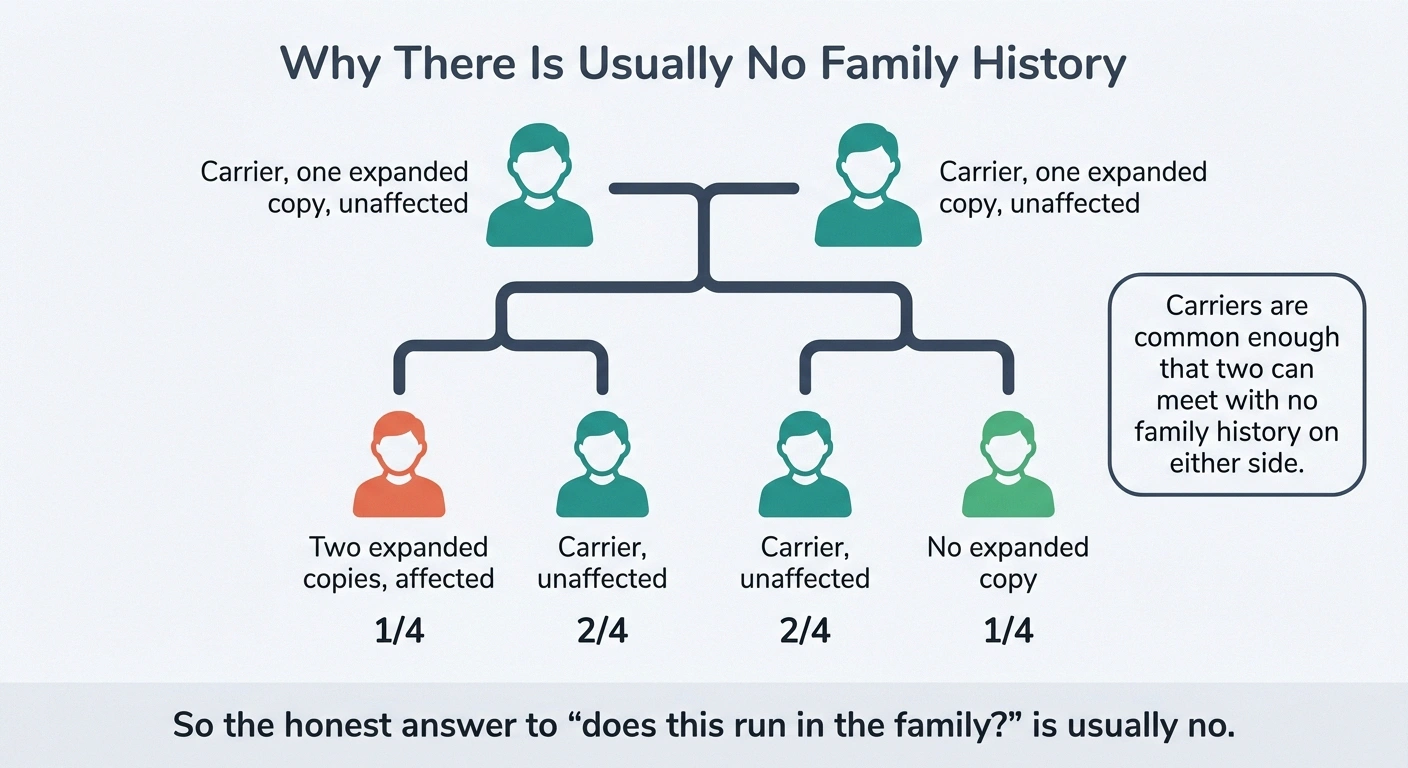
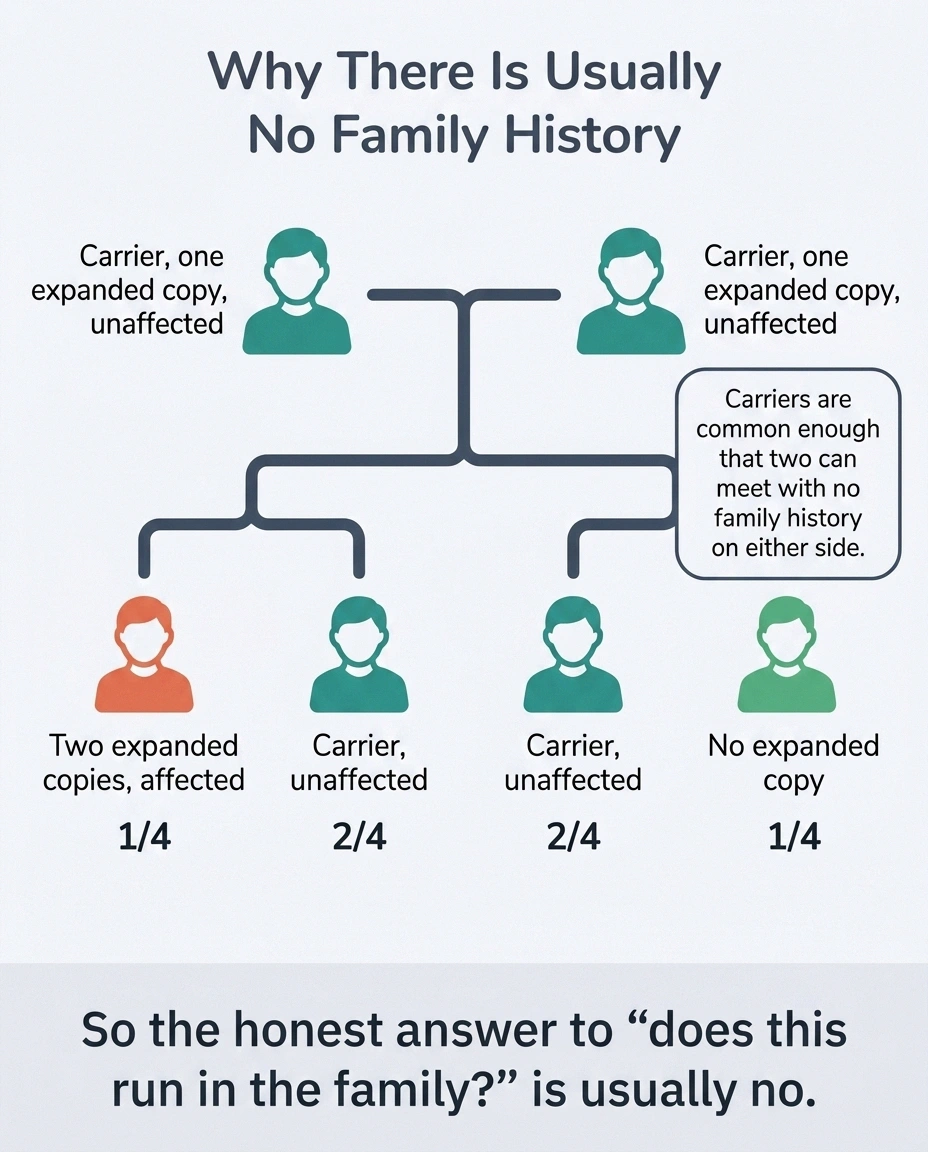
RFC1 disease is inherited recessively. You need the expansion on both copies of the gene, one from each parent.
Carriers with a single expanded copy are generally unaffected, and given the carrier frequency, there are a great many of them walking around with no idea. Two carriers can have children for decades without anything appearing in the family. Which means most people with RFC1 disease have no family history of neuropathy at all, and when a doctor asks whether anything like this runs in the family, the honest answer is no.
That answer then argues against genetic testing, and the condition stays labeled idiopathic. It’s a clean trap and nobody in it is making a mistake.
Recessive inheritance also shapes what a diagnosis means for your family. Your children each inherited one expanded copy from you with certainty, but they’d need a second from the other parent to be affected. Siblings have a one in four chance of having inherited two. Those are conversations for a genetic counselor working from your actual family structure, not for a web page, and genetic counseling is usually available alongside the testing itself.
What Testing Actually Involves
The test itself is straightforward: a blood sample sent to a laboratory equipped to size the repeat.
Access is the harder part, and I want to be careful not to overpromise here. RFC1 repeat expansion testing is offered through specialized neurology centers, academic neuromuscular clinics, and certain genetics laboratories. Availability, cost, and insurance coverage vary considerably by where you live and how your care is organized. A general neurologist may need to refer you to a neuromuscular or ataxia specialist to order it, and some people will find the route straightforward while others won’t.
What makes a stronger case when you raise it:
A purely sensory neuropathy with preserved strength, particularly one where sensory responses are absent rather than merely slowed.
Chronic unexplained dry cough, however long ago it started. Especially if it started long ago.
Imbalance out of proportion to the numbness, and dramatically worse in the dark.
A pattern that isn’t length-dependent — hands, face, or trunk involved without the feet being clearly worst.
Oscillopsia, the sense that the visual world bounces or jitters when you walk, which points at vestibular involvement.
A workup that’s genuinely exhausted the common causes. If your B12 has never been checked, that’s the cheaper thing to do first, and our page on what a full workup should include covers the ground that comes before this.
If you’ve been through all of it and gotten nowhere, a second opinion at a center that sees a lot of neuropathy is often the practical path, since these are the centers where RFC1 testing is routinely on the menu.
What an Answer Is Worth When There’s No Cure

I want to be straight about this, because false hope is its own kind of harm. There is no treatment that corrects the underlying genetics of RFC1 disease. Confirming it does not give you a drug.
It gives you other things, and having watched people go through both versions, I don’t think they’re small.
The search for a cause can stop. People with unexplained neuropathy often cycle through years of investigations, repeat blood work, new specialists, occasional invasive procedures. Finding a cause usually ends that hunt, and the relief of not having to keep looking is genuine. It does not rule out something else contributing alongside it, so a new or changing symptom still deserves its own look rather than being filed under a diagnosis you already have.
The rehabilitation gets aimed correctly. Balance training for combined sensory and vestibular loss is a different program from balance training for a foot problem. Vestibular rehabilitation specifically, plus fall prevention built around losing your footing in the dark, is targeted work rather than general advice.
You stop being told it’s something it isn’t. A lot of people in this situation have been quietly filed under anxiety, deconditioning, or ordinary aging. A named genetic condition ends that conversation.
The cough gets explained. Which sounds minor until you’ve spent thirty years apologizing for it in restaurants.
You become eligible for research. You can’t be enrolled in a study of a condition you haven’t been diagnosed with. RFC1 disease went from genetically unknown to well-characterized in about six years, and that’s the phase where therapeutic work begins. Being findable in a trial registry requires a diagnosis first.
Your family gets information. Not alarming information, in most cases. Just accurate information.
Who This Is Actually For
Most people reading this do not have RFC1 disease. Neuropathy has many causes, diabetes and prediabetes lead by a wide margin, and the odds favor something more ordinary. Our guide to idiopathic neuropathy covers the broader picture, and the fuller list of what causes nerve damage is worth reading before landing on a genetic explanation.
“Has RFC1 repeat expansion testing been considered, and was it included in any genetic testing I have already had?”
Two things make that question land better than a printout does. Mention the cough, including roughly what year it started, even though it will feel unrelated. And describe the balance problem in terms of light: what happens in a dark hallway, or in the shower with your eyes closed.
A specific no is still a better outcome than another year of “idiopathic”, because a specific no comes with a reason attached.
But there’s a specific person this is for, and if you’re them, you’ve probably recognized yourself already: purely sensory symptoms, balance that’s worse than the numbness would explain, much worse in the dark, a workup that found nothing, and possibly a cough you gave up mentioning years ago.
If that’s you, the ask is a single question, and it’s a reasonable one: has RFC1 repeat expansion testing been considered, and was it part of any genetic testing I’ve already had?
The answer might be no, this doesn’t fit your picture. That’s a fine answer, and a specific one, which beats “idiopathic” either way.
Frequently Asked Questions
What is CANVAS syndrome?
CANVAS stands for Cerebellar Ataxia, Neuropathy, and Vestibular Areflexia Syndrome, a late-onset condition in which balance, sensation, and inner ear function are all progressively affected. In 2019 it was traced to a repeat expansion in the RFC1 gene. Because many people have only part of the full picture, often the neuropathy without prominent ataxia, researchers increasingly use the broader term RFC1 disease or RFC1 spectrum disorder.
How common is RFC1 disease in people with idiopathic neuropathy?
In a study published in Brain in 2021, biallelic RFC1 expansions were found in 34% of patients with sensory chronic idiopathic axonal polyneuropathy. Broken down by pattern, the expansion appeared in 53% of those with pure sensory neuropathy, 18% with predominantly sensory neuropathy, and 2% with sensorimotor neuropathy. Those figures come from people already referred to specialist centers with an idiopathic diagnosis, so they describe a selected group rather than everyone with neuropathy.
Why would a chronic cough be related to neuropathy?
A dry, spasmodic chronic cough is one of the most consistent features of RFC1 disease, reported in 30% to 97% of patients across studies. It appears to share a cause with the neuropathy, involving the same population of sensory nerve cells. What surprises people is the timing: the cough can begin more than thirty years before any neurological symptoms appear, so it is rarely connected to the later diagnosis.
Can standard genetic testing detect RFC1 expansions?
Usually not. Standard exome and genome sequencing read DNA in short overlapping fragments, and a sequence repeating hundreds or thousands of times produces fragments that look identical, so the length cannot be determined. Detecting it requires a specific method such as repeat-primed PCR, long-range PCR, or long-read sequencing analyzed for this purpose. A normal genetic panel does not rule out RFC1 disease unless that specific test was included.
Is RFC1 disease inherited?
Yes, in a recessive pattern. A person needs the repeat expansion on both copies of the gene, one inherited from each parent. People carrying a single expanded copy are generally unaffected, and carriers are common enough that two of them may have no idea. This is why most people with RFC1 disease have no family history of neuropathy, which in turn is why genetic testing often is not considered.
Is there a treatment for RFC1 disease?
There is no treatment that corrects the underlying genetic cause. Management focuses on the consequences: vestibular rehabilitation, balance and gait training aimed at combined sensory and vestibular loss, fall prevention, home safety changes, and mobility aids where appropriate. A confirmed diagnosis usually ends the search for a cause and makes participation in research studies possible.
Why is my balance worse in the dark?
Balance relies on three inputs: vision, the vestibular system of the inner ear, and position sense from the feet and legs. RFC1 disease damages two of them at once, leaving vision doing nearly all the work. In low light or with your eyes closed, that last input drops out and there is little left to compensate. This is why symptoms are often noticeably worse at night, in dim rooms, or in the shower.
What makes RFC1 neuropathy different from ordinary peripheral neuropathy?
Most neuropathy is length-dependent, damaging the longest nerve fibers first, so symptoms start in the toes and progress upward in a predictable pattern. RFC1 disease damages the sensory nerve cell bodies in the dorsal root ganglia instead, where nerve length is irrelevant. Symptoms can therefore appear in the hands, trunk, or face without the feet being clearly worse, and the distribution is often patchy or asymmetric rather than even.
About the Author