
A guy I'll call Ray came up to me after a talk I gave last winter. Mid-60s, retired carpenter. He rolled up the cuffs of his jeans and pointed at the tops of his feet. “Burns like I'm standing on hot asphalt,” he said. “All day. Worst at night.” His doctor had put him on gabapentin two years earlier. It took the edge off the burning but left him foggy — the kind of foggy where he'd forget conversations, forget where he'd set his coffee mug, and finally stopped driving because he didn't trust himself behind the wheel. When his pain flared over the summer, a pain-management doctor tried a low-dose opioid. It worked for the pain, sort of, but he hated the way it made him feel — dull, constipated, oddly numb about everything — and he tapered off within six weeks. He was back on gabapentin, back in the fog, and he had one question for me.
“What's next?” he asked. “There has to be something better than this.”
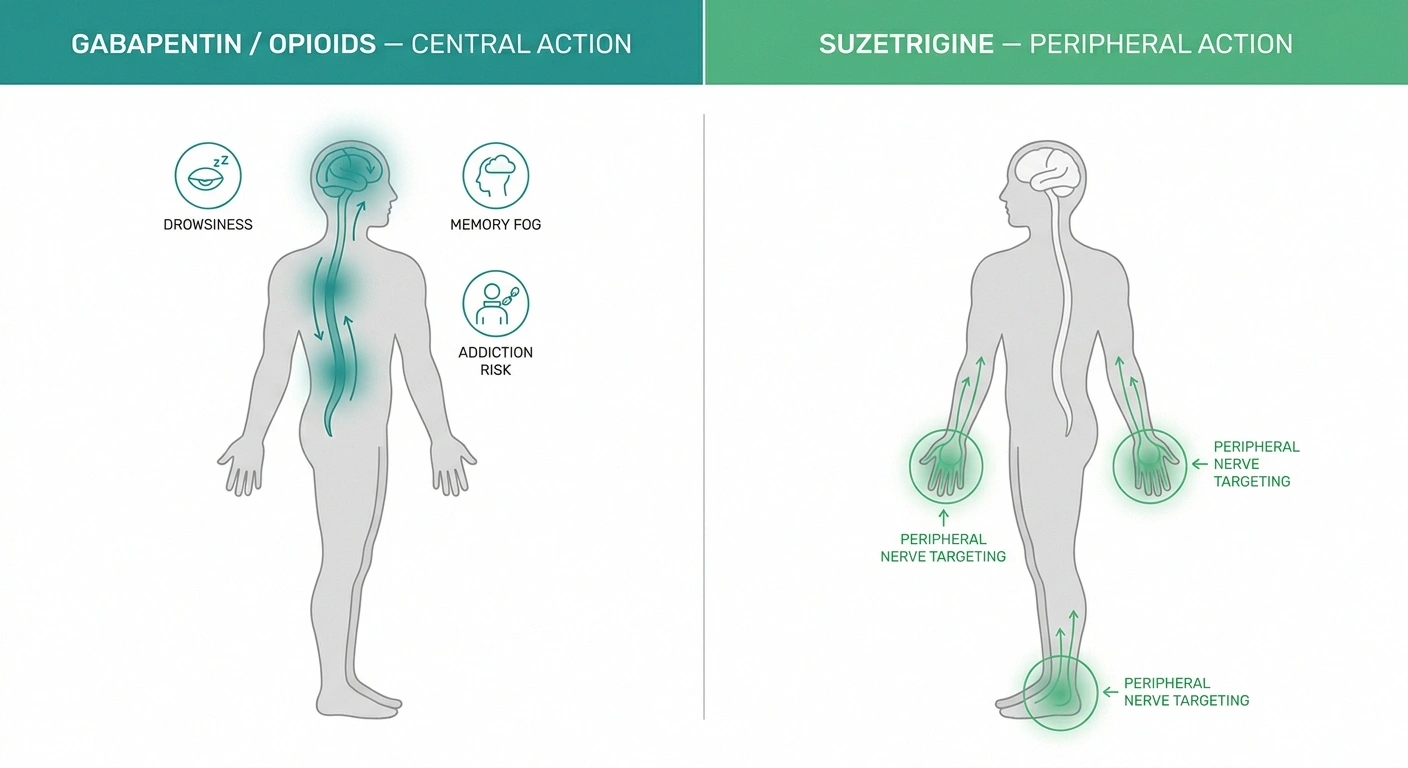
For a long time, the honest answer was “not really.” The nerve pain toolbox — gabapentin, pregabalin, duloxetine, tricyclics, opioids as a last resort — has been essentially unchanged for two decades. Every drug in that list works by dampening signals in the brain and spinal cord, which is why they all come with some flavor of drowsiness, cognitive fog, weight gain, or dependence risk. Every drug in that list is a compromise.
That answer is finally starting to change. A new class of drugs is arriving that targets sodium channels — specifically a channel called Nav1.8 — that live only in the peripheral pain nerves, not in the brain. The first one, suzetrigine (brand name Journavx), was FDA-approved in January 2025 for acute pain after surgery. It is not yet approved for chronic neuropathy. But the science behind it is genuinely worth understanding, because it is the first honest crack at “pain relief without the fog” that the field has produced in a very long time. This article is the mechanism explainer I wish Ray had walked away with.
Why Sodium Channels Are the “Wire” of Your Nerve Pain
To understand what makes Nav1.8 different, it helps to spend a minute on how a nerve actually signals pain in the first place. Every nerve fiber in your body is essentially a long biological cable. When something painful happens at the end of that cable — a stubbed toe, a burn, or the low-grade nerve inflammation that causes burning feet syndrome — the nerve fires an electrical signal that races up the cable toward your spinal cord and brain. That's when you feel it.
The electrical signal isn't magic. It's driven by tiny protein pores in the nerve membrane called ion channels. Sodium ions rush in through one set of channels, potassium ions rush out through another, and the net movement of charge creates the electrical spike we call an action potential. Sodium channels are the pores responsible for the fast, upward part of that spike — the ignition switch. Without them opening, no pain signal fires. Block only the sodium channels used by pain nerves, without touching the ones in heart, brain, or muscle, and you have a targeted way to quiet pain at its source.
This is exactly what surgeons and dentists have been doing for over a century with lidocaine. Lidocaine blocks all sodium channels indiscriminately — that's why it numbs the whole area, and that's why it can be dangerous if it gets into the bloodstream and reaches the heart. What researchers have been trying to do for the past twenty years is find a way to do what lidocaine does, but with molecular precision — hit only the sodium channels in the peripheral pain nerves, and leave everything else alone. Nav1.8 turned out to be the door that finally opened.
The Nine Sodium Channels — And Why Nav1.7 and Nav1.8 Stand Out
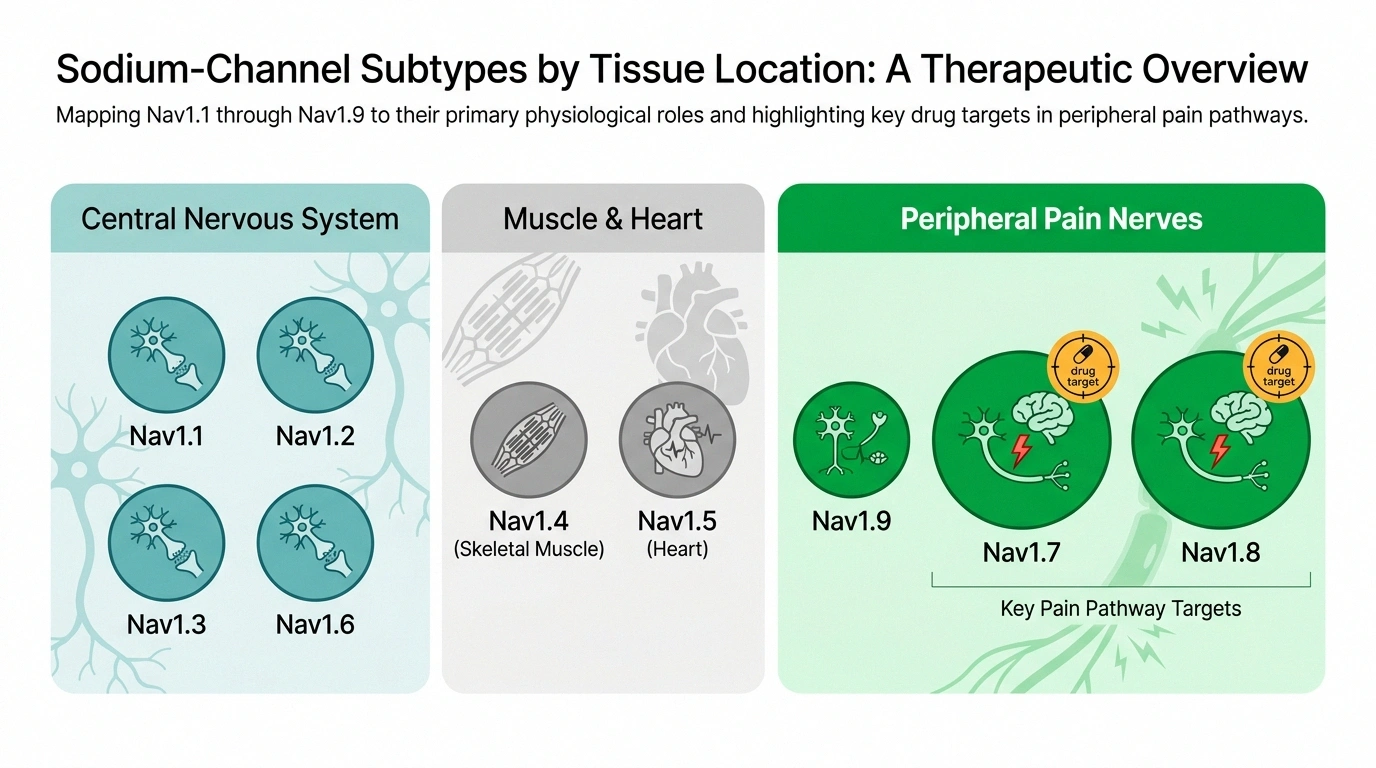
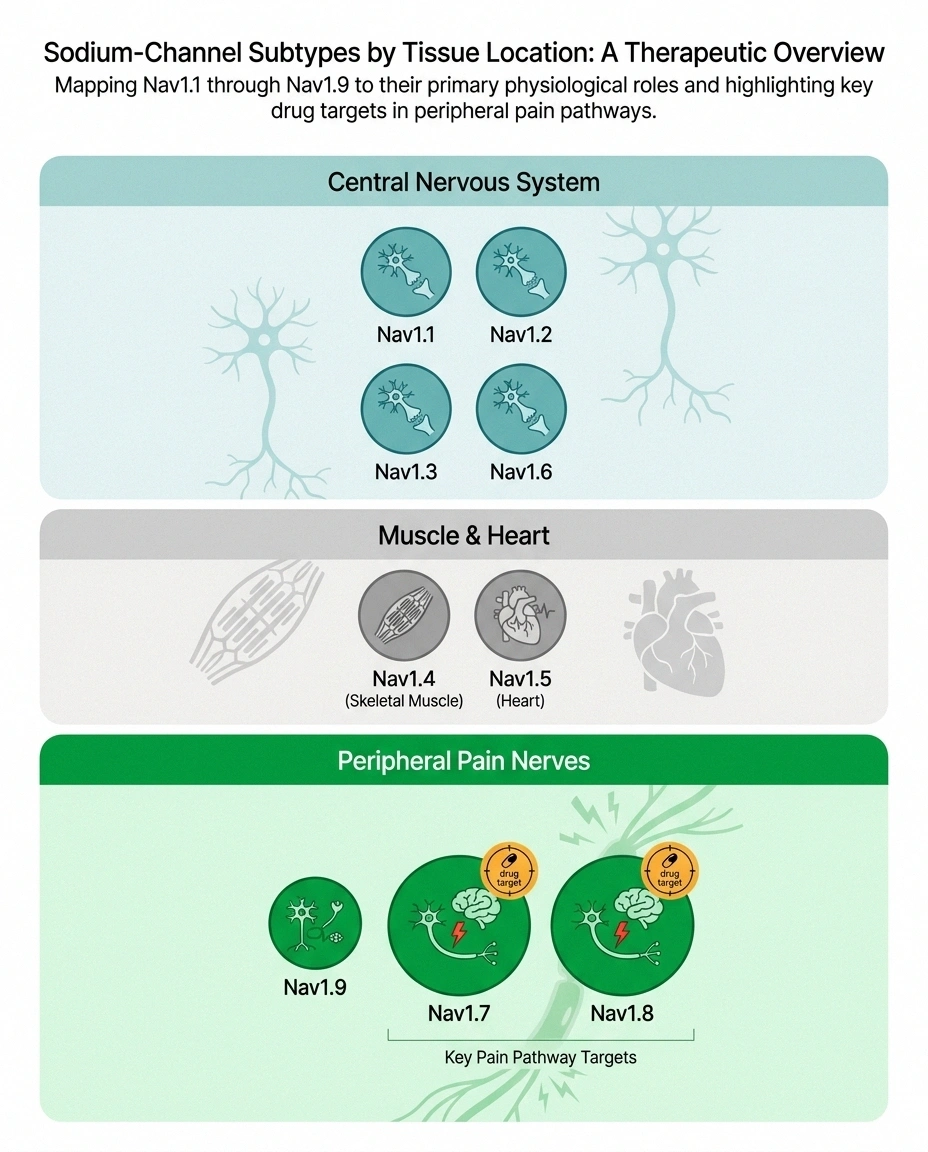
Your body doesn't have one kind of sodium channel. It has nine different subtypes, cleverly named Nav1.1 through Nav1.9. Each one is coded by its own gene, and each one sits in a specific set of tissues, doing a specific job. Understanding the family tree is the whole reason the Nav1.8 story matters.
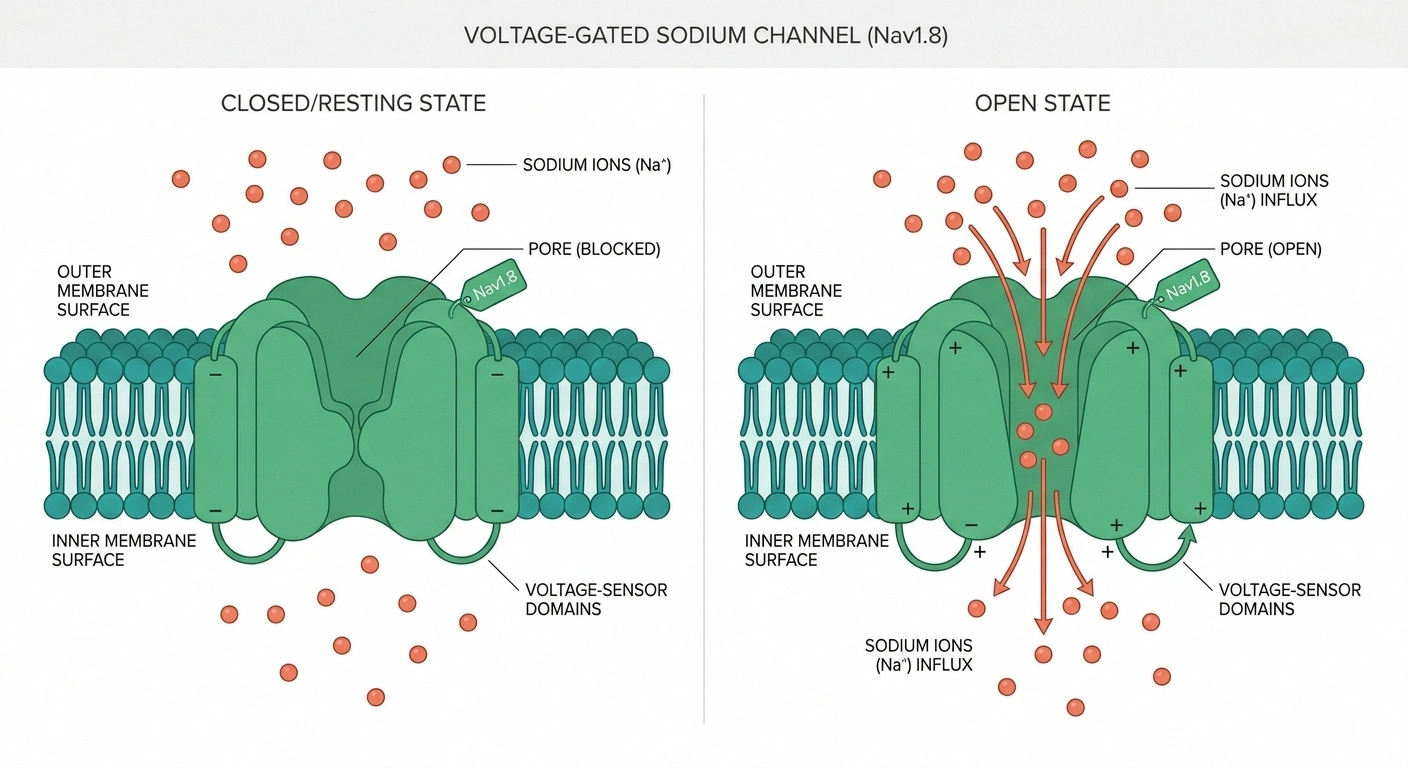
Key takeaway
Nav1.8 is a sodium channel found almost exclusively in the peripheral pain nerves — not in the brain, spinal cord, heart, or muscle. That selectivity is the whole point. A drug that blocks Nav1.8 can quiet pain signaling at its source without producing the drowsiness, cognitive fog, or addiction risk of the older nerve-pain medications. The first drug in this class, suzetrigine (Journavx), is now FDA-approved for acute pain. Its role in chronic neuropathy is still being tested in clinical trials.
- Nav1.1, Nav1.2, Nav1.3, Nav1.6 live mostly in the brain and spinal cord. Blocking these is what makes seizure medicines work — and what causes drowsiness, cognitive slowing, and mood changes.
- Nav1.4 lives in skeletal muscle. Blocking it would cause weakness.
- Nav1.5 lives in the heart. Blocking it can cause dangerous rhythm problems, which is why cardiac safety is the first hurdle any sodium-channel drug has to clear.
- Nav1.7 and Nav1.8 live almost exclusively in peripheral pain-sensing nerves — the dorsal root ganglion neurons that carry hurt from your feet, hands, and skin toward the spinal cord.
- Nav1.9 also lives in peripheral pain neurons, but its slower kinetics and difficult pharmacology have made it a hard target to drug so far.
Two of those subtypes — Nav1.7 and Nav1.8 — are the ones that pain researchers have obsessed over for the past two decades. Both are peripheral. Both fire during pain signaling. Both are essentially absent from the brain, which means blocking them shouldn't cause the fog, dependence, or mood effects that come with drugs that reach the central nervous system. The tantalizing possibility has always been: what if you could shut down peripheral pain firing without touching anything in the brain at all?
The genetic evidence made this even more tantalizing. People born with loss-of-function mutations in the Nav1.7 gene can feel touch and temperature normally but do not feel pain — they've been known to walk on broken bones without realizing it. People born with gain-of-function mutations in the Nav1.8 gene develop small-fiber neuropathy with severe, burning pain. Nature ran the experiment for us. The channels are pain channels. Block them, and pain should ease.
What Makes Nav1.8 Different From Nav1.7 (And Why Drugs Are Finally Landing)
Here is where the story gets humbling. For about fifteen years, Nav1.7 was the darling of the pain-drug industry. Pfizer, Amgen, Xenon, Vertex, and others poured money and years into Nav1.7 blockers. Most made it into Phase 2 trials. Almost none made it to approval. The drugs either weren't strong enough at safe doses, hit off-target channels, or simply didn't produce meaningful pain relief in humans despite the genetic evidence saying they should have. It was a long lesson in how a beautiful hypothesis can survive the mice and mutations and still fail in the clinic.
Nav1.7 vs Nav1.8 — Why one class finally worked
Tissue: Peripheral pain nerves
Track record: 15+ years, many drugs, most failed clinically
Challenge: Structural similarity to cardiac Nav1.5 made clean selectivity hard
Tissue: Peripheral pain nerves
Track record: Suzetrigine approved 2025, first non-opioid class in decades
Advantage: Distinct structure allows 30,000x selectivity over cardiac Nav1.5
Both channels sit in peripheral pain nerves. Nav1.8's structural distinctness was the difference between a good hypothesis and a shipping drug.
Nav1.8 was quieter in the background. Structurally, it is different enough from the other sodium channels — particularly the cardiac Nav1.5 — that chemists could design molecules that fit Nav1.8 like a key and don't fit the others. Vertex Pharmaceuticals eventually developed a compound called VX-548 (later named suzetrigine) with more than 30,000-fold selectivity for Nav1.8 over the other sodium subtypes. That means the drug can shut down pain firing at doses where every other channel keeps functioning normally.
The mechanism is subtle. Suzetrigine doesn't sit inside the pore the way lidocaine does. Instead, it binds to a spot on the outside of the channel — an allosteric site — and stabilizes the channel in its closed, resting state. Under normal conditions, that stabilization is modest. But in an actively firing pain nerve, where the channel is trying to open again and again, the drug's grip becomes much stronger. That's called activity-dependent inhibition, and it's a beautiful piece of pharmacology because it means the drug preferentially quiets nerves that are firing pain signals, while leaving quieter nerves largely untouched.
Suzetrigine (Journavx) — The First Nav1.8 Drug FDA Approved
On January 30, 2025, suzetrigine became the first Nav1.8-selective inhibitor to receive FDA approval in the United States. It's marketed under the brand name Journavx. This is a genuinely big moment. It is the first truly novel non-opioid oral analgesic to reach the market in more than twenty years, and the first drug in an entirely new pharmacological class approved for pain since the launch of the gabapentinoids in the 1990s.
Research says
In the pivotal Phase 3 trials that led to Journavx's approval, suzetrigine produced roughly 50% pain reduction versus placebo over the first 48 hours after abdominoplasty and bunionectomy surgery. Pain relief was comparable to hydrocodone-acetaminophen, but without any of the opioid's sedation, cognitive effects, or abuse liability. Suzetrigine binds Nav1.8 with an IC50 around 0.27 nM and shows more than 30,000-fold selectivity for Nav1.8 over the other eight sodium-channel subtypes — the cleanest peripheral-pain drug selectivity the field has ever produced.
Important: Journavx is NOT approved for chronic neuropathy
Suzetrigine (Journavx) is FDA-approved only for moderate-to-severe acute pain in adults — the short-term pain that follows surgery, injury, or a procedure. It is not approved for diabetic neuropathy, chemotherapy-induced neuropathy, post-herpetic neuralgia, small-fiber neuropathy, or any form of chronic nerve pain. Off-label use for chronic neuropathy is not standard practice, is not covered by insurance, and at roughly $232 per day of therapy is out of reach for almost anyone as self-pay. Vertex is running trials in painful diabetic peripheral neuropathy and painful lumbosacral radiculopathy — those results will decide whether the chronic-pain indication ever gets approved. Watch this class, but do not chase it off-label right now.
Here's what the approval actually covers, and here's where the careful part starts. Journavx is approved for the treatment of moderate-to-severe acute pain in adults. That means short-term pain — the kind you might have for a few days after surgery, an injury, or a procedure. It is not approved for chronic pain of any kind. It is not approved for neuropathy. It is not approved for the everyday burning, tingling, or nerve pain that most readers of this site are dealing with. If you go to a pharmacy today and ask for Journavx for your diabetic neuropathy, you will not get it, and your doctor cannot legally prescribe it for that purpose.
The trials that got Journavx approved were specifically in post-surgical patients — one after abdominoplasty (tummy-tuck) and another after bunionectomy (foot surgery). Suzetrigine reduced pain compared to placebo by roughly 50% over the first 48 hours and matched a commonly prescribed hydrocodone-acetaminophen combination without any of the opioid side effects, sedation, or abuse liability. In human abuse-liability studies, participants did not experience the euphoria or rewarding effects associated with opioids. That's an enormous safety win, and it's the primary reason so many pain physicians are excited about the drug even as they wait for the neuropathy data.
For a fuller breakdown of the drug itself — dosing, cost, insurance coverage, and its role in post-surgical care — see the companion article on suzetrigine (Journavx) for neuropathy. This article stays focused on the underlying Nav1.8 science and where the class is headed.
What Suzetrigine Doesn't Yet Do — The Chronic-Neuropathy Trial Reality
Here is where honest science communication has to do the heavy lifting. Suzetrigine's approval is for acute pain, and the extension to chronic neuropathy is a question the trials are still trying to answer. Vertex has been running Phase 2 and Phase 3 studies in painful diabetic peripheral neuropathy and painful lumbosacral radiculopathy (a kind of sciatica caused by nerve-root compression). The trials are testing whether daily suzetrigine can meaningfully reduce chronic nerve pain over weeks and months of use.
The results so far are mixed. In some studies, suzetrigine has produced measurable improvement in chronic neuropathic pain scores compared to placebo. In others, the drug has struggled to separate cleanly from placebo — a common problem in chronic-pain trials, where the placebo response is large. As of this writing, no chronic-pain or neuropathy indication has been approved. Vertex has stated the programs remain a priority, but the timeline is not certain, and the outcome is genuinely not guaranteed.
What this means for you as a patient reading this: if your neurologist tells you that Journavx is not yet a proven option for your neuropathy, they are right. Off-label prescribing for chronic neuropathic pain is not standard practice for suzetrigine, insurance generally will not cover it, and the list price of roughly $232 per day would put self-pay use out of reach for almost everyone. This is a drug worth understanding and watching — but not a drug to be chasing off-label right now.
Other Nav1.8 Drugs in Development (VX-993 and Beyond)
Suzetrigine is not the only Nav1.8 drug in development. Now that the class has been validated in humans, the pipeline is filling up. Understanding what's coming behind Journavx is a big part of understanding why this is a story about a class of drugs, not just a single molecule.
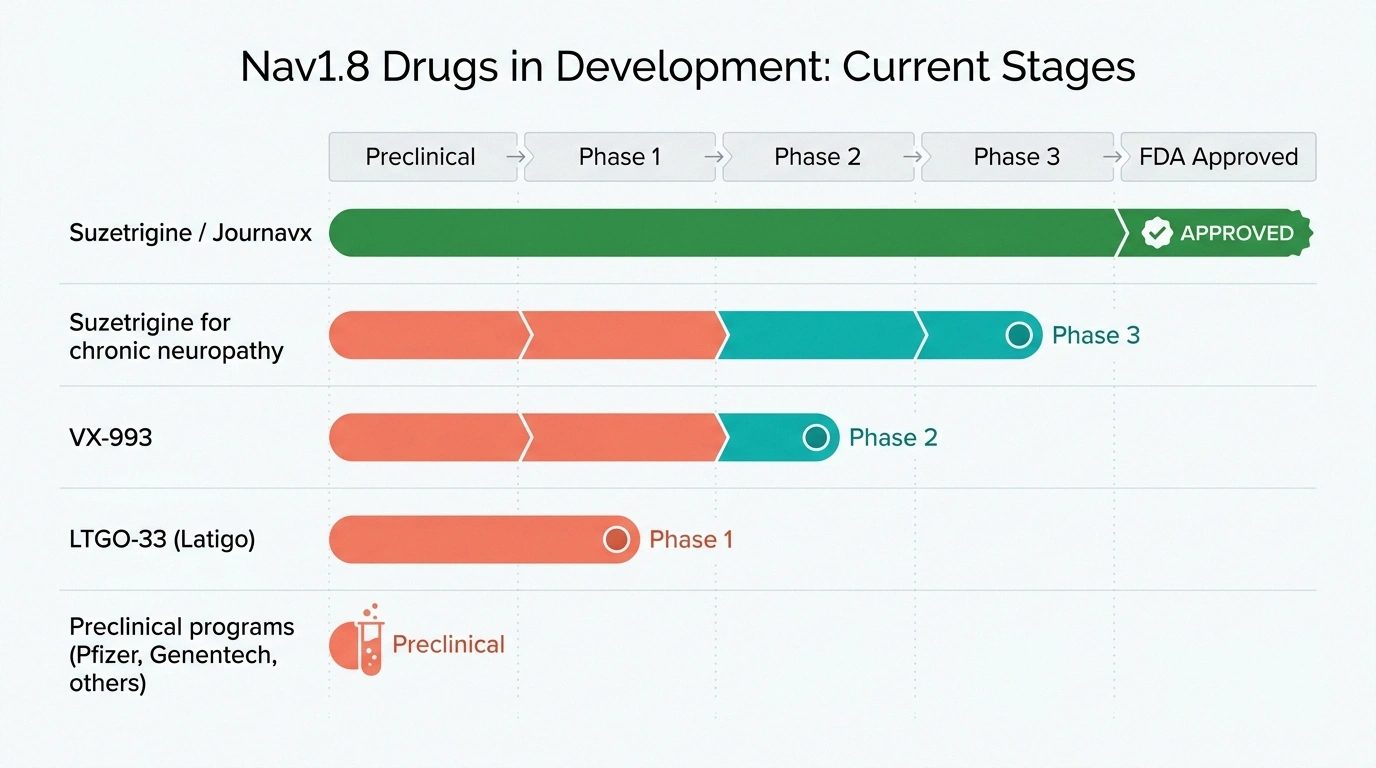
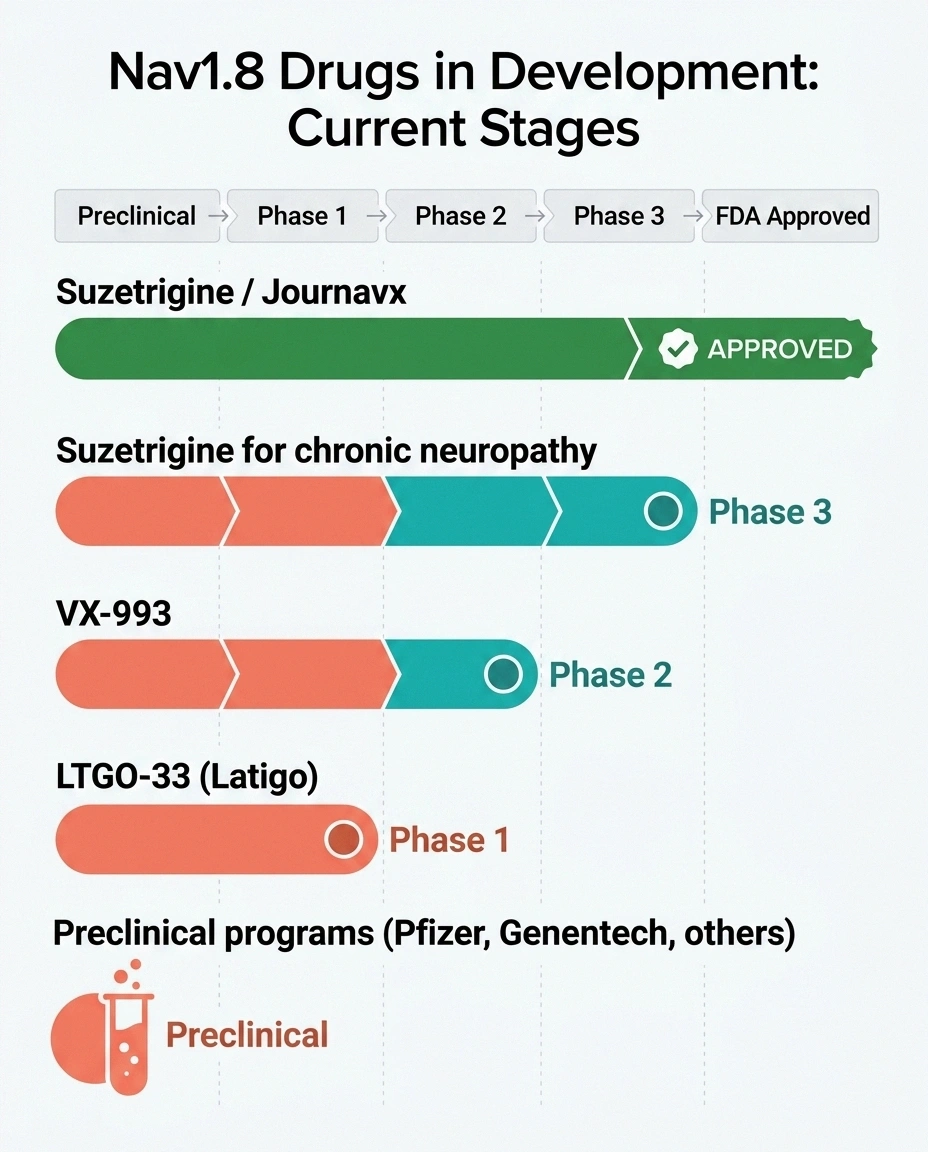
VX-993 is Vertex's own next-generation Nav1.8 inhibitor. It's been designed to be more potent than suzetrigine and is being developed in both oral and intravenous formulations, the latter aimed at hospitalized patients with acute post-surgical or trauma pain. Early-phase trials have shown a similar side-effect profile to suzetrigine and possibly a wider therapeutic window. If VX-993 makes it through pivotal trials, Vertex will have two Nav1.8 drugs in different formulations covering different clinical settings.
LTGO-33 (Latigo Biotherapeutics) is a separate Nav1.8 inhibitor from a newer company, in earlier-stage development but designed with the same overall selectivity profile and being evaluated in both acute and chronic pain settings.
Preclinical programs at Pfizer, Genentech, and several biotech startups are pursuing Nav1.8 with a mix of small molecules and other approaches. A few are moving toward first-in-human trials. Most drug programs don't succeed, but the sheer number of companies now working on Nav1.8 tells you the field considers it a real target, not a curiosity.
The broader pipeline of new nerve-pain treatments — Nav1.8 drugs, gene therapies, siRNA drugs, novel topicals — is where a lot of the meaningful change in this field is going to come from over the next five years. For a wider view of what's coming, see the roundup on new neuropathy treatments in 2026.
What This Class Could Mean For You If You Have Nerve Pain
Let me pull the science down to the practical level. If — and it is still an if — Nav1.8 inhibitors succeed in chronic neuropathic pain trials, here's what a person like Ray could reasonably expect from this class of drugs in the next few years.
How Nav1.8 drugs differ from the older nerve-pain toolbox
Trade-offs: Sedation, constipation, dependence, abuse potential
Trade-offs: Fog, drowsiness, weight gain, memory issues
Trade-offs: Nausea, mood effects, dry mouth
Trade-offs: No fog, no addiction, no CNS effects — cost is the barrier
The older classes all work in the brain and spinal cord. Nav1.8 is the first class that acts entirely outside the central nervous system — the reason its side-effect profile looks so different.
Meaningful pain relief without the fog. Because Nav1.8 is not expressed in the brain, a properly selective Nav1.8 drug should not cause the drowsiness, cognitive slowing, memory issues, or mood changes that make gabapentin and pregabalin so hard to tolerate for many people. Suzetrigine's clinical safety data in the acute pain trials is consistent with this — sedation and cognitive side effects have not been prominent.
No addiction risk. Nav1.8 drugs don't touch the opioid receptors, don't reach the brain's reward pathways, and don't produce the euphoria or dependence associated with opioids. In human abuse-liability studies, suzetrigine has shown no signal of abuse potential. For patients who've had bad experiences with opioid dependence — or who've been denied opioid prescriptions because of a history of substance use — this is a genuinely different path.
Not a cure, and not a full replacement. The magnitude of pain relief from suzetrigine in acute-pain trials is meaningful but not miraculous — roughly 50% reduction on average compared to placebo, similar to what you'd get from a low-dose opioid. Even if it succeeds in chronic neuropathy, most patients will likely still need to combine it with other approaches — physical therapy, blood-sugar control, topical treatments, and lifestyle changes. It will be another tool in the toolbox, not a replacement for the toolbox. Whether nerve damage itself can be reversed is a separate question we cover in can neuropathy be reversed — and the honest answer for most people is “progression can often be halted, but existing damage doesn't fully undo itself.”
Cost will be a real obstacle. Journavx's launch price of roughly $232 per day works out to around $85,000 per year for continuous use. If Nav1.8 drugs get approved for chronic neuropathy, insurance formulary battles will be significant, and there will be years of prior-authorization paperwork before this becomes as accessible as a $4 generic gabapentin prescription. This class will not be a first-line option overnight, even after approval.
Practical Steps — Clinical Trials and Talking to Your Neurologist
If you have chronic nerve pain and you want to be part of the way this class gets studied — and possibly to access it years before it reaches the pharmacy — the practical route is clinical trials. Vertex, Latigo, and others are actively enrolling patients in trials of Nav1.8 inhibitors for painful diabetic peripheral neuropathy, painful lumbosacral radiculopathy, and other chronic pain conditions.
The bigger picture
Nav1.8 is the first genuinely new pain-drug target to reach the market in more than twenty years. The class is small today — one approved drug, a handful in trials — but the science is real, and the pipeline is filling. If the chronic-pain and neuropathy trials succeed, patients like Ray will finally have an option that eases nerve pain without the fog or the dependence. That's a meaningful “if,” and the trials will take years. But for the first time in a very long time, “what's next?” has a specific, credible answer.
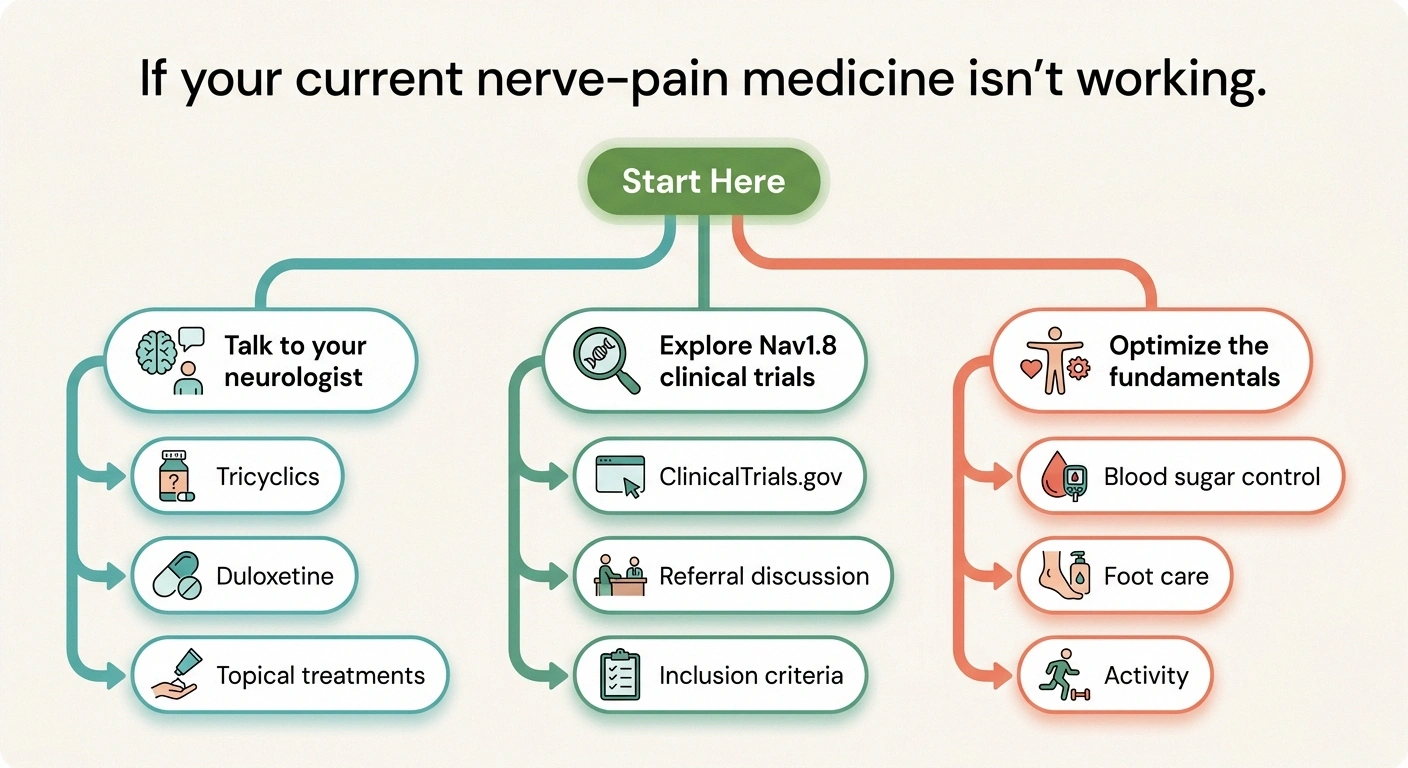
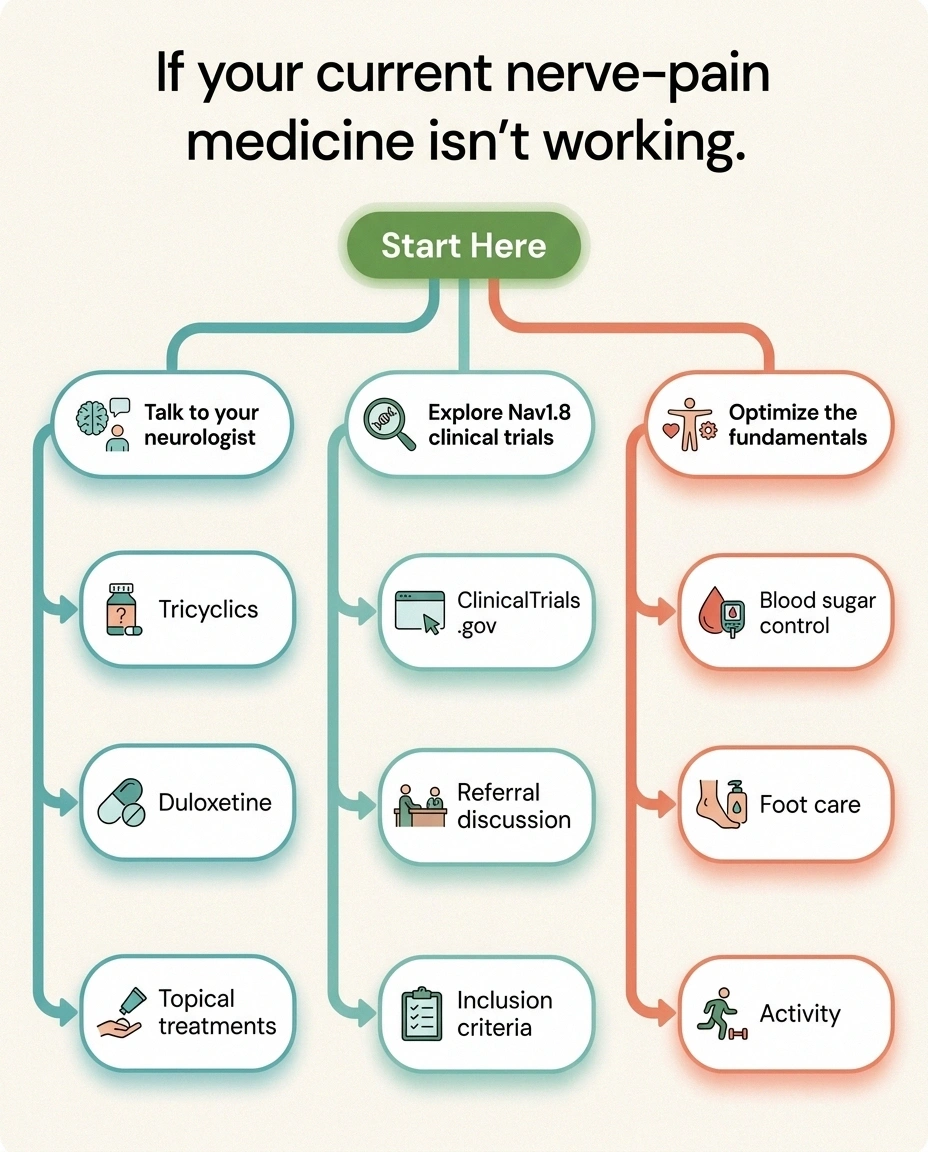
The best starting point is ClinicalTrials.gov. Search for the drug name (suzetrigine, VX-548, VX-993), the target (Nav1.8), or your condition plus “clinical trial” (for example, “diabetic peripheral neuropathy clinical trial”). The site lists active trials, enrolling sites, and inclusion criteria. If a trial is enrolling within reasonable driving distance and you meet the criteria, ask your neurologist about a referral. Being in a well-run trial means you'll be closely monitored, most trial-related care is covered, and you get access to a drug that may not be approved for years yet.
When you talk to your neurologist, the framing matters. The conversation isn't “please prescribe me suzetrigine off-label.” The productive version is: “I've been reading about the Nav1.8 class. My current gabapentin isn't working well, or the side effects are hurting my daily life. Are there Nav1.8 clinical trials I'd be a candidate for? What other options should I be thinking about?” That reframes the visit around a real clinical decision and gives your neurologist a specific, useful question to work on with you.
In parallel, don't stop working on the fundamentals. Well-controlled blood sugar, physical activity that you can tolerate, weight loss where relevant, careful foot care, and evaluating whether your current medication regimen is actually doing more good than harm — those are still where most of the day-to-day gains come from, and they don't have to wait for a new drug to be approved.
Zooming out one more level: the bigger story here is that pain drug development, which has been essentially stalled for decades, is starting to move again. Nav1.8 is the first success. Peripheral nerve regeneration research, gene therapies, and other novel targets are behind it. It's a slow tide, and much of it is still years away, but it's real.
Frequently Asked Questions
Is suzetrigine approved for neuropathy?
No. Suzetrigine (Journavx) is FDA-approved for moderate-to-severe acute pain in adults — the short-term pain you might have for a few days after surgery or an injury. It is not approved for chronic neuropathy of any kind. Vertex is running clinical trials in painful diabetic peripheral neuropathy and painful lumbosacral radiculopathy, but no chronic-pain or neuropathy indication has been approved yet. Your neurologist cannot legally prescribe it for chronic nerve pain today, and insurance will not cover it for that purpose. Watch this space, but do not chase it off-label.
What is Nav1.8, in plain English?
Nav1.8 is a specific type of protein that sits in your peripheral pain nerves and helps them fire electrical signals to your brain. It's one of nine sodium-channel subtypes in the human body, and it's almost exclusively found in the peripheral nerves that carry pain — not in the brain, spinal cord, heart, or muscle. That makes it an unusually clean target for a pain drug: block Nav1.8 and you can quiet pain signaling without touching the brain, so no drowsiness, no addiction risk, and no cognitive fog. That's the promise of the class.
Why did Nav1.7 drugs fail if Nav1.7 is also a pain channel?
Nav1.7 was heavily pursued for about fifteen years and most of the drugs failed in clinical trials. Some weren't potent enough at safe doses. Others hit off-target channels — particularly cardiac Nav1.5 — before they could shut down enough Nav1.7 to make a difference. Some worked in animals but did not translate to meaningful pain relief in humans. Nav1.8 has been easier to selectively drug because it's structurally more distinct from the cardiac and central-nervous-system channels, which is why it finally produced a clinical winner.
How is suzetrigine different from gabapentin or opioids?
Gabapentin and pregabalin work in the central nervous system by dampening calcium signaling in the brain and spinal cord, which is why they can cause drowsiness, weight gain, and cognitive fog. Opioids activate opioid receptors in the brain, which can cause sedation, constipation, and dependence. Suzetrigine blocks Nav1.8 sodium channels only in the peripheral pain nerves — cutting the pain signal off before it reaches the brain. That's why it can reduce pain without producing the CNS side effects, addiction risk, or abuse potential of the older drugs.
How much does Journavx cost?
The list price is approximately $232 per day of therapy, which is expensive relative to older acute-pain medications. For a short course after surgery, insurance coverage varies widely and prior authorization is often required. If the drug is eventually approved for chronic conditions like diabetic neuropathy, cost will be one of the biggest obstacles to widespread access — daily use at that price runs to approximately $85,000 per year. The company is likely to negotiate coverage with major payers and offer patient assistance programs, but affordability will be a significant question for years to come.
Are there Nav1.8 clinical trials I can join for chronic neuropathy?
Yes, there are active clinical trials of Nav1.8 inhibitors in painful diabetic peripheral neuropathy and painful lumbosacral radiculopathy. Vertex is running the largest of these programs with suzetrigine and its next-generation drug VX-993. Latigo Biotherapeutics has trials with LTGO-33. The best place to search is ClinicalTrials.gov, using the drug name, the condition name, or the target (“Nav1.8”). If you find a trial within reasonable travel distance and you meet the criteria, ask your neurologist about a referral. Being in a trial gives you monitored access to a drug that may not be approved for years.
Can Nav1.8 drugs cause the cognitive fog that gabapentin does?
Based on the clinical data so far, no. Nav1.8 channels are essentially absent from the brain, so a properly selective Nav1.8 drug like suzetrigine should not cause the drowsiness, memory issues, or cognitive slowing that make gabapentin and pregabalin so hard to tolerate for many people. In the acute-pain trials that led to Journavx's approval, sedation and cognitive side effects were not prominent, and the drug did not show abuse-liability signals. That's one of the biggest reasons pain physicians are excited about the class, especially for patients who need to stay mentally sharp for work, driving, or family responsibilities.
If suzetrigine gets approved for diabetic neuropathy, how will it compare to gabapentin?
The honest answer is: we don't know yet, because the head-to-head trials aren't complete. Based on the science, a Nav1.8 drug would likely offer meaningful pain reduction with a much better tolerability profile than gabapentin — no fog, no weight gain, no dependence signal. But the magnitude of pain relief in chronic neuropathy trials so far has been mixed, and even if approved, the cost will be dramatically higher than generic gabapentin. Real-world use will likely start with patients who cannot tolerate or do not respond to older medications, then expand from there as long-term data accumulates.
About the Author