
Ashwagandha turns up in almost every supplement conversation now. Someone in my book club just started taking it for stress; my daughter-in-law swears it’s helping her sleep; and a woman at my last support group meeting asked me, point-blank, whether it might quiet the burning in her feet. That last question deserves a careful, honest answer — not the excited answer you’ll find on supplement-company websites, and not the dismissive answer that pretends we know nothing.
Here’s what I’ve been able to piece together after digging through the research, and here’s what I’d tell a friend before they added ashwagandha to their neuropathy toolkit.
What Ashwagandha Actually Is
Ashwagandha, or Withania somnifera, is a small shrub native to India and parts of North Africa. In Ayurvedic medicine, its root has been used for thousands of years as a “rasayana” — a rejuvenating herb — and it’s classified in modern herbalism as an adaptogen, meaning a plant thought to help the body cope with physical and emotional stress.
Ashwagandha is an adaptogen with real biology — not a nerve-repair supplement.
Standardized root extract (KSM-66 or Sensoril) at 300 to 600 mg per day has real pharmacological activity, thousands of years of traditional use, and encouraging animal research for nerve pain. Human evidence in peripheral neuropathy specifically remains zero.
What you buy today isn’t the raw root someone dug out of the ground. It’s a standardized extract, usually taken as capsules, tablets, or gummies. The two most-studied preparations are KSM-66 (a full-spectrum root extract) and Sensoril (which includes both root and leaf, with a different active-compound profile). Doses in modern clinical trials typically range from 300 to 600 mg per day.
The active compounds — a family called withanolides — appear to affect several systems at once. They influence the stress-hormone axis, calm inflammation, act as antioxidants, and interact with the GABA system in the brain (the same system alcohol and benzodiazepines target). That broad, gentle activity is why ashwagandha has been studied for everything from anxiety to sleep to muscle recovery to, more recently, nerve pain.
The Nerve-Pain Evidence: What We Actually Have
Let me be straightforward with you before we dive in: there are no published randomized controlled trials of ashwagandha in people with peripheral neuropathy. Not for diabetic neuropathy, not for chemo-induced neuropathy, not for idiopathic. The human evidence base for neuropathy specifically is essentially zero.
What we do have is a growing body of animal research. Here’s what those studies show, honestly reported.
In a 2023 rat study published in Comparative Clinical Pathology, researchers induced diabetic neuropathy by injecting rats with alloxan (a chemical that destroys the insulin-producing cells of the pancreas). They then treated some of the rats with a phenolic compound extracted from ashwagandha root. The treated rats showed reduced oxidative stress markers, lower inflammatory cytokines (TNF-alpha, IL-6), and improved responses on mechanical and thermal pain tests compared to untreated diabetic rats.
An earlier study in Inflammopharmacology (2017) tested ashwagandha root extract in two rat models: a postoperative pain model and a spared nerve injury model (a standard research analog for peripheral neuropathy). Rats treated with ashwagandha showed significantly increased mechanical withdrawal thresholds at both six and twenty-four hours after the intervention — meaning they tolerated more pressure before pulling away.
A newer 2025 preclinical study used a mouse fibromyalgia-like model and showed ashwagandha root extract improved pain behaviors and changed brain neurochemistry consistent with pain modulation.
These are real findings. They’re also rat and mouse findings. The gap between “helped rats with induced nerve damage” and “will help a person with idiopathic small-fiber neuropathy” is enormous, and I want to be honest with you about that gap rather than paper over it.
How It Might Work (The Proposed Mechanisms)
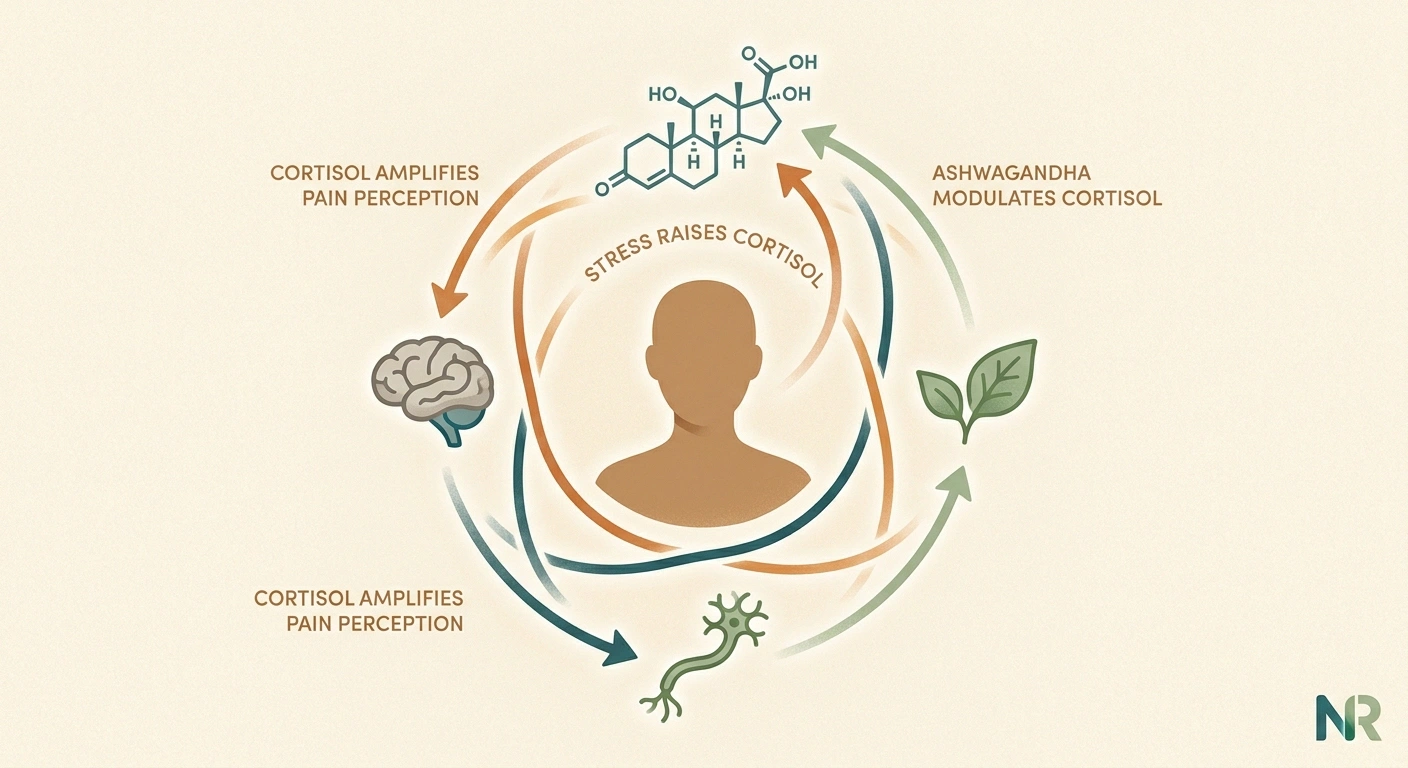
If ashwagandha does help nerve pain in humans — a big if — the pathways would likely include:
Cortisol reduction. This is the most consistently proven human effect. Multiple well-designed trials in stressed adults show ashwagandha lowers salivary and serum cortisol by roughly 14 to 30 percent at doses of 300 to 600 mg per day. Chronic elevated cortisol amplifies pain perception, worsens sleep, and drives inflammation. Bringing cortisol down doesn’t directly fix nerves, but it can meaningfully change how much pain a person feels and how well they sleep — both of which matter enormously in daily life with neuropathy.
Anti-inflammatory action. Withanolides inhibit NF-kappa B, a master switch for inflammatory cytokines. Since inflammation is one of the mechanisms driving nerve pain in many neuropathies, this is a plausible mechanism.
Antioxidant support. Ashwagandha activates the Nrf2 pathway, one of the body’s main antioxidant defense systems. Oxidative stress is a well-documented driver of diabetic and chemo-induced nerve damage.
GABA-ergic effects. Ashwagandha appears to enhance GABA activity, contributing to its calming, sleep-supporting reputation. Gabapentin and pregabalin — the two most-prescribed neuropathy medications — work indirectly on GABA-related pathways. This isn’t the same mechanism, but there’s some conceptual overlap.
Note what none of these are: nerve regeneration. Ashwagandha isn’t repairing damaged nerve fibers. If it helps at all, it’s more likely by dialing down inflammation, oxidative stress, and pain amplification — not by rebuilding what’s already lost.
What About the “Ashwagandha for Diabetic Neuropathy” Buzz?


You’ll find articles online claiming ashwagandha “reverses” or “stops” diabetic neuropathy. Some of them are Ayurvedic tradition papers; some are supplement marketing dressed up as content; some cite the rat studies as if they applied directly to humans.
Here’s what’s fair to say about diabetic nerve pain specifically:
Ashwagandha has been studied for blood-sugar effects in humans, with mixed but generally favorable results. Some small trials show modest reductions in fasting glucose and A1C. If it does help nerve outcomes in diabetic patients, part of that benefit might come indirectly through better glucose control — which we know matters enormously for nerve health.
The direct evidence, though, is still confined to rodents. A prudent read: ashwagandha may be one of several supportive tools worth considering in diabetic neuropathy management, but the primary strategy remains blood-sugar control, appropriate medications, and lifestyle changes. Ashwagandha isn’t a substitute for any of those.
How Much and Which Kind
If you and your doctor decide to try ashwagandha, here’s what the human trials on other indications have generally used:
- Standardized root extract, 300 to 600 mg per day. The 600 mg dose is more common in stress and sleep studies. Some studies split the dose (300 mg morning, 300 mg evening).
- Standardized preparations like KSM-66 or Sensoril have the most human research behind them. Unstandardized “ashwagandha root powder” varies wildly in potency.
- Withanolide content should be listed on the label — typically 2.5% to 5% withanolides for KSM-66 or higher for Sensoril.
- Timeline: Human stress/sleep trials generally show measurable effects in 4 to 8 weeks. If you’re going to try it, give it a real trial — a bottle isn’t enough.
A caution I want to underline: dosing higher isn’t safer or more effective. Ashwagandha has real pharmacological activity, and more is not more.
In animal models of diabetic neuropathy, ashwagandha root extracts reduce inflammatory cytokines (TNF-alpha, IL-6), lower oxidative stress markers, and improve mechanical and thermal pain thresholds. Whether these effects translate to people with peripheral neuropathy has not been tested in high-quality clinical trials.
Sources: Comparative Clinical Pathology 2023 (alloxan-induced neuropathy rats); Inflammopharmacology 2017 (spared nerve injury model).
Safety: Where This Herb Deserves Real Respect

This is the section I wish supplement labels would print at the top. Ashwagandha is not risk-free, and several of its interactions matter enormously for the neuropathy community specifically.
Ashwagandha interacts with several important things.
- Thyroid medication: raises T3/T4 — can cause over-replacement.
- Autoimmune conditions: theoretically immunostimulating (CIDP, Sjögren’s, RA, lupus).
- Sedatives and gabapentinoids: additive sedation risk.
- Immunosuppressants: potential interference (tacrolimus, cyclosporine, biologics).
- Blood pressure meds: modest additive lowering (fall risk).
- Pregnancy: avoid entirely.
- Surgery: stop at least 2 weeks before.
Thyroid. Ashwagandha raises T3 and T4 hormones. If you have hyperthyroidism, or if you’re on thyroid replacement (levothyroxine, Synthroid), it can push you into over-replacement territory. This shows up as heart palpitations, tremor, weight loss, anxiety — and it can worsen certain neuropathies. Never add ashwagandha if you’re on thyroid medication without checking with your doctor and planning to recheck labs.
Autoimmune conditions. Ashwagandha appears to stimulate certain immune functions. If your neuropathy has an autoimmune driver — CIDP, Sjögren’s, rheumatoid arthritis, lupus, sarcoidosis, or an anti-MAG neuropathy — this is theoretically the last thing you want. Talk to a neurologist before starting.
Immunosuppressant medications. If you’re on tacrolimus, cyclosporine, mycophenolate, or biologics like rituximab or IVIG for an autoimmune neuropathy, ashwagandha could theoretically interfere. Same caution.
Sedatives, benzodiazepines, alcohol. Ashwagandha’s GABA-related effects can compound with these. If you’re already on gabapentin or pregabalin, or if you take a sleep medication or benzo, extra sedation is a real possibility. Start low, monitor how you feel, and never stack ashwagandha with alcohol.
Blood pressure medications. Ashwagandha can modestly lower blood pressure. Combined with a BP medication, this may cause lightheadedness — which is a fall risk for anyone with existing balance issues from neuropathy.
Liver. Since 2019, there have been growing case reports of ashwagandha-associated liver injury, catalogued in the NIH’s LiverTox database. It’s rare, but real. Symptoms include unexplained fatigue, jaundice, dark urine, or abdominal discomfort in the weeks after starting. If any of these show up, stop and see your doctor.
Pregnancy. Avoid entirely. Traditionally used as an abortifacient.
Surgery. Stop at least two weeks before any planned surgery due to potential effects on blood pressure, blood sugar, and sedation.
Where Ashwagandha Might Realistically Fit
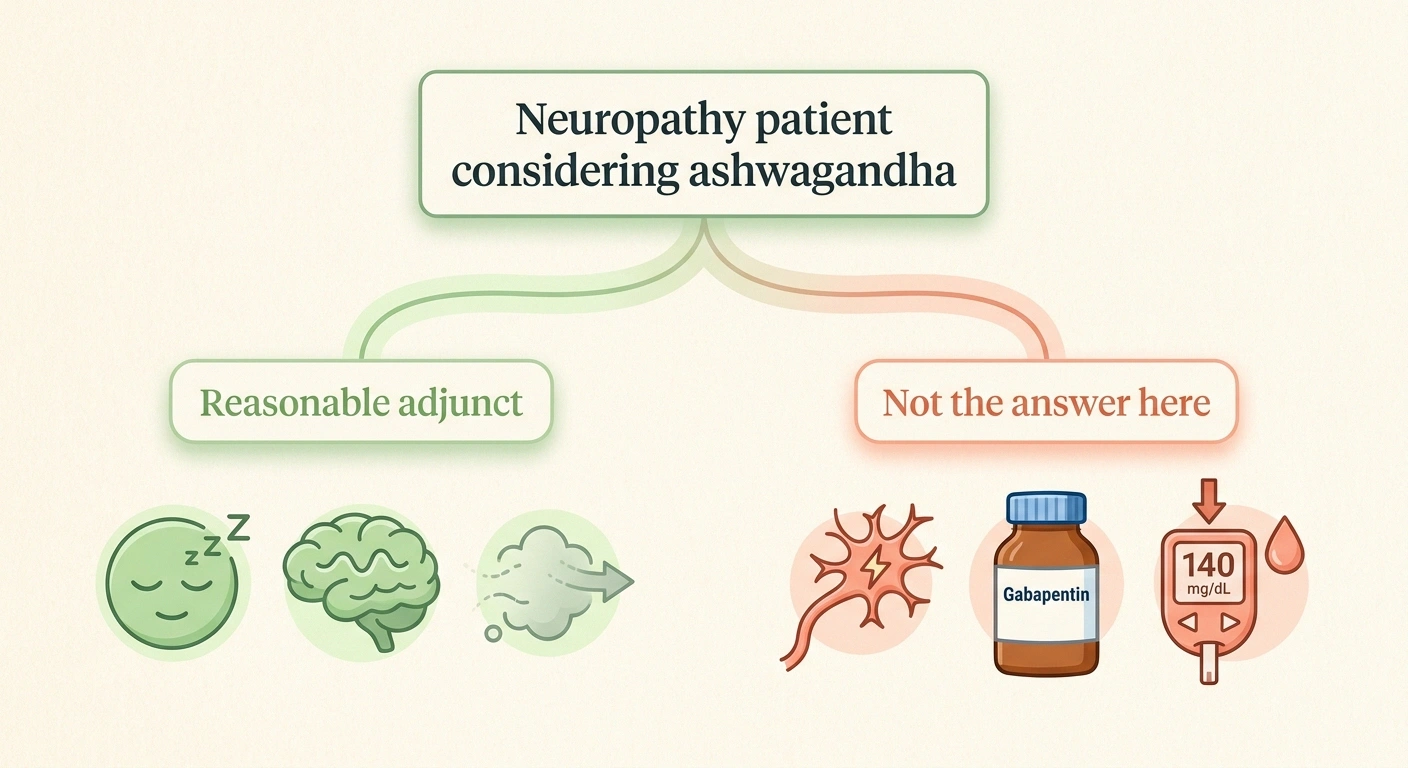
Given all of the above, here’s my honest read on where ashwagandha could realistically play a helpful role for someone living with neuropathy — and where it probably can’t.
- Stress-driven pain amplification
- Poor sleep worsening symptoms
- Adjunct to a broader evidence-based supplement plan
- Gabapentin, pregabalin, or duloxetine
- Blood-sugar control in diabetes
- Nerve fiber regeneration (nothing does this reliably)
Where it might help:
- As a stress-reduction and sleep-support tool for someone whose neuropathy pain is amplified by anxiety and poor sleep (both are common). The emotional side of neuropathy is often underestimated, and calming the nervous system’s baseline arousal is a legitimate way to reduce perceived pain.
- As a modest adjunct to a broader supplement stack, potentially alongside evidence-based options like alpha-lipoic acid, acetyl-L-carnitine, or magnesium — with your doctor’s awareness.
- In someone with diabetic neuropathy whose glucose control could benefit from an incremental push, with the primary strategy still being diet, exercise, and appropriate medications.
Where it probably won’t help — or shouldn’t be tried:
- As a stand-alone treatment for peripheral neuropathy. There’s no evidence this works.
- In place of gabapentin, pregabalin, duloxetine, or other prescribed neuropathy medications.
- In autoimmune neuropathy without specialist guidance.
- Alongside thyroid medication without dose adjustment.
- In someone actively pregnant or preparing for surgery.
The Broader Supplement Picture
I want to zoom out for a moment. Ashwagandha is one of dozens of supplements being marketed to the neuropathy community. Most of them have thin evidence, and the ones with the most persuasive advertising rarely have the most robust research behind them.
The supplements with the strongest evidence for neuropathy specifically are alpha-lipoic acid, acetyl-L-carnitine, methylcobalamin (B12), and benfotiamine (a form of B1). These aren’t miracle cures either, but they’ve been studied in humans with neuropathy, not just rats. If you’re building a supplement approach, I’d start there and consider adding ashwagandha only as a supporting tool for stress, sleep, and general resilience — not as a nerve-repair intervention.
Our roundup of the best neuropathy supplements covers the evidence for each of these in more depth.
How to Actually Try It (If You’re Going To)
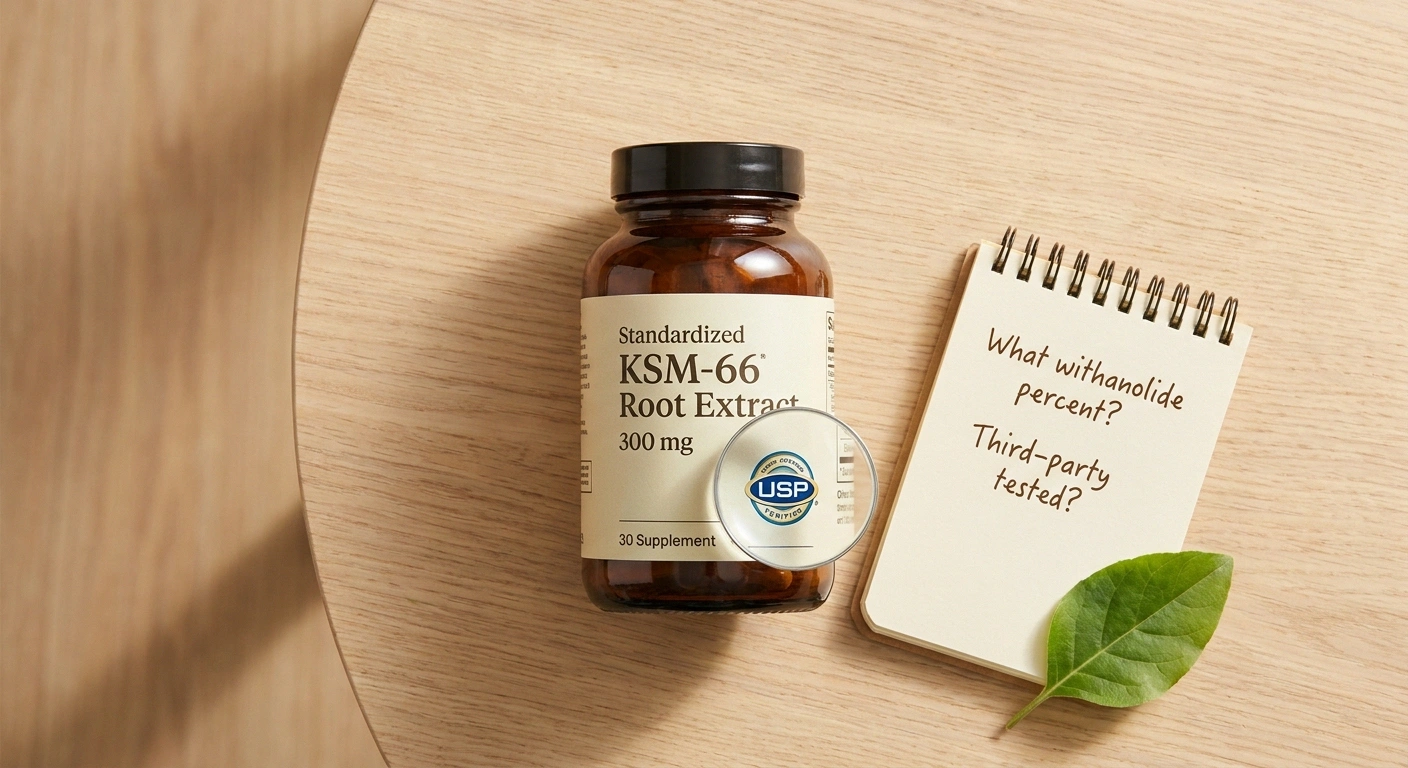
If, after all this, you and your doctor decide ashwagandha is worth a try:
- Interaction check — bring med list to your doctor or pharmacist
- Buy quality — standardized KSM-66 or Sensoril, third-party tested
- Start low — 300 mg once daily for 2 weeks
- Journal it — sleep, pain, energy, mood; glucose if diabetic
- Give it time — 4 to 8 weeks minimum
- Recheck labs — thyroid at 8 to 12 weeks if on replacement
- Stop if rash, jaundice, dark urine, palpitations, or worsening pain
1. Check for interactions first. Bring your full medication list — prescription and OTC — to your doctor or pharmacist and specifically ask about ashwagandha compatibility. Thyroid, immune, sedative, and blood-pressure drugs are the flags.
2. Buy quality. Choose a standardized preparation from a company that publishes third-party testing (USP verified, NSF, or ConsumerLab-tested is ideal). Cheap generic ashwagandha varies wildly in potency and can contain contaminants.
3. Start low. A 300 mg once-daily dose for two weeks lets you check for sedation, digestive upset, or other reactions before increasing.
4. Track carefully. Keep a simple journal: sleep quality, pain levels, energy, mood. If you’re diabetic, watch your glucose readings — ashwagandha can lower them modestly, which may require adjustments if you’re on insulin or a sulfonylurea.
5. Give it a real trial. Human trials show benefits building over 4 to 8 weeks. A one-week trial isn’t a trial.
6. Recheck thyroid labs at 8-12 weeks if you’re on thyroid replacement.
7. Stop and reassess if: you develop rash, jaundice, dark urine, unusual fatigue, palpitations, tremor, or if pain worsens rather than improves.
The Bottom Line

Ashwagandha is an interesting plant with real biological activity, thousands of years of traditional use, and encouraging preclinical research for nerve pain. It also has essentially zero human trials in neuropathy, several significant drug and health-condition interactions, and a marketing ecosystem that overstates its benefits.
A plausible adjunct — not a nerve-repair miracle.
If your doctor sees no red-flag interactions and your neuropathy is compounded by stress, poor sleep, or anxiety, an 8-week trial of a quality standardized extract is reasonable. Expect stress and sleep support more than direct nerve-pain reduction — and either kind of help is worth having.
Where I’ve landed after reading the research: it’s a plausible adjunct for someone whose neuropathy is compounded by stress, poor sleep, or anxiety, and whose doctor sees no red-flag interactions. It is not a nerve-repair supplement, and it should never replace evidence-based treatments or blood-sugar control.
If a friend called me tomorrow and asked whether they should try ashwagandha for their burning feet, I’d want to know three things first: what medications they’re on, whether they have any autoimmune diagnoses, and whether they’ve optimized the higher-evidence pieces (blood sugar, prescribed medications, sleep, and the better-studied supplements) already. If the answers were reassuring on all fronts, I’d tell them it might be worth an 8-week trial with a good product — with realistic expectations that it’s more likely to help their stress and sleep than their nerves directly, and that either kind of help is worth having.
Talk to your doctor. Don’t stop your prescribed neuropathy medications. And treat ashwagandha the way you’d treat any real medicine: with respect, careful monitoring, and honest expectations.
Frequently Asked Questions
Does ashwagandha actually help nerve pain?
There are no completed randomized controlled trials of ashwagandha in people with peripheral neuropathy. Animal studies (in rats and mice) show reduced pain behaviors and less inflammation in induced neuropathy models. Human trials for other conditions show consistent reductions in cortisol and improvements in stress, sleep, and anxiety — which can indirectly reduce perceived pain. Direct nerve-pain benefit in humans remains unproven.
What’s the best dose of ashwagandha for neuropathy?
There’s no established neuropathy-specific dose because there are no human trials. Doses used in stress, sleep, and general wellness trials range from 300 to 600 mg per day of a standardized root extract like KSM-66 or Sensoril. Starting at 300 mg once daily and monitoring response is prudent.
How long does ashwagandha take to work?
Human trials on stress and sleep typically show measurable effects at 4 to 8 weeks of consistent use. Faster or dramatic improvements are unusual.
Can I take ashwagandha with gabapentin or pregabalin?
Combining ashwagandha with gabapentin or pregabalin may increase sedation because of overlapping calming effects on the nervous system. It’s not a strict contraindication, but starting low and watching for excessive drowsiness or unsteadiness is essential. Discuss with your doctor first, especially if you already have balance issues from neuropathy.
Is ashwagandha safe if I have autoimmune neuropathy?
Probably not without specialist guidance. Ashwagandha has immunostimulating properties that could theoretically worsen autoimmune conditions such as CIDP, Sjögren’s syndrome, lupus, rheumatoid arthritis, or sarcoidosis-related neuropathy. If you have any autoimmune diagnosis, check with your neurologist before starting.
Can ashwagandha interact with thyroid medication?
Yes — this is one of the most important cautions. Ashwagandha raises T3 and T4 thyroid hormone levels. If you’re on levothyroxine (Synthroid) or similar thyroid replacement, adding ashwagandha can push you into over-replacement, which causes palpitations, tremor, anxiety, and weight loss. Never combine without your doctor’s awareness and a plan to recheck labs.
Does ashwagandha help diabetic neuropathy specifically?
Animal studies in diabetic neuropathy models show reduced pain behaviors and oxidative stress markers. Some small human trials on general blood-sugar control show modest reductions in fasting glucose and A1C. Whether ashwagandha directly helps diabetic nerve damage in people has not been tested in high-quality trials. Blood-sugar control through diet, exercise, and appropriate medications remains the primary nerve-protective strategy in diabetes.
Is ashwagandha safe long-term?
Most human trials have run 8 to 12 weeks. Long-term safety data (beyond a year of daily use) is limited. There have been rare reports of ashwagandha-associated liver injury since 2019, catalogued in the NIH LiverTox database. Periodic breaks from continuous use, quality sourcing, and stopping at any sign of liver-related symptoms (jaundice, dark urine, unusual fatigue) are reasonable precautions.
About the Author