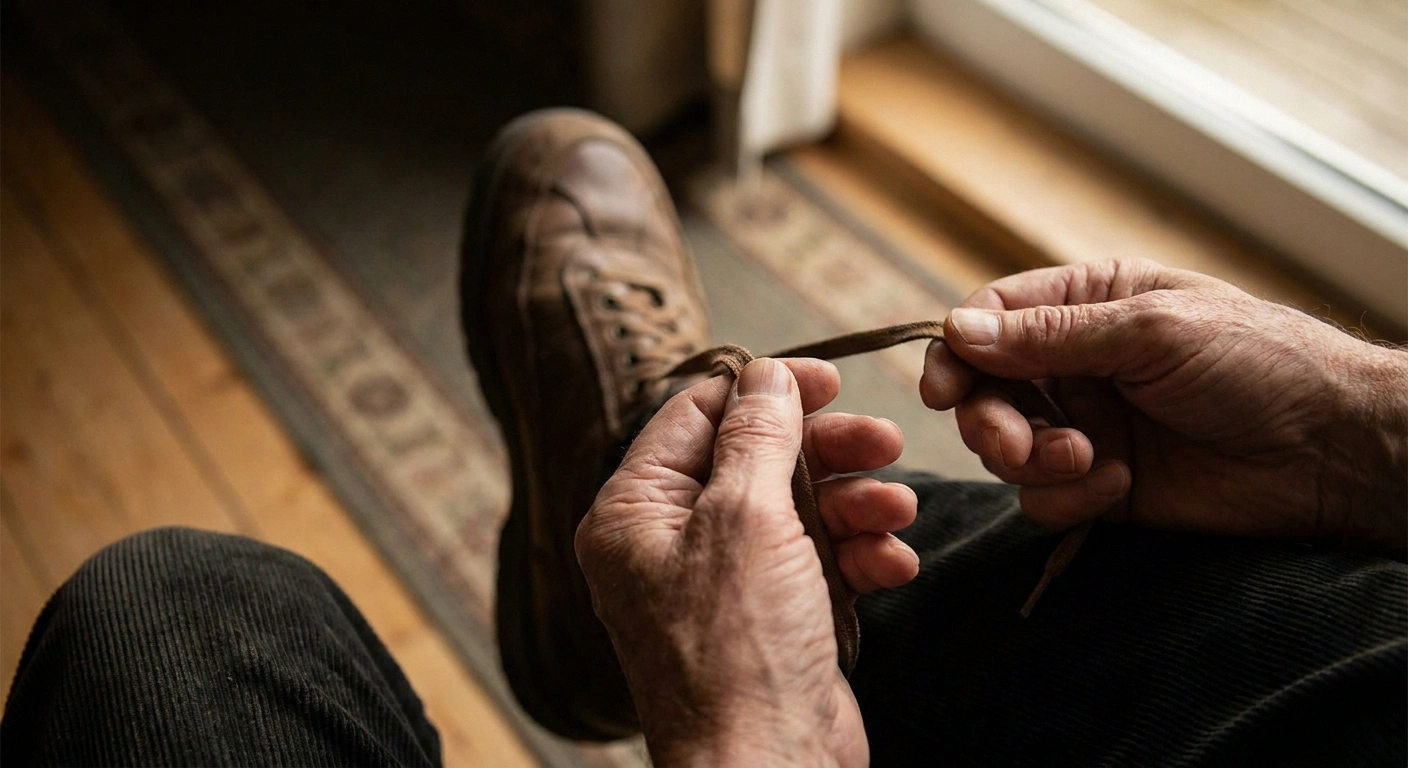
I stopped tying my own shoes properly about three years ago, and the odd part is that I can still do it.
My fingers work. I can loop a lace, pull it through, make a bow. What I cannot do any more is tell how tight I made it. The lace goes taut and my fingertips report back something vague and delayed, like a phone call with a bad connection, and I genuinely do not know whether I have made that shoe snug or strangled my foot until I have walked on it for twenty minutes.
That is a different problem from the one every article about no-tie laces is written to solve.
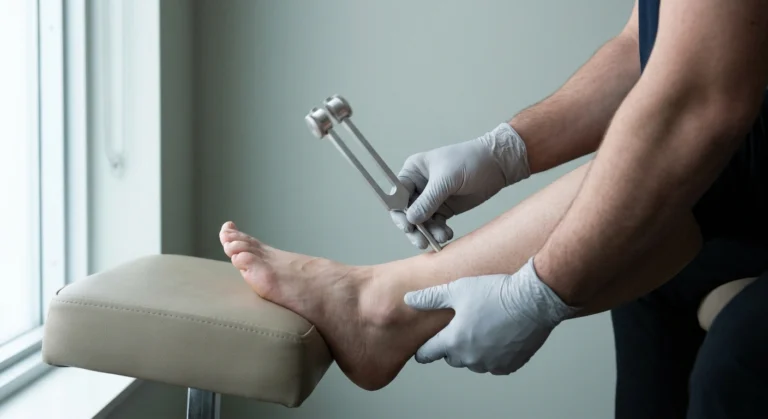
Search for shoelace alternatives and you will find page after page written for arthritis, or for people with the use of one hand. Those are real problems and the solutions overlap. But arthritis is pain and grip with sensation intact — you can still feel the lace. Neuropathy in the hands takes the feedback away and often leaves the strength, and neuropathy in the feet means the shoe cannot tell you it is too tight either.
Two ends of the same system gone quiet. That changes which products are good and which ones are quietly a bad idea.
The Five Systems, and What Each One Really Is
Here is the actual market, stripped of marketing.
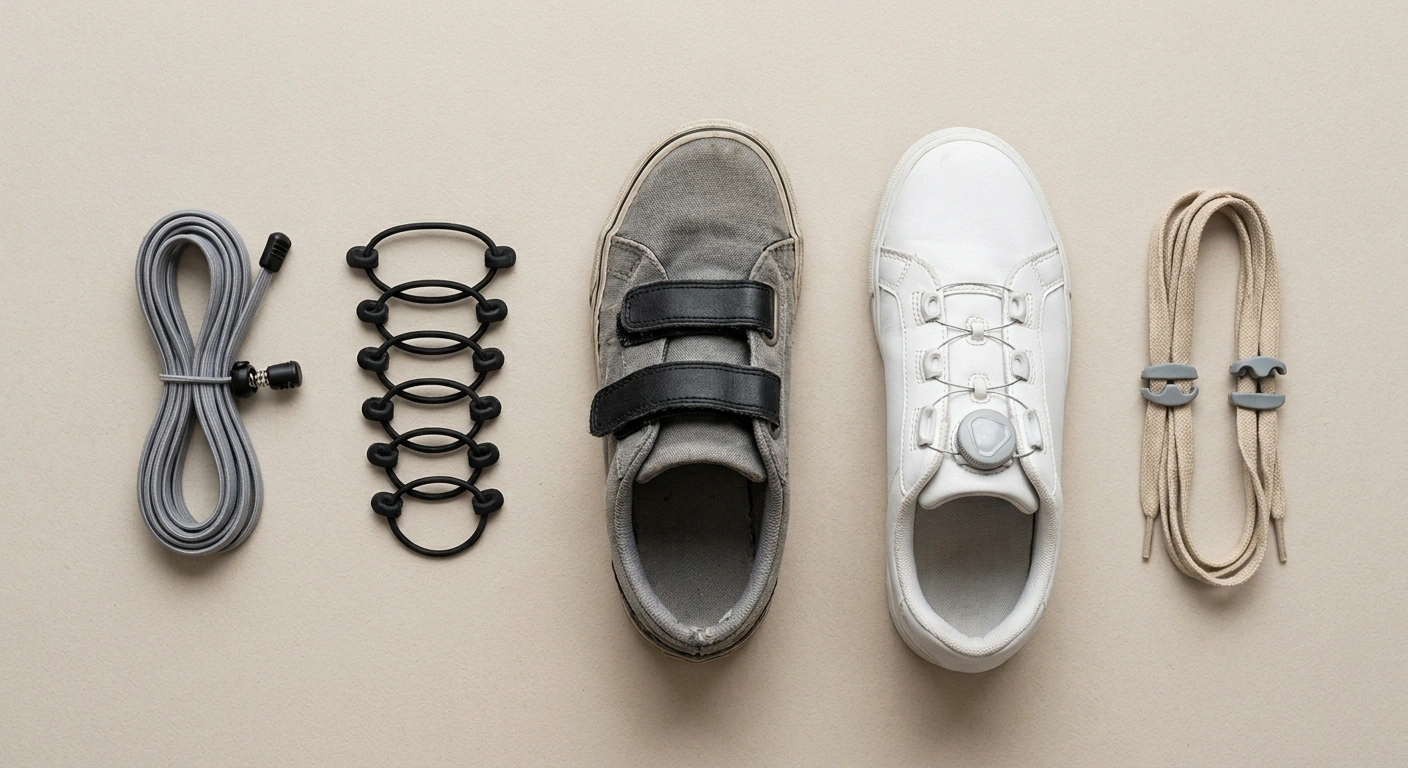
Elastic laces with a spring lock. Round or flat elastic cord threaded through your existing eyelets, with a small spring-loaded toggle that clamps it at whatever tension you set. Trim the ends and your lace-up becomes a slip-on that still holds its shape. This is the workhorse of the category, costs a few dollars a pair, and works on almost any shoe with eyelets.
Elastic laces without a lock. Silicone bungee segments that clip into each eyelet pair, or coiled curly laces that just stretch. No tension setting at all — you get whatever the elastic gives you. Easy, and that ease is exactly the problem, because there is no way to dial the fit.
Hook-and-loop straps. Velcro. Decades old, still excellent, and undersold because it looks institutional. Two or three straps, secure, adjustable in seconds, no fine motor requirement whatsoever. Usually built into the shoe rather than retrofitted.
Dial systems. A thin steel wire routed through guides, tightened by a ratcheting dial you turn with two fingers. Better dials loosen as well as tighten without releasing entirely. Migrated from ski boots and cycling shoes into walking shoes and some diabetic footwear.
Lace anchors and zipper kits. Small clips that stop conventional laces working loose, or a zipper panel added alongside laces so you tie once and then zip. Half-measures — and occasionally exactly the right half-measure.
Why Set-and-Forget Is the Whole Design Problem
Every one of those systems does the same fundamental trade. It replaces tension you feel and adjust each time with tension you set once and stop thinking about.
- Spring lock, worn out
- Slips all at once. The shoe is obviously loose and you will notice on the first step. Loud failure, which is the good kind.
- Velcro, clogged with lint
- Loses grip a few percent a month. No single day feels different. Quiet failure, and the reason to brush it out and check the corners.
- Elastic, gone slack
- Stretches out over months until the shoe moves on your foot while walking, which causes friction rather than pressure. Replace annually rather than waiting for a symptom.
- Dial, cracked or jammed
- Fails completely and immediately, usually leaving the wire either locked tight or fully released. Obvious, but it can strand you mid-outing, so it is worth knowing whether your model has replaceable parts.
For most people that trade is pure profit. If your feet have normal sensation and you set an elastic lace slightly too tight, your foot complains within a block, you stop, you loosen it, and the whole episode lasts ninety seconds.
With reduced sensation, nothing complains. A lace that is fifteen percent too tight is not an uncomfortable afternoon — it is eight hours of steady pressure over the top of the foot that you will find out about when you take the shoe off and see a red band, or worse, when you do not look and find a blister a day later. This is the same reason daily foot checks matter so much in the first place.
So the criteria that should drive your choice are not the ones on the packaging. Forget “quick and easy.” Ask four questions instead:
- Can I set the tension precisely, or does the product decide for me?
- Does it hold that tension, or drift over hours and days?
- When it fails, does it fail visibly, or invisibly?
- Can I adjust it mid-day when my foot swells, without taking the shoe off?
Score the five systems on those and the ranking shifts considerably from what you would guess.
What I Would Choose, and Why
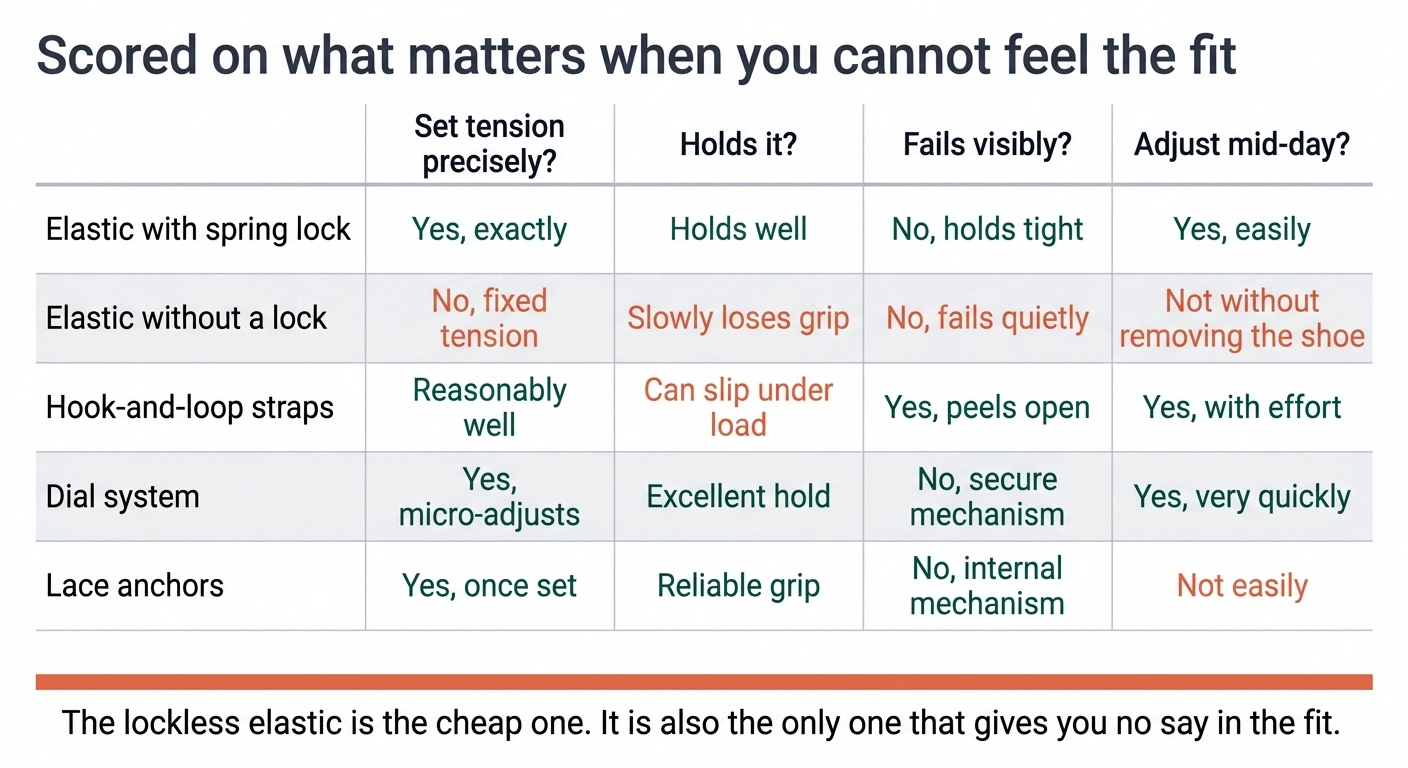
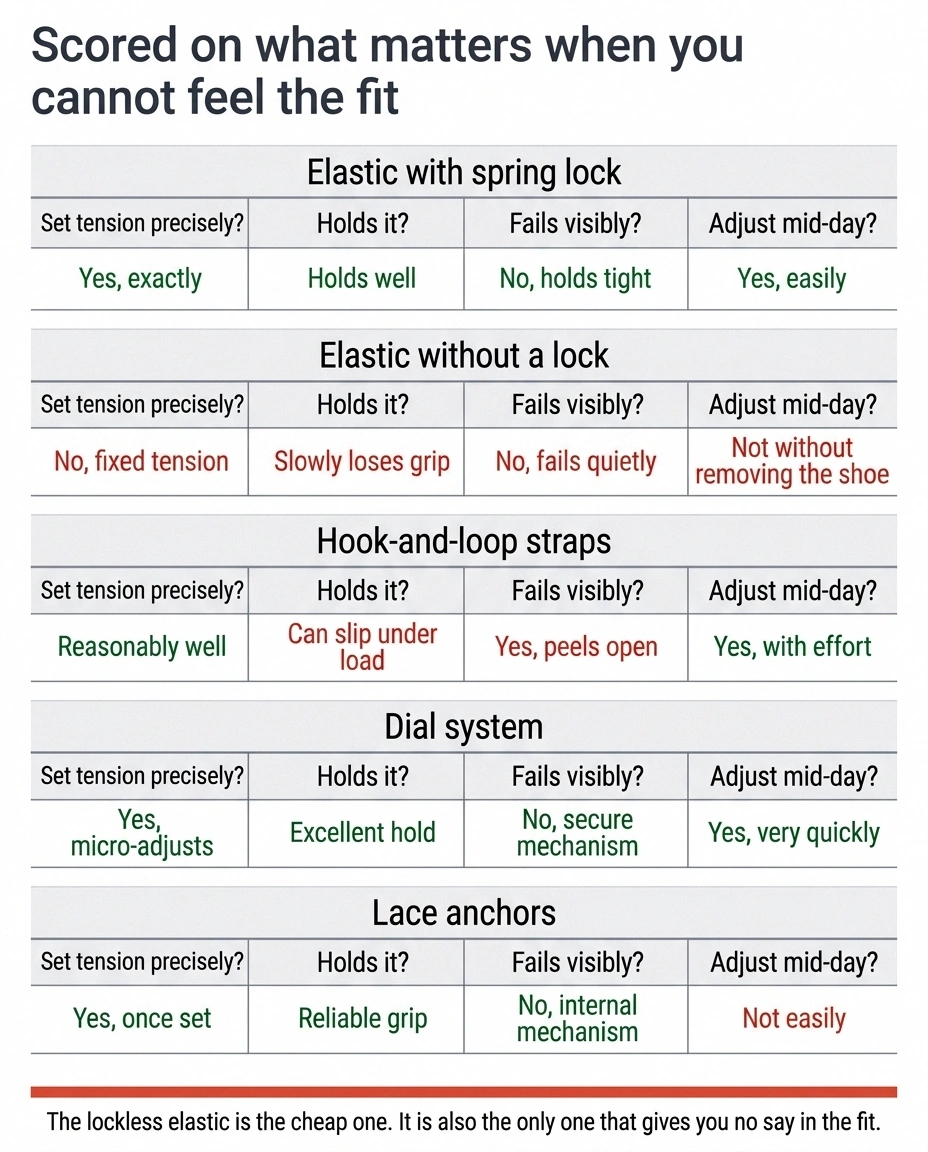
Elastic laces with a spring lock: the default recommendation. They win because the lock lets you set an exact tension and the elastic then absorbs the day’s changes without you touching it. The failure mode is also honest — a spring lock that has given up slips visibly and the shoe is obviously loose. You will notice. Buy the flat kind rather than round if your shoe has narrow eyelets, and buy a length appropriate to the shoe rather than trimming a long pair down to nothing.
| When | What to do | Act if |
|---|---|---|
| Setting day | Set tension in the evening, one flat finger under the laces | Two fingers fit, or none do |
| First 10 minutes | Walk, then take the shoe off and look at your instep | A defined red band, not a fading pink line |
| Days 1 to 7 | Look at both feet once daily, when the shoes come off | Any mark still visible after five minutes, or any warmth |
| Monthly after that | Same check, plus squeeze the lock and brush the Velcro | The lock gives, or a strap has begun to peel |
Hook-and-loop straps: the best choice if your hands are the main problem. Nothing else requires less of your fingers. The catch is that Velcro dies slowly. It fills with lint and sock fibres, loses grip a little at a time, and the strap that held firm in March holds slightly less in September without any single day feeling different. If you go this route, clean the hooked side with a stiff brush every month or two, and treat a strap that has started to peel at the corner as due for replacement rather than as still fine.
Dial systems: the best fine control, at a price. A good dial is genuinely the most precise adjustment available and the easiest to make mid-day without bending down far. That mid-day point matters more than people expect, because feet with neuropathy swell and the shoe that fit at breakfast is not the shoe you are wearing at four. The downsides are cost, the fact that you usually have to buy the whole shoe, and a failure mode that is abrupt — a dial that cracks or jams leaves you with no adjustment at all rather than a gradually looser shoe.
Elastic without a lock: my one genuine caution. These are the ones I would steer away from. Silicone bungees and coiled laces give you whatever tension the manufacturer chose, across every eyelet, with no way to make the forefoot looser and the ankle snugger. If your foot is a standard shape and your sensation is fine, they are harmless. If you have a bunion, a hammer toe, a high instep, or a foot that cannot report pressure, you are handing the fit decision to a piece of moulded rubber. That is the wrong decision to delegate.
Lace anchors: good for a specific case. If your problem is only that laces work loose and you keep having to bend down and retie, an anchor solves precisely that and changes nothing else about the fit you already trust.
Setting the Tension Without Feedback
This is the part no other page covers, and it takes about five minutes once.
Worth seeing together, because the cheapest option and the one that gives you the least control are the same product.
Set it late in the day, never first thing. Your feet are at their largest in the late afternoon or evening. A fit dialled in at 7am is a fit dialled in on your smallest foot, and you will spend every evening in a shoe that has quietly become too tight. Put the shoes on after a normal day on your feet — that is your real foot — and set the lock then.
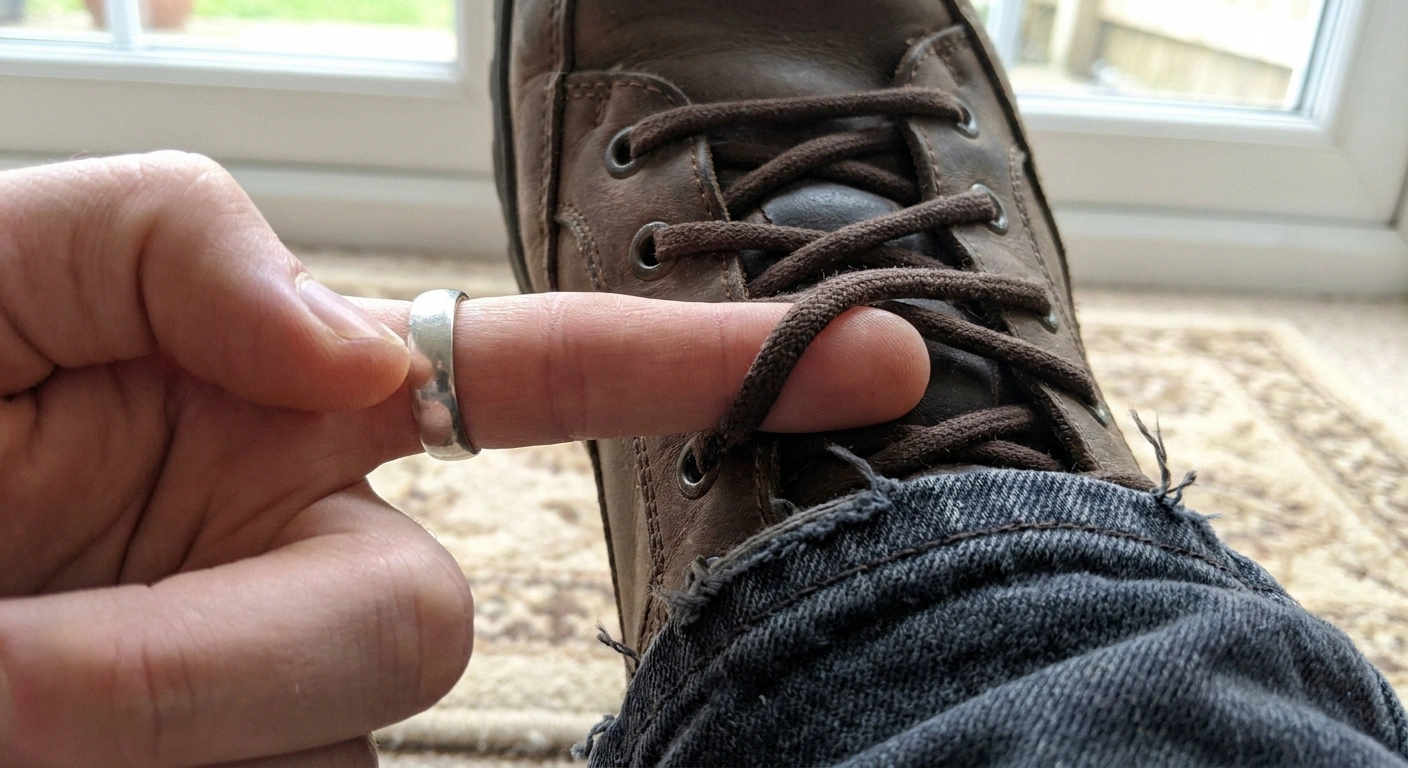
Use your hand, since your foot cannot vote. With the shoe on and the lace set, slide one finger flat under the laces at the top of the foot. It should go in with a little resistance and come out without a struggle. Two fingers is too loose, no fingers is too tight — one, with mild resistance, is the target. This is a crude test and it is far better than nothing, because it moves the judgement to a part of your body that still reports accurately.
Look at the tongue. If the tongue is folding, bunching or pulling off to one side, the tension is uneven across the eyelets even if the overall snugness feels right. Elastic laces are particularly prone to this because you thread them once and then never see them individually again.
Then walk for ten minutes and take the shoe off. Look at the top of your foot. A faint pink line that fades in a minute or two is normal pressure. A defined red band, an indentation still visible after five minutes, or any warmth means loosen it a notch and test again. You are substituting your eyes for the nerves that are not reporting.
Repeat the check for the first week. Every day, once, when you take the shoes off. A new fastening system is a new pressure distribution, and the first week is when a problem is both most likely and easiest to fix. If you have diabetes as well as neuropathy, treat this as non-negotiable rather than thorough.
After that week, monthly is enough — plus any time your feet have been swelling more than usual, or you have changed socks. A thicker sock changes the fit meaningfully, which is why the sock you wear and the lace you set are really one decision, not two.
Getting the Shoe On Is a Separate Problem
Worth separating, because people conflate them and then buy the wrong fix.
The first-week skin check stops being thoroughness and becomes the whole point. Reduced sensation and reduced healing together mean a pressure mark that would be a nuisance on any other foot can become a wound on yours, and the fastening system is a new and untested pressure source.
One practical adjustment: set the tension a notch looser than feels right on the first day and tighten it on day three if the shoe is sliding. Starting loose and firming up costs you a slightly sloppy day. Starting tight costs you a week of healing.
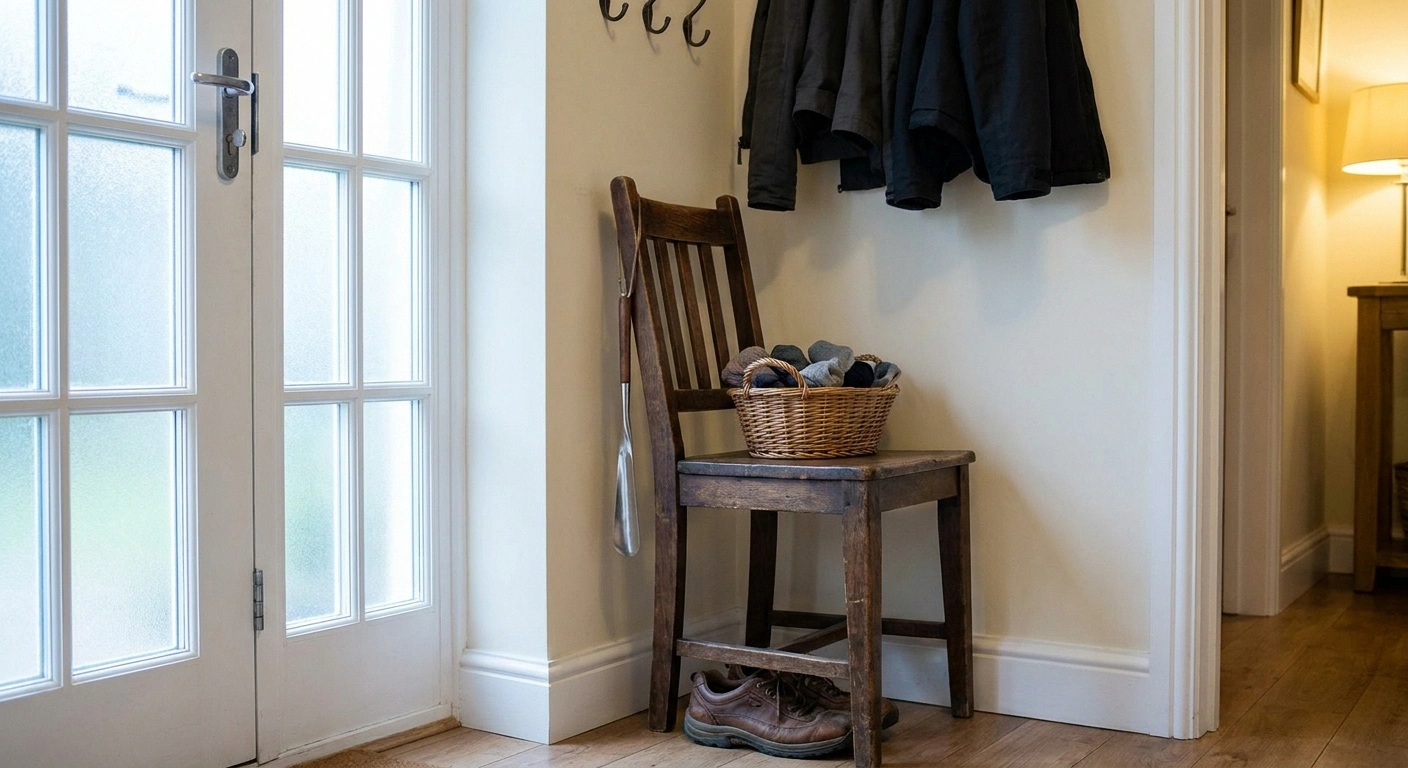
If tying is the hard part, a lace system solves it. If bending down and reaching your foot is the hard part, no lace in the world helps, and the answer is a long-handled shoehorn and a chair by the door. If getting the heel past the collar is the hard part, you want a shoe with a wide opening or a rear zip.
The chair matters more than the equipment — genuinely. Standing on one leg to put on a shoe is a balance task, and it is one of the more common ways people come off their feet at home. Sitting down removes the risk entirely and costs nothing. Our broader guide to getting dressed with neuropathy goes through the rest of the sequence, and much of the same logic applies to getting compression socks on, which is arguably the harder job.
When the Answer Is a Different Shoe
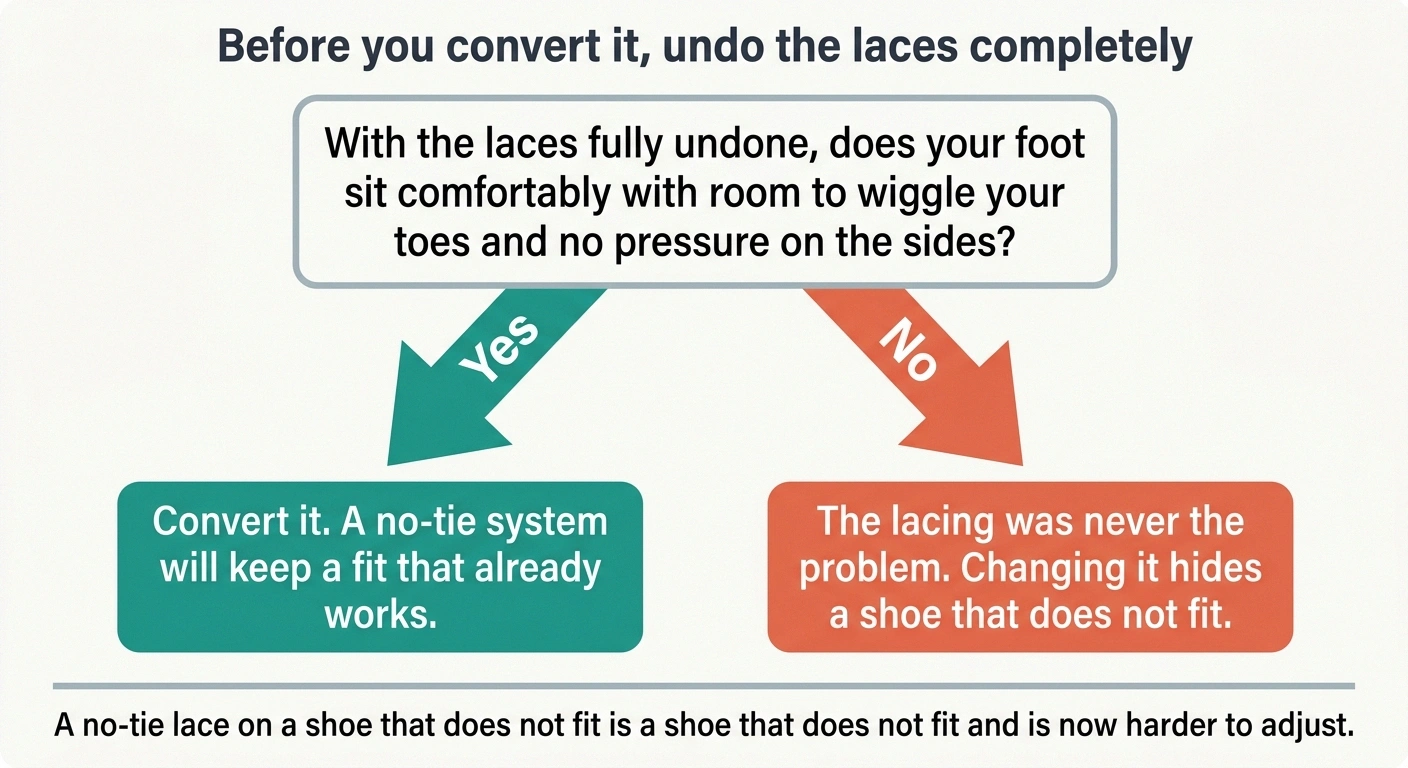
Sometimes converting the shoe you have is the wrong project.
If the shoe is already too narrow, too shallow in the toe box, or worn through at the heel counter, changing the lacing rearranges the problem rather than fixing it. A no-tie lace on a shoe that does not fit gives you a shoe that does not fit and is now harder to adjust.
The honest test: with the laces completely undone, does your foot sit comfortably in the shoe with room to wiggle your toes and no pressure on the sides? If yes, convert it. If no, the lacing was never the issue, and the fitting guide or a look at shoes built for neuropathy is the better use of your money.
And if your hands are the limiting factor across a lot of daily tasks rather than just this one, an occupational therapist is the person who solves that category properly. They will look at your actual shoes, your actual hands and your actual doorway, which is more than any article can do.
Frequently Asked Questions
Are elastic no-tie laces safe if I have diabetes and neuropathy?
They can be, with one condition attached: you have to check your feet, especially in the first week. The concern is not the product itself but that it sets a fixed tension you cannot feel. Look at the top of your foot each evening for red bands or indentations that do not fade within a few minutes, and loosen the setting if you find any.
What is the best no-tie lace system for numb fingers?
Elastic laces with a spring lock are the most versatile, because they work on shoes you already own and let you set an exact tension. If your hand function is significantly reduced, hook-and-loop straps ask less of your fingers than anything else, and a dial system offers the finest adjustment if you are buying new shoes anyway.
Do no-tie laces come loose over time?
Spring locks can weaken with repeated use, though this usually shows up as visibly loose shoes rather than a hidden change. Velcro degrades more quietly as it fills with lint and fibres. Check both periodically. A lock that no longer holds firmly when you squeeze it, or a strap peeling at a corner, should be replaced rather than tolerated.
When should I set the tension on elastic laces?
Late in the day, when your feet are at their most swollen — evening rather than morning. Setting them in the morning produces a fit calibrated to your smallest foot, which becomes uncomfortably tight by evening without you necessarily noticing.
Are slip-on shoes a better answer than converting my laced shoes?
Often not. Slip-ons usually get their hold from a snug fit around the midfoot, which is the opposite of what a swollen or sensitive foot wants, and they offer no adjustment at all. Converting a properly fitted lace-up keeps the support and the room while removing the tying, which is generally the better trade.
How tight should the laces actually be?
Snug enough that your heel does not lift when you walk, loose enough to slide one flat finger under the laces at the top of the foot with mild resistance. If two fingers fit easily it is too loose and your foot will slide, which causes its own friction problems.
Can I use these on any shoe?
Elastic laces work on almost any shoe with conventional eyelets. They work poorly on shoes with very few eyelet pairs, since there is not enough elastic in the system to stretch usefully, and they cannot be fitted to shoes with hooks at the top rather than holes. Dial systems generally have to be built into the shoe.
Do these work if my feet swell during the day?
That is one of the better arguments for elastic. It stretches as your foot expands rather than staying at a fixed circumference the way a tied lace does. A dial system handles swelling differently but arguably better, since you can loosen it a click without taking the shoe off or bending down far.
About the Author