
A few years ago a woman in one of my neuropathy support groups mentioned she was spending sixty dollars a month on a supplement called Tru Niagen. Her feet still burned at night, but she said she felt like she was finally doing something. I wrote the name down and promised I'd look into it, and then didn't look into it for months because life got in the way.
The supplement is nicotinamide riboside — NR for short. It's a form of vitamin B3 that your body converts into a molecule called NAD+, which nerves need to make energy. The pitch is straightforward: keep NAD+ topped up, protect the nerves. The biology behind that pitch is some of the most interesting science in neuropathy right now.
What I want to do today is walk through what the research actually shows, separate the marketing from the human trial data, and tell you where I've landed on NR after digging into the 2024–2026 evidence. I am not a doctor. I am a person with neuropathy who has read a lot of papers and wants to save you the reading time. If you're considering NR, please loop in your own care team before making a call.
What Nicotinamide Riboside Actually Is
Nicotinamide riboside is a form of vitamin B3, closely related to the niacin and niacinamide you may already recognize from a multivitamin label. It was identified as a distinct NAD+ precursor in the early 2000s, and a company called ChromaDex commercialized it under the trademark Niagen. The consumer-facing product is Tru Niagen, though NR now shows up in many other supplement brands too.
Nicotinamide riboside is a form of vitamin B3 that reliably raises NAD+ in humans. Whether that translates into meaningful protection for peripheral nerves is a separate question — one the human trial data has only started to answer, and the answer so far is mixed.
The reason NR became interesting is what your body does with it. Once you swallow an NR capsule, your cells convert it fairly efficiently into NAD+ (nicotinamide adenine dinucleotide), a molecule that is absolutely central to how every cell in your body makes energy. NAD+ isn't optional. Without it, mitochondria stop working, DNA repair falters, and cells eventually die.
NAD+ declines with age. It also drops sharply during metabolic stress — chemotherapy, uncontrolled diabetes, physical nerve injury. That decline is the hook. If low NAD+ is bad for nerves, and NR reliably raises NAD+, then maybe NR could protect the nerves. That “maybe” is the crux of everything that follows.
Why Neuropathy Researchers Care About NAD+ At All
For most of the last century, doctors thought of nerve damage as a slow, passive process — a nerve wearing down over months and years from bad blood sugar, chemotherapy toxins, or nutrient deficits. That picture wasn't wrong. It just missed a big piece.
Starting in the 1990s, researchers realized nerves have an active self-destruct program. When an axon (the long fiber that carries nerve signals) gets injured or metabolically stressed, a specific enzyme called SARM1 wakes up and starts destroying NAD+ inside that axon. Within minutes, energy production collapses. Within hours, the axon fragments cleanly and rapidly. It's called programmed axon death, or Wallerian degeneration.
Here's the connection to NR. Under normal conditions, NAD+ stays high and SARM1 stays asleep. If NAD+ drops far enough, SARM1 activates. Once activated, it destroys NAD+ faster than any supplement on Earth could restore it. So the theory goes: if you can keep NAD+ topped up all the time — using NR or a similar precursor — you keep your nerves further from the SARM1 threshold in the first place. Prevention, not rescue.
It's an elegant theory. Whether it works in humans is a different question.
The SARM1 Connection and Why Timing Matters
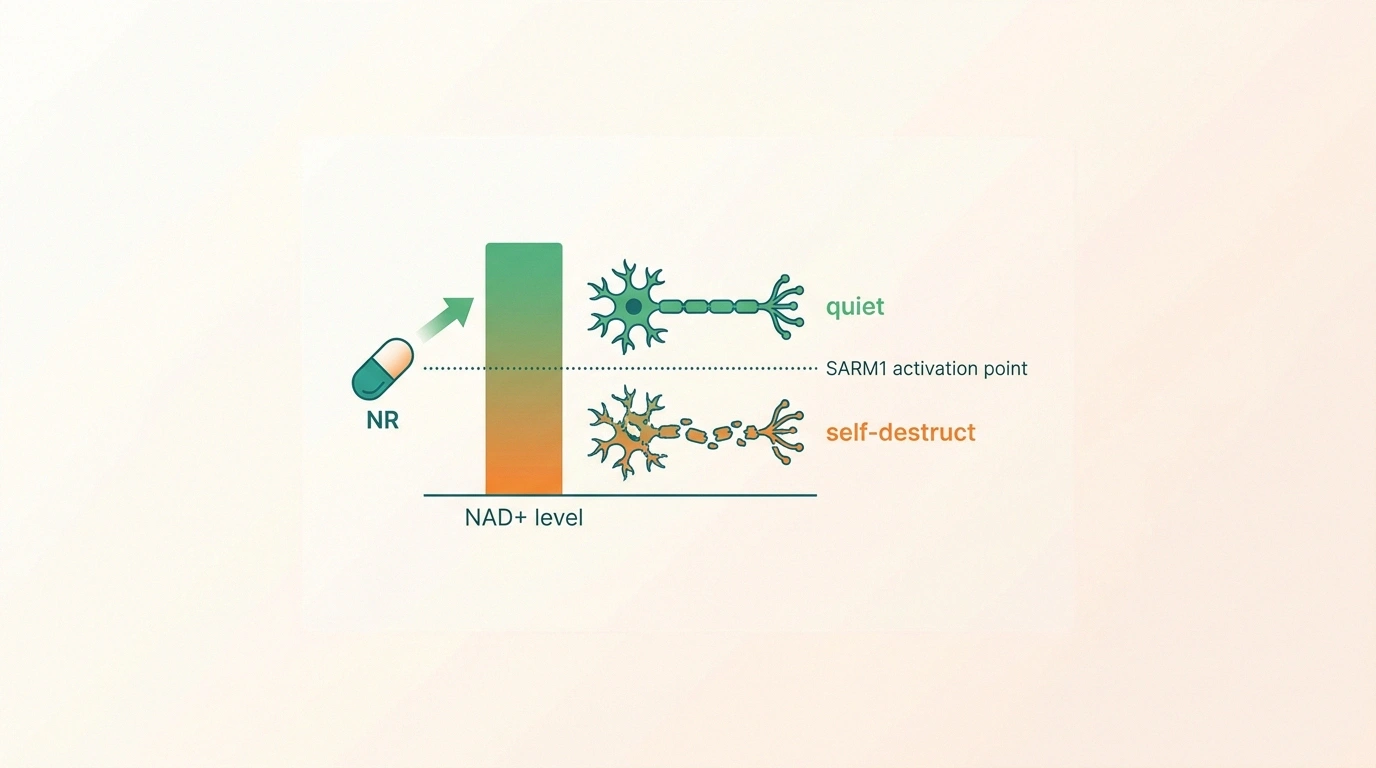
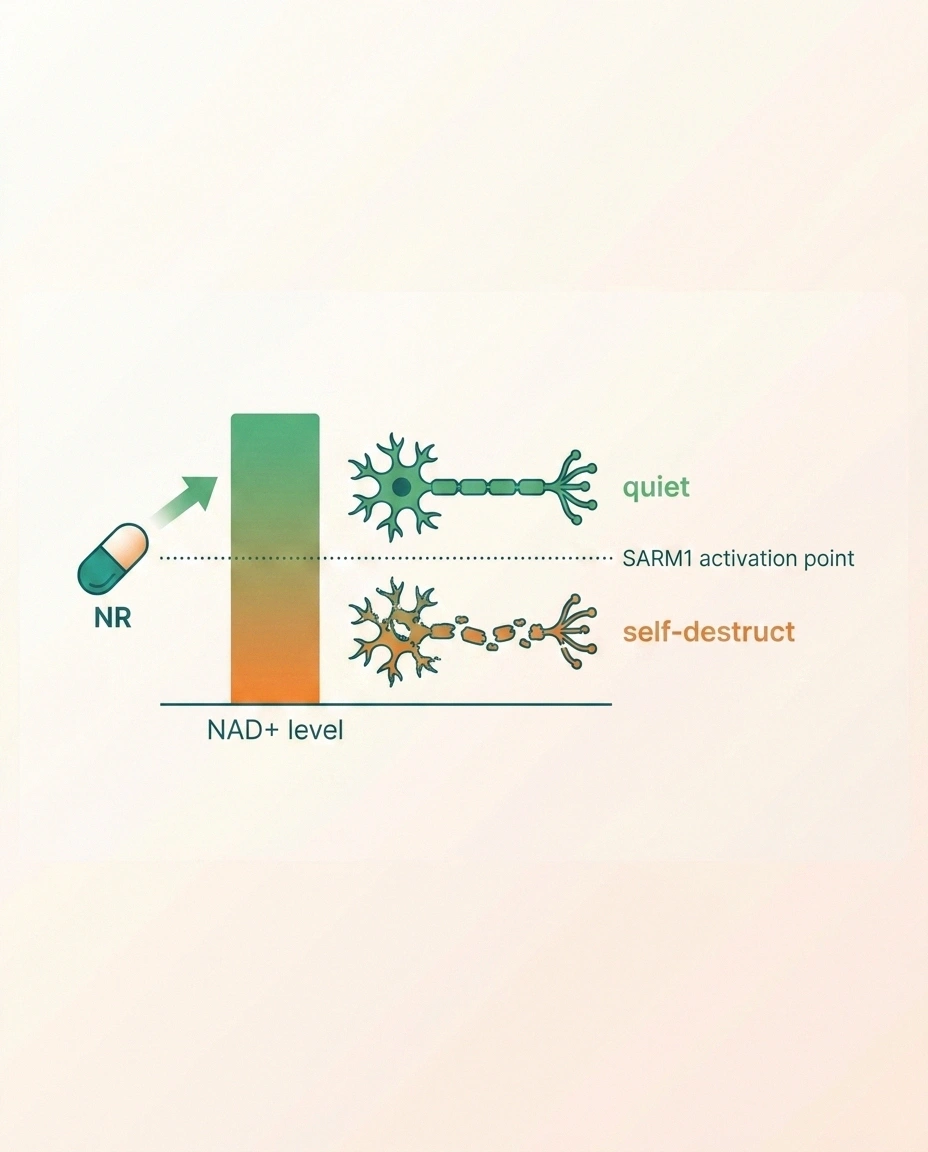
This is the part of the NR conversation that gets glossed over most often, and I think it's the most important detail for anyone considering the supplement.
Do not treat NR as a substitute for standard neuropathy care.
Once SARM1 has fired inside an axon, no oral supplement can restore NAD+ fast enough to save it. NR's biological argument is preventive, not restorative — and the strongest human neuropathy trial to date came up negative. Talk with your doctor before starting NR, especially if you are on chemotherapy, diabetes medications, or in active oncology care.
Raising NAD+ makes biological sense as a preventive strategy — as a way to keep nerves that are still healthy from crossing the metabolic tipping point where SARM1 fires. Once SARM1 has fired in a particular axon, though, that axon is already in demolition mode. The enzyme destroys NAD+ inside that axon faster than any oral supplement can rebuild it. You cannot out-drink the fire hose with a garden hose.
What this means practically: NR is not a treatment for existing nerve damage. If your neuropathy is already established and your symptoms are stable or slowly progressing, NR's biological story is about protecting whatever nerves you still have — not repairing what's gone. It might slow future damage. It cannot regrow dead axons.
I mention this because supplement marketing tends to blur that line. The rationale you'll see on Niagen's own site is careful and honest. The rationale you'll see in some Instagram testimonials is not. Keep the distinction clear.
What Human Trials Actually Show for Neuropathy
Here's where I have to be blunt: as of 2026, the human trial evidence for NR in peripheral neuropathy is emerging and limited. Not zero. Not conclusive. Somewhere in between, and the picture is genuinely mixed.
Preclinical data (mostly mice) look pretty exciting. NR has been shown to blunt diabetic neuropathy in mouse models, protect against cisplatin chemotherapy nerve damage by activating a downstream enzyme called SIRT2, and preserve small-fiber nerves under stress. Multiple independent labs have replicated pieces of this. In mice, the case is fairly strong.
Human trials are where the story gets complicated. Three neuropathy trials matter most:
- A Phase 2 study in chemotherapy-induced peripheral neuropathy (CIPN), testing whether Niagen prevents nerve symptom progression in breast and gynecologic cancer patients on paclitaxel. Data emerging but not yet definitive.
- A six-month diabetic neuropathy trial in people with type 2 diabetes or impaired glucose tolerance, run out of the University of Maryland. Also underway.
- A completed small-fiber neuropathy trial whose results were posted in June 2024 and are worth their own section, because they didn't go the way anyone hoped.
Let me take that third one first, because it's the most sobering piece of data we have.
The Small-Fiber Neuropathy Trial That Didn't Work

In 2024, researchers published results from a randomized trial testing whether oral NR could prevent small-fiber nerve degeneration in healthy volunteers. The design was clever: they used topical capsaicin (the compound in chili peppers) to induce a small, controlled patch of nerve damage on volunteers' skin. Then they measured how well their small nerve fibers survived and regenerated, comparing NR-treated participants to placebo.
A 2024 randomized trial tested 1,000 mg/day of NR for small-fiber nerve protection and regeneration in humans.
Conclusion, in the researchers' words: NR “cannot be recommended to prevent neuropathy or to improve nerve regeneration” at the doses tested. Ongoing trials in diabetic and chemo-induced neuropathy may still change the picture, but the strongest completed signal so far is a null.
The conclusion was, in the researchers' own words: oral NR supplementation, at the doses used in this study, cannot be recommended to prevent neuropathy or to improve nerve regeneration.
That's not a nuanced hedge. That's a study designed to detect NR's neuroprotective effect in humans, and it didn't find one at the doses tested. If NR were the axon-saving miracle some marketing suggests, this trial should have shown something.
Now, one negative trial doesn't kill a hypothesis. The doses might have been too low. The capsaicin injury model might not mirror how nerve damage happens in diabetes or chemotherapy. The measurement window might have been off. All of those are legitimate scientific questions, and the CIPN and diabetic neuropathy trials are testing different scenarios in different populations. But this is the strongest human signal we have on NR for neuropathy prevention right now, and it was disappointing. That deserves to be reported plainly. For context on what small-fiber neuropathy is and how it differs from other forms, see our overview of small fiber neuropathy.
Where the Diabetic and Chemo Neuropathy Trials Stand
The diabetic and CIPN trials are where the more targeted evidence will come from over the next couple of years.
For diabetic peripheral neuropathy, the University of Maryland trial is the one to watch. Niagen for six months in people with type 2 diabetes or prediabetes, with endpoints on both skin nerve fiber density and patient-reported symptoms. Results pending. If positive, it will be the first credible human signal that NR can slow diabetic nerve damage.
For chemotherapy-induced peripheral neuropathy, the situation is more urgent — 30% to 70% of patients on certain chemo regimens develop nerve symptoms that can become permanent. The current Phase 2 NIAGEN trial is single-arm (everyone gets NR), designed to see if there's enough signal to justify a full placebo-controlled Phase 3. Neither trial has produced published, peer-reviewed results yet.
NR vs. NMN vs. Niacinamide: The NAD+ Booster Family
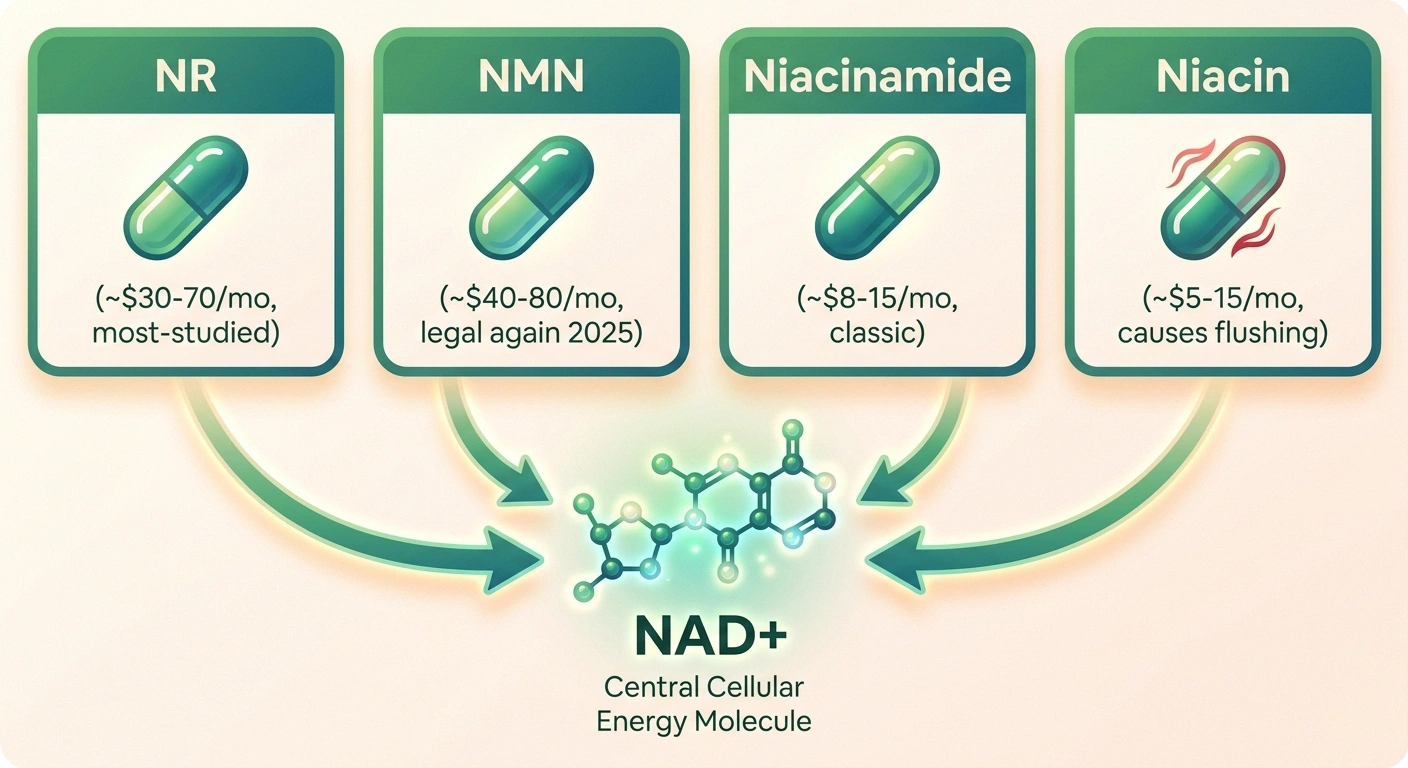
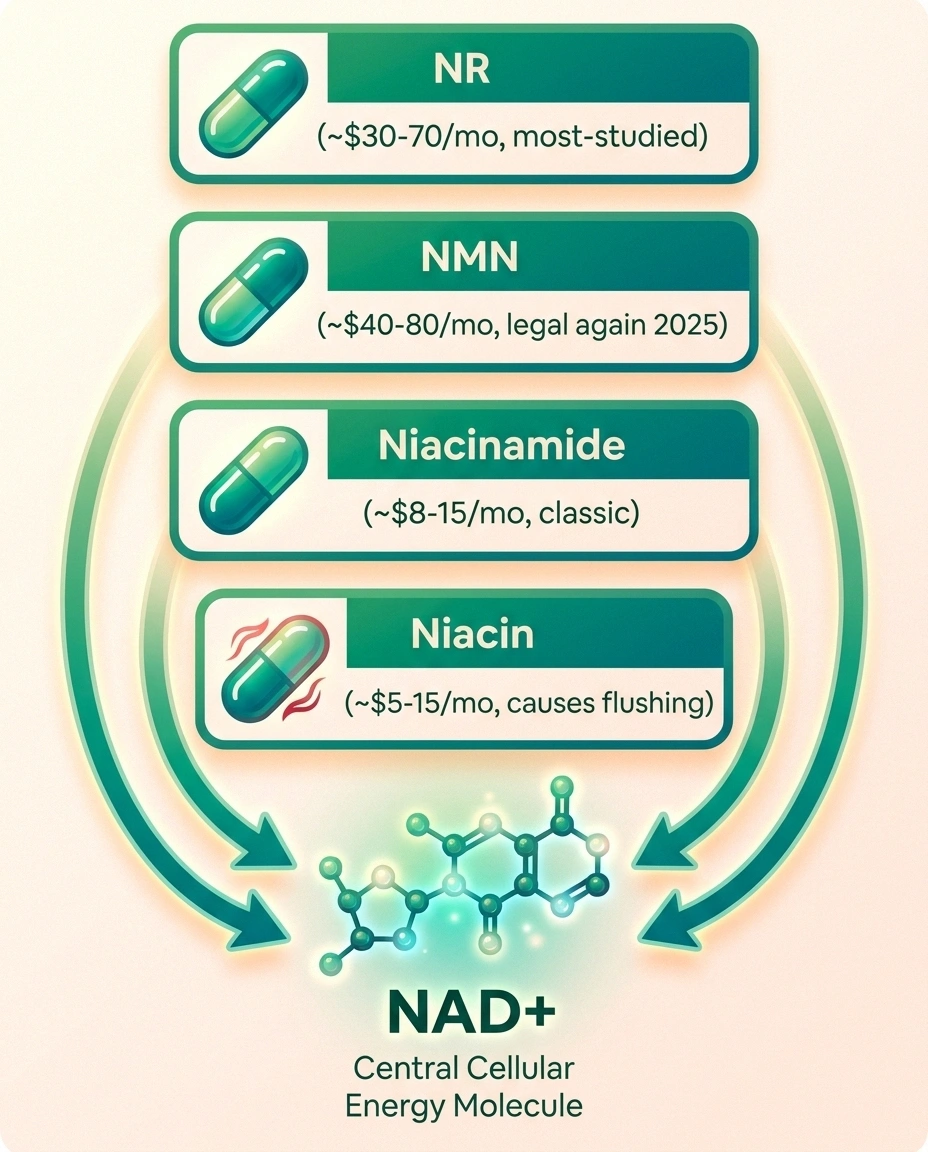
Because NR has become a marketing category as much as a molecule, it helps to see how it compares to its cousins. All four of these are forms of vitamin B3, and all four end up as NAD+ inside your cells. Where they differ is efficiency, cost, and how much human research sits behind them.
Nicotinamide riboside (NR) is the most-studied modern NAD+ booster in humans overall, though most of that research is on outcomes other than neuropathy (aging biomarkers, Parkinson's, kidney function). Typical monthly cost: $30–70.
Nicotinamide mononucleotide (NMN) is one step closer to NAD+ in the biochemical pathway. Its regulatory story has been messy — the FDA excluded it from the supplement definition in late 2022, then reversed that decision in September 2025 after a Natural Products Association lawsuit. As of 2026, NMN is legally on the market as a supplement again. Cost: $40–80/month.
Niacinamide (nicotinamide) is the classic form found in every B-complex vitamin. It raises NAD+ less efficiently than NR in head-to-head studies, but it's been used safely for decades and costs about $8–15 a month. If cost matters and you want a NAD+ precursor, niacinamide is the honest budget answer.
Niacin (nicotinic acid) raises NAD+ too, but at effective doses it causes flushing — a hot, red-skin reaction many people find intolerable. Cheap, usually not the first choice.
The blunt read: NR has more brand marketing and more overall research than niacinamide, but for “will this help my neuropathy,” neither has been proven. If you're going to experiment, the choice is less about molecule and more about how much you want to spend on an unproven bet.
Dose Reality: What Trials Use, What Consumers Take
The consumer default for Tru Niagen is 300 mg per day, a single capsule. Clinical trials range higher. Typical research doses are 500 to 1,000 mg per day, and Parkinson's safety work has gone as high as 3,000 mg for a month with no serious issues. The 2024 small-fiber trial that came up negative used 1,000 mg, so it wasn't a low-dose failure.
An 8-week trial in overweight adults measured how much whole-blood NAD+ actually rose at different doses: 100 mg gave a 22% increase, 300 mg gave 51%, 1,000 mg gave 142%. Dose does matter for how much NAD+ you push up. Whether that matters for neuropathy outcomes is still the open question.
If you decide to try NR, most protocols I've seen from integrative doctors start at 300 mg and increase to 600 mg after a few weeks if there's no reason to hold. Higher-dose experimentation without a physician isn't something I'd recommend.
Cost Reality: What NR Actually Costs

Let me put dollar figures on this. Tru Niagen at 300 mg runs about $40 for 30 days retail, roughly $30 on subscription. Doubling to 600 mg puts you at $60–$80 a month, or $720–$960 a year, or roughly $3,600–$4,800 over five years.
Basis by Elysium Health bundles NR with pterostilbene at a similar price. Generic NR from smaller brands can be cheaper, though third-party purity testing matters more when there's no trademarked source vouching for the chloride form.
Compare that to niacinamide at $8–$12 a month, or alpha-lipoic acid — an antioxidant with more direct (though still modest) human evidence for diabetic neuropathy — at $15–$30. Cost isn't the only factor, but it's a real one when the pricier option isn't better supported than the cheaper ones.
Safety Profile: What Trials Show So Far
The good news is that NR is remarkably well tolerated. Randomized trials have consistently found no meaningful differences in adverse events between NR and placebo, including at doses well above what any consumer would take. 1,000 mg per day for 8 weeks caused no significant side effects. 2,000 mg per day for 6 months in older adults was tolerated. 3,000 mg per day for 30 days in Parkinson's patients passed safety review with no methyl-donor depletion (a theoretical concern with high-dose B3).
Occasionally reported: mild digestive upset at start, rare and usually transient liver-enzyme elevations, and — unlike niacin — no flushing. What we don't know is what happens over 10 or 20 years of daily use. NR is a young supplement in the long-term-safety sense. The signals so far are clean, but “so far” is doing some work.
The Chemo Caution I Take Very Seriously
This is the section I want you to remember if you take nothing else from this article.
A study published in early 2026 showed that NR and related B3 derivatives — NMN in particular — appeared to shield pancreatic cancer cells from three standard chemotherapy drugs (oxaliplatin, 5-fluorouracil, and gemcitabine) in laboratory experiments. The mechanism is plausible: cancer cells also need NAD+, especially for DNA repair, and giving them more NAD+ may help them survive chemo attacks that are trying to break their DNA.
This is not a settled finding. Earlier mouse work showed NR could reduce cisplatin nerve damage without shielding the cancer cells in that specific setup. So the picture is mixed and highly dependent on which cancer and which chemo drug you're talking about. But the safe read is this:
If you are on chemotherapy — or about to start it — do not add NR without your oncologist's explicit approval. Not “I'll ask them next week.” Before your next dose. The idea of a supplement quietly helping your cancer resist the drug meant to kill it is exactly the scenario where being cautious is worth infinitely more than being clever. If chemotherapy neuropathy is the thing driving you toward NR, please read our overview of chemo-induced neuropathy and bring the questions to your oncology team.
Who Might Reasonably Consider Trying NR (and Who Shouldn't)
Given all the caveats, is there anyone the current evidence still supports experimenting with NR? Honestly, cautiously, yes — as long as the framing is right.
Might reasonably consider it, with a doctor's input:
- Someone with early or mild neuropathy who has already handled the higher-yield basics — tight blood sugar, corrected B12, movement, alcohol reduction — and wants to add a low-risk supplement with a plausible preventive mechanism.
- Someone with a family history of neuropathy who is looking for a preventive tool while the SARM1 drug pipeline matures.
- Someone with prediabetes or early diabetic neuropathy whose primary care doctor is comfortable with a 3–6 month trial alongside standard care.
Should probably wait:
- Anyone in active cancer treatment without oncology sign-off.
- Anyone hoping NR will reverse existing nerve damage. The biology doesn't support that use, and money spent on false hope is money not spent on things that might actually help.
- Anyone on a tight budget who hasn't yet addressed the higher-evidence basics like correcting a documented vitamin deficiency, controlling blood sugar, or getting evaluated for reversible causes.
NR isn't the first thing anyone should try. It might be a reasonable ninth or tenth thing, as an experiment, in the right patient. That's where I'd honestly place it.
What I'd Ask My Doctor Before Starting
If you and your doctor agree an NR trial is reasonable, here are the questions I'd bring to the conversation:
Before deciding on NR, bring these five questions to your next appointment:
- Is NR safe with the medications I'm already on?
- If I have (or might have) cancer, does my oncologist sign off?
- Should we recheck liver enzymes at three months?
- What symptoms will we use to judge whether it's helping?
- How long is a fair trial before we decide to stop?
- Do you have any concerns about NR interacting with the medications I'm already on, particularly for blood sugar, blood pressure, or blood thinners?
- If I'm on or heading toward chemotherapy, will my oncology team approve this specifically?
- Should we recheck liver enzymes after 3 months to make sure nothing unusual is showing up?
- What symptoms or measurements should we use to decide whether the trial is helping or not?
- How long should we give it before deciding it either helped, didn't help, or needs to stop?
The last question matters most. Without a decision rule up front, supplements have a way of becoming permanent expenses without ever being properly evaluated. A three-month or six-month trial with clear before-and-after checkpoints is much more useful than “I've been taking it for two years, I'm not sure if it does anything, but I'm afraid to stop.”
My Honest Take on Where NR Sits in 2026
Here is where I've personally landed, for whatever it's worth.
NR has one of the most interesting biological rationales in the neuropathy space. The SARM1 story genuinely does suggest that keeping NAD+ high should be protective. The mouse data are strong. The safety profile is excellent. And the fact that ChromaDex funded years of independent research rather than only marketing is a point in NR's favor culturally.
But the one head-on human trial testing NR for neuropathy prevention came up negative, the diabetic and chemo trials haven't reported yet, and the 2026 signal that NR might blunt chemotherapy in cancer cells adds a real caution that wasn't on the table two years ago. Add the cost, and NR sits in the “promising, but I'd want to see the CIPN and diabetic trials read out before recommending it broadly” category.
If you're already taking it and it feels right and your doctor is fine with it, I would not tell you to stop. If you're considering starting, I'd rank it below correcting known vitamin deficiencies, tight blood sugar control, and reasonable movement, and roughly equal to alpha-lipoic acid as a supplement experiment — with ALA arguably having slightly better direct-neuropathy data. You can see how these all stack in our broader guide to the best neuropathy supplements for nerve health.
What I don't want anyone doing is taking NR instead of working with a real neuropathy care plan. That's the mistake this whole article is trying to prevent. Supplements are add-ons. Standard care and root-cause work are the foundation.
Frequently Asked Questions
Is nicotinamide riboside proven to treat neuropathy?
No. As of 2026, NR is not proven to treat or prevent peripheral neuropathy in humans. There is a strong biological rationale and supportive mouse research, but the one completed human trial testing NR for small-fiber neuropathy prevention returned a negative result in 2024. Trials in diabetic and chemotherapy-induced neuropathy are ongoing.
How much NR do I take for neuropathy?
There is no established dose for neuropathy because no dose has been proven to work. Consumer products commonly provide 300 mg per day. Clinical trials for other conditions have used 500 to 1,000 mg daily, and safety trials have gone as high as 3,000 mg daily for short periods without serious problems. Any decision about dose should involve your doctor.
Is NR the same as NMN?
No, though they are related. Both are precursors to NAD+ and both are forms of vitamin B3. NR (nicotinamide riboside) has more overall human research behind it. NMN (nicotinamide mononucleotide) sits one step closer to NAD+ in the biochemical pathway. As of September 2025, NMN is legal in dietary supplements in the US again after the FDA reversed a prior exclusion. Both remain unproven for neuropathy.
Can I take NR while on chemotherapy?
Not without your oncologist's explicit approval. Recent laboratory work suggests NR and related NAD+ boosters may help some cancer cells survive standard chemotherapy drugs. That research is not settled, and it may not apply to every cancer or every drug, but the risk is serious enough that you should not add NR during active cancer treatment without direct medical clearance.
How long before I know if NR is helping?
If it is going to help in a measurable way, most protocols suggest a 3 to 6 month trial with clear before-and-after checkpoints — symptom tracking, and ideally objective measures like nerve fiber density or nerve conduction where available. If nothing has changed in six months, honest evaluation is fair.
Are there side effects?
NR is remarkably well tolerated in trials. The most common issues reported are mild digestive upset when starting, rare and usually transient elevations in liver enzymes, and occasional headache. Unlike niacin, NR does not cause the classic hot-flushing reaction. Long-term safety beyond a few years is not yet well established.
Can I just take a cheaper form of vitamin B3 instead?
Possibly. Niacinamide is dramatically cheaper and also raises NAD+, though less efficiently in head-to-head studies. If cost is the main barrier and you want to experiment with a NAD+ precursor, niacinamide is a reasonable starting point to discuss with your doctor. Neither form has been proven to help neuropathy specifically.
Should I take NR as prevention if I have a family history of neuropathy?
The biological argument for prevention is stronger than the argument for treatment, but it is still theoretical. Higher-impact preventive steps include controlling blood sugar, correcting any documented vitamin deficiencies, staying active, and addressing risk factors like heavy alcohol use. NR would sit on top of those, not instead of them, and only after a conversation with your doctor.
About the Author