
I want to start this one differently than I usually do, because of who I think is reading it.
If you found this article at two in the morning after noticing your calf twitching, or after a hand started feeling clumsy, or because a parent's foot started dragging — I know what that search feels like. The word ALS is heavy in a way few medical terms are, and once it enters your head it is very hard to get it back out.
So here is what I can offer. Not a diagnosis, because I am not a doctor and no article can give you one. What I can do is lay out, clearly and in plain language, how these two conditions actually differ, what a neurologist is looking at when they examine you, and which patterns genuinely warrant a fast appointment versus which ones are the kind of thing that turns out to be ordinary.
The short version, which I will spend the rest of the article supporting: peripheral neuropathy and ALS produce quite different symptom patterns, and the differences are usually apparent to an experienced neurologist within one exam. The confusion tends to happen in the space before anyone has examined you — in the space where you are searching alone.
What Each Condition Actually Is
Peripheral neuropathy is damage to the nerves outside the brain and spinal cord — the long wiring that runs out to your hands and feet. Those nerves carry two kinds of traffic: sensory information coming back in, and motor commands going out. Most common neuropathies damage the sensory fibers first and most, which is why the classic story is numbness, tingling, burning, and pain in the feet, then later the hands.
Peripheral neuropathy is largely about feeling. ALS is about moving. One damages the sensory wiring that reports numbness, tingling and burning. The other damages motor neurons and produces weakness while leaving sensation intact. Almost every practical difference between them falls out of that single distinction.
ALS — amyotrophic lateral sclerosis — is a disease of motor neurons specifically. It damages the upper motor neurons in the brain and spinal cord and the lower motor neurons that carry the final command out to muscle. It is a motor system disease. In its classic form, it does not damage the sensory system at all.
Hold onto that sentence, because it is the single most useful thing on this page. One condition is largely about feeling. The other is about moving. Almost every practical difference falls out of that.
Discriminator One: Do You Have Sensory Symptoms?
This is the biggest one, and it is the reason most people who arrive here worried can exhale a little.
Peripheral neuropathy characteristically produces sensory symptoms. Numbness. Pins and needles. Burning. That maddening feeling of walking on gravel or having a sock bunched under your arch when there is no sock. Pain that gets louder at night. If that describes your experience, you are describing a sensory nerve problem, and classic ALS does not cause sensory symptoms.
ALS produces weakness. Not numbness — weakness. A hand that cannot grip the jar, not a hand that feels fuzzy. A foot that will not lift, not a foot that burns. When neurologists run nerve conduction studies on someone with ALS, the sensory responses typically come back normal, and that normality is part of what supports the diagnosis.
Now, the honest caveats. Plenty of older adults have both a sensory neuropathy from something ordinary like diabetes and some other problem — coexistence is common in the age group where both conditions appear. And research has documented subtle peripheral nervous system involvement in some people with ALS. Neither of those changes the practical takeaway: burning, numb, tingling feet point toward neuropathy, not ALS. Our overview of burning feet syndrome covers the many far more common explanations for that particular symptom.
Discriminator Two: Is It Painful?
Peripheral neuropathy is frequently painful. Sometimes spectacularly so. Burning, stabbing, electric jolts, the skin that hurts when the bedsheet touches it — pain is one of the defining complaints and the reason most people seek care in the first place.
Peripheral neuropathy
- Sensation: numb, tingling, burning
- Pain: often prominent
- Pattern: symmetric, both feet first
- Reflexes: reduced or absent
- Speech/swallow: unaffected
ALS
- Sensation: typically normal
- Pain: characteristically absent early
- Pattern: asymmetric, starts in one limb
- Reflexes: often brisk, with wasting
- Speech/swallow: affected in 20–30% at onset
No single row settles anything on its own. Neurologists read the whole pattern, and the pattern is usually clear within one examination.
Early ALS is characteristically painless. The weakness arrives without announcing itself with pain. People often describe noticing it accidentally: a shoe that started slapping the pavement, difficulty turning a key, a slight slur that a spouse heard before they did.
This is not absolute — ALS does eventually cause pain from muscle cramps, immobility, joint strain, and spasticity — but painless progressive weakness at the outset is a meaningfully different presentation from painful numb feet.
Discriminator Three: Is It Symmetric?
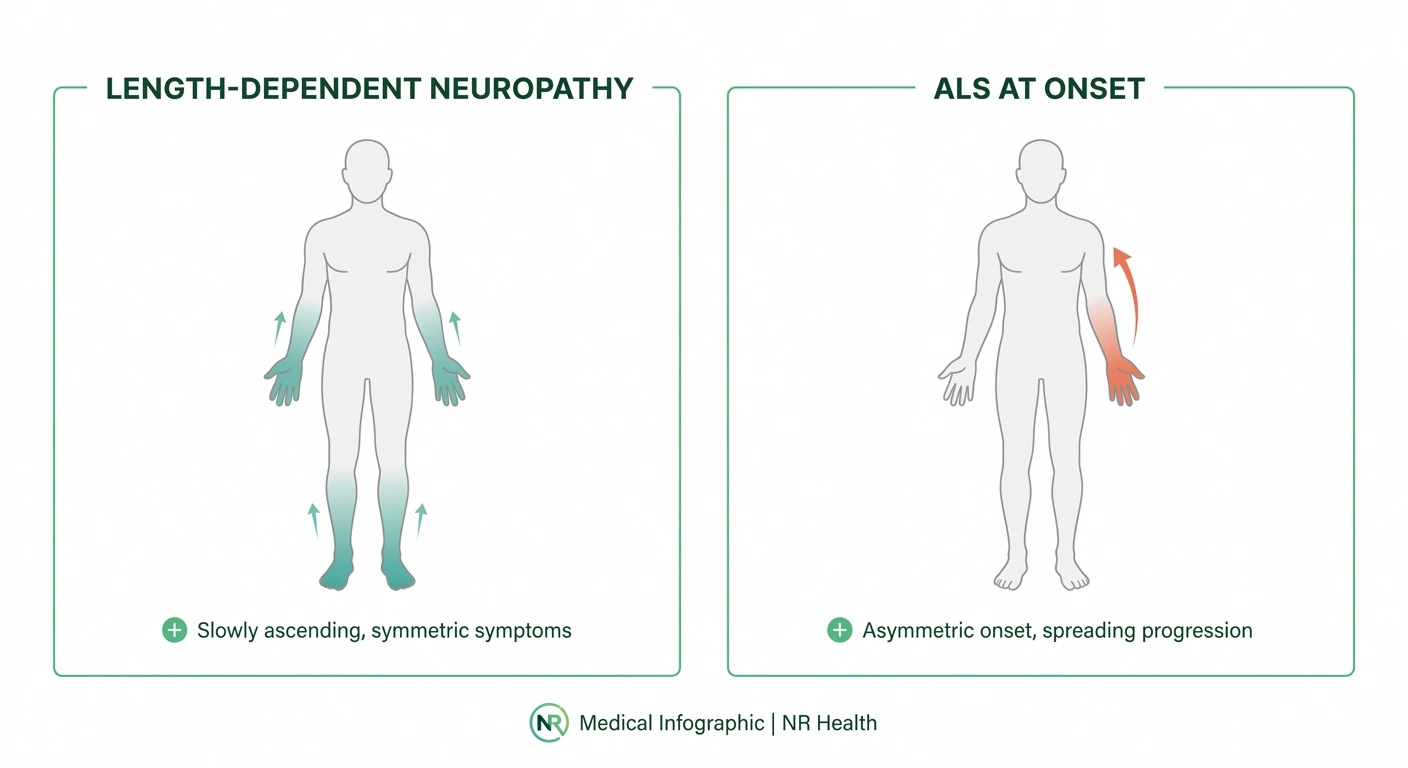
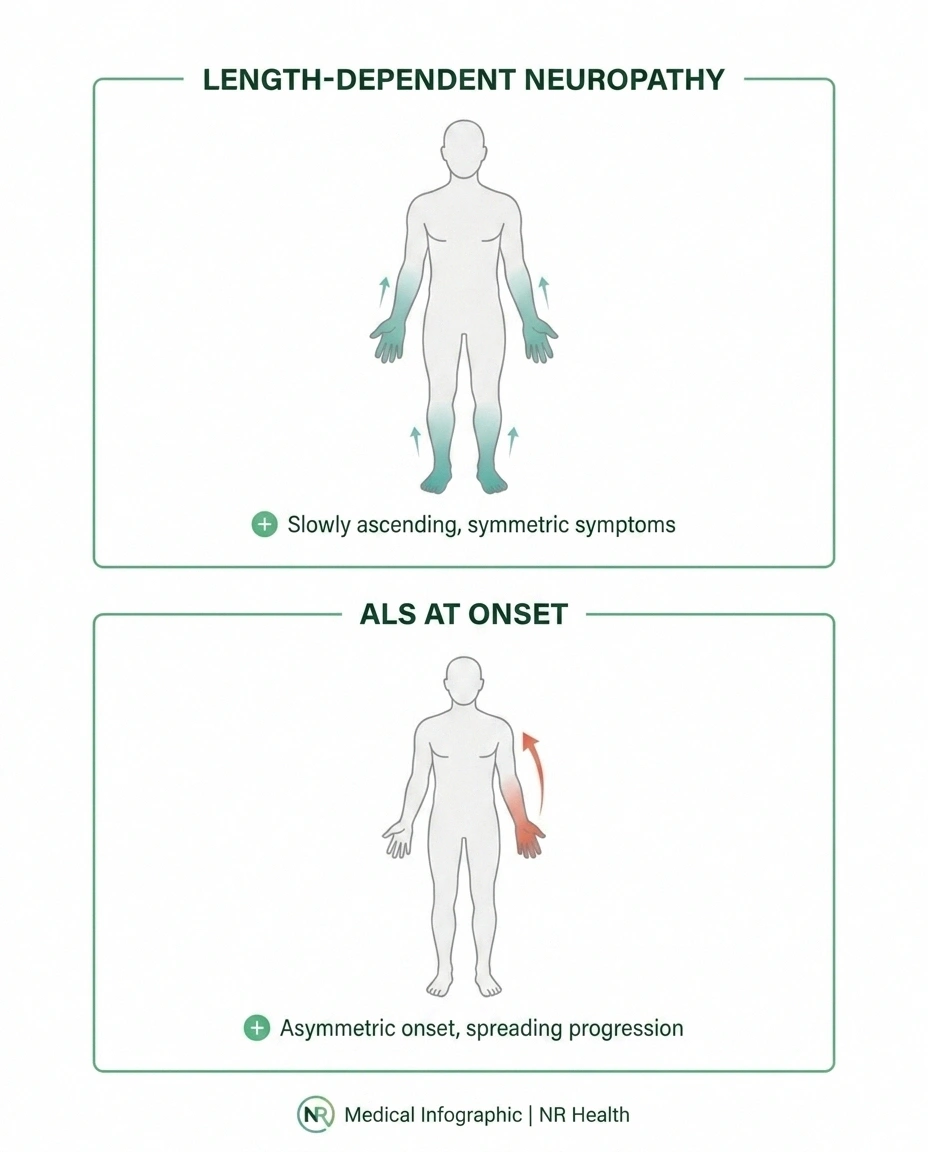
The most common form of peripheral neuropathy is length-dependent, meaning the longest nerves fail first and roughly equally on both sides. Both feet. Then, later, both hands. If you drew it on a body outline, it would look like socks and gloves.
ALS is almost always asymmetric at onset. It starts in one place — one hand, one foot, one side — and spreads to adjacent regions over months. Someone with early ALS will often tell you exactly which hand went first and when. Someone with length-dependent neuropathy usually cannot, because it crept in on both sides at once.
If your symptoms are symmetric, distal, sensory, and slowly ascending, you are describing the textbook pattern of ordinary small fiber or length-dependent neuropathy, not the textbook pattern of ALS.
Discriminator Four: What Are Your Reflexes Doing?
This one you cannot check yourself, and it is one of the most informative things in the entire exam.
Upper motor neuron damage removes the brain's braking system, so reflexes go up — brisk, exaggerated, sometimes with spasticity. Lower motor neuron and peripheral nerve damage breaks the loop itself, so reflexes go down — reduced or absent, especially at the ankle.
The standout finding: muscle wasting combined with brisk reflexes. A visibly shrinking, weak muscle on a limb with hyperactive reflexes is not something peripheral neuropathy produces — in neuropathy, wasting comes with diminished reflexes. It is one of the first things a neurologist checks.
When a doctor taps your knee or ankle with that rubber hammer, they are testing a reflex loop that runs out through the peripheral nerve and back. They are also watching for how much the brain and spinal cord are restraining that reflex.
In peripheral neuropathy, the loop itself is damaged, so reflexes go down. Reduced or absent ankle jerks are one of the most consistent findings in length-dependent neuropathy.
In ALS, upper motor neuron damage removes the brain's braking system, so reflexes go up. Brisk, exaggerated reflexes. Sometimes spasticity — a stiff, catching resistance when a limb is moved. Sometimes an abnormal toe response.
And here is the finding that stands out most: muscle wasting combined with brisk reflexes. That combination — a visibly shrinking, weak muscle attached to a limb with hyperactive reflexes — does not happen in peripheral neuropathy. In neuropathy, wasting comes with diminished reflexes. It is a genuinely characteristic pattern, and it is one of the first things a neurologist checks.
Discriminator Five: Speech and Swallowing

Roughly 20 to 30 percent of ALS begins with bulbar symptoms — problems with the muscles of speech and swallowing. Slurred or thickened speech. Choking on thin liquids. A tongue that looks wasted or twitches. Changes in voice quality that other people notice first.
Peripheral neuropathy does not cause slurred speech. The nerves involved are not the ones affected in the common neuropathies, and if you have burning feet and clear speech, those two things are not part of one story.
A new, persistent, unexplained change in speech or swallowing — not from a cold, not from a dental issue, not from a new medication — deserves prompt medical evaluation. That is true regardless of what is causing it, and there are many causes that are neither ALS nor neuropathy.
The Twitching Question, Answered Honestly
I am giving this its own section because I suspect a large share of the people reading this article are here for exactly this reason.
The question that helps is not “am I twitching?” It is “has anything stopped working?”
- Can you still open a jar?
- Climb a flight of stairs without the rail?
- Hold your arms overhead to dry your hair?
- Turn a key, fasten a button, carry a grocery bag?
Function is the signal. Twitching is noise. Fasciculations without weakness are overwhelmingly benign and can persist harmlessly for years.
Muscle twitches — fasciculations — are extremely common and almost always benign. They show up with caffeine, fatigue, stress, dehydration, low magnesium, after exercise, and often for no reason at all. The eyelid flutter, the calf that ripples for three days, the thumb muscle that jumps while you are trying to fall asleep. Ordinary.
What matters in ALS is not the twitching itself. It is twitching accompanied by weakness and muscle wasting, persistent and widespread, in muscles that are demonstrably losing strength and size. In ALS, the fasciculations are a byproduct of motor neurons dying — and dying motor neurons produce visible functional loss.
Twitching without weakness is overwhelmingly benign, and there is even a name for it: benign fasciculation syndrome. It can go on for years. It is unnerving and harmless.
The self-check that actually helps: not “am I twitching” but “has anything stopped working?” Can you still open the jar, climb the stairs, hold the hairdryer up, turn the key, carry the grocery bag? Function is the signal. Twitching is noise.
And if the anxiety itself has become the problem — if you are checking your tongue in the mirror multiple times a day, testing your grip strength, unable to sleep — that is worth addressing as its own thing, with real help. Health anxiety is genuinely miserable, and it responds to treatment. Our piece on neuropathy and mental health touches on how much this loop can cost, and it applies here just as much.
What the Testing Actually Shows
Two tests do most of the work, and they are usually done in one appointment.
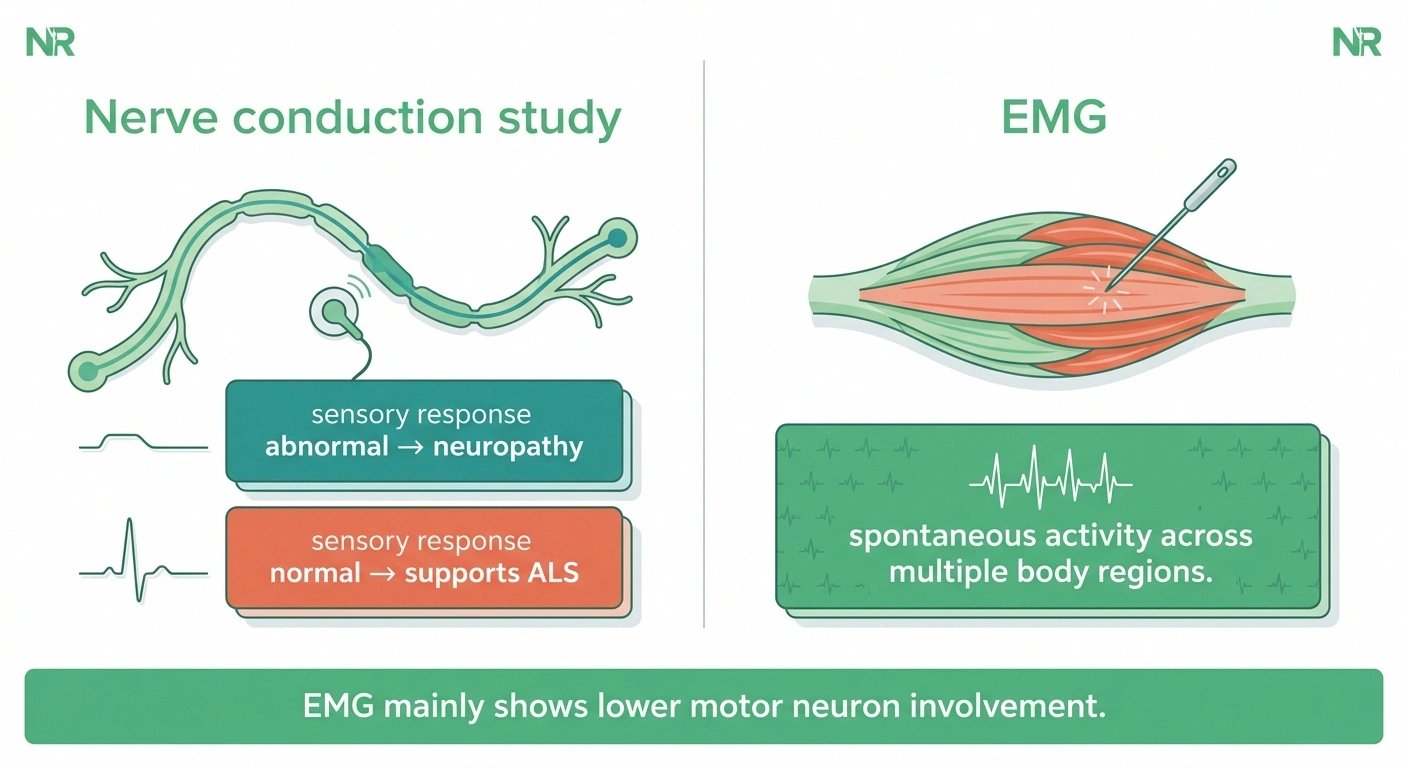
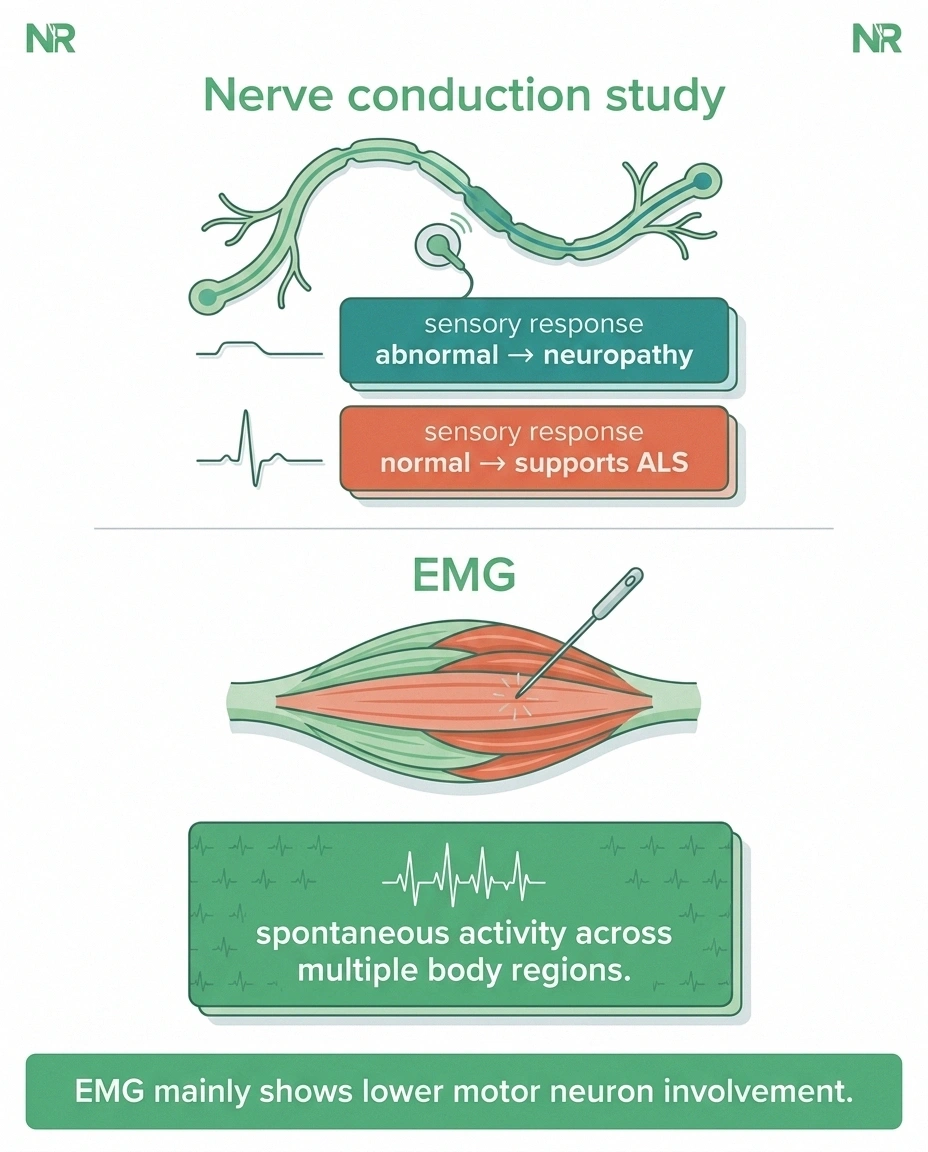
Nerve conduction studies (NCS). Small shocks are delivered along a nerve and the response measured. In peripheral neuropathy, you typically see slowed conduction or reduced signal amplitude, and crucially, abnormal sensory responses. In ALS, sensory responses are typically normal — which is a positive finding in its own right, not just an absence.
Electromyography (EMG). A fine needle records electrical activity inside the muscle. In ALS, the EMG shows spontaneous activity — fibrillations and fasciculation potentials — along with changes indicating chronic reinnervation, and critically, it shows them across multiple body regions and multiple nerve and root distributions. That distribution pattern is what separates a motor neuron disease from a single pinched nerve or a localized problem.
Our guide to neuropathy diagnosis and the tests your doctor may order walks through what each of these feels like and how to prepare.
Two things worth knowing about the limits. First, EMG primarily demonstrates lower motor neuron involvement. There is no routine, definitive objective test for upper motor neuron damage; central motor conduction time via magnetic stimulation is the most reliable research measure, and an MRI finding called the motor band sign is an emerging biomarker, but both remain adjuncts rather than everyday diagnostics. Second, and following from the first, ALS remains largely a clinical diagnosis — built from the exam, supported by EMG, with MRI and bloodwork used mostly to exclude the things that mimic it.
The Mimics, Including One That's Treatable
A meaningful part of an ALS workup is ruling out conditions that look like it. Some of them matter enormously because they respond to treatment.
ALS affects roughly 5 to 9 people per 100,000. Peripheral neuropathy affects an estimated 20 million Americans. When a symptom could belong to either, the base rates are not close.
And one important mimic is treatable: multifocal motor neuropathy with conduction block (MMN) causes progressive, asymmetric, painless weakness without sensory loss — a close resemblance to early ALS — but it is immune-mediated and often responds to immunoglobulin therapy. This is exactly why “it looks like ALS” is not the same as “it is ALS.”
The one I most want people to know about is multifocal motor neuropathy with conduction block (MMN). It causes progressive, asymmetric, painless weakness without sensory loss — which is to say, it looks a great deal like early ALS. But it is an immune-mediated neuropathy, and it often responds to immunoglobulin therapy. Distinguishing it requires careful nerve conduction studies looking for conduction block, and sometimes antibody testing. This is exactly why “it looks like ALS” is not the same as “it is ALS,” and why the full workup matters.
Other conditions on the list include CIDP, cervical spine disease compressing the cord, myasthenia gravis, inclusion body myositis, thyroid disease, certain paraneoplastic syndromes, and Kennedy's disease. Several are treatable. Several are considerably more common than ALS.
Which is worth stating in plain numbers: ALS affects roughly 5 to 9 people per 100,000. Peripheral neuropathy affects something on the order of 20 million Americans. When you have a symptom that could belong to either, the base rates are not close.
Can You Have Both?

Yes, and it happens more than you would expect — mostly because both become more common with age.
Someone in their seventies with long-standing diabetes may well have a length-dependent sensory neuropathy that has been quietly present for a decade. If that person develops ALS, they now have both, and the sensory findings from the neuropathy can muddy the clean picture the textbooks describe. This is one of several reasons a neurologist weighs the whole pattern — history, distribution, reflexes, EMG across regions — rather than any single finding.
There is also research documenting subclinical peripheral nerve involvement in ALS itself. It is a real finding in the literature. It does not change what you should do, which is get examined rather than reason your way to a conclusion from a list of features.
When to Be Seen Quickly
Not everything needs an urgent appointment. These do:
- Progressive weakness without numbness, especially spreading from one limb
- New foot drop — toe catching, foot slapping, tripping on flat ground
- Visible muscle wasting, particularly between thumb and index finger
- Slurred speech or swallowing difficulty with no other explanation
- Twitching plus weakness in the same muscle group
- Breathlessness lying flat, or waking short of breath
- Rapid change — days to weeks rather than months to years
None of these is a diagnosis, and several have entirely treatable explanations. But all describe a motor problem, and motor problems get seen sooner than sensory ones.
- Progressive weakness without numbness — especially if it started in one limb and is spreading
- New foot drop — the toe catching, the foot slapping, tripping on flat ground
- Visible muscle wasting, particularly the hollow between the thumb and index finger
- Slurred speech or swallowing difficulty with no other explanation
- Twitching combined with weakness in the same muscle group
- Breathlessness lying flat, or waking short of breath
- Rapid change of any kind — days to weeks rather than months to years
None of these is a diagnosis. Several have explanations that are entirely treatable — a compressed nerve, a thyroid problem, a vitamin deficiency, MMN. But all of them describe a motor problem, and motor problems get seen sooner than sensory ones.
What the Evaluation Actually Looks Like
Knowing the shape of it takes some of the fear out.
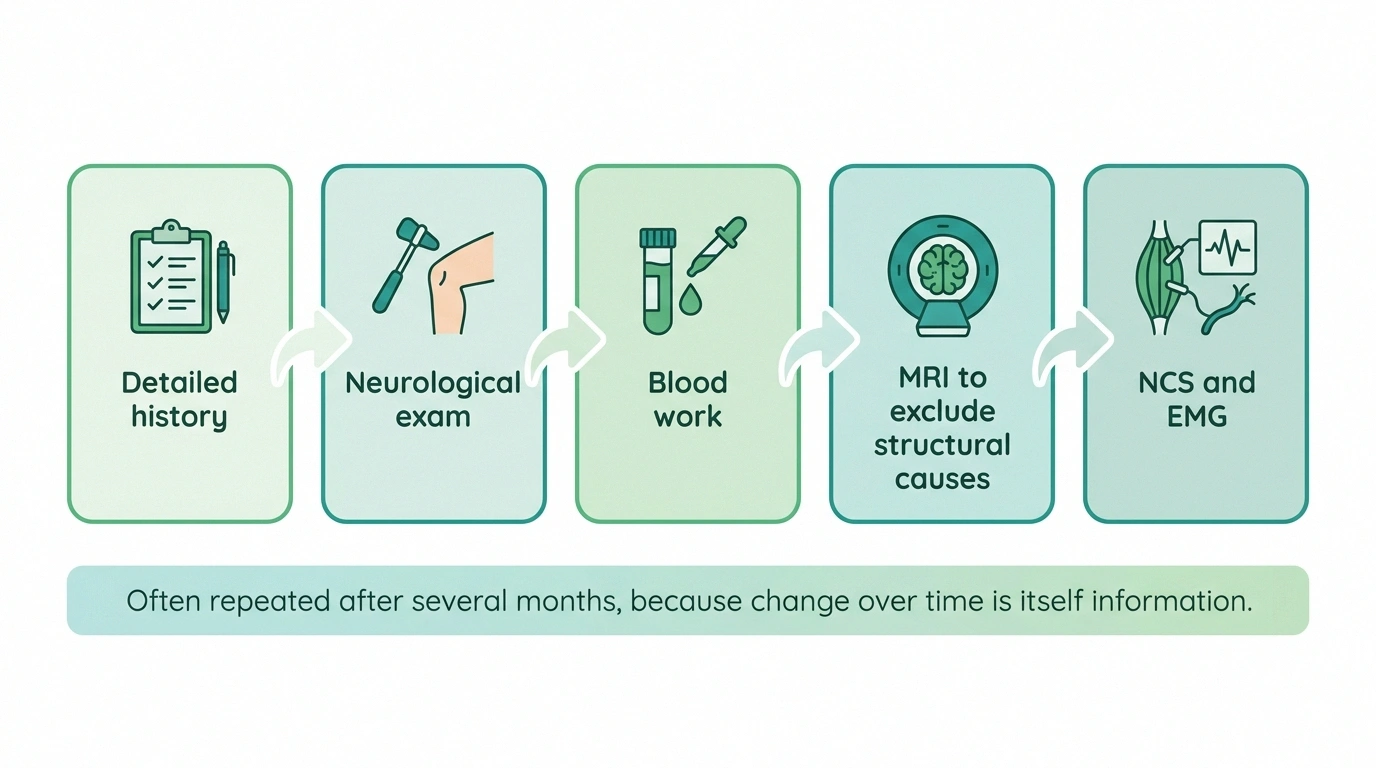
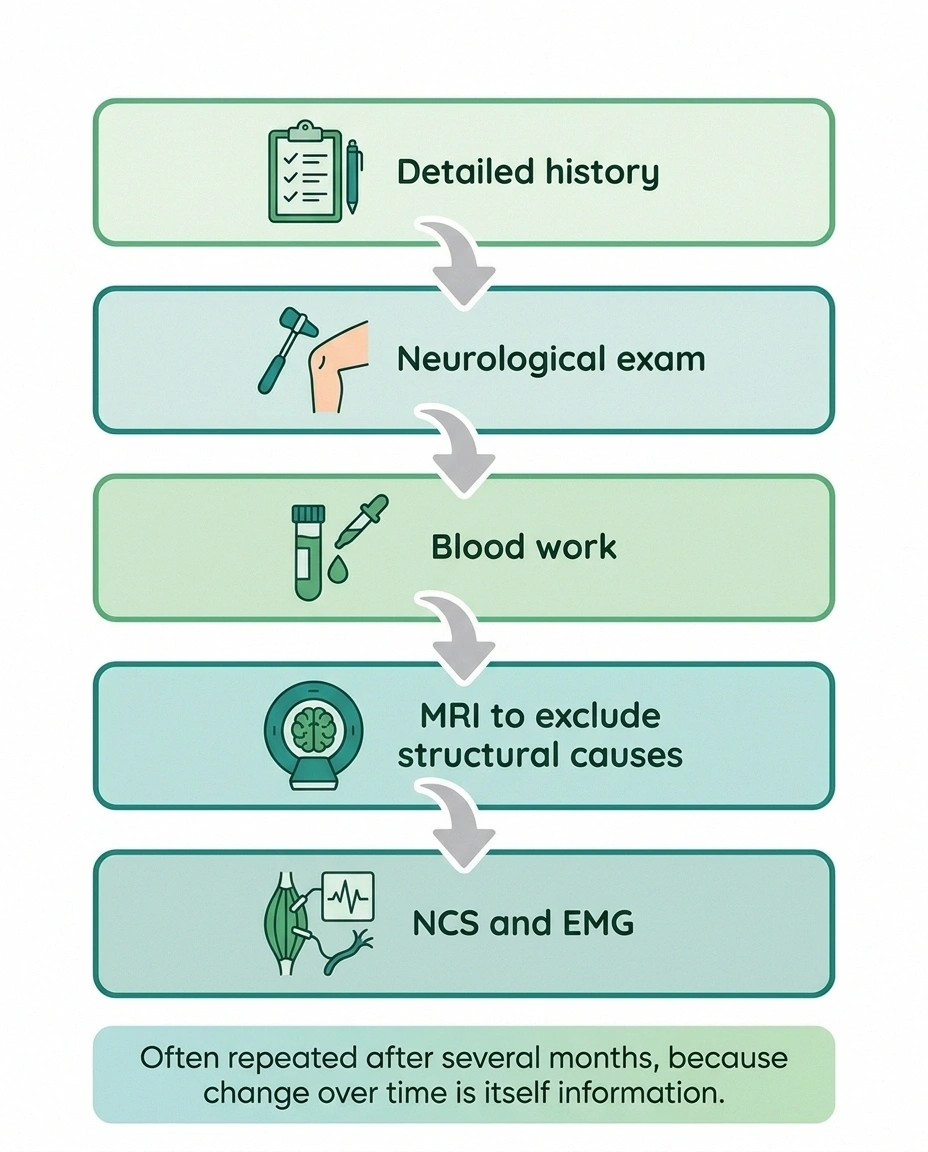
You will start with a detailed history — what changed, when, in what order, on which side. Then a neurological exam: strength tested muscle by muscle, reflexes, tone, sensation, coordination, gait, and a look at the tongue and speech. Much of the answer comes from this exam alone.
From there, likely bloodwork, likely an MRI of the neck or brain to rule out structural causes, and likely NCS plus EMG. If the picture is uncertain, neurologists often repeat the EMG a few months later, because progression over time is itself diagnostic information. Nobody diagnoses ALS on a single ambiguous test, and a good neurologist will not rush toward that answer.
Waiting through this is genuinely hard. It is also how careful medicine works, and the care taken is on your side — the same care that catches the treatable mimic.
Living Through the Uncertainty
The stretch between “something is wrong” and “here is what it is” can run weeks or months, and it is its own particular kind of difficult. A few things that helped people I know get through it.
- Write down function, with dates. “Tuesday, couldn't open the jam jar with my left hand” is worth more to your neurologist than any symptom search.
- Cap the searching. Past about twenty minutes the internet stops informing and starts feeding the fear.
- Bring someone. You will not retain half the appointment.
- Say the fear out loud. “I'm worried this is ALS” is something neurologists hear weekly, and saying it lets them address it directly instead of leaving you to interpret their silence.
Write down what you actually observe, with dates. Specific function, not sensation: “Tuesday, could not open the jam jar with left hand.” This is more useful to your neurologist than any symptom search, and it converts anxious rumination into something productive.
Set a hard limit on searching. The internet cannot examine you, and past about twenty minutes it stops informing and starts feeding the fear.
Bring someone to the appointment. You will not retain half of it, and a second set of ears matters.
And tell the neurologist directly what you are afraid of. Saying “I am worried this is ALS” out loud is not silly and it is not rare — they hear it weekly. It also lets them address it head-on instead of leaving you to interpret their silence.
What I'd Want Someone to Take Away

If your feet burn, tingle, and feel numb, symmetrically, slowly getting worse over years — that is the pattern of peripheral neuropathy, and there is a great deal you can do about it. Our overview of the stages of neuropathy is a reasonable next stop, and idiopathic neuropathy covers what happens when no cause is found. If the numbness is mostly in your hands, neuropathy in the hands goes through the specific causes there. And if you are trying to sort nerve pain from a circulation problem, nerve pain versus vascular pain covers that distinction.
If something has stopped working — asymmetrically, painlessly, progressively — that is a different pattern and it needs a neurologist soon. Not because it means ALS. Because motor problems have a list of causes that includes several treatable ones with real time pressure attached, and that list deserves attention.
And if you are here at two in the morning with twitching calves and full strength: that is the most common story of anyone who reads an article like this, and it is the reassuring one. Sleep if you can. Make an appointment if it would settle your mind. Then close the laptop.
Frequently Asked Questions
Can peripheral neuropathy be mistaken for ALS?
It is uncommon for a neurologist to confuse the two once an examination has been done, because the patterns differ substantially. Peripheral neuropathy typically causes symmetric sensory symptoms such as numbness, tingling and burning, with reduced or absent reflexes. ALS causes asymmetric painless weakness with muscle wasting, often with brisk reflexes, and no sensory loss. The genuine diagnostic challenge is not neuropathy versus ALS, but distinguishing ALS from motor neuropathies such as multifocal motor neuropathy with conduction block, which can look similar and is treatable. That distinction requires nerve conduction studies and sometimes antibody testing.
Does ALS cause numbness and tingling?
Classic ALS does not cause numbness or tingling, because it is a disease of motor neurons rather than sensory nerves. Nerve conduction studies in people with ALS typically show normal sensory responses, and that normal result helps support the diagnosis. Some people with ALS do report vague sensory complaints, and research has documented subtle peripheral nerve involvement in some cases, but prominent numbness, tingling or burning points toward a sensory neuropathy rather than ALS.
Is ALS painful in the early stages?
Early ALS is characteristically painless. The defining early experience is progressive weakness, often noticed accidentally as a dragging foot, a weakened grip or a change in speech. Pain does commonly develop later from muscle cramps, spasticity, joint strain and reduced mobility. Peripheral neuropathy, by contrast, is frequently painful from early on, with burning, stabbing or electric-shock sensations. Painless progressive weakness and painful numb feet are quite different presentations.
Do muscle twitches mean I have ALS?
Muscle twitching by itself is very common and almost always benign. Twitches are triggered by caffeine, stress, fatigue, dehydration, exercise and often nothing identifiable, and a condition called benign fasciculation syndrome can produce them for years without any underlying disease. In ALS, twitching matters only when it occurs alongside weakness and visible muscle wasting in the same muscles. The useful question is not whether you are twitching but whether anything has stopped working, such as grip strength, stair climbing or holding your arms overhead.
Can an EMG tell the difference between ALS and neuropathy?
Nerve conduction studies and EMG together are the main electrical tests and they distinguish the two well in most cases. Nerve conduction studies show abnormal sensory responses in peripheral neuropathy and typically normal sensory responses in ALS. EMG in ALS shows spontaneous activity such as fibrillations and fasciculation potentials along with chronic reinnervation changes, and importantly shows them across multiple body regions and multiple nerve and root distributions. EMG mainly demonstrates lower motor neuron involvement, so the upper motor neuron component of ALS is still assessed clinically through reflexes, tone and other exam findings.
What is usually the first sign of ALS?
Most cases begin with limb-onset weakness, meaning asymmetric weakness in one arm or leg. Common first experiences include foot drop that causes tripping or a slapping gait, hand weakness affecting buttons or keys, or difficulty climbing stairs. Roughly 20 to 30 percent of cases begin with bulbar symptoms instead, meaning slurred speech, swallowing difficulty or facial and tongue weakness. In both patterns, the weakness is progressive and typically painless at the outset.
Can you have ALS and peripheral neuropathy at the same time?
Yes. Both conditions become more common with age, so coexistence occurs, particularly in older adults who already have a diabetic or age-related sensory neuropathy. When both are present, the sensory findings from the neuropathy can obscure the cleaner picture described in textbooks. This is one reason neurologists weigh the entire pattern, including history, distribution, reflexes and EMG findings across multiple body regions, rather than relying on any single test result.
How long does it take to get an ALS diagnosis?
ALS is generally a clinical diagnosis supported by EMG and made after other conditions have been excluded, so the process often takes several months. It typically involves a detailed neurological examination, blood work, MRI of the brain or spine to rule out structural causes, and nerve conduction studies with EMG. Neurologists frequently repeat the EMG after an interval, because change over time is itself diagnostic information. The deliberate pace exists to avoid missing treatable conditions that can resemble ALS, including multifocal motor neuropathy and cervical spine disease.
About the Author