There is a particular kind of tired that sends people to the internet at eleven at night.
Not ordinary tired. The kind where your legs work fine walking to the mailbox and then simply stop cooperating on the way back. Where you can lift a coffee cup all morning and by four in the afternoon your arm feels like it belongs to someone else. Where your eyelid droops by dinner and is fine again by breakfast.
When people describe that to me, they have usually already searched “neuropathy” and found our site, and the shoe does not quite fit. Because what they are describing is not the story neuropathy tells. Neuropathy talks about feeling. This is talking about doing.
So this article is about a different condition entirely, one that gets mistaken for nerve damage all the time: myasthenia gravis. I want to lay out how the two actually differ, what a neurologist is weighing during an exam, and which patterns deserve a fast appointment rather than a wait-and-see. I am a patient advocate, not a doctor, and nothing here diagnoses anyone. But the differences between these two are unusually clean, and knowing them helps you describe your symptoms in a way that gets you to the right specialist faster.
Two Different Places the Signal Can Fail
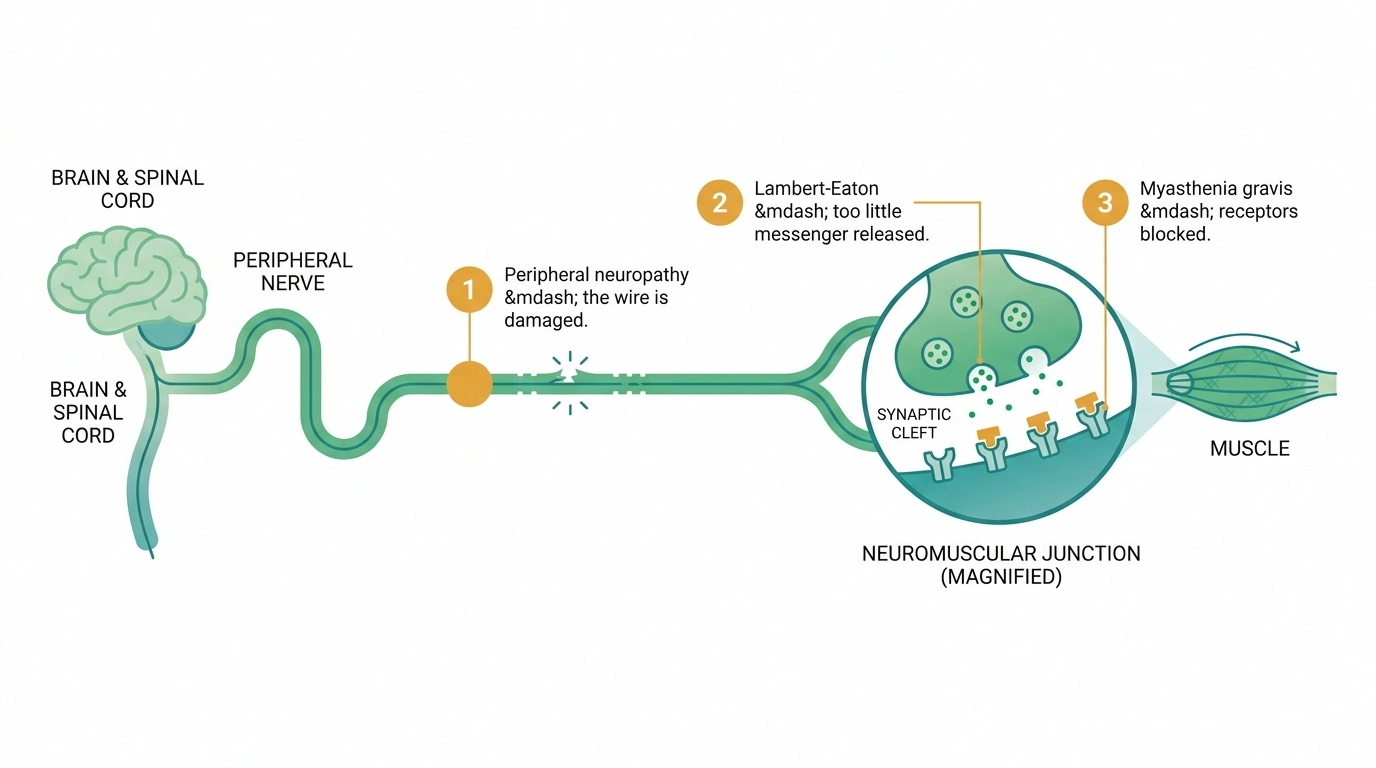
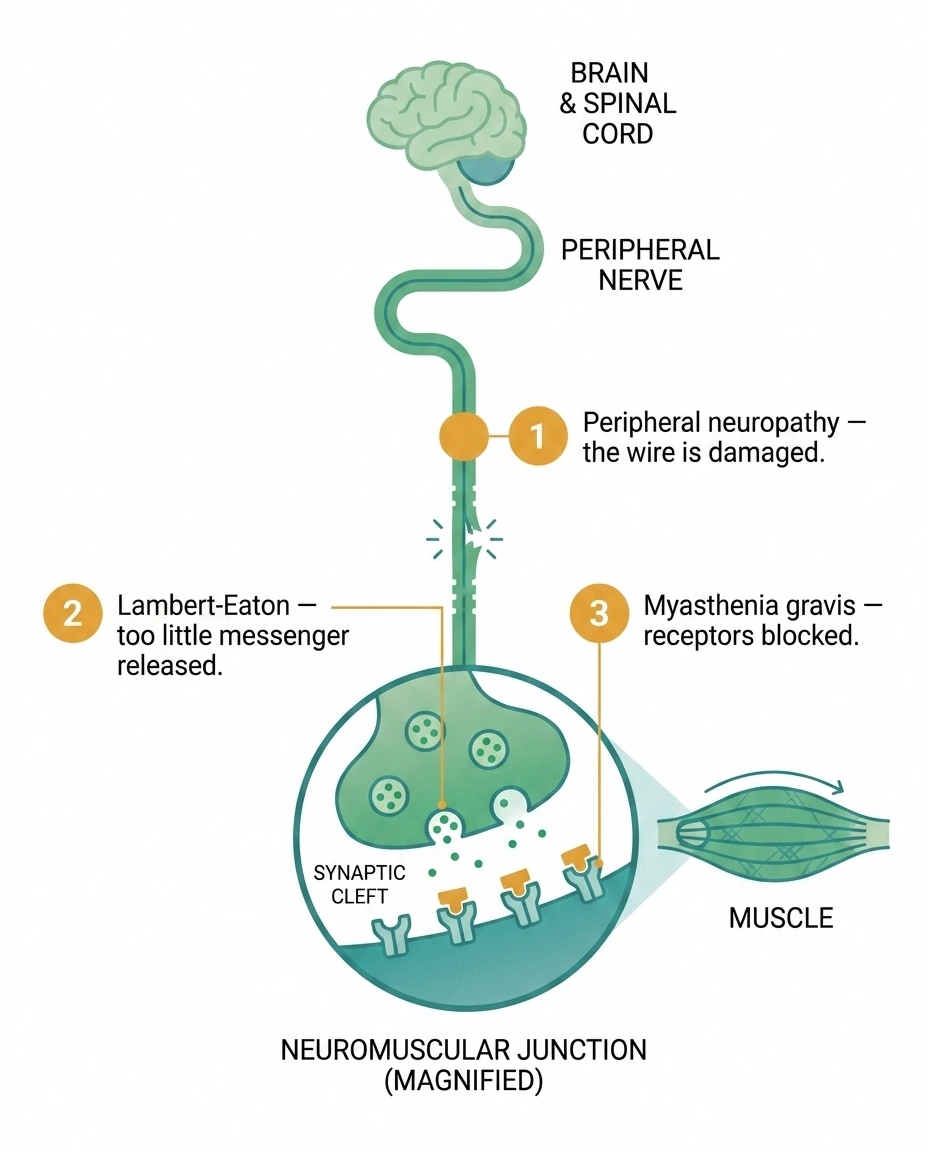
Picture the path a command takes to move your foot. It starts in the brain, runs down the spinal cord, then travels out along a peripheral nerve, sometimes three feet of it, all the way to the muscle. At the very end, the nerve does not physically touch the muscle. There is a microscopic gap. The nerve releases a chemical messenger called acetylcholine across that gap, the muscle has receptors waiting to catch it, and the catch is what triggers the contraction.
Neuropathy damages the wire. Myasthenia gravis blocks the delivery at the far end of it. In myasthenia the nerve is healthy and the message is sent perfectly — there is simply nobody left on the receiving dock to sign for it. Same pathway, different address, and every practical difference between the two conditions falls out of that.
That gap and its machinery is the neuromuscular junction.
Peripheral neuropathy is damage to the wire itself, upstream of the junction. The nerve is frayed, degraded, or dying back from its far end.
Myasthenia gravis is a problem at the junction. It is an autoimmune condition in which the immune system produces antibodies that block, alter, or destroy the acetylcholine receptors on the muscle side of the gap. The nerve is perfectly healthy. The message is sent perfectly. There is just nobody left on the receiving dock to sign for it.
Same wire, different address. And because they fail at different addresses, they fail in observably different ways. Everything below follows from that one fact.
The Most Useful Question: Does It Get Worse the More You Use It?
If you remember one thing from this page, make it this one.
Myasthenia gravis produces fatigable weakness. Not general tiredness, which everyone has. Fatigable weakness means a specific muscle works, then measurably stops working as you keep using it, and then recovers when you rest it. Look up at the ceiling and hold it, and the eyelid slides down. Chew through the first half of a steak and the jaw quits on the second half. Talk for twenty minutes on the phone and the voice goes nasal and thin, then comes back after a break.
Neurologists describe it as weakness that fluctuates hour to hour and day to day, generally worse later in the day, and that recovers with rest. Patients describe it as a battery that will not hold a charge.
Now compare that to what our readers here know intimately. Neuropathy symptoms characteristically get louder when you are still. Burning feet that torment you the moment you lie down. Tingling that fills in the quiet. We even have a whole article on why neuropathy gets worse at night, and none of the reasons involve having used the muscle too much.
So the directions are opposite. Myasthenia is worse with use and better with rest. Neuropathy pain is often worse with rest and better with movement. If you have been trying to force your experience into the neuropathy shape and it keeps not fitting, this may be why.
Where It Starts: Top-Down Versus Bottom-Up
The second discriminator is geography, and it is nearly as reliable as the first.
Which end of your body went first?
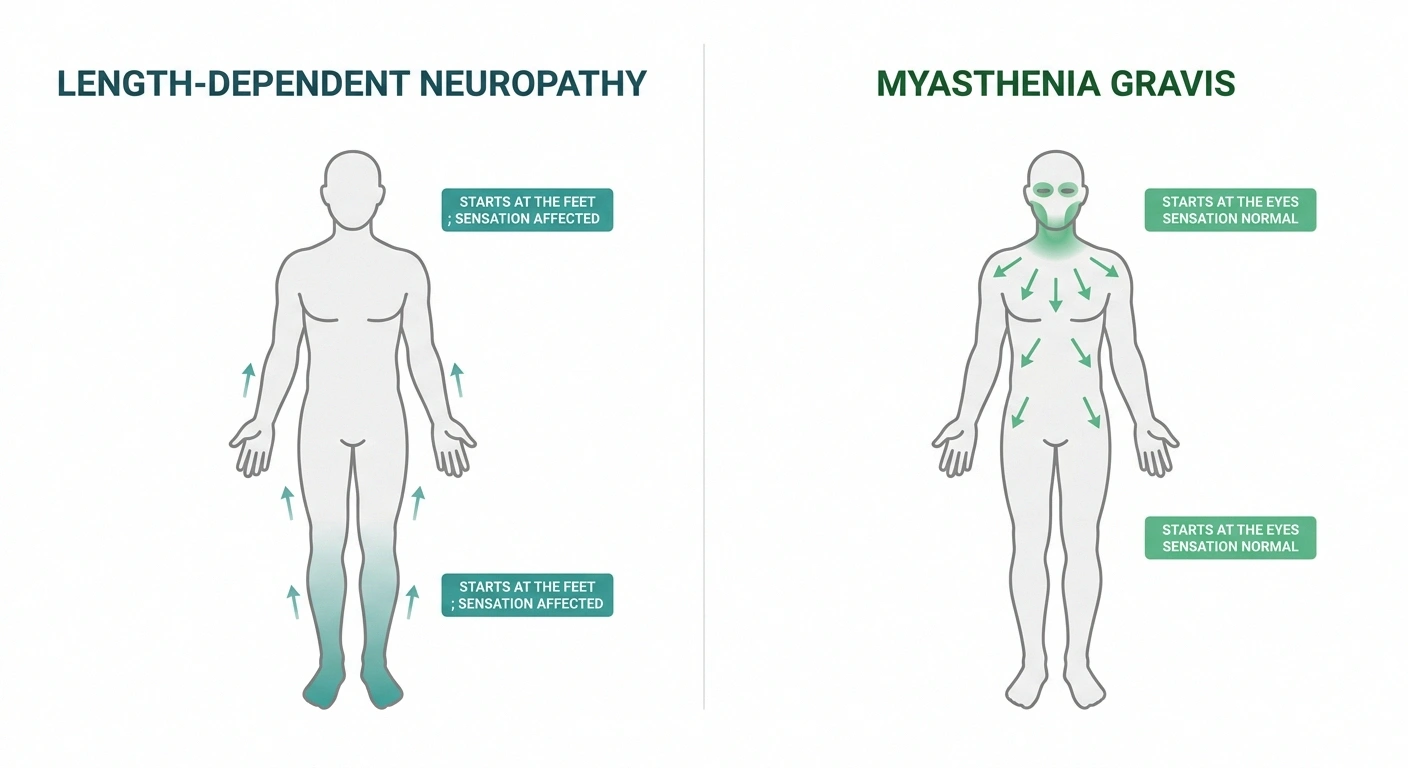
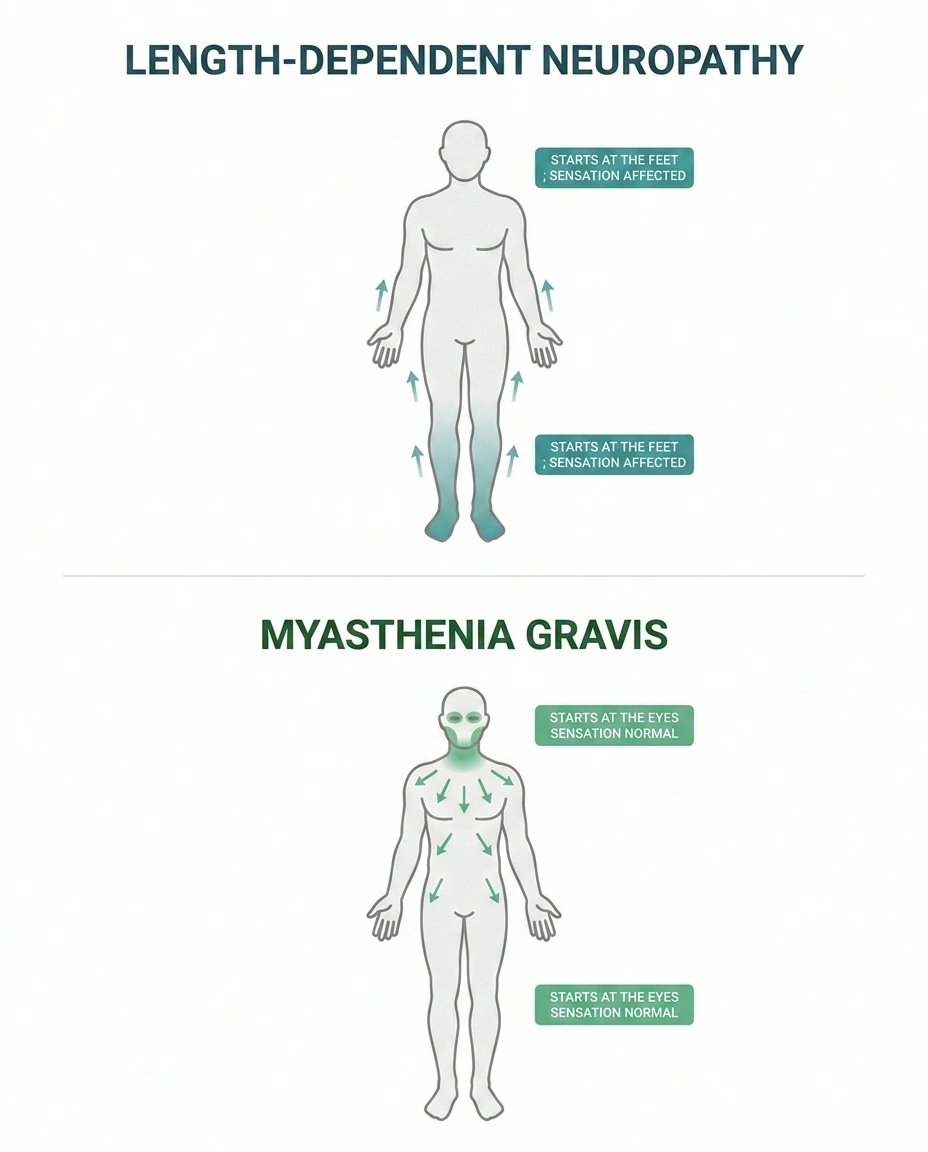
Feet first, creeping upward over months or years, is the signature of length-dependent neuropathy. Eyes, jaw, or voice first, spreading downward toward the shoulders and hips, is a different pattern entirely. It is a question you can answer from memory in about five seconds, and it separates these two conditions more cleanly than most laboratory tests.
The most common form of peripheral neuropathy is length-dependent, which means the longest nerves in the body fail first. The longest nerves end at your toes. So it starts at the feet, creeps up over months or years, and reaches the hands much later, if at all. Our overview of the stages of neuropathy walks through that upward progression in detail. Bottom-up.
Myasthenia gravis usually does the reverse. It very commonly announces itself in the small muscles around the eyes. Drooping eyelid. Double vision. For a large share of people, that is the first symptom, and for some it stays confined to the eyes indefinitely. When it spreads, it tends to move to the face, jaw, throat, neck, and then to the limbs, with a preference for muscles closer to the body's center: shoulders, hips, upper arms, thighs. Top-down.
Ask yourself which end of your body went first. It is a plain question, and it separates these two more cleanly than most laboratory tests.
The Sensory Test: Is Anything Numb?
Here is the discriminator that is closest to absolute.
Peripheral neuropathy
- Sensation: numb, tingling, burning
- Starts: at the feet, moves upward
- With activity: often eases
- Reflexes: reduced or absent
- Eyes and speech: unaffected
Myasthenia gravis
- Sensation: entirely normal
- Starts: at the eyes, moves downward
- With activity: measurably worsens
- Reflexes: typically normal
- Eyes and speech: commonly involved
No single row settles anything on its own. Clinicians read the whole pattern, and where both conditions are present at once the pattern is deliberately re-weighed.
Myasthenia gravis is a purely motor condition. It affects the machinery of contraction. It does not involve sensory fibers at all. It does not cause numbness. It does not cause tingling. It does not cause burning, pins and needles, or that maddening sensation of a sock bunched under your arch when there is no sock. It does not make your skin hurt when the bedsheet touches it.
Peripheral neuropathy, in its most common forms, does exactly those things and often does them first. The whole category of small fiber neuropathy is defined by sensory symptoms with normal strength.
So the question is simple. Is there numbness or altered sensation anywhere?
If yes, something sensory is going on, and myasthenia gravis alone does not explain it. If your only complaint is that muscles quit on you while sensation is entirely normal, that is a genuinely different conversation, and it is one that should include a neurologist.
Drooping Eyelids and Double Vision
These two deserve their own section because they are the signature, and because people routinely explain them away.
Ptosis is the medical word for a drooping upper eyelid. In myasthenia gravis it is often worse at the end of the day, worse after sustained upward gaze, and it may switch which eye it favors, which is unusual and telling. Diplopia is double vision, and in myasthenia it happens because the small muscles that aim the two eyes fatigue at different rates, so the eyes stop pointing at exactly the same place. The double image typically resolves when one eye is covered.
People attribute both to aging, to tiredness, to needing new glasses. Sometimes that is right. But new droop or new double vision in an adult is a symptom that earns a real evaluation, not a stronger reading prescription. Peripheral neuropathy in its common forms does not cause either one.
You may read about the ice pack test, where a cold pack is placed on a closed drooping lid for up to two minutes and the eyelid opening is measured before and after. Cooling temporarily improves transmission at the junction, so an improvement of more than about two millimeters points toward myasthenia. It is a genuinely useful bedside maneuver, and it is a clinician's maneuver performed with measurement and interpretation. It is not a home test, and a positive or negative result from your bathroom mirror will not tell you anything reliable.
Speech, Chewing, and Swallowing

The muscles of speech and swallowing are called bulbar muscles, and myasthenia gravis affects them in a distinctive, fatigable way.
The muscles that manage swallowing sit next door to the muscles that manage breathing. When weakness reaches them, the situation changes from urgent to immediate.
- Shortness of breath at rest, or breathlessness when lying flat
- Choking, or an inability to manage saliva
- A weak, breathy voice together with breathing difficulty
- Generalized weakness worsening rapidly over hours to days
If you already carry a myasthenia diagnosis, put this list on the refrigerator and make sure your family has read it.
The histories people give are specific and consistent. A voice that starts clear and turns nasal or slurred partway through a conversation. Jaw fatigue that arrives in the middle of a meal, so tough foods get abandoned halfway. Difficulty swallowing, sometimes with coughing on thin liquids. Trouble holding the head up late in the day.
Common peripheral neuropathies do not do this. If your feet burn and your speech is clear, those two facts are not part of one story.
Bulbar symptoms also carry more urgency than limb symptoms, because the same muscle group that handles swallowing sits next door to the muscles that handle breathing. More on that below.
What Your Reflexes Say
This is one you cannot check yourself, and it is one of the more informative parts of the exam.
When a doctor taps your ankle or knee with a rubber hammer, the response travels out along the peripheral nerve and back. In peripheral neuropathy the nerve carrying that loop is damaged, so reflexes go down. Reduced or absent ankle jerks are among the most consistent findings in length-dependent neuropathy.
In myasthenia gravis, the nerve is intact. The reflexes are typically normal, even in a limb that has become noticeably weak.
That combination is striking when you see it written down: real, demonstrable weakness sitting alongside perfectly ordinary reflexes and perfectly ordinary sensation. In neuropathy, weakness of any significance usually arrives with diminished reflexes and some sensory loss as company. Weakness traveling alone is a different animal.
The Time-of-Day Pattern, and Why It Fools People
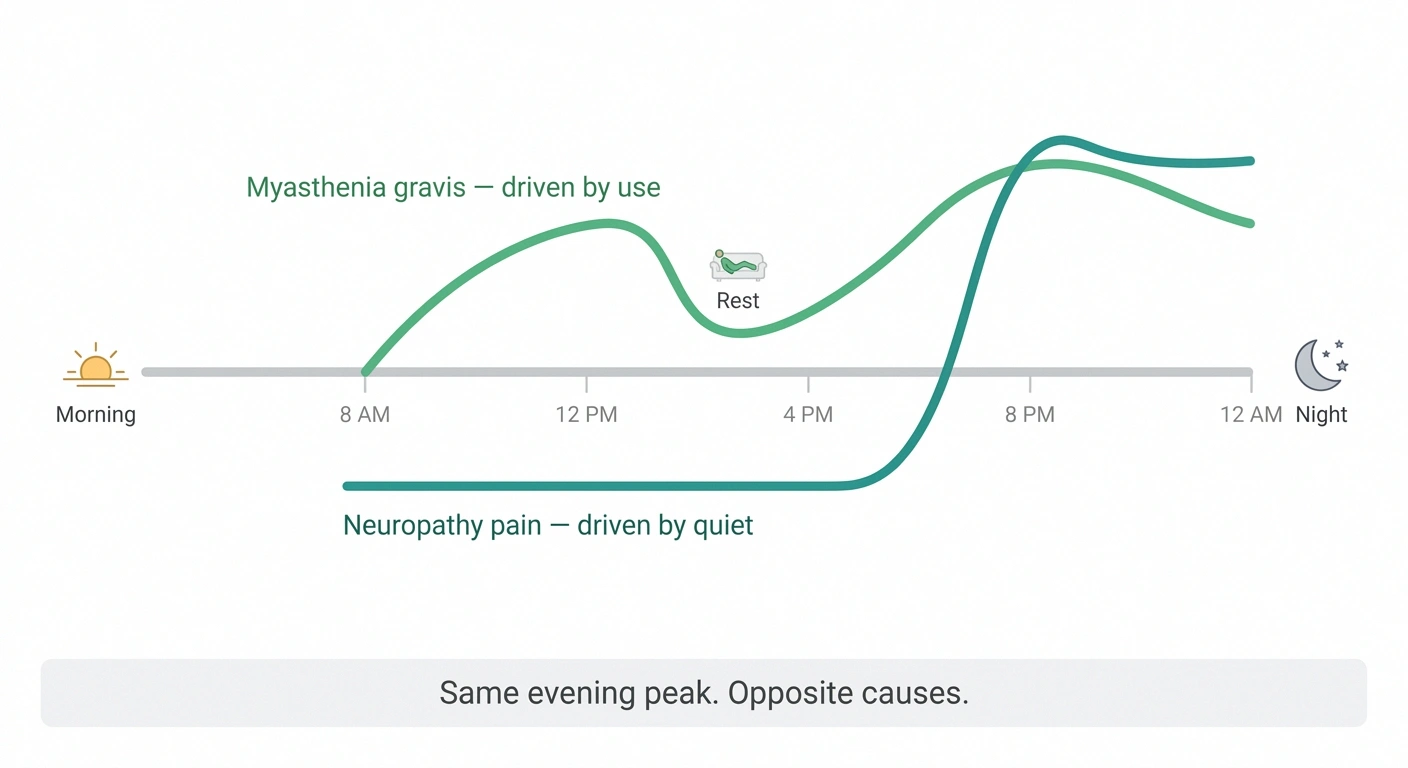
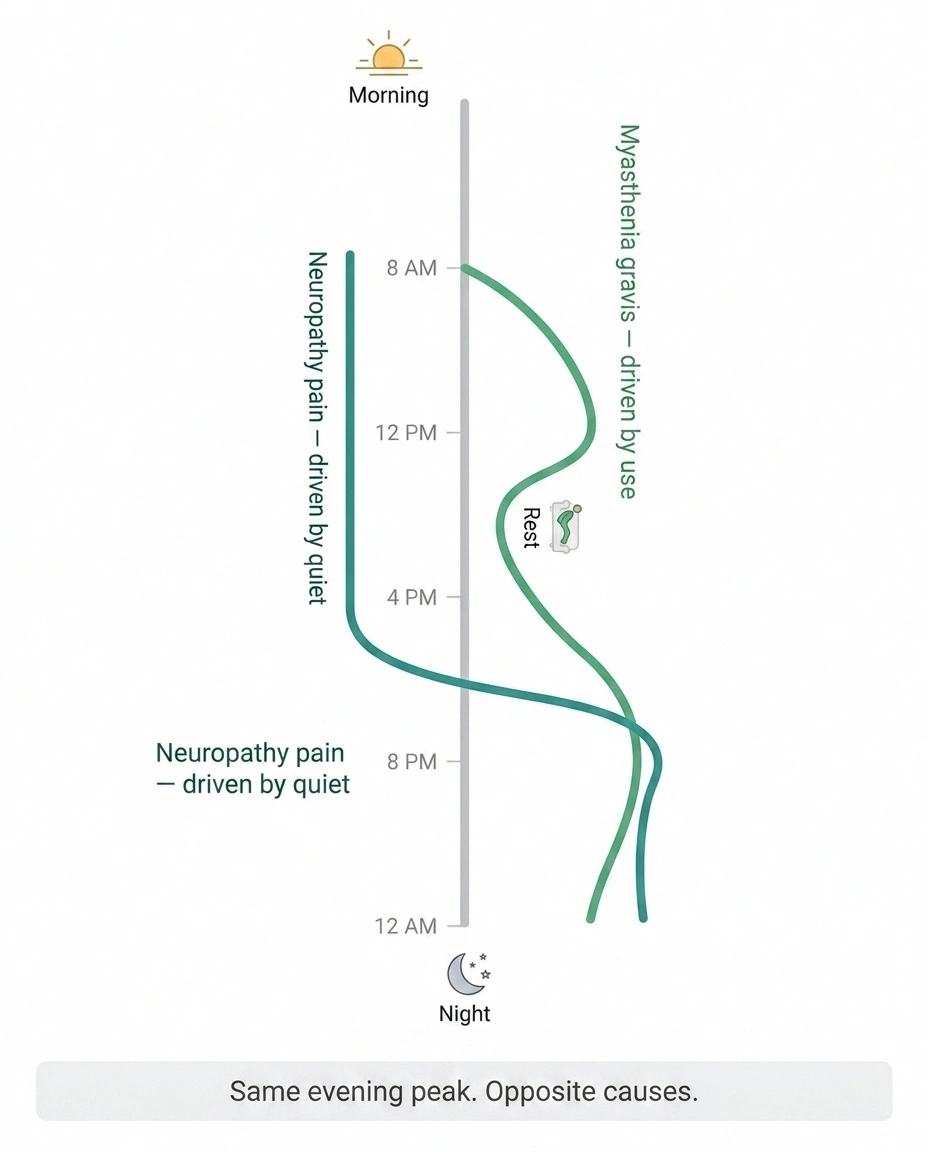
Both conditions have an evening story, and this is where a lot of self-diagnosis goes off the rails.
Myasthenia is worse in the evening because the day's accumulated use has drained the junction's reserve. It is a use effect. A person with myasthenia who spends a day in bed often feels comparatively fine.
Neuropathy is frequently worse at night for entirely different reasons: fewer competing sensory inputs, skin temperature changes, and the simple fact that nothing distracts you from it. It is a quiet effect. A person with painful neuropathy who spends a day in bed often feels worse, not better.
So “worse in the evening” alone tells you very little. The follow-up question is what does it. Was it a busy day on your feet, or a quiet day in a chair? If activity reliably makes things worse and rest reliably makes them better, that pattern deserves attention.
What Testing Looks Like for Each
The workups barely overlap, which is another sign of how different these conditions are.
~72%
Repetitive nerve stimulation sensitivity in generalized disease
~39%
The same test in disease confined to the eyes
Most sensitive
Single-fiber EMG, which is why it is reserved for the harder cases
A clean first round of testing is genuinely good news, but it is not proof that nothing is happening. If the fatigable pattern continues, that is a reason to keep the conversation open rather than to conclude you imagined it.
For peripheral neuropathy, the standard path involves nerve conduction studies and EMG to characterize the damage, skin biopsy when small-fiber disease is suspected, and a blood workup hunting for a cause: blood sugar and A1c, B12, thyroid function, protein studies, and more depending on the picture. Our guide to neuropathy diagnosis covers what each of those tests is looking for. Finding the cause matters enormously, because some causes, like the vitamin deficiencies, are correctable.
For myasthenia gravis, the workup targets the junction:
Antibody blood tests. The main one looks for antibodies against the acetylcholine receptor. There are additional antibody tests for people who test negative on the first and still have a convincing clinical picture.
Repetitive nerve stimulation. A nerve is stimulated repeatedly with small electrical pulses while the muscle response is recorded. In myasthenia the response characteristically shrinks with repetition, a decrement that mirrors the fatigability seen clinically. It is more sensitive in generalized disease, roughly seven in ten, than in disease confined to the eyes, where it catches well under half.
Single-fiber EMG. The most sensitive test available for this, measuring the timing variability, called jitter, between individual muscle fibers. It matters most in the person whose antibody tests came back negative and whose repetitive stimulation was unremarkable, but whose story still sounds like myasthenia.
That sensitivity ladder is worth understanding for one reason only: a normal test does not always close the question. If your first round comes back clean and your symptoms continue in the same fatigable pattern, that is a reason to keep the conversation open, not a reason to conclude you imagined it.
Lambert-Eaton: The Third Possibility
There is a third condition in this differential that patient-facing articles almost never mention, and it is worth knowing exists.
In myasthenia gravis, brief exertion makes strength worse. In Lambert-Eaton myasthenic syndrome, brief exertion can temporarily make strength and reflexes better. Two conditions at the same junction, failing on opposite sides of the gap, producing opposite responses to the same simple test.
Lambert-Eaton is also frequently paraneoplastic, meaning it can surface as the immune system's response to an underlying cancer — sometimes before that cancer has been found. That is not a reason for alarm. It is the clearest argument on this page for why unexplained progressive weakness earns a real workup instead of a wait-and-see.
Lambert-Eaton myasthenic syndrome is also a junction disease, but it fails on the other side of the gap. In myasthenia the problem is the receiving dock. In Lambert-Eaton the problem is on the nerve side, where not enough acetylcholine gets released in the first place.
It presents differently. Weakness tends to concentrate in the hip and thigh muscles, so difficulty rising from a chair or climbing stairs is common. Reflexes are typically reduced, which makes it look more neuropathy-like than myasthenia does. Dry mouth and other autonomic symptoms are common companions, in the same family as the symptoms we describe in autonomic neuropathy.
And it has a genuinely strange signature: brief exertion can temporarily improve strength and reflexes, the exact reverse of myasthenia's fatigability. A neurologist may test for this deliberately.
The other reason it matters is that Lambert-Eaton is frequently paraneoplastic, meaning it can appear as the body's immune response to an underlying cancer, most often small-cell lung cancer, sometimes before the cancer has been found. That is not said to frighten anyone. It is said because it is one of the clearest examples of why unexplained progressive weakness deserves a real diagnostic workup rather than a wait-and-see.
Can You Have Both at Once?
Yes, and it is not rare enough to ignore.
Peripheral neuropathy is extremely common in older adults. Myasthenia gravis has a bimodal pattern with a meaningful share of new diagnoses in older adults, particularly men. Those two populations overlap. A person who has had diabetic neuropathy for a decade and then develops myasthenia will present with a muddled picture: numb feet and reduced ankle reflexes from the neuropathy, plus fatigable droop and swallowing trouble from the myasthenia.
This is exactly the scenario where the textbook contrasts stop being clean, and it is one of the reasons neurologists weigh the entire pattern rather than any single finding. It is also a good argument against deciding you already know which condition you have. If you have known neuropathy and something genuinely new and different starts happening, particularly anything fatigable or anything above the neck, that deserves to be reported as a new problem rather than absorbed into the old diagnosis.
When Weakness Is an Emergency

Most of this article is about getting an appointment. This section is not.
The muscles that control breathing can be affected in myasthenia gravis, and when respiratory weakness becomes severe it is called a myasthenic crisis. It is a medical emergency. It can be triggered by infection, surgery, stress, or certain medications, and it can develop over hours.
Get emergency care, not an appointment, for:
Shortness of breath at rest, or breathlessness when lying flat. Difficulty swallowing to the point of choking or being unable to manage saliva. A weak, breathy voice combined with breathing difficulty. Rapidly worsening generalized weakness over hours to days. New severe difficulty holding the head up along with any of the above.
If you already carry a myasthenia diagnosis, this list should be on your refrigerator and your family should have read it. If you do not, and you are experiencing any of it, this article is not the right resource. Emergency care is.
Why This Diagnosis Gets Missed for So Long
Delays of months to years are common with myasthenia gravis, and the reasons are worth naming, because a few of them are things you can work around.
It fluctuates
You arrive on a good morning and demonstrate perfectly normal strength.
It scatters
The droopy lid goes to an eye doctor, the jaw fatigue goes to a dentist, and nobody compares notes.
It gets attributed
To aging. To stress. To not sleeping well. Sometimes correctly, often not.
The word betrays you
“Fatigue” is the most discounted word in medicine. This is the one you can fix — describe what fails, not how you feel.
The symptoms fluctuate, so people arrive at appointments on a good day and demonstrate normal strength. The early symptoms are individually unremarkable, and a droopy lid gets sent to an eye doctor while jaw fatigue gets sent to a dentist and neither of them is comparing notes. Older adults get told it is aging. Women get told it is stress. And the word “fatigue,” which is the honest word for the experience, is the single most overused symptom in medicine, so it gets discounted the moment it is said.
That last one is the fixable one. Do not say “I am tired.” Say what fails, when it fails, and what makes it come back.
How to Prepare for the Appointment

You get a limited window with a specialist, and the quality of your description does real work in it. Two practical things.
Name what stopped working. Not “weak legs.” The stairs, the jar lid, the second half of the meal.
Say how far in it failed. Twenty minutes into the phone call. Halfway up the second flight. Ten minutes into chewing.
Say how long the recovery took. This is the part almost nobody reports, and it is the part that separates fatigable weakness from everything else.
Bring the photographs. Same face, straight on, morning and late evening, across several days. A specialist seeing you at ten in the morning may find nothing at all.
Keep a use-and-recovery log for two weeks. Not a pain diary. A log of what stopped working, at what point in the activity, and how long the rest took before it worked again. “Could not finish chewing dinner, twenty minutes into the meal, jaw fine after fifteen minutes of rest.” That structure is diagnostic information. “Feeling weak lately” is not.
Bring photographs. This one changes appointments. If your eyelid droops in the evening, have someone photograph your face straight on in the morning and again at nine at night, on several different days. A neurologist seeing you at ten in the morning may find nothing, and a phone showing the same face at ten at night can transform the visit. Same for anything visible.
Also bring a complete medication list, including anything started in the months before symptoms began. Some medications can unmask or worsen myasthenia, and a great many can cause neuropathy in their own right, which we cover in our article on medications that can cause neuropathy. Your prescriber needs the whole list, over-the-counter items included.
What Happens After a Diagnosis, Either Way

I want to end somewhere other than the anxiety, because the reason to sort this out is that both answers lead somewhere.
Myasthenia gravis is treatable, and that is the reason getting the diagnosis right is worth the effort. It is a condition that neurologists manage actively, with a range of approaches aimed at the junction and at the immune process behind it, and the treatment landscape has expanded considerably in recent years. What that looks like for any individual is a conversation with a neuromuscular specialist, not something an article can prescribe. The relevant point here is only that this is not a diagnosis you receive and then get sent home empty-handed.
Peripheral neuropathy leads somewhere too, though the road is different. The most important step is finding the cause, because the causes that can be corrected, addressed early, genuinely change the trajectory. Beyond that, a great deal of what improves daily life is practical: symptom management, protecting the feet, and adapting the environment. If balance has become part of your picture, our guide to neuropathy and fall prevention covers the changes that actually reduce risk.
What both paths have in common is that they start with a real evaluation rather than a search bar. If your weakness fatigues with use and recovers with rest, if it started above the neck, if your sensation is entirely normal, or if something new and different has appeared on top of a neuropathy you already know about, take that specific description to a doctor. Not the word “tired.” The pattern.
Frequently Asked Questions
Is myasthenia gravis a type of neuropathy?
No. Myasthenia gravis is a disorder of the neuromuscular junction, which is the connection point where a nerve communicates with a muscle. Peripheral neuropathy is damage to the nerve itself, upstream of that connection. In myasthenia gravis the nerve is healthy and the receiving end on the muscle is impaired by autoantibodies against acetylcholine receptors. Because the two conditions fail at different points along the same pathway, they produce different symptom patterns, respond to different tests, and are managed by different treatments, even though both can be described loosely as neuromuscular conditions.
Does myasthenia gravis cause numbness or tingling?
No. Myasthenia gravis affects only motor function, meaning the ability of muscles to contract. It does not involve sensory nerve fibers, so it does not cause numbness, tingling, burning, or altered sensation of any kind. If numbness or tingling is present alongside weakness, something other than myasthenia gravis is contributing, which may be a peripheral neuropathy, a nerve compression, a spinal problem, or two conditions occurring together. Sensory symptoms are one of the most useful features separating these conditions, and their presence should be reported clearly to the evaluating clinician.
What is usually the first sign of myasthenia gravis?
Eye symptoms are the most common first sign. A drooping upper eyelid, called ptosis, or double vision, called diplopia, appears first in a large share of cases, and in some people the condition remains confined to the eye muscles. Characteristically these symptoms worsen through the day and improve with rest, and the droop may alternate between eyes. Other early presentations include jaw fatigue while chewing, a voice that weakens during a long conversation, difficulty swallowing, and weakness of muscles closer to the body's center such as the shoulders and hips.
Can you have myasthenia gravis and peripheral neuropathy at the same time?
Yes. Both conditions become more common with age, so coexistence occurs, particularly in older adults who already have a diabetic or age-related sensory neuropathy. When both are present the picture is less clean than the textbook contrast, because the neuropathy contributes numbness and reduced reflexes while the myasthenia contributes fatigable weakness. This is one reason clinicians weigh the whole pattern rather than any single finding. Anyone with an established neuropathy who develops genuinely new symptoms, especially fatigable weakness or anything affecting the eyes, speech, or swallowing, should report it as a new problem rather than assume it belongs to the existing diagnosis.
Why is myasthenia gravis worse at the end of the day?
The weakness in myasthenia gravis is driven by use rather than by time of day itself. Each muscle contraction depletes some of the limited reserve at the neuromuscular junction, and because that reserve is already reduced by the antibodies, it runs down over hours of ordinary activity. Rest allows partial recovery, so symptoms typically improve after a nap or overnight and worsen again with sustained use. This is a different mechanism from neuropathy pain that intensifies at night, which is generally attributed to fewer competing sensory inputs, temperature changes, and the absence of daytime distraction.
Can a blood test diagnose myasthenia gravis?
Antibody blood testing is a central part of the workup, most commonly testing for antibodies against the acetylcholine receptor, with additional antibody tests available for people who test negative on the first. However, a negative antibody result does not exclude the diagnosis, since a proportion of people with genuine myasthenia gravis test negative on standard antibody panels. In those cases clinicians rely on the clinical examination together with electrophysiological testing such as repetitive nerve stimulation and single-fiber EMG. The diagnosis is made from the overall picture, not from one laboratory value.
What is the ice pack test and can I do it at home?
The ice pack test is a bedside maneuver used by clinicians when a drooping eyelid raises suspicion of myasthenia gravis. Cooling temporarily improves transmission at the neuromuscular junction, so a cold pack is applied to the closed drooping lid for up to about two minutes and the eyelid opening is measured before and after. An improvement of more than roughly two millimeters is considered a positive result. It is not a home test. The result depends on careful measurement and on interpretation alongside the rest of the examination, and a self-administered version cannot reliably confirm or exclude anything.
When should weakness be treated as an emergency?
Weakness affecting breathing or swallowing requires emergency care rather than a scheduled appointment. Warning signs include shortness of breath at rest or when lying flat, choking or an inability to manage saliva, a weak breathy voice combined with breathing difficulty, and generalized weakness that worsens rapidly over hours to days. In myasthenia gravis this situation is called a myasthenic crisis and it can be triggered by infection, surgery, stress, or certain medications. Anyone with a known diagnosis should keep these warning signs somewhere visible and make sure family members know them.
About the Author