There is a question that comes up in almost every conversation I have with someone finishing platinum chemotherapy, and it is asked with real bewilderment.
“Why is it getting worse? I'm done.”
They finished the last infusion six weeks ago and expected the hard part to be over. Instead the numbness has climbed past the ankles, the hands have joined in, and buttons have become a project. Nobody warned them this could happen after treatment ended, so they assume something new has gone wrong.
Nothing new has gone wrong. What they are experiencing has a name, it is well documented, and it happens because cisplatin damages nerves in a genuinely different way than most other chemotherapy drugs. That single mechanical difference explains almost everything people find confusing here, and it is the thread I want to pull for the rest of this article.
I am a patient advocate, not an oncologist, and nothing here should change a single decision about your cancer treatment. Those decisions belong to you and your oncology team, and the cancer matters most. What I can offer is a clear explanation of what is happening to your nerves and what genuinely helps, so the conversation at your next appointment is a sharper one.
Why Cisplatin Damages Nerves Differently From Other Chemo Drugs
Most chemotherapy neuropathy is what is called a dying-back axonopathy. The drug injures the long nerve fibers and they degrade from the far end inward, like a rope fraying from the tip. That is why so much chemo neuropathy starts at the toes and creeps upward, and why our general guide to chemotherapy-induced peripheral neuropathy describes that pattern.
Most chemotherapy frays the cable. Cisplatin damages headquarters.
Platinum accumulates in the sensory nerve cell bodies clustered just outside the spinal cord, not in the long fibers running out to your toes. That one structural fact accounts for nearly everything people find confusing here: why hands and feet can go at the same time, why it keeps progressing after the last infusion, why balance suffers more than pain, and why recovery has a lower ceiling than other chemo neuropathies.
Cisplatin does something else.
Just outside your spinal cord, at each level, sits a small cluster of nerve cell bodies called the dorsal root ganglion — the switchboard where every sensory nerve in that region has its headquarters. The fiber running to your toe is just a cable. The cell keeping that cable alive lives back here, near the spine.
Platinum binds strongly to DNA and accumulates preferentially in those neurons, partly for structural reasons: most peripheral nerve is shielded by a barrier limiting what can reach it, and the dorsal root ganglion does not enjoy the same protection. The platinum gets in, forms adducts with the DNA, and impairs the cell's ability to function. How well an individual repairs that damage appears to be part of why some people are hit hard and others barely affected.
The result is called a sensory neuronopathy. The damage is at headquarters, not at the far end of the cable — and that explains why symptoms can appear in hands and feet at roughly the same time instead of marching upward, why the process continues after the drug is gone, why balance takes the hardest hit, and why Lhermitte's sign happens at all.
The Dose Numbers Worth Knowing
Cisplatin neuropathy is strongly dose-dependent, and the cumulative thresholds are reasonably well characterized. Symptoms typically begin to appear once cumulative exposure reaches roughly 250 to 350 mg/m². By 500 to 600 mg/m², neuropathy develops in nearly everyone.
250–350 mg/m²
Where symptoms typically begin to appear
500–600 mg/m²
Where neuropathy develops in nearly everyone
These are population figures, not personal predictions, and they vary considerably between individuals. They are context for a conversation with your oncologist — not a limit for you to enforce. The cancer outranks the neuropathy, and your team weighed that trade when they chose the regimen.
Two things about those numbers. They are population figures, not personal predictions — some people develop significant symptoms well below the typical threshold while others sail past it comparatively intact. And they are context for a conversation, not a limit for you to enforce. Your oncologist chose your regimen weighing the cancer against the toxicity, using information you do not have and I certainly do not. Knowing roughly where you sit on the curve helps you ask better questions. It is not a reason to want fewer cycles.
What is worth doing is knowing your number. Ask what your cumulative cisplatin dose is so far and what it will be at the end of the planned course. It is an ordinary question and it frames everything that follows.
What It Actually Feels Like
The early symptoms are sensory and usually arrive as numbness and tingling rather than pain.
Fingers and toes go first. People describe a persistent muffled quality, like thin gloves that never come off, and a vagueness at the fingertips that makes small objects harder to manage. Losing track of whether you turned one page or two is a small, specific complaint I hear constantly.
As it progresses the losses become structural. Vibration sense fades, which a clinician tests with a tuning fork. Ankle reflexes diminish. Position sense degrades, so your brain loses its reliable feed of where your feet are in space.
Motor function is usually spared, and people are often surprised that their strength is essentially intact while their coordination is not. Pain occurs, and for some it is significant, but burning agony is less characteristic of cisplatin than of other causes of nerve damage. If you were bracing for the burning-feet experience you read about elsewhere and instead got a strange, silent unsteadiness, that is a very typical cisplatin story.
Why Balance Is the Bigger Problem Than Burning
This deserves its own section because it is where cisplatin neuropathy diverges most sharply from what most people expect nerve damage to be.
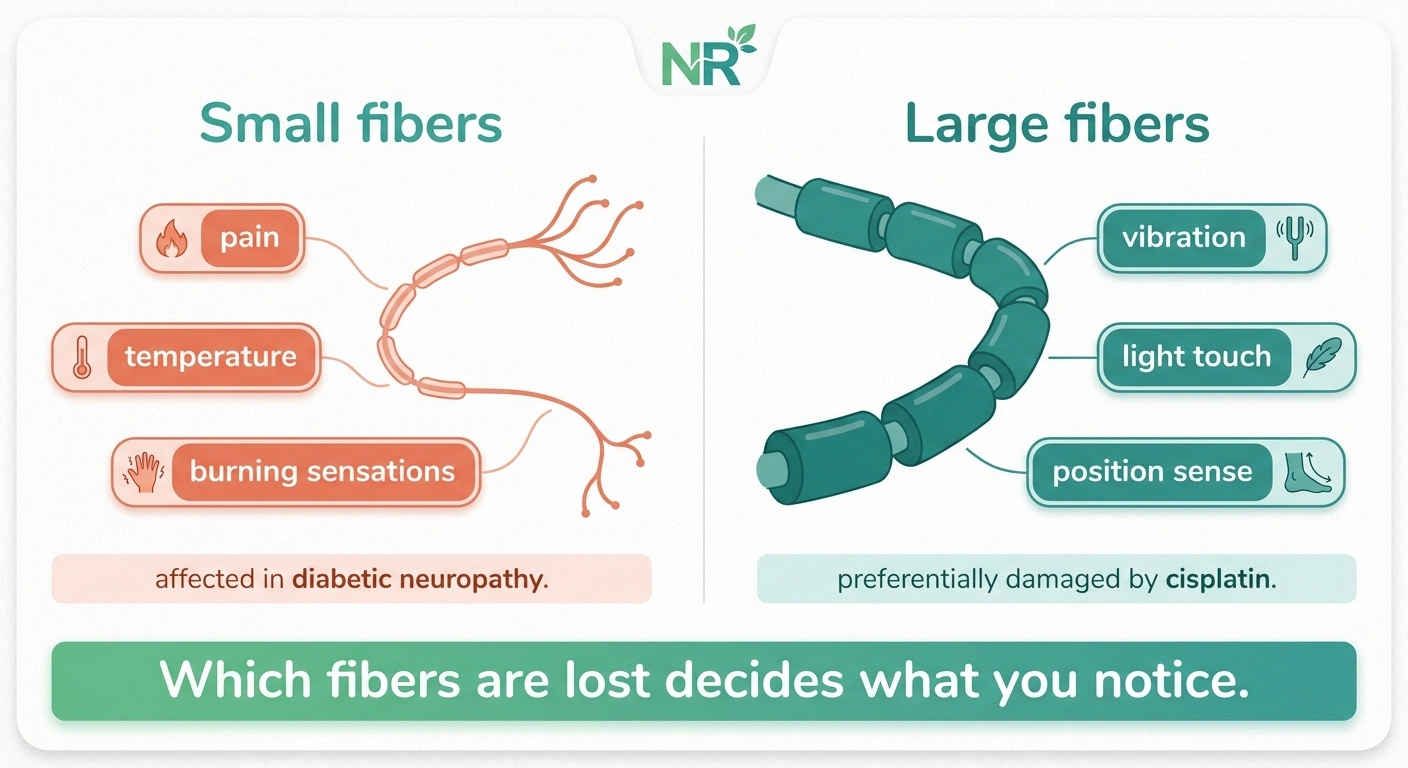
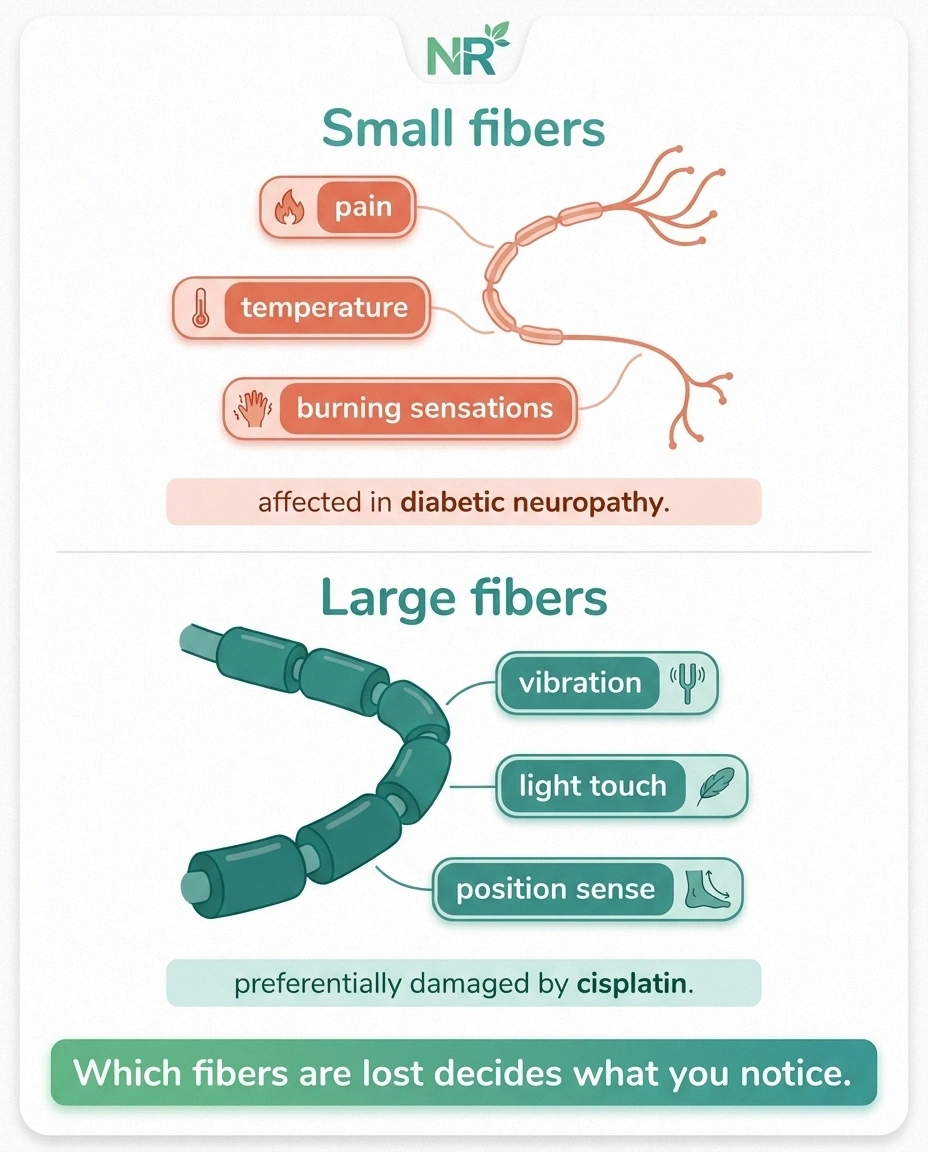
Peripheral nerves come in different calibers, and the caliber determines the job. Small fibers carry pain and temperature. Large fibers carry vibration, light touch, and proprioception, the continuous unconscious report of where your limbs are.
Diabetic neuropathy and many others hit small fibers hard, which is why burning and painful hypersensitivity dominate those stories, and why our page on small fiber neuropathy reads the way it does. Cisplatin preferentially damages large sensory fibers.
So the headline symptom is not pain. It is the quiet disappearance of your body's internal map. You lose the background stream telling your brain where your feet are, and your brain compensates by leaning harder on vision — which works fine until it does not.
You notice it in specific places. In the shower with your eyes closed under the water. Getting up at night in a dark hallway. On uneven ground. Turning quickly. Walking on grass or gravel. People describe planting their feet wider than they used to and looking down more than they used to, and neither is a habit. Both are compensation.
This matters practically, because the intervention that helps most is not a pain medication. It is balance work and fall prevention. Our guide to neuropathy and fall prevention covers the changes that reduce risk, and for large-fiber neuropathy they are the main event rather than a footnote.
Lhermitte's Sign: The Shock Down Your Spine
Here is a symptom that frightens people badly, partly because it is dramatic and partly because nobody mentioned it might happen.
You tip your chin toward your chest and a sensation like an electric shock runs down your spine, sometimes into your arms or legs. It lasts a second, then it is gone. Tip your head again and it may repeat.
That is Lhermitte's sign, reported often enough in platinum chemotherapy to be a recognized feature rather than a curiosity. It happens because sensory pathways near the spinal cord have been affected, and flexing the neck stretches them enough to make them fire.
The reassuring part is that it is generally not a sign of anything structural going wrong with your spine, and it typically fades over months. The part requiring care is that it is not exclusive to chemotherapy — it appears in several other conditions, including B12 deficiency and multiple sclerosis. So report it rather than assume. Say it plainly: “When I bend my neck forward, I get an electric shock down my back.” They will know exactly what you mean.
Coasting: Why It Gets Worse After Treatment Ends
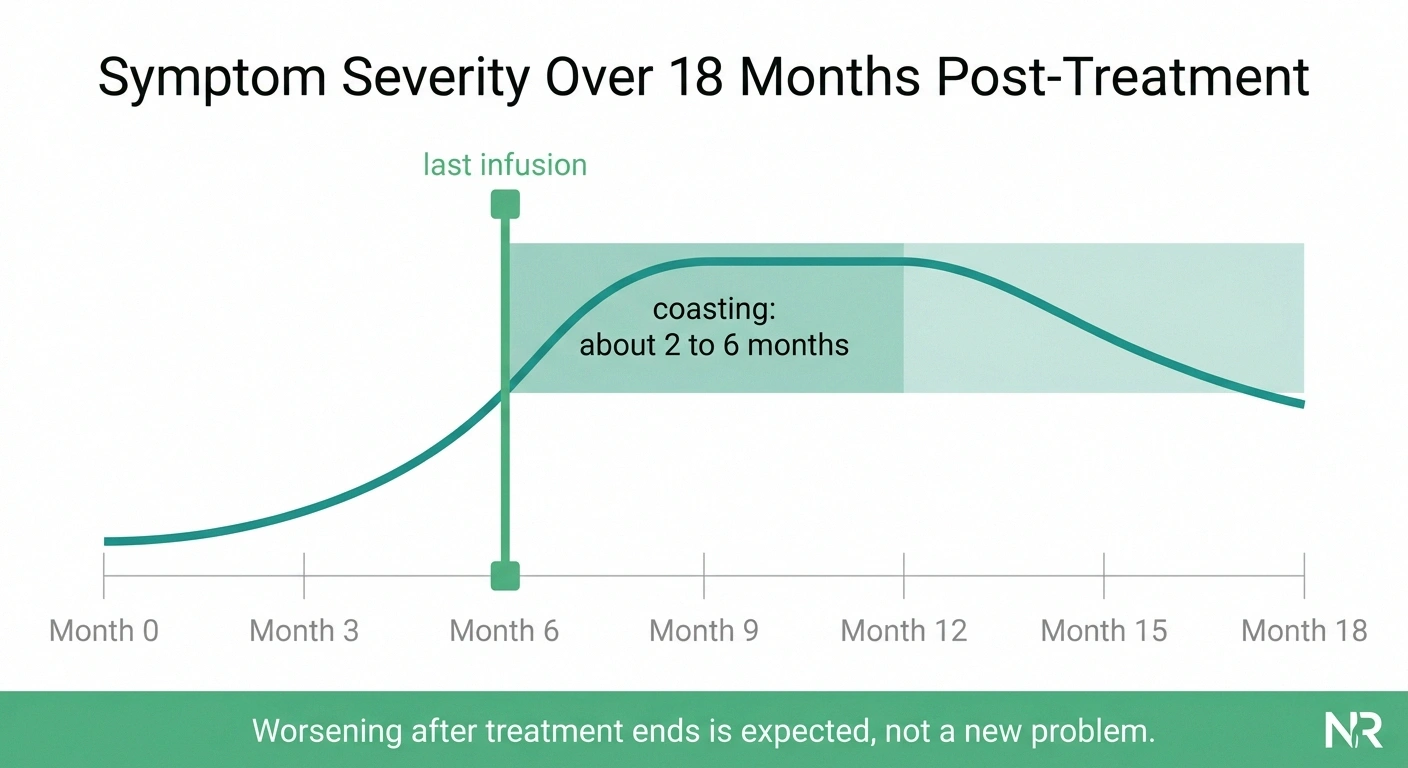
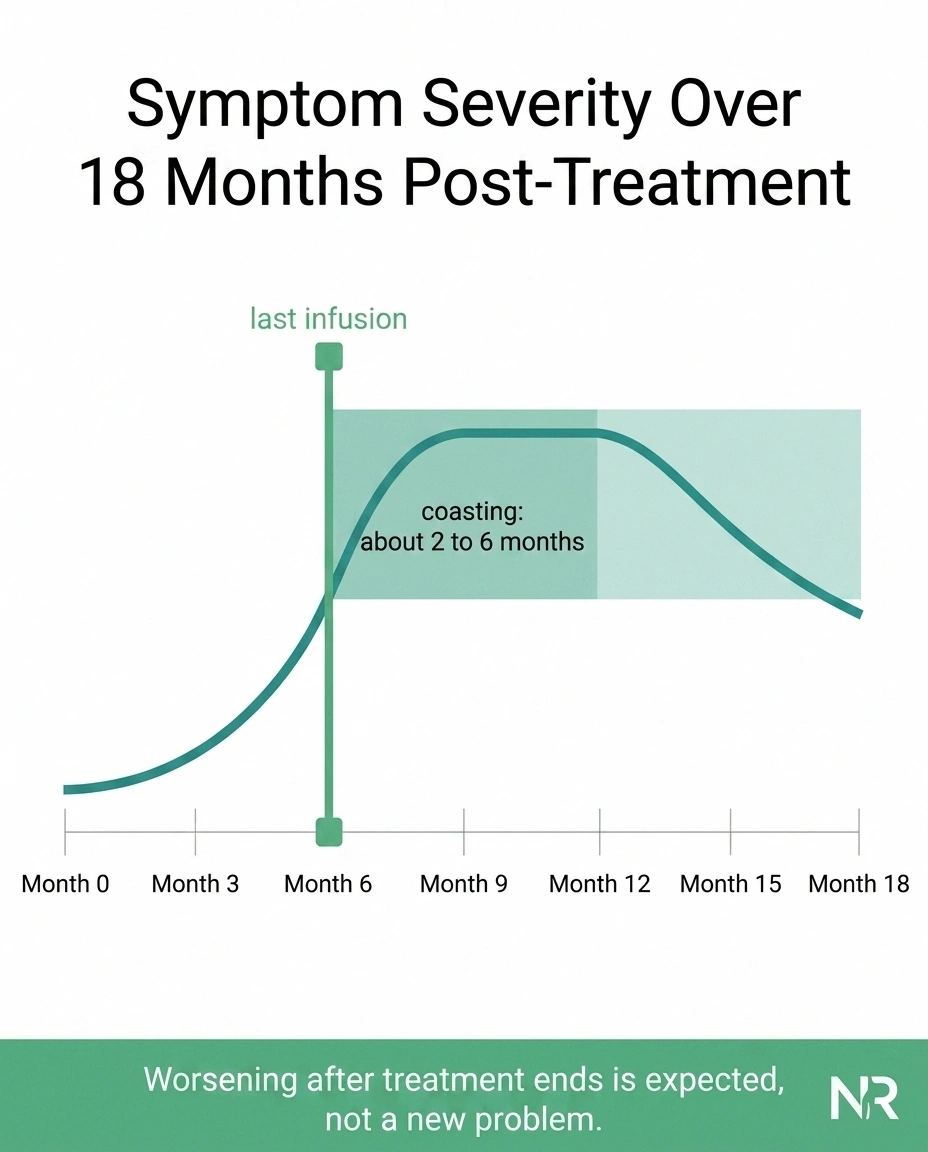
This is the part that sends people searching at midnight, and it is a direct consequence of the mechanism.
Platinum neuropathy can continue to worsen for roughly two to six months after the final infusion. It has a name — coasting — and it is well documented. The platinum has already accumulated inside those sensory cell bodies and already done its work; the drug clearing your bloodstream does not undo what is sitting inside the cell.
You are not failing at recovery, and nothing new has attacked you. Report the worsening anyway — expected is not the same as ignore — but you can stop carrying the fear that something went wrong.
Platinum neuropathy can continue to worsen for roughly two to six months after the last infusion. The phenomenon has a name — coasting — and it is well documented with cisplatin and oxaliplatin in particular. It makes sense once you know where the damage sits. The platinum already accumulated in those dorsal root ganglion cells and already did its work on their DNA. The cells then decline over the following weeks and months. The drug leaving your bloodstream does not undo what is sitting inside the cell.
Two implications matter. The first is emotional, and I do not want to skip past it: if your neuropathy is worsening two months after your final cycle, you are not failing at recovery and nothing new has attacked you. It is expected. That knowledge does not make your hands work better, but it removes a layer of fear a lot of people carry alone because nobody named it for them.
The second is clinical. Because coasting cannot be predicted in advance, the stop-and-go dosing strategies that help with some other chemotherapy toxicities do not reliably prevent it. That is not a failure of your care team; it is a hard problem the field has not solved.
Still report the worsening. Expected is not the same as ignore it, and your team needs the information — both for you and because unusual symptoms deserve assessment rather than filing under a label.
The Hearing Connection Nobody Warns You About
Cisplatin's neurotoxicity is not confined to the peripheral nerves. The two most common forms are peripheral neuropathy and ototoxicity, meaning damage to the hearing apparatus. High-frequency hearing loss and tinnitus are both well described, and the inner ear's balance organ can be affected too.
Vision
Usually intact — and doing nearly all the work
Inner ear
Can be degraded by the same drug
Position sense
Degraded by the large-fiber damage
Balance runs on three channels. Cisplatin can knock out two of them at once, leaving vision alone to carry it — which is exactly why the trouble shows up in the dark hallway, in the shower with your eyes closed, and on ground you cannot see clearly. Mention any ringing, muffled hearing, or trouble following conversation in a noisy room. It is part of this picture, not a separate complaint.
Put those two facts side by side, because this may be the most underappreciated thing in the article. Human balance runs on three inputs: what your eyes see, what your inner ear senses about head position and motion, and what your feet and joints report. Cisplatin can degrade the inner ear input and the proprioceptive input at the same time, leaving vision doing nearly all the work alone.
That is why some people find their unsteadiness disproportionate to their numbness. They are not imagining it. They have lost two of three channels, and the remaining one shuts off every time they close their eyes or walk into a dark room.
So if you notice ringing in your ears, muffled hearing, or difficulty following conversation in a noisy restaurant, mention it. Hearing changes and balance problems are related pieces of one picture here, not two unrelated complaints, and a hearing evaluation is a reasonable thing to ask about.
What Recovery Actually Looks Like

I want to be honest here rather than encouraging, because false optimism does real damage to people trying to plan their lives.
Recovery is typically partial, slow, and variable. After coasting ends and symptoms plateau, gradual improvement is common, measured in many months to years rather than weeks. And a meaningful number of people are left with some permanent residual, most often numbness in the toes and fingertips and reduced vibration sense. Nerve cell bodies do not regenerate the way peripheral axons can, so when the damage is at headquarters rather than along the cable, the repair ceiling is lower.
What genuinely improves for most people is function, and it comes from two directions. Some is nerve recovery. A great deal is your brain adapting — recalibrating balance strategies, relearning grip without full feedback, building new habits. That second half is not a consolation prize. It is where most of the practical gain lives, and unlike the first half, it responds directly to effort.
For a framework on where you are in the arc, our overview of the stages of neuropathy is a reasonable orientation, with the caveat that a chemotherapy neuronopathy does not follow the same progression as a slowly developing metabolic neuropathy.
What the Evidence Says About Prevention
A great many agents have been tested for preventing platinum neurotoxicity: thiol compounds, vitamin E, various anticonvulsants, calcium and magnesium infusions, assorted antioxidants and supplements. The results have been inconsistent, largely negative, and in some cases raised concern about interfering with the chemotherapy itself. Major oncology guidance does not endorse any agent for prevention.
Do not add any supplement during platinum chemotherapy without clearing it with your oncologist first.
This is not general caution. Some antioxidants carry a theoretical potential to interfere with how platinum chemotherapy works — which is the one thing you cannot afford to gamble with. People in active cancer treatment are among the most heavily marketed-to groups in the supplement industry, and “prevents chemo neuropathy” sells well precisely because the fear is real and the honest medical answer is unsatisfying. No agent is currently endorsed for prevention. Bring the bottle to your appointment, including the things that seem too minor to mention.
I want to say the uncomfortable part plainly. People in active cancer treatment are among the most heavily marketed-to groups in the supplement industry, and “prevent chemo neuropathy” sells extremely well precisely because the fear is real and the medical answer is unsatisfying. The absence of a proven preventive is not a gap a bottle fills.
There is also a specific hazard beyond wasted money. Some antioxidants carry a theoretical potential to interfere with how platinum chemotherapy works, which is exactly what you cannot afford to gamble with. Do not add any supplement during platinum chemotherapy without clearing it with your oncologist first. That is not general caution boilerplate. It is specific to this drug class.
Duloxetine and the Short List of Things That Help
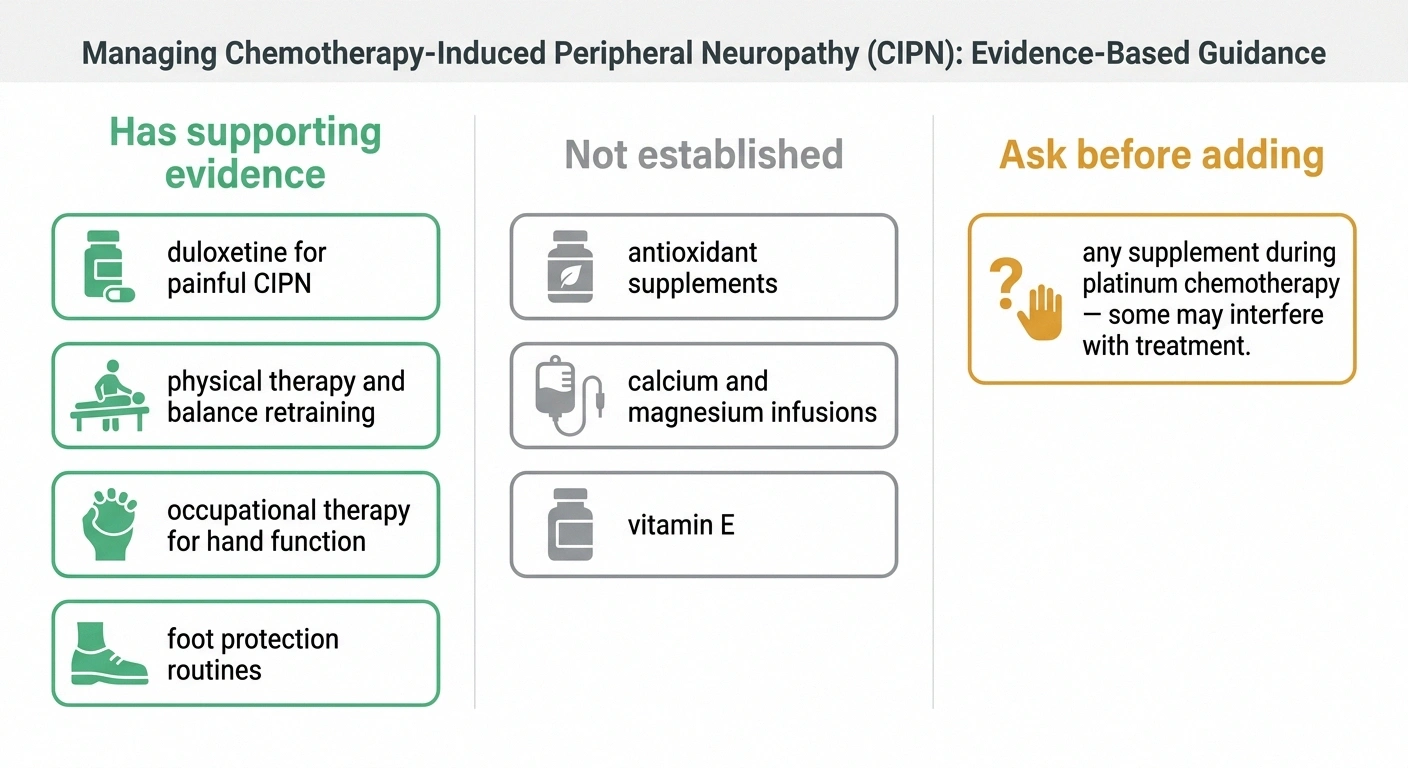
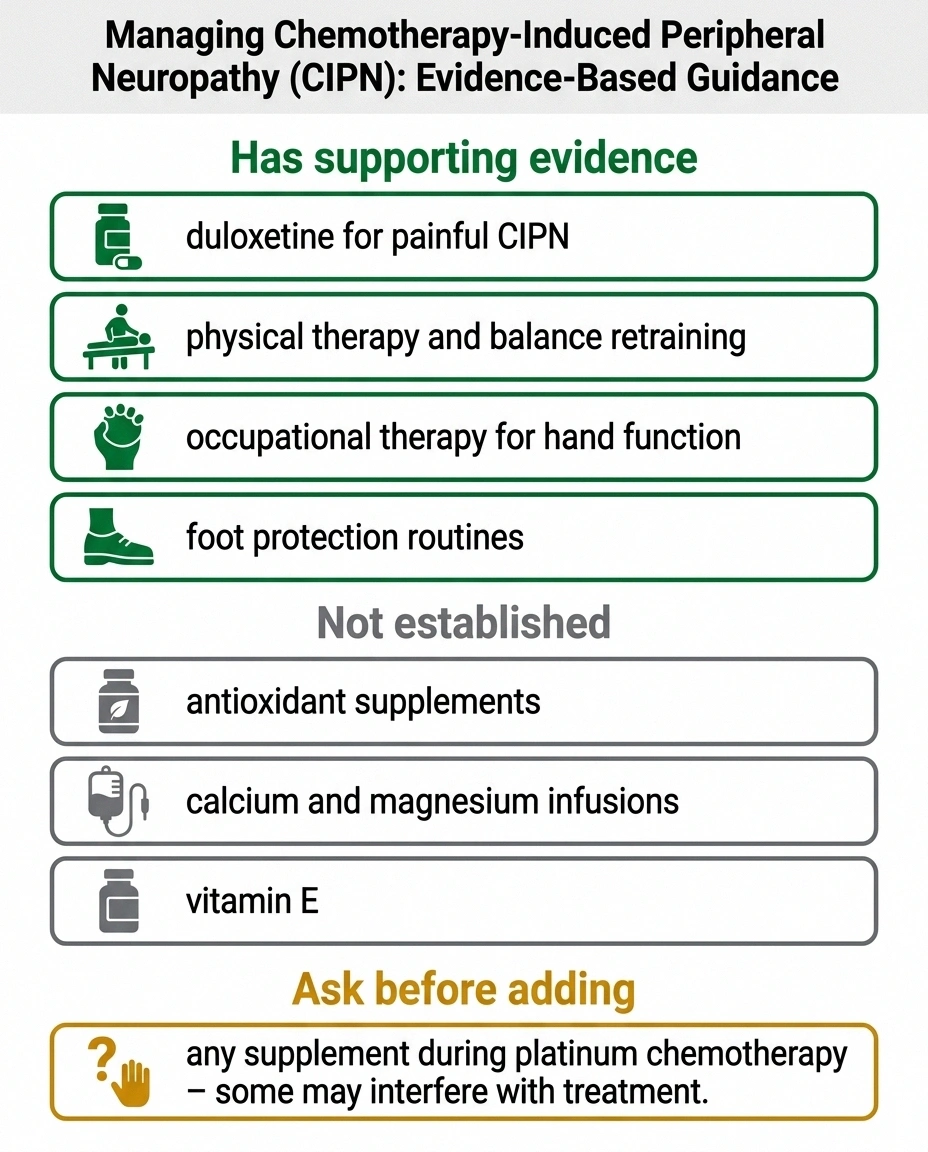
The list of things with real supporting evidence is short, and honesty about its length is more useful than padding it.
Duloxetine is the one medication carrying a positive recommendation in major oncology guidance for painful chemotherapy neuropathy. Two honest caveats: it treats pain, so it is not aimed at the numbness-and-unsteadiness picture that is more typical of cisplatin, and the benefit in trials was real but modest.
Everything else that reliably helps is not pharmaceutical: physical therapy, occupational therapy, balance retraining, foot protection, and environmental changes. That reads like a downgrade. For a large-fiber sensory neuropathy it is where nearly all the functional improvement actually comes from — and unlike the chemotherapy, it is the part where what you do moves the needle.
Duloxetine is the one agent with meaningful evidence behind it for painful chemotherapy-induced neuropathy, and the only one carrying a positive recommendation in major oncology guidance. It is a prescription medication, originally an antidepressant, working on pain-signaling pathways rather than on the nerve damage itself. Our page on duloxetine for neuropathy covers what it does and what side effects people encounter. Worth raising with your oncologist if pain is a significant part of your picture.
Two honest caveats. It treats pain, so if your dominant problem is numbness and unsteadiness — the more typical cisplatin picture — it is not aimed at your main complaint. And the benefit in trials was real but modest.
Beyond that, the useful interventions are largely not pharmaceutical: physical therapy, occupational therapy, balance training, foot protection, environmental adaptation. That sounds like a downgrade. For a large-fiber sensory neuropathy it is where nearly all the functional improvement comes from.
What Doesn't Work, and Why It's Still Sold to You
A short, blunt list, because people spend real money here at a time when money is already stretched. Compounded “nerve repair” creams promising regeneration. Infrared and laser devices marketed with reversal claims. High-dose supplement stacks aimed at chemotherapy patients. Clinics offering expensive proprietary protocols with testimonials in place of published results.
The reason this market exists is straightforward: a large population in genuine distress, an honest medical answer amounting to “time, therapy, and one modestly effective drug,” and no regulatory pressure on wellness marketing to prove much of anything. Some of it is harmless and merely expensive. A few are not harmless during active treatment. Run anything you are considering past your oncology team, including what seems too minor to mention.
Physical Therapy and Balance Retraining
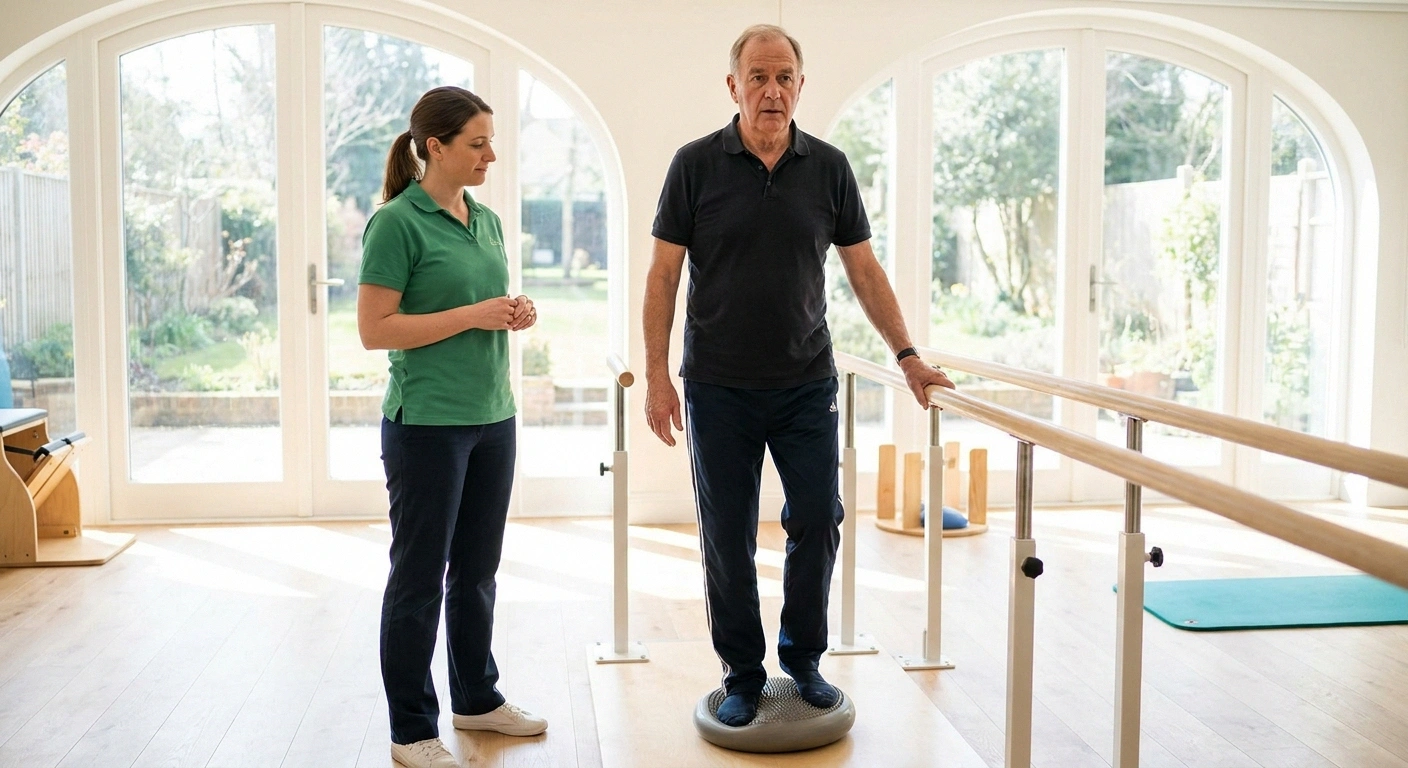
If you take one action item from this article, make it this one: ask for a physical therapy referral, and ask early.
Balance is trainable, including balance that has lost its sensory input. Your brain can learn to weight its remaining channels differently and use strategies not dependent on feeling the floor. That is the operating principle behind balance rehabilitation generally.
A good program works on ankle and hip strength, since stronger muscles correct faster; gait retraining, since the wide-based cautious walk people adopt is itself a fall risk; practice at reduced visual input, so the dark hallway is not the first test; and specific transitions, since sit-to-stand and turning are where falls concentrate.
Ask about occupational therapy separately if your hands are affected. Buttons, zippers, jar lids, keyboards, and handwriting all have adaptive answers, and an occupational therapist knows them.
Ask during treatment rather than after. Referrals take time, and there is no reason to wait for coasting to finish before starting.
Protecting Feet You Can't Feel
The unglamorous section, and the one that prevents the most serious problems.
Look every day. Tops and soles, using a mirror or your phone camera for the parts you cannot see. Attach it to an existing habit so it never gets skipped.
Sweep the inside of your shoes with your hand before you put them on. A pebble can ride along for an entire afternoon without announcing itself.
Test water with your elbow or a thermometer, never your foot. And no heating pads or hot water bottles on numb skin, ever.
Report wounds, redness, or color changes promptly rather than watching them. If you are also managing diabetes or anything affecting healing, this moves from important to essential.
When sensation is reduced, your feet stop reporting injuries. A blister forms unnoticed. A pebble rides in your shoe all afternoon. Water is far hotter than you realize. None of it hurts, which is precisely the danger, because pain is the alarm system you have lost.
The replacement is a schedule, set out below.
Our detailed guide to neuropathy foot care covers the full routine, and choosing appropriate shoes does more preventive work than most people expect.
If you are also managing diabetes, or on anything affecting healing or immune function, this moves from important to essential. Report any wound, redness, or color change promptly rather than watching it.
Talking to Your Oncology Team About Dose

This section needs the clearest boundary in the article, so here it is at the top: the decision about your chemotherapy dose belongs to you and your oncologist, and the cancer outranks the neuropathy. Nothing on this page should push that conversation in either direction.
Easy to under-weight
- “My feet feel a bit weird”
- “Some tingling, nothing major”
- “I don't want to complain”
Gets heard
- “I can't feel the pedals well enough to drive at night”
- “I dropped a glass twice this week”
- “I've started holding the wall on the stairs”
Report by cycle so the trajectory is visible, and ask two questions outright: what is my cumulative dose, and what would change the plan? Your team cannot weigh what they do not know.
What is genuinely useful is being an accurate reporter, because dose decisions depend on information only you can supply. Report symptoms early and in terms of function rather than sensation, since function is the language that gets heard. Report by cycle, so the trajectory is visible — symptoms that emerged after cycle three and worsened after cycle four tell a different story than symptoms that have been stable.
Then ask two things outright: what your cumulative dose is, and what would change the plan. Knowing the threshold in advance tells you what is worth calling about between appointments rather than saving up.
Understating symptoms out of a wish to be a good patient, or to avoid seeming to complain, is common and counterproductive. Your team cannot weigh what they do not know.
Living With It Long-Term
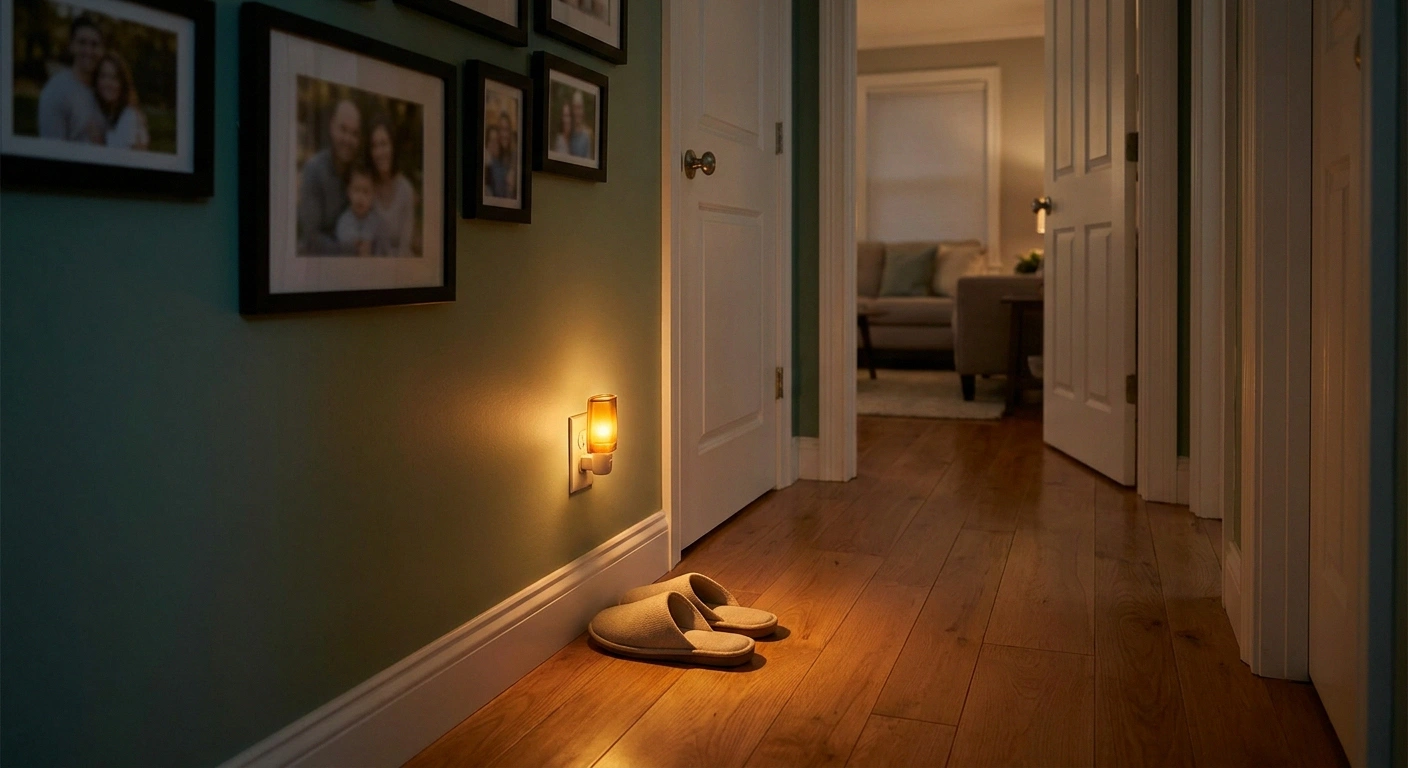
For a large number of people some degree of this becomes permanent, and I would rather say that honestly than pretend everyone returns to baseline.
The residual is usually not the dramatic version people fear. More often it is numb toes, slightly clumsy fingertips, and a balance system that needs light and attention it never used to need. Real, but livable, and considerably less limiting than the acute phase.
The adaptations carrying the most weight are small and environmental. Nightlights along every route you walk after dark, which is the single highest-yield change for large-fiber neuropathy. Grab bars in the bathroom before you need them rather than after. Supportive footwear indoors. Removing loose rugs. Slowing down the specific transitions — standing up, turning, stepping off a curb — where balance failures concentrate.
Two other things. Fatigue after cancer treatment is real and interacts badly with balance problems, so pacing is not indulgence; it is fall prevention. And the emotional weight of finishing treatment only to be left with a daily physical reminder is something a great many people carry quietly. If that is where you are, name it out loud to your care team, who almost certainly have resources you do not know about.
You got through the treatment. This part gets better too, more slowly than it should and not always completely, but it does. And unlike the chemotherapy, this is the part where what you do actually moves the needle.
Frequently Asked Questions
How long does cisplatin neuropathy last?
Symptoms often continue to worsen for roughly two to six months after the final infusion, a pattern called coasting, before reaching a plateau. Gradual improvement typically follows, but it unfolds over many months to years rather than weeks. A meaningful number of people are left with some permanent residual, most commonly numbness in the toes and fingertips and reduced vibration sense. Recovery is usually partial rather than complete, because the damage sits in sensory nerve cell bodies in the dorsal root ganglion rather than only in the nerve fibers, and those cell bodies have limited capacity to regenerate.
Why does my neuropathy keep getting worse after chemo ended?
This is the coasting phenomenon, and it is expected with platinum-based chemotherapy rather than a sign that something new has gone wrong. Cisplatin accumulates in dorsal root ganglion sensory neurons and forms DNA adducts inside those cells. The injury is delivered during treatment, but the affected cells decline over the following weeks and months, so symptoms continue to progress after the drug has cleared the bloodstream. Worsening should still be reported to the oncology team, both so the trajectory is documented and because unusual or unexpected symptoms deserve assessment rather than being attributed to a label.
What dose of cisplatin causes neuropathy?
Symptoms typically begin to appear at cumulative doses of roughly 250 to 350 mg/m², and by cumulative doses of about 500 to 600 mg/m² neuropathy develops in nearly all patients. These are population-level figures rather than individual predictions, and susceptibility varies considerably between people, partly due to differences in how efficiently DNA damage is repaired. Knowing your own cumulative dose is a reasonable question to ask the oncology team, but the figures are context for that conversation rather than a limit for a patient to enforce independently.
Is cisplatin neuropathy the same as other chemo neuropathy?
No. Most chemotherapy neuropathy is a dying-back axonopathy in which long nerve fibers degrade from the far end inward, producing a symmetric pattern that climbs upward from the toes. Cisplatin instead damages the sensory nerve cell bodies in the dorsal root ganglion, producing what is called a sensory neuronopathy. That difference explains several distinctive features: symptoms can appear in hands and feet at similar times, the process continues after treatment ends, large sensory fibers carrying position sense are preferentially affected, and Lhermitte's sign may occur.
What is Lhermitte's sign?
Lhermitte's sign is a brief electric-shock sensation that travels down the spine, and sometimes into the limbs, when the chin is tipped forward toward the chest. It is reported often enough with platinum chemotherapy to be a recognized feature, and it occurs because sensory pathways near the spinal cord have been affected and neck flexion stretches them enough to make them fire. It is generally not a sign of structural spinal damage and typically fades over months. Because it also occurs in other conditions including vitamin B12 deficiency and multiple sclerosis, it should be reported rather than assumed to be chemotherapy-related.
Can anything prevent cisplatin-induced neuropathy?
No agent is currently endorsed for prevention in major oncology guidance. Thiol compounds, vitamin E, various anticonvulsants, calcium and magnesium infusions, and assorted antioxidants have all been studied, with inconsistent and largely negative results. There is an additional concern specific to this drug class, since some antioxidants have a theoretical potential to interfere with how platinum chemotherapy works. For that reason no supplement should be added during platinum chemotherapy without clearing it with the oncology team first, including products marketed specifically to chemotherapy patients.
Does cisplatin cause hearing loss as well as neuropathy?
Yes. Peripheral neuropathy and ototoxicity are the two most common forms of cisplatin neurotoxicity, and high-frequency hearing loss and tinnitus are both well documented. The balance organ of the inner ear can also be affected. This matters beyond hearing itself, because balance depends on three inputs working together: vision, inner ear signals, and position sense from the feet and joints. Cisplatin can degrade two of those three simultaneously, which is why some people experience unsteadiness that seems out of proportion to their numbness. Hearing changes are worth reporting for that reason.
Why is my balance worse than my pain?
Cisplatin preferentially damages large sensory nerve fibers, which carry vibration sense, light touch, and proprioception, the continuous unconscious report of where the limbs are positioned. Small fibers, which carry pain and temperature, are relatively less affected, which is the reverse of what happens in conditions such as diabetic neuropathy. Losing large-fiber input removes the body's internal position map, so the brain compensates by relying more heavily on vision. That is why unsteadiness is most noticeable in the dark, in the shower with eyes closed, and on uneven ground, and why balance training tends to help more than pain medication.
About the Author